
Asparagus altissimus Munby (Endemic North-West Algeria and South Morocco) New Species for the Flora of Saida (West Algeria)
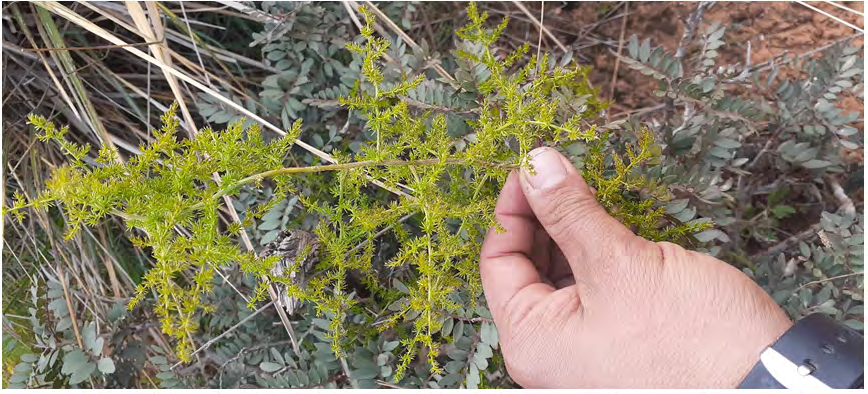
The Saida area is diversified from an ecosystem and floristic perspective. A floristic inventory and monitoring of the phytodiversity of this area have been started since 2017 and it is continuing to this day to establish an inventory of the flora. Rare, endemic, protected taxa, orchidoflora, etc. are the subject of special attention and monitoring for us. Among the results obtained, many discoveries include Asparagus altissimus, it is an Endemic North-West Algerian and South Moroccan species and it is considered a new species for the flora of Saida.
Introduction
In the genus Asparagus, about 230 taxa are considered accepted as species. The last sub-generic classification divided asparagus into three sub-genera: Asparagus, Myrsiphyllum and Protasparagus and they recently reorganized into the new order (Asparagales) [1]. These species are widely distributed on the continents of the Old World and the center of species diversity is Africa and especially in the Mediterranean region [2], with the exception of Aspargus racemosus Willd and aspargoides (L) which are native respectively from Australia and South Africa. This family posed taxonomic problems. Several studies, the most important of which are those by Dahlgren, et al. [4] and Batchelor and Scott [4] have discussed the phylogenetic relationships in this family. The monophyly has been confirmed by Malcomber and Demissew [5] and the genera Asparagus contain dioecious and hermaphrodite species. Hermaphrodite species belonging to the subgenera Asparagus, Myrsiphyllum and Protasparagus are bisexual flowers, which have stamens and pistils in a flower, while the dioecious species which belong to the subgenus Asparagus have male and female flowers, which have stamens fertile and sterile pistils or sterile stamens and fertile pistils in a flower. Rudall, et al. [6] allowed defining a new genus (Hemiphylacus) of Mexican origin. This family has multiple interests. It constitutes in particular with the Smilacaceae and Rubiaceae a set of lianas characteristic of forests and maquis. In Algeria, they develop a lot in the Tellian region but under diversified station conditions especially between the semi- arid, sub-humid and humid bioclimatic stages. Also it should be noted that this genus is among the rare taxa present of XY type sex chromosomes which leads to the creation of new plants (spermals) of an YY chromosomal constitution [7]. Few studies have focused on North African taxa. Maire [8] and Quézel and Santa [9] described 5 taxa widely distributed in Algeria: A. acutifolius, A stipularis, A. albus, A. officinalis L. and A. altissimus. During fieldwork (elaboration of a floristic catalog of the wilaya of Saida) in the region of Ain Branisse, northwest of the wilaya of Saida, we collected plants of the genera Asparagus, which identified as Asparagus altissimus previously unrecorded in the territory of Saida and even in the regions of western Algeria such as Tlemcen [10, 11].
Methodology
Campaigners in the field are divided into two research teams (one in the West region of Saida and the second in the East region) for the realization of the inventories; these campaigns were carried out on the basis of an exhaustive inventory during the autumns and springs of the years 2017 to date. More than 700 floristic surveys have so far been carried out in the different types of area (plant stands) covering the entire study area (wilaya of Saida). The number of surveys carried out in each homogeneous zone depends on the diversity of ecological descriptors and the extent of each plant formation [12, 13, 14]. At the level of each survey, we mentioned the geographical coordinates, the soil characteristics, the orography, the substrate, the structure and the rate of cover of each stratum as well as the abundance-dominance coefficient (CAD) and the sociability of each species. The botanical identification of taxa was made at the research laboratory of Ecology and Management of Natural Ecosystems at the University of Tlemcen using the works: Maire [8], Quézel and Santa [9], Fennane [15], Dobignard and Chatelain [16]. To determine the protected taxa in Algeria, we consulted Executive Order 12-03 of 10 safar 1433 corresponding to 4 January 2012 setting out the list of protected spontaneous species in Algeria and the IUCN Red List [17] (Table 1).
Results
Out of the 5 species of Asparagus known for Algeria [9, 16], 3 species were recorded in the region of Saida during our floristic surveys in the field (Table 1; Figure 1).
| Taxa | Biogeographical origin | Rare | Protection | Class | Area |
|---|---|---|---|---|---|
| A. acutifolius | Med. | CC | No | IV | All |
| A. albus | W. Med. | C | No | III | Merdja, Doui Thabet, Mekhnez, Taffrent, Fenouane |
| A. altissimus | End (N.W Alg et S. Mar) | QC | No | + | Aioune Branisse and Mimouna |
Table 1: ** Asparagus’ genera in the Saida area.
C : common; AC: quite common; End : endemic; Alg : Algerian; Mar : Moroccan; N : North; + : very rare; Med : Mediterranean; W. Med. : West Mediterranean ; CC : Very common. C: commun ; AC: assez commun ; End: endémique ; CC: Très commun ; Alg: Algérien ; Mar: Marocain ; +: très rare; Méd : méditerranéen; Méd : Méditerranéen ; E-Med : Est de la Méditerranéen. Table 1: Asparagus’ genera in the Saida area.
Discussion
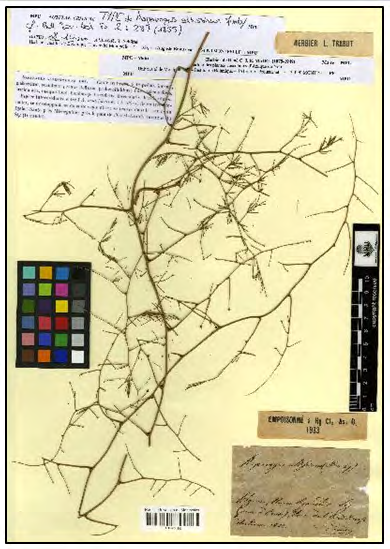
Asparagus altissimus was first reported in Algeria by G.L. Durando in 1852 in the region of Sig (West Algeria - former Union Agricole du Sig, province of Oran, edges of the Oued- Krouft) (Figure 2). It was described by Quézel and Santa [9] as a woody plant (shrub or liana), with stems and branches neither whitish nor very thorny. Climbing or sub-climbing plants. Fasciculated cladodes 4-12. Liana with long, slender stems, smooth, flexuous and very branched. Cladodes fascicled by 4-9, soft and mucronate but not spinescent, 3-5 mm. Flowers white, hermaphroditic, with peduncles of 4-5 mm, solitary or bundled 2-5.
Taxonomy of the species
-Classification
- Branch: Angiosperms
- Class: Asparagales Link
- Family: Asparagaceae Juss.
- Genera: Asparagus L.
- Taxa: Asparagus altissimus Munby -Synonyms
- Asparagus altissimus var. asperulus Maire
- Asparagus altissimus var. foeniculaceus (Lowe) Maire
- Asparagus declinatus Schousb.
- Asparagus foeniculaceus Lowe
Ecological importance
Asparagus species play an essential role in litter production and therefore in mineral inputs and primary productivity. Some of them, such as A. horridus and A. albus, form large thorny bushes, real shelters for biological recovery in open environments, especially steppes, but also in the protection of young tree seedlings in forests. All these lianas therefore represent key indicators in monitoring the dynamics and management of forest ecosystems.
Botanical description and systematic position
From our observations, Asparagus altissimus is a geophyte species, the adult plant includes:
- An underground part which is composed of a horizontal rhizome and roots in the form of fleshy cylinders.
- An aerial part made up of upright stems starting from the rhizome, bears cladodes which are chlorophyllian branches in the form of needles.
- The cladodes are arranged in bundles; the true leaves are reduced to small scales.
- The flowers are small, solitary arranged at the base of the cladodes.
- The parts of the perianth (tepals and sepals) are concolorous, small, free or slightly fused at the base.
- The androecium consists of 6 stamens with filiform filaments.
- The ovary is surmounted by a style bearing two or three stigmas.
- The fruit is a globose berry, red or black when ripe, sometimes initially green or purple.
Habitats
According to our prospecting campaigns, this genera (Asparagus) is found under forest cover in matorrals, degraded scrubland and in open areas: A. acutifolius: It grows mainly in the undergrowth in the pine forest; it is always associated with Quercus coccifera, Pistacia lentiscus, Clematis cirrhosa, Smilax aspera and Rosmarinus tournfortii. A. albusis: less widespread than A. acutifolius. This species is also linked to dry and rocky biotopes and on cliffs. It is always associated (according to our surveys in our study area) with Genista spp. and Calycotome spinosa. A. latissimus: It grows in anthropized habitats, along fields and roads under Tetraclinis articulata (Vahl) Mast, Pistacia
lentiscus and Chamaerops humilis L.
Medicinal interests
According to our ethnobotanical study [18, 19, 20, 21, 22, 23, 24], Asparagus is considered to be genera with great medicinal (therapeutic) values in our study area [25]. The roots are used as an infusion to remove kidney stones, also as an anti- inflammatory, antioxidant and antifungal [26, 27].
Conclusion
The aim of the present study was to gather basic data on species of the genus asparagus, in particular A. altissimus, since it has a great botanical interest (endemic) in the territory of the wilaya of Saida. These species are strongly associated with forest ecosystems and are indicators of their evolution and dynamism. It also has food and therapeutic interests. Its conservation is a major concern in this region due to overexploitation and above all it is exploited by people not trained in the field (unqualified herbalist), according to our prospection it is harvested from these roots and also during the winter period (before fruiting).
Acknowledgement
The author would like to thank Prof. Mohamed Ibn Tattou (Mohammed VI University, Rabat-Morocco) in the contribution (for botanical identification).
References
-
APG II (2003) Classification of orders and families of flowering plants. Botanical journal of the Linnean Society, pp: 141.
-
Doijode SD (2001) Seed storage of horticultural crops. Edt. Illustrée, pp: 339.
-
Dahlgren RMT, Clifford HT, Yeo PF (1985) The families of the monocotyledons: Structure, evolution and taxonomy. Edt. Springer. Berlin pp: 520.
-
Batchelor KL, John KS (2006) Review of the Current Taxonomic Status and authorship for Asparagus weeds in Australian. Plant Protection Quarterly 21(3): 128-130.
-
Malcomber ST, Demissew S (1993) The status of Asparagus and Myrsiphyllum in the Asparacgaceae. Royal Botanic Garden Kew Bulletin 48: 1-10.
-
Rudall P, Englemanj EM, Hensen L, Chase MW (1998) Embroylogy, Cytology and systematic of Hemiphylacus, Asparagus and Anemarrthena. Plant Systematic and Evolution 211: 181-199.
-
Sneep J (1953) The signification of Andromonecism for the Breeding of Asparagus Officinalis L. II. Euphratica 2: 224-228.
-
Maire R (1952) Flore De L’Afrique Du Nord. Tomes 1 A 16. Paul Lechevalier, Paris. Encyclopédie Biologique, pp : 5559.
-
Quézel P, Santa S (1962-1963) Nouvelle flore de l’Algérie et des régions désertiques méridionales. CNRS2: 1170.
-
Babaali B (2014) Contribution à une étude phytoécologique des monts de Moutas (Tlemcen- Algérie occidentale): Aspects syntaxonomique, biogéographique et dynamique. Thése Doct. Université de Tlemcen, pp: 160.
-
Miara MD, Ait Hammou M, Rebbas K, Hadjaj-Aoul S Et Vela E (2018) Les Orchidées de la wilaya de Tiaret (Algérie nord-occidentale) : inventaire, écologie, taxonomie et biogéographie. Bull Mens Soc linn Lyon 87(10): 273-293.
-
Géhu JM, Rivas-Martínez S (1981) Notions fondamentales de phytosociologie. Berichte der Internationalen Symposien der Internationalen Vereinigung für Vegetationskun de. Syntaxonomie. J Cramer Berlin, pp: 5-33
-
Aafi A, Benabid A, Machrouh A (1997) Etude et cartographie des groupements végétaux du Parc National De Talassemtane. Ann Rech For Maroc 30(1): 62-73.
-
Aafi A (2003) Richesse et diversité floristique du Parc National de Talassemtane. Revue du Muséum d’Histoire Naturelle de Marrakech: Naturalia Maroccana 1(1) : 45- 48.
-
Fennane M, Tattou IM, Mathez J, Ouyahya A, El Oualidi J (1999) Flore Pratique Du Maroc. Manuel De Détermination Des Plantes Vasculaires. Trav Inst Sci Rabat Sér Botanique 36: 558.
-
Dobignard A, Chatelain C (2010-2013) Index synonymique et bibliographique de la flore d’Afrique du Nord.
-
IUCN (2019) The IUCN Red List of threatened species.
-
Aouadj SA (2021) Impact des techniques de restauration écologique sur la dynamique des écosystèmes dégradés des monts de Saida : Cas des forêts de Doui Thabet – (Ouest Algérie). Thesis of Doctorat, University of Tlemcen, Algeria, pp: 167.
-
Aouadj SA, Hasnaoui O, Nasrallah Y (2020) Ethnobotanical Approach and Floristic Inventory of Medicinal Plants in the Doui Thabet Region (Saida-Western Algeria). PhytoChem & BioSub Journal 14(1): 92-104.
-
Aouadj SA, Nasrallah Y, Hasnaoui O (2020) Ecological characterization and evaluation of the floristic potential of the forest of Doui Thabet (Saida Western Algeria) in the context of the restoration. Eco Env Cons 26(1): 266- 278.
-
Aouadj SA, Nasrallah Y, Hasnaoui O (2020) Note on the orchids of mounts of Saida (Saida Western Algeria) in the context of the restoration. Eco Env Cons 26(2): 521- 529.
-
Aouadj SA, Nasrallah Y, Hasnaoui O (2020) Regional phytogeographic analysis of the flora of the Mounts of Saida (Algeria): evaluation-restoration report. Biodiversity Journal 11(1): 25-34.
-
Aouadj SA, Nasrallah Y, Hasnaoui O, Khatir H (2020) Impacts of anthropogenic pressure on the degradation of the forest of Doui Thabet (Saida, Western Algeria) in the context of the restoration. Acta scientifica naturalis 7(2): 68-78.
-
Aouadj SA, Nasrallah Y, Hasnaoui O, Khatir H (2020) Rare, endemic and threatned flora of the mounts of saida (western of Algeria). Agrobiologia 11(2): 45-57.
-
Djebbouri M (2020) Floristic diversity with particular reference to endemic, rare, or endangered flora in forest formations of Saida (Algeria). Thesis of Doctorat, University of Saida, Algeria.
-
Djebbouri M, Terras M (2019) Floristic diversity with particular reference to endemic, rare, or endangered flora in forest formations of Saida (Algeria). International journal of Environment Studies 76(1): 1-8.
-
JORA (2012) Décret exécutif du 18 janvier 2012, complétant la liste des espèces végétales protégées. Journal Officiel de la République Algérienne.
- Lessons to Learn: Trees are More than the Lungs of the World
- Community Forestry Enterprises as a Model for Sustainable Forest Development: The Case Of The "Baja Tarahumara" in Chihuahua, Mexico
- Ecological and Socio-Economic Impacts of Chromolaena odorata and Mesosphaerum suaveolens, Two Invasive Alien Species in Central and Southern Benin, West Africa
- Epigenetic Sustainability: Modeling the Human Factor as a Natural Resource through Science 4.0 and the NR3C1 Biological Pilot
- Growth-at-Risk: A Framework for Assessing Economic Vulnerability
- The Rural Territory as a Socioecological System for the Management of Public Policy for Sustainable Rural Development