
Importance of Mangroves: Perception and Awareness of Householders of Consuelo, Macabebe, Pampanga
Introduction
Mangroves are an assemblage of tropical and sub- tropical halophytic (salt-tolerant) woody plants, [1]. Mangrove forests are one of the world’s most prolific forest ecosystems, and they’re unusual in that they connect terrestrial and marine systems via the intertidal zone. It also provides several ecological functions such as protection from powerful waves during tsunamis and storm surges, as well as shelter for marine wildlife. Mangroves, more so than tropical rainforests, are one of the most carbon-rich woods in the tropical ecosystem. However, economic growth and climate change pose a serious threat to many mangrove forests, making it more important than ever to monitor the remaining mangrove forest cover.
Mangrove forests are one of the most vulnerable and underappreciated ecosystems on the planet, according to ZSL (2014) [2]. They provide a diverse range of ecosystem services worth US$1.6 billion globally. Mangrove habitats provide livelihoods, critical protein supplies, and coastal protection for many coastal communities. Mangroves, with a carbon storage and sequestration potential larger than tropical forests, appear to play an essential role in climate stability, according to compelling research. Mangroves are being removed at an alarming rate, and these ecosystems are facing various concerns, including land development, pollution, fuel destruction, and climate change. The establishment of fishponds for aquaculture is one of the key factors for the loss of mangroves. It is estimated that between 20 and 35 percent of global mangroves have been destroyed since 1980, with annual losses of roughly 1%. According to the most recent IUCN assessment, more than one in every six mangrove species is currently threatened with extinction.
According to Ramos J [3] Mangrove ecosystems are among the most productive and biologically diverse ecosystems in the world, providing food, employment opportunities, and other resources to communities all over the world while also protecting some of the most vulnerable coastal communities from the devastating effects of climate change. They also serve as important habitats for fish, sharks, manatees, crabs, and other important species.
Climate change and coastal development, according to UNDRR [4], are increasing the hazards of flooding to people and property around the world. The WAVES Program, led by the World Bank, presented a new study today that quantifies the benefits provided by mangroves across the Philippines and finds that they minimize flooding damage to people and property by 25% annually. The Philippines is one of the world’s most vulnerable countries to flood damage from typhoons and other extreme events: Typhoon Haiyan alone killed over 6,000 people and inflicted over $2 billion in damage in 2013. The mangroves on the Philippine beaches are a potent natural defense. Many coastal habitats, such as mangroves, coral reefs, and salt marshes, can significantly reduce flooding and erosion, protecting people and property from storms, sea level rise, and king tides.
The goal of this study is to know the Perception and Awareness of the Resident near Consuelo, Macabebe, Pampanga about the importance of mangrove to their community.
Statement of the Problem
The study aims to determine the perception and awareness of the householders of Consuelo, Macabebe, Pampanga about the importance of mangroves to their community. It sought to determine the following; 1. Respondent perception on mangroves and mangrove ecosystem in Consuelo, Macabebe, Pampanga. 2. Use of mangroves to the community of Consuelo, Macabebe, Pampanga.
Hypothesis
This study assumes that the majority of the population in Consuelo, Macabebe, Pampanga has limited awareness and information about the mangrove forest in above mentioned community.
Significance of the Study
The researcher believes that the research will not only provide data that will be useful to him, but also to the people in the following groups. The community: In particular the resident of Consuelo, Macabebe, Pampanga near mangrove forest who do not have any knowledge and ideas on what are the benefits they get from mangroves. On the other hand, the other inhabitant who already has expertise will be given more. The barangay official: To give them enough awareness on what are the different benefits that mangroves give to their constituents. The caretaker of the area: To give him more knowledge on how to properly manage and take care of the mangroves. Tourist: To show them awareness on what are the possible things they will see whenever visiting mangroves in Consuelo. Future Researchers: The findings of this research study will serve as a guideline and their reference for the future researchers who will be conducting the related studies on similar field.
Scope and Delimitation
The study will cover perception and awareness of the resident in the said area. The primarily subject of this research study are the thirty percent 30% of the total number of householders which live in Consuelo. The total number of populations is three thousand one hundred twenty-two (3,122)and the total number of households were six hundred seventy-five(675). The 30% of the households are employing as respondent. To get the thirty percent (30%), 0.30 is multiply to six hundred seventy-five (675), which equals to two hundred two (202) who are residents of Consuelo, Macabebe, Pampanga. Participated in this study data were collected directly from householder through face-to-face interview, systematic random sampling is use to determine the respondent.
Definition of terms
Holophytic: Obtaining food after the manner of a green plant by photosynthetic activity. Environmental degradation: The deterioration in environmental quality from ambient concentrations of pollutants and other activities and processes such as improper land use and natural disasters.
IUCN-International Union for Conservation of Nature (IUCN): In full International Union for Conservation of Nature and Natural Resources. Ecosystem: The complex of living organisms, their physical environment, and all their interrelationships in a particular unit of space. Vulnerable: Any species that is likely to become endangered within the foreseeable future. Perception: The act or faculty of perceiving, or apprehending by means of the senses or of the mind.
Botanical Description
According to Britannica [5], a mangrove is any of a group of shrubs and trees that primarily belong to the families Rhizophoraceae, Acanthaceae, Lythraceae, Combretaceae, and Arecaceae; grow in dense thickets or forests along tidal estuaries, salt marshes, and muddy coasts; and have prop roots, or exposed supporting roots. Mangrove thickets and woodlands are also referred to as mangroves. Many species have respiratory or knee roots (pneumatophores), which protrude above the mud and have small apertures (lenticels) through which air passes, traveling through the soft spongy tissue to the roots beneath the mud. Mangroves are vital to the coastal environments in which they live. They act as a physical barrier between marine and terrestrial ecosystems, shielding shorelines from destructive winds, waves, and floods. Mangrove thickets minimize coastal erosion and improve water quality by filtering pollutants and trapping sediments from the land. Many species of coastal and offshore fish and shellfish need mangroves entirely for breeding, spawning, and hatching, and they provide habitat for a varied array of terrestrial organisms. Mangroves are generally among the first species to colonize mud and sandbanks flooded by seawater because of their high salt tolerance, but their global numbers have declined due to increased coastal development and altered land use. The International Union for Conservation of Nature’s (IUCN) Red List of Threatened Species has several species designated as vulnerable or endangered.
A mangrove is a plant or tree that thrives in coastal salty or brackish water [6, 7]. The phrase is also applied to tropical coastal vegetation made up of these plants. Mangroves can be found all over the world in the tropics and subtropics, as well as certain temperate coastal areas, primarily between the latitudes of 30° N and 30° S, with the greatest mangrove acreage occurring within 5° of the equators. Mangrove plant families first appeared from the Late Cretaceous through Paleocene epochs, and they spread worldwide due to tectonic plate movement. Mangrove palm fossils have been found dating back 75 million years.
Mangroves are tropical plants adapted to lose, wet soils, salt water, and being frequently inundated by tides (Florida Department of Environmental Protection 2021). Climate, saline water, tidal fluctuation, and soil type believed to be the four key factors that limit mangrove dispersal. Mangroves are found in about 50 different species all over the world. Mangroves are three species of tropical wetland trees that grow along the shorelines of several estuaries in central and southern Florida. The department enforces rules that govern their alteration and trimming. The red mangrove (Rhizophora mangle), black mangrove (Avicenniagerminans), and white mangrove (Rhizophora mangle) are all native to Florida (Lagunculariaracemosa).
Importance of Mangroves
Mangroves are important ecologically and economically as a hub for tropical marine biotopes [8]. The mangroves are also home to some of the world’s most diverse ecological and genetic resources. Furthermore, 90 percent of marine organisms spend part of their lives in this habitat, and mangroves account for 80 percent of global fish captures. Mangroves and the biota that surrounds them have also been discovered as a viable source of natural and new pharmaceuticals. On the other hand, the scientific community considers this ecosystem to be one of the world’s most endangered biomes as a result of previous human meddling and ongoing climate change. Many countries have already lost their vast mangrove resources in the last two decades. Furthermore, the loss of mangrove cover may result in irreversible damage to ecosystem services provided to humans.
Mangrove forests are incredibly valuable coastal resources that are critical to our socioeconomic growth, [8]. The protection of the coast from solar UV-B radiation, “greenhouse” effects, and the wrath of cyclones, floods, sea level rise, wave action, and coastal erosion accounts for a large part of mangroves’ ecological value. Mangroves play an important role in the global carbon cycle and generate a lot of litter in the form of fallen leaves, branches, and other debris. Mangrove ecosystems also play a role in intricate food webs and energy transfer.
According to Mangroves are important to the ecosystem too. Their dense roots help bind and build soils. Their above- ground roots slowly down water flows and encourage sediment deposits that reduce coastal erosion. The complex mangrove root systems filter nitrates, phosphates and other pollutants from the water, improving the water quality flowing from rivers and streams into the estuarine and ocean environment. Mangrove forests capture massive amounts of carbon dioxide emissions and other greenhouse gases from the atmosphere, and then trap and store them in their carbon-rich flooded soils for millennia. This is an important ecosystem service as we face climate change. This buried carbon is known as “blue carbon” because it is stored underwater in coastal ecosystems like mangrove forests, sea grass beds and salt marshes. Mangrove forests also provide habitat and refuge to a wide array of wildlife such as birds, fish, invertebrates, mammals and plants. Estuarine habitats with coastal mangrove shorelines and tree roots are often important spawning and nursery territory for juvenile marine species including shrimp, crabs, and many sport and commercial fish species such as redfish, snook and tarpons.
According to the uninitiated, mangroves might appear to be merely coastal cousins of inland forests, but these rich ecosystems support the planet and people in unique ways, from providing breeding grounds for fish to carbon storage, to protection against flooding. Yet despite their importance, mangrove forests are under threat. Over a third has already disappeared, and in regions such as the Americas they are being cleared at a faster rate than tropical rainforests. Much of that clearance is to reclaim land for agriculture, industrial development and infrastructure projects. In addition to climate change and pollution, there are also local threats. These include overharvesting of wood for fuel and construction, dams and irrigation that reduce the flow of water reaching the forests, and overfishing causing disruption to food chains and fish communities.
Increasing data demonstrates that mangrove forests safeguard coastal communities during tropical storm events [9]. Despite this, there is no large-scale analysis that documents the worldwide benefits of storm protection. We present data from around the world that mangroves protect economic activity from tropical cyclones and that this protection prevents otherwise irreversible economic losses. These findings show that even a little amount of mangrove forest covering can provide significant storm protection, highlighting the need of mangrove conservation in many vulnerable coastal communities that have previously received less attention. Coastal towns suffering mangrove degradation are increasingly vulnerable to economic damages caused by cyclones, which are sheltered by mangroves during hazardous storm occurrences.
Mangrove habitats continue to be among the least valued and poorly cared for in the world while offering a variety of ecological benefits to humans [10]. In 123 nations, mangroves are found along the tropical and subtropical coasts where land meets the sea. Prior to 20 years ago, research centred on the providing, sustaining, and cultural functions of mangroves, but more recently, attention has turned to the mangroves’ role in controlling the global carbon cycle. Mangroves are now known to store 50 times more carbon than tropical forests, providing compelling evidence that they constitute the missing carbon sink. Despite their significance, mangroves are still under danger due to human activity, hence protection is needed. The significance of mangroves to humans, their function in the cycling of nutrients and carbon, and the risks they still face across their range are all covered in this study.
Mangroves have a significant impact on the fish community structure on nearby coral reefs. Additionally, when adult habitat is linked to mangroves, the biomass of numerous economically significant species more than doubles. Scarusguacamaia, the biggest herbivorous fish in the Atlantic, is functionally dependent on mangroves and has experienced local extinction as a result of mangrove destruction. The function of the ecosystem, the productivity of the fisheries, and the resilience of the reefs are all expected to be severely negatively impacted by the current rates of mangrove deforestation. Connected mangrove, sea grass, and coral reef corridors should all be protected via conservation initiatives [11].
Coastal people rely on the resources provided by mangrove ecosystems [12]. Mangroves are under severe threat, despite their importance as a source of essential ecological services. The destruction of these ecosystems would have a negative impact on local, national, and global welfare. It’s a difficult undertaking to precisely quantify those losses and utilize them to make better decisions about land use and conversion. Economic values linked with healthy mangrove ecosystems can be derived via economic analyses that aim to quantify the ecosystems’ use and non-use values. Mangroves are associated with positive values, which have been utilized to influence legislation. The products and ecosystem services offered by mangroves can be very important to human wellbeing, thus an optimal mangrove management approach should consider this. The establishment of markets for forest environmental services allows the value of multiple-use ecosystems like mangroves to be recognized and used in decision-making. Understanding the complexity of ecological and socio-economic processes within mangrove ecosystems can be aided by taking an ecosystem approach to resource management. Such assessments are critical in developing nations for promoting equity and poverty reduction.
The rising losses from tropical cyclones in developing nations underscore the need of knowing how natural habitats might be leveraged to safeguard assets and economic activity from this hazard [13]. In this paper, we examine the relationship between hurricane strength and economic losses in Central America, as well as how mangrove environments ameliorate these losses. We discover that hurricanes cause considerable economic losses in the short term, and that extensive mangrove belts can mitigate these costs. These findings have the critical conclusion that only large-scale mangrove conservation activities will likely give a benefit in terms of protection. This article investigates if mangroves can reduce the economic impact of hurricanes. The study compiles a regional panel dataset that assesses local economic activity using nightlights, probable hurricane damages using a thorough wind field model, and mangrove protection by mapping the width of mangrove forests along the coast’s path. The findings suggest that storms have a negative short-term impact on economic activity, with losses concentrated in coastal lowlands vulnerable to both wind and storm surge. Nightlights in these coastal lowlands are estimated to be reduced by up to 24% in regions where mangroves are not present.
Mangroves serve as vital refuge and feeding areas for marine wildlife, but the extent to which mangrove-derived carbon contributes to local food webs has long been contested [14] In this work, stable isotope analysis was utilized to determine the significance of mangrove carbon in the diets of macro invertebrates and fish in a macro tidal Tanzanian estuary’s intertidal bordering mangrove forest and adjacent intertidal/sub tidal mudflats.
Climate change is expected to have an impact on tropical mangrove forests due to decreased rainfall, sea level rise, and increasing seasonality of floods [15]. During the tropical dry season, such changes are expected to have an impact on the habitat quality of migratory songbirds that use mangrove wetlands. Although it is established that overwintering habitat quality is linked to migratory songbird fitness, most research have focused on territorial species.
Benefits of Mangroves
Mangroves are a form of tropical forest that is particularly positioned at the dynamic interface of land and water [16]. They may be found around the coasts and estuaries of the tropics and subtropics, and are capable of flourishing in saline water, where just a few species have acclimated. Mangroves are the cornerstone of a highly productive and biologically diverse ecosystem that serves as a home and feeding ground for a diverse range of species, many of which are threatened with extinction. Despite the fact that mangroves make up less than 1% of all tropical forests on the planet, they are highly valued ecosystems that provide a variety of essential goods and services that help coastal communities’ livelihoods, well-being, and security. Mangrove roots have a sophisticated network that can assist minimize wave energy, limit erosion, and protect coastal settlements from the devastating powers of tropical cyclones. Mangrove ecosystems are an important source of seafood for both subsistence consumption and the local and national seafood commerce, as well as other commodities like firewood and timber, which support the livelihoods of tens of thousands of coastal residents. Mangroves serve a significant role in global climate regulation in addition to their immediate advantages.
Mangroves provide habitats for animals, locations for bird foraging, and feeding and breeding grounds for fisheries. They also serve to manage the water quality and stabilize the beach. The importance of mangrove trees to coastal populations’ lives [17].
In the study of Abdel-Aziz S [18], medicinal plant research has gotten a lot of interest in recent years because of its usefulness and potential for treating human ailments. Mangroves are a type of vascular plant that grows in saline coastal settings and is noted for its ability to withstand harsh environmental conditions. Mangrove plants are used to treat a variety of ailments, including bacterial, fungal, and viral infections. Antibiotic-resistant microbes are one of the most important challenges in the world’s healthcare systems, and infectious diseases are the second leading cause of mortality. As a result, new medications must be developed to tackle such infections, and novel chemicals with antibacterial capabilities must be discovered. Medicinal-plant extracts are less hazardous to humans and environmentally beneficial because they produce fewer bioactive chemicals that interact with other creatures in the environment. Medicinal plants’ antimicrobial effects are becoming more well known around the world. Mangroves are biochemically distinctive in that they create a wide range of novel natural compounds, including steroids, triterpenes, saponins, flavonoids, alkaloids, and tannins.
Tsunamis and storm surges have killed over one million people globally, and three billion people are currently at risk of these disasters, which are getting more frequent and severe. Healthy coastal forests, which can lessen the energy of tsunamis, can effectively mitigate such calamities. Due to detrimental human and natural actions, these natural barriers have been eroding in recent years. Mangrove forests have lost over half of their area in the last 20 years, making them one of the most vulnerable environments on the planet. It is critical to restore them and use them as a tsunami shield as well as a resource to provide the best socioeconomic, ecological, and environmental outcomes. This report analyses the current state of mangrove forests, addresses tsunami safety, and suggests a means to improve the situation. We hope that these suggestions may assist communities and agencies in collaborating to accomplish a common goal [19].
Geographic Distribution
Mangroves can be locally found in Palawan, Quezon, Samar Province, Zamboanga del Sur, Zamboanga Sibugay, Surigao del Norte and Sulu Provinces [20]. Recent satellite image analysis revealed that Luzon and Mindoro had the fewest mangrove areas, whereas Mindanao had the most (29 percent of the nation’s total). 4,582 hectares of old-growth mangrove forests can be found primarily in Mindanao and Palawan (5,317 hectares).
Methodology
Locale of the Study
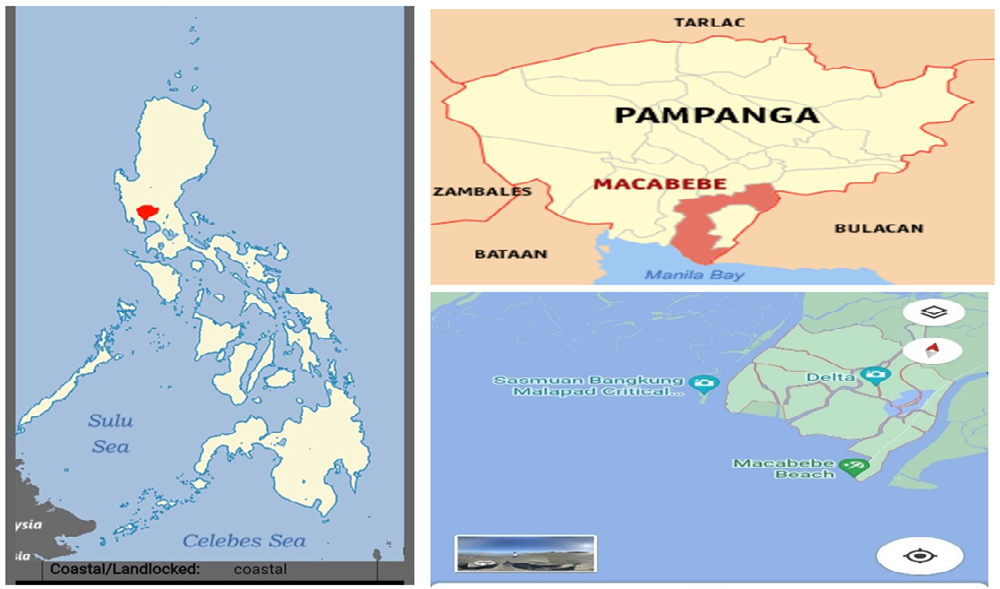
The study has been conducted in Consuelo, Macabebe, Pampanga. Coordinates14.8037, 120.6561 (14° 48’ North, 120° 39’ East) Estimated elevation above sea level 2.7 meters (8.9 feet)
Sample and Sampling
In order to finish this study, the researcher used a systematic random sampling technique, giving each resident a three-interval window in which to determine the respondent. The list of population came from the said Barangay.
Respondent of the Study
There are six hundred seventy-five (675) total number of households in Consuelo, the respondent of this study are the thirty percent (30%) or two hundred-two (202) household in Consuelo, Macabebe, Pampanga. This study used Systematic Random Sampling in determining the respondent. This study solemnly focuses on the head of the household participated in this study as the respondent. The list of residents came from the said barangay.
Research Instrument
For this study, researcher used survey questionnaire. The questionnaire was divided into four (4) parts, Demographic Profile, where their personal information was collected, Name, Age, gender, educational attainment, how long they residing the area, Civil status. (2) Respondent awareness on mangroves and mangrove ecosystem in Consuelo, Macabebe, Pampanga. (3) Respondent perception on mangroves and mangrove ecosystem in Consuelo, Macabebe, Pampanga. (4) Use of mangroves to the community of Consuelo, Macabebe, Pampanga.
Data Collection
Before the study conducted, a formal letter from the Barangay is requested. Data was gathered through Face- to-face questionnaire by strictly follow the protocol and guidelines prescribed by the IATF. Each response from the respondent revealed their perception and awareness. Questions were translated to Tagalog and English; the target respondents were 21household daily.
Statistic Design and Treatment of the Data
To check for and eliminate errors, administrative questionnaires were completed to ensure completeness, correctness, and consistency of responses. The Measure of Central Tendency (Mean, Median, Mode) was used to analyze the acquired data, while the rest was investigated descriptively. The data was turned into statistical tables and visualizations for comparison and understanding. For qualitative data, however, descriptive interpretation and data distribution analysis were utilized as a technique during the study.
Results and Discussion
The study site is located at Consuelo, Macabebe, Pampanga. Consuelo has a total of 2,771.31 Hectares (Pampanga PPDO Data) land are, the existing Mangrove Area 51.3 Hectares (South-western portion of Consuelo), the species of mangrove Bakauan (Rhizophora spp.), Api- api(Avicennia marina), Pagatpat/Palapat (Sonneratia alba), Nipa (Nypafruticans).Situated at approximately 14.8037, 120.6561, in the island of Luzon. Elevation at these coordinates is estimated at 2.7meters or 8.9 feet above mean sea level. The DENR – PENRO Pampanga designated the beach area of Brgy. Consuelo as a proposed swimmable beach area in Pampanga. This action is in line with the targets of this Office for the management and protection of existing beach areas/coastlines along Manila Bay, and to make them safe/ fit for swimming, skin diving and other forms of recreational activities.
Since 2019, this Office regularly implements regular coastal clean-up activities, mangrove enrichment programs, information campaigns, bamboo planting activities and other pipeline projects under the Manila Bay Rehabilitation Project. One of its major accomplishments is the installation of trash booms along the coastal waters of Brgy. Consueloin Macabebe, Pampanga. Last June 2021, this Office installed a 200-meter trash boom to control the movement of solid wastes from the beach area to the open waters of Manila Bay. A 77-meter trash boom was also installed by this Office last March 2022.
In order to sustain the gains of the ongoing Manila
Bay Rehabilitation, the DENR –PENRO Pampanga closely monitors the level of fecal coliform along waterways and coastal waters of the province. The quality of water at the mouth of Pampanga River and beach area in Brgy. Consuelo is regularly monitored. As of March 2022, results showed that water samples in the abovementioned stations were now below the DENR Standard for fecal coliform at 100 MPN / 100 mL compared to the previous monthly results. These results correspond on the continuous improvement and rehabilitation of Manila Bay.
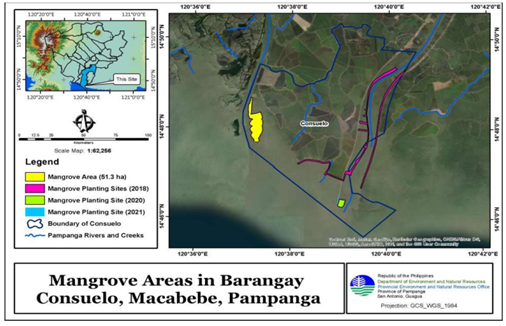
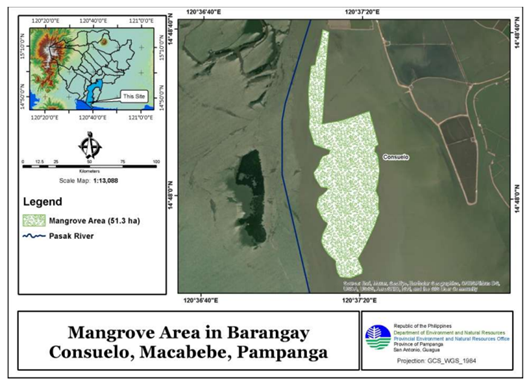
Natural barriers between land and sea are provided by mangrove forests. Typhoon-induced storm surges are prevented from damaging coastal settlements, and erosion along the shoreline is kept under control so that the waves do not quickly consume the land. Mangrove forests therefore provided protection from the high winds and waves.
Demographic Profile
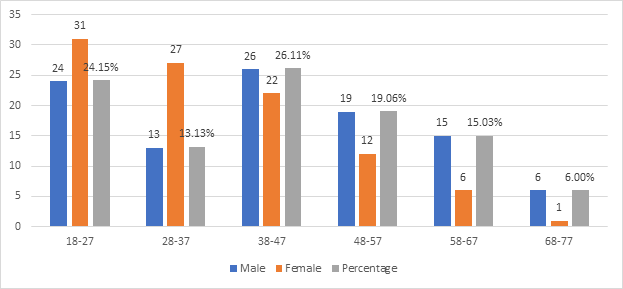
This figure shows the highest gender percentage of the respondents. It shows that male got the highest number of respondents at one hundred-three (103) or 50.99% and ninety-nine (99) or 49.01% are female. The graph below showed the highest to lowest age range of the respondents. Ages 38-47 or (26.11%) got the highest percentage.
Followed by ages 18-27 or (24.15%). Next, were ages 48- 57 or (19.06%). After which, ages 58-67 or (15.03%). Then ages 28-37 or (13.13%). Lastly, ages 68-77 or (6.00%) got the lowest percentage. Based on the data gathered by the researcher the respondents aged 38 to 47, literally shows that they are most active respondents.
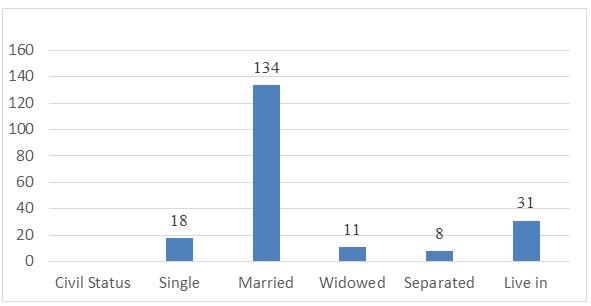
Illustrated below is the figure for the civil status of respondents. From highest to lowest percentage were considered as follows: (1) Hundred thirty-four (134) or 66% were already married. (2) Thirty-one (31) or 15% were living in together. (3) Eighteen (18) or 9% claimed that they are single. (4) Eleven (11) or 5% answered they were widowed. (5) Eight (8) or 4% state that they were separated. Evidently based result of the interview conducted, married and living in together were the most are the most active and most aware about mangroves.
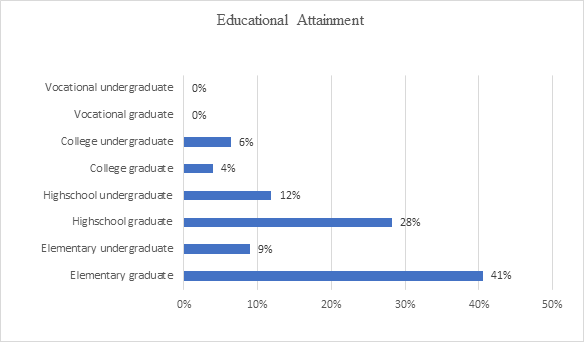
In this figure presents the Educational Attainment of the respondents. Percentage of 41% or the (82) of the respondents were Elementary graduate. Followed by 28% or the fifty- seven (57) of the respondents were High school graduate. Next is 12% or the twenty-four (24) of the respondents were High school undergraduate. Next after 9% or the (18) of the respondents are Elementary undergraduate. Followed by
6% or the thirteen (13) of the respondents that is college undergraduate. Next is 4% or the eight (8) of respondent were graduate of college and 0% or no one of the respondent study vocational courses. Among this respondent the college graduate and college undergraduate have advance knowledge about mangrove this was the researcher’s own observation upon conducting the interview.
The table below presents the Occupation of the respondents. The highest percentage of respondent has 55.94% or the one hundred thirteen (113) of them were self-employed. Followed by 36.14% or the seventy-three (73) of the respondents were unemployed. Next is 3.96% or the eight (8) of the respondents that were private employee. Next after is 3.47% or the seven (7) of the respondents were Government employee. Lastly the 0.50 % or the (1) of the respondent is a business owner.
| Frequency | Percentage | |
|---|---|---|
| Unemployed | 73 | 36.14% |
| Self employed | 113 | 55.94% |
| Private employee | 8 | 3.96% |
| Government employee | 7 | 3.47% |
| Business owner | 1 | 0.50% |
| Total | 202 | 100 |
Table 1: Occupation.
| Scale | 0 | 1 | 3 | 4 | Mean | SD | ||||
|---|---|---|---|---|---|---|---|---|---|---|
| Statement | F | % | F | % | F | % | F | % | ||
| Statement 1 | 5 | 2 | 1 | 0 | 22 | 11 | 174 | 86 | 4.83 | 0.52 |
| Statement 2 | 15 | 6 | 0 | 0 | 71 | 35 | 116 | 57 | 4.53 | 0.68 |
| Statement 3 | 185 | 91 | 6 | 3 | 3 | 1 | 8 | 4 | 2.38 | 1.07 |
| Statement 4 | 79 | 39 | 5 | 2 | 68 | 34 | 50 | 25 | 3.94 | 1.12 |
| Statement 5 | 9 | 3 | 2 | 1 | 41 | 20 | 150 | 74 | 4.71 | 0.62 |
| Statement 6 | 171 | 84 | 20 | 10 | 1 | 0 | 10 | 5 | 2.33 | 1.13 |
| Statement 7 | 190 | 94 | 3 | 1 | 1 | 0 | 8 | 4 | 2.18 | 1.19 |
| Statement 8 | 175 | 96 | 1 | 0 | 1 | 0 | 5 | 2 | 1.42 | 0.89 |
| Statement 9 | 130 | 64 | 9 | 4 | 38 | 19 | 25 | 12 | 3.25 | 1.38 |
| Statement 10 | 19 | 9 | 2 | 1 | 117 | 58 | 64 | 32 | 4.24 | 0.72 |
| Statement 11 | 191 | 95 | 0 | 0 | 6 | 3 | 5 | 2 | 1.51 | 1.01 |
| Statement 12 | 74 | 36 | 17 | 8 | 81 | 40 | 30 | 15 | 3.85 | 0.95 |
| Statement 13 | 195 | 96 | 2 | 1 | 1 | 0 | 4 | 2 | 1.73 | 0.93 |
| Statement 14 | 185 | 91 | 0 | 0 | 5 | 2 | 12 | 6 | 2.11 | 1.41 |
| Statement 15 | 179 | 89 | 3 | 1 | 4 | 2 | 16 | 8 | 2.33 | 1.52 |
Table 2: Respondent Awareness on Mangroves and Mangrove Ecosystem in Consuelo, Macabebe, Pampanga
| Scale | 0 | 1 | 2 | 3 | 4 | 5 | MEAN | SD | ||||||
|---|---|---|---|---|---|---|---|---|---|---|---|---|---|---|
| Statement | F | % | F | % | F | % | F | % | F | % | F | % | ||
| Statement 1 | 4 | 2 | 0 | 0 | 0 | 0 | 3 | 1 | 8 | 4 | 187 | 93 | 4.93 | 0.3 |
| Statement 2 | 90 | 45 | 3 | 1 | 1 | 0 | 50 | 25 | 29 | 14 | 29 | 14 | 3.71 | 1 |
| Statement 3 | 12 | 6 | 1 | 0 | 3 | 1 | 3 | 1 | 79 | 39 | 104 | 51 | 4.48 | 0.7 |
| Statement 4 | 109 | 54 | 2 | 1 | 6 | 3 | 50 | 25 | 20 | 10 | 15 | 7 | 3.43 | 0.9 |
| Statement 5 | 95 | 47 | 0 | 0 | 6 | 3 | 53 | 26 | 30 | 15 | 18 | 9 | 3.56 | 0.8 |
| Statement 6 | 78 | 39 | 1 | 0 | 7 | 3 | 33 | 16 | 62 | 31 | 21 | 10 | 3.77 | 0.8 |
| Statement 7 | 83 | 41 | 0 | 0 | 8 | 4 | 50 | 25 | 38 | 19 | 23 | 11 | 3.64 | 0.9 |
| Statement 8 | 108 | 53 | 3 | 1 | 15 | 7 | 18 | 9 | 37 | 18 | 21 | 10 | 3.62 | 1.1 |
| Statement 9 | 5 | 2 | 0 | 0 | 6 | 3 | 2 | 1 | 86 | 43 | 103 | 51 | 4.45 | 0.7 |
| Statement 10 | 9 | 4 | 0 | 0 | 7 | 3 | 15 | 7 | 67 | 33 | 104 | 51 | 4.39 | 0.8 |
| Statement 11 | 2 | 1 | 2 | 1 | 4 | 2 | 1 | 0 | 31 | 15 | 162 | 80 | 4.74 | 0.7 |
| Statement 12 | 1 | 0 | 2 | 1 | 3 | 1 | 0 | 0 | 24 | 12 | 172 | 85 | 4.8 | 0.6 |
Table 3: Respondent Perception on Mangroves and Mangrove Ecosystem in Consuelo, Macabebe, Pampanga.
| Scale | 1 | 2 | 3 | 4 | 5 | MEAN | SD | |||||
|---|---|---|---|---|---|---|---|---|---|---|---|---|
| Statement | F | % | F | % | F | % | F | % | F | % | ||
| Statement 1 | 191 | 95 | 4 | 2 | 5 | 2 | 1 | 0 | 1 | 0 | 1.1 | 0.5 |
| Statement 2 | 2 | 1 | 2 | 1 | 2 | 1 | 69 | 34 | 127 | 63 | 4.57 | 0.7 |
| Statement 3 | 176 | 87 | 14 | 7 | 9 | 4 | 1 | 0 | 2 | 1 | 1.21 | 0.6 |
| Statement 4 | 5 | 2 | 9 | 4 | 2 | 1 | 45 | 22 | 141 | 70 | 4.52 | 0.9 |
| Statement 5 | 174 | 86 | 14 | 7 | 8 | 4 | 2 | 1 | 4 | 2 | 1.26 | 0.8 |
| Statement 6 | 6 | 3 | 1 | 0 | 5 | 2 | 67 | 33 | 123 | 61 | 4.49 | 0.8 |
| Statement 7 | 199 | 99 | 3 | 1 | 0 | 0 | 0 | 0 | 0 | 0 | 1.01 | 0.1 |
| Statement 8 | 179 | 89 | 15 | 7 | 2 | 1 | 4 | 2 | 2 | 1 | 1.19 | 0.6 |
| Statement 9 | 191 | 95 | 8 | 4 | 1 | 0 | 2 | 1 | 0 | 0 | 1.08 | 0.4 |
| Statement 10 | 196 | 97 | 4 | 2 | 1 | 0 | 0 | 0 | 1 | 0 | 1.05 | 0.3 |
| Statement 11 | 177 | 88 | 18 | 9 | 2 | 1 | 2 | 1 | 3 | 1 | 1.2 | 0.7 |
| Statement 12 | 188 | 93 | 11 | 5 | 2 | 1 | 1 | 0 | 0 | 0 | 1.09 | 0.4 |
| Statement 13 | 200 | 99 | 1 | 0 | 1 | 0 | 0 | 0 | 0 | 0 | 1.01 | 0.2 |
| Statement 14 | 199 | 99 | 2 | 1 | 1 | 0 | 0 | 0 | 0 | 0 | 1.02 | 0.2 |
Table 4: Use of Mangroves to the Community of Consuelo, Macabebe, Pampanga. Figure 7 according to the illustration below, respond
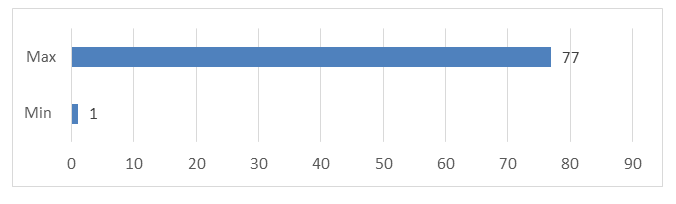
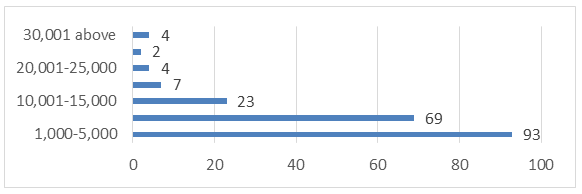
Figure 8 revealed that there are 93 respondents has a monthly income range from 1,000 to 5,000. Followed by 69 of the respondents in the range from 5,001-10,000.
23 respondents from income range of 10,001-15,000. 7 respondents from 15,001 to 20,000. 4 respondents from 20,001-25,000 and 2 respondents from 25,001 above.
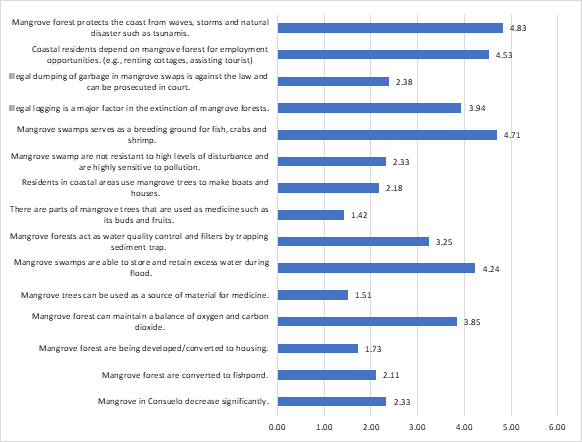
Respondent are asked if they are aware if “Mangrove Forest protects the coast from waves, storms and natural disaster such as tsunamis”. Out of two hundred-two (202) respondent, 86% of them answered they are “Highly aware”. Followed by another respondent answered “Aware” with 11%.While “Not aware” with 2%and “Moderately aware” with 0%.The general mean was 4.83 which is the majority and falls under “Highly aware”.
Respondent are asked if they are aware that “Coastal residents depend on mangrove forest for employment opportunities. (e.g., renting cottages, assisting tourist)”. Out of two hundred-two (202) respondent, 57% of them answered that they are “Highly aware”. Followed by another 35% of the respondent answered they are “Aware”. The 6 % answered they are “Not aware” and 0% answered “Moderately aware”. The general mean was 4.53 which is the majority and falls under “Highly aware”.
Respondent are asked if they are aware if “Illegal dumping of garbage in mangrove swamps is against the law and can be prosecuted in court”. Out of two hundred-two (202) respondent, 91% of them answered “Not aware”. As 4% answered they are “Highly aware”. Another3 % saying they are “Moderately aware”. And 1% said they are aware. The general mean was 2.38 which is the majority and falls under “Not aware”.
Respondent are asked if they are aware that “Illegal logging is a major factor in the extinction of mangrove forests”. Out of two hundred-two (202) respondent, the 39% of them answered “Not aware”. Followed by “Aware,” with 34%. As 25% stated that they are “Highly aware” and 2% answered “Moderately aware”. The general mean was 3.94 which is the majority and falls under “Aware”.
Respondent are asked if they are aware if “Mangrove swamps serves as a breeding ground for fish, crabs and shrimp”. Out of two hundred-two (202) respondent, 74% of them answered “Highly aware”. 20% claimed that they are “Aware”.3% said they are “Not aware,” and “Moderately aware” with 1%.The general mean was 4.71 which is the majority and falls under “Highly aware”.
Respondent are asked if they are aware if “Mangrove swamp are not resistant to high levels of disturbance and are highly sensitive to pollution”. Out of two hundred-two (202) respondent, 84% answered “Not aware”.10% said they are “Moderately aware”. As5% is “Highly aware” and 0% are “Aware”. The general mean was 2.33 which is the majority and falls under “Moderately aware”.
Respondent are asked if they are aware if “Residents in coastal areas use mangrove trees to make boats and houses” out of two hundred-two (202) respondent, 94% answered “Not aware”.4% are “Highly aware”. 1%” Moderately aware”. And 0% is “aware”. The general mean was 2.18 which is the majority and falls under “Not aware”.
Respondent are asked if they are aware if “There are parts of mangrove that are used as medicine such as its buds and fruits”. Out of two hundred-two (202) respondent, 96% of the respondent answered “Highly not aware”. As2% answered “Highly aware”. “Moderately aware and Aware” both scored 0%. The general mean was 1.42 which is the majority and falls under “Not aware”.
Respondent are asked if they are aware if “Mangrove forests act as water quality control and filters by trapping sediment trap”. Out of two hundred-two (202) respondent, 64% of the respondent answered “Not aware”. Followed by 19% said they are “Aware”.12% answered “Highly aware”. And 4% answered “Moderately aware”. The general mean was 3.25 which is the majority and falls under “Moderately aware”.
Respondent are asked if they are aware if “Mangrove swamps are able to store and retain excess water during flood”. Out of two hundred-two (202) respondent, 58% of the respondent answered they are “Aware”. Followed by 32% answered they are “Highly aware”.9% answered “Not aware”. And 1% answered “Moderately aware”. The general mean was 4.24 which is the majority and falls under “Highly aware”.
Respondent are asked if they are aware if “Mangrove can be used as a source of material for medicine”. Out of two hundred-two (202) respondent, 95% of the respondent answered “Not aware”. 3% answered they are “Aware”. 2% are “Highly aware” and 0% “Moderately aware”. The general mean was 1.51 which is the majority and falls under “Not aware”.
Respondent are asked if they are aware if “Mangrove Forest can maintain a balance of oxygen and carbon dioxide”. Out of two hundred-two (202) respondent, 40% of them answered they are “Aware”.36% answered “Not aware”. 15% answered “Highly aware”. And 8% answered “Moderately aware”. The general mean was 3.85 which is the majority and falls under “Aware”.
Respondent are asked if they are aware if the “Mangrove Forest are being developed/converted to housing”. Out of two hundred-two (202) respondent, 96% of the respondent “Not aware,” 2% said they are “Highly aware”. 1% “Moderately aware”. While “Aware” has 0%.The general mean was 1.73 which is the majority and falls under “Not aware”.
Respondent are asked if they are aware if the “Mangrove Forest are converted to fishpond”. Out of two hundred-two (202) respondent, 91% answered” Not aware”. 6% said they are “Highly aware”. 2% are “Aware”. While 0% for “Moderately aware”. The general mean was 2.11 which is the majority and falls under “Not aware”.
Respondent are asked if they are aware if the “Mangrove in Consuelo decrease significantly”. Out of two hundred-two (202) respondent, 89% of the respondent answered “Not aware”. 8% are “Highly aware”. 2% are “Aware”. While 1% is “Moderately aware”. The general mean was 2.33 which is the majority and falls under “Not aware”.
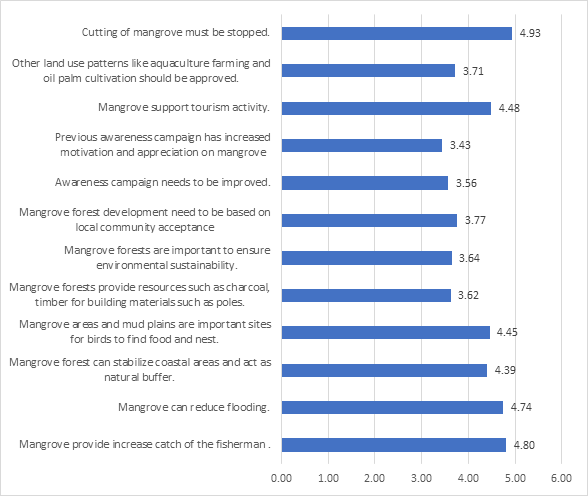
(0-.83) Don’t know (0.84-1.66) Strongly Disagree (1.67-2.49) Disagree (2.50-3.32) Neutral (3.33-4.15) Agree (4.16-5.00) strongly agree. Figure 10: Respondent perception on mangroves and mangrove ecosystem in Consuelo, Macabebe, Pampanga.
Majority of the respondents believed that mangrove forest protects the coast from waves, storms and natural disaster such as tsunamis. This finding relates to a study by Lindsay and Steven 2013, found that mangroves may serve as an effective natural barrier against storms, flooding, coastal erosion, and strong waves, albeit the degree to which they minimize typhoon damage is debatable (and tsunami). Coastal residents depend on mangrove forest for employment opportunities. This finding is consistent with the research by Ahmad, et al. [21], which found out that the mangrove ecosystem has great advantages for the environment, society, and economy. The demand for mangrove forest nature tourism is growing globally. Mangrove forests have long been a well-liked tourist attraction. Illegal dumping of garbage in mangrove swamps is against the law and can be prosecuted in court and illegal logging is a major factor in the extinction of mangrove forests. Mangrove swamps serves as a breeding ground for fish, crabs and shrimp the findings are related to the study of Abu El-Regal, et al. [22] seeks to research the value of mangrove areas as modifying grounds for reef fish juveniles in the Red Sea. A beach seine net was used to gather young fish from three mangrove swamps over the course of three seasons in 2010. Three times, the net was dragged along the bottom for 100 meters. A total of 269 young fish were gathered, with 21 species and 19 families represented. Mangrove swamp is not resistant to high levels of disturbance and is highly sensitive to pollution. There are parts of mangrove that are used as medicine such as its buds and fruits the outcome of this research has related to the study of P Saranraj, [23] state that Folkloric medicines have been made from mangrove plants, and extracts from certain mangrove species have demonstrated inhibitory efficacy against diseases that affect people, animals, and plants. Mangrove forests act as water quality control and filters by trapping sediment trap, the result has connection to the study of Sarker, et al. [24] implies that mangrove, a community of salt-tolerant plants that thrive in the areas where freshwater and marine water systems converge, are crucial as sediment traps. Litter fall accumulates as organic carbon and nutrients over the sediment surface in mangrove habitats, where bioturbation has a massive effect on the sediment biogeochemistry. Mangrove swamps are able to store and retain excess water during flood. Mangrove can be used as a source of material for medicine. This outcome relates to the research conducted by Sadeer, et al. [25] explain thatthe biological activities of the phytoconstituents extracted from mangrove plants, including gallic acid, galactose, lupeol, catechins, and carotenoids, were examined. These substances are utilized to create antibacterial, antioxidant, anticancer, antidiabetic, and other therapeutic agents in the pharmaceutical and nutraceutical sectors. Information on the biotechnological potentials of mangrove plants and their bioactive chemicals as a new source of innovative medications, enzymes, nanoparticles, and therapeutically significant microbial pigments is provided in the current review. Mangrove Forest can maintain a balance of oxygen and carbon dioxide expound that this outcome is connected to research of Abhijit’s 2019 mangroves offer a wide range of ecosystem services, such as better air quality, temperature stabilization, less UV radiation, oxygen production, carbon sequestration, habitat for various flora and fauna (improving biodiversity), visual appeal, etc. One of the most common but little-studied advantages of mangroves is oxygen production. Mangrove Forest are being developed/converted to housing, this outcome is related to previous work by Rudianto and Bengen [26] state that Mangrove forests are being lost as a result of the significant land modifications that are becoming necessary for the construction of settlements in coastal areas for both low- and high-income populations. Mangrove Forest is converted to fishpond. Majority of the respondent answered do not know this might be because due to their brief residence in the area compared to the 6 percent and 2 percent of respondents who indicated they were well informed and had lived there for a long period of time. Mangrove in Consuelo decrease significantly this can be related to previous research of Zhang, et al. [27] determine that understanding the dynamics of mangrove forests at the landscape scale and creating a baseline that enables the detection of the consequences of future environmental change.
Respondent are asked on their perception on “Cutting of mangrove must be stopped” out of two hundred-two (202) respondent, 93% answered “Strongly agree,” 4% are “Agree,” followed by 2% “Don’t know,” 1% answered “Neutral” and both “Strongly disagree and Disagree” has 0%. The general mean was 4.93 which the majority and falls under “Strongly agree”.
Respondent are asked about their perception on “Other land use patterns like aquaculture farming and oil palm cultivation should be approved”. Out of two hundred- two (202) respondent, 45% answered “Don’t know,” 25% answered “Neutral,” both “Agree and Strongly agree” has the same percentage of 14%, followed by 1% “Strongly disagree” and “Disagree” has 0%.The general mean was 3.71 which the majority and falls under “Agree”.
Respondent about their perception on “Mangrove support tourism activity”. Out of two hundred-two (202) respondent, 51% answered “Strongly agree,”39% answered “Agree,” followed by 6% “Don’t know,” both “Disagree and Neutral” has the same percentage of 1% and “Strongly disagree has 0%.The general mean was 4.48 which the majority and falls under “Strongly agree”.
Respondent are asked about their perception on “Previous awareness campaign has increased motivation and appreciation on mangrove”. Out of two hundred-two (202) respondent, 54% answered “Don’t know,” 25% answered “Neutral,” followed by 10% “Agree,” 7% answered “Highly agree,” 3% are “Disagree” and 1% are “Highly disagree”. The general mean was 3.43 which the majority and falls under “Don’t know”.
Respondent are asked about their perception on “Awareness campaign needs to be improved”. Out of two hundred-two (202) respondent, 47% answered “Don’t know,” 26% answered” Neutral” followed by 15 % answered “Agree” 9% are “Strongly agree” 3% answered “Disagree” and 0% for “Strongly disagree”. The general mean was 3.56 which the majority and falls under “Agree”.
Respondent are asked about their perception on “Mangrove Forest development need to be based on local community acceptance”. Out of two hundred-two (202) respondent, 39%answered “Don’t know” 31% answered “Agree” 16% are “Neutral” followed by “Strongly agree” 10%“Disagree” 3% and “Strongly disagree” is 0%.The general mean was 3.77 which the majority and falls under “Agree”.
Respondent are asked about their perception on “Mangrove forests are important to ensure environmental sustainability”. Out of two hundred-two (202) respondent, 41% answered “Don’t know,” 25% answered “Neutral” 19%” are “Agree” 11% are “Strongly agree” 4% are “Disagree” and “Highly disagree” 0%.The general mean was 3.64 which the majority and falls under “Agree”.
Respondent are asked about their perception on “Mangrove forests provide resources such as charcoal, timber for building materials such as poles”. Out of two hundred- two (202) respondent, 53% answered “Don’t know” 18% are “Agree” and 10% are “Strongly agree” followed by “Neutral” 9%, 7 % answered “Disagree” and “Highly disagree”1%.The general mean was 3.62 which the majority and falls under “Agree”.
Respondent are asked about their perception on “Mangrove areas and mud plains are important sites for birds to find food and nest”. Out of two hundred-two (202) respondent, 51% answered “Strongly agree,” 43% are “Agree,” followed by 3% who “Disagree,”2% “Don’t know” 1% “Neutral” and 0% “Disagree”. The general mean was 4.45 which the majority and falls under “Strongly agree”.
Respondent are asked about their perception on “Mangrove Forest can stabilize coastal areas and act as natural buffer”. Out of two hundred-two (202) respondent, 51% answered “Strongly agree” 33% are “Agree” 7% are choose “Neutral” 4% answered “Don’t know” 3% answered “Disagree” and 0% answered “Strongly disagree”. The general mean was 4.39 which the majority and falls under “Strongly agree”.
Respondent are asked about their perception on “Mangrove can reduce flooding”. Out of two hundred-two (202) respondent, 80% answered “Strongly agree” 15% answered “Agree” 2% answered “Disagree” both “Don’t know” and “Strongly disagree” has the same percentage of 1% and “Neutral” get 0%.The general mean was 4.74 which the majority and falls under “Strongly agree”.
Respondent are asked about their perception on “Mangrove provide increase catch of the fisherman”. Out of two hundred-two (202) respondent, 85% answered “Strongly agree” 12% are “Agree” both “Disagree and Strongly disagree” has the same percentage of 1%, “Don’t know and Neutral” has the same percentage of 0%.The general mean was 4.80 which the majority and falls under “Strongly agree”.
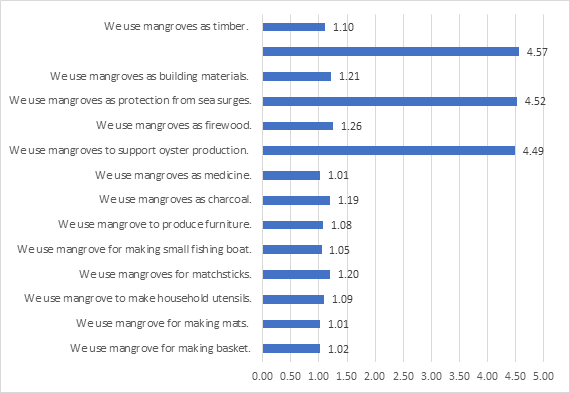
(1-1.80) Never (1.81-2.60) Seldom (2.61-3.40) Sometimes (3.41-4.20) Frequently (4.21-5) Always Figure 11: Uses of mangrove to the community of Consuelo, Macabebe, Pampanga.
Majority of the resident are Strongly agreed that cutting of mangrove must be stopped, the result has a related to the study of Sakthivel 2010 which discuss that mangrove lands received the least care, and no country was an exception. Fewer countries now pay attention to protecting mangroves as they realize their importance from an ecological standpoint. Other land use patterns like aquaculture farming and oil palm cultivation should be approved this relates to the study of Bostock, et al. [28]. Which depicts that Aquaculture, which includes fish, crustaceans, and mollusks but excludes mammals, reptiles, and aquatic plants, provided 43% of aquatic animal food for human consumption in 2007 and is predicted to increase in the future to satisfy demand. Mangrove support tourism activity, this outcome relates to the study of Rahmila and Hamil’s [29] describes that with an ecotourism appropriateness rating of 74.36 percent, mangrove forests have the potential to be used as tourist destinations for fishing, boating, and enjoying the natural beauty of the mangrove forest. Awareness campaign needs to be improved. Mangrove Forest development needs to be based on local community acceptance. The outcome is related to the research by M Sawairnathan and N Halimoon [30]. In light of current and potential development issues, the local community has an opinion on how the mangrove forest should be managed and preserved. Mangrove forests are important to ensure environmental sustainability. The result has been related to the study of Jusoff K, et al. [31] determinethat a wide variety of animals and plants can be found in mangrove forests, which also serve as an essential breeding site for a massive. Mangrove forests provide resources such as charcoal, timber for building materials such as poles. This result has connection to the study of Guebas, et al. [32] which demonstrates that mangroves are an important contributor of timber for building homes, burning for fuel, making charcoal, and making boats. Mangrove areas and mud plains are important sites for birds to find food and nest, the outcome is connected to the research by Kathiresan K, et al. [33] defines biology of mangroves and mangrove ecosystems. Mangrove areas and mud plains are important sites for birds to find food and nest other types of creatures are housed in the aerial roots, trunks, leaves, and branches. Numerous crab species can be found in the canopy, on the trunks, or even living among the roots. The habitat is abundant with insects, reptiles, amphibians, birds, and mammals, which adds to its distinctive character. Mangrove Forest can stabilize coastal areas and act as natural buffer this supported by the study of Chow, J. [34] specifies that by storing carbon, improving coastline stability, and shielding coastal populations from storm surges, mangroves offer services that can help mitigate losses. To mitigate the effects of sea level rise, mangroves in particular can quickly colonize and stabilize intertidal sediments while encouraging coastal accretion. Mangrove can reduce flooding; this outcome is related to the research done by Menéndez, et al. [35] which indicate that flood threats on the coast are gradually increasing. Every 20 km worldwide, we provide high resolution assessments of the economic worth of mangrove forests for reducing flood risk. Mangrove provide increase catch of the fisherman, this result has connection to the study of Carrasquila, et al. [36] which describes that in tropical and subtropical areas, mangrove ecosystems rank among the most productive ecosystems. Mangroves have historically been thought to support artisanal fisheries.
Respondent are asked if they are using “mangroves as timber”. Out of two hundred-two (202) respondent, 95% answered “Never” both “Seldom and Sometimes” has the same percentage of 2%, “Frequently and Always” has the same percentage of 0%.The general mean was 1.10 which the majority and falls under “Never”.
Respondent are asked if they are using “mangroves as breeding ground of fish, shrimps, etc.” Out of two hundred- two (202) respondent, 63% answered “Always” 34% answered “Frequently” while “Never, Seldom, sometimes” are all the same got 1%.The general mean was 4.57 which the majority and falls under “Always”.
Respondents are asked if they are using” mangroves as building materials”. Out of two hundred-two (202) respondent, 87% answered “Never” 7% answered “Seldom”, followed by 4% answered “Sometimes” 1% are “Always” 0% “Frequently. The general mean was 1.21 which the majority and falls under “Never”.
Respondents are asked if they are using “We use mangroves as protection from sea surges”. Out of two hundred-two (202) respondent, 70% answered “Always” 22% answered “Frequently” followed by seldom 4%, 2% answered “Never” and “Sometimes” has 1%.The general mean was 4.52 which the majority and falls under “Always”.
Respondents are asked if they are using “Mangroves as firewood”. Out of two hundred-two (202) respondent, 86% answered “Never” 7% answered “Seldom” followed by 4% answered “Sometimes” 2% answered “Always” 1% for “Frequently”. The general mean was 1.26 which the majority and falls under “Never”.
Respondents are asked if they are using” Mangroves to support oyster production”.Out of two hundred-two (202) respondent, 61% answered “Always” 33% answered “Frequently” followed by “Never” 3%, “Sometimes” 2% and “Seldom” 0%.The general mean was 4.49 which the majority and falls under “Always”.
Respondents are asked if they are using “Mangroves as medicine”. Out of two hundred-two (202) respondent, 99% answered “Never” 1% are “Seldom,” “Sometimes, Frequently and Always” are the same percentage of 0%.The general mean was 1.01 which the majority and falls under “Never”.
Respondents are asked if they are using “Mangroves as charcoal”. Out of two hundred-two (202) respondent, 89% answered “Never” 7% answered “Seldom” 2% are “Frequently” and both “Sometimes and Always” has the same percentage of 1%.The general mean was 1.19which the majority and falls under “Never”.
Respondents are asked if they are using “Mangrove to produce furniture”. Out of two hundred-two (202) respondent, 95% answered “Never” 4% answered “Seldom” 1% are “Frequently” and both “Sometimes and Always” has the same percentage of 0%.The general mean was 1.08 which the majority and falls under “Never”.
Respondents are asked if they are using “Mangrove for making small fishing boat”. Out of two hundred-two (202) respondent, 97% answered “Never” 2% answered “Seldom” “Sometimes, Frequently and Always” are all the same 0%.The general mean was 1.05 which the majority and falls under “Never”.
Respondents are asked if they are using “Mangroves for matchsticks”. Out of two hundred-two (202) respondent, 88% answered “Never” 9% answered “Seldom” both “Sometimes, Frequently and Always” has the same percentage of 1%.The general mean was 1.20 which the majority and falls under “Never”.
Respondents are asked if they are using “Mangrove to make household utensils”. Out of two hundred-two (202) respondent, 93% answered “Never” 5% answered ‘Seldom” 1% answered Sometimes” and both “Frequently and Always” has the same percentage of 0%.The general mean was 1.09 which the majority and falls under “Never”.
Respondents are asked if they are using “Mangrove for making mats”. Out of two hundred-two (202) respondent, 99% answered “Never” “Seldom, Sometimes, Frequently, always” are all the same percentage of 0%.The general mean was 1.01 which the majority and falls under “Never”.
Respondents are asked if they are using “Mangrove for making basket”. Out of two hundred-two (202) respondent, 99% answered “Never,” 1% answered “Seldom” “Sometimes, Frequently and Always” has all the same percentage of 0%.The general mean was 1.02 which the majority and falls under “Never”.
The majority of respondents said that they never use mangroves as timber; the outcome is related to the assessment of Palacios 2017 which explains that mangrove management ought to be a top priority because of the necessity of mangroves for coastal communities. Mangroves as breeding ground of fish, shrimps. The result has relation to the study of Ravikanth L, et al. [37]. By acting as a habitat for marine life’s breeding grounds and nurseries, mangroves assist and improve fisheries. Mangroves as building materials, mangroves as protection from sea surges in accordance to the study of Zhang, et al. [38] state that in locations with a combination of mangrove islands and open sea, the surge amplitude diminishes at a rate of 20 cm/ km and 40-50 cm/km, respectively, across the mangrove forest. However, due to the “blockage” of mangroves by surge water, the amplitudes of storm surges at the front of the mangrove zone rise by roughly 10 to 30 percent. This can have a higher impact on structures at the front of mangroves than it would without mangroves. Mangroves as fire wood in relation to study of Barbosa [39] determine that over-harvesting of mangroves for firewood and clearance of mangroves for solar salt manufacturing are two major dangers to mangroves. Oil pollution, unchecked coastal migration, and coastal industrial growth are all potential dangers. Mangroves to support oyster production, The outcome is related to the research done by Nakayama, et al. [40]. The findings show that mangroves support local oyster production by serving as a major contributor of DIC and TA, and that oyster aquaculture assisted in carbon sequestration in a lagoon ecosystem dominated by mangroves. Mangrove as medicine, Mangroves as charcoal, Mangrove can produce furniture and Mangrove for making small fishing boat. These four statements’ outcomes have bearing on Bandaranayake’s research in Bandaranayake WM [41] explain that in terms of their economic significance, medical properties, and other uses and functions, it also summarizes the resources and goods produced by mangroves around the world. Products from mangrove ecosystems have a wide range of commercial applications. Mangroves have historically been used as a source of firewood, charcoal and Mangroves have also been used to make furniture, boats, fishing equipment, homes, tannins for dyeing fabrics, and leather. For the people who live in the mangroves, food and a vast range of traditional goods and art if acts are provided by the mangroves. Mangroves for matchsticks, mangrove to make household utensils, making matts and making basket The outcomes of these two assertions are related to the study of Mamiit-Coburn And Wijayaweera [42] which expound that households in the mangrove areas useCereberamanghas to produce papers, matchsticks, and household utensils. These species supply necessary wood and non-timber goods for domestic and commercial usage [43, 44, 45, 46, 47, 48].
Conclusion and Recommendations
The primary objective of this research is to know the Perception and Awareness of residents of Consuelo, Macabebe, Pampanga. To determine their perception and awareness about the importance of mangrove to their community. Mangrove forests are one of the world’s most prolific forest ecosystems, and they’re unusual that they connect terrestrial and marine systems via the intertidal zone. This study was conducted to determine the perception and awareness of the householders of Consuelo, Macabebe, Pampanga, where in there are 675 householders. In which, two hundred-two (202) households were interviewed. The study used an open-ended Survey questionnaire. The study used systematic random sampling in determining the respondent, the respondent of this study was the head of the household. In term of Socio-Demographic profile, one hundred three (103) are male and ninety-nine (99) are female. And the age range were from eighteen (18) and above. In terms of awareness on mangrove ecosystems in their area the result revealed that the majority of respondent are aware about the importance of mangrove to their community. In relation to respondents’ awareness majority of the respondent are highly aware that Mangrove Forest protects the coast from waves, storms and natural disaster such as tsunamis with the mean of 4.83, coastal residents depend on mangrove forest for employment opportunities. (e.g., renting cottages, assisting tourist) with the mean of
4,53 and Mangrove swamps serves as a breeding ground for fish, crabs and shrimp with the mean of 4.71. In terms of their perception on mangrove ecosystem majority of the respondent strongly agree to the statement of cutting of mangrove must be stopped with the mean of 4.93.Mangrove can reduce flooding with the mean of 4.74 and Mangrove provide increase catch of the fisherman 4.80. When it comes to the used of mangrove, they always use as breeding ground of fish, shrimps, etc. 4.57and we use mangroves as protection from sea surges 4.52 [49, 50, 51, 52].
Conclusion
The primary objective of this research is to know the Perception and Awareness of residents of Consuelo, Macabebe, Pampanga, to determine their perception and awareness about the importance of mangrove to their community. To ensure the long-term survival and preservation of mangroves in Consuelo, that it was essential to understand the value of mangroves.
In line with the findings of the study, the following was concluded: Majority of the respondent are aware of the following, Mangrove Forest protects the coast from waves, storms and natural disaster such as tsunamis, and Coastal residents depend on mangrove forest for employment opportunities. (e.g., renting cottages, assisting tourist). Illegal logging is a major factor in the extinction of mangrove forests. Mangrove swamps serves as a breeding ground for fish, crabs and shrimp and Mangrove swamps are able to store and retain excess water during flood. On their perception majority of the respondent agreed that cutting of mangrove must be stopped, Mangrove support tourism activity, Mangrove areas and mud plains are important sites for birds to find food and nest, Mangrove can reduce flooding and Mangrove provide increase catch of the fisherman. Respondent are always using mangroves as breeding ground of fish, shrimps, etc., as protection from sea surges and using mangroves to support oyster production.
Recommendations
As a result of the conclusions and findings, the researcher recommends the following:
- The residents that are new in the community may not be aware about the importance of mangrove. Programs on information dissemination may be considered to make them aware about the benefits they can derive from mangroves.
- The respondents, who have been a long residency in the area, should be given the fundamental training and the confidence to initiate the mangrove regeneration. Replanting mangroves could be very successful given that the local communities already have a relatively good level of awareness about the function and conservation of mangrove forests.
- The barangay officials, with the LGU officials is suggested to conduct seminar about mangroves for their constituent who has limited knowledge about the importance of mangroves and to bring less harm to the mangrove when they are visiting the area.
- The tourist might check out social media or other internet platforms first to get a sense of what to expect when they visit Consuelo.
- The caretaker of the area he may be included on the seminar so that he will be given more knowledge in taking care of the mangrove area.
- The Future researchers may try further on improving of this research by giving more ideas on the community, on how to increase the number of mangroves in the area.
This might significantly help the locals in the area by providing them with protection from natural disasters and ensuring their food security.
References
-
Buitre MJC, Zhang H, Lin H (2019) The Mangrove Forest Change and Impact from Tropical Cyclone in the Philippines Using Time Series Satellite Imagery Remote Sens 11(6): 688.
-
ZSL (2014) Rehabilitating Mangroves in the Philippines.
-
Ramos J (2017) On Worlds Mangrove Day, a new strategy to protect the world’s most important ecosystem. Conservation International.
-
(2017) In the Philippines, Mangroves are a valuable Flood Defense. UNDRR.
-
(2019) Mangrove: Plant. Encyclopedia Britannica.
-
Giri C, Ochieng E, Tieszen LL, Zhu Z, Singh A, et al. (2011) Status and distribution of mangrove forests of the world using earth observation satellite data: Status and distributions of global mangroves. Global Ecology and Biogeography 20(1): 154-159.
-
Friess DA, Rogers K, Lovelock CE, Krauss KW, Hamilton SE, et al. (2019) The State of the World’s Mangrove Forests: Past, Present, and Future. Annual Review of Environment and Resources 44(1): 89-115.
-
Sandilyan S, Kathiresan K (2012) Mangrove conservation: a global perspective. Biodivers Conserv 21: 3523-3542.
-
Hochard J, Hamilton SE, Barbier EB (2019) Mangroves shelter coastal economic activity from cyclones. Proceedings of the National Academy of Sciences 116(25): 12232-12237.
-
Cummings AR, Shah M (2018) Mangroves in the global climate and environmental mix. Geography Compass 12(1): e12353.
-
Mumby PJ, Edwards AJ, Ernesto Arias Gonzalez J, Lindeman KC, Blackwell PG, et al. (2004) Mangroves enhance the biomass of coral reef fish communities in the Caribbean. Nature 427(6974): 533-536.
-
Acharya GD (2016) Life at the margins: The social, economic and ecological importance of mangroves. Madera Y Bosques 8: 53-60.
-
del Valle A, Eriksson M, Ishizawa OA, Miranda JJ (2019) Mangroves protect coastal economic activity from hurricanes. Proceedings of the National Academy of Sciences 117(1): 265-270.
-
Kruitwagen G, Nagelkerken I, Lugendo BR, Mgaya YD, Bonga SE (2010) Importance of different carbon sources for macroinvertebrates and fishes of an interlinked mangrove-mudflat ecosystem (Tanzania). Estuarine Coastal and Shelf Science 88(4): 464-472.
-
Bulluck LP, Ames EM, Bayly NJ, Reese J, Viverette CB, et al. (2019) Habitat‐dependent occupancy and movement in a migrant songbird highlights the importance of mangroves and forested lagoons in Panama and Colombia. Ecology and Evolution 9(19): 11064-11077.
-
Duke N, Nagelkerken I, Agardy T, Wells S, Van Lavieren H (2014) The importance of mangroves to people: a call to action. Report. United Nations Environment Programme World Conservation Monitoring Centre (UNEP-WCMC), Cambridge, UK., pp: 128.
-
Aksornkoae S, Tokrisna R, Sugunnasil W, Sathirathai S (2004) The importance of mangroves: ecological perspectives and socio-economic values. Shrimp farming and mangrove loss in Thailand, pp: 27-36.
-
Abdel-Aziz S, Mouafi FE, Moustafa YA, Abdelwahed NA (2016) Medicinal Importance of Mangrove Plants. Microbes in Food and Health, pp: 77-96.
-
Osti RP, Tanaka S, Tokioka T (2009) The importance of mangrove forest in tsunami disaster mitigation. Disasters 33(2): 203-213.
-
Tacio H (2012) Mangrove Deforestation in the Philippines. Gaia Discovery.
-
Ahmad Y, Suratman MN (2021) The Roles of Mangroves in Sustainable Tourism Development. Mangroves: Ecology, Biodiversity and Management, pp: 401-417.
-
El Regal MAA, Ibrahim NK (2014) Role of mangroves as a nursery ground for juvenile reef fishes in the southern Egyptian Red Sea. The Egyptian Journal of Aquatic Research 40(1): 71-78.
-
Saranraj P, Sujitha D (2015). Mangrove Medicinal Plants: A Review. American-Eurasian Journal of Toxicological Science 7(3): 146-156.
-
Sarker S, Masud‐Ul‐Alam M, Hossain MS, Rahman Chowdhury S, Sharifuzzaman SM (2021) A review of bioturbation and sediment organic geochemistry in mangroves. Geological Journal 56(5): 2439-2450.
-
Sadeer NB, Zengin G, Mahomoodally MF (2022) Biotechnological applications of mangrove plants and their isolated compounds in medicine-a mechanistic overview. Critical Reviews in Biotechnology, pp: 1-22.
-
Rudianto R, Bengen DG (2020) An Analysis of Mangrove Forest Damage Due to Illegal Logging and Its Effect on Carbon Stock and Absorption in East Java, Indonesia. Research Square.
-
Zhang K, Thapa B, Ross M, Gann D (2016) Remote sensing of seasonal changes and disturbances in mangrove forest: a case study from South Florida. Ecosphere 7(6): e01366.
-
Bostock J, McAndrew B, Richards R, Jauncey K, Telfer T, et al. (2010) Aquaculture: global status and trends. Philosophical Transactions of the Royal Society B: Biological Sciences 365(1554): 2897-2912.
-
Rahmila YI, Halim MAR (2018) Mangrove forest development determined for ecotourism in Mangunharjo Village Semarang. E3S Web of Conferences. EDP Sciences 73: 04010.
-
Sawairnathan M, Halimoon N (2017) Assessment of the local communities’ knowledge on mangrove ecology. International Journal of Human Capital in Urban Management 2(2): 125-138.
-
Jusoff K, Taha D (2008) Managing sustainable mangrove forests in Peninsular Malaysia. Journal of Sustainable Development 1(1): 88-96.
-
Dahdouh Guebas F, Mathenge C, Kairo JG, Koedam N (2000) Utilization of mangrove wood products around Mida Creek (Kenya) amongst subsistence and commercial users. Economic Botany 54(4): 513-527.
-
Kathiresan K (2012) Importance of Mangrove Ecosystem. The international journal of marine science 2(10): 70- 89.
-
Chow J (2018) Mangrove management for climate change adaptation and sustainable development in coastal zones. Journal of Sustainable Forestry 37(2): 139-156.
-
Menéndez P, Losada IJ, Torres Ortega S, Narayan S, Beck M (2020) The Global Flood Protection Benefits of Mangroves. Scientific Reports 10: 4404.
-
Carrasquila HM, Juanes F (2017) Mangroves enhance local fisheries catches: A global meta-analysis. Fish and Fisheries 18(1): 79-93.
-
Ravikanth L, Kumar K (2017) Economic analysis of mangrove and marine fishery linkages in India. Ecosystem services 24: 114-123.
-
Zhang K, Liu H, Li Y, Xu H, Shen J, et al. (2012) The role of mangroves in attenuating storm surges. Estuarine, Coastal and Shelf Science 102-103: 11-23.
-
Barbosa FM, Cuambe CC, Bandeira SO (2001) Status and distribution of mangroves in Mozambique. South African Journal of Botany 67(3): 393-398.
-
Nakayama K, Kawahara Y, Kurimoto Y, Tada K, Lin HC, et al. (2022) Effects of oyster aquaculture on carbon capture and removal in a tropical mangrove lagoon in southwestern Taiwan. Science of The Total Environment 838: 156460.
-
Bandaranayake WM (1998) Traditional and medicinal uses of mangroves. Mangroves and salt marshes 2(3): 133-148.
-
Mamiit-Coburn RJ, Wijayaweera K (2009) Chapter seven shoreline protection and mangroves: a post-tsunami community assessment. Sustaining a Resilient Asia Pacific Community, 93.
-
Das S (2017) Ecological restoration and livelihood: contribution of planted mangroves as nursery and habitat for artisanal and commercial fishery. World Development 94: 492-502.
-
Gijsman R, Horstman EM, van der Wal D, Friess DA, Swales A, et al. (2021) Nature-based engineering: a review on reducing coastal flood risk with mangroves. Frontiers in Marine Science 8: 702412.
-
Hakim L, Siswanto D, Nakagoshi N (2017) Mangrove Conservation in East Java: The Ecotourism Development Perspectives. J Trop Life Science 7(3): 277-285.
-
(2021) The Importance of Mangrove Forest for Migratory Birds. Mangrove Action Project.
-
Mitra A (2019) Natural oxygen counter in Mangrove forests. Advanced Science Letters, pp: 6-13.
-
Azlan NI, Othman R (2009) Monitoring of Mangrove Area Using Remote Sensing Toward Shoreline Protection. GIS Ostrava.
-
Nagelkerken ISJM, Blaber SJM, Bouillon S, Green P, Haywood M, et al. (2008) The habitat function of mangroves for terrestrial and marine fauna: a review. Aquatic botany 89(2): 155-185.
-
Palacios ML, Cantera JR (2017) Mangrove timber use as an ecosystem service in the Colombian Pacific. Hydrobiologia 803: 345-358.
-
Rafique M (2018) A Review on the status, ecological importance, vulnerabilities, and conservation strategies for the mangrove ecosystems of Pakistan. Pak J Bot 50(4): 1645-1659.
-
Vinoth R, Kumaravel S, Ranganathan R (2019) Therapeutic and traditional uses of mangrove plants. Journal of Drug Delivery and Therapeutics 9(4-s): 849- 854.
- Lessons to Learn: Trees are More than the Lungs of the World
- Community Forestry Enterprises as a Model for Sustainable Forest Development: The Case Of The "Baja Tarahumara" in Chihuahua, Mexico
- Ecological and Socio-Economic Impacts of Chromolaena odorata and Mesosphaerum suaveolens, Two Invasive Alien Species in Central and Southern Benin, West Africa
- Epigenetic Sustainability: Modeling the Human Factor as a Natural Resource through Science 4.0 and the NR3C1 Biological Pilot
- Growth-at-Risk: A Framework for Assessing Economic Vulnerability
- The Rural Territory as a Socioecological System for the Management of Public Policy for Sustainable Rural Development