
Recommendations for the Management, Conservation, and Promotion of Urban Biodiversity
This rapid review explores the published scientific literature of the last 22 years in search of recommendations and consensus applicable to the management, conservation and promotion of urban biodiversity. Our search allowed us to compile 517 publications, 134 were considered for this study, from which 78 recommendations were extracted (Table 1) located in 27 of these publications. The size of green spaces is one of the most mentioned aspects, as well as the connectivity and heterogeneity of spaces in the city. In addition, the use of native plants or facilitating resources such as the installation of nest boxes or insect hotels is recommended to support biodiversity conservation in cities. However, important gaps were identified, such as the low representation of taxonomic groups on which the authors base their recommendations or the need for future research to provide concrete recommendations and how they are to be implemented.
Introduction
Over the next three decades, large cities are expected to support rising populations, in addition to absorbing the existing rural exodus. City dwellers could come to represent 86% of the population in developed countries and 64% in less developed countries in this period [1]. This leads to a rapid expansion of the surface area of cities [2, 3]. Urbanization is considered one of the human actions with the greatest impact on natural systems, causing the modification of habitats in a drastic and prolonged manner [4]. The original ecosystem is replaced by an artificial one created and strongly influenced by humans [5]. It causes, among other consequences, habitat destruction, degradation and fragmentation [6] or alteration of natural regimes and processes, such as nutrient and water cycles [7]. This also implies local extinctions and loss of biodiversity, one of the main environmental problems at the planetary level [8].
Traditionally, cities have been treated as “biological deserts” [9]. However, different studies show that species richness in urban environments sometimes rivals or exceeds peripheral natural environments [10]. Even at times, cities are home to endangered species and can be key places to ensure their survival [11]. Urbanization, in a first step, reduces species diversity and abundance [4]. A process of biotic homogenization occurs, in which generalist species become more dominant, as they have a better capacity to adapt to the transformations produced [12], and the number of alien species, some of them considered invasive, increases [13]. This occurs in general terms, but species responses to urbanization are greatly variable. Most species disappear during the urbanization process and are unable to colonize new habitats [4]. Some species, despite being sensitive to urbanization processes, are able to persist within cities when there are remnant habitats or little disturbed green spaces [4]. Others disappear during the urbanization process, but are able to colonize later, benefiting from the decrease in natural predators, the abundance of resources or the thermal benefits of heat islands offered by cities [14]. Much of the urbanization process takes place in areas of high biodiversity, often referred to as “biodiversity hotspots”, where available resources (water, fertile soils, etc.) are abundant and easily accessible [15]. Urbanization and biodiversity loss are two interrelated problems that will need to be addressed in the coming years [16]. High biodiversity in cities is important for its intrinsic value (e.g., when it hosts threatened or endemic species), for the multiple benefits it brings to citizens (e.g., carbon sequestration, air purification and shade provided by trees) [17] and for contributing to maintaining resilience to disturbances [18]. Therefore, there is an urgent need to conserve and enhance urban biodiversity and its associated ecosystem services at all scales [19]. However, urban biodiversity can have disadvantages, some of which can be the presence of invasive species [20], the deterioration of pavements, buildings or infrastructures due to the action of roots or branches [21], or the accumulation of bird excrement [22]. It is essential that landscape planners and designers take biodiversity and its ecological processes into account to make better decisions about land use and land cover changes, thus minimizing their loss [16]. In addition to their own role, managers and conservationists have the possibility of involving citizens, who tend to imitate in their private gardens the practices carried out in local green spaces, which can be of great interest to achieve more biodiverse cities [23, 24]. In conclusion, to meet the challenge of designing more biodiverse cities, efforts from the scientific-ecological sphere are not enough; the collaboration of politicians, landscape designers, planners, architects, managers and conservationists is required [25, 26]. All this will not be possible without adequate practical guidelines based on scientific knowledge of urban ecology [27], to support the conservation, management and reduction of urban biodiversity loss, one of the main problems to be addressed in the 21st century [28]. This review explores the scientific publications of the last 22 years to locate useful recommendations for the management, conservation and promotion of urban biodiversity. This has not been done to date and may be important for achieving more diverse and sustainable cities. The main objective of this paper is to answer the following questions: (1) are there sufficient and applicable recommendations for the management, conservation and promotion of urban biodiversity? (2) What are they? (3) What are their characteristics?
Materials and Methods
We followed the PRISMA guidelines for our search (Appendix A). The search engine selected for this rapid review was Web of Science (WoS), including the WoS core collection, Science Citation Index Expanded, Social Sciences Citation Index, and Book Citation Index-Science. The range of years was set at the last twenty-two years (2000-2022). The term “urban biodiversity” was used in conjunction with the search string “adaptive management OR conservation OR adaptation OR urban ecosystem”. Only articles, reviews and book chapters were considered.
After reading the title and abstract of the articles resulting from the search, those that could contain explicit and applicable recommendations were selected. Table 1 shows a summary of the inclusion and exclusion criteria.
| Inclusionary | Exclusionary |
|---|---|
| Articles, reviews and book chapters | Conference and other academic papers |
| Published in English | Articles on biodiversity and ecosystem services |
| Articles on biodiversity | Technical or methodological articles |
Table 1: Criteria of selection.
A database was created with the localized recommendations and their characteristics to better understanding them. The characteristics of each recommendation were obtained following the methodology used by Heller NE [29], in which a series of questions with predefined answers are posed. The questions and the answers to each one of them are as follows:
- Who is the addressee of the recommendations? (1) Political changes (P), (2) technological/scientific research (T/C), (3) society (referring to the population) (S) and (4) management/planning/conservation (MPC). Policy recommendations were selected based on policy changes aimed at urban sustainability, environmental education, or environmental legislation. The technological/scientific research category includes recommendations that require a major research effort on a specific topic. Recommendations directed at the practices and actions of the population are included in the category called society. Finally, planning, management and conservation is an extensive category that includes a wide range of recommendations intended to guide the groups involved in making decisions or implementing their practices.
- On what basis do the authors make recommendations? (1) Case studies (CS), (2) survey of experts or citizens (Sur), (3) ecological deduction (ED), the latter category includes publications based on essays or opinions based on established knowledge.
- Type of recommendation? We differentiate between two types, (1) general (Gen) and (2) specific (Spe). A general recommendation is a generic recommendation that does not indicate how it should be carried out, while a specific recommendation is one that exemplifies how the recommendation is to be implemented.
- Is the recommendation geographically limited? The response options are (1) no geographic limit (G) or (2) local (L).
- Where is the recommendation applicable? The possible answers are (1) matrix (peripheral areas and the city as a whole) (M), (2) green areas (public parks and public or private gardens) (GA), (3) green infrastructure (tree- lined streets, green walls, green roofs or other elements that may constitute green infrastructure in the city) (GI), (4) non-specific (recommendations applicable to more than one of the above options) (NE) or (5) undetermined, (recommendations that are not applicable to the proposed responses) (U).
Results
Our initial search located 517 publications. After reading the title and abstract and applying the inclusion and exclusion criteria (Table 1), the number of publications becomes 134. Finally, after a full reading 78 recommendations (Appendix B) were found in 27 articles (Listing S1). Table 2 shows the topics addressed by the recommendations.
| Focus of the recommendations | Nº. articles | Topics | Recommendation number (Supplementarym aterial) |
|---|---|---|---|
| Consider patch size | 5 | Heterogeneity | 7,9 61,66,71 |
| Landscape vision | 4 | Heterogeneity | 25,28,36,64 |
| Water bodies | 2 | Heterogeneity | 4,78 |
| Spatial heterogeneity | 2 | Heterogeneity | 7,70 |
| Connectivity | 6 | Connectivity | 7,10,14,34,56,64 |
| Conserve and restore habitat | 6 | Connectivity | 12,13,25,41 42,43 |
| Increase vegetation cover | 15 | Increase in vegetation cover | 5,6,15,17,23,24,29,35,39,45,46,47, 51,60,65 |
| Species selection | 12 | Increase in vegetation cover | 8,27,39,49,54,55,57,58,59,67,73,74 |
| Tree maintenance | 3 | Increase in vegetation cover | 3,48,62 |
| Biodiversity support actions | 6 | Architectural, spatial design ands upport measure | 1,2,20,21,22,37 |
| Areas of human-nature conflict | 2 | Architectural, spatial design ands upport measure | 11,63 |
| Architectural measures | 2 | Architectural, spatial design ands upport measure | 19,31 |
| Stakeholders | 5 | Outreach andi ntegration | 33,38,44,69,75 |
| Outreach | 2 | Outreach andi ntegration | 69,77 |
| Increase awareness | 3 | Research | 8,63,76 |
| Pollution and disturbance | 8 | Pollution andd isturbance | 18,21,25,30,50,53,68,72 |
| Urban sprawl | 1 | City design | 40 |
Table 2: Number of explicit recommendations identified in each of the articles of the scientific literature reviewed, description
Studies focus mainly on species diversity in urban areas and on the effects of urbanization on specific taxonomic groups, such as vegetation [13, 14, 15, 16, 17, 18, 19, 20, 21, 22, 23, 24, 25, 26, 27, 28, 29, 30, 31, 32, 33, 34, 37, 40, 41], invertebrates [35, 36, 37, 38, 39, 40, 41, 42, 43, 44, 45, 46, 47, 48, 49, 50, 51], reptiles [32, 47], birds [23, 30, 31, 39] or mammals [34, 42]. Studies that explicitly provide recommendations are few (n=27) and aimed at the mentioned taxonomic groups.
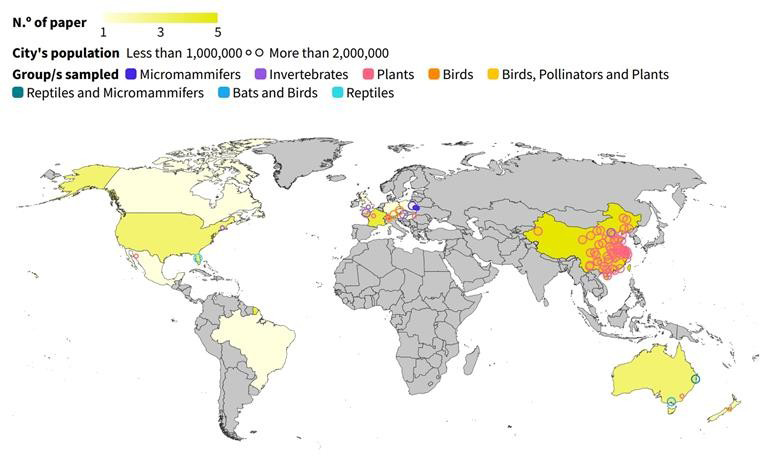
The number of publications with recommendations has increased in the last decade and the temporal distribution is more significant in the last 5 years. The spatial distribution of the publications considered indicates that the studies have been carried out in a total of 12 countries and 88 cities, China being the most relevant country with 5 publications (Figure 1). The population size of the cities shows that 68 cities have more than one million residents, 20 have less than one million and 9 have less one hundred thousand residents.
Who is the addressee of the recommendations?
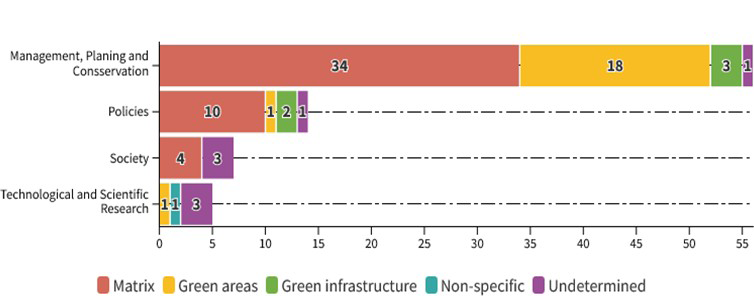
A greater number of recommendations were identified (n=56) (Figure 2) related to “management, planning and conservation” (hereafter referred to as MPC), including recommendations referring to the promotion of biodiversity through actions prior to the growth or modification of cities or any of their components or actions linked to city maintenance practices from a holistic perspective [13, 47]. Recommendations directed at policies applied in cities are the second most frequently found (n=14). Those directed to “technological/scientific research” and “society” are the least localized (n=12). Theorem-type environments (including propositions, lemmas, corollaries etc.) can be formatted as follows:
On what basis do the authors make recommendations?
Case study articles are widely represented (85%), 3 articles result from ecological deduction (essay and opinion) and, finally, only one article based on a survey of experts.
Type of recommendation? Fifty-three percent of the recommendations are of a general nature. Recommendations of a specific type are varied and concern the management of spontaneous plants [13, 43], avoiding rapid turnover in building construction [33, 39] or the maintenance of water troughs or other supporting structures for biodiversity [31], among others.
Is the recommendation geographically limited?
The geographical limitation of the recommendations is reduced, only 3 of the recommendations are limited to the local level while the rest do not describe any limitation. Where is the recommendation applicable?
The “Matrix” class has the highest number of recommendations (Figure 2), followed by the “Green areas” class. A total of 8 recommendations are not referenced in any of the proposed classes. The “Non-specific” class is less frequently found and, lastly, the “green infrastructure” class receives the least attention.
Discussion
Are there sufficient and applicable recommendations for the management, conservation, and promotion of urban biodiversity? According to the articles reviewed in this paper, there has been an increase in recommendations showing a growing interest in the scientific literature for the knowledge and protection of urban biodiversity [52]. However, there are not enough explicit recommendations, as only 20% of the publications reviewed contained them. There are studies from which recommendations could be drawn, but they do not appear concretely in the text (see, for example, [53]). In contrast, the inclusion of explicit recommendations seems to be more frequent in other areas, such as the improvement of urban mobility (e.g., [54, 55]). Even so, the detailed recommendations identified can be extrapolated into technical manuals (e.g.,[56]) and management plans (e.g., [57]), accessible to politicians and managers, capable of bringing about real changes in cities.
What are the recommendations?
The recommendations identified are mainly related to the size and connectivity of urban green spaces, major components of the urban landscape that affect its biodiversity [16]. A larger size of the green area allows for greater species diversity [58]. Despite this, the importance of smaller spaces should not be underestimated, as they can contribute considerably to increasing the overall biodiversity of the city [48]. The implementation of a functional network of green infrastructures in cities, connecting the different green spaces, regardless of their size, and their peripheral environment, is one of the main measures that contribute to maintaining their biodiversity and the provision of ecosystem services [12, 37]. Ecological corridors such as natural urban waterways can be important elements to improve this connectivity [31]. Furthermore, in order to achieve effective connectivity between green spaces, some authors point out the importance of improving the structure and diversity of vegetation in these corridors [34, 44]. For example, the presence of large trees in the streets supports a multitude of species (food, shelter, etc.) facilitates their movement between green spaces and thus contributes to their promotion and conservation [31]. Therefore, the conserving and enhancing of large tree stands should be a priority in urban planning [45]. Also important is the use of native plants [16, 39, 41, 42] adapted to the environmental conditions where the cities are located and that provide further support to the conservation of remaining native biodiversity [34]. Other authors point out the capacity of exotic species to colonize cities and use urban corridors for their dispersal in natural or semi- natural bordering areas [59]. Therefore, it is necessary to exclude those exotic species with invasive behavior [43]. Another component that affects biodiversity is the heterogeneity of habitats in the urban landscape [16]. Habitat heterogeneity is also related to the size of green spaces; larger size often hosts more diverse habitats that are heterogeneous to each other [60]. There are elements such as water bodies that provide heterogeneity [49]. Therefore, the construction of naturalized ponds should be taken into account in the planning of new green areas [30]. Another way to bring heterogeneity to the urban landscape is through the implementation of architectural solutions that can contribute to promote biodiversity in cities [16]. Green roofs or walls contribute significantly to the colonization of some organisms [36]. Habitat heterogeneity can also be improved outside public green spaces, for example, by enhancing biodiversity in private gardens [30, 51]. There are also recommendations for the conservation of specific faunal groups in cities. In this sense, the authors highlight recommendations such as the installation of nest boxes [31], bat roosts or insect hotels, and another author states the application of measures to avoid deaths due to unnatural causes such as, for example, the collision of birds in the windows of buildings. However, sometimes these measures may not be sufficiently detailed in scientific literature, which makes their correct application and effectiveness difficult. It is particularly relevant to solve this problem, there are currently national and supranational strategies to conserve urban biodiversity and prevent the deterioration of ecosystem service provision in cities. One such initiative is “Vision 2050”, a program launched by the European Union (https://biodiversity.europa.eu/policy) in 2011, which consists of six objectives, including the full implementation in urban environments of the Birds and Habitats, Agriculture and Forestry Directives, increased efforts to combat invasive species and the prevention of global biodiversity loss. However, although it is necessary to continue conserving and promoting biodiversity in cities, we should not ignore that in order to effectively conserve a species and its ecological functions; we must also do so in its natural habitats [11]. The management practices used in urban green areas conditions the biodiversity present in them regardless of their size, connectivity or heterogeneity of habitats. Several pieces of research reviewed in this paper provide recommendations on lawn management in cities, highlighting that mowing lawns less frequent improves biodiversity [35, 48]. Other research indicates the importance of reducing the use of pesticides and fossil fuels to limit negative impacts on biodiversity [31, 41]. Citizens can also contribute to promoting biodiversity in the city through actions on private property, such as diversifying garden flora [30, 50] or installing bird feeders [31].
What are their characteristics?
The characteristics of these recommendations are generally in line with those described by other research [29] and are aimed at management, planning and conservation. Articles containing these recommendations focus primarily on understanding how management practices or planning for new urban green spaces affect biodiversity [10, 46]. Policy-based recommendations emphasize the maintenance of remnant natural areas, the promotion of new green areas, or the maintenance and use of native species [39, 41]. The works addressed to the social part manifest the need to disseminate knowledge on biodiversity promotion [31, 48]. Recommendations based on case studies are the most used by the authors, and plants and birds (>50%) are the main object of their studies. These recommendations are in line with the main lines of research developed in this discipline [52]. Research is mainly carried out in northern hemisphere countries (Figure 1), something that has already been highlighted by other authors. However, in the southern hemisphere there are a large number of other types of publications on urban biodiversity not indexed in global databases [52], which are not reflected in this study. Most of the research is carried out in cities with big population’s size. Even though the size of cities influences numerous factors that condition their biodiversity. Although more research has been carried out in the northern hemisphere, most of the proposed recommendations are applicable globally, only some very specific ones are locally bounded (see, for example, [50]).
Conclusion
In this rapid review, the Wos database has been used to identify explicit recommendations in the promotion, management and conservation of biodiversity. Most of the recommendations are related to the size of the green areas, their connectivity and heterogeneity. An interconnected green infrastructure is recommended, including large green areas and, also preserving smaller spaces that, due to their characteristics, have the capacity to support native or specialist species. The diversification of spaces must also go beyond green areas, for which a greater presence of vegetation throughout the city is recommended. Architectural measures such as green roofs or green walls can help achieve this goal in areas with higher building density. In these areas, the use of native plants is endorsed as well as the avoidance of invasive exotic species. Likewise, participatory governance is advocated in which all stakeholders are involved in decision making. Future research could focus on providing more explicit and actionable recommendations while expanding taxonomic groups underrepresented in the literature. In addition, it is necessary to do it not only from a taxonomic approach, but also from a functional one. The geographic scope of the research should be broadened, increasing the representation of the southern hemisphere. More research should also be conducted in small cities or towns since most studies focus on large cities. Finally, it is of the utmost priority to convey the recommendations based on scientific knowledge, to politicians, managers and curators, as they are ultimately the main decision-makers in metropolitan areas.
References
-
Pitman SD, Daniels CB, Ely ME (2015) Green infrastructure as life support: Urban nature and climate change. Trans R Soc S 139(1): 97-112.
-
Clucas B, Parker ID, Feldpausch-Parker AM (2018) A systematic review of the relationship between urban agriculture and biodiversity. Urban Ecosyst 21: 635-643.
-
Lopucki R, Kitowski I (2017) How small cities affect the biodiversity of ground-dwelling mammals and the relevance of this knowledge in planning urban land expansion in terms of urban wildlife. Urban Ecosyst 20: 933-943.
-
McKinney ML (2022) Urbanization, biodiversity and conservation. Bioscience 52(10): 883- 890.
-
Grimm N, Faeth SH, Golubiewski NE, Redman CL, Wu J, et al. (2008) Global change and the ecology of cities. Sci 319: 756-760.
-
Alberti M (2005) The effects of urban patterns on ecosystem function. Int Reg Sci Rev 28(2) 168-192.
-
Andersson E, Barthel S, Borgström S, Colding J, Elmqvist T, et al. (2014) Reconnecting cities to the biosphere: Stewardship of green infrastructure and urban ecosystem services. Ambio 43: 445-453.
-
Uchiyama Y, Kohsaka R (2019) Application of the City Biodiversity Index to populated cities in Japan: Influence of the social and ecological characteristics on indicator- based management. Ecol 106: 105420.
-
Lambert MR, Donihue CM (2020) Urban biodiversity management using evolutionary tools. Nat Ecol Evol 4: 903-910.
-
Shwartz A, Muratet A, Simon L, Julliard R (2013) Local and management variables outweigh landscape effects in enhancing the diversity of different taxa in a big metropolis. Biol Conserv 157: 285-292.
-
Luna A, Romero-Vidal P, Hiraldo F, Tella JL (2018) Cities may save some threatened species but not their ecological functions. Peerj 6: e4908.
-
Morelli F, Benedetti Y, Ibáñez-Álamo JD, Tryjanowski P, Jokimäki J, et al. (2020) Insurance for the future? Potential avian community resilience in the cities across Europe. Clim Change 159: 195-214.
-
Bonthoux S, Voisin L, Bouché-Pillon S, Chollet S (2019) More than weeds: Spontaneous vegetation in streets as a neglected element of urban biodiversity. Landsc Urban Plan 185: 163-172.
-
McKinney ML (2006) Urbanization as a major cause of biotic homogenization. Biol Conserv 127(3): 247-260.
-
Campbell-Arvai V (2019) Engaging urban nature: improving our understanding of public perceptions of the role of biodiversity in cities. Urban Ecosyst 22: 409- 423.
-
Rastandeh A, Pedersen Zari M, Brown DK (2018) Components of landscape pattern and urban biodiversity in an era of climate change: a global survey of expert knowledge. Urban Ecosyst 21: 903-920.
-
Livesley SJ, McPherson EG, Calfapietra C (2016) The urban forest and ecosystem services: impacts on urban water, heat and pollution cycles at the tree, street and city scale. J Environ Qual 45(1): 119-124.
-
Bengtsson J, Angelstam P, Elmqvist T, Emanuelsson U, Folke C, et al. (2003) Reserves, resilience and dynamic landscapes. Ambio 32(6): 389-396.
-
Collins R, Schaafsma M, Hudson MD (2017) The value of green walls to urban biodiversity. Land use policy 64: 114-123.
-
Cariñanos P, Calaza-Martínez P, Brien LO, Calfapietra C (2017) The cost of greening: disservices of urban tree. In the urban forest 1st (Edn.), In: Pearlmutter D, et al. Springer Cham: New York City, USA, 7: 79-87.
-
Mehmood-Shah A, Liu G, Huo Z, Yang Q, Zhang W, et al. (2022) Assessing environmental services and disservices of urban street trees. An application of the emergy accounting. RCR advances 186: 106563.
-
Lyytimäki J (2019) Disservices of urban trees. In Routledge handbook of urban forestry, 1st (Edn.), Ferrini F, et al. Routledge: London, UK, pp: 13.
-
Fontana S, Sattler T, Bontadina F, Moretti M (2011) How to manage the urban green to improve bird diversity and community structure. Landsc Urban Plan 101(3): 278- 285.
-
Goddard MA, Dougill AJ, Benton TG (2013) Why garden for wildlife? Social and ecological drivers, Motivations and barriers for biodiversity management in residential landscapes. Ecol Econ 86: 258-273.
-
Bryant MM (2006) Urban landscape conservation and the role of ecological greenways at local and metropolitan scales. Landsc Urban Plan 76(4): 23-44.
-
Parris KM, Amati M, Bekessy SA, Dagenais D, Fryd O, et al. (2018) The seven lamps of planning for biodiversity in the city. Cities 83: 44-53.
-
Garrard GE, Williams NSG, Mata L, Thomas J, Bekessy SA (2018) Biodiversity Sensitive Urban Design. Conserv 11(2): 1-10.
-
Hooper DU, Chapin III FS, Ewel JJ, Hector A, Inchausti P, et al. (2005) Effects of biodiversity on ecosystem functioning: a consensus of current knowledge. Ecol 75(1): 3-35.
-
Heller NE, Zavaleta ES (2009) Biodiversity management in the face of climate change: A review of 22 years of recommendations. Biol Conserv 142(1): 14-32.
-
Ferenc M, Sedláček O, Fuchs R (2014) How to improve urban greenspace for woodland birds: Site and local- scale determinants of bird species richness. Urban Ecosyst 17: 625- 640.
-
Savard JPL, Clergeau P, Mennechez G (2000) Biodiversity concepts and urban ecosystems. Landsc Urban Plan 48(4): 131-142.
-
Garden JG, McAlpine CA, Possingham HP (2010) Multi- scaled habitat considerations for conserving urban biodiversity: Native reptiles and small mammals in Brisbane, Australia. Landsc 25: 1013-1028.
-
Muratet A, Machon N, Jiguet F, Moret J, Porcher E (2007) The role of urban structures in the distribution of wasteland flora in the Greater Paris area, France. Ecosyst 10: 661-671.
-
Threlfall CG, Williams NSG, Hahs AK, Livesley SJ (2016) Approaches to urban vegetation management and the impacts on urban bird and bat assemblages. Landsc Urban Plan 153: 28-39.
-
Lerman SB, Contosta AR, Milam J, Bang C (2018) To mow or to mow less: Lawn mowing frequency affects bee abundance and diversity in suburban yards. Biol Conserv 221: 160-174.
-
Madre F, Clergeau P, Machon N, Vergnes A (2015) Building biodiversity: Vegetated façades as habitats for spider and beetle assemblages. GECCO 3: 222-233.
-
Hüse B, Szabó S, Deák B, Tóthmérész B (2016) Mapping an ecological network of green habitat patches and their role in maintaining urban biodiversity in and around Debrecen city (Eastern Hungary). Land Use Policy 57: 574-581.
-
Soanes K, Sievers M, Chee YE, Williams NS, Bhardwaj M, et al. (2019) Correcting common misconceptions to inspire conservation action in urban environments. Biol Conserv 33(2): 300-306.
-
Rastandeh A, Pedersen Zari M, Brown DK (2018) Land cover change and management implications for the conservation of a seabird in an urban coastal zone under climate change. Ecol Manag Restor 19(2): 147-155.
-
Le Roux DS, Ikin K, Lindenmayer DB, Blanchard W, Manning AD, et al. (2014) Reduced availability of habitat structures in urban landscapes: implications for policy and practice. Landsc Urban Plan 125: 57-64.
-
Ortega-Rosas CI, Enciso-Miranda CA, Macías-Duarte A, Morales-Romero D, Villarruel-Sahagún L (2020) Urban vegetation cover correlates with environmental variables in a desert city: Insights of mitigation measures to climate change. Urban Ecosyst 23: 1191- 1207.
-
Łopucki R, Klich D, Kitowski I, Kiersztyn A (2020) Urban size effect on biodiversity: The need for a conceptual framework for the implementation of urban policy for small cities. Cities 98: 102590.
-
Hu S, Jin C, Huang L, Huang J, Luo M, et al. (2022) Characterizing composition profile and diversity patterns of spontaneous urban plants across China’s major cities. J Environ Manage 317: 115445.
-
Han D, Zhang C, Wang C, She J, Sun Z, et al. (2021) Differences in response of butterfly diversity and species composition in urban parks to land cover and local habitat variables. Forests 12(2): 140.
-
Mühlbauer M, Weisser WW, Müller N, Meyer ST (2021) A green design of city squares increases abundance and diversity of birds. Basic Appl Ecol 56: 446-459.
-
Li X, Zhang J, Huang J, Lin W, Wu S, et al. (2022) To Preserve Green Buffer under Polarization and Diffusion Effects of a Fast-Developing Megalopolis. Land 11(5): 724.
-
Gainsbury AM, Santos EG, Wiederhecker H (2022) Does urbanization impact terrestrial vertebrate ectotherms across a biodiversity hotspot? Sci Total Environ 835: 155446.
-
Vega KA, Küffer C (2021) Promoting wildflower biodiversity in dense and green cities: The important role of small vegetation patches. Urban For Urban Green 62: 127165.
-
Yang J, Luo X, Lu S, Yang Y, Yang J (2022) Effects of compositional and configurational heterogeneity of the urban matrix on the species richness of woody plants in urban remnant forest patches. Landsc 37: 619-632.
-
Pendi M, Hussain RI, Moser D, Frank T, Drapela T (2022) Influences of landscape structure on butterfly diversity in urban private gardens using a citizen science approach. Urban Ecosyst 25: 477-486.
-
Hill MJ, Wood PJ, Fairchild W, Williams P, Nicolet P, et al. (2021) Garden pond diversity: Opportunities for urban freshwater conservation. Basic Appl Ecol 57: 28-40.
-
Rega-Brodsky CC, Aronson MF, Piana MR, Carpenter ES, Hahs AK, et al. (2022) Urban biodiversity: State of the science and future directions. Urban Ecosyst 25: 1083- 1096.
-
Gill N, Waitt G, Head L (2009) Local engagements with urban bushland: moving beyond bounded practice for urban biodiversity management. Landsc Urban Plan 93: 184-193.
-
Leo A, Morillón D, Silva R (2017) Review and analysis of urban mobility strategies in Mexico. Case Stud Transp Policy 5: 299-305.
-
Van der Koogh M, Chappin E, Heller R, Lukszo Z (2021) Are we satisfying the right conditions for the mobility transition? A review and evaluation of the dutch urban mobility policies. Sustainability13(22): 12736.
-
Fernández Calvo IC (2019) 100 medidas para la conservación de la biodiversidad en entornos urbanos SEO/BirdLife.
-
Consejería de Medio Ambiente (2018) Madrid. Plan de Infraestructuras Verdes y Biodiversidad.
-
Blake JR, Karr JR (1987) Breeding birds of isolated woodlots: area and habitat relationships. Ecology 68(6): 1724-1734.
-
Francis RA, Chadwick MA, Turbelin AJ (2019) An overview of non-native species invasions in urban river corridors. River Res Appl 35(8): 1269-1278.
- Lessons to Learn: Trees are More than the Lungs of the World
- Community Forestry Enterprises as a Model for Sustainable Forest Development: The Case Of The "Baja Tarahumara" in Chihuahua, Mexico
- Ecological and Socio-Economic Impacts of Chromolaena odorata and Mesosphaerum suaveolens, Two Invasive Alien Species in Central and Southern Benin, West Africa
- Epigenetic Sustainability: Modeling the Human Factor as a Natural Resource through Science 4.0 and the NR3C1 Biological Pilot
- Growth-at-Risk: A Framework for Assessing Economic Vulnerability
- The Rural Territory as a Socioecological System for the Management of Public Policy for Sustainable Rural Development