
Possibility of Neutralization and Industrial Use of Waste Fly Ash from Sewage Sludge Combustion
The article presents research on the possibilities of neutralization and industrial use of waste fly ash generated in the process of sewage sludge incineration. The aim of the research was to develop an effective method of ash stabilization, enabling its safe and economical use in industry, for example as a component of construction materials. It was shown that immobilization of heavy metals is possible using cement as a stabilizer, but the minimum required amount is 50% of the ash mass. Challenges related to the homogenization of the mixture and the disposal of the liquid remaining after the mixing process was also identified. The research results suggest the need for further optimization of the process in order to minimize costs and improve efficiency, which opens up prospects for a wider use of waste ash in industry.
Sylwester Kulig* and Tomasz Mieloch
Complex Sp. z o.o., Opole, Poland
Keywords: Sewage Sludge Fly Ash; Concrete; Cement; Stabilization; Heavy Metals Leaching
Introduction
The problem of industrial waste generation such as fly ash from sewage sludge combustion is significant. Sewage treatment in urban agglomerations leads to the generation of significant amounts of excess activated sludge. As a result, it is necessary to manage it, which is a significant problem in a situation of limited space. One of the solutions is composting excess activated sludge. In addition to the necessary space, odours are a problem [1]. For this reason, municipal (domestic) sewage treatment plants are sometimes equipped with thermal processing installations. Combustion of excess activated sludge is one of the solutions used in densely populated regions. This solution is used in the European Union and other highly developed countries as an alternative to biological and agricultural methods [2, 3].
The factor causing the construction of an increasing number of sewage sludge incinerators in Poland are legal regulations. Due to the ban on storing waste with a calorific value exceeding 6 MJ/kg of dry mass, in force since 1 January 2016, some plants use their combustion [4]. Growing urbanization leads to an increase in the number of inhabitants and more intensive use of urban infrastructure. This naturally translates into larger volumes of sewage. The increasing number of buildings, industrial plants and service facilities generate a larger volume of waste, which must be effectively treated by sewage systems. As a result, the amount of sewage sludge produced, which is a by-product of the sewage treatment process, also increases. Managing this sludge is becoming an increasing challenge, requiring modern technological solutions and a sustainable approach to waste management [5]. One of the approaches is energy recovery in power plants or immediate incineration at the place of generation. This concept involves minimizing the amount of waste through its reuse, recycling and implementation of recovery processes, including treating waste as a potential source of secondary raw materials and energy. The use of such fuels is beneficial both ecologically and socially, as it reduces the amount of waste going to landfills and limits the demand for land designated for their storage [6].
Dewatered sewage sludge (dry), depending on the stabilization processes, contains on average 50–70% of organic matter and 30–50% of minerals (including 1–4% of inorganic carbon), 3.4–4.0% N, 0.5–2.5% P and significant amounts of other nutrients, including microelements [7]. Its further management is associated with possible contamination. In the case of sewage sludge combustion, mineral contaminants are important. They are not biodegradable, so they can accumulate in the soil and enter the food chain and bioconcentrate in the environment. Historically, the most important are heavy metals, classified as chemical elements with a specific gravity greater than 4.5 g cm-3 [8]. The presentation of the problem of mineral contamination, or more precisely heavy metals in sewage sludge, is important due to the residues after their incineration. It should be emphasized that the content of mineral substances in sewage sludge is not constant and depends on factors such as the size of the industry, technological development of the region or ecological awareness of the inhabitants. Examples of heavy metal content in sewage sludge are: Pb - 34 mg/kg, Cd - 1 mg/kg, Cr - 33 mg/kg, Cu - 292 mg/kg, Ni - 25 mg/kg, Hg - 0.5 mg/ kg, Zn - 762 mg/kg [9].
There are several thermal technologies for using municipal sewage sludge to obtain useful energy. These include pyrolysis, gasification, combustion and co-combustion processes [10]. Compared to other solid fuels such as coal, sewage sludge has a higher and variable ash content of about 20 to 50 wt% on a dry basis, which causes high loads on the ash handling and flue gas cleaning system of the incinerator [11]. Annually, about 10 megatons of dry matter of sewage sludge are produced in the 28 EU Member States, of which 22% is combusted [12]. Combustion is becoming an effective way of disposing of sewage sludge, as it is an important way of utilizing the calorific value, compressing the volume and destroying pathogenic bacteria, pathogenic microorganisms and harmful organic matter [13]. In the European Union, ashes from sewage sludge combustion have been marked with two codes: 190107* (hazardous waste) and 190114 (non-hazardous waste) [14]. During sewage sludge combustion, two types of waste are generated. One of them is the bottom fraction, which is characterized by different properties than the hazardous waste constituting the volatile fraction [15]. Many publications describing the possibility of using fly ash in concrete mixtures draw attention to the issue of the fraction used for testing.
Many publications indicate that the main components of fly ash from sewage sludge combustion are SiO2, CaO, Al2O3, Fe2O3, MgO and P2O5. These compounds, theoretically, make the described waste a good pozzolanic material. It is indicated that after fine grinding the discussed material exhibits cementitious properties. The available literature [15, 16, 17] discusses primarily the oxide composition in the range of light metals and selected non-metals. However, the issue of soluble substances is omitted. This is a significant problem due to the composition of living organisms forming sewage sludge. We are talking here primarily about chlorides and sulphates, which usually form salts soluble in water. In the case of treating fly ash as an additive to concrete, these substances are important.
Ashes from combusted sewage sludge (ISSA), a by- product of sewage sludge combustion in wastewater treatment plants, are increasingly being produced and landfilling is a common method of disposal. Given the limited availability of landfill space, this is no longer a sustainable waste management solution for ISSA [18, 19]. Another important aspect is that the issues related to the leaching of heavy metals from the waste have been neglected due to differences in the legal regulations of countries around the world. The issue of water-soluble salts, which can deteriorate the properties of concrete, is also important. Therefore, fly ash with a high content of soluble substances may not be a beneficial additive. This paper presents a concept for the disposal of fly ash with a high content of water-soluble sulphate salts.
Ettringite precipitation characteristics
In nature, ettringite occurs as a mineral that is sparingly soluble in water. Its general formula is:
3CaO ∙ Me2O3 ∙ 3CaX ∙ 32H2O, [20].
where: Me is a trivalent metal, which is most often aluminum (Al3+) or e.g. iron (Fe3+), chromium (Cr3+) and others; X is an anion, which is most often sulphate anion (VI) (SO4 2-) [21]. Etringite synthesis also occurs during the hydration of expansive cements. Its formation is also observed during the solidification process of industrial waste. The formation of the so-called “hard” structure in the solidified masses proceeds primarily as a result of the formation of crystalline phases, which significantly increase their volume at the hydration stage: calcium sulphate aluminates form ettringite, calcium oxides are transformed into calcium hydroxides Ca(OH)2, magnesium oxides form magnesium hydroxides Mg(OH)2. The formation of the ettringite phase is the main and most frequently used reaction responsible for the expansion of cement binders. The duration of ettringite crystal growth depends on the conditions and components of the expansive cement, it can be noticeable already during its setting and lasts continuously for several hundred days. The concept of the technology is based on the production of precast concrete elements, the production of which uses industrial waste from thermal processing of sewage sludge. This waste will mainly contain soluble sulphate and sodium ions, which are not suitable, due to the easy solubility of these ions, for the production of full-value precast concrete elements. This waste was previously subjected to pre-treatment, based on a series of chemical reactions, the purpose of which was to prepare the waste for mixing with other components, thus creating a concrete matrix [21].
The production of concrete products involves many aspects related to the quality of the raw materials used. There are appropriate standards regulating the quality of aggregates used for concrete, the quality of cements, additives and admixtures for concrete. These standards include both physical and chemical requirements that must be met to produce a full-value product. One of the important chemical parameters that must be met during the production of cement products is the content of chlorides and sulphates. The content of sulphates is directly related to the phenomenon of sulphate corrosion of concrete and cement products, which is extremely dangerous and causes significant damage to concrete structures [22].
Sulphate corrosion is a process in which chemical reactions take place between the active components of concrete and sulphate ions. These reactions can lead to the formation of a highly expansive crystal, which is ettringite. During crystallization, after filling the free space in the pores of concrete, ettringite begins to exert pressure on the surrounding walls of the pores of concrete. This pressure can lead to the formation of microcracks in the hardened cement mortar, which in consequence will lead to a reduction in the elastic moduli and weakening of the structural element. The reaction leading to the formation of ettringite in the case of external sulphate corrosion is a two-stage reaction. In the first stage, Na2SO4 or MgSO4 diffusing under the influence of the difference in concentrations reacts in the solution with calcium hydroxide present in concrete. The product of this reaction, significant in the case of further corrosion, is gypsum CaSO4∙2H2O [22]. Ca(OH)2 + Na2SO4 + 2H2O → CaSO4∙2H2O + 2NaOH In the second stage, a reaction takes place between the newly formed gypsum and the unhydrated tricalcium aluminate
3CaO∙Al2O3 + 3(CaSO4∙2H2O) + 26H2O → 3CaO∙Al2O3∙3CaSO4∙32H2O
or a reaction between newly formed gypsum and monosulfate Ca4Al2(OH)12∙SO4∙6H2O + 3(CaSO4∙2H2O) + 26H2O → 3CaO∙Al2O3∙3CaSO4∙32H2O [22] Considering the situation in which tricalcium aluminate or monosulfate react with gypsum in the second phase of the reaction, a different volumetric deformation value is obtained. After stoichiometric analysis of the above reactions, the following increase in the product volume is shown in relation to the volume of the substrates: Reaction between tricalcium aluminate and gypsum [22]: - When gypsum is dissolved in water: 8.96 - When gypsum is in a solid state: 1.84 Reaction between monosulfate and gypsum: - When gypsum is dissolved in water: 1.31 - When gypsum is in a solid state: 0.51
The ettringite formed in these reactions can only cause damage to concrete if the reactions occur in hardened concrete.
Similar reactions also occur during cement hydration, but due to the susceptibility of fresh concrete, they do not cause damage. However, hardened concrete no longer has such a capacity to compensate for deformations, as a result of which the expansion of ettringite can cause the formation of micro-cracks and the degradation of elastic constants.
The use of waste materials, which contain largely soluble sulphate ions, entails a problem that appears in the case of gypsum products, and more precisely their low water resistance. The softening coefficient, i.e. the ratio of the strength of a gypsum product in a state of water saturation to the strength of dry gypsum, gypsum products from a paste with a standard consistency, has a value of about 0.3. The most important reason for the low water resistance of gypsum products is the relatively high solubility of gypsum in water - in the case of dihydrate gypsum it is 2.05 g/l at 20°C. When a product becomes damp, a saturated calcium sulphate solution is formed in its pores as a result of dissolving small gypsum crystals that are more susceptible to changes, which create intercrystalline adhesions, which in consequence results in weakening the bonds between the crystals and leads to a decrease in the strength of the product. This phenomenon, when damp, is the result of water absorption by the internal surfaces of micro-cracks in the gypsum crystals. The resulting de-wedging effect of water shells results in the separation of un-grown crystals and the disappearance of the weakest bonds in the product (which are conditioned by Van der Waals forces), which also leads to a decrease in the strength of the product. The adsorption effect of gypsum materials is intensified by their porosity. The low water resistance of gypsum products is caused by the simultaneous action of the above-mentioned factors [23].
The above-mentioned factors will occur when soluble sulphate (VI) ions are bound to gypsum using calcium compounds, which, when incorporated into the mass of prefabricated elements, will contribute to the weakening of their strength, especially in the case of moisture.
Based on current experience with binders of this type, in which hemihydrate gypsum is used, it can be concluded that the issue of durability of the obtained products over time is becoming of great importance. Gypsum binder with the addition of appropriate materials after mixing with water constitutes a system in which, due to the strength of the resulting structure, hydrated calcium sulfate aluminates play an important role, formed as a result of the reaction of gypsum with tricalcium aluminate contained in cement. Hydrated calcium sulfate aluminates can be formed in a high- sulfate form as ettringite and a low-sulfate form as hydrated calcium monosulfate aluminate.
Etringite is characterized by the fact that it can strengthen or significantly weaken, or even destroy the structure, depending on the crystallization conditions. The concentration of calcium hydroxide, which is formed in the liquid phase of the system as a result of the hydrolysis of cement minerals, is of significant importance in this process. At a concentration higher than the specified limit concentration, the ettringite crystallization process extends in time, whereas when the product becomes moist, it can occur in the hardened system, producing secondary ettringite. This mineral, by exerting crystallization pressure, can in turn cause the destruction of the material’s structure. An important role in this type of system is played by the material containing active silica. This component reacts with calcium hydroxide, binds it and initiates the formation of sparingly soluble in water hydrated calcium silicates of the C-S-H type. By doing so, it reduces the concentration of calcium hydroxide in the system and improves the water resistance of the entire system [23].
Based on the above literature data, it is possible to use industrial waste generated in the process of thermal neutralization of sewage sludge and municipal waste, which contain a significant amount of soluble sulphates. Such waste can be subjected to pretreatment, the purpose of which will be to bind soluble sulphate ions, among others, to precipitate ettringite.
Materials and Methods
The study used fly ash from the incineration of sewage sludge from the “Czajka” sewage treatment plant located in Warsaw. The waste was orange in color. It had a dusty form. The bulk density was 720 kg/m3. A sieve analysis of the test material sample was performed. The results are presented in Table 1.
| Sieve size | Mass of matherial on sieve | % kontent matherial on sieve |
|---|---|---|
| 1 mm | 0,23g | 0,22% |
| 500 um | 0,21g | 0,20% |
| 125 um | 10,79g | 10,20% |
| 63 um | 31,42g | 29,70% |
| pon. 63 um | 63,14g | 59,68% |
| SUMA | 102,4g | 100,00% |
Table 1: Result of waste sieve analysis.
The next substance used was Portland cement 42.5R, distilled water, calcium oxide, aluminum oxide, sodium sulphide. A 5 dm3 tank with a circular base was used. In addition, a technical laboratory scale with an accuracy of 0.01 g, a mechanical stirrer, a set for filtration under reduced pressure and plastic molds for storing mixture samples.
First, the waste was mixed with water in a ratio of 1:5 to extract contaminants such as heavy metals and water- soluble salts. Sodium sulphide was then added to bind and precipitate heavy metals as water-insoluble compounds.
Then, alumina, calcium oxide and cement were added in stoichiometric amounts to the ettringite. Slow mixing was continued for 4 hours. The slurry was then filtered and mixed with cement to produce a concrete-like product.
Results
The research has shown that there is a possibility of chemical stabilization of waste after incineration of sewage sludge. A comparison of the results of the waste and stabilized material has shown a reduction in the content of undesirable substances. Table 2 presents the results of the analysis of the water extract of the tested waste in the ratio of waste: water = 1:10 and the material after stabilization in the same ratio. The results of the tests of sample 190107/06 MPWiK Warszawa (BG/003) as the final product of the process have also been added.
| Tested parameter | Waste [mg/l] | Stabilized matherial [mg/l] | Concrete [mg/l] |
|---|---|---|---|
| Zn | 12,2 | <0,1 | <0,1 |
| Cr | 2,1 | <0,1 | <0,1 |
| Pb | <0,1 | <0,1 | <0,1 |
| Cd | <0,1 | <0,1 | <0,1 |
| Ni | <0,1 | <0,1 | <0,1 |
| Cu | 3,6 | <0,1 | <0,1 |
| Hg | 0,31 | <0,01 | <0,01 |
| Cl- | 627 | 273 | 204 |
| SO 2- 4 | 24 163 | 2 153 | 2 261 |
Table 2: Chemical composition of water extracts.
The next stage was the production of materials similar to concrete. For this purpose, several series of tests of different compositions were performed. Table 3 gives the compositions of the more important tests.
| Sample No. | Sample composition/method of preparation | Test result, observations |
|---|---|---|
| 190107/01/ MPWiK Warszawa | 300g – 190107* 60g – Ca(OH) (20%1)) what corresponds CaO (15%1)) 2 30g – Cement (10%1)) 170g – distilled water All ingredients were mixed dry and then water was added | After 7 days the sample solidified, was hard, and was grey-orange in colour. After immersing a piece of the sample in water, a slow disintegration of the sample was observed. After 2 days the sample completely disintegrated in water after drying, forming a fine powder. Result was negative. |
| 190107/02/ MPWiK Warszawa | 300g – 190107* 60g – Ca(OH) (20%1)) what corresponds CaO (15%1)) 2 45g – Cement (15%1)) 170g – distilled water All ingredients were mixed dry and then water was added | After 7 days the sample solidified, was hard, and grey-orange in color. After immersing a piece of the sample in water, a slow disintegration of the sample was observed. The sample disintegrated slower than the previous one, but the effect of the test was still negative. |
| 190107/03/ MPWiK Warszawa | 300g – 190107* 60g – Ca(OH) (20%1)) what corresponds CaO (15%1)) 2 60g – Cement (20%1)) 170g – distilled water All ingredients were mixed dry and then water was added | After 7 days the sample solidified, was hard, and grey-orange in colour. In water it showed much better strength, however after 2 days of immersion partial disintegration of the sample was observed. The test was also negative. |
| 190107/06 MPWiK Warszawa (BG/003) | 200g – 190107* 102g – Cement (30%2)) (51%1)) 150g – distilled water All ingredients were mixed dry and then water was added | The sample after 7 days was very hard. It did not disintegrate in water after 2 days of immersion. Result was positive. |
Table 3: Composition of selected samples.
1) percentage of the waste mass 2) percentage of dry sample mass Table 3: Composition of selected samples.
The results of the research on the stabilization of ash after the combustion of sewage sludge have shown that effective stabilization of these materials is only possible when significant amounts of cement are used. In particular, positive results were obtained when about 50% of cement was added to the ash. This proportion of cement turned out to be crucial for obtaining the desired physical and chemical properties of the stabilized material. Figure 1 shows the appearance of selected solidification tests.
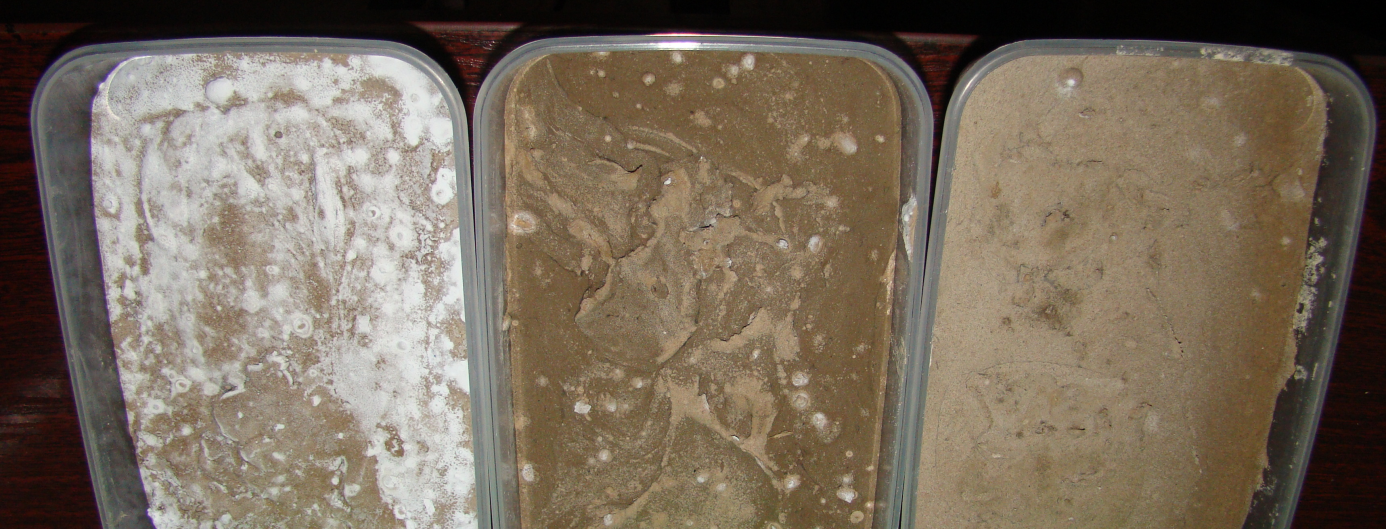
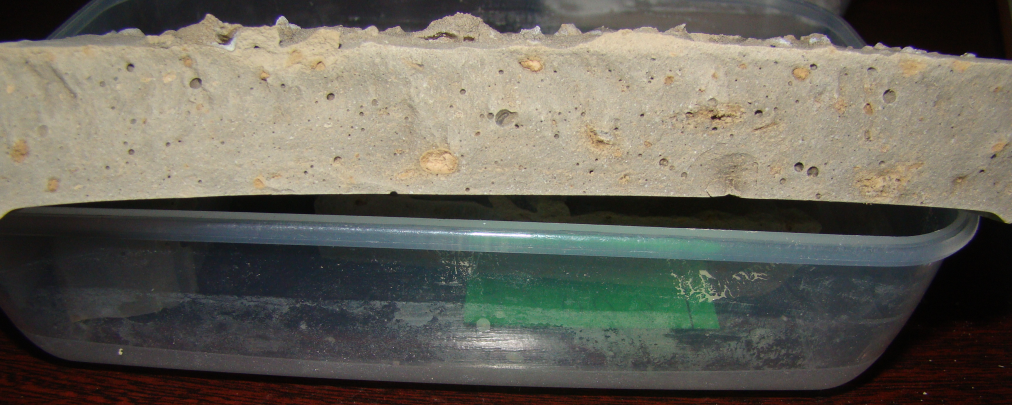
Based on the visual assessment, it was found that the sample with the smallest amount of cement had numerous white efflorescences and low mechanical strength. The sample with 50% cement content was of the best quality. However, problems with the precise homogenization of the concrete mix were found. This is confirmed by the presence of unmixed orange inclusions, as shown in Figure 2.
Stabilization with the addition of cement in the indicated amount allowed for a significant reduction in the leaching of heavy metals, and also improved the mechanical strength of the final product. Thanks to this, the ashes became more environmentally safe, which opens up possibilities for their further use, for example in construction as a component of building materials. However, a high share of cement may affect the costs of the stabilization process and the final use of the obtained material, therefore further research is necessary to optimize this process.
Discussion
First of all, the studies confirmed that effective immobilization of heavy metals in ash after sewage sludge incineration is possible when using cement as a stabilizer. However, the minimum cement content necessary to achieve satisfactory results was as much as 50%. Although such an addition ensures appropriate stability and immobilization of metals, it can also affect the economics of the entire process and the final properties of the material. High cement concentration is also associated with a potential increase in costs and demand for raw materials. In the works of other authors, different results were obtained. FAMSS-modified concretes showed low values of water penetration depth (less than 50 mm), as well as good compressive strength (reaching a minimum class of C30/37 after 130 days of curing) - similar to the compressive strength obtained for conventional concrete. It should be noted, however, that the addition of ash (waste) was used in the amount of maximum 25% of the concrete mass [24]. In subsequent studies, the positive effect of ash addition is also confirmed, but there is no research on the raw material in terms of soluble salts causing corrosion of concrete [25]. The results of other researchers confirm the correct approach of the authors of this study. There is data indicating the problem of heavy metals and other substances in ashes after the combustion of sewage sludge. The stabilizer in this case was kaolin [26].
Another significant challenge identified during the research was the problem of homogenizing the concrete mix.
Due to the variety of ingredients and their physicochemical properties, obtaining a uniform mix was difficult, which may affect the quality and durability of the final product. Uneven distribution of components in the mix may lead to local weakening of the structure and to non-uniform immobilization of heavy metals. It would therefore be necessary to extend the mixing time or use a more powerful mixer.
An additional problem that was highlighted was the presence of liquid left after wet mixing. Although it did not contain harmful compounds, its disposal in a sewage treatment plant can be burdensome and generate additional costs. This is particularly important in the context of large quantities of waste, where even small volumes of liquid can lead to significant logistical and operational problems. A concept that requires further research is determining the possibility of using the liquid for the production of fertilizers. The results of the study indicate the need for further optimization of the stabilization process to minimize both the technical and economic challenges associated with this approach. Possible directions for further work may include the search for alternative stabilizers or additives that will allow for the reduction of cement content, improved mix homogenization, and efficient disposal of residual liquid.
Conclusions
Based on the research conducted on the stabilization of ash waste after the incineration of sewage sludge, the following conclusions can be drawn:
- Fly ash from the incineration of sewage sludge can be a raw material for the production of concrete mixtures, although it is necessary to test each batch of waste in order to select the appropriate process parameters.
- The research confirmed that the use of cement and sodium sulphide as a stabilizer ensures effective immobilization of heavy metals, which is crucial for reducing their harmfulness and minimizing the risk of environmental pollution.
- To achieve the desired stabilization results, it was necessary to use cement in an amount of at least 50% of the ash mass. This level ensures adequate stability, but generates challenges related to the costs of the process and the potential impact on the mechanical properties of the final product.
- During the stabilization process, difficulties were encountered in obtaining a uniform concrete mix. Problems with homogenization can lead to a non-uniform structure of the material, which negatively affects its strength and the efficiency of metal immobilization.
- The liquid remaining after the wet mixing process, although it did not contain harmful substances, may pose a problem in the context of its disposal in sewage treatment plants. The need for its proper management may generate additional costs and operational problems.
- The results indicate the need for further research and optimization of the stabilization process in order to reduce the cement content, improve the homogenization of the mixture and develop more effective methods of disposing of the liquid formed in the stabilization process. These conclusions suggest that although the stabilization method using cement is promising, it requires further improvement so that it can be widely and economically used in practice.
References
-
Sudlitz M, Chmielewski AG (2019) Wykorzystanie promieniowania jonizującego w obróbce osadów z oczyszczalni ścieków: ‘Zeroenergetyczna” technologia do obróbki osadów ściekowych. Raporty IchTJ: 27-29.
-
Rosikon K (2014) Osady sciekowe w nawożeniu wybranych roślin energetycznych. Inżynieria i Ochrona Środowiska 17(2): 339-348.
-
Bień J (2014) Unieszkodliwianie komunalnych osadów ściekowych, Wydawnictwo Politechniki Częstochowskiej, Częstochowa, pp: 5-32
-
Siekierski M, Majewska K, Podsiadło S (2021) Gospodarka odpadami Termiczne przekształcanie odpadów–spalarnie i współspalarnie. MAZOWSZE Studia Regionalne (38): 29-50.
-
Jaworski T, Wajda A (2022) Wykorzystanie paliw z odpadow, biomasy oraz osadów ściekowych w ciepłownictwie. Nowa Energia 4: 42-51.
-
Kulczycka J (2019) Gospodarka o obiegu zamkniętym w polityce i badaniach naukowych. Instytut Gospodarki Surowcami Mineralnymi i Energią Polskiej Akademii Nauk, Wydawnictwo IGSMiE PAN, Kraków.
-
Kacprzak M, Neczaj E, Fijałkowski K, Grobelak A, Grosser A, et al. (2017) Sewage sludge disposal strategies for sustainable development. Environmental research 156: 39-46.
-
Kabata-Pendias A (2010) Pierwiastki śladowe w glebach i roślinach, CRC Press.
-
Williamson KE, Radosevich M, Wommack KE (2005) Abundance and diversity of viruses in six Delaware soils. Appl Environ Microbiol 71(6): 3119-3125.
-
Magdziarz A, Wilk M, Gajek M, Nowak-Woźny D, Kopia A, et al. (2016) Properties of ash generated during sewage sludge combustion: A multifaceted analysis. Energy 113: 85-94.
-
Wang L, Skjevrak G, Hustad JE, Grønli MG (2012) Sintering characteristics of sewage sludge ashes at elevated temperatures. Fuel Processing Technology 96: 88-97.
-
Lynn CJ, Dhir RK, Ghataora GS, West RP (2015) Sewage sludge ash characteristics and potential for use in concrete. Construction and Building Materials 98: 767- 779.
-
Liu H, Wang Y, Ren X, Xu H, Chen J (2022) Study on the transformation of Zn, Mn and Cr during sewage sludge combustion. Process Safety and Environmental Protection 161: 819-826.
-
ROZPORZĄDZENIE MINISTRA KLIMATU z dnia 2 stycznia 2020 r. w sprawie katalogu odpadów, Dz.U. 2020 poz. 10.
-
Pietrzak A (2019) Wpływ popiołów powstałych ze spalania osadów ściekowych na podstawowe właściwości mechaniczne betonu. Budownictwo o zoptymalizowanym potencjale energetycznym 8: 29-35.
-
Rutkowska G, Fronczyk J, Filipchuk S (2020) Wpływ właściwości popiołu lotnego z termicznego przekształcania osadów ściekowych na parametry betonu zwykłego. Acta Scientiarum Polonorum. Architectura 19(3): 43-54.
-
Brunarski L, Dohojda M (2016) An approach in-situ compressive strength of concrete. Bulletin of the Polish Academy of Sciences-Technical Sciences 64(4): 687-695.
-
Dhir RK, Ghataora GS, Lynn CJ (2017) Introduction. In: Dhir RK, Ghataora GS, Lynn CJ, editors. Sustainable Construction Materials: Woodhead Publishing, pp: 1-8.
-
Chen Z, Poon CS (2016) Comparing the use of sewage sludge ash and glass powder in cement mortars. Environmental technology 38(11): 1-20.
-
Łukowski P (2014) Domieszki przyspieszające wiązanie i twardnienie betonu. Budownictwo. Technologie Architektura 2: 60-62.
-
Kowalski M, Kozak A, Staroń A (2010) Próby usuwania chromu (VI) ze ścieków przemysłowych na zasadzie tworzenia się etryngitu. Czasopismo Techniczne. Chemia 107: 141-149.
-
Węglewski W (2008) Modelowanie zniszczenia betonu wywołanego korozją siarczanową. Instytut Podstawowych Problemów Techniki Polskiej Akademii Nauk, Warszawa.
-
Piasta W (2018) Zewnętrzna korozja siarczanowa betonu (External sulphate attack on concrete) (No. M108). Wydawnictwo Politechniki Świętokrzyskiej.
-
Rutkowska G, Wichowski P, Franus M, Mendryk M, Fronczyk J (2020) Modification of ordinary concrete using fly ash from combustion of municipal sewage sludge. Materials 13(2): 487.
-
Rutkowska G, Chalecki M, Żółtowski M (2021) Fly ash from thermal conversion of sludge as a cement substitute in concrete manufacturing. Sustainability 13(8): 4182.
-
Cyr M, Idir R, Escadeillas G (2012) Use of metakaolin to stabilize sewage sludge ash and municipal solid waste incineration fly ash in cement-based materials. Journal of hazardous materials 243: 193-203.
- Lessons to Learn: Trees are More than the Lungs of the World
- Community Forestry Enterprises as a Model for Sustainable Forest Development: The Case Of The "Baja Tarahumara" in Chihuahua, Mexico
- Ecological and Socio-Economic Impacts of Chromolaena odorata and Mesosphaerum suaveolens, Two Invasive Alien Species in Central and Southern Benin, West Africa
- Epigenetic Sustainability: Modeling the Human Factor as a Natural Resource through Science 4.0 and the NR3C1 Biological Pilot
- Growth-at-Risk: A Framework for Assessing Economic Vulnerability
- The Rural Territory as a Socioecological System for the Management of Public Policy for Sustainable Rural Development