
Who is who in Rembrandt's Painting “The Anatomy Lesson of Doctor Tulp” and Painting « The Anatomy Lesson of Doctor Dr Deyman» in Reflection of Philately
In this research article, its author presents the results of a study directly related to the identification of participants in an anatomy lesson conducted by Nicholas Tulp, in the famous painting by Rembrandt, in reflection of such collecting means as philately, faleristics and numismatics. The author of the article indicates all the characters in this picture, which are presented in the philatelic part of the collection collection, on postage stamps. In total, this article presents 44 collectible, philatelic, philocartistic, specimens, as well as 6 screenshot copies of paintings, old books and other color auxiliary illustrations.
Introduction
Many artists of the past and present pay considerable attention to the depiction of a living person, in a variety of situations, and, in all possible projections. But for the depiction of dead people, and, moreover, to represent the autopsy of a person, the lot of a few. Therefore, the world- famous painting by Rembrandt “The Anatomy Lesson of Dr. Nicolaes Tulp” is classified as a unique work of art.
But anatomical subjects, and especially the dissection of a dead person, are an extremely rare subject for paintings. But, among the total number of paintings by such a famous painter as Rembrandt, his 2 paintings are dedicated to the theme of anatomy lessons - the famous “Anatomy Lesson of Dr. Nicholas Tulp”, and the no less famous painting – “Anatomy Lesson of Dr. Deyman”. Figure 1 shows reproductions of these paintings, and Digital reconstruction attempt of Anatomy Lesson of Dr. Deijman [1, 2].
The first picture, “The Anatomy Lesson of Dr. Nicholas Tulp,” shows 8 people and the corpse of a man being dissected by Dr. Tulp. Apart from the generally known data about the surgeon himself and the deceased (the object of the action), there is very little data about the other characters in this picture in the available sources of information [1]. The plot of what is happening, in sufficient volume, is presented in a number of collecting means - such collecting means as philately, on postage stamps, envelopes and postal blocks of a number of countries in the world, in philocarty - on postcards and art cards, in numismatics - on commemorative coins and medals , in faleristics, on thematic badges. The only means of collecting in which all participants in this anatomical lesson are represented individually is philately. As a result of the research, the author selected a wide variety of thematic collection materials, as well as journal articles devoted to the analysis of this painting by the great Rembrandt, as well as its characters present at this demonstration anatomy lesson, as a result of which this author’s research article appeared.
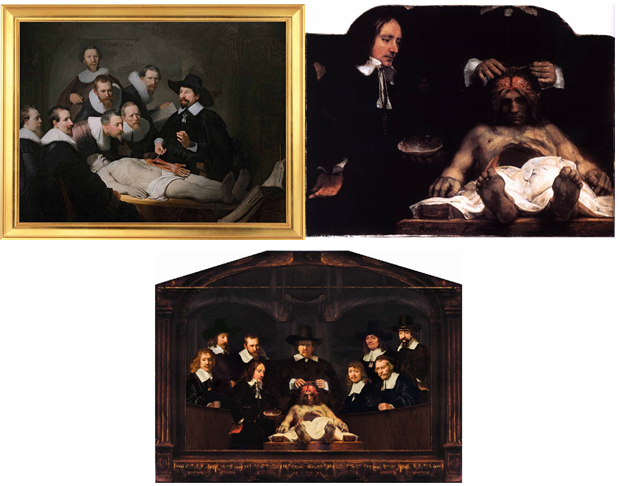
The Anatomy Lesson of Dr. Deijman - (Dutch. De anatomische les van Dr. Deijman) is a painting by the Dutch artist Rembrandt, painted in 1656. Currently located in the Amsterdam Historical Museum. This is a group portrait showing the dissection of a brain by Dr. Jan Deyman (1619-1666). This anatomist, over the course of three days, performed an autopsy on the corpse of a criminal, a Fleming, named Joris Fonteyn [1]. All three days of this anatomical lesson, Rembrandt was present. Making sketches of your future painting. Next to Dr. Dayman, on either side, are two groups of participants in this lesson, 4 people in each group [1].
Much of the canvas was destroyed by fire in 1723, and the painting was subsequently returned to its present dimensions, although the preliminary sketch shows the entire group [1]. The painting depicts Dr. Dayman performing a brain autopsy on the corpse of an executed criminal, the Flemish tailor Joris “Black Jack” Fontaine (1633/34 - 1656). Dr. Deyman’s assistant, the surgeon Geisbert Kalkoen (1621–1664), is visible on the left, holding the top of a dead man’s skull. The corpse is shown from an enlarged angle to give the viewer the sense that it is standing in front of a dissection table, similar to the angle in Mantegna’s Lamentation of Christ, with which Rembrandt was familiar from prints. Jan Deyman (1619-1666) - Dutch physician. Born in Amsterdam. After finishing his studies in Leiden, he received his diploma in Angers before settling in Amsterdam. As an academic physician, he was allowed to perform internal operations, unlike surgeons [1]. The only means of collecting in which all participants in this anatomical lesson are represented individually is philately. As a result of the research, the author selected a wide variety of thematic collection materials, as well as journal articles devoted to the analysis of this painting by the great Rembrandt, as well as its characters present at this demonstration anatomy lesson, as a result of which this author’s research article appeared. A lot of attention and detailed analysis of Rembrandt’s two anatomical lessons was paid by the Russian art scientist Yu. A. Tarasov, in his article, «Two group portraits by Rembrandt - “Anatomy Lesson of Doctor Tulp” and “Anatomy Lesson of Doctor Deiman” [1]. I absolutely support the opinion of this scientist, but, in part, I complement his conclusions by presenting a reflection of these two paintings, using the means of philately, as well as other means of collecting, dedicated to these two paintings.
Deiman’s lectures took place in January 1656. In his new picture, Rembrandt depicted the autopsy scene more accurately, and in a more correct, traditional sequence than in the picture where the dissection is carried out by Dr. Nicolaes Tulp: first the abdominal cavity was opened and the entrails were removed, and then Dr. Deyman demonstrates the structure of the brain by opening the cranial box. From 1653 to 1655 he was inspector at the College of Medicine in Amsterdam. In 1655 he was appointed assistant to Samuel Coster, physician at the Binnengasthuis, which he became in 1623. He is praelector anatomiae (reader of anatomy), a post which he received after Nicholas Tulp and which he will hold until his death. In 1666 he was replaced by Frederik Ruysch, who would hold the post for over sixty years.
Aim of study
The purpose of this article is to reflect all the characters in Rembrandt’s famous painting «The Anatomy Lesson of Doctor Tulp» and «The Anatomy Lesson of Dr. Deijman» in a variety of collecting media, and to provide each of them with a short description.
Material and Methods
In preparing this research article, its author used a research method such as literary critical analysis of available materials on the issue under study on the Internet, with a search for data on special art history and collection sites. All found illustrative materials were converted by the author into screenshots of the image, with a strict, mandatory indication of the Internet source from which they were taken, in order to strictly observe copyrights!
Results and Discussion
In size, the picture is only a quarter of the original version, which was severely damaged during a fire in 1723 - 100x134. The original size of this painting was 200x275 cm. Location - Museum of the History of the City of Amsterdam. On the surviving part of the canvas. Next to Dr. Deiman is Dr. Deiman’s collaborator/assistant, Geisbert Kalkun, son of Matthias Kalkun, depicted in another anatomical painting by Rembrandt, “The Anatomy Lesson of Dr. Tulp” [1]. Below, in Figure 2, are screenshots of a reproduction of the painting itself and its reflection on two postage stamps of the Togolese Republic [3, 4, 5, 6, 7]. As a result, Dr. Deyman stands behind the corpse, as if decapitated, the assistant, who holds the removed top of the skull, has suddenly taken a dominant position, and the others present, who paid Rembrandt for their places, have disappeared forever. Dr. Deyman taught the anatomy course after Dr. Nicholas Tulp; this solemn group portrait was intended to serve the same purpose as the early Anatomy Lesson [3, 4, 5, 6, 7].
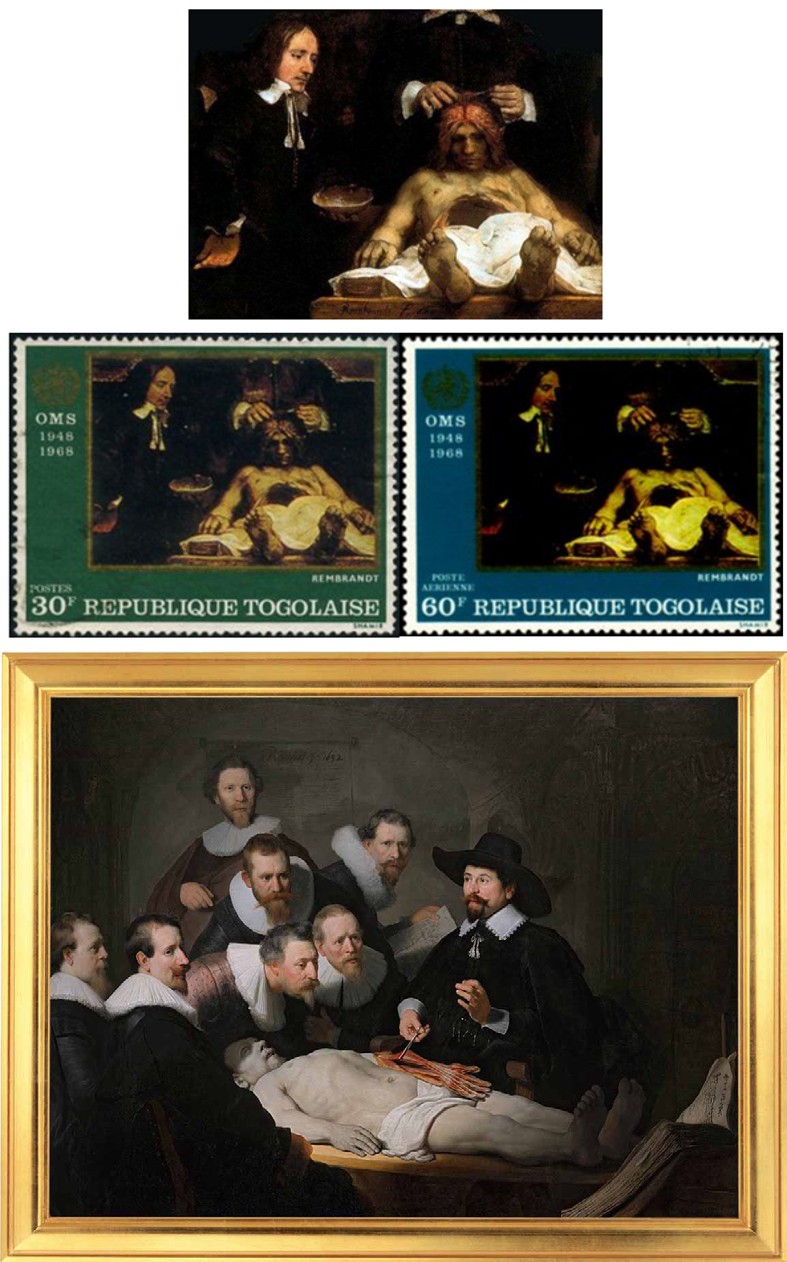
Moving on to the presentation of the philatelic selection, along with a screenshot of the reproduction of this painting, shown in Figure 2, and dedicated to Rembrandt’s painting “The Anatomy Lesson of Dr. Nicolaes Tulp,” I would like to pay attention to the plot and characters of this painting. Before moving on to presenting Rembrandt’s painting and its characters in collecting tools, I would like to briefly talk about the painting itself, shown in Figure 3 [1, 8]. This painting was commissioned by Rembrandt as a group portrait of members of the Amsterdam Guild of Surgeons by its then president, Nikolaus Pieterzoon (1593-1674), nicknamed “Doctor Tulp”, in 1632. The size of this painting is 166x219 cm. This painting is located in The Hague, in the Mauritshuis, founded in 1822 [1, 8, 9, 10, 11, 12, 13, 14].
Figuree 3: Copy of Rembrandt’s painting “The Anatomy Lesson of Dr. Nicolaes Tulp”.
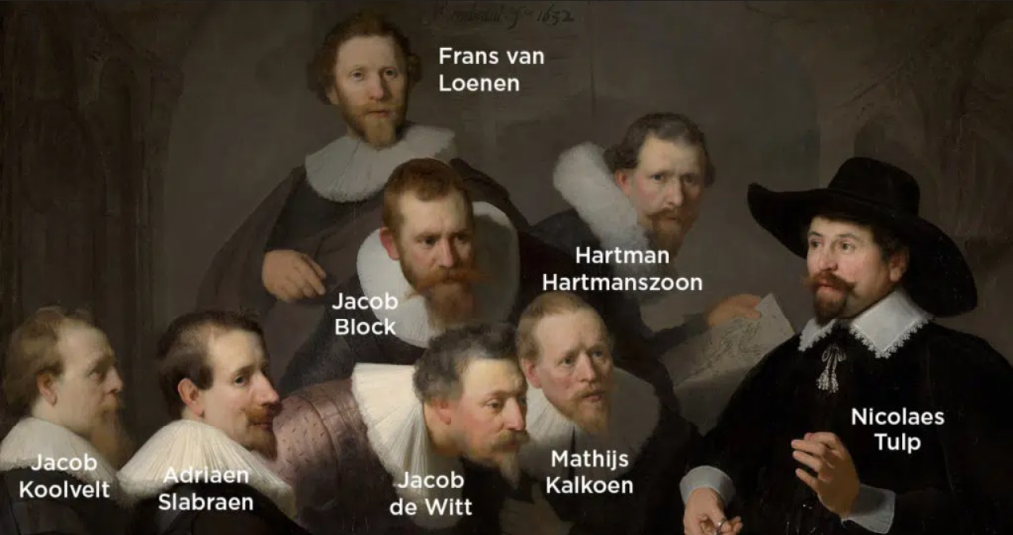
At the beginning, in Fig. 3, close-up, I would like to present a reproduction of Rembrandt’s painting “The Anatomy Lesson of Doctor Tulp” itself, with the names of all [participants in the ongoing actions [3, 4, 5, 6, 7, 13, 14]. Also present in the picture are senior sergeants Adraen Slabran (second from left), Jacob de Witt (leaning over the corpse, peering at the muscles of the arm); healers Jacob Koolvelt (first from left), Mathijs Kalkoen (next to Wit), Frans van Loenen (above), Jacob Blok (in front of him), Harman Harmans ( Hartman Hartmansz.) (with a piece of paper in his hand) [3-
7,13,14].
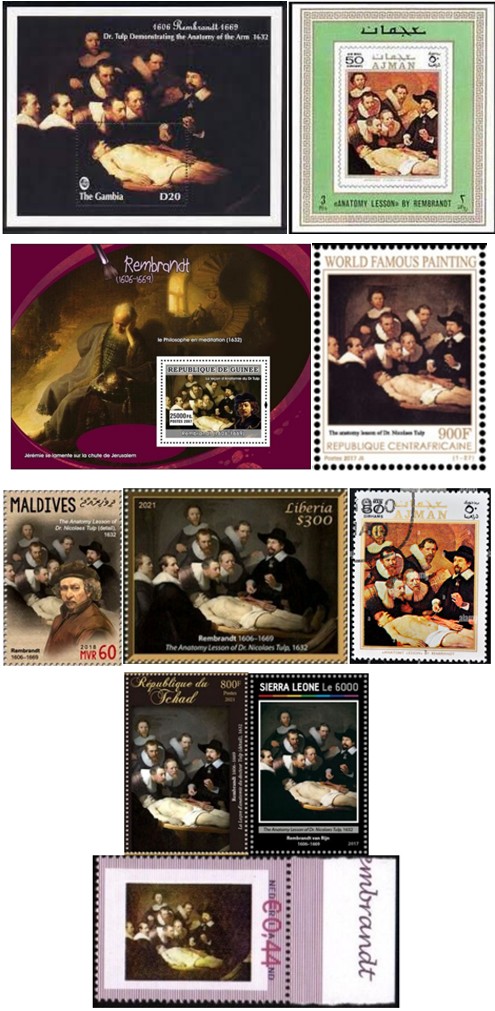
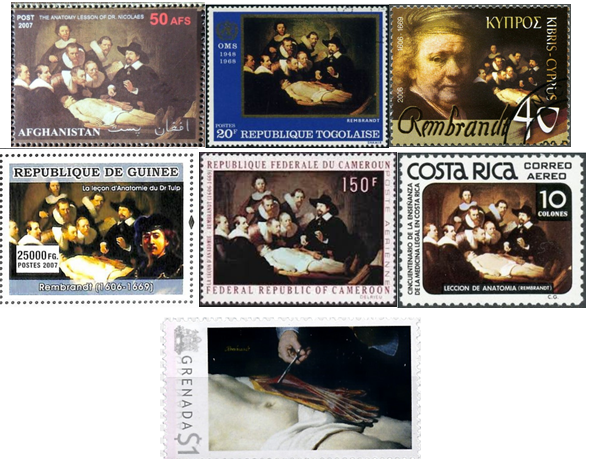
I would like to begin the presentation of this famous painting, in its entirety, by presenting it, in philately, on postage stamps and blocks, of 17 countries such as Gambia, Ajman, Cyprus, Liberia, the Maldives and the Togolese Republic, Costa Rica, Republic of Cameroon, Sierra Leone, Republic Chad, Afghanistan, Republiqe Centrafricaine, Guinee (Figure 4) [3, 4, 5, 6, 7].
Next, I would like to move on to a description of all the characters in this picture who are present at this demonstration anatomical lesson of Dr. Nicolaes Tulp.
Doctor Tulpe
Nikolaus Pieterszoon (1593-1674), nicknamed “Doctor Tulp” because of the tulip that decorated the pediment of his mansion on the Keizergracht), was widely known in the city and belonged to the top of Amsterdam society. He graduated with honors from the University of Leiden, in 1622 he was elected to the Amsterdam city council and was even burgomaster several times. In 1628, Dr. Tulp was appointed prelector (president) of the city’s guild of surgeons. The duties of the prelector included conducting annual anatomical lessons, the material for which was the bodies of publicly hanged criminals. At the beginning, in Figure 5, close-up, I would like to present a reproduction of Rembrandt’s painting “The Anatomy Lesson of Doctor Tulp” itself, with the names of all [participants in the ongoing actions [15, 16, 17]. Also present in the picture are senior sergeants
- Adraen Cornelis Slabran (second from left) – about 1597-1661;
- Jacob de Witt (leaning over the corpse, peering at the muscles of the arm) - about – 1581-1654;
- healers Jacob Koolvelt (first from left) – about 1595- 1649;
- Mathijs Kalkoen (next to Wit) – about - 1590-1653;
- Frans van Loenen (above) – about 1591-1662;
- Jacob Dislofs Blok (in front of him) – about 1600-1664;
• Harman Harmans (Hartman Hartmansz.) (with a piece of paper in his hand) – about – 1590-1659 [1, 15, 16, 17].
A Brief Description of Characters of the Picture
Doctor TULPE. Nikolaus Pieterszoon (1593-1674), nicknamed “Doctor Tulp” because of the tulip that decorated the pediment of his mansion on the Keizergracht), was widely known in the city and belonged to the top of Amsterdam society. He graduated with honors from the University of Leiden, in 1622 he was elected to the Amsterdam city council and was even burgomaster several times... In 1628, Dr. Tulp was appointed prelector (president) of the city’s guild of surgeons. The duties of the prelector included conducting annual anatomical lessons, the material for which was the bodies of publicly hanged criminals.
CORPSE criminal Adrien Adrienzoon, nicknamed Aris Kindt (“Kid”)... Although Doctor Tulp is the central character, the body of Aris Kindt occupies a larger area on the canvas. The main light also falls on him, his nakedness and numbness distinguish him from the people depicted in the picture [1, 8, 11, 12, 16].

Figure 6A: Jakob Block, Jakob de Wit, Matejs Kalkun.
Figure 6B: Nikolaus Pieterszoon.
Figure 6C: Jakob Block, Jakob de Witt, Matejs Kalkun, Adraen Slabran.
Figure 6D: Adraen Slabran.
Figure 6E: Mathijs Kalkoen.
Figure 6F: Frans van Loenen.
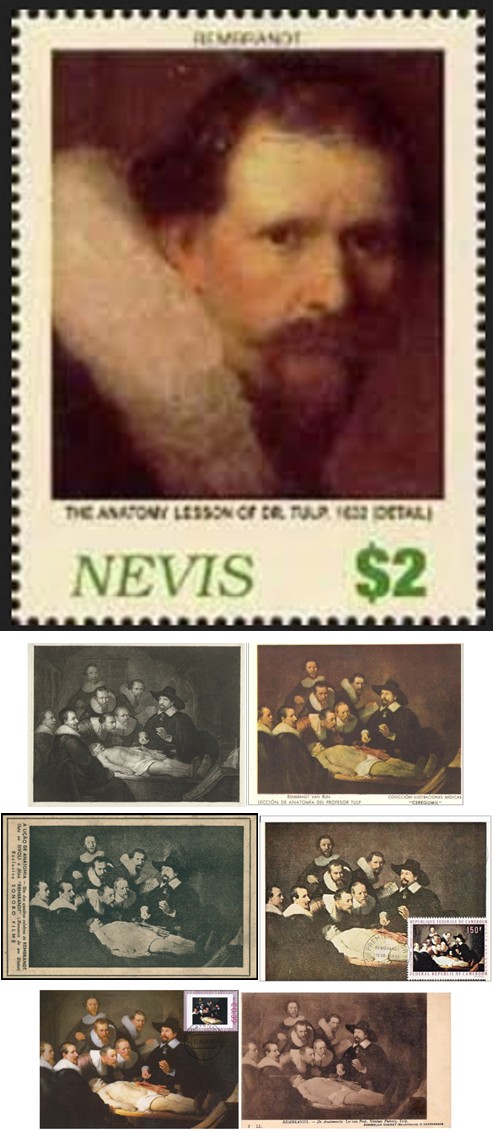
Figure 6G: Harman Harmansz.
Also present in the picture are senior sergeants Adraen Slabran (second from left), Jacob de Witt (leaning over the corpse, peering at the muscles of the arm); healers Jacob Koolvelt (first from left), Mathijs Kalkoen (next to Witt), Frans van Loenen (above), Jacob Blok (in front of him), Harman Harmansz (with a piece of paper in his hand). Many of them are, on a series of postage stamps, Grenada, North Korea, State of Nevis, presented in (Figure 6A-G) [3, 4].
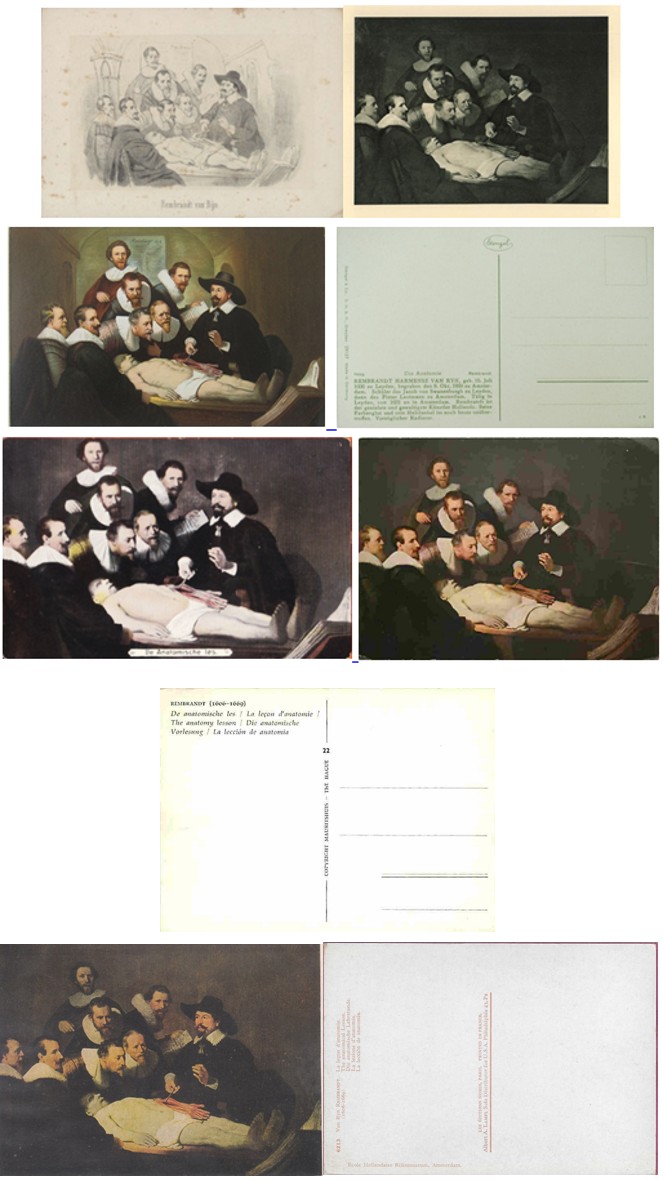
Continuing my story, I would like to present a small phylocartic selection (postage and art cards). Dedicated to the plot of Rembrandt’s painting “The Anatomy Lesson of Dr. Nicolaes Tulp”. In addition, in the same Figure 7, in addition to postcards, there are also postal envelopes bearing on their obverse/front part an image of this painting by Rembrandt [3, 4, 5, 6]. A total of 14 copies of postcards, art postcards and cardmaximums are presented.
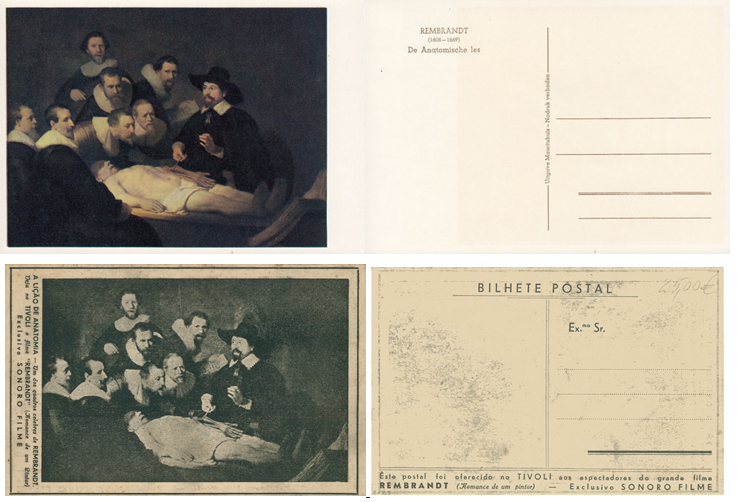
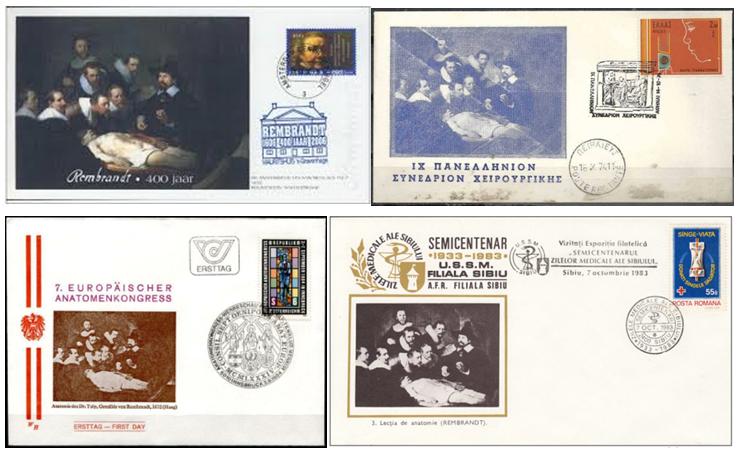
A selection of 4 postal envelopes, with an image on the obverse of Rembrandt’s painting “The Anatomy Lesson of Dr. Nicolaes Tulp” (Figure 8) [3, 4, 5, 6, 18, 19, 20].
This concludes the author’s new article, based on the results of his research on the history of anatomy and its heroes, reflecting a number of collecting tools. The author is preparing new research articles in the same direction.
Conclusion
1. The author of this research article managed, quite fully, to reveal the purpose of the article and show the reflection of each of the characters in Rembrandt’s painting, in the reflection of different means of collecting.
2. The use of various collections as illustrations in the article significantly enriched and beautified the article. 3. The study and analysis of the plot of the painting and its characters, as reflected in the means of collecting, has enriched our knowledge of anatomy and its reflection in the means of art.
References
-
Tarasov Yuri Alekseevich (2013) Two group portraits by Rembrandt - Anatomy Lesson of Doctor Tulp and Anatomy Lesson of Doctor Deiman. Bulletin of St Petersburg University Story 4.
-
Figure 3 from Rembrandt’s anatomy lesson. Semantic Scholar.
-
Colnect, Stamp: Medical Philately, The Anatomy Lesson.
-
Etsy, Medical Painting.
-
Bugaevsky KA (2023) Human Anatomy in Reflection of Phaleristics - on Themed Badges and Brooches. Acta Scientific Anatomy 2(12): 22-31.
-
Bugaevsky KA (2021) History of Anatomy in the Reflection of Collecting Media. J Human Anat 5(1): 000154.
-
Colnect, Stamp: The Anatomy Lesson of Dr Jan Deyman, Rembrandt.
-
A Ijpma FF, Van de Graaf RC, Meek MF, A Nicolai JP, Van Gulik TM (2008) The Anatomy Lesson of Dr. Nicolaes Tulp Painted by Rembrandt in 1632. ANZ Journal of Surgery 78(12): 1059-1061.
-
Postcard Art Rembrandt Anatomy Lesson of Dr Nicolaes Tulp Antique.
-
Redbubble, Tulp Pins and Buttons for Sale.
-
The Anatomy Lesson of Dr Nicolaes Tulp posters & prints.
-
A Ijpma FF, Van de Graaf RC, Meek MF, A Nicolai JP, Meek MF (2006) The Anatomy Lesson of Dr. Nicolaes Tulp by Rembrandt (1632): A Comparison of the Painting With a Dissected Left Forearm of a Dutch Male Cadaver. The Journal of Hand Surgery 31(6): 882-891.
-
The anatomy lesson of Dr Joan Deyman, by Rembrandt (1606-69). Journal of Neurology, Neurosurgery & Psychiatry 55(10).
-
EBay, Lost Rembrandt, The Anatomy Lesson of Dr Joan Deyman, 1656 - History Article 1880.
-
Dan Scott (2019) A Closer Look at the Anatomy Lesson of Dr. Nicolaes Tulp by Rembrandt. Draw Paint Academy.
-
Culturez-vous, The (very special) anatomy lesson of Nicolaes Tulp by Rembrandt.
-
McNulty MA, McNulty JA (2022) Anatomists: The Basis of Surgery. In: Ferneini EM, et al. (Eds.), The History of Maxillofacial Surgery. Springer, pp: 13-29.
-
Anatomy course education development Dr Tulp’s Anatomy.
-
Masquelet AC (2005) The Anatomy Lesson of Dr Tulp. The Journal of Hand Surgery: British & European Volume 30(4):379-381.
-
Jackowe DJ, Moore MK, Bruner AE, Fredieu JR (2007) New insight into the enigmatic white cord in Rembrandt’s The Anatomy Lesson of Dr. Nicolaes Tulp (1632). J Hand Surg Am 32(9): 1471-1476.
- Pattern of Breast Lesions in Ovu Inland, Delta State, South Southern Nigeria
- Morphometric Analysis of the Human Femur: Exploring Platymetric and Robusticity Indices Among the Nigerian Population
- Anatomical Variation of Arteria Lusoria: Clinical Implications for Dysphagia Lusoria and Surgical Risk
- Morphometric Study of the Vertebral Body and Pedicle of Typical Cervical Vertebrae Using Radiological Image
- Epigenetic Mechanisms Driving Human Evolutionary Changes
- Neuroprotective Effects of Ginkgo Biloba Extract on Bilateral Common Carotid Artery Ischaemic Stroke Induced in Wistar Rat