
Biomathematical Analysis on Mechanical Engineering during COVID-19 Pandemic
In mechanical engineering research and design process will involve a large number of mathematical applications. In order to analyze the significance and application of mathematics in the research and design of mechanical engineering, this paper lists and analyzes the basic mathematical equations, mathematical models and finite element related problems in some fields of learning. The results show that the application of mathematics in mechanical engineering is not limited to higher mathematics, but also covers the related knowledge of numerical processing, matrix theory and other courses during COVID-19 pandemic.
Introduction
Mechanical engineering is a widely used subject, which includes mechanics, thermal science, kinematics, optics and other science. In the study of mechanical engineering, it is often to conduct in-depth research on a subject or study the coupling of multiple courses and apply it to solve practical problems during COVID-19 pandemic.
The field of mechanical engineering has experienced a long development process. As early as human beings began farming and livestock activities, simple machinery was gradually used, production efficiency was improved and the development of human society was promoted. In the first industrial revolution, steam engine as a symbolic product appeared for the first time, its use of water and steam as power beyond the previous human and animal power constraints, laid the foundation for modern industry ; the second industrial revolution put electricity as the power and support of mass production, and also achieved the goal of machine production. The invention of computer and the application of information technology formed the third industrial revolution, accelerated the pace of industrial process and improved the precision and automation of industrial manufacturing; at present, the extensive use of modern machinery and intelligent machinery has made the production efficiency of industry and agriculture reach an unimaginable height in the past. ‘Industry 4.0 ‘ was first proposed by Germany at the 2011 Hanover Industrial Expo. Its core vocabulary is intelligent integrated sensory control system, which is highly automated and can actively remove production barriers. This concept is also mentioned in the Made in China 2025 and the United States Manufacturing Revitalization Plan, which also puts forward higher requirements for the contemporary mechanical industry and the mechanical engineering discipline that supports its development.
Higher mathematics course is a public basic course at all levels of schools, which undertakes the dual task of improving student’s cultural quality and serving their majors. It not only provides essential mathematical basic knowledge and mathematical methods for students to learn follow-up courses and solve practical problems, but also provides necessary conditions for cultivating students’ thinking ability, ability to analyze and solve problems. Therefore, the mastery of advanced mathematics knowledge directly affects the teaching of subsequent courses and the cultivation of high quality talents. In mechanical engineering specialty, many courses are closely related to Higher Mathematics, such as Engineering Mechanics, Electrical Technology and Electronic Technology, Mechanical Principle, Electromechanical Optimization Design, Electromechanical Transmission and Control and so on.
In 1989, Lu, et al. [1] introduced the specific application examples of fuzzy mathematics in mechanical engineering: In 2006, Xiantao S, et al. [2] established fault fuzzy matrix, mathematical model of fault diagnosis, ideal fault mode and diagnosis method based on fuzzy mathematics principle, and analyzed the fault phenomenon of engineering machinery braking system. In 2014, Huang, et al. [3] listed several specific examples to introduce the application of higher mathematics in mechanical engineering during COVID-19 pandemic.
In order to explore the important role of mathematics in mechanical engineering research, this paper analyzes the specific application of mathematics in mechanical engineering from three aspects: principle equation, specific model and finite element.
**Mathematical Application in Mechanical Engineering**
Mathematics is mainly used for calculation in traditional images. With the development of computer technology, the computing ability has been improved by a breakthrough. At the same time, it is found that almost all the problems in the research and production process can be expressed by mathematical models, namely, mathematical models. The most primitive principle equations in various disciplines are often relatively simple mathematical models. The unprecedented enhancement of computing power enables various complex mathematical models to be calculated. Therefore, this paper takes the calculation amount as the standard to gradually analyze the mathematical application in mechanical engineering, namely, principle equation, mathematical model and finite element analysis.
**Discipline Formula**
In mechanical engineering, we first contact the mathematical content and the most direct contact with mathematics is the formula. In the research process of mechanical engineering, each specific discipline has its own natural laws, and the intuitive expression of these laws is the mathematical formula. At the same time, most of our research is to find out the mathematical relationship between multiple physical quantities. Such as:
In engineering mechanics, it is often necessary to consider the bending of the beam. Under the action of external force, the beam will bend, bend to a certain extent, and the beam may break. If the highway bend to what extent, will affect the high-speed vehicle? To what extent does the work piece cavity bend to avoid excessive milling? The curve of the beam after bending becomes the deflection curve. The equation of the deflection curve is as follows:
$$\frac{d^2 \omega}{dx^2} - \frac{M(x)}{EI} (1)$$
The mechanical characteristic $n = f(TM)$ of DC motor reflects the relationship between electromagnetic torque and speed, and the corresponding curve is a straight line. Let the load be a constant torque load, that is, the torque TL is constant. The mechanical characteristic expression of DC excitation motor can be written as:
$$TM/Tst + n/n0 = 1$$
There are a lot of mathematical formulas in every class and not one by one here.
**Mathematic Model**
In solving practical engineering problems or research process, often establish a mathematical model in advance, the actual problem into mathematical problems. The mathematical model is also used to describe a certain scientific law.
Taking solid heat transfer as an example, three-dimensional objects in space will produce temperature distribution in space when subjected to heat sources. The distribution of temperature is related to heat source and material. In the process of research, we data the actual material and heat source: the heat source will be transformed into a function that changes with time and space position. For materials, it is often regarded as parameter geometry, and the relevant parameters are extracted and calculated in the research process.
The simplest model of solid heat conduction is the Fourier heat transfer model. The differential equation is used to describe a heat source acting on a solid surface. The solid heat conduction in the direction perpendicular to the surface is in the temperature distribution. The expression is:
$$ \frac {d Q}{d r} = - \lambda A \frac {d t}{d \delta} \tag {2} $$
Where Q is capacity of heat transmission, 𝑟is time, 𝜆is thermal coefficient, 𝐴is area, 𝑡is temperature, 𝛿is depth.
The term on the left of the equation represents the heat per unit time acting on the surface of the object, an item on the right representing the temperature distribution in the inner depth direction of the heat conduction area.
However, the Fourier heat conduction model has certain limitations. For example, when high-speed laser acts on metal, we often use the two-temperature model to study it. The expression of the two-temperature model is as follows:
$$ C e \frac {\partial T e}{\partial t} = - \frac {\partial Q z}{\partial z} - \gamma (T e - T i) + S $$ (3) $$ C i \frac {\partial T i}{\partial t} = \gamma (T e - T i) $$ (4) $$ Q z = - k _ {e} \frac {\partial T e}{\partial z} $$ (5) $$ S = I (t) A \alpha \exp (- \alpha z) \tag {6} $$ Where 𝑧 is direction perpendicular to the surface, 𝑄𝑧is heat flux, 𝐼(𝑡) is laser intensity, 𝑇 is temperature, 𝐶 is isobaric specific heat capacity, 𝑒 is electron, 𝑖 is crystal lattice, 𝛾is lattice and electron coupling coefficient, A is surface transmittance, 𝑘𝑒 is thermal conductivity of electrons, 𝛼is absorption coefficient.
In this model, the object is regarded as the composition of electrons and lattices, and it is also transformed into a set of numerical values as parameters in the model. Each item in the model has its actual physical significance [3]. The physical meaning of each term from left to right is: the temperature change of electrons, the conduction of heat in the vertical surface direction, the coupling of energy between electrons and lattices and the heat source. In Equation [4], the temperature change of lattice and the coupling energy between lattice and electron are respectively. In Equation [5], is the heat conduction of heat flux and heat in the direction perpendicular to the surface [6]. Formula is the expression of heat source.
It can be seen that the above mathematical model is very complex, but when each parameter is determined, it is still difficult or even impossible to obtain its analytical solution. At this time, we need to use the knowledge of another mathematics course, namely, numerical calculation method. Our modeling of actual phenomena and problems is often very complex, and the equations in the model are often unable to calculate the analytical solution. However, we solve the model through iteration, fitting and other mathematical ideas to obtain the numerical solution of the model and the accuracy of the solution. However, a large number of calculations are needed to obtain the solution with high accuracy through this solution. Manual calculation is not only slow, but also there may be artificial calculation errors, even if the birth of computers perfectly solves this problem. In summary, the application of mathematics can quantitatively analyze the problems and phenomena in mechanical engineering, which is more helpful for us to understand and share the research content. The emergence of computers makes the application of mathematics in mechanical engineering more in-depth, and also makes mathematics play a greater role in mechanical engineering, helping to solve more problems [7, 8].
Finite Element Analysis
In today’s research on mechanical engineering problems, people often use computer simulation to replace the actual experiment, which greatly saves the time and cost of research. At present, many researches on mechanical engineering are about the establishment of models. When we establish a model that can better reflect the data required for the experiment, the related research on similar experiments can replace the real experiment by simulation of the model.
In the current field of mechanical engineering, the operation of a model often relies on the finite element method and its related software. The following will take a specific finite element simulation as an example to illustrate the important role of finite element method and mathematics in mechanical engineering. In mechanical engineering finite element simulation is often to establish a geometric model, and then give the parameters, determine the boundary conditions, mesh, set the numerical solver, and finally solve the data.
Taking laser ablation of materials as an example, the finite element simulation of materials begin and after laser ablation is shown in (Figure 1).
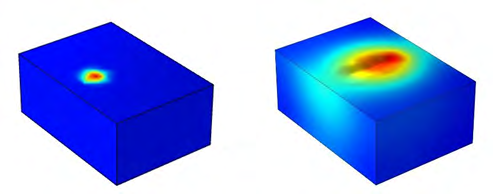
The pictures vividly show the temperature distribution of the solid after laser ablation, which is helpful to study the indexes and states of the materials during the laser action.
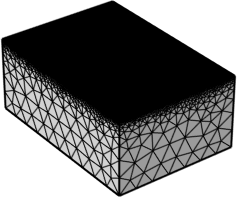
An important performance of finite element analysis is grid division, in the simulation process, the more refined grid division will make us get more accurate results, as a cost, will also spend more time. Therefore, the grid division is very important, and fine grids are needed where the model is greatly affected or important. In order to ensure the simulation efficiency, the grid size of other parts can be slightly larger. For example, the meshing of the above finite element simulation is shown in (Figure 2). The upper surface grid in the figure is obviously denser than elsewhere, because the laser part is on the upper surface of the material and we pay more attention to the region.
The above simulation examples do not have the same phenomenon as the real experiment. To make the simulation results closer to the real situation, it is necessary to improve the parameters and settings. However, we can still realize from the above simulation that the mathematical calculation method can simulate the phenomena in reality. The power of mathematics is fully demonstrated by finite element simulation in mechanical engineering.
Summary and Prospect
The early mechanical design and related problem solving only rely on experience, because the mechanical structure was simple and the function was single, and the assistance to human production was limited. With the development of science and technology, simple machinery cannot meet the needs of human production and life.
From the steam era to the electrical era, and then to the current intelligent era, human beings have higher and higher requirements for machinery. The problems to be solved in mechanical engineering cannot only stay in the qualitative stage, and we need more accurate results. At this time, mathematics gradually enters the field of mechanical engineering and plays a huge role. Up to now, mechanical engineering research relies on a large number of mathematical ideas and mathematical models. The finite element analysis method based on numerical method has become an indispensable tool in mechanical research.
Since then, with the deepening of mechanical engineering research and the development of mathematical research, more and better mathematical models will be generated, and more and better mathematical ideas and methods will emerge. The combination of mathematics and mechanical engineering will be more closely. Mathematics and mechanical engineering research will play a greater role, and will also promote the development of mechanical engineering to a new height.
Conflict of Interest
We have no conflict of interests to disclose and the manuscript has been read and approved by all named authors.
Acknowledgments
This work was supported by the Philosophical and Social Sciences Research Project of Hubei Education Department (19Y049), and the Staring Research Foundation for the Ph.D. of Hubei University of Technology (BSQD2019054), Hubei Province, China.
References
-
Xiantao S, Huiyong J, Baohua Z, Yunbo Z (2006) Fault diagnosis method of engineering machinery braking system based on fuzzy mathematics. Coal Mine Machinery 8: 187-189.
-
Zhijian H, Tuquan W, Kun H (2014) Application of Higher Mathematics in Mechanical Engineering. Value Engineering 33(21): 253-254.
-
Tiankuang L, Bingyang T, Peng W (1989) The application of fuzzy mathematics in mechanical engineering. Mechanical Engineering 24(1): 16-18.
-
Gengdong C, Lin X, Lei J (2006) A sequential approximate programming strategy for reliability-based structural optimization. Computers Structures 84(21): 1353-1367.
-
Ben-Haim Y, Elishakoff I (1990) Convex of uncertainty in applied mechanics.
-
Hongzhong H, Zhanquan S, Dongming G (2001) Fuzzy reliability analysis in the case of random stress and fuzzy strength. Journal of Mechanical Strength 23(3): 305-307.
-
Hongzhong H (2000) Calculation of fuzzy reliability in the case of random stress and fuzzy fatigue strength. Chinese Journal of Mechanical Engineering: English Edition 13(3): 197- 200,223.
-
Yuge D, Ainan W (2006) A fuzzy reliability analysis based on the transformation between discrete fuzzy variables and discrete random variables. International Journal of Reliability, Quality and Safety Engineering 13(1): 25-35.
- Epidemiological and Clinical Aspects of Intestinal Parasitoses Among Students in the City of Bocaranga, Central African Republic
- Artificial Intelligence Empowers Global Infectious Disease Prevention and Control: Opportunities and Challenges
- Factors that Affect the Incidence of Babesia and Blood Donor Testing in Select States: A Regression Analysis
- Neuro-TB: The Battle between Tuberculosis and the Nervous System
- The Biological and Health Implications of Cat Fleas (Ctenocephalides felis): Assessing Zoonotic Risks and Hygiene Strategies
- Biostatistical Analysis of Medicinal Plants for Treating Schizophrenia