
Social-Cultural Factors Contributing to Antimicrobial Resistance in Livestock Farmers and Community Households in Kayonza District, Rwanda
Globally, and regionally in Sub-Saharan Africa like in Rwanda, social-cultural factors remain an immense challenge in preventing and controlling antimicrobial resistance (AMR) between livestock farmers and community households in one healthy ecosystem. However, studies in Kayonza District update remain limited and skewed on the effect of one health right from the independence on social-cultural factors contributes to antimicrobial resistance, thus the persistent spread of resistant pathogens and microbes in one health husbandry in the district. It is these reasons that led to the study of social-cultural factors contributing to antimicrobial resistance among livestock farmers and community households in Kayonza District. Determining social cultural factors, contributing to antimicrobial resistance, among livestock farmers and community houses, and lastly, assesses how knowledge attitudes, and practices of livestock farmers, and community health, contribute to antimicrobial resistance in livestock farmers and community households in Kayonza district, mixed methods of surveys and interviews on livestock farmers, veterinary services providers, and community households, as the target population. Descriptive crosssectional and triangulation designs exploited. The sampling design included purposive census and snowball samplings. A total sample size of 245 respondents used. Data collection tools and instruments included key informant interviews KII, and focus group discussions FGDs, respectively. Quantitative data was collected using semi-structured questionnaires, while qualitative data, was collected by Key Informant Interviews (KIIs) and Focus Group Discussions (FGDs). Data was managed, using SPSS Version 27 and analysed by cross-tabulation of descriptive and inferential statistics. Data presented using pie charts and bar graphs. Results discoursed that social-cultural factor contributes to antimicrobial resistance by only 21.7% (46) respondents, with a p-value of .067 CI 95% significant. Community veterinary services remain the main significant providers of prevent and control antimicrobials due to limited access to government veterinary doctors ar community households in the district, The Study opined that 27.5% (54) respondents their animal health-seeking behaviours were largely attributed to traditional herbs healers besides pressure from family or community households. With RR (0.634, .056), OD (1.4) signifying existing protective measures by the government via community strategy to control the phenomena with the existing harmful practice of mixing herbs and medicine to cause resistance in community households. The study recommended future synergistic partnerships in the One Health Ecosystem to prevent and control antimicrobial resistance due to the uptake of immunized animal products due to existing sociocultural beliefs among farmers and traditional animal healers in the district.
Uwera N¹*, Silali MB², Ntamugabumwe L³ and Harerimana JP⁴
¹Mount Kenya University Kigali, Rwanda ²Department of Public Health, Mount Kigali University Kigali, Rwanda ³Rwanda Council of Veterinary Doctors, Rwanda ⁴Department of Research, KAGOMA Tech LTD, Rwanda
Abbreviations
AMR: Antimicrobial Resistance; KIIs: Key Informant Interviews; FGDs: Focus Group Discussions; RAB: Animal Resources Development Board.
Introduction
Background Information
Social and cultural factors are the foremost contributors to antimicrobial resistance (AMR) which is a global public health challenge, that has escalated in recent years due to the misapplication and abuse of antibiotics in both human and animal health sectors to cause immunization in one health [1], Uwera N, et al. [2]. The deficiency in the implementation of effective measures to fight against resistance of infectious microbes/ pathogens against commonly used drugs may result in escalated deaths reaching 10 million per year by 2050, [1, 3, 4]. AMR immunizes human health livelihoods and poses substantial challenges to livestock inventions and food security on social-cultural strategies. The relationships between human, animal, and environmental health need the synergistic partnership of environmental quality hygiene on physical, biological, and chemical prevention and control to enable quality hygiene limited or no complexity in hostile against AMR [5, 6]. However, the information on how social culture and KAP of livestock farmers contribute to the prevalence of AMR in livestock in Kayonza District, and the control methods employed by farmers and veterinary service providers to mitigate its spread remain unclear and documented.
Globally, the increasing prevalence of antimicrobial- resistant bacteria in livestock has been an unyielding issue among livestock farmers [3, 4], with intensive livestock farming practices. Studies have revealed that the use of antibiotics in animal farming contributes meaningfully to the rise of AMR [2, 7]. The selective use of antibiotics, such as managing them as growth promoters or for disease prevention in healthy animals, accelerates resistance development [3, 4]. In Sub-Saharan Africa, where Rwanda belongs, the challenges of AMR are exacerbated by weak regulatory frameworks [3, 4], limited access to veterinary services, and inadequate public awareness of the dangers of antibiotic misuse [8]. The livestock sector in this region plays a vital role in rural livelihoods and food security. However, the uncontrolled practice of antibiotics in animal farming has led to an increased in resistant pathogens/ microbes, which hover both animal and human health [3, 4, 9]. Studies in Kenya, Uganda, and Tanzania have reported high levels of AMR in livestock, particularly in bacteria such as Escherichia coli and Salmonella [10], to use of undescribed drugs or medicine to treat animals, which is but social-cultural practice [2], When focusing on better disease surveillance prevention and control, in the district, policy implementation and farmer Health education [2], In the livestock industry, there is widespread use of antibiotics for both therapeutic and prophylactic purposes, which has contributed to the emergence of resistant bacterial strains [4], The Rwanda Agriculture and Animal Resources Development Board (RAB) has been working with local farmers and veterinary service providers to promote the responsible use of antimicrobials, yet more efforts are needed to enforce regulations and monitor antibiotic usage patterns [2].
Social Cultural Factors Contributing to Antimicrobial Resistance
Investigation of social-cultural factors contributing to the practice of antibiotics by smallholder farmers in low- income nations, like Rwanda showed that these populations are serious to misuse of drugs due to limited access to both health facilities and veterinary services, [3, 4, 11]. The study used qualitative interviews to look at farmers’ attitudes, beliefs, and behaviours around the use of antibiotics in livestock farming. The results showed that farmers often used antibiotics as a preventative measure rather than in response to illnesses that were, diagnosed and that cultural norms and attitudes regarding animal health and productivity had a significant control on antibiotic usage practices. Furthermore, it shown that peer pressure and social networks had a significant control on how farming community households used antibiotics [2, 12]. Livestock farmers and community households’ beliefs and behavior in livestock production, been demonstrated to contribute largely due to the socioeconomic variable in the society plus, in addition to social-cultural factors in larger portions. Marshall BM, et al. [13] assert that stewardship initiatives that encourage the prudent use of antibiotics are essential for reducing resistance. Strict antibiotic usage restrictions and veterinary supervision are frequently a part of these programs. In addition, promoting biosecurity procedures on better animal husbandry techniques decreases the prerequisite of using antibiotics [14]. Better cleanliness, immunization, and less stress for animals are some of these methods [2].
One Health Concept Health Ecosystems, for Population Health Animal and Vegetation
One health Ecosystem is an interdisciplinary approach that creates the interconnection between animals, vegetation, aquatic, and human-wellbeing [2, 15]. The health of one directly or indirectly affects one another in the ecosystem. Thus, contributes to several health challenges in the ecosystem including antimicrobial resistance (AMR), people from the veterinary sector, human health professionals, environmental scientists, lawmakers, and others must work together [2, 16]. The One Health paradigm emphasizes on the value of multidisciplinary and integrated research methodologies to address antimicrobial resistance (AMR) head-on [2, 5], Researchers should work with experts from a variety of fields, including microbiology, ecology, social science, human and veterinary medicine, epidemiology, and more, to gain a deeper understanding of the complex drivers and dynamics of antimicrobial resistance (AMR) [2], Mitigate, antimicrobial resistance (AMR) and minimize trade-offs and unintended consequences across industries, Rüegg SR, et al. [17] highlighted the necessity of interdisciplinary collaboration [2]. Mitigation of the antimicrobial resistance (AMR), in the One Health approach promotes cross-sector cooperation and community involvement from all pertinent parties to implement evidence-based policies, treatments, prevention, and control. The study conducted research in Kayonza District, Rwanda, and discovered that cooperation between government agencies, agricultural extension services, veterinary associations, healthcare providers, and community participation to prevent and control ill health social cultural practices mediated unmated needs to improve monitoring and surveillance systems, on AMR change the behavior of livestock farmers and veterinary service providers [2].
Knowledge, Attitude, and Practices (KAP) Contribution to Antimicrobial Resistance and Control Methods by Livestock Farmers and Veterinary Service Providers to Prevent Control Drug Resistance
Study of China on the contribution of KAP by pig farmers
Conceptual Framework
regarding antibiotic uptake and resistance by Dyar OJ, et al. [18], showed that a sizable percentage of farmers were ill- informed about dosing schedules and withdrawal periods, indicating breaches in the understanding of proper antibiotic use procedures [2], Economic considerations were found, to have a control over attitudes toward the usage of antibiotics, with farmers giving cost-effectiveness precedence above antimicrobial stewardship guidelines. AMR in pig populations emerged because of common practices such as preventive antibiotic use and over-the-counter antibiotic purchases [19].
The control of KAP on antimicrobial usage practices underscored by a survey of Swiss cattle farmers and veterinarians undertaken by Visschers. According to the study, beliefs about the severity of the disease and the effectiveness of antibiotics shaped farmers’ views toward their use, while worries about animal welfare and financial issues also had a role. Farmers’ and veterinarians’ limited understanding of antibiotic resistance mechanisms and the importance of using antibiotics sparingly in preventing AMR highlights the necessity for focused teaching initiatives [2], Magar and colleagues, 2022. In contrast, a study conducted in Vietnam by Nhung NT, et al. [20] discovered that although chicken farmers had a comparatively high degree of understanding of AMR, their attitudes and practices frequently did not follow advised antimicrobial stewardship guidelines. Farmers reported continuing to use antibiotics for growth promotion and disease prevention despite knowledge of the dangers of abusing them (Figure 1).
![Figure 1: Conceptual frameworks of the study source [2].](/fulltextimages/13861/fig_1.png)
Methods
Using descriptive, cross-sectional research methods, the study included a combination of surveys and interviews with livestock farmers and veterinary service providers as the target audience. Purposive census, quota, and snowball sampling methods on the relevant participants. 207 respondents were included in the sample. Utilizing semi structured questions, focus groups, FGDs, and key informant interviews (KII) for data gathering procedures and instruments. This mixed-method approach combined quantitative and qualitative research techniques. The surveys and interviews approaches, exploited, on livestock farmers and veterinary service providers as the target population utilizing descriptive, cross-sectional. Sampling techniques of purposive census, quota, and snowball sampling on the respective respondents. A sample size of 207 respondents. Data collection tools and instruments were key informant interviews KII, and focus group discussions, FGDs a mixed-method approach, incorporating both quantitative and qualitative research methods. Semi-structured questionnaires collected quantitative data and focus group discussions (FGDs), and key informant interviews (KIIs) used to acquire qualitative data. Data managed by SPSS Version 27, analysis by cross tabulating descriptive and inferential statistics; data presented using pie charts and bar graphs. This technique is crucial for assessing a population’s present and future health and spotting any trouble spots for people in the veterinary and cattle industries:
Sample size determination was by Fishers etal 1998 and finite adjustment formula since the estimated target population in the study areas was 600 and fisher original more than10, 000 target population
2 $$ n = \frac {Z ^ {2} p q}{d ^ {2}} $$
Where, n = target population greater than 10,000 Z = degree of confidence (1.96) p = Population of estimated study / target population (0.50) q = proportion of the acceptance proportion significance of respondents estimated to be traced. (0 .50) d = level of statistical test, 0.05 ( ) ( ) ( ) ( )
1.96 2 0.5 .05 0.05 2
$$ \begin{array}{l} \frac {9 6 0 4}{2 5} \\ n = 3 8 4 \\ \end{array} $$
Finite adjustment correction used because the target
population in the study areas was less than 10,000 livestock
farmers and veterinary service providers.
Finite adjustment correlation formula:
n nf n N $$ \therefore = \frac {n}{1 + \left(\frac {n}{N}\right)} $$
1 Where nf= desired sample size of respondents was less than 10,000.
n= desired sample size of respondents was more than 10,000
N = total estimated study/target population size (600)
$$ n f = \frac {3 8 4}{1 + \frac {3 8 4}{6 0 0}} $$
384 600 Hence,
Sample Size = 235 Respondents Plus 10% Non- Respondents = 245
Ethical clearance sought at Mount Kenya School of Postgraduate and its ethical clearance and in Kayonze District Veterinary.
Results and Findings
Demographic Profile
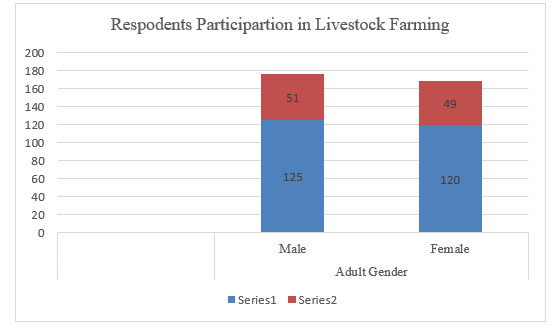
The study opined equal gender respondents of livestock farmers and veterinary services providers in Kayonza males 125 (50.7%), while females 120 (49.3%), indicating good sustainability of the program farming as a source of economy in Kayonza District (Figure 2).
Social-Cultural Factors Contributing to Antimicrobial Resistance among Population Health in Kayonza District
The study opined that social-cultural factors contribute to antimicrobial resistance by only 21.7% (54), which is significant in population health, with a p-value of .047 and 95% CI, and may hinder the performance of community veterinary services to prevent and control antimicrobials, due to limited of access to quality one healthcare facilities. Thus, 27.5% (69) participants, contributed to the uptake of traditional medicine belief, besides utilization from family or community households, with RR (0.634, .056), and OD (1.43). Demonstrating that cultural beliefs or practices of livestock farmers highly contributed to the uptake of antimicrobials at community households is protective to neighbouring farmers but constantly chance to contribute resistance to populations that have not developed. Thus, critical to prevention and control, social and cultural variables via community participation in health education on the effects of antimicrobial misuse and promote and improve livestock management (Figure 3).

The result, confirmed during the KII discussion with a series of findings from veterinary doctors, “The majority of livestock farmers only seek veterinary advice, after attempting their traditional methods and finding that they are failed or ineffective. Therefore, when they rush or call for veterinary service when the prognosis is worsening and when a cow dies and they know the illness is not related to zoonotic, they cannot burrow the carcasses but must boil them to eat to avoid a double loss.” KII in Kayonza district on August 25, 2024.
Extend Knowledge, Attitude, and Practice (KAP) Contribution to Antimicrobial Resistance
The results showed that 19.3% (47) of respondents are aware of and believe in self-medication practices, which contributes to high risks of antibiotic resistance that need accessibility of veterinary consultation to enable prevention and control. Also 24.6% (61) of livestock farmers in the district shared this belief, practices indicating a reliance on local veterinary services, from top to bottom level of perception and trust in veterinary service providers contributes to limited resistance with a significant of 0.045 P values. The use of traditional beliefs and remedies practices, such as herbal medicines or other non-scientific methods, reported by a percentage of respondents (Figure 4).
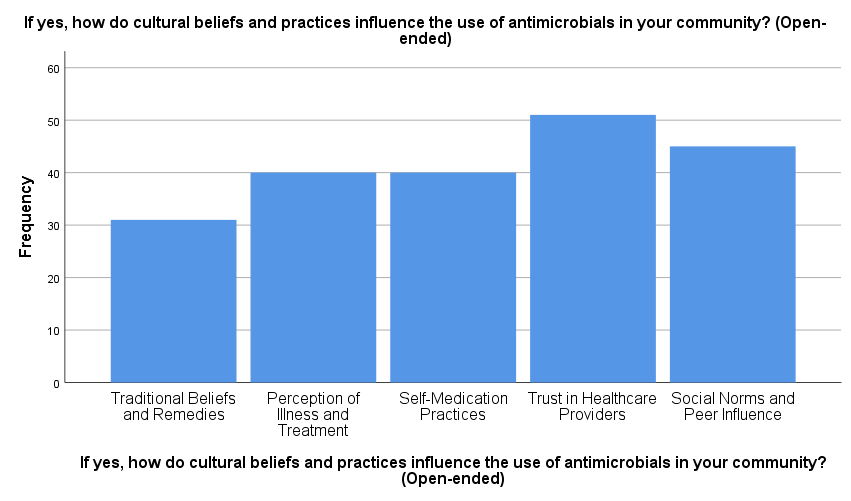
Community participation in social culture, taboos, stigmas, livestock farmers’ partnerships, the district’s community veterinarian, and the affordability of services at the time of seeking medical significance in the uptake of both herbal medicine and antibiotics the main contributed, knowledge, attitudes, and practices (KAP) among the community households in Kayonze District. In addition, study also opined in FGDs findings:
“(We usually use our appropriate knowledge, attitude, and experiences in managing our cattle during many illnesses, and only seek veterinary doctors for advice, when the cow are deathly seriously sick. But if die we slaughter and share the carcasses with the other community households, in exchange for maize or other food as barter trade instead of burying it, so longs give little cash and sell skin to get sugar for the following day)” FGD held on 26/08/2024
Conclusions and Recommendations
Social cultural beliefs, knowledge, and practices in the community contexts have significantly contributed to low uptake of quality one health ecosystem thus causing antimicrobial resistance in Kayonza District, particularly among livestock farmers and community households. The study revealed that increased traditional methods of treatment, due to limited trust in formal veterinary services, and a preference for self-medication are prevalent in the community, which may contribute to the inappropriate use of antibiotics and thus the need faster health education to promote quality animal husbandry. Need for synergistic sector-wide approaches to address antimicrobial resistance (AMR) in Kayonza District, by partnership participation of the three key ministries that form One Health mainly; Health, Veterinary, and Environment) to improve the environmental health and sanitation measures in comprehensive and holistic approaches. Need to impress, Public-private partnerships PPP) Are (essential) for the prevention and control of antimicrobial resistance in livestock farmers and community households at large due to existing limited resource. The private sector, particularly pharmaceutical companies, veterinarians, and agricultural businesses should collaborate with the government and local communities to promote responsible antimicrobial use. Engaging the private sector in these efforts will help bridge resource gaps, improve the accessibility of veterinary services, and foster a more sustainable approach to managing AMR. Through joint initiatives, public-private collaboration can strengthen the overall effectiveness of AMR interventions and promote healthier communities and ecosystems in Rwanda [21, 22, 23]. Need for Further studies on roles of effective of interventions and quality health education in shifting cultural norms regarding health-seeking behaviours and antibiotic uptake and holistic uptake of the integrated One Health approaches in combating AMR, by collaboration human health, veterinary services, and environmental hygiene and sanitation. To prevent and control antimicrobial resistance in the study area.
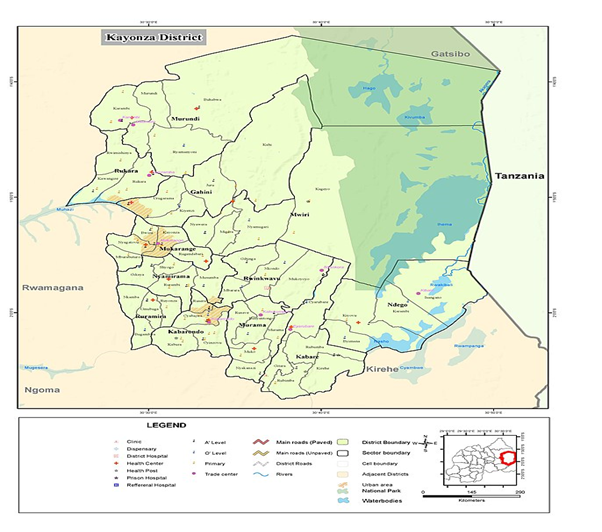
Map Showing Distribution Boundaries of Kayonza District , Rwanda
References
-
(2025) New report calls for urgent action to avert antimicrobial resistance crisis. World Health Organization.
-
Uwera N, Silali MB, Ntamugabumwe L (2024) Journal of Pharmaceutical Analysis Prevalence of Antimicrobial Resistance and Control Methods Used by Livestock Farmers and Veterinary Service Providers in Kayonza District to Improve One Health in Rwanda. Current Pharmaceutical Analysis 14(2): 326-341.
-
Iraguha B, Mpatswenumugabo JPM, Gasana MN, Åsbjer E (2024) Mitigating antibiotic misuse in dairy farming systems and milk value chain market: Insights into practices, factors, and farmers education in Nyabihu district, Rwanda. One Health 19: 100843.
-
Van TTH, Yidana Z, Smooker PM, Coloe PJ (2020) Antibiotic use in food animals worldwide, with a focus on Africa: Pluses and minuses. Journal of Global Antimicrobial Resistance 20: 170-177.
-
Pokharel S, Shrestha P, Adhikari B (2020) Antimicrobial use in food animals and human health: time to implement ‘One Health’ approach. Antimicrobial Resistance and Infection Control 9(1): 181.
-
Roca I, Akova M, Baquero F, Carlet J, Cavaleri M, et al. (2015) The global threat of antimicrobial resistance: science for intervention. New Microbes and New Infections 6: 22-29.
-
Van Boeckel TP, Glennon EE, Chen D, Gilbert M, Robinson TP, et al. (2017) Reducing antimicrobial use in food animals. Science 357(6358): 1350-1352.
-
Kimera ZI, Mshana SE, Rweyemamu MM, Mboera LE G, Matee MIN (2020). Antimicrobial use and resistance in food-producing animals and the environment: An African perspective. Antimicrobial Resistance and Infection Control 9(1): 37.
-
Mugwaneza D, Rwagasore E, El-Khatib Z, Dukuziyaturemye P, Omolo J, et al. (2024) Factors Associated with Inappropriate Use of Antibiotics Among Animal Health Professionals in Selected Districts of Rwanda, 2021. Journal of Epidemiology and Global Health 14: 265-273.
-
Caudell MA, Quinlan MB, Subbiah M, Call DR, Roulette CJ, et al. (2017) Antimicrobial Use and Veterinary Care among Agro-Pastoralists in Northern Tanzania. Plos One 12(1): e0170328.
-
Kanan M, Ramadan M, Haif H, Abdullah B, Mubarak J, et al. (2023) RETRACTED: Empowering Low- and Middle- Income Countries to Combat AMR by Minimal Use of Antibiotics: A Way Forward. Antibiotics 14(1): 84.
-
Aarestrup FM (2015) The livestock reservoir for antimicrobial resistance: a personal view on changing patterns of risks, effects of interventions and the way forward. Philosophical Transactions of the Royal Society B: Biological Sciences 370(1670): 20140085.
-
Marshall BM, Levy SB (2011) Food animals and antimicrobials: Impacts on human health. Clinical Microbiology Reviews 24(4): 718-733.
-
Van Boeckel TP, Pires J, Silvester R, Zhao C, Song J, et al. (2019) Global trends in antimicrobial resistance in animals in low- And middle-income countries. Science 365(6459).
-
Kaczmarek P, Wiszniewska M, Słomka S, Walusiak- Skorupa J (2024) The One Health concept: a holistic approach to protect human and environmental health - how does it work in Total Worker Health strategy. Medycyna Pracy 75(5): 433-444.
-
Kahn LH (2017) Antimicrobial resistance: a One Health perspective. Transactions of The Royal Society of Tropical Medicine and Hygiene 111(6): 255-260.
-
Rüegg SR, Nielsen LR, Buttigieg SC, Santa M, Aragrande M, et al. (2018) A systems approach to evaluate One Health initiatives. Frontiers in Veterinary Science 5.
-
Dyar OJ, Zhang T, Peng Y, Sun M, Sun C, et al. (2020) Knowledge, attitudes and practices relating to antibiotic use and antibiotic resistance among backyard pig farmers in rural Shandong province, China. Preventive Veterinary Medicine 175: 104858.
-
Van Boeckel TP, Pires J, Silvester R, Zhao C, Song J, et al. (2019) Global trends in antimicrobial resistance in animals in low- And middle-income countries. Science 365: (6459).
-
Nhung NT, Cuong NV, Thwaites G, Carrique-Mas J (2016) Antimicrobial Usage and Antimicrobial Resistance in Animal Production in Southeast Asia: A Review. Antibiotics 2016 5(4): 37.
-
Hirwa EM, Mujawamariya G, Shimelash N, Shyaka A (2024) Evaluation of cattle farmers’ knowledge, attitudes, and practices regarding antimicrobial use and antimicrobial resistance in Rwanda. PLOS ONE 19(4): e0300742.
-
(2022) Republic of Rwanda Ministry of Health.
-
Roca I, Akova M, Baquero F, Carlet J, Cavaleri M (2015) The global threat of antimicrobial resistance: science for intervention. New Microbes and New Infections 6: 22-29.
- Capacity Constraints in Pediatric Inpatient Psychiatric Care: A Cross-Sectional Analysis of Bed Availability and Geographic Access in North Carolina
- Why Healthcare Analytics Still Optimizes the Wrong Things
- Coding, Coverage, and Care: The Infrastructure of Transgender Health Inequities
- The Effect of Classroom Attendance on Academic Achievement of Management and Leadership Discipline of Nursing Students at Instituto Superior Cristal and Universidade de Dili, Timor-Leste, 2024: A Case Study
- The Role of Social Bonds in Facilitating Shared Investments and Resource Allocation: Addressing the “Wrong Pocket Problem” in Public Health and Healthcare
- Health as Consumable Item: The Indian Scenario