
Role of Fibroheal Powder in the Treatment of Partial Thickness Burns
Aim of this case report is to assess the role of Fibroheal powder, a silk fibroin based pharmaceutical, in the treatment of partial thickness burns and split-thickness skin graft donor sites. Clinical examination of the burn wounds before and after use Fibroheal powder was done.
Abbreviation
SF: Silk Fibroin.
Introduction
The management of partial thickness burns has been widely debated and researched. There is broad agreement on the advantages of early excision and grafting for deep burns in reducing morbidity and mortality. However, the early excision of partial thickness burns remains a controversial topic. While removing non-viable tissue can reduce the risk of infection and prevent the burn from deepening, surgical debridement can lead to significant blood loss and may damage healthy tissue [1].
In recent years, biomimetic wound dressings have emerged as promising solutions for enhancing soft tissue regeneration. An ideal dressing is typically made from a biocompatible material that supports healing. Although there are various skin replacement products available, the diversity of wound types and locations demands a broader range of dressing options [2, 3]. The success of wound healing largely depends on the choice of biomaterial. Natural polymer- based dressings are particularly noteworthy due to their low immunogenicity and favorable bioactivity. Silk fibroin (SF) is a prominent example, showing potential in wound dressings. SF-based dressings not only promote complete healing but also serve as effective carriers for localized delivery of medications, bioactive agents, and growth factors [4].
Powder-based hemostatic agents are particularly effective for managing small, hard-to-reach, and irregular wounds. These powders act specifically at the bleeding site and exhibit adhesive properties. Upon contact with blood, the powder absorbs moisture, swells, and forms a physical barrier to stop the bleeding. Additionally, the absorption of moisture increases the local concentration of clotting factors, promoting the clotting process [5].
Materials and Methods
This management of burn wound was carried out in a tertiary care facility’s plastic surgery department. There
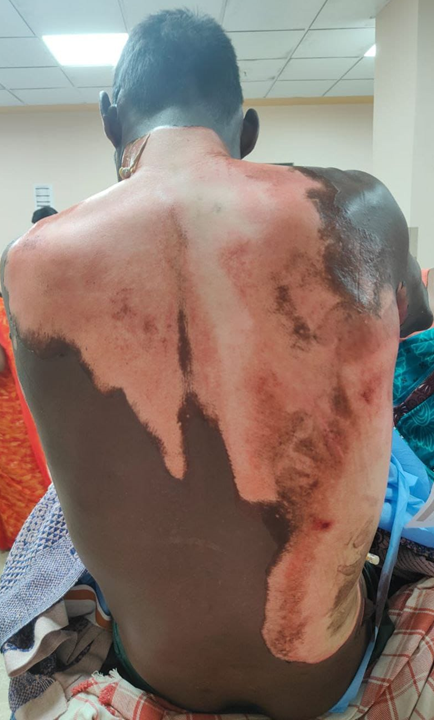
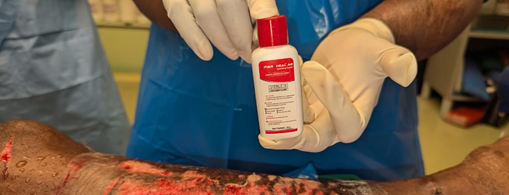
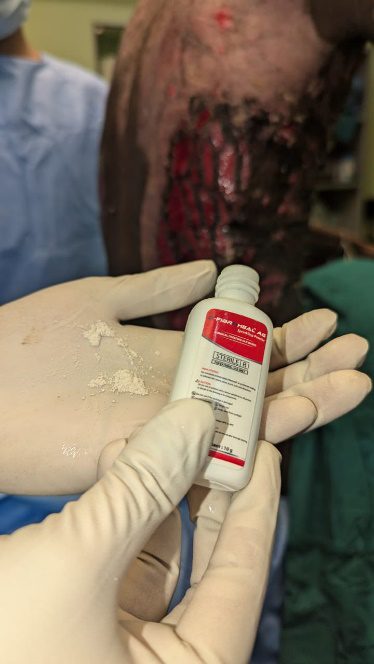
was informed consent received. The study subject was a male 42-year-old male without comorbid conditions who developed a grade 38% TBSA in his chest, neck and both upper limbs (Figure 1) as a result self-intentional burns with petrol. He was alone when this happened. The patient was admitted to the Burns ICU and was given painkillers, antibiotics, and IV fluids. Bandages are applied, and healing measures are taken the wound was covered with fibroheal ointment regularly (Figures 2 & 3). The wound had almost fully recovered by the time he left [6, 7, 8, 9].
Results
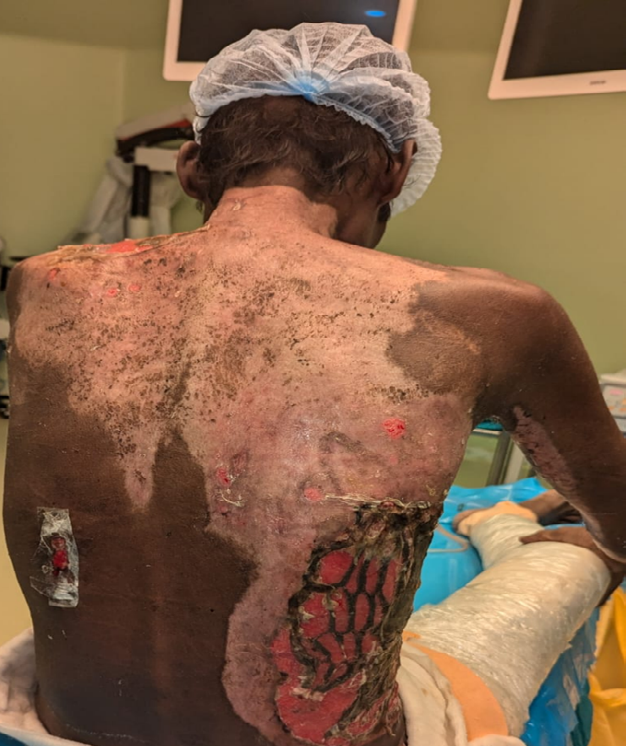
Fibroheal powder have been presented as the ideal wound treatment as they are cost effective, dynamic, noncytotoxic, biodegradable, and highly biocompatible. The natural polymer’s customizable nanostructures and tunable degradation have led to applications in the form of SF tissue scaffolds and nanoparticles. SF tissue scaffolds serve as an ECM mimic, allowing cells to adhere and proliferate within the wound. SF nanoparticles can modulate novel drug delivery systems for controlled release of therapeutics and aid in wound healing and early recovery of burn wounds (Figure 4).
Discussion
Over the past decade, advancements in the treatment of burn wounds have expanded significantly. Numerous new materials, techniques, and dressings incorporating active agents have been introduced, with even more currently in development. Silk fibroin (SF), derived from the cocoons of Bombyx mori silk worms and the silk of spiders, mites, and other insects, has emerged as a versatile biomaterial for wound treatment. Silk comprises two main proteins: SF and sericin. SF is a fibrous structural protein utilized for therapeutic purposes, while sericin, which forms a gum- like glycoprotein layer around SF, is often removed due to its potential immunogenicity. The process of isolating SF involves removing sericin through degumming and regenerating the purified SF via electrospinning, a simple and cost-effective technique. SF’s adaptable properties make it suitable for various wound treatment applications, including molecular scaffolds, topical treatments, and novel delivery systems. As a natural, bioactive polymer, SF is not only effective and accessible but also cost-efficient, making it an excellent candidate for widespread use. This review focuses on SF’s application in treating partial thickness burn wounds, though its regenerative potential extends to other tissues such as bone, cornea, nerve, and cartilage D-Fibroheal Ag Sprinkling Powder is an advanced antimicrobial powder wound dressing containing silk protein and asiaticosides complex, to facilitate high cell attachment, cell migration and tissue regeneration properties for faster wound closure and also aids in fluid handling as it absorbs the excess wound exudates, which can be easily removed during wound cleansing process.
In addition, D-Fibroheal Ag Sprinkling Powder delivers a constant stream of antimicrobial silver ions into the wound that are required to maintain a continuous antibacterial barrier without any cytotoxicity. It effectively creates an environment hostile to bacteria and fungi, inhibits the growth of new bacteria, helps prevent the migration of existing bacteria at the wound site and thus reduces the risk of infection.
- Easily fits to any wound shape and size
- Constant antimicrobial protection, reduces bioburden
- Absorbs excess exudates and maintains optimal moist environment
- Supports cell migration, cell attachment and healthy granulation
- Reduces pain and minimizes scar formation This powder dressing can be used in combination with other dressings and treatment procedures like compression bandage, total contact cast, NPWT transition dressing and hyperbaric oxygen therapy.
Conclusion
D-Fibroheal Ag Sprinkling Powder is first of its kind, in terms of its unique components, properties and performance. It is specially formulated to offer bioburden reduction, fluid management and faster healing to virtually any size, shape or depth of the wound, providing faster healing, decreased pain and better antimicrobial action to the burn wounds. Limitations were that it was done on a single patient.
Conflicts of Interest
This study does not require any institutional approval.
Declarations
Author’s Contributions
All authors made contributions to the article
Availability of Data and Materials
Not applicable
Financial Support and Sponsorships
None
Consent for Publication
Not applicable
References
-
Winkler S, Kaplan DL (2000) Molecular biology of spider silk. Rev Mol Biotechnol 74(2): 85-93.
-
Rockwood DN, Preda RC, Yucel T, Wang X, Lovett ML (2011) Materials fabrication from Bombyx mori silk fibroin. Nat Protoc 6: 1612-1631.
-
Mottaghitalab F, Farokhi M, Shokrgozar MA, Atyabi F, Hosseinkhani H (2015) Silk fibroin nanoparticle as a novel drug delivery system. J Control Release 206: 161- 176.
-
Farokhi M, Mottaghitalab F, Fatahi Y, Khademhosseini A, Kaplan DL (2018) Overview of Silk Fibroin Use in Wound Dressings. Trends Biotechnol 36(9): 907-922.
-
Indrakumar S, Joshi A, Dash TK, Mishra V, Tandon B, et al. (2023) Photopolymerized Silk Fibroin Gel for Advanced Burn Wound Care. Int J Biol Macromol 233: 123569.
-
Mertz PM, Marshall DA, Eaglstein WH (1985) Occlusive Wound Dressings to Prevent Bacterial Invasion and Wound Infection. J Am Acad Dermatol 12(4): 662-668.
-
Lehmann T, Vaughn AE, Seal S, Liechty KW, Zgheib C (2022) Silk Fibroin-Based Therapeutics for Impaired Wound Healing. Pharm 14(3): 651.
-
Barkun AN, Moosavi S, Martel M (2013) Topical Hemostatic Agents: A Systematic Review with Particular Emphasis on Endoscopic Application in GI Bleeding. Gastrointest Endosc 77(5): 692-700.
-
Babiuc RD, Purcarea M, Sadagurschi R, Negreanu L (2013) Use of Hemospray in the Treatment of Patients with Acute UGIB - Short Review. J Med Life 6(2): 117- 119.
- Psychogenic Erectile Dysfunction in Late Adulthood: A Case Report on Clinical Intervention and Intimacy Restoration
- Clinical Trials on COVID-19 in 2025: A New Chapter in Global Health Research
- Innovations and Challenges in Contemporary Medical Clinical Trials: An Editorial Perspective
- Innovations and Challenges in Contemporary Medical Clinical Trials: A Critical Perspective
- Reimagining Clinical Trials: The Power of Continuous Feedback from Medical Reports
- Factors Influencing Brain Drain: Perspectives from a Medical School in Turkey