
Evaluation of Alternaria alternata Isolates for Metabolite Production Isolated from Different Sites of Varanasi, India
Twelve isolates of Alternaria alternata were isolated from various vegetable crops grown in different locations of Varanasi. There colony and conidial morphology on culture medium exhibited complete resemblance with Alternaria alternata. Each isolate was found positive for the production of a secondary metabolite in liquid medium. TLC and HPLC analysis further confirmed the presence of secondary metabolites in the samples prepared from the culture filtrate of different isolates.
Introduction
Phytotoxins and mycotoxins produced by fungal plant pathogens are generally low molecular weight secondary metabolites that exert toxic effects on host plants and animals, respectively. A widespread distribution of Alternaria fungi, belonging to the Dematiaceae of the Hyphomycetes in the Fungi Imperfecti, is found in nature. Alternaria exhibits all kind of life forms found in fungi; they act as plant pathogens, weak facultative parasites, saprophytes and endophytes [1]. Alternaria are known to produce several metabolites which are toxic to plants and animals, and are designated as phytotoxins and mycotoxins, respectively [2, 3, 4]. The metabolites produced by Alternaria exhibit a wide variety of biological activities ranging from phytotoxic, cytotoxic, and antimicrobial activities. Owing to possess such diverse properties, the metabolites of Alternaria have drawn the attention of many chemists, pharmacologists, and plant pathologists to consider them as tools in research programs as well as in application studies [5, 6].
Members of the genus Alternaria are known to produce a wide range of phytotoxic secondary metabolites which affect a large number of plants on which the fungus is found [7]. These phytotoxins include alternariol, alternariol monomethyl ether (AME), altenuene, altenuic acid, tenuazonic acid (TA), tentoxin, alternaric acid, AK- toxin and AAL-toxin and posses a broad range of biological and metabolic effects [8]. Sometimes these phytotoxic metabolites have been referred to as ‘host- specific’ because they are toxic only to the host that is susceptible to the pathogen which produces the toxic metabolite and if they induce nearly all symptoms of the disease are considered to be definitive chemical probes in the study of disease susceptibility and physiological stress at the molecular level. Alternaria alternata is a ubiquitous fungus and one of the most frequently occurring species of genus Alternaria which is of particular interest because it produces a number of harmful secondary metabolites. Some of the secondary metabolites produced by Alternaria alternata include alternariol, alternariol monomethyl ether, altenuene, tentoxin, tenuazonic acid and many more. The
metabolites alternariol and alternariol monomethyl ether have been found in sorghum, sunflower seeds, barley, wheat, oats, tomatoes, mandarin oranges, pepper and melons. The pathogen produces brown to black spots on leaves and stems that may coalesce into larger lesions. Affected leaves may turn yellow then drop, leaving the fruit exposed to sunburn. In severe infection of pathogen on tomato, their symptoms of disease appear on the stems and fruits as freckles, spots or lesions. Alternaria alternata has also been reported to be a major causal agent for post harvest loss of crops, fruits and vegetables [9]. The present study was taken with an objective to isolate several isolates of Alternaria alternata from different vegetables being cultivated in different field locations of Varanasi and screen them for production of metabolite(s).
Materials and Methods
Collection, Isolation and Identification of the Fungal Isolates
Leaves showing symptoms of infection of Alternaria spp. were sampled from different locations of different vegetable fields from Varanasi. Leaf and stem tissues containing lesions were surface sterilized with 0.5% sodium hypochlorite solution for 1 min followed by three washes by sterile distilled water each of 2 min and then placed on the Potato Dextrose Agar (PDA) medium in petri dishes and incubated at 27°C for 5-7 days under a 12 h light/dark photoperiod [10]. Streptomycin sulfate antibiotic was added in the medium at concentration of 1µg ml-1 to avoid the bacterial contamination. The isolates of the recovered fungi were maintained on PDA slants as stock cultures at 4°C [11]. After 5-7 days of growth at 27°C identification of the isolated fungus was carried out. Morphological observations were taken based on colony colour, texture and appearance. Light microscopy was used to study the type of conidium, conidiophores and other microscopic structures [12, 13].
Production and Extraction of the Sample Containing Metabolite
Extraction and purification of the sample containing metabolite from the culture filtrate was carried out following the Methodology of Janardhanan and Hussain [14]. The fungal isolates were grown in potato dextrose broth medium for 20 days and were then processed. The culture filtrate was obtained by passing the broth culture through 4 layers of cheese cloth followed by filtration through filter paper (Whatman number 4) using a Buchner funnel. To 500 ml of culture filtrate was added an equal amount of methanol. This was mixed well and filtered again through Buchner funnel. The filtrate was taken for further processing and the precipitate was discarded. To the filtrate was added an equal amount of ethyl acetate and was mixed well. After proper mixing the phases were allowed to separate in a separatory funnel. Following phase separation the aqueous phase was discarded and the organic phase was taken and concentrated on rotatory vacuum evaporator at 40°C. Following this an oily residue was obtained which was absorbed in activated charcoal and was eluted with methanol. The charcoal pad was discarded and the methanol elute was again concentrated on rotatory vacuum evaporator at 40°C. Following this again an oily substance was obtained. This was again dissolved in minimum amount of methanol with a second round of concentration on rotatory vacuum evaporator at 40°C to remove any possible soluble impurity. The yellow viscous oily material obtained was then dissolved in minimum amount of 1% methanol and was analyzed by TLC.
Thin Layer Chromatography
The extracted metabolites were analyzed for the presence of diverse kind of metabolites by using TLC. The TLC analyses of the extracted metabolite containing sample was carried out on silica gel, using the solvent system chloroform: methanol (80:20) (v/v). The silica gel plates were spotted with 20 µL each the extracted metabolite sample. Detection for the presence of different metabolites in each sample was done by spraying the plates with 0.2% FeCl3 prepared in 95% ethanol.
High Performance Liquid Chromatography
The extracted samples were also analyzed for the presence of metabolites using HPLC. For HPLC analyses of the extracted sample containing metabolites 10 µl from each sample (one at a time) was injected in the HPLC column and was chromatographed on C18 column with C18 Guard Pak. The mobile phase comprised of 75% methanol and 25% of an aqueous solution of 0.1M Phosphate buffer (pH 5.8). The flow rate was maintained at 0.7 ml/min and run time was 20 minutes for each sample. Absorbance was recorded at 254 nm on a photo diode array (PDA) detector.
Results
Isolation and Identification of the Fungus
The fungus Alternaria alternata produces brown to black, target-like spots on leaves. The spots on the leaf are circular and ½ inch in diameter with a pattern of concentric rings. Several spots may coalesce into larger lesions comprising of dead cells. Affected leaves may turn yellow and then drop off. The fungus also attacks stems and fruit. A symptom on stems and fruit shows canker, freckles, spots or lesions. Pieces of spot containing tissue obtained from infected plants were placed on PDA. Twelve fungal isolates showing disease symptoms in field similar to infection of Alternaria alternata were isolated from tomato, brinjal, cauliflower, cabbage, mustard, parthenium and eichhornia growing in different areas of Varanasi (Table 1).
| S. | Fungal | Plant | Infected | Isolate | Colony | ||||||||||||||||||
|---|---|---|---|---|---|---|---|---|---|---|---|---|---|---|---|---|---|---|---|---|---|---|---|
| Location | Hyphae and Conidial structure | ||||||||||||||||||||||
| No. | Species | Species | tissue | No. | morphology | ||||||||||||||||||
| 1. | A. alternata | Brinjal | Leaf | Agri. Farm, BHU | BJ 1 | Dark green compact | Light grey, ovoid to obclavate conidia, transverse and longitudinal septations | ||||||||||||||||
| 2. | A. alternata | Brinjal | Leaf | Agri. Farm, BHU | BJ 2 | White green cottony | Light grey, ovoid conidia, transverse and longitudinal septations | ||||||||||||||||
| 3. | A. alternata | Eichhornia | Leaf | BHU Pond | EC 1 | Dark green | Septate hyphae with elongated conidia, transverse and longitudinal septations | ||||||||||||||||
| 4. | A. alternata | Tomato | Fruit | Ramnagar | TM 1 | White olive brown-green cottony | Septate hyphae with ovoid to obclavate conidia, transverse and longitudinal septations | ||||||||||||||||
| 5. | A. alternata | Tomato | Stem | Ramnagar | TM 2 | White light- green | Brown and ovoid conidia with elongated apical cell | ||||||||||||||||
| 6. | A. alternata | Tomato | Stem | Ramnagar | TM 3 | White dark- green | Brown conidia with chain formation, longitudinal septations | ||||||||||||||||
| 7. | A. alternata | Tomato | Fruit | Ramnagar | TM 4 | Dark green | Conidia brown, transverse septaion | ||||||||||||||||
| 8. | A. alternata | Tomato | Leaf | Ramna | TM 5 | Light grey | Dark brown, small and ovoid to obclavate conidia, transverse and longitudinal septations | ||||||||||||||||
| 9. | A. alternata | Cauliflower | Leaf | Ramnagar | CF 1 | Olive brown light-green | Brown, transverse and longitudinal septations | ||||||||||||||||
| 10. | A. alternata | Mustard | Leaf | Adalpura | MT 1 | Grey brown | Dark brown conidia with chan formation, transverse and longitudinal septations | ||||||||||||||||
| 11. | A. alternata | Cabbage | Leaf | Ramnagar | CA 1 | Light-green compact | Light brown conidia with chain formation, septate hyphae, transverse and longitudinal septations | ||||||||||||||||
| 12. | A. alternata | Parthenium | Leaf | BHU Roadside | PT 1 | White-Green cottony | Light olive brown, elongated and septations |
Table 1: List of different isolates of Alternaria alternata and their characteristics isolated from different locations of Table
Table 1: List of different isolates of Alternaria alternata and their characteristics isolated from different locations of Table 1: List of different isolates of Alternaria alternata and their characteristics isolated from different locations of Varanasi. A small-spored long-chained pathogen grew from 95% of the tissue and in most isolation this was the only fungus obtained (Table 1; Figures 1 & 2).
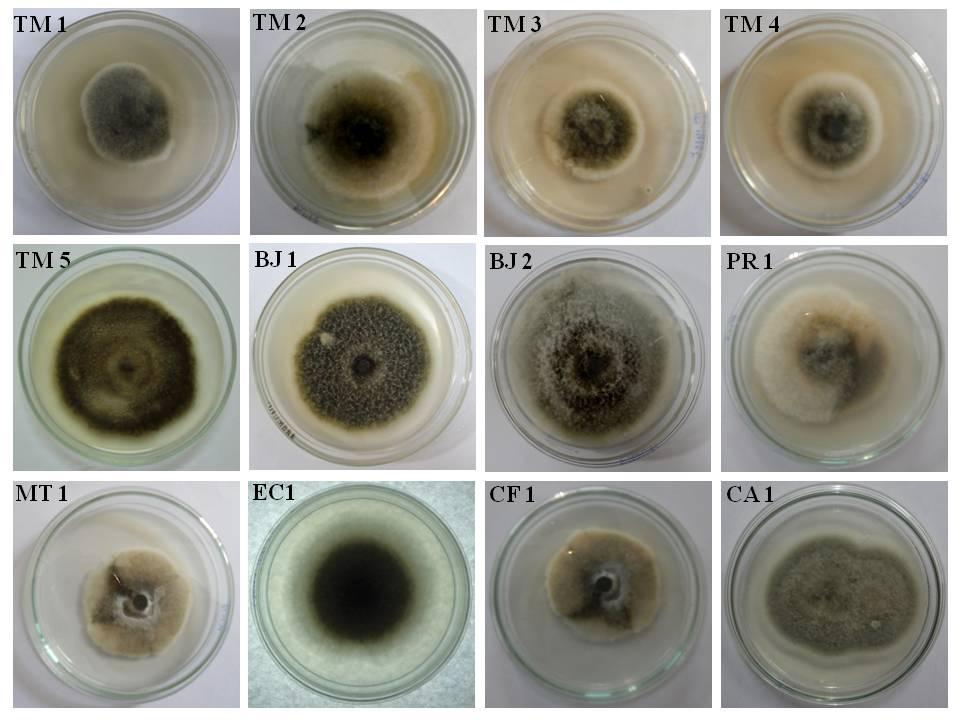
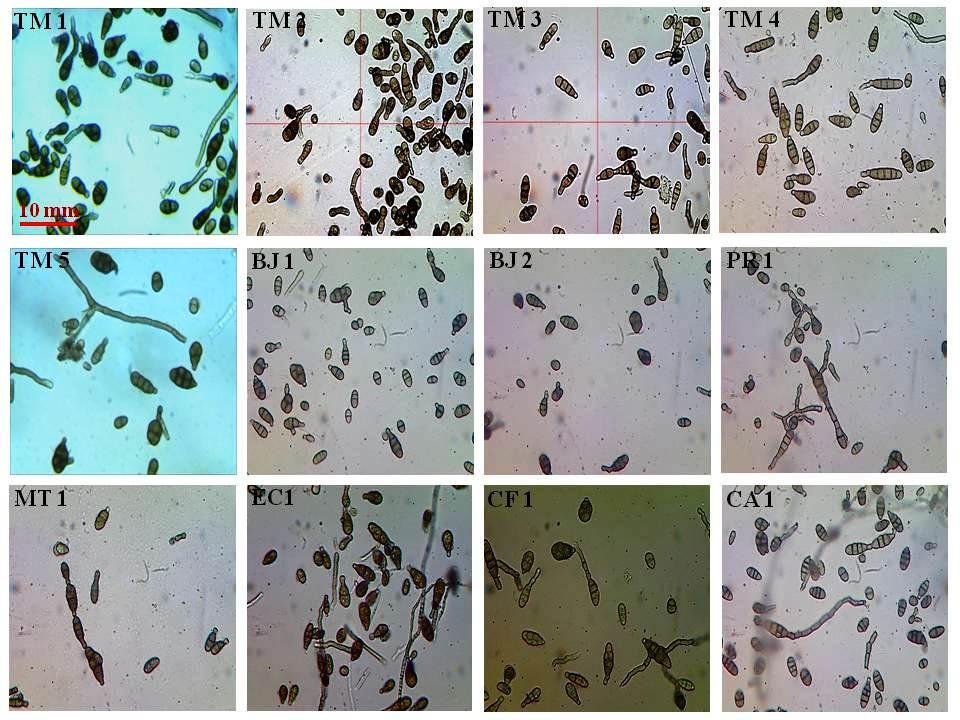
Various kind of colony morphology was obtained on PDA plates (Table 1). After the colony extended over the entire plate sporulation was abundant and the colony became appressed and nearly black. The fungus Alternaria alternata was consistently isolated and identified based on morphological characters. Microscopic observations showed that the conidiophores were brown, straight, bearing light brown or dark brown or light grey conidia formed in long chains and were obclavate and muriform, often with a short conical or cylindrical, pale beak, less than one third of the length of the conidium. Conidia had 3-7 transverse septa and usually several longitudinal or oblique septa (Figures 1 & 2).
Analyses of the Metabolites Produced by the Isolates of Alternaria alternata
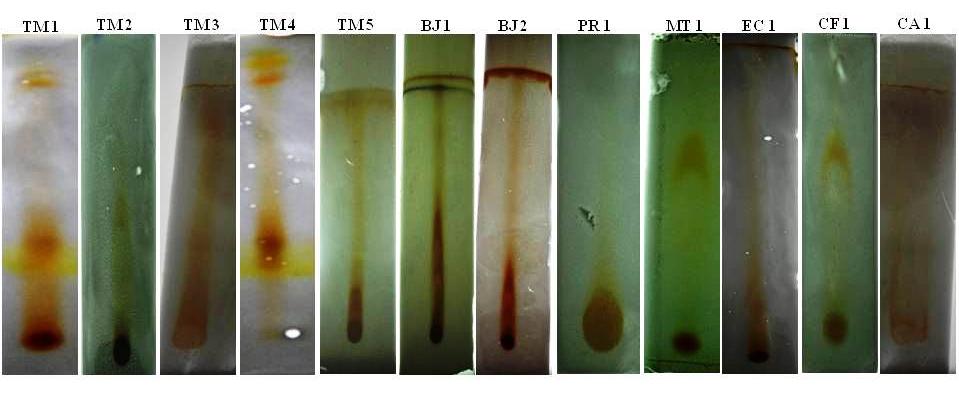
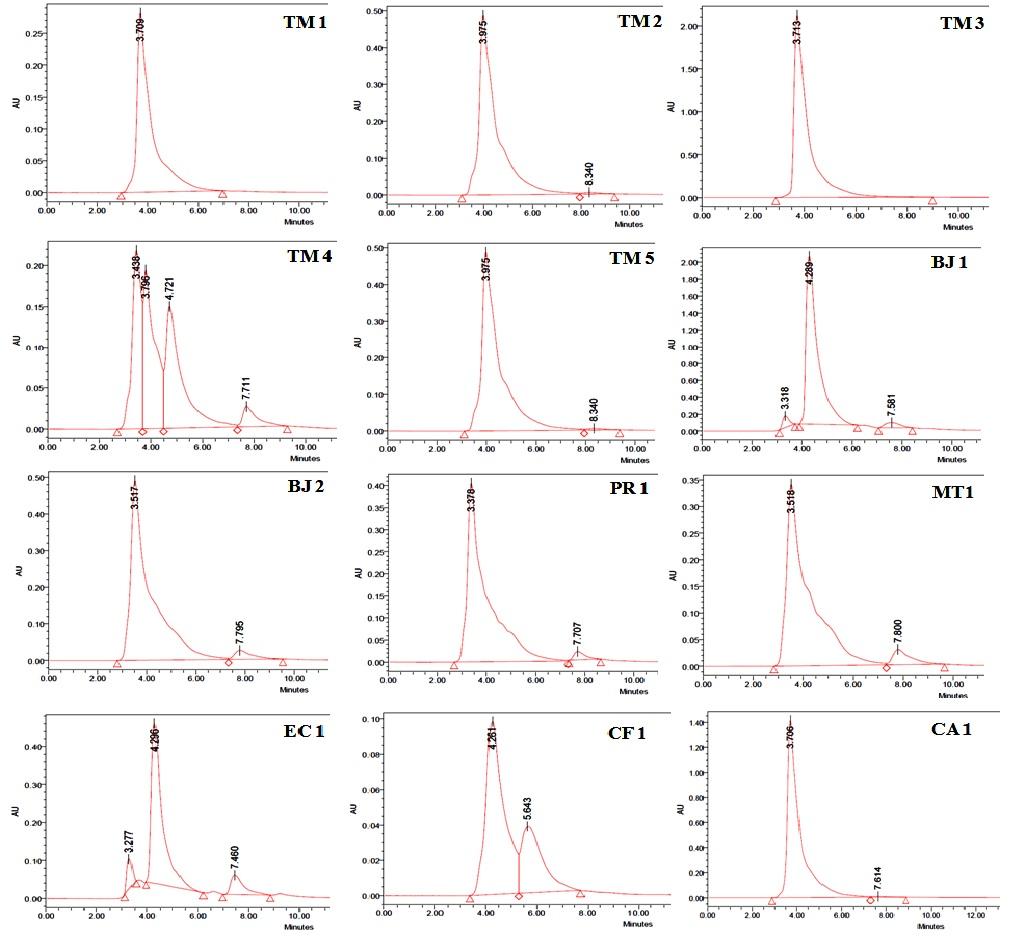
All the 12 isolates were checked for metabolite production in broth culture. Following sample extraction from the culture filtrate of all the Alternaria alternata some kind of viscous oily material was obtained which was subjected to further analysis by TLC and HPLC (Figure 3 & 4). After separation on silica gel and developing the plates with ethanolic FeCl3 several brilliant reddish orange bands of metabolites were produced in the extracted sample of most of the isolates (Figure 3).
Following TLC separation these sample were then analyzed by HPLC. The HPLC chromatogram also revealed the presence of metabolites in the extracted samples of the isolates (Figure 4). Seven samples showed the presence of single metabolite in good concentration and exhibited a similar retention time. The other isolates exhibited the production of multiple metabolites as more than one peak was visual in their chromatogram (Figure 4).
Discussion
Members belonging to the genus Alternaria are amongst the common fungi found in soil and are agents for spoilage of commercially important crops [1]. Alternaria generally attacks the aerial parts of its host. In the leafy vegetables, symptoms of Alternaria infection typically start as a small, circular, dark spot. As the disease progresses, the circular spots may grow to ½ inch or more in diameter and are usually brown to black in colour. In the present work isolation was carried out on potato dextrose agar medium from infected tissues collected from the field. The fungus Alternaria alternata was consistently isolated and identified based on morphological characters [15]. Alternaria is a cosmopolitan fungal genus widely distributed in soil and organic matter. It includes saprophytic, endophytic and pathogenic species. At least 268 metabolites from Alternaria fungi have been reported in the past few decades. The metabolites from Alternaria fungi can be grouped into several categories which include nitrogen-containing compounds, steroids, terpenoids, pyranones (pyrones), quinones, phenolics, etc_. Several metabolites are unique to one _Alternaria species, but most metabolites are produced by more than one species [9]. For the detection and quantification of the secondary metabolites produced by Alternaria alternata in broth culture TLC and HPLC studies have been very widely and efficiently used [14, 16, 17]. In the present study also the identification of the metabolites revealed that the isolates produced several metabolites in the culture filtrate as was evident from TLC analysis and the same was supported by HPLC chromatograms. Alternaria metabolites act as phytotoxins to plants or as mycotoxins to humans and animals. They have been examined to have a variety of biological activities and functions, which mainly include the effects on plants, cytotoxic and antimicrobial activities. Plant pathogenic Alternaria species can affect cereals, vegetables and fruit crops in the field and during storage. Alternaria fungi contamination is responsible for some of the world’s most devastating plant diseases, causing serious reduction of crop yields and considerable economic losses. The metabolites from plant pathogenic fungi are usually toxic to plants and are called phytotoxins. They are further divided into host-specific and host non-specific toxins. The host-specific toxins (HSTs) are toxic only to host plants of the fungus that produces the toxin [18, 6]. Another definition seems to be more acceptable that the host-specific toxins are toxic to plants that host the pathogen, but have lower phytotoxicity on non-host plants [19, 20]. Most HSTs are considered to be pathogenicity factors, which the fungi producing them require to invade tissue and induce disease [21]. All isolates of the pathogen that produce HST are pathogenic to the specific host. All isolates that fail to produce HSTs lose pathogenicity to the host plants. Plants that are susceptible to the pathogen are sensitive to the toxin. Host non-specific Alternaria phytotoxins can affect many plants regardless of whether they are a host or non- host of the pathogen [18, 6]. Host non-specific nitrogen- containing phytotoxins include tenuazonic acid, porritoxin and tentoxin. Tentoxin, a cyclic tetrapeptide from A. alternata, inhibited chloroplast development, which phenotypically manifests itself as chlorotic tissue [22]. Tentoxin was suggested to exert its effect on chlorophyll accumulation through over energization of thylakoids [23]. Tenuazonic acid was investigated in Chlamydomonas reinhardtii thylakoids which revealed that TA inhibited photophosphorylation with the action site at QB level [24]. Host non-specific pyranone phytotoxins include radicinin, deoxyradicinin, alternaric acid, alternuisol, altertenuol, dehydroaltenusin, alternariol, alternariol 9-methyl ether, and alternuene. They are very common non-specific phytotoxic metabolites of Alternaria species [9]. The potential applications of Alternaria metabolites as antitumor agents, herbicides, and antimicrobials as well as other promising bioactivities have led to considerable interest within the pharmaceutical community. Chemical syntheses have been achieved for a few bioactive metabolites such as AAL-toxin TA1, maculosin, AM-toxin I, alternariol, alternariol 9-methyl ether, altenuene, isoaltenuene, neoaltenuene, altertoxin III, zinniol, altenusin and alterlactone. In recent years, more and more Alternaria fungi have been isolated as plant endophytic fungi from which large amounts of bioactive compounds have been structurally characterized. Another approach is to discover novel bioactive compounds from the Alternaria fungi isolated from marine sources. These Alternaria fungi could be the rich sources of biologically active compounds that are indispensable for medicinal and agricultural applications [25].
Conclusions
In the present study 12 different isolates of A. alternata were obtained from different locations of Varanasi infecting different plant types. After preliminary screening through TLC and HPLC all the isolates were found to be producers of certain number of metabolites in the culture media. Now, these metabolites need further biophysical and biochemical characterization to warrant their applicability in different sectors.
Acknowledgement
The author MM is thankful to RGNF-(UGC) for providing the necessary facilities during the course of this study. The author is thankful to the Head Department of Botany and Programme Coordinator, Centre of Advanced Study in Botany, Banaras Hindu University for providing necessary research facilities for the experiments.
References
-
Thomma BPHJ (2003) _Alternaria_ spp.: From general saprophyte to specific parasite. Mol Plant Pathol 4(4): 225-236.
-
Strange RN (2007) Phytotoxins produced by plant pathogens. Nat Prod Rep 24(1): 127-144.
-
Mobius N, Hertweck C (2009) Fungal phytotoxins as mediators of virulence. Curr Opin Plant Biol 12(4): 390-398.
-
Duke SO, Dayan FE (2011) Modes of action of microbially-produced phytotoxins. Toxins (Basel) 3(8): 1038-1064.
-
Brase S, Encinas A, Keck J, Nising CF (2009) Chemistry and biology of mycotoxins and related fungal metabolites. Chem Rev 109(9): 3903-3990.
-
Tsuge T, Harimoto Y, Akimitsu K, Ohtani K, Kodama M, et al. (2013) Host-selective toxins produced by the plant pathogenic fungus _Alternaria alternata_. FEMS Microbiol Rev 37(1): 44-66.
-
Bruce VR, Stack ME, Mislivec PB (1984) Incidence of toxic _Alternaria_ species in small grains from the USA. Journal of Food Sciences 49(6): 1626-1627.
-
Nishimura S, Kohmoto K (1983) Host-specific toxins and chemical structures from _Alternaria_ species. Annu Rev Phytopathol 21: 87-116.
-
Lou J, Fu L, Peng Y, Zhou L (2013) Metabolites from _Alternaria_ fungi and their bioactivities. Molecules 18(5): 5891-5935.
-
Montazeri M, Mojaradi M, Rahimian- Mashhadi H (2006) Influence of adjuvants on spore germination, desiccation tolerance and virulence of _Fusarium_ _antho_philum on barnyardgrass (_Echinochloa crus-_ _galli_). Pakistan Journal of Weed Sciences Research 12(1-2): 89-97.
-
Safari Motlagh MR, Kaviani B (2008) Characterization of New _Bipolaris_ spp, the causal agent of rice brown spot disease in the north of Iran. International Journal of Agricultural and Biology 10(6): 638-642.
-
Leslie JF, Summerell BA (2006) The Fusarium Laboratory Manual. Blackwell Publishing. First edition, 388.
-
Simmons EG (2007) _Alternaria_ an identification manual. In: CBS Fungal Biodiversity Center Utrercht the Netherland, 1-775.
-
Janardhanan KK, Hussain A (1983) Studies on isolation, purification and identification of tenuazonic acid, a phytotoxin produced by _Alternaria_ _alternata_ (Fr.) Keissler causing leaf blight of _Datura_ _innoxia_ Mill. Mycopathology 83(3): 135-140.
-
Ellis MB (1971) Dematacious Hyphomycetes. Commonwealth Mycological Institute, Kew, pp 608.
-
Clouse SD, Martensen AN, Gilchrist DG (1985) Rapid purification of host-specific pathotoxins from _Alternaria_ _alternata_ sp. _lycopersici_ by solid-phase adsorption on octadecysilane. Journal of Chromatography 350(1): 255-263.
-
Xu L, Du L (2006) Direct detection and quantification of _Alternaria alternata_ f. sp. _lycopersici_ toxins using high-performance liquid chromatography- evaporative light-scattering detection. Journal of Microbiological Methods 64(3): 398-405.
-
Montemurro N, Visconti A (1992) _Alternaria_ metabolites—Chemical and biological data. In _Alternaria_: Biology, Plant Disease and Metabolites; Chelkowski J, Visconti A, Eds.; Elsevier: Amsterdam, The Netherlands, pp. 449-557.
-
Graniti A (1991) Phytotoxins and their involvement in plant diseases. Experientia 47(8): 751-755.
-
Pedras MSC, Biesenthal CJ, Zaharia IL (2000) Comparison of the phytotoxic activity of the phytotoxin destruxin B and four natural analogs. Plant Sci 156(2): 185-192.
-
Howlett BJ (2006) Secondary metabolite toxins and nutrition of plant pathogenic fungi. Current Opinion in Plant Biology 9(4): 371-375.
-
Halloin JM, De Zoeten GA, Gaard GR, Walker JC (1970) Effects of tentoxin on chlorophyll synthesis and plastid structure in cucumber and cabbage. Plant Physiology 45(3): 310-314.
-
Avni A, Anderson JD, Hollan N, Rochaix JD, Gromet- Elhanan Z, et al. (1992) Tentoxin sensitivity of chloroplasts determined by codon 83 of beta subunit of proton ATPase. Science 257(5074): 1245-1247.
-
Liu YX, Xu XM, Dai XB, Qiang S (2007) _Alternaria_ _alternata_ crofton-weed toxin: a natural inhibitor of photosystem II in _Chlamydomonas_ _reinhardtii_ thylakoids. J Agric Food Chem 55(13): 5180-5185.
-
Beresteskiy AO (2008) A review of fungal phytotoxins: from basic studies to practical use. Applied Biochemistry and Microbiology 44: 453–465.
- Enhancement of Vegetative Growth and Fruit Yield in Cucumber (Cucumis sativus L.) via Spiritual Blessing (Biofield) Energy Intervention
- Production of Açaí (Euterpe oleracea Mart.) under Different Agroforestry System Management Intensities in Amazonian Floodplain (Varzea) Forests
- Coffee and the Production Region: What is the Secret to the Expression "Quality"?
- Experiential Agripreneurship Training in Sub-Saharan Africa: Integrating a Business Incubator into Postgraduate Livestock Education at the University of Buea
- Advances in Agricultural High-Quality Development
- Linking Compost Residue to ABAGE in Plants - a Short Note