
Sustainable Rice Production System as Influenced by Organic Manures and Biofertilizers
Agriculture continues to be the key stream of India’s economy. Nearly two third of the Indian population still depend on agriculture. The past achievement in food production was attributed to the availability of land, crop varieties with high yield potential, expansion in irrigation resources, increasing use of fertilizers to meet the nutritional requirement of crop, but the current situation is different. Modern agricultural practices and newer technological process have introduced another kind of pollution. Continuous use of inorganic fertilizers and neglecting of organic and bio fertilizers paved the way of deterioration of soil health and increased the ill effects of human beings and animals. Today, the use of organic manure in agriculture is considered an important strategy in the effort to preserve the global environment. Organic agriculture builds the health of the soil, providing the foundation for healthy crops and a livelihood for good stewards of the land. A healthy soil effectively supports plant growth, protects air and water quality and ensures human and animal health. Field experiment was conducted at Experimental Farm, Annamalai University in the winter (December, 2015-March 2006) aimed at understanding the effect of organic manures and biofertilizers on sustainable production of rice. Research results have established the beneficial effects of organic manures and biofertilizers on soil health and crop yields. In order to maintain high, crop yields and improve soil quality proper use of organics are recommended.
Introduction
Rice is one of the most important food crops that are being extensively cultivated in India. It occupies a pivotal position in the food security system of India, contributing to 41.5% of the total grain production. The future food security of India depends on the ability to achieve a continuous improvement in the productivity and profitability of rice farming. Rice is the main source of calories for 40 per cent of the world’s population [1]. Self sufficiency in rice production has been a major goal of agricultural research and development in most of the countries. In 2025, the global demand for rice world increase by 70 percent requiring a production of 810 million tonnes of unmilled rice as against the present production of 480 million tonnes. It has been repeatedly emphasized that to meet the demand, rice yields will have to increase from the present mean of 4.5 to 8.0 t ha-1. Low productivity of rice is due to continuous and increased use of chemical fertilizers. The role of plant nutrient would be extremely important from sustainability point of view. It is the therefore necessary to judiciously manage the inflow of organic source of nutrients. In sustainable crop production, organic source of nutrients play an important role in enhancing the productivity. Sustainability and increasing of rice production can be achieved only through the use of organic manures [2]. By continuously using of organic manure, fertility status of soil can be improved which certainly be beneficial for rice crop in increased crop yield. The recent crop production technology stress the need of organic manures viz, Vermicompost, Farm, Pressmud and biofertilizers. In recent years, worldwide awareness to increase the use of organic manures has been felt in order to improve environmental conditions and public health and to reduce the cost of chemical fertilizer. In this context organic manures hold great promise in meeting the growing nutrient demand of intensive agriculture and maintaining the crop productivity at a fairly high level. Hence, the present investigation was taken up to develop an organic input package for rice.
Materials and Methods
A field experiment was conducted at Annamalai University Experimental Farm, Annamalai Nagar, India during winter (December 2015-March 2016) to study the effect of age of seedlings and organic manures with biofertilizers on the sustainable growth and yield of rice. The experiment was conducted in the split plot design replicated thrice with three treatments as main plots viz.,
12 days old seedlings (M1), 15 days old seedlings (M2), 18 days old seedlings (M3) and five organic manure and biofertilizer treatment as the sub plot treatments viz., S1 – Vermi compost @ 5 t ha-1 with Azospirillum and phosphobacteria, S2 – FYM @ 12.5 t ha-1 with Azospirillum and phosphobacteria, S3 - pressmud @ 10t ha-1 with Azospirillum and phosphobacteria, S4-Azospirillum and phosphobacteria, S5-no organic and biofertilizers. The weather at Annamalai Nagar is moderately warm with hot summer. The soil of the experimental field was clayey loam in texture with low in available nitrogen, medium in available phosphorus and high in available potassium. The short duration variety of rice cv ADT 36 was choose for the study. The seeds were sown by adopting a seed rate of 5-10kg/ha. The seeds were soaked in water for 12 hours and incubated for 18 hours before sowing. The sprouted seeds were sown in the nursery (Dapog method). 12days, 15 days and 18 days old seedling were planted @ 1 Seedling hill-1 with a shallow depth. A spacing of 20×20 cm was adopted. Gap filling were done within 10 days after transplanting to maintain population.
Results
Growth and yield attributes: The observations recorded on leaf area index and dry matter production of rice is presented in Table 1.
| Production panicle | Number of filled grains/ | ||||||||||||||||
|---|---|---|---|---|---|---|---|---|---|---|---|---|---|---|---|---|---|
| Treatment | Number of tillers m | 2 | Leaf area index | D | MP Kg ha- | 1 | |||||||||||
| number m2 | panicle | ||||||||||||||||
| S 1 | 824 | 6.49 | 15496 | 815 | 113.2 | ||||||||||||
| S 2 | 797 | 6.13 | 14424 | 768 | 110.27 | ||||||||||||
| S 3 | 809 | 6.43 | 15027 | 790 | 112.78 | ||||||||||||
| S 4 | 780 | 6.08 | 14201 | 764 | 109.79 | ||||||||||||
| S 5 | 665 | 4.73 | 12670 | 714 | 99.56 | ||||||||||||
| SED | 17.98 | 0.04 | 145.28 | 20.01 | 0.75 | ||||||||||||
| CD (P=0.05) | 36 | 0.08 | 290.59 | 41.1 | 1.51 |
Table 1: Effect of organic manures on growth and yield attributes of rice.
All the treatments exerted significant influence on the growth components of rice. Among the treatments, S1 application of vermi compost @ 5t ha-1 Azospirillum and phosphobacteria recorded the higher values of growth and yield components. This treatment was found to be significantly superior over other treatments by recording the maximum growth components. The treatment pressmud with biofertilizers was next in order. The Raman R and Prakash P. Sustainable Rice Production System as Influenced by Organic Manures and Biofertilizers. J Agri Res 2017, 2(2): 000126.
lowest growth components were recorded under no organic manure treatment (S5). Yield Components: The data recorded on the yield are presented in Figure 1.
Copyright© Raman R and Prakash P.
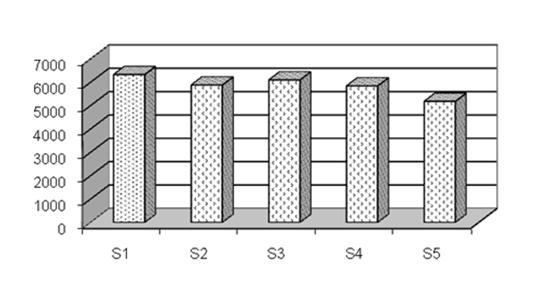
All the treatments exerted significant influence on the yield of rice. Among the treatments, application of vermi compost @ 5t ha-1 with Azospirillum and phosphobacteria was superior and recorded the highest yield of rice. Treatment S3 – Press mud @ 10t ha-1 with Azospirillum and phospho bacteria was next in order of ranking. The least yield of rice was recorded in the treatment with no organic manure and biofertilizers (S5).
Discussion
The results showed that application of organic nutrients and biofertilizers favorably influenced all the growth and yield attributes. Application of vermicompost with biofertilizers increased the yield mainly due to the presence of higher amount of available nutrients as well as growth promoting substances such as Indole Acetic Acid and indole aceto nitrate [3]. The increased yield altitudes are due to the application of vermi compost and biofertilizers might have easy availability of essential plant nutrients to crop and increased translocation of nutrients which has a great bearing a better conversion of assimilates in to source and then accumulate in the sink [4]. The increased grain yield with vermi compost might be attributed to the significantly higher yield attributes like number of panicles per hill and number of grains per panicle. This might be attributed to higher availability of nutrients in vermi compost ,increased availability of both the native and applied nutrients and better source and sink relationship which contributed to better dry matter production at all stages of crop growth leading to the production of favorable yield components. The present results are in agreement with the findings of Ashok Kumar et al. [5].
Raman R and Prakash P. Sustainable Rice Production System as Influenced by Organic Manures and Biofertilizers. J Agri Res 2017, 2(2): 000126.
Conclusion
In order to maintain high yields and improve soil health, proper uses of organics are recommended. Tests in rice show that organic manure application significantly increased crop yields. Application of organic manure and biofertilizers are observed to be appropriate agro techniques for augmenting the productivity and profitability of rice crop without affecting the soil fertility and soil health. Thes practices would help in sustaining the supply of nutrients for longer period to achieve a stable yield which could fit into the concept of “Sustainable agriculture”.
Acknowledgments
The authors are thankful to the university authorities for the facilities extended during the course of this study.
References
-
De Datta SK (1981) Principles and practices of Rice production, Wilsey and Sons New York. USA. 9-14.
-
Vasanthi D, Kumaraswamy K (1999) Efficacy of vermi compost to improve soil fertility and rice yield. J Indian Soc Soil Sci 47(2): 268-272.
-
Bhavja I, Cadet P, Albercht A, Lavelle P (1998) Agricultural intensification, soil biodiversity of agro ecosystem function in the tropics: Appl Soil Ecol 6: 87-108.
-
Murali MK, Setty RA (2001) Growth, yield and nutrient uptake of scented rice (_Oryza sativa_ L.) as influenced by level of NPK, vermi compost and triacontanol. Mysore J Agric Sci 35(1): 1-4.
-
Ashok Kumar D, Yadav S, Kumar A (1995) Use of organic manure and fertilizer in rice (_Oryza sativa_) wheat (_Triticum aestivum_) cropping system for sustainability. Indian Journal of Agri Sci 65(10): 703- 703. Copyright© Raman R and Prakash P.
- Enhancement of Vegetative Growth and Fruit Yield in Cucumber (Cucumis sativus L.) via Spiritual Blessing (Biofield) Energy Intervention
- Production of Açaí (Euterpe oleracea Mart.) under Different Agroforestry System Management Intensities in Amazonian Floodplain (Varzea) Forests
- Coffee and the Production Region: What is the Secret to the Expression "Quality"?
- Experiential Agripreneurship Training in Sub-Saharan Africa: Integrating a Business Incubator into Postgraduate Livestock Education at the University of Buea
- Advances in Agricultural High-Quality Development
- Linking Compost Residue to ABAGE in Plants - a Short Note