
LlaNAC Transgenic Tobacco Lines Efficiently Sequester and Stockpile Carbon
Rapidly changing environment, particularly the global warming require plants to be more stress tolerant and display better productivity. We have assessed the abilities of a NAC over-expressor transgenic line of tobacco vis-à -vis wild type to survive the conditions of elevated carbon dioxide (500 ppm) and elevated temperatures (32°C) throughout the post-germination period in the life cycle of the plants. All the seeds were germinated under optimum conditions. The control plants in the experiment were the equal number of plants that were allowed to grow under optimum conditions of 390 ppm CO2 and 25°C temperature. Significant differences in growth, and accordingly carbon captured by different plants were observed even under optimum conditions. The biomass accumulated by transgenics was two and a half times more than the wild type plants on 90th DAS. Under elevated temperature and carbon dioxide, the difference in height between the transgenics and the wild type under these conditions was by nearly five times, and carbon captured was seven times more than the wild type. Presumably, transgenic plants had a better water use efficiency, and made use of additional carbon dioxide available to synthesize more carbohydrates, and consequently the biomass. Transgenic plants, as the one described here are potential solutions of uncertainty of agricultural yields that the world is facing today, and may lead to sustainable future in agriculture for food, feed and fuels.
Introduction
Genetic engineering or Recombinant DNA Technology (RDT) has the potential to deliberately and considerably modify characteristics of an organism by the manipulation of the genetic material to create new variations of life. The technology has made it virtually possible to introduce traits of almost any organism to any other organism, popularly called as transgenic or genetically modified organisms (GMO). Such transgenic organisms can be programmed to manufacture various bio-products like enzymes, monoclonal antibodies, hormones, etc. in bulk [1]. Further, these GMOs can also be employed for providing a number of services for the mankind as well as for the environment health, e.g., in bioremediation to clean the environment [2, 3]. Recently, GMOs have also been proposed to play a major role in production of biofuels. A number of microorganisms have been proposed to facilitate second generation biofuel processes, so as to secrete the fuels or their precursors by feeding on a lignocellulosic diet [4]. The fourth generation biofuels too have been proposed which exclusively refer to GMOs, and may include the microbes that make the raw material amenable for easy conversion to biofuels, or they may refer to plants, which accumulate more biomass, absorb higher carbon, has higher water use efficiency, etc. The crop plants that are being produced or modified by genetic engineering methods are variously called genetically engineered crops, bio-engineered crops, genetically modified crops, or biotech crops. Many important crops are already being grown from seeds engineered with built-in immunity to herbicides, viruses, insects, and disease. While, the primary targets of genetic modification in plants at present are the food crops, the technology and the traits presently being introduced are of equal importance to cash crops and biofuel crops. Infact, strategic modifications can make a particular crop to serve the dual purposes as well. In the nutshell, the genetic modification technology is like a printing press technology for food, fiber, fodder, feed, Pharmaceutical and fuel in 21st century. It does not only provide an alternative solution, but it also provides security in all these areas with no alternatives. In our laboratory, we have over expressor transgenic lines in tobacco by transforming a NAC gene from Lepidium latifolium (LlaNAC). The transgenic lines have initially been reported to have tolerance to cold stress, mature early, have shorter life cycles and accumulate more biomass than the wild type lines [5]. In short, all of the traits induced by a single gene have direct implications for engineering both for food as well as fuel crops. Thus, an interesting matter of investigation emerging is that by how much the capability of stockpiling and sequestering environmental carbon has improved in LlaNAC transgenic plants. It is further pertinent to mention here that it is generally agreed that as we would have more carbon dioxide available in the environment the productivity of the plant would improved, thus more biomass would be produced by the plants. However, the same would get nullified as the temperatures would increase as a coupled effect to the global warming. Thus, realizing the fact that LlaNAC is aiding the plant to adjust to the conditions of abiotic stress, and it is also aiding the plant to accumulate more biomass, we decided to investigate that how much is the capability to capture and stock the carbon of these plants, and what, if any, would be the effects of elevated temperatures on these plants.
Materials and Methods
Plant material, validation and treatments
LlaNAC over expressing Nicotiana tabacum line NC10 (generation T2) was studied for biomass characters [5]. Each individual plant was tested for its genetic uniformity/stability based on herbicide tolerance assay (150 ppm paromomycin) and a real time PCR assay following [6]. The native growth conditions, i.e., temperature (25 ± 2°C) and carbon dioxide (400 ppm) were considered as the control conditions, while an elevated temperature of 32°C (constant) and carbon dioxide concentration of 500 ppm in a plant growth chamber (LT-105, Percival Scientific, USA) was considered as experimental (Figure 1).
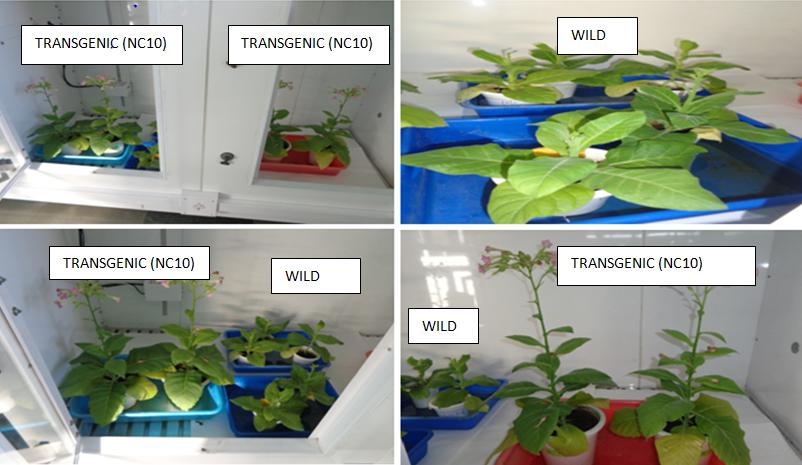
The plants were transferred to the plant growth chamber at 30 DAS, and were allowed to complete their life cycle inside the chamber. For each mature plant, the expression of the gene was tested at 100th DAS to confirm that the gene and its over expressor line are functional.
**Calculations of carbon stockpiled and sequestered**
We measured the plant height and stem circumference at 90th DAS, which is the mean half life of the wild type plants. Stem circumference was used to deduce the stem diameter, assuming the stem to be a perfect circle. Based on the estimates released by Georgia Forestry Commission(http://www.forestdisturbance.net/publications/GF%20RP60-Clark.pdf), fresh weight (FW) of the standing plants was computed to be-
$$FW = 1.2 \times 2 \times D^2 H$$
As per the data presented earlier on the dry weight of the NAC transgenic and wild type tobacco plants (Grover et al. 2014), the dry weights (DW) of the plants in present experiment were deduced to be 10.61% of the fresh weight. The average carbon content, i.e., the carbon stockpiled, is generally 50% of the dry biomass (United States Department of Forest Agriculture System, http://www.ianrpubs.unl.edu/epublic/live/g1554/build/g1554.pdf). Finally, the carbon sequestered was determined based on the molar ratio of carbon (MW 12.001115) to a single molecule of carbon dioxide (MW 43.999915). Thus, the carbon stockpiled was multiplied by 3.6663 to arrive at the values of carbon sequestered during one life cycle of the transgenic as well as wild-type plants.
**Results and Discussion**
**Validation of Transgenic Lines and Expression**
The seeds of both the transgenic line as well as wild type were germinated on moist filter papers under selective concentration of 150 ppm paromomycin [5]. Wild-type seeds failed to germinate. Therefore, wild type seeds had to be germinated on antibiotic free moist filter papers. Later, transcript expression of *LlaNAC* and *nptII* was confirmed using real time PCR with cDNA as template, synthesized from the leaf tissues. The expression of the gene was also estimated at 100th DAS in transgenic lines using qRT-PCR, and ~1800 fold higher expression compared to the normalizer (*Actin*) in control was observed.
**Accumulation of Biomass and Exposure to Higher Temperature and Carbon Dioxide**
The present study was based on four set of experiments- a wild-type line and a transgenic line growing under each of the optimum temperature as well as under simulated global warming environment with carbon dioxide concentration of 500 ppm and temperature 32°C. All the seeds were germinated under optimum conditions, and 30 DAS, a subset of plants of both wild type and transgenic types were transferred to the ‘global warming’ environment. Another subset continued growing under optimum conditions.
Significant difference in growth, and accordingly carbon captured by different plants were observed even under optimum conditions (Table 1), as has earlier been reported [5]. By 90th day, the height of the transgenic plants was nearly twice that of the wild-type plants (Table 1), endorsing our previous observations [5]. Consequently, the biomass accumulated by transgenics was two and a half times more than the wild type plants (Table 1), which is slightly more than our previous findings [5]. Such differences might have emerged because of the different strategies used to calculate the fresh and the dry weights of the shoots and the roots. These values, however, have accounted for capture and sequestration of equivalent amount of carbon from the environment (Table 1).
| | Stem circumference (cm) | Diameter (cm) | Height (cm) | Fresh Weight (g) | Dry Weight (g) | Carbon stocked (g) | Carbon sequestered (g) |
| :--- | :--- | :--- | :--- | :--- | :--- | :--- | :--- | :--- |
| (c) | (d=c x 7/22) | (h) | (FW= 2.4 x d² x h) | (DW= 0.1061 x FW) | (CC=DW/2) | (CS=3.6663 X CC) | |
Even the more significant differences were observed when the plants were kept under elevated temperature and carbon dioxide. The transgenic plants gained more biomass and height, at even higher accelerated rates, and consequently capturing more carbon dioxide from their environment (Table 2). The difference in height between the transgenics and the wild type under these conditions was by nearly five times (Table 2), and carbon captured was seven times more than the wild type.
| Stem circumference (cm) | Diameter (cm) | Height (cm) | Fresh Weight (g) | Dry Weight (g) | Carbon stocked (g) | Carbon sequestered (g) | |
|---|---|---|---|---|---|---|---|
| (c) | (d=c x 7/22) | (h) | (FW=2.4 x d² x h) | (DW=0.1061 x FW) | (CC=DW/2) | (CS=3.6663 X CC) | |
| NC10 | 3.25±0.29 | 1.03±0.09 | 45.12±2.91 | 14.60±2.91 | 1.55±0.31 | 0.77±1.54 | 2.84±0.57 |
| WT | 2.55±0.17 | 0.81±0.05 | 9.5±0.71 | 1.88±0.31 | 0.20±0.03 | 0.10±0.02 | 0.37±0.06 |
| P(t) | 0.02 | 0.02 | 0 | 0 | 0 | 0 | 0 |
Table 1: Average values of growth parameters and deduced quantities of carbon capture and sequestration in transgenic and wild-ty
Table 2: Average values of growth parameters and deduced quantities of carbon capture and sequesteration in transgenic Most profound effects of global warming include elevated carbon dioxide, increased precipitation and higher temperatures. The first two, i.e., higher carbon dioxide concentration in the environment and increased precipitation obviously encourage accumulation of higher biomass and yields by plants including crops. The effect is brought about as a combined effect of better water use efficiencies, higher photosynthetic rates, favourable C:N ratios and increased production of carbohydrates by plants. However, the elevated temperatures to a great extent reduce the productivity and biomass by providing a heat and drought stress to the plants (http://www.fao.or g/docr ep/w5183e/w5183e06.htm). In the present study, however, we found that while the transgenic plants are accumulating more biomass and growing at a significantly faster rate, the growth and biomass characteristics of the wild type plants are considerably being compromised in the ‘global warming’ environment (Figure 2).
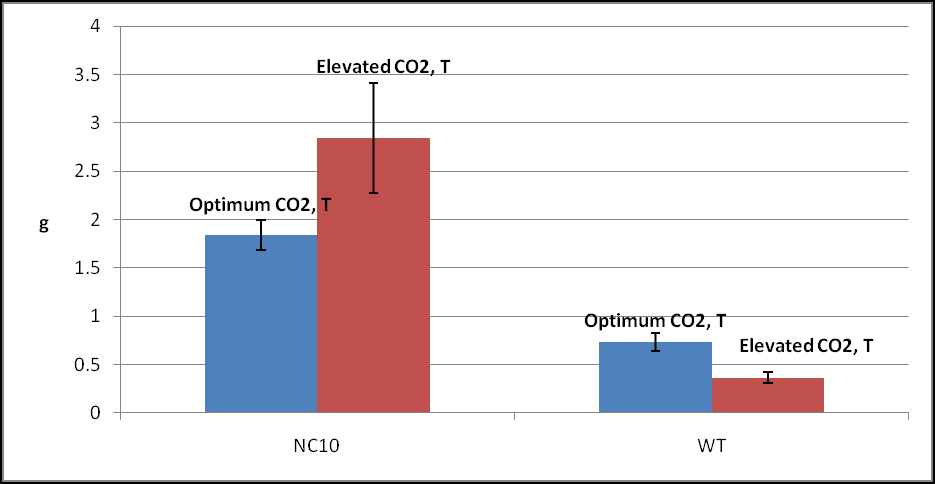
Such a contrasting behaviour might have occurred due to the fact that the transgenic line NC10 is tolerant to Singh S and Khalid H. LlaNAC Transgenic Tobacco Lines Efficiently Sequester and Stockpile Carbon. J Agri Res 2017, 2(2): 000131.
abiotic stress, and at least its tolerance to the heat stress during the germination stage has been reported earlier Copyright© Singh S and Khalid H.
[5]. Thus, as the elevated temperatures cause heat and drought stress, the NC10 plants manage the stress more efficiently, presumably with better water use efficiency, and make use of additional carbon dioxide available to synthesize more carbohydrates, and consequently the biomass. On the other hand, the growth of wild-type plants get restricted precisely due to the same parameters- the heat, and the consequent drought. All the efforts of the plant get restricted to manage the survival, and the growth gets suspended, despite higher quantities of carbon dioxide available. Considering the estimates submitted by Intergovernmental Panel on Climate Change (IPCC), global mean temperature would be 21°C by 2025, i.e., 1°C above the level it was in 1990 [7]. Crop growth simulations indicate that yields of plants will decrease with each 1°C increase in seasonal average temperatures. With an increasing population to feed, the world today needs technologies that ensure more grain for food and biomass for fuel production under elevated temperatures, precipitation, infrequent floods, droughts, cyclones, etc., and elevated carbon dioxide. Unseasonal rains in first quarter of 2015 alone have damaged crops hugely in North India, leading the farmers to commit suicides even in agriculturally rich states of Punjab and Uttar Pradesh. Transgenic plants, as the one described here are potential solutions of uncertainty of agricultural yields that the world is facing today. The LlaNAC gene has already been shown to provide tolerance to cold and heat stress, shortening the life cycle of the plant, providing more biomass without affecting the seed yields.
Conclusion
The cultivable land is rapidly reducing due to creation of housing resources for increasing population, and degradation of soil due to anthropogenic activities. Degraded lands are already being recommended for cultivation of biofuel crops. Thus, abiotic stress tolerance will be the foremost trait that future crops need to possess. Transgenic plants containing LlaNAC is a likely solution thus for ensuring biomass and yields in future. Breeding of such plants with varieties having other desired traits is a practical suggestion for agriculturists in future [8] to suit to specific agroclimatic zones. The genetic engineering product described here (LlaNAC transgenic line NC10) is truly a technology available towards sustainable future in agriculture for food, feed and fuels.
Singh S and Khalid H. LlaNAC Transgenic Tobacco Lines Efficiently Sequester and Stockpile Carbon. J Agri Res 2017, 2(2): 000131.
Acknowledgement
Author is thankful to the Dr M. Nasim, DIBER for providing necessary infrastructure, logistic support and moral encouragement.
References
-
Clark JL and Zhang P (2013) Plant biotechnology for food security and bioeconomy. Plant Mol Biol 83(1- 2): 1-3.
-
Grover A, Patade VY, Kumari M, Gupta SM, Arif M, et al. (2013a) Omics approaches in biofuel production for Green Environment. In: Barh D, Zambare V and Azevedo V (eds) Omics: Applications in Biomedical, Agricultural and Environmental applications. CRC Press, Taylor & Francis, LLC, USA: 623-636. **3.** Grover A, Patade VY, Kumari M, Gupta SM, Arif M, et al. (2013b) Bioenergy crops enter into the omics era. In: Omics applications in crop science. CRC Press, Taylor & Francis LLC, Abingdon, USA: 549-561.
-
Grover A, Singh S, Pandey P, Patade VY, Gupta SM, et al. (2014) Overexpression of _NAC_ gene from _Lepidium_ _latifolium_ enhances biomass, shortens life cycle and induces cold stress tolerance in tobacco: potential for engineering fourth generation biofuel crops_._ Mol Biol Rep Netherlands 41(11): 7479-7489.
-
Gupta SM, Grover A, Nasim M (2013) Transgenic technologies in agriculture: from lab to field to market. CIBTech J Biotechnol 3(3): 20-47.
-
Houghton JT, Collander BA, Ephraums JJ (Eds.) (1990) Climate change- The IPCC Scientific Assessment. Cambridge University Press, Cambridge, UK: 135.
-
Patade VY, Khatri D, Kumar K, Grover A, Kumari M, et al. (2014) RNAi mediated _curcin precursor gene_ silencing in Jatropha (_Jatropha curcas_ L.). Mol Biol Rep 41(7): 4305-4312.
-
Uzogara SG (2000) The impact of genetic modification of human foods in 21st century: A review. Biotechnol Adv 18(3): 179-206. Copyright© Singh S and Khalid H.
- Enhancement of Vegetative Growth and Fruit Yield in Cucumber (Cucumis sativus L.) via Spiritual Blessing (Biofield) Energy Intervention
- Production of Açaí (Euterpe oleracea Mart.) under Different Agroforestry System Management Intensities in Amazonian Floodplain (Varzea) Forests
- Coffee and the Production Region: What is the Secret to the Expression "Quality"?
- Experiential Agripreneurship Training in Sub-Saharan Africa: Integrating a Business Incubator into Postgraduate Livestock Education at the University of Buea
- Advances in Agricultural High-Quality Development
- Linking Compost Residue to ABAGE in Plants - a Short Note