
Meal Cultures - A New Concept in Food Security Debates on African Leafy Vegetables in Kenya and East Africa
<p>The debate on food security predominantly focuses on availability of and access to food as agricultural products like wheat, rice, maize etc. However, human beings usually do not eat raw agricultural products, but prepared dishes. This is why it is pivotal to take account of the whole process of transforming food to meals. Food security debates that concentrate on agricultural products only, remain too narrow. Human nutrition is a complex socio-cultural phenomenon. All living species need food for survival, but human beings are governed by cultural norms and taboos regulating this process of incorporation of natural products. I have introduced the concept of meal culture in my research because I felt a strong need for a new view – a new paradigm that reflects the social, cultural, and environmental embeddedness of our gender relations in the nutritional and agricultural sciences.</p> <p>Thus, the meal culture approach can be seen as a challenge to the classical discussion on food security and safety, or even food sovereignty. It can be seen as a query, even to critical agro-food studies, as the concept of “meal†has not been given the needed merit by having been included as a focal point of investigation and research, yet. The concept of meal culture offers a way to build new transdisciplinary connections within the scientific debates on food and nutrition. It is part of a broader concept of humans interacting with the natural and cultural environments. In this contribution, a human and cultural ecological approach to meal culture will be introduced. As meals shape our social relations and communication systems, including gender relations, they should be part of scientific reflections about our daily diet. It is not only a matter of what people eats, but also how they organize the whole process of preparing and sharing. Meals can bring people together and strengthen human interactions. Meals are constitutive in community building and are, thus, especially important in food insecure regions where social ties significantly determine whether someone is food insecure or not. Moreover, environmental conditions and the availability of water and energy, for example, need to be taken into consideration. The infrastructure including the necessary knowledge and technology for cooking, and not to forget the needed time beside social and cultural criteria of choice as well as the division of labor has to be considered in order to prepare and share a meal. Still meal preparation in most of the food studies and discussions remain in the dark, as long as these activities are taken place at home as part of care economy. With a new methodological systematization of research areas based on a human and cultural ecological funnel an inclusive meal culture concept will be introduced. Environmental aspects as well as socio economic and technological dimensions will be considered. The undervalued tasks of female contribution to household economy give space to integrate crucial questions of human nutrition and livelihood. The rediscovery of AIV in the last two and a half decades allows for reflecting historical development in East Africa with regard to changes in food habits. During colonial times African leafy vegetables were referred to as weeds or poor people’s food. Based on a broad literature revue and in-debth interviews with Kenyan experts and empirical studies the reconstruction of AIV in meal culture in Kenya is presented. Traces of development are followed from poor people’s crop to a commercialized enterprise present in supermarkets of bigger cities. The results so far can show an ambivalent situation with regard to the increased popularity and consumption of local vegetables. One aspect is the increase of prices for AIV in the market, no longer poor people’s crop. The other point has to reflect changes in gender relation and the consequences with regard to food and meal security on family as well as on local and national level. In Kenya and in many other African countries production, marketing preparation of AIV was and partly still is one of the last domains of women’s economic autonomy. Female farmers were mastering this field of subsistence economy and income generating activity which has given them self reliance and sovereignty. Female farmers as well are the ones in processing and preparing of meals guaranteeing nutrition health and security. But in the meantime men become more interested in taking over the AIV production and marketing with connection to supermarkets and whole sale as the prices rise and cultivating AIV and dealing with these crops become a money making source. Now if by these new processes of promoting AIV female farmers will lose the control in this field of autonomous activity, discussions around women’s empowerment becomes a farce. Careful evaluation is needed before it becomes too late. If nutrition security is the aim, research activities cannot become successful without studying gender relations in meal policy and meal culture. Agricultural sciences will gain by becoming more open to a meal culture approach and gender dimension of meal security.</p>
Introduction
Part 1: The Project: Hortinlea
This paper is a contribution to a larger German BMBF1 funded research project “Diversifying Food Systems. Horticultural Innovation and Learning for Improved
1BMBF – Bundesministerium für Bildung und Forschung – Ministry for Education and Research
Nutrition and Livelihoods in East Africa” (HORTINLEA).” It is part of the subproject 07 - “Meal Cultures in Market Trends and Consumption Habits,” with regard to African Indigenous Leafy Vegetables (AIV). These vegetables and processes of value chain are the main focus of the HORTINLEA research project in East Africa and especially in Kenya that started in 2013. The final reports are expected in 2018. This paper concentrates on the concept of meal culture as an innovative approach in the food security debate. The important aspect of people’s nutrition and meal culture on an everyday basis had been neglected in the scientific debates on food security for long. In the first part (PART I) the theoretical concept of meal culture is introduced referring to human and cultural ecological approaches. Research questions are systematized in a research funnel where environmental aspects as well as socio economic, technological and cultural dimensions of human nutrition and livelihood are considered. In the second part (PART II), I refer to documents and discourses with regard to African Indigenous Vegetables from different scientific and local knowledge perspectives. Looking back to colonial times allows for reflecting historical development in East Africa with regard to the intangible cultural heritage and changes in food habits. This includes socioeconomic as well as socio cultural dimensions of AIVs. The gendered division of labor in production as well as in the reproduction sphere encompasses the whole process of preparation and cooking of AIVs. All steps from field to plate need to be analyzed in order to understand processes of consumption, food habits and food ways and finally meal culture in East Africa and especially in Kenya.
Meal Culture a New Concept
The debate on food security predominantly focuses on availability of and access to food. However, human beings usually do not eat raw agricultural products, but prepared dishes. This is why it is pivotal to take account of the whole process of transforming food to meals. It is this process of transforming food to meals that needs our attention. Thus, the meal culture approach can be seen as a challenge to the classical discussion on food security and safety, or even food sovereignty. It can be seen as a query, even to critical agro-food studies, as the concept of “meal” has not been given the needed merit by having been included as a focal point of investigation and research, yet.
Food security debates that concentrate on agricultural products only, remain too narrow. Human nutrition is a complex socio-cultural phenomenon. It cannot be reduced to the quantity of food and political strategies based on economic data of calculated averages, statistical figures, and kilo calories [1, 2]. It needs a closer look at differences between social groups and actors and their entitlement that can even be different within a household unit [3]. The food security debate needs to be discussed from a broader concept of humans interacting with the natural and cultural environments. This has been taken up by the food sovereignty discourses that started in Latin America by a movement of small farmers called “La Via Campesina.” This strong social movement for the right of communities to produce their own food stands against the globalization processes in agricultural commodities by multinational companies that have taken ground from the small farmers, mostly female farmers in the Global South [4, 5, 6, 7, 8]. For la Via Campesina, food sovereignty is defined as: “The right of each nation to maintain and develop their own capacity to produce foods that are crucial to national and community food security, respecting cultural diversity and diversity of production methods.” They explain: “We, the Via Campesina, a growing movement of farm workers, peasant, farm and indigenous peoples’ organizations from all the regions of the world, know that food security cannot be achieved without taking full account of those who produce food. Any discussion that ignores our contribution will fail to eradicate poverty and hunger. Food is a basic human right. This right can only be realized in a system where Food Sovereignty is guaranteed.” [9]. Thus, the concept of Food Security needs to be revisited by taking the discussion on Food “Sovereignty” into consideration. It can be reshaped in the direction of social and environmental responsibilities with the livelihood concept. But even the so called “Sustainable food security” idea cannot be feasible, if the people’s nutritional habits, their customs, believes, and cultural attitudes towards food in the context of power structures and gender relations are not appropriately taken into account. Human and cultural ecological approaches can offer a way to shape an inclusive meal culture concept [10, 11, 12, 13, 14], in combination with the theoretical approaches of care economy [15, 16, 17, 18, 19, 20, 21, 22], that underlines the undervalued tasks of female contribution to household economy. Still the meal preparation in most of the food studies and discussions remain in the dark, as long as these activities are taken place at home. There are good reasons for changing the term “food security” to “food sovereignty,” with all the environmental, social, economic, cultural, and political consequences. In the long run it might even make sense to combine this mew movement of food sovereignty with the meal culture concept and come up with a term like “Meal Sovereignty”. This can be a separate discussion that will not be perused in this paper, but might be dealt with later, on another occasion. In this paper, I will investigate “Meal Culture” and gender order in combination with African Indigenous Vegetables. Adopting the term “Meal Culture” ensures that the gender aspect of meals, the division of labor in processing, preparing, and sharing get out of shade and become visible.
Sources of Inspiration
Positive impulses can be picked up in social and cultural sciences to place the concept of meal culture in the scientific debate. Cultural and social anthropological studies have taken the matter of human nutrition, environmental conditions, and use of resources, processing, and cooking serious. Human ways of eating are more than just the feeding and supply of calories. The symbolic order is of tremendous importance and therefore need to be included in all categories of food discourses. It is interesting that Georg Simmel, a German sociologist, had used the term “meal“ in a speech he gave at the 10th of October 1910, for the hundred-years anniversary of the Humboldt-University of Berlin. His speech has been published as an article called “Sociology of Meal” (Soziologie der Mahlzeit), more than a century ago [23]. In this publication Simmel has underlined the importance of meals as a social institution. He argues that all human beings have eating and drinking in common, but this remains a very individual act. Simmel even calls it an egotistical affair, as what one has eaten, cannot be shared with others. He explains this in his Sociology of the Meal: Und gerade dieses ist eigentümlicherweise das Egoistischste, am unbedingtesten und unmittelbarsten auf das Individuum Beschränkte: was ich denke, kann ich andere wissen lassen; was ich sehe, kann ich sie sehen lassen; was ich rede, können Hunderte hören - aber was der einzelne isst, kann unter keinen Umständen ein anderer essen“ Simmel (1910) [24] Jukka Gronow in the book about: The Sociology of Taste has written the following with regard to this citation:
“Simmel started his discussion of eating and drinking with a paradox: namely, he stated that eating and drinking are common to all human beings but at the same time they are the most selfish and individual activities. According to Simmel’s understanding, ohers can hear and see whatever I hear and see but no one can strictly speaking taste - or ingest – the same articles as I do. The sensual pleasure of eating is, thus completely individual. It is this antinomy of eating as simultaneously something totally universally human and completely individual that, to Simmel, gives the meal a social form” Gronow (1997/2001) [25]. Therefore, the meal (Mahlzeit), is a social construction where sharing becomes an important cultural process of socialization. Unfortunately, this meal concept was nearly forgotten. It did not become apparent in the scientific debate on food and nutrition or in the “food security” debates of international organizations like the UN and others. A valuable source in German publications is a book written by Klaus Eder, who sees the process of eating as (Einverleibung) “incorporation” of nature. He has dedicated his work to the history of the carnivore societies, dealing with eatables and taboos, as well as modern culinary cultures and the symbolic order of nutrition [26]. Another interesting author is Norbert Elias (1988) [27], with his late discovered work “About the Process of Civilization”. He has looked intensively at manners of eating in historical context, along with changes in instruments and tableware used by the upper classes in Europe. A topic that has been discussed by many other social and cultural science oriented authors like Pierre Bourdieu (1982) [28]. He looked at the eating habits that were different by social classes. Meal culture is the means of distinction, personal and social identity, and “othering” in all societies [11, 28, 29, 30]. This can become especially important in societies with experiences in migration, differences in ethnicity, as well as colonial and postcolonial traditions, and regional differences like Kenya [31, 32, 33]. “If food security is oriented towards the survival of human beings, much more attention should be given to the fact that human nutrition is culturally bound. It is a process by which humankind embodies nature through culture [34]. All living species need food for survival, but human beings are governed by cultural norms and taboos regulating this process of incorporation of natural products” Teherani-Krönner (1999) [35]. Marvin Harris has given interesting examples of taboos, like cows that are considered sacred in India and abominable pig in the Middle East, especially in old Egypt, among Jews and Muslims. He also refers to holy beef in USA. Harris argues from diverse ecological, economical, and socio political perspectives and shows the rationality behind these taboos [11]. Even under difficult circumstances, human beings will not easily accept and eat anything that may be available to supply their need for calories, vitamins, proteins and minerals, even if they are hungry [26, 12]. All religions or cultural orders have some sort of taboos with regard to eatables. “For every omnivore, especially humans, ingestion is both a private and a dangerous act. Eating implies incorporation, i.e., taking the food in, across the body’s boundaries, and letting it become an integral part of the self. Both the scientific literature and everyday observation show that some foods are more likely than others to cause concern: products of animal origin are typically perceived as more dangerous. At the same time, meat is the most universally craved of all foods; no documented society is completely vegetarian. And in all cultures, the majority of dietary prohibitions and the most marked individual aversions are focused on meat and other animal products” [36]. Thus, in general, meals can be seen as socially and culturally constructed, no matter how simple or sophisticated they are prepared. Gerd Spitter has described how joyful the Kel Ewey eat the same simple meal every day [37]. The social construction of everyday life Berger/ Luckmann (1982) [38] is present in our daily meals and dishes (Mahlzeiten) [23, 28, 39, 40, 41, 42]. Thus studying meal culture can become an excellent opener to understand people’s way of life and cooking can path the way.
Cooking as a Missing Link
Meal preparation and cooking are among the oldest social and cultural practices of human beings. They are important for understanding problems of food insecurity. Therefore, they should be taken into account in agricultural and nutritional sciences. The concept of meal culture can offer a way to build new transdisciplinary connections within the scientific debates on food and nutrition. In fact, human beings do not get satisfied by just agricultural products, but from processed and cooked meals. Agricultural crops, vegetables or animal products, as well as commodities from fishery and forestry need to be treated by different techniques in order to become eatable. Some agricultural products need to be handled in a laborious process to become digestible meals. Manioc for example, common in Latin American as well as African countries as a staple, must be treated properly and with caution to lose its toxic character. “Die Wurzel der Maniok-Pflanze ist der wichtigste Stärkelieferant für etwa 300 Millionen Menschen. Sie muß dabei zu einem Brei zerrieben und mit Wasser ausgewaschen werden, um die giftigen Blausäureglykoside zu entfernen“[43]. “The roots of Maniok also known as Cassava are a vital source of starch and a stable to about 300 Million people. The roots have to be grind and washed and cooked in water in order to remove the toxic hydrogen cyanide effect Gartenpflanzen (2013) [43] free translated by P T-K) This process of turning food or the raw into cooked and ready to eat, or transforming agricultural and horticultural products into a meal, has been a topic of anthropological investigations. In fact, cooking is regarded as one of the most important achievements of civilization, the way it has been introduced by Claude Lévi-Strauss (1983) [44] as well as by the Iranian anthropologist Ali Bulookbashi in his work: Cook and Kitchen (2013) [45]. Michal Pollan (2013) [46] is a famous researcher, activist and journalist as well as professor for journalism at University of California, Berkeley, USA. He reconstructs the history of cooking along the four major elements, fire, water, air, and soil, in his book called: “Cooked: A Natural History of Transformation” [46]. Fire became important in the long run of human nutrition to prepare meat and make it tender. Water and the boiling of plants and meat prove to be more energy effective and is the most common way of preparing things we eat. Air is important for the process of fermentation it improves digestibility and creates new qualities of products beside the fact that it is a wonderful conservation technology. Finally it is the soil that gives ground to cultivate all sorts of grain and plants. All of these authors admit the importance of cooking as one of the first creative inventions and a precondition to the development of cultural achievements of human kind. From an anthropological point of view, cooking has enabled human beings to reduce the energy they otherwise would need to digest the raw natural products they gathered. With this developed art of cooking Homo sapiens were enabled to spend their time on investigations and creations of other cultural achievements [47]. East African vegetables are mostly not eaten raw. The indigenous leafy sorts are mainly cooked or fermented. That means horticultural products, such as African Leafy Vegetables (AIVs), are turned into meals by a whole set of activities, such as processing, cooking, steaming, baking, and serving. For example, the processes of fermentation have a long tradition in East Africa where this knowledge is still alive, especially among elderly rural women. In 1993, Dirar, who is a Sudanese scholar, published his collection of the many different techniques of conservation of food like fermentation for survival during scarce periods [48]. Unfortunately, these sociological, cultural, and anthropological researches have not yet been absorbed by the food security debate. Not being recognized as a serious topic even by feminist research, cooking for a long period of time was a neglected issue. It was avoided, as not worthy of investigation from a scientific point of view [49, 50, 51, 12, 13]. Of course there were always some exceptions, like the work presented by Martina Kaller- Dietrich and Annemarie Schweigenhofer-Brauer (2001) [52] under the title: “Women cook: a cultural anthropological view on female cooks, kitchen and eating”, or the contribution by Elisabeth Meyer- Renschhausen (2010&2014) [53, 54], showing the historical process from the “Black to the White Kitchen”. Bahr Bugge (2003) [55] has investigated in: “Cooking - As Identity Work”, looking at Norwegian everyday life and the performance in television programs. There cooking can be regarded as entertaining but made sensitive towards traditional food as well. It will be interesting to follow this issue in East Africa and in Kenya as well.
Meal Culture in a Human Ecological Approach
In this contribution, a human and cultural ecological approach to meal culture will be introduced. As meals shape our social relations and communication systems, including gender relations, they should be part of scientific reflections about our daily diet. It is not only a matter of what people eats, but also how they organize the whole process of preparing and sharing. Meals can bring people together and strengthen human interactions. Meals are constitutive in community building and are, thus, especially important in food insecure regions where social ties significantly determine whether someone is food insecure or not. Moreover, environmental conditions and the availability of water and energy, for example, need to be taken into consideration, including the necessary time and the division of labor in order to prepare and share a meal.
With a meal culture concept a new chapter in scientific research will be opened. Placing - what nurtures people- in the core of food security studies and research will broaden the debate on human nutrition. This encompasses the environmental and socio-cultural dimensions, as well as people’s mode of production and interaction. When thinking about “meals”, we will recognize that there are much more components necessary to prepare a tasty meal that will fit the habits and preferences of people in different societies based on the available environmental and social resources [12, 13]. Food systems and the mode of preparation are diverse and they change from region to region based on ecological, technological, economical, as well as political conditions. And last but not least, we should remember the normative value system that shapes the taste, preferences, and nutritional taboos [11]. It is necessary to understand the local criteria for healthy and appreciated meals with respect to ethical criteria. Beside the physical need the remaining question is what makes a meal social and culturally accepted and having it a joyful act. With a human ecological approach, changes in the environment and social structure can be analyzed and understood. Movements that occur in rural and urban areas will affect nutritional habits and meal cultures, and vice versa. This following human ecological concept is close to the models that had been developed by human ecologists in the early 20th century Park and Burgess (1921) Park (1936/1952) [56, 57] and cultural ecologists like [10]. Human Ecology has a long history. It was developed as part of the Chicago School of Sociology and the Department of Geography. It was further developed and reconstructed in German publications by Glaeser (ed. 1989) [58] Glaeser / Teherani-Krönner (eds. 1992) [59], Weller, Stephen et al. (no year) [60], Bruckmeier and Serbser (eds. 2008) [61], Teherani-Krönner (1992, 2008, 2014b) [20, 21, 62, 63] and others. Though human ecologists did not pay attention to gender issues at that time, still it is helpful to respect their roots of thinking. Their models were already quite holistic with different dimensions. They conceptualized the relationship of human beings with their social and natural environment, looking at ecology as the basis of human societies [57].
Figure 1: Engendering Human Ecology. Meal culture, like all other phenomenon of the interplay of nature-culture can be placed in the middle of the human ecological triangle [63, 64, 19, 20]. Human beings exploit their environments by developing and using technologies. The relationship of human beings with their social environment is based on communication. It is a combination of material and intangible culture, along with social institutions Steward (1955) [10], that depends on the resources, the technology that is used, and the social institutions. The communication system with the human need for social acceptance has to be seen as equally important as the need for existence. This is why I have modified the human ecological triangle as the Nature-Culture arrangements that operate with two dynamic motivations. The assumption is that human beings depend as much on their material needs as they are longing for social acceptance. A German philosopher, Axel Honneth, even gives priority to the idea of social acceptance in his theory, by highlighting “The Struggle for Recognition” [65]. For him, social recognition is the incentive for most of human activities. I think a concept of dual basic needs have to be considered as equal forces in shaping our cultural development and all human activities. And eating is one of the very basic actions [23,66,67,45,46,]. It is within this human-nature-environmental-constellation, where our concepts of meal habits and livelihood, as well as gender order are constructed [21, 20]. Respecting these dimensions will help to understand (“sinnverstehen”) people’s decision making processes and choices. I had developed a first draft of the human and cultural ecological triangle in an earlier publication in order to Social institutions Agencies Communication Need for social include and respect the socio-cultural dimensions in development studies [68]. A human and cultural ecological approach in meal culture can also be visualized as an inverted pyramid or a funnel with seven layers [19], where the division of labor, the local knowledge, the political power structure, and gender relations are encompassed. A combination with the concept of gender order is present in my article: “A Human Ecological Approach to Ester Boserup. Steps towards Engendering Agriculture and Rural Development” [20]. I have explained the main dimensions of the extended pyramid and the different steps in my contribution about: “Meal Politics, Meal Security and Meal Culture” [19, 61, 69]. There a methodology to investigate in meal culture research that can be used as an analytical framework is presented that can be used for field studies in Kenya as well. It is based on the extended human ecological pyramid with a funnel of seven steps:
A Human and Cultural Ecological Funnel
![Figure 1: Engendering Human Ecology. Meal culture, like all other phenomenon of the interplay of nature-culture can be placed in the middle of the human ecological triangle [63,64,19,20]. Human beings exploit their environments by developing and using technologies. The relationship of human beings with their social environment is based on communication. It is a combination of material and intangible culture, along with social institutions Steward (1955) [10], that depends on the resources, the technology that is used, and the social institutions. The communication system with the human need for social acceptance has to be seen as equally important as the need for existence. This is why I have modified the human ecological triangle as the Nature-Culture arrangements that operate with two dynamic motivations. The assumption is that human beings depend as much on their material needs as they are longing for social acceptance. A German philosopher, Axel Honneth, even gives priority to the idea of social acceptance in his theory, by highlighting “The Struggle for Recognition” [65]. For him, social recognition is the incentive for most of human activities. I think a concept of dual basic needs have to be considered as equal forces in shaping our cultural development and all human activities. And eating is one of the very basic actions [23,66,67,45,46,]. It is within this human-nature-environmental-constellation, where our concepts of meal habits and livelihood, as well as gender order are constructed [21,20]. Respecting these dimensions will help to understand (“sinnverstehen”) people’s decision making processes and choices. I had developed a first draft of the human and cultural ecological triangle in an earlier publication in order to Social institutions Agencies Communication Need for social include and respect the socio-cultural dimensions in development studies [68]. A human and cultural ecological approach in meal culture can also be visualized as an inverted pyramid or a funnel with seven layers [19], where the division of labor, the local knowledge, the political power structure, and gender relations are encompassed. A combination with the concept of gender order is present in my article: “A Human Ecological Approach to Ester Boserup. Steps towards Engendering Agriculture and Rural Development” [20]. I have explained the main dimensions of the extended pyramid and the different steps in my contribution about: “Meal Politics, Meal Security and Meal Culture” [19,61,69]. There a methodology to investigate in meal culture research that can be used as an analytical framework is presented that can be used for field studies in Kenya as well. It is based on the extended human ecological pyramid with a funnel of seven steps:](/fulltextimages/1368/fig_1.png)
Translation of the German modified version in: Teherani-Krönner (2014) [35]
The leading questions can be:
Natural Ecological Resources: to be combined with a question like
- What do we eat?
- Who eats what?
- What are the natural sources of our nutrition?
- Technological Equipments for Producing and Cooking
- How do we prepare?
- What are the technologies in use?
- Who controls these technologies?
- Economy and the Division of Labor
- Who does the work and takes responsibility?
- What are the gender boundaries of work and their conditions?
- Social Institutions and the Organization of Meals
- How is the meal arranged
- What are the rules?
- Who sets them?
- Social Action – Everyday Life
- Cooking Abilities – what are our meal habits
- What and how and with whom do we share meals?
- Local Knowledge – Gendered Knowledge
- Who knows how to prepare?
- What to eat and what are the criteria for a ‘good meal’?
- Where do we get our recipes? What can be combined?
- Symbolic Order and the Normative System
- What is enjoyable and what is disgusting and why?
- What are customs and believes
A sensitive gender perspective is crucial to all these dimensions. These questions can be specified with regard to meal culture in East Africa and especially with respect to African Indigenous Vegetables. They can lead a comprehensive research to reach a deeper understanding of the emeddedness of our nutrition and broaden the “food security” debate essentially.
If the food security debate and the agricultural policy and economy would focus more on meal cultures and not just on some particular marketed cash crops and commodities, the whole socio-cultural process can become an important part of scientific reflection on nourishment [12]. This goes far beyond the value chain of production, marketing, and consumption, but would also include meal preparation, sharing, eating, and enjoying a meal as part of the food system and culture. Looking at vegetables from agricultural and horticultural perspectives is only one side of the picture. Looking into the whole cycle of production, consumption by including the social reproduction sphere is the other side. It goes into preparation of meals, eating and sharing, which can be seen as a new approach in the field of horticultural value chain research. The innovative aspect is to include the social reproduction sphere as an essential part of the whole meal culture and value chain approach.
**Part 2: Meal Culture in East Africa – Particularly in Kenya**
**Discourses on African Vegetables**
Meal culture has not yet been introduced in the academic literature dealing with nutritional matters in African countries. As explained before, meal culture is a term seldom used in the scientific debate and available sources dealing with food, nutrition and food security. Therefore, I will include the meal concept in a broader frame of food studies. Especially, debates around nutrition and health issues will be considered with regard to African vegetables that are called African Indigenous Vegetables (AIV), as well as African Leafy Vegetables (ALV), or in some cases African Traditional Vegetables (ATV). I will explore sources that touch or get closer to the ideas that I had formulated to conceptualize meal culture and meal policy. Much attention has been given to issues around food with regard to nutritional and health issues, but not so much to consumption habits or food studies and foodways 2. Available literature and publications, as well as internet information by institutions and scientists of the last two and a half decades dealing with AIV or ALV will be discussed. The history and the re-discovery of these African horticultural plants are enlightening. It is vital to learn that these vegetables have a long tradition in that region supporting food (or better to say meal) security of the people in East Africa. During the last centuries these vegetables were essential to poor people’s nutrition on one hand, and on the other, they were known as “female crops.” It will be interesting to see how changes with regard to AIV during these last years have influenced these two dimensions of these traditional East African crops.
2Food ways – in the sources I found are written together as “food ways” (Maundu et. al 2013a), therefore I will follow this spelling.
These vegetables were neglected for a long period of time by scientific research [32, 70]. I will show some steps in the history and re-discovery of AIVs in Kenya and East Africa. By naming some institutions, research projects, and conferences dealing with AIV of the last decades, we can follow the food transition Raschke et al. (2007) [70] and the increased importance given to these newly celebrated crops. Some researchers who have promoted the rediscovery of AIV have become well respected in this debate. Research projects and conferences that had set questions around these leafy vegetables in Africa on their agenda will be acknowledged by referring to their topics. Finally, I will refer to some research projects that have similar ideas to meal culture even if the term is not used. Some parts of the report might go far beyond the discussion around meal culture – but it can show how important the AIV debate has become during a relatively short period of time. Attention has been given to these leafy vegetables by external and internal institutions and promoted by the international research network AVRDC (the World Vegetable Center - Regional Center for Africa and many others). Research topics with regard to the evidence of re-discovery of AIV from a social and cultural point of view, looking at meal culture (especially in combination with gender from a social science point of view), are not easy to find. It looks as if food anthropology or food sociology with a more holistic perspective has not discovered the AIV as their research topic. I am pleased to at last be able to introduce few sources and provide information about unpublished data collections that can be used in future when the results of ongoing investigations become accessible. Even if the term has not been used keywords like food culture; – traditional food; and especially the term “foodways,” bring us quite close to the meal culture concept.
Re-Discovering African Indigenous Vegetables AIV
Since the late 80s and early 90s, AIVs have been re- discovered as a possible source of improving nutritional status of East African countries. Meanwhile, there are remarkable activities that can show the emphasis given to this long forgotten source of meal culture in Africa. Activities regarding this re-discovery come from inside and outside of the region. Research institutes and university departments of agriculture and horticulture are dedicating part of their activities towards the AIV [32]. They have organized conferences and Internet platforms for information and exchange of research results. At the Trope tag in Germany for example the issue of African Indigenous Vegetables are present since 2007.
Most of the AIV research deals with the nutritional value of these crops; The research mostly concentrates on the natural science analysis of vegetables. The outcome of such analysis had shown the relative advantage of these local vegetables with respect to the ingredients: “many of them are richer in protein, vitamins, iron, and other nutrients than popular non-native crops such as kale, and they are better able to endure droughts and pests” Cernansky (2015) [71]. “These vegetables are generally rich in calcium and folate as well as vitamins A, C and E”. “According to Patrick Maundu of Bioversity International, nightshade provides good levels of protein, iron, vitamin A, iodine, zinc, and selenium at seven times the amounts derived from cabbage. The high levels of vitamins and micronutrients, he says, are especially important to people at risk of malnutrition and disease, particularly HIV/AIDS” New Agriculturalist (2008) [72]. The combination of medical treatments with these AIV is assumed to be especially effective to improve the immune system of those suffering from HIV/AIDS. But such information has another side effect that needs more investigation. People who eat these vegetables might get stigmatized as being HIV/AIDS positive and week. This information has been passed to me during our last visits in Kenya. Unfortunately I haven’t found a written source that has dealt with this issue. But I can mention the comments to this text by Rita Schäfer, who is an expert on the discourses on HIV/AIDS in Sub-Saharan countries and a long experience in Zimbabwe [73, 74]. She was asking whether the situation in Kenya is similar to Zimbabwe, where people avoid eating vegetables because these vegetables are associated with meal for the “week and sick” people [73]. Another valuable source for information on the African indigenous vegetables can be found in the Kenya Resource Centre for Indigenous Knowledge (KENRIK). Here again, Patrick Maundu writes about this institution: “Their work shows the potential of indigenous food plants in improving food security. In Africa, around 4,000 species of plants have the potential for producing food, with about 1,000 species used as leafy vegetables.” And “Traditional vegetables are usually rich in nutrients such as vitamin A and iron – often lacking in the diets of children and pregnant women” Maundu in New Agriculturalist (2008)3 [72]. This means that attention is given to health issues from a nutritional science perspective. Until now, most of the research work has
3Dr. Patrick Maundu is the head of the Kenya Resource Centre for Indigenous Knowledge
been dedicated to questions around the nutritional value of these vegetables on one hand, and the breeding and cultivation of these vegetables on the other. The value chain of AIV is a question that has been pursued by the HORTINLEA project since 2012, with the intention to improve production and facilitate distribution and consumption through a broad market in Kenya in rural, peri-urban, and urban areas [75]. Most of the research activities around AIV, as well as the financial support, go in the direction of breeding, where problems are recorded: “A main focus has been basic problems such as difficulties with germination and a lack of information about how best to store seeds. Indigenous vegetables are not up to modern farming standards for characteristics such as uniformity of seeds and yield, so there is a lot of catching up to do” [71]. As a social scientist with long experience in development studies, I was amazed that during our first discussion within the HORTINLEA project, little attention was paid to the local knowledge regarding breeding of AIV. Women, mostly the elderly female rural farmers, were the ones who could help because of their expertise and experience. They were knowledgeable and had done cultivation of AIV for centuries. But there was no attempt to include this indigenous knowledge about breeding. The interesting point that I learned was the misunderstanding about the term “reproduction”. I, coming from a social science background, was talking about the “reproduction sphere” as the domain of female activities at home in the household, and her contribution to care economy. My colleagues from the Department of Plant Breeding were thinking about “reproduction” as an activity in the laboratory for plant breeding. It took us quite some time before we discovered our terminological misunderstanding. Still the problem remains that the local knowledge was not taken serious and its value was not investigated before taking the seeds to the lab [76].
Some Historical Aspects
I will briefly show the importance of the discourse about African vegetables and meal culture from a historical perspective that could be part of food and meal history to be investigated. It is important to underline the significance of such a discovery, especially in East Africa as the region was a hot spot for rich plant diversity and eatable vegetables since ancient times. There is an exciting documentation about this noteworthiness in a research work from colonial times of 1930 to 1960, in Tanzania (former Tanganyika), by Max-Planck-Nutrition Research Unit, known as Oltersdorf Collection. This historical source has been introduced by Verena Raschke, et al, during her time at the University of Agriculture in Vienna, with her research work done in 2006, 2007, and 2008. “Historical, empirical evidence of the richness of traditional African food habits is currently coming to light. Our research group, through Professor Ulrich Oltersdorf, recently gained access to a unique collection of data obtained through the activities of the Max-Planck- Nutrition Research Unit, previously located in Bumbuli, Tanzania (former Tanganyika). This valuable collection provides evidence of the traditional foods and food habits of various ethnic groups located throughout Kenya, Tanzania and Uganda from the 1930s to the 1960s. The collection includes data pertaining to: traditional foods, food taboos, food preparatory practices, agricultural practices, local markets, cooking methods, nutritional status in relation to dietary intake, and chemical composition of traditional foods and their health implications [77]. This discovery even pays attention to African food habits, food preparation, and methods of cooking as important enough to be investigated. It is as well an indicator for the comprehensive understanding of nutritional issues of that time and probably much closer to the concept of meal culture than the fractionation of scientific work about food in the last decades. Verena Raschke stated this information was not openly available in 2007: “At present, the historical dataset collected by the Max- Planck-Nutrition Research Unit and additional historical and novel sources of information on traditional African food habits, has not been amalgamated and has not been made available for access by researchers and the public [77]. But the information became accessible later, as Raschke et al. offered more detailed information about these manuscripts shortly after this publication [31]. Anyhow these data have been stored at the University of Karlsruhe for over 30 years named “Oltersdorf Collection”. It is a precious source of historic information regarding meal habits in East Africa – Tanzania, Kenya and Uganda4. “Professor Oltersdorf was involved in nutrition research in the 1960s carried out through the Max Planck Nutrition Research Unit placed in Bumbuli in Tanzania.
4In a later publication Verena Raschke stated that all reports included within the Oltersdorf Collection have been manually scanned and converted to full text PDF-documents which are now accessible for free download via our online collection (http://www.healthyeatingclub.org/).
The fundamental step for the research Unit in East Africa in the 1930s was commenced by a German scientist (Professor Dr. Heinrich Kraut) who was very interested in nutrition of third world countries [31]. Coming back to the re-discovery of AIV in the last two and a half decades, I had the chance to interview Mary Abukutsa Onyanago, a horticultural researcher at Jomo Kenyatta University of Agriculture and Technology (JKUAT), in Kenya during our meeting in March 2012. She's almost like the mother of indigenous vegetables in Kenya, says Jane Ambuko, head of horticulture at the University of Nairobi [71]. Mary Abukutsa-Onyanago told me her own story dealing with African vegetables that is part of colonial past and present in Kenya. It is important enough to be briefly mentioned here from an authentic source as my interview with her is published Abukutsa Onyango (2014)5 [32]. She told me the history of these indigenous vegetables and her passion for them. “Long before colonial times we were using them widely in home and in our villages. They were collected or cultivated in small scale for supply of vegetables. People had observed that they were just strong. Sometimes they were collected in the wild or in deserted homesteads. During the colonial times the systems changed and new crops came in. People were told the native vegetables were back warded; that they were of low quality not good enough for the Europeans; and of low standard. People in Kenya were used to eat the indigenous vegetables, but now started to cultivate and eat cabbage and other newly introduced and imported seeds, so called ‘exotic vegetables’” (ibid). This means that during colonial times these African Indigenous Vegetables were normally referred to as weeds or poor people’s food. They were neglected and they started disappearing. Only old mostly female farmers continued to grow them and thereby conserving diversity. During her school time Amaranth and ‘pig weed’ (only good enough for pigs), were ignored. The plant called ' spider weed’, now has turned to ' ‘spider plant’, and black nightshade is called African nightshade. “Until the ‘80s, no one would talk about these crops. They were officially considered as useless weeds”.
5The following citations have been edited by Mary Abukutsa-Onyango as I had sent her the interview before translating it into German for the publication: “Mahlzeitenpolitik. Zur Kulturökologie von Ernährung und Gender” (Teherani-Krönner / Hamburger (eds.) 2014) Mary Abukutsa-Onyango has her own story and what she experienced in the UK while passing her PhD. She had already started a working group about AIV in 1991 at Jomo Kenyatta University of Agriculture and Technology. In 1992 Mary Abukutsa Onyango won a scholarship to continue her Ph.D. research. She wanted to pursue studies in the UK and proposed to study one of the indigenous vegetables. But this was rejected because these vegetables were not regarded of importance they were classified as weeds. They said: ‘Why don’t you go for onions?’ So I accepted”. Back in Kenya in December 1995 she used her knowledge to do research on indigenous vegetables first in Maseno University before coming back to JKUAT She became active in initiating a new working group to promote the sustainable production and consumption of AIV. Meanwhile, these vegetables have become well known as a valuable source for nutrition and health. This has been documented by a research work during a conference in South Africa [32].
Nutrition Transition
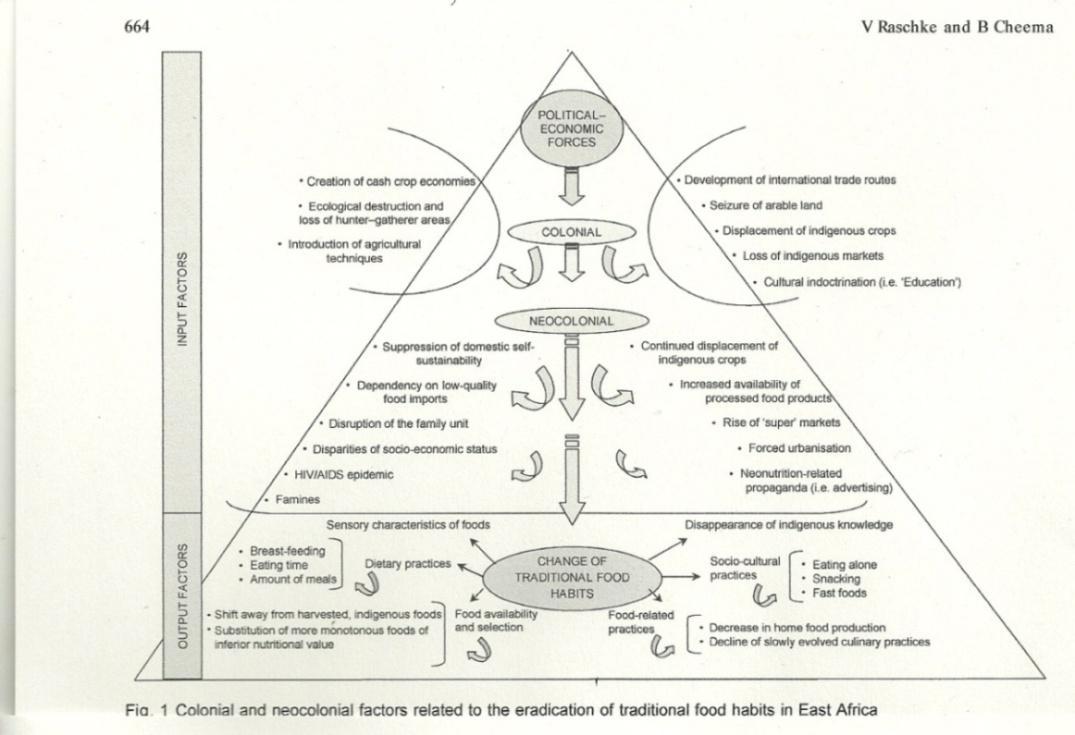
Verona Raschke et al. have prepared a questionnaire administered to opinion leaders in the nutritional sciences at the 18th International Congress of Nutrition (ICN), in Durban, South Africa, September 2005. At the congress, 92 questionnaires were completed. Referring to this empirical research, she came up with the following information: “Findings from the survey revealed that 86% of our cohort agreed that Africa is currently undergoing a nutrition transition. Nearly 80% believed that knowledge of traditional African food habits is being lost. Indigenous African interviewees noted reduced consumption of sorghum and millet and an increased consumption of wheat and rice within their region of origin [70]. In a more historically oriented article, Raschke and Cheema articulate a radical critical position about colonial and neocolonial processes in Africa. The globalization processes are blamed as a threat to food security in East Africa and the global South. They see as well the problematic aspects of re-discovery of indigenous vegetables and knowledge that will lead to discussions around intellectual property rights, biopiracy as a still ongoing neocolonial practice [78, 79, 80, 81, 82]. “The dissemination of traditional knowledge and grassroots campaigns must continue. Importantly, such efforts must elude being hijacked by the very forces they are intending to thwart, including individuals and organisations intending to profiteer from the patenting of particular crops and their genes. Ultimately, it is the individual, the family unit and the local community that must unite to reclaim their birthright to grow and consume their own local whole foods according to their own traditional practices. Such concerted efforts are required to circumvent the New World Order and their multinational corporations which currently control the global food system.
In summary, it is imperative that greater efforts be directed towards exposing the colonial and neocolonial forces which have undermined food security in East Africa and throughout the rest of the world. Heightened awareness of these forces is essential for proposing genuine, holistic solutions to the nutrition transition and related NCD epidemics in East Africa and indeed worldwide [78].
Promoting the AIV from Inside and Outside of the Country
Like in many countries of the Global South the situation in Kenya is serious. “Global food security is one of the pressing challenges of the 21st Century. In Kenya, half of the population is unable to meet their daily nutritional requirements, while the majority of Kenyans depend on farming. Horticultural crops and particularly African leafy indigenous vegetables provide essential nutrients that are lacking in the diet of millions” [83]. “According to the Famine Early Warning Systems Network, aside from a few areas, no part of the country is food secure as this season’s harvest of maize-the country’s staple food-was not enough to feed the nation” Gathigah (2014) [84]. Abukutsa-Onyanago is also aware of this problem and says “In Africa, malnutrition is such a problem. We want to see indigenous vegetables play a role” [71].
I had asked Mary Abukutsa-Onyanago: “Who supported and promoted activities around African vegetables?” She answered: “The activities were funded by various funding agencies. About 20 multidisciplinary and multi institutional projects have been funded since 1991/1992. The funding agencies included SIDA, SAREC, EC, National Council of Science and Technology, Maseno University and Jomo Kenyatta University of Agriculture and Technology. Such projects were funded since 1991/1992 –we had different projects. One was funded by SIDA – Sarec, the Swedish aid and research agency through IPGRI on African Leafy Vegetables. From 2006-2008, I became part of an EU funded project called INDIGENOVEG that involved seven African countries and five European institutions and market supply chains of African indigenous vegetables that covered fourteen cities in Kenya, Tanzania, Uganda, South Africa, Senegal, Benin, and Ivory coast” [32]. “Another project at the Maseno University/Kenya was funded by IFS (International Foundation for Science), the Swedish Aid Agency ín Pottier, Johan (1999) [85]. The research was multidisciplinary. As indigenous vegetables had been neglected before, we had to identify the problems and look at the whole process (value chain) – we had to look at the players along the value chain, from the ground to the table. It was the technology that we had to take care of. We had to work in multidisciplinary teams to have a holistic approach.” [86]. This combination of external and internal activities are also mentioned in an article:, “African Leafy Vegetables Come Out of the Shade” (New Agriculturist 2008) [72]. Mainly three Institutions are named to be influential with regard to this re-discovery of AIV in that region. “In East Africa, the renewed interest in nightshade and other indigenous vegetables, including amaranth, African eggplant, Ethiopian mustard, cowpea, jute mallow and spider plant, has been partially stimulated by a successful campaign in Kenya and Tanzania led by Bioversity International, Farm Concern International and the World Vegetable Center (AVRDC), who have worked to promote the nutritional benefits of the crops, as well as encouraging improved production techniques” (New Agriculturalist 2008:1) [72]. One of these activities that has been launched from outside is the HORTINLEA project. This is a research project in cooperation with German and East African research institutions and universities, especially located in Kenya. As mentioned before HORTINLEA is an interdisciplinary research project addressing food security in East Africa, particularly in Kenya. The overall goal is to improve the livelihood and nutritional situation of the rural and urban poor.” The research project aims at capacity building among young scientists by offering forty PhD scholarships, mostly to East African (especially Kenyan) students, from 2013 onward. Gender order and meal culture are two of the subprojects, managed and coordinated by the Division of Gender & Globalization of the Humboldt-University of Berlin, sponsored and funded by the German Ministry of Science and Education.
An Awareness Campaign on AlV in Nairobi
It is good to know that there was an “awareness campaign” on AlV in Nairobi between 2002 and 2005. The idea was to increase consumption of AIV, especially in the capital, as the population in urban areas like Nairobi prepared and ate less of these vegetables than people living in the rural countryside. Information about the nutritional and health benefits was the message of this campaign that I will not discuss here, but I refer to a research work that investigated the results of this promoting activity. Beside these health components, Elisabeth Obel-Lawson, (School of Journalism, University of Nairobi), was interested to learn more about the subject. She looked at the perception of these vegetables among the city dwellers. She wanted to identify cultural, social, and economical factors underlying attitudes and behaviours towards African leafy vegetables in her research project in 2006. This interesting work includes a list of more than 50 good reasons for eating ALV, which is worth to study [33]. Another interesting finding includes the channels of information that were used during the campaign and other sources that had influenced the questioned persons. “The research significantly found that of the top four channels of communication on ALVs and nutrition, the audience’s main channels of information were non-media sources (60.6%), with a quarter (25.6%) of the sampled population attributing their source to their mothers, and about 21% reporting the informal network or ‘ word of mouth’ as their primary channel. Family or village tradition was the third most significant channel (13.9%). Broadcast media channels followed closely with about 12% respondents citing radio and TV, while print media was reported by only 8.4% respondents.” Obel-Lawson (2006) [33]. During my interviews with Mary Abukutsa-Onyango in 2012 and 2013 (published in 2014), she told me that she was active in promoting use of these vegetables in hospitals, via the contacts that she had at the ministry of health. Since 2003, a scientist at the Kenyatta National Hospital was very helpful in implementing the given recommendation for the meals served to the patients during their stay in hospital [32]. “Her passion, coupled with her careful scientific research, has repositioned African indigenous vegetables from a poor man’s crop to a commercialized enterprise that can be found in supermarkets today.” [87]. With the increase in market demand, crop breeders are developing higher-yielding and tastier varieties. Dr. Christopher Ojiewo6, a crop breeder and a pioneer in new cultivars who produces fewer fruits and more leaves says:
6 Chris Ojiewo, AVRDC-The World Vegetable Center, Tanzania has worked in Japan. He was among the "I have already produced two mutants which I have sent to Jomo Kenyatta University of Agriculture & Technology (JKUAT), for trials before eventual release to farmers." (PROFAF (2011), Ojiewo in New Agriculturalist 2008) [72], Ojiewo, Christopher (2012,2015) [88, 89, 90].
Cooking AIV and Recipes as a Topic in Academic Research
In many of the information platforms and discussions around AIV, it is remarkable that among the scientific analysis about these vegetables the topics of preparing, cooking, and the taste of vegetables are issues to be discussed. This is why in addition to the natural science analysis of these vegetables, numerous recommendations on preparing and cooking AIV to meals can be made. Although the intention of these studies is mostly a natural science perspective of how the nutritional value changes in the process of preparing and cooking, it remains a noticeable fact. It is worth to record that even on the homepage of AVRDC, the World Vegetable Center, Regional Center for Africa, we can follow videos that show recipes to prepare and cook different AIV. They have added books and information with recipes on their list of publications. It is part of promoting these vegetables, not only in East, but in West Africa as well. This is why some of the videos come from the Food Technology Department of the Research Institute for Applied Sciences and Technologies (IRSAT). Burkina Faso created the video in the following link that highlights some delicious and nutritious recipes for traditional vegetables (AVRDC 2015)7 [91]. Mama Guga, AVRDC Regional Center for Africa, shows how this discovery or shedding light on AIV should be promoted to show the processes of preparing, cooking, and testing AIV8. Thus, cooking has become a topic in the discussion about AIVs, – but this is mostly with regard to its nutritional values and taste. In my interview with Mary Abukutsa, she mentioned that they have tried to prepare the meals with different AIVs and tested them among the scientists in our first meeting in Nairobi in 2012, and very open to the issues of meal culture and gender order. Unfortunately, he had other commitments and was not able to join HORTINLEA in later years. But he provided me with some useful links to literature that were discussed during conferences in East and South Africa. 7YouTube includes videos about cooking the re-discovered vegetables: http://avrdc.org/enjoy-traditional-african-vegetables/ (accessed 15.12.2015). 8 https://www.youtube.com/watch?v=cVJALqcZHyg ((accessed 15.12.2015).
students of JKUAT. Probably she is one of the few plant breeders who include cooking of vegetables as part of her activities. Nature published an article on the 9th of June 2015, titled “The Rise of Africa’s Super Vegetables”. Long overlooked in parts of Africa, indigenous greens are now capturing attention for their nutritional and environmental benefits, as described in an article by Rachel Cernansky in Nature (2015) [71]. “In recent years, Abukutsa has been studying how to maximize nutritional benefits using different cooking methods. Compared with raw vegetables, boiled and fried greens contain much more usable iron and could help to combat the high rates of anaemia in parts of East Africa. They can also be important sources of protein, she says. ‘Some people just live on vegetables, and they cannot may be afford meat’.” [71] “Unlike larger leafy vegetables such as kale, many of the indigenous varieties have small leaves that must be separated from their stems individually before cooking-a laborious process. Recipes are often vegetable-specific; spider plant can be cooked with sour milk, for example, but cowpea leaves go better with soya bean or peanut paste. Although older generations and some rural populations know what to do with nearly any local vegetable, much of the region's traditional cooking knowledge has been lost. So Abukutsa got to work on collecting and testing recipes to maximize the amount of iron and other nutrients the dishes contain. K'Osewe was one of the first restaurants to take an active interest, and others soon followed” [71].
Taste Preferences of Bitterness
The bitterness of AIV is one of the discussed issues regarding indigenous vegetables. The campaign has focused on the taste preferences of different consumer groups. In Kenya, for example, coastal and western communities opt for the bitter types, while those living in the central highlands and urban areas prefer the non- bitter varieties. In Tanzania, most communities have a preference for the bitter leaves but the broad leaved sweeter types that were newly introduced by AVRDC are increasingly being [72]. This topic has been discussed in Nature (2015) [71] and Ann Aswani as well mentions it as one of the important characteristics of AIV [92, 93]. In dealing with this bitterness, Kenyan cooking knowledge has developed and used a special salt, called “ley.” I had asked Mary Abukutsa-Onyango about this specility. Ley is a product based on very specific regional knowledge that needs careful preparation.
“Dried leaves of special plants are burnt to ash, and then the ash is filtered to produce a clear substance that is used for cooking indigenous vegetables. It is called lye and it can improve the texture and palatability of indigenous vegetables.”. Further explanations about the production and use of ley are available as well in Maundu 2013 a, b, d) [94, 95, 96] with pictures and recipes.
The Time Consuming Preparation of AIVs
Following the processes of preparation a meal with AIV on a video that Anne Aswani, a nutritionist and one of HORTINLEA Ph.D. candidates, we became aware of the elaborate cooking task. The video shown during the conference “From the Field to the Table-Investigating Gender Dynamics in Production, Marketing and Consumption of African Indigenous Vegetables (AIVs) in Kenya” (May 2015), demonstrated how time intensive as well as energy consuming this activity is. Even after producing or purchasing AIV, the preparation starts with washing, picking, plucking, and washing again, and cutting, that needs a lot of time and a lot of hopefully clean water. This is most relevant as the farm women and mostly the female cooks were sensible with regard to the quality of water for these vegetables from the health and hygienic point of view. Here the environmental aspects of preparing these vegetables play an important role. It consists of another not to be overlooked aspect that these vegetables that have to cook for a long time need a lot of energy. This is sometimes difficult to obtain and costly. This means that if these vegetables are going to be recommended and consumed on a daily basis within busy work programs of women and men in urban settings, some new technologies are needed to facilitate the processing and cooking activities. These can be done by using dried versions of these vegetables that at least will reduce the process of plucking, picking and washing etc. Another possibility can be an even more processed version offering these vegetables conserved and more readymade in cans. I mention this process because the preparation of an Iranian meal, like a stew called “ghorme sabzi,” that needs many different herbs and vegetables, – is now readily available in cans. Even very good cooks admit that it has a good taste. Cooks only add some meat to that mixture of pan fried and precooked Iranian herbs and vegetables to serve this otherwise very time consuming meal, even to blessed and honored guests.
Food Habits and Foodways as a Key to Meal Culture
During last meetings of HORTINLEA, members in Kenya and in Berlin were informed that Patrick Maundu is successfully collecting data and information about foodways in Kenya during these last years. Dr. Patrick Maundu is an ethnobotanist, and the Director of the Biodiversity Department of the National Museum in Kenya, and also the initiator of the Kenya Resource Centre for Indigenous Knowledge (KENRIK). He is involved in most of the AIV activities and referenced in publications available on the Internet. It is promising news that a comprehensive database and a lot of information is collected at the National Museum of Kenya in Nairobi, dealing with AIV as well as with meal cultures in different areas of Kenya. Unfortunately, there is no written documentary about this treasure, or gathered sources available to the public so far. Even for scientists it is difficult to get access to this collection that probably needs to be systematized and prepared for publication in future. There are a few publications like the well illustrated book: “Traditional Food Plats of Kenya” [97]. There we find more than 200 plats described with illustrations. A map of Kenya on each page shows the area where these plants are growing, and some information about how they can be used. As mentioned before, we can find many and broad information about AIV during last decades. But when it comes to preparing and consumption with the idea of meal culture, publications are rare. Except for a few sources, I was not able to get information as publications, but gladly find a few available on the Internet. These resources offer interesting insides into the question of foodways – written foodways in their documents - in different regions of Kenya. One case is about a project that has been developed with school pupil, investigating in traditional foodways among different ethnic groups and regions of the country (Maundu et.al. 2013 a, b, c, d) [94, 95, 96, 98]. These documents can play an important role in investigating the meal culture in that region.
Safeguarding Intangible Cultural Heritage
One of the interesting initiatives with regard to foodways in Kenya (relatively close to the concept of meal culture), is a project called: “Safeguarding Intangible Cultural Heritage”. This empirically based project with an innovative method of data collection has been supported by the UNESCO, as well as local institutions in Kenya. It has addressed young school pupils of 13 to 15 years (upper primary school students). The study indicates that it could be used by others like students and field researchers, aiming at understanding the local foodways of a community, to observe their traditional customs and eating practices.
The study manual could be used to observe and investigate in other region’s local knowledge and traditions. The instructions were motivating to the school pupils. A very good didactical concept was offered by coordinators and instructors. This included a set of information, equipped by photo and video cameras to document discoveries and findings about the nutritional praxis in Kenya. Financial grants by the government of Japan through the Japanese-Funds-In-Trust, made this project possible. The Kenyan institutions were: Kenya Society of Ethnoecology, National Museums of Kenya, and the Department of Culture and Bioversity International. Between 2010 and 2012, the project about “Safeguarding traditional foodways of two communities in Kenya” Isukha and East Pokot, has been documented. The aim of the project is to “revitalize the traditional foodways in these two communities by: identifying and inventorying their traditional foodways; encouraging these communities to appreciate traditional food practices; and raising awareness in Kenya about the endangered diversity of its traditional foodways“. [94]. The results are published in four booklets that fortunately are available on the Internet [94, 95, 96, 98]. These four documents are worth to be briefly mentioned. The interesting point is that their definition of foodways corresponds highly with the concept of meal culture introduced in this paper before. Their method of data collection is quite innovative and down to ground offering a broad range of information and data with illustrations and clear pictures of the meal culture process. Part of the collected data has been brought together for publication and is available on the Internet. Unfortunately, it is not easy to get the printed version of the complete study, not even at the National Museum, as mentioned before. In these publications, the reconstruction of traditional foodways includes the whole food cycle, the way it still exists as their intangible heritage. “Traditional foodways involves practices transmitted within a community concerning the growing, harvesting, collecting, preparation and consumption of food, including the provision of ingredients and the roles of all people involved. Traditional foodways, both those related to everyday life as well as those associated with special occasions (such as rituals, social practices, and festive events) constitute an important part of the intangible heritage of communities in the World. In Kenya, as in many countries, because of globalization, modernization and urbanization traditional foodways are being abandoned for western style foodways. The younger generation is particularly affected as they are no longer aware of the traditional foodways and their associated traditions and practices of their communities.” [94]. Few books on this subject are UNESCO publications in the year 2013:
- A Photo book of Traditional Foodways of the Isukha and East Pokot Communities of Kenya,
- Traditional Foodways of the East Pokot Community of Kenya
- Traditional Foodways of the Isukha Community of Kenya (Maundu et. al. 2013 b, c, d) [95, 96, 98] These four booklets are indeed the best documentations with regard to meal culture in Kenya that I was able to find for this report. The definition given here is pretty close to the human and cultural ecological models that I have introduced for meal cultures. They are important as a pedagogical tool to make young pupils and students aware of their roots and the plurality of information that exists on the local level. Finally, with the equipment they got and the presentation of the result, it is good to mention that such a process should motivate young people to appreciate their local knowledge and enjoy investigating in these matters. “Conducting an interview, illustrating, photography, audio video recording of songs and other activities, folk sayings and stories and documentation through prose. Documentation of traditional foodways should be fun” [94]. “Foodways are different and are dictated by the natural environment, our culture and values and roles in the community. Food practices of agriculturalists for example differ widely from those of pastoralists”. [94]. A good reason to look at foodways in this document is the definition given by Maundu et. al. When they answered the question: “What are traditional Foodways?” “Foodways entails knowledge, practices, beliefs and all cultural aspects relating to how a community acquires, stores, prepares and uses its food. It also entails all related gender and seasonal dynamics. It involves understanding how we acquire food (market, cultivation, hunting, gathering etc.), how it is prepared/ processed, who prepares it, what implements tools are used, when it is prepared, who eats and where we eat from. The food we eat varies a lot with the seasons and what we do with it is governed a lot by our traditions including taboos, beliefs and so on.” [94].
It is creditable and an especially noticeable fact that this definition includes gender awareness regarding food and meal culture. All these mentioned aspects are close to the leading question that has been summarized in the Human and Cultural Ecological Funnel to Meal Culture in the first part of this paper. It demonstrates the importance of foodways and meal culture by underlining the consolidated local knowledge in Kenya about the AIV. This can be a basic foundation to set up a sustainable and locally oriented meal culture. In this way the nutrition transition can refer to the rich and diverse cultivation and preparation procedures that would get lost otherwise. The future of meal security in Kenya should be embedded in the socio-cultural and environmental setting if stable and sustainable. I come back to the first part of this paper with the introduction of the human ecological funnel. Now the seven steps can become more specific with regard to the discussion about AIVs in Kenya. These are some aspects that are present in the literature, inspired by few expert interviews and observations during my short visits to Kenya. All these points can be followed and complemented in the empirical case studies of HORTINLEA.
Ecological Funnel to Meal Culture with respect to AIV
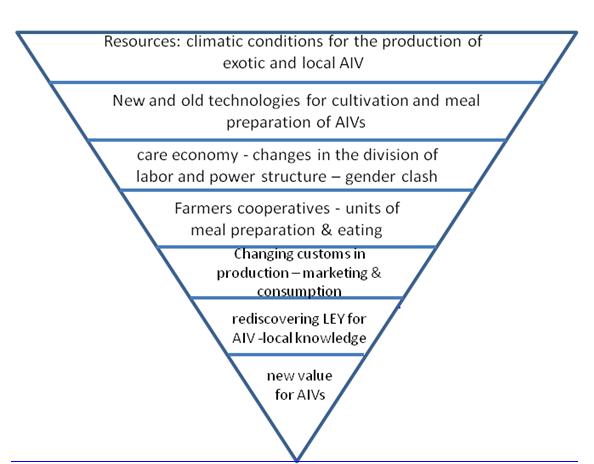
Figure 3: Ecological Funnel to Meal Culture with respect to AIV. Natural Ecological Resources and factors: AIVs are rediscovered as valuable resources to prepare healthy meals – diverse sorts and plenty varieties exist. The climatic conditions are favorable for AIV cultivation; they grow fast and can be harvested every six weeks in most of the areas of Kenya. They are well adapted to the East African geological realities and robust to climate change. Water and energy is needed to prepare AIVs and cook a meal with them. Technological Equipments for Producing and Cooking: The technologies in use depend on social class and regional equipment – where energy and access to fire plays an important role. Clean water is an important issue – as well as access to fire and energy for cooking. As AIVs become a commercialized crop the economic interests grow; new technologies are used and implemented. AIVs become a commercial crop that needs capital to intensify farming. The question of who controls these technologies need local empirical evidence, but in most of the cases up till now technologies tend to strengthen the power position of men in farming activities. It will be important to follow the outcome of this process on gender relations, empowerment and food security for the poor. Economy and the Division of Labor: AIVs have been known as female crops – women were the ones who collected or cultivated these vegetables during decades and centuries. They took responsibility for reproducing them, selling them on the market and preparing them to meals in the social reproduction sphere. With the rediscovery of AIVs as healthy and economically interesting crops new arrangements in the division of labor occurs that need sensitive evaluation. These processes often are not in favor of the former producers, the female farmers in the society. This give rise to conflicts in the social structure and gender relations are affected strongly. Social Institutions and the Organization of Meals: Social institutions and their structures are important aspects to understand meal habits and meal cultures with respect to AIVs. This encompasses the production as well as the reproduction sphere, where mostly women take responsibility. The institutional setting of production whether on an individual basis or within a household unit or even within a cooperative has consequences for social relations and interactions within communities. While more men enter the production sphere the gender arrangements will shift and will be transformed essentially. The gender order within the value chain of AIVs touches upon the respected community structures. The social reproduction sphere with preparing, cooking, serving, eating, washing etc. and the power relations within the household unit will be part of this process of change.
Social Action – Everyday Life: Meal habits and cooking abilities have changed – but AIVs are still important ingredients for a “proper meal”, especially during festivities. AIVs are sensitive plants and have to be prepared fresh, otherwise they lose quality, taste and esthetic look. Local people know about this sensitivity. Time is important in preparing AIVs and will be an obstacle in cooking and serving it regularly for every day meals whenever and wherever there is time scarcity. Cooking is a matter of habit and every change needs extra energy. The arrangements around cooking and serving and the people who come together and share meals belong to every day routine. Meals are important in social relations because meals are ties that bind. There routine of eating and sharing in everyday life are important to understand people’s attitudes and their scope of action. More research is needed regarding foodways and the rituals around AIVs in the social and communication system that can safeguard (food) meal security – First steps have been set with Maundu et al. within an UNESCO project, mentioned before [94, 95, 98]. Local knowledge – gendered knowledge: What people enjoyable and what is classified as disgusting differs among regions, social class, ethnicity, gender, and cultural groupings. It is important to know about the local criteria for producing, cooking and eating AIVs. Different regions have their peculiarity regarding the preferable sort of AIVs and the consumption still defers within the regions of Kenya. The history of AIV is a key to understand foodways, it is a matter of local identity as described by Maundu in the UNESCO report (ibid). Knowledge about cultivation, collection, reproduction and preparation of AIVs is among elderly female people in East Africa and Kenya. This knowledge is changing constantly as well as criteria for a delicious meal. The bitterness is preferred by elderly people but rejected by the younger. Breading new varieties became a topic of research and development. Local knowledge exist with regard to the combination of different sorts of vegetables partly to reduce the bitterness among those who cook on an everyday basis. An important local and traditional ingredient is “Ley”, a special salt that needs careful preparation and is extracted from herbs. It makes AIVs tender and gives them a special taste. The knowledge about such an exceptional salt is among locals. Symbolic Order and the Normative System: The symbolic value of AIV has changed in the historical run and is part of colonial past and post colonial present. Once it was part of common daily nutrition – then it became poor people’s crop and food. Now it is recognized as healthy and nutritious and even recommended during the treatment of HIV AIDS. But this aspect might as well turn to be a problem. If AIVs are identified with a sign of sickness; those eating these vegetables can be stigmatized. Initiatives like the one leaded by Maundu (ibid) in his UNESCO project try to give new value and discover the positive potential in foodways and AIVs. The intention is to improve the symbolic meaning and acceptance among the younger generation. It can help to keep local identity and step in the direction of food/ meal sovereignty. The project of safeguarding intangible heritage Maundu et al. (2013) [94] follows the idea not to give up cultural resources but respect biodiversity as well as cultural diversity. It is to upgrade a cultural resource that has been degraded as weed during colonial times.
Final Remarks: Critical Comments to the AIV Research
At the end of this contribution, I will mention issues that have not yet been tackled sufficiently. They have not received the needed attention, but can be of importance to grasp the problems of meal culture in the respected areas of Africa with regard to food security and the contribution of indigenous vegetables to accomplish this aim for poor people.
Food Security in Danger
Increased Popularity and Consumption of AIV
In one of the YouTube videos by “Bioversity Inernational” called bioversityvideo on the topic of African Leafy Vegetables in Kenya, – Patrick Maundu explained how successful the campaign to increase AIV consumption in Nairobi has become. It was mentioned that these vegetables can be purchased in supermarkets of the capital city. But the information in the video was most ambiguous: The price of this commodity has increased by 1,100% during two years [99]. This means something that might have been sold at a price of 1 Euro a kilo, is now more than ten times or 11 Euro, which is incredible. Of course those farmers who can deliver their products to such supermarkets might become better off. But if these vegetables were supposed to improve the nutritional and meal security in that region of the world, it is most problematic. Will the vegetables reach the poor segment of the population? They were supposed to be the ones to be addressed by a project like HORTINLEA. The processes of value chain have to be critically analyzed with regard to the overall aim of the project of reaching food and more so meal security for the poor. Another aspect of this food transition process is the shift in the division of labor and the gender relation. Because AIV were female crops, they need careful investigation in following the changes in gender relations with the value chain processes. The aim of reaching the poor, as well as gender empowerment might be in danger. The recommendation by the development aid agencies of “Do no harm” is sincerely put in question. I have discussed both of these points with Mary Abukutsa-Onyango on the 3.12.2015 while she was in Berlin for a HORTINLEA meeting. She also sees both of these aspects of the ongoing process with regard to the value chain upgrading in AIV. It will be a challenge to see these processes as a dilemma and challenges that need careful compensation and investigation in order not to worsen the given food security situation. It is unfortunate to come up with such a skeptical conclusion. This will be in line with so many neo-colonial processes. And it would not be the first time that development projects come up with negative outcome - even though the intention might have been good.
Gender as Missing Dimension in the Debate on AIV
On the one hand we can have access to large and considerable publications about women, gender and environment studies in Africa with respect to rural areas and agriculture (Schäfer 2012, FAO 2011)9 [100, 101]. On the other hand questions around processing, cooking, and the whole preparation of a meal that consists of AIVs, especially from a social and cultural science perspective, are still underexposed. And even if women are well known as the main actors and the ones responsible for the cultivation of this female crop and preparation of vegetable meals, the gender dimension and the power relation in these processes are hardly grasped. Gender studies with regard to meal culture of AIV are not explored and published. Few publications that have mentioned gender issues within their research papers [102, 103, 104, 33, 70], do not go deep into addressing changes in gender power relations and new gender arrangements.
9 The United Nation Environment Programme (UNEP) is preparing a report on: GLOBAL GENDER AND ENVIRONMENT, not yet published.
“We find that women participate in all segments of the chain, and dominate wholesale and retail activities. Low capital requirements for entry allow even the poorest households to participate. Based on a multivariate regression analysis we show that women’s income along the supply chain is generally lower than that of their male counterparts. Women face various constraints in their activities and thus need support of policy and decision makers” [104]. Exceptions can be seen in work done about gender in the production of vegetables in Africa by Catherine Dolan (2001&2002) [105, 106]. She investigated the production of vegetables in Kenya, not the AIV, but the exotic vegetables for export, especially to England. She has followed the processes of interfering in the agricultural production system by foreign investments in two different regions in Kenya. In her work, problems of division of labour and the consequences are highlighted. She is able to show empirically the tremendous changes in power relations within the farm household, between women and men. Her observations show that women lost their economic ground and social status [105, 107, 21]. Even if Dolan is not dealing with AIV or meal culture, we can take her research findings as advice to pay careful attention to the changes in gender order and power relations, as there are dramatic consequences to be confronted with. A set of new social conflicts arise because “horticulture, the historical domain of women, has been rapidly intensified, commoditized and in many cases, appropriated by men” [108]. These processes give rise to gendered struggles over land, labour, and income that destruct women’s social status. Such processes have been already observed by Ester Boserup (1970) [107] in her pioneering work “Women’s Role in Economic Development” where she had mentioned the loss of access to resources and especially the gap in technological equipment and productivity as a reason for women’s loss in social status. Dolan explains the discourse on witchcraft as a powerful weapon through which women can level intra–household disparities. In her work with the title “good wife” she even mentions that some women undergo Christian conversion while others poison their husbands. “In Meru, witchcraft discourses are a vehicle through which gendered struggles over contract income are articulated and contested, and through which the social costs of agrarian transition become apparent” [108]. As AIVs were female crops for most of the time in history, actors involved in processes of food transition need to pay attention to this important socio economic and socio cultural fact. Probably production, marketing of AIV was and partly still is one of the last domains of women’s economic autonomy. Female farmers were mastering this field of subsistence economy and income generating activity which has given them self reliance and sovereignty. Female farmers as well are the ones in processing and preparing of meals as key to nutrition health and security. But in the meantime men become more interested in taking over the AIV production and marketing with connection to supermarkets and whole sale as the prices rise and cultivating AIV and dealing with these crops become a money making source. Now if by these new processes of promoting AIV female farmers will lose the control in this field of autonomous activity, discussions around women’s empowerment becomes a farce. Having food security of the poor population in mind, it will not be helpful to take away women’s fields of productive activites, pass it to the male producers without compensation. One should not wonder why she loses her economic ground and status in society [107, 109, 21]. Thereafter looking for new projects and income generating activities for the female population who remain the most responsible for the meal security of the children and family members in most of the regions will be in vain. It might become too late (Lachenmann, Gudrun 2004, 1996) [110, 111]. This makes it even more important that within the HORTINLEA research, the subprojects Sp 7 and especially SP 10, the gender dimension will be highlighted. These issues are going to be investigated and elaborated in order to step towards food sovereignty and meal security [112, 113, 114]. If nutrition security is the aim, research activities cannot become successful without studying gender relations in meal policy and meal culture, Egger, Kurt / Teherani-Krönner, Parto (2004) [115].
References
-
The bitterness of AIV is one of the discussed issues regarding indigenous vegetables. The campaign has focused on the taste preferences of different consumer groups. In Kenya, for example, coastal and western communities opt for the bitter types, while those living in the central highlands and urban areas prefer the non- bitter varieties. In Tanzania, most communities have a preference for the bitter leaves but the broad leaved sweeter types that were newly introduced by AVRDC are increasingly being [72]. This topic has been discussed in Nature (2015) [71] and Ann Aswani as well mentions it as one of the important characteristics of AIV [92,93]. In dealing with this bitterness, Kenyan cooking knowledge has developed and used a special salt, called “ley.” I had asked Mary Abukutsa-Onyango about this specility. Ley is a product based on very specific regional knowledge that needs careful preparation. “Dried leaves of special plants are burnt to ash, and then the ash is filtered to produce a clear substance that is used for cooking indigenous vegetables. It is called lye and it can improve the texture and palatability of indigenous vegetables.”. Further explanations about the production and use of ley are available as well in Maundu 2013 a, b, d) [94-96] with pictures and recipes.
- Enhancement of Vegetative Growth and Fruit Yield in Cucumber (Cucumis sativus L.) via Spiritual Blessing (Biofield) Energy Intervention
- Production of Açaí (Euterpe oleracea Mart.) under Different Agroforestry System Management Intensities in Amazonian Floodplain (Varzea) Forests
- Coffee and the Production Region: What is the Secret to the Expression "Quality"?
- Experiential Agripreneurship Training in Sub-Saharan Africa: Integrating a Business Incubator into Postgraduate Livestock Education at the University of Buea
- Advances in Agricultural High-Quality Development
- Linking Compost Residue to ABAGE in Plants - a Short Note