
Study on the Progress in Maize Varieties Registration under PPV & FRA in India
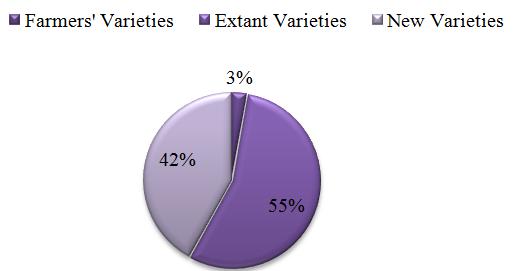
In view of providing legal protection to plant varieties PPV&FRA, 2001 has agreat impact on seed industry in India. Since 2007 to January 2018 the Authority has received 15790 applications in total for the registration of various cereal crops and horticultural plant varieties, out of which 1045 are for maize. Out of all the application received for maize varieties registration, the highest share (42%) is of farmers’ varieties. Detailed analysis of registration certificate issued for the maize varieties by the authority revealed that highest numbers of varieties were registered under extant category (55%) followed by new (42%) then farmers’ (3%). Public sector contribution was 47% of maize varieties registered. However, private sector has contributed more in terms of new varieties with 59%. Results indicate the widening gap in new varieties development and acquiring their protection rights under PPV&FRA between the public and private sector seed companies. The public sector units (PSUs) involved in seed development and research centers need to be more strengthened so that those can deal with the current age challenges. Farmers’ varieties registration started first time in India which may motivate developing countries for protecting farmers’ rights.
Yogesh Kumar Tiwari* and Sushil Kumar Yadav
Central Research Institute for Dryland Agriculture, Santoshnagar, Hyderabad, 500059, India Hyderabad, 500059, India, Email: ytalld@gmail.com India which may motivate developing countries for protecting farmers’ rights.
Keywords: Maize; Plant variety protection; PPV&FRA; Seed; Farmers’ rights
Introduction
In the year 2001 “Protection of Plant Varieties and Farmers’ Rights (PPV&FR) Act” was enacted by Government of India with a purpose to protect the intellectual rights of independent breeders, farmers and the rural & tribal communities and thus encouraging the development of new plant varieties. After these many years of implementation of the act it is necessary to know its impact on seed industry and farming communities in the country. In the present day scenario when organized sector including public and private both share only 15- 20% seeds available in India [1]. The act has established an efficient system which is providing legal protection to all the players in seed development and the provisions are in fine tuning with the regulations of International Union for the Protection of New Varieties of Plants (UPOV), 1978 [2]. PPV&FRA identifies and protects the contributions of all the stake holders (individual farmers/farmers’ groups/professional plant breeders) involved in plant breeding activity. Simultaneously it also provides to execute Trade-Related Aspects of Intellectual Property Rights (TRIPs) in a way that supports the specific social and economic interests of all the stakeholders including private, public sector seed companies and research centers/institutions, as well as resource-constrained farmers. The act is being implemented by “Protection of Plant Varieties and Farmers’ Rights Authority” which is being regulated by Department of Agriculture and Cooperation, Ministry of Agriculture, Govt of India. The Authority was established on November 11, 2005. The Authority has 16 members in total including Chairperson. Fifteen members other than Chief executive/Chairperson are nominated by the Govt of India; 8 are from different Departments/Ministries, 3 from state agricultural universities and the State Governments, 1 is farmers’ representative, 1 for tribal organization, 1 for seed industry and 1 for women groups/organizations involved in farming [3]. Purpose of this Act is, specifically to provide legal protection to intellectuals’ rights of breeders, farmers, specially rural and tribal communities involved in preservation, conservation of wild species and improvement of germplasm of economically important plants. The major responsibilities of the Authority are registration and providing legal certificate to the applicant/s of new and extant varieties. Documentation and cataloguing of all the varieties registered under the act. The Authority is also responsible for ensuring seed availability for farmers and issuing licenses for multiplication of the seeds [4]. Here we have examined details how the act benefited seed development and triggered varieties protection in As on 12 January 2018, applications for 107 crops/plants were received by the Authority seeking registration under different categories [6]. Authority received its first application on May 21, 2007 [7]. For 107 crop/plants total 15790 applications seeking registration under different varietal category were received till January 12, 2018. Applications were received from across the crop types and stakeholders including individual farmers, government organizations and private/multinational companies involved in seed development.
India after its implementation. The specific objectives are given as bellow: a. Applications Received by the Authority for the Protection of Maize Varieties; b. Status of maize varieties under protection with PPV & FR Authority (till January-2018); c. % Share of different stakeholders in receiving legal certificate of maize varieties protection.
Secondary Data and Methods
This is a secondary data research based on previously published reports, journals, gadgets of GOI, and the data available on the website of PPV&FRA. Data collection, compilation and comparisons in terms of percentage contribution of different varietal categories in issuance of Certificate of Registration (CoR) were made as per the standard procedures. Conversion ratios and percent share of different stakeholders have been worked out as per described by Manjunatha, et al. [5]. Data were also analyzed in terms of contribution made by different stakeholders in the development of new varieties. A fare comparison was also made between public and private sector industries in developing and protecting maize varieties by registering under PPV&FRA.
Results and Discussion
Applications Received by the Authority for the Protection of Plant Varieties
| Items | New varieties | Extant varieties | Farmers' varieties | Essentially Derived Varieties | Total |
| Total No of applications | 390 | 217 | 438 | 0 | 1045 |
| % Share in applications | 37 | 21 | 42 | 0 | 100 |
| CoR issued | 91 | 120 | 6 | 0 | 217 |
| % Share in CoR issued | 42 | 55 | 3 | 0 | 100 |
Table 1: Number of applications for the registration of maize varieties under PVP and CoR issued.
Status of Maize Varieties under Protection with PPV & FR Authority (till January-2018)
Critical analysis of data available at PPV&FRA website revealed that out of 15790 applications, 1045 have been received for maize from different sectors; public, private and farmers. Out of 1045 applications, CoR were issued for only 217 maize varieties as on 12 January 2018 [7, 8, 9]. It was February 12, 2009 when first certificate was issued for maize variety registration [10]. Out of 1045 applications received by the Authority, only 438 are by
Number of Applications Received Year-wise
farmer’s/group of farmers (42%). Public sector has applied for 138 varieties (13%) whereas highest number of applications has been received from private sector, total 469 (45%) varieties under PPV FRA 2001 Act. Maximum number of applications was received under the category of farmers’ varieties followed by new and extant varieties. It is rather ironical and disappointing to note that no application was received for Essentially derived. The year-wise analysis of applications received for registration of varieties is described in Figure 1.
| EsDsVenst ivaallryie Dtieesrived Varieties | |||
|---|---|---|---|
Figure 1: Year-wise Applications seeking protection under PPV&FRA for maize varieties (as on 12 January 2018). Source: Plant Variety Journal of India and website. 2017 was the year when Authority received maximum numbers of applications for maize varieties registration. In 2017 out of 233 applications 40 were for new varieties, 3 for extant, 190 for farmers’ and there was no application received for Essentially derived varieties. 2011 was the poorest performing year in terms of receiving applications for maize variety registration and the number was only 31. Out of 31, 16 were for New and 15 applications for extant varieties. In 2011 there was no application for Farmers` and Essentially derived variety registration. Since 2007 to 2010 there is no application received for Farmers` and Essentially derived variety registration. In 2012 only 1 application was received for Farmers` variety registration. 2013-2016: Out of 495 applications the highest 247 were for Farmers` varieties, 214 for New and 34 for extant varieties. Till 12 January 2018, no application was received for maize varieties registration under any category.
2007 2008 2009 2010 2011 2012 2013 2014 2015 2016 2017 2018
Year
Issue of Certificates of Registration by the Authority under the Act and Conversion Ratio (%)
Applications received by the Authority are examined under various parameters subjected to respective crop/plant and a certificate of registration bearing an unique number is being issued for the varieties qualified. Figure 2 illustrate the number of certificate issued per year under different varietal category of maize. Results showed a continuous increase in providing CoR by the Authority over the years except for the year 2014 and 2017. In case of maize, extant varieties category received highest number of CoR with total share of 55%. New varieties contributed nearly 42% whereas farmers’ varieties share is only about 3% (Figure 3). The conversion ratio, a mathematical calculation of total number of certificate issued by the Authority from the application received till date (January 12, 2018). So far CoR for Farmers` variety is only 1%. Out of 438 applications received for farmers’ variety registration, CoR is issued for only 6 varieties. Conversion rate for Extant varieties of maize is highest with the highest number of CoR (55%) issued by the Authority followed by new varieties (23%) (Table 3). The status of farmers’ variety registration is very poor and alarming. However, it will be very early to comment on status when the issuance of certificate was started just less than a decade before. It is expected from the Authority to concentrate more over the issuance of registration certificate to farmers’ varieties so that the purpose of establishing PPV & FRA could be justified.
| Varieties | New varieties | Extant varieties | Farmers' varieties |
|---|---|---|---|
| Total No of applications | 390 | 217 | 438 |
| CoR issued | 91 | 120 | 6 |
| Conversion Ratio (%) | 23 | 55 | 1 |
Table 3: Conversion Ratio (%) for maize varieties under different categories; as on 12 January 2018 [10].
| EEDsVsesn vtiaarlileyt iDeserived Varieties | |||
|---|---|---|---|
| New varieties Extant varieties Farmers’ varieties EDVs varieties | EDVs varieties | ||
2007 2008 2009 2010 2011 2012 2013 2014 2015 2016 2017 2018
Year
Share of Different Stakeholders in Receiving Legal Certificate of Protection
The % share of government organizations, private players in the field, independent breeders and Farmers in receiving registration certificate is given in Figure 4. The private sector companies are leading with 50% of total share in receiving legal certificate from the authority while the public sector (ICAR+SAU) shares about 47%. The least share in receiving certificate is of farmers’ which is only 3%. Among public sector ICAR is the highest contributor with 74% which was due to its efforts in getting all its varieties notified under Seeds Act, 1966 being applied for PVP.
![Figure 2: Registration certificate issued/year for maize varieties; as on 12 January 2018 [10].](/fulltextimages/2088/fig_2.png)
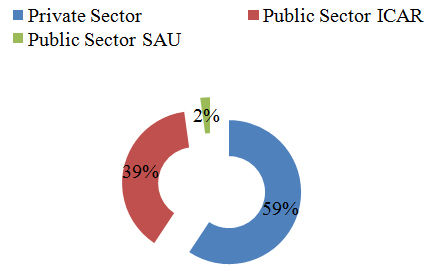
Figure 5: % Share of different stakeholders involved in maize variety development in receiving CoR for new maize varieties (as on 12 January 2018). Share of different stakeholders involved in maize variety development in receiving CoR for new maize varieties is described in Figure 5. Results revealed that despite of having 47% share in getting certificate of registration for maize varieties government sector organizations have only 41% in case new varieties registration. On the contrary private companies are dominating in getting registration for the new varieties with total share of 59%. Higher number of new varieties registration by the private sectors reflects their leading position in developing new varieties, hybrids and getting their legal rights.
Conclusion
Since the initial days of starting the act received positive response among all the sectors involved in seed development which gradually improved with time. In a very short span of time from its establishment the authority has issued legal certificates to a large number of applicants. The results clearly indicate about popularity of the act among different stakeholders for the registration of almost all kind of crops. Government/Government of sponsored seed developing units dominated in applying and receiving legal rights under the extant category crop varieties, whereas private companies were leading in case of new varieties. The similar trends were also reflected in maize varieties registration. Seed companies of private sector concentrated more on developing and registering for commercial crops; fruits, vegetables, oil seeds, cotton, where as government organizations focused more once real and pulses. The PVP applications from farmers initially were very disappointing but in recent years since 2013 it also has increased to a good number. From the point of view to CoR issued cereals are trending well. As on 31 January 2014, the most of applications received and legal certificate issued for cotton and cereals crops. Maize alone has contributed for 91 new varieties, 120 extant and 6 for farmers’ varieties. For farmers’ maize varieties conversion ratio % was only 3%, while it was 42% for new and 55% for extant category. Public sector contributed for 47% of the total CoR issued under all categories of maize varieties. But in case of new maize varieties the private sector dominated with a share of almost 59%. The widening gap between the public and private sector seed companies in the development of innovations (new varieties and hybrids) and getting their legal protection is alarming. However, in recent years this gap is being narrowed to some extent. The public sector seed industry has to be revitalized to address the present day challenges of competitiveness in R&D, market access, and efficient technology transfer systems. The performance of SAUs is very poor, it needs special attentions. Simultaneously more certificates needs to be issued for farmers’ varieties to rationalize the purpose of the act.
References
-
MoA (2011) State of Indian Agriculture 2011-12. Report, Department of Agriculture and Cooperation, Ministry of Agriculture, New Delhi, India.
-
Union for the Protection of New Varieties of Plants (UPOV), 1978.
-
Gazette Notification No. 3064 dated Dec.01,2009 for appointment of members of Authority.
-
Singh AK, Singh PK, Srivastava M, Misra DS (2011) Implementation of PPV & FR Act, 2001 in India. National Seed Congress pp: 154-158.
-
Manjunatha BL, Rao DUM, Dastagiri MB, Sharma JP, Burman RR (2013) The Legal Protection of Public and Private Plant Varieties in India: A Comparative Analysis. J Bioremed Biodeg 4: 207.
-
http://www.plantauthority.gov.in/pdf/Status%20Cr op%20wise%20Application1.pdf.
-
http://plantauthority.gov.in/pdf/Application%20Stat us.pdf.
-
http://plantauthority.gov.in/pdf/Close%20Applicati on%20Status.pdf.
-
http://plantauthority.gov.in/pdf/Legal%20Issues%2 0Status.pdf.
-
http://plantauthority.gov.in/List_of_Certificates.htm.
- Enhancement of Vegetative Growth and Fruit Yield in Cucumber (Cucumis sativus L.) via Spiritual Blessing (Biofield) Energy Intervention
- Production of Açaí (Euterpe oleracea Mart.) under Different Agroforestry System Management Intensities in Amazonian Floodplain (Varzea) Forests
- Coffee and the Production Region: What is the Secret to the Expression "Quality"?
- Experiential Agripreneurship Training in Sub-Saharan Africa: Integrating a Business Incubator into Postgraduate Livestock Education at the University of Buea
- Advances in Agricultural High-Quality Development
- Linking Compost Residue to ABAGE in Plants - a Short Note