
Phytonutrients Potential Properties of Graviola Leaves Extract
Recent studies indicated that regular consumption of antioxidant rich foods reduce cellular oxidative stress and protect against health related problems. Annona muricata, is a tropical fruit, commonly known as Graviola, which has been identified as a rich source of bioactive compounds and is considered as an integral part of folklore medicine. The use of Graviola leaves as a therapeutic agent is recently accelerated, yet there is scarce scientific evidence justifying its use. This study aimed to assess the in vitro antioxidant properties and phytonutrients content of the Omani cultivated Graviola leaves. Our study revealed that Graviola leaves extract is rich in phytonutrients content (The total phenolic content was 16.82 mg Gallic acid equivalent (GAE)/g dry solid and the total flavonoid content was 7.79 mg Catechin equivalent (CE)/ g dry solid) and acted as a potent free radical scavenger and provided protection against H2O2-induced oxidative stress.
Al-Malki, Salha Saleh Ahmed Al-Maskri
Muscat, Oman
Keywords: Graviola Leaves, Antioxidant Properties, Phytonutrients, Oxidative Stress
Introduction
Graviola fruit (Annona muricata) belongs to the family of Annonceae, is a heart shaped fruit with white flesh inside an evergreen rind with dark green leaves [1]. Graviola plants predominantly grow in humid tropical regions such as India, Philippines, Brazil and, central Africa [2]. Graviola fruit, roots and leaves used as juice, tea or other solutions, have been important part of traditional medicine and remedies throughout the world [3]. For instance, the Graviola leaves and seeds extract have been used to treat liver problems, fever, and inflammations, along with the fruit have been used as anticancer, anti-diabetic and antihypertensive[3, 4]. Graviola fruit is rich in bioactive compounds such an alkaloid, flavonoid and phenols and is known to possess antioxidant capacity in which it plays an important role in prevention of oxidative stress-mediated human chronic diseases [5, 6]. Previous reports studied Graviola extract properties in different cancer cell lines [7, 8].
Oxidative stress is a condition under which an imbalance exists between the factors that promote oxidation (such as reactive oxygen species, ROS) and antioxidant defenses, including intracellular glutathione (GSH), dietary antioxidant and antioxidant enzymes [9].
Oxidative stress is involved in the cell degenerative changes during aging process and in the pathogenesis of a wide variety of human chronic diseases, such as cancer, atherosclerosis, coronary heart disease, macular degeneration, Alzheimer's disease, and inflammation [10]. Hydrogen peroxide (H2O2) is a well-known ROS that is formed during normal metabolism, where it is produced in the brain during the catalytic degradation of neurotransmitters such as dopamine and it is estimated that about 3 % of body's hemoglobin is autoxidized daily to produce H2O2 [11]. GSH is the primary redox buffer in all human neuronal cells, and when two molecules of GSH combine to form oxidized glutathione (GSSG), two reducing equivalents of H+ are made available for the quenching of ROS, thereby protecting human cells from oxidative damage [12]. GSH can also combine with xenobiotics and heavy metals resulting in an increase in their rate of excretion and provides an important mode of detoxification [13]. Depletion of GSH indicates that the production of ROS exceeds the capacity of cellular antioxidant protective mechanisms. There was negligible research conducted to explore the protective role of Graviola leaves extract against oxidative stress insults, therefore the aim of this study was to measure the phytonutrients content of Graviola leaves extract and to evaluate its protective effect against H2O2-induced oxidative stress. Findings of this study will shed light on the potential use of Graviola leaves, as a rich source of natural antioxidants, against the oxidative stress-related disorders.
Materials and Methods
Preparation of Graviola Leaves Extract
Fresh leaves of Graviola plant were collected from Adam wilayat, Aldakhilia governate in middle south of Oman. The leaves were then taken to the Crop Science Department in the College of Agricultural and Marine Sciences at Sultan Qaboos University to be identified and verified by botany. Then the undesirable parts of the leaves were removed, the leaves then washed by distal water, and cut to small pieces. The water content of the leaves was 88.6 g/100 g leaves. The leaves were free dried using a benchtop freeze dry system (Labconco, USA) at -40 °C. After freeze drying the plants were placed in desiccators containing silica gel at 20oC for one week. Dried leaves were ground into powder using a hammer mill with sieve size 1.0 mm (Model MF 10 Basic, IKA Works, USA). The dried powder was equilibrated for four weeks in desiccators at 20oC containing a saturated lithium chloride solution to maintain the relative humidity of the environment at 11.3%. The dried powder was mixed with distilled water (10 g/150 g) and the mixture was stirred on a magnetic stirrer for 4 hours at room temperature. The mixture was then centrifuged at 2000 g at 4°C for 30 min and the supernatant was collected and then stored at -80 ºC for subsequent analysis. The solid content of the extract was 3 g/100 g extract.
Measurement of Total Phenol Content (TPC)
Total phenolic content (TPC) for the aqueous extract was determined by method of Folin-Ciocalteu. Briefly, in test tubes, 100 µl of the aqueous extract was mixed with 250 µl of Folin-Ciocalteu reagent. Then, 750 µl of 1.9 M sodium carbonate (Na2CO3). Total volume was made up to 5 ml by adding deionized water, then vortexed for 5-15s. The mixture was then incubated in the dark for 2 hours. The analysis was performed in triplicates. Then immediately the absorbance was measured utilizing UV- visible spectrophotometer (Thermo Spectronic, UK) at 765 nm. The absorbance of the samples were measured against a blank solution containing all reagent used in the essay except the extract. Then, the calibration curve was prepared using Gallic Acid as a standard solution. Finally, the total phenolic content was calculated in mg Gallic Acid equivalent (GAE)/ g dry solid of graviola leaves sample using the equation in the calibration curve.
Determination of Total Flavonoids Content (TFC)
Total flavonoids content (TFC) was determined as follow: 1 ml of the aqueous extract was mixed with 4ml of deionized water. Then, 0.3 ml of 5% (w/v) (NaNO2) was added followed by 0.3ml of 10% (w/v) (AlCl3). Then, 2 ml of 1 M (NaOH) was added to the mixture after 5 minutes, then, the mixture was diluted by the addition of 2.4 ml of deionized. The mixture was then vortexed using (Nickel electro Ltd, Weston-super-Mare, England). The analysis was performed in triplicates. The absorbance was then measured at a wave length of 510 nm using UV-visible spectrophotometer (Thermo Spectronic, UK). The absorbance was estimated against a blank solution containing all the reagents except the extract. Then, the calibration curve was prepared using Catechin as a standard solution. Finally, the total flavonoid content was calculated in mg Catechin equivalent (CE)/ g dry solid of Graviola leaves sample using the equation in the calibration curve.
Evaluation of the Free Radical Scavenging Capacity by the DPPH Photometric Assay
The capacity of Graviola leaves extract to scavenge 1, 1-diphenyl-2-picrylhydrazyl (DPPH) free radicals was measured by a spectrophotometric method. Briefly fifty microliters (50 µl) of each extract, at different concentrations (μg/ml) were mixed with 50 μl of a DPPH methanolic solution (0.04 mg/ml). Absorbance was measured at 517 nm after 30 min of reaction at room temperature. Controls contained all the reaction reagents except the Graviola leaves extract or 2, 6-di-tert-butyl-4- hydroxytoluene (BHT) as a positive control. The free radical scavenging capacity of different samples was expressed as % DPPH inhibition, a higher % free radical scavenging activity value indicates a higher antioxidant activity and calculated as follow:
% DPPH inhibition = [(Absorbance of control – Absorbance of sample) /Absorbance control] X 100
Evaluation of the Antioxidant Activity of by the ABTS Antioxidant Assay
A colorimetric method using ABTS Antioxidant Assay Kit (Zenbio, Cat#AOX-1, USA) was used. The assay is based on the incubation of Graviola leaves extract samples at different concentrations (μg/ml) with 2, 2’- azino-di-[3-ethylbenzthiazoline sulphonate (6)] diaammonium salt (ABTS) with a peroxidase (methmyoglobin) and hydrogen peroxide to produce the radical cation ABTS+ which has a relatively stable blue- green color that is measured at 405 nm. Antioxidants present in the assayed extract samples inhibit the oxidation of ABTS to ABTS+ (cause suppression of the color production) to a degree that is proportional to their concentration. The total antioxidant capacity of the assayed extract samples was compared with that of standard Trolox, a water soluble tocopherol analogue.
Statistical Analysis
Statistical analysis was performed using Graph Pad Prism (version 5.03; Graph Pad Software Inc. San Diego, CA). The results are expressed as means + standard deviation (SD). The student’s unpaired t-test was used for pair wise comparisons and P< 0.05 was considered to be significant.
Results
Gallic Acid standard curve was prepared in different concentration and used for the measurements of total phenolic content of Graviola leaves extract. The total phenolic content was16.82 mg Gallic Acid equivalent (GAE)/ g dry solid. Likewise, Catechin standard curve was prepared in different concentration and used for the assessment of total flavonoid content of Graviola leaves extract. The total phenolic content was 7.79mg Catechin equivalent (CE)/ g dry solid.
BTH is a synthetic additive that acts as an antioxidant and is used to preserve the food from oxidation and DPPH formation in a mechanism that is mainly attributed to its hydrogen-donating ability. As presented in Figure 1, Graviola leaves extract significantly (P< 0.05) scavenged DPPH free radicals in a dose-dependent manner (5 to 300 µg/ml). Both BTH and Graviola leaves extract inhibited the DPPH free radical formation and reached a plateau at a concentration of 30 μg/ml. The dose-dependent effects of both BTH and Graviola leaves extract were similar with no statistical significant difference (t=0.821, P>0.05).
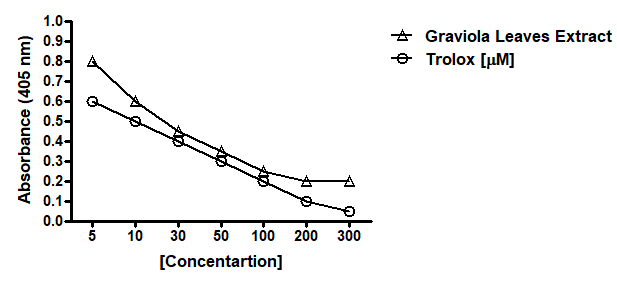
Figure 1: Scavenging effect of Graviola leaves extract and BTH against DPPH free radicals formation. The extract significantly scavenged DPPH free radicals in a dose-dependent manner. Both BTH and Graviola leaves extract inhibited the DPPH free radical formation and reached a plateau at a concentration of 30 µg /ml. The dose-dependent effects of both BTH and the extract were similar with no statistical significant difference. Results are the means ± SD of 6 measurements.
As illustrated in Figure 2, both the Graviola leaves extract and Trolox standard (Vitamin E analog) showed inhibition of ABTS radical formation in a dose-dependent manner. The IC50 (concentration of Graviola leaves extract or the Trolox standard in µg/ml, required to scavenge 50% of ABTS+ formation), was comparable for Graviola leaves extract and Trolox standard (30 µg/ml) with no statistical significant difference (t=0.846, P>0.05). These data collectively suggests that Graviola leaves extract exhibits an in vitro free radical scavenging and antioxidant activities and we speculated that it may be related to its phytonutrients content as measured in this study.
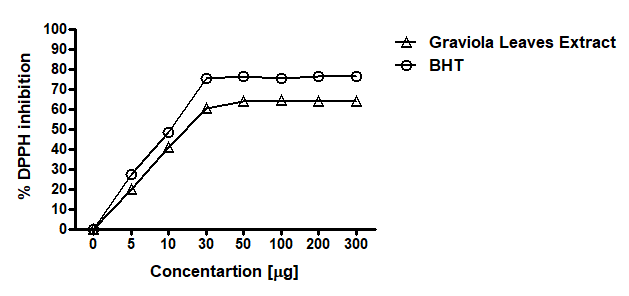
Figure 2. Free radicals scavenging ability of Graviola leaves extract and Trolox against ABTS+ radicals formation. Both extract and Trolox standard (Vitamin E analog) showed inhibition of ABTS radical formation in a dose-dependent manner. The IC50 was comparable for Graviola leaves extract and Trolox standard with no statistical significant difference. Results are the means ± SD of 6 measurements.
Discussion
The maintenance of normal cellular growth and metabolism is based on the cellular redox homeostasis. Oxidative stress is the imbalance between the production of reactive oxygen species (ROS) and the ability of the cell to deactivate it by production of the antioxidant. Low concentrations of ROS are necessary for signaling molecules which needed in cellular proliferation, migration, and apoptosis [14]. High concentrations of ROS useful against pathogens which help to increased leukocyte and activate the platelet, and increase use of leukocyte [15]. Most of ROS are harmful which cause irreversible damages to proteins, lipids and to DNA that lead to mutations and cell death. ROS and oxidative stress cause in a number of diseases including cancer [16]. Reactive species are categorized into four groups: ROS, reactive nitrogen species (RNS), reactive sulfur species (RSS) and reactive chloride species (RCS). The most abundantly produced, among the four groups, is ROS. They define as oxygen-containing small species which are superoxide anion radical (O2•−), hydroxyl radical (OH•), hydroxyl ion (OH−), hydrogen peroxide (H2O2), singlet oxygen (1O2), and ozone (O3) [16].
Functional Food is a natural or processed food that contains known biologically-active compounds which when consumed in defined quantitative and qualitative amounts provides a clinically significant health benefit which helps in the prevention, management and treatment of chronic diseases [17]. Functional foods deliver additional or enhanced benefits with their basic nutritional value. Functional foods enriched with antioxidants have potential therapeutic interventions against oxidative stress in chronic diseases development by scavenging or neutralizing the free radical formation.
The quantitative assessment of phytochemicals (flavonoids, and phenols) revealed the presence of bioactive compounds in the assayed Graviola leaves extract. Flavonoid and polyphenols are known to pose antioxidants activity which protect human cells against oxidative damage caused by free radicals such as hydrogen peroxide, and work to minimize the risk of developing specific types of cancers. Our study suggested that the Omani cultivated Graviola leaves extract has the potential to be used as a supplement based on its higher content of both total phenolic compounds (TPC) and total flavonoids (TF), as compared with the commercially available extracts in the form of powders or capsule. Natural foods brand produces the Graviola leave in the powder form and it constitutes of TPC, and TF is (53.02 mg GAE and 19.56 mg CE per grams of dry solid respectively). In addition, the health leads brand produces the Graviola leaves in 90% capsule with a constitutes of TPC, and TF is (65.14 mg GAE and 32.92 mg CE per grams of dry solid respectively). The hydrogen peroxide scavenging activity of Graviola leaves extract is corresponded to its total phenolic and flavonoids content, and therefore protects against the hydroxyl radicals- induced lipids peroxidation and its associated diseases.
Conclusion
The Graviola leaves extract has significantly ameliorated the oxidant inhibitory effect of H2O2. Therefore, it can be used as a functional food or as a therapeutic agent with a high antioxidants properties.
Acknowledgements
This study was supported by Sultan Qaboos University research fund, IG/AGR/FOOD/17/01.
References
-
Kushwaha D, Verma Y (2017) Evaluation of Antioxidant and Free Radical Scavenging Activity of Tagetes patula. Annual Research & Review in Biology 13(6): 1-8.
-
Son YR, Choi EH, Kim GT, Park TS, Shim SM (2016) Bioefficacy of Graviola leaf extracts in scavenging free radicals and upregulating antioxidant genes. Food Function 7(2): 861-871.
-
Kalalinia F, Karimi-Sani I (2017) Anticancer Properties of Solamargine: A Systematic Review. Phytotherapy Research 31(6): 858-870.
-
Omale J, Olakunle S (2015) In vitro and in vivo evaluation of antioxidant activity of Annona muricata stem bark extracts in Rattus norvegicus. Planta Medica 81(16).
-
Nam JS, Seo-Yeon P, Hye-Lim J, Rhee YH (2017) Phenolic compounds in different parts of young Annona muricata cultivated in Korea and their antioxidant activity. Applied Biological Chemistry 60(5): 535-543.
-
Abdullah M (2017) Chemopotential Features of Annona muricata Leaves for Colorectal Neoplasm. The Indonesian Journal of Gastroenterology 17(3): 153-154.
-
Gavamukulya Y, Abou-Elella F, Wamunyokoli F, AEl- Shemy H (2014) Phytochemical screening, anti- oxidant activity and in vitro anticancer potential of ethanolic and water leaves extracts of Annona muricata (Graviola). Asian Pacific Journal of Tropical Medicine 7S1: S355-363.
-
Watson R, Preedy V (2010) Bioactive foods in promoting health Fruits and vegetables. Bioactive Foods in Promoting Health pp: 621-643.
-
Gavamukulya Y, Abou-Elella F, Wamunyokoli F, AEl- Shemy H (2014) Phytochemical screening, anti- oxidant activity and in vitro anticancer potential of ethanolic and water leaves extracts of Annona muricata (Graviola). Asian Pac J Trop Med 7S1: S355- 363.
-
Olakunle S, Onyechi O, James O (2014) Toxicity, Anti- Lipid Peroxidation, Invitro and Invivo Evaluation of Antioxidant Activity of Annona Muricata Ethanol Stem Bark Extract. American Journal of Life Sciences 2(5): 271-277.
-
Sakihama Y, Cohen MF, Grace SC, Yamasaki H (2002) Plant phenolic antioxidant and prooxidant activities: phenolics-induced oxidative damage mediated by metals in plants. Toxicology 177(1): 67-80.
-
Waly MI, Guizani N (2016) Health aspects of antioxidant nutrients: a concise update. OAJAR 1(1): 1-6.
-
Hayes JD, McLellan LI (1999) Glutathione and glutathione-dependent enzymes represent a co- ordinately regulated defence against oxidative stress. Free Radic Res 31(4): 273-300.
-
Ingenbleek Y, Kimura H (2013) Nutritional essentiality of sulfur in health and disease. Nutr Rev 71(7): 413-432.
-
Koekkoek WA, van Zanten AR (2016) Antioxidant Vitamins and Trace Elements in Critical Illness. Nutr Clin Pract 31(4): 457-474.
-
Margaritelis NV (2016) Antioxidants as therapeutics in the intensive care unit: Have we ticked the redox boxes? Pharmacol Res 111: 126-132.
-
Matera MG, Calzetta L, Cazzola M (2016) Oxidation pathway and exacerbations in COPD: the role of NAC. Expert Rev Respir Med 10(1): 89-97.
- Enhancement of Vegetative Growth and Fruit Yield in Cucumber (Cucumis sativus L.) via Spiritual Blessing (Biofield) Energy Intervention
- Production of Açaí (Euterpe oleracea Mart.) under Different Agroforestry System Management Intensities in Amazonian Floodplain (Varzea) Forests
- Coffee and the Production Region: What is the Secret to the Expression "Quality"?
- Experiential Agripreneurship Training in Sub-Saharan Africa: Integrating a Business Incubator into Postgraduate Livestock Education at the University of Buea
- Advances in Agricultural High-Quality Development
- Linking Compost Residue to ABAGE in Plants - a Short Note