
Economic Environment of the Agricultural Sector in Crisis Times: Case Study of Turkey
Straddling Europe and Asia, Turkey is considered as an emerging economic power (MAAF, 2015). As a member of several organizations such as the OECD, NATO and the G20, Turkey plays a major role in the region to which it belongs
Short Communication
Straddling Europe and Asia, Turkey is considered as an emerging economic power (MAAF, 2015). As a member of several organizations such as the OECD, NATO and the G20, Turkey plays a major role in the region to which it belongs. That country is considered all as great agricultural country, not only able to feed its large population, due to a discreet but effective "green revolution", but also capable of exporting both to Europe and to its Middle Eastern neighbors ( Tapia, 2007). However, internal instability, jihadist terrorism linked to the war in Syria, the resumption of the Kurdish conflict and the current monetary crisis that is raging since several years affected on all sectors particularly the agricultural sector’s economy (Merz , 2018, & Kasnakoglu Çakmak, 2016).The fall of the Turkish lira has numerous implications for Turkey's economy in general, and that of the agricultural sector in particular. This Communication aims to describe the economic environment of that area at this time of crisis.
Agricultural Production and Inputs
The issue of currency crisis is the key word of contemporary debates in Turkey; A crisis that is becoming more and more severe in the sense that the Turkish Lira is at its lowest level. This situation raises more than one question on a global scale. The effect of the crisis is felt on the production factors especially on production inputs. Survey results published by the FAO in 2015 were used to analyze the evolution of arable land and fertilizer consumption in Turkey in recent years. The analysis of these results shows that the amount of fertilizer used per hectare of arable land has increased by 19.08 kg between 2002 and 2006 and then of 34.64 kg between 2008 and 2015. However, the areas of the arable land remain constant and are around 50% of the total area of the country. There is therefore an intensification of agriculture without increasing arable land. In this context of crisis, famers have an incentive to sell their product within Turkey, rather than outside. This justifies the drop observed in the export of agricultural products. By cons the importers come out winners with the fall of the Turkish currency. The increase in fertilizer aims to improve efficiency in order to maximize agricultural production and by extension to cover the loss of currency.
Agricultural Production: Import and Export
While an agricultural intensification plan has been implemented to cover food needs, significant imports have been realized in recent years. The “Market reports of agricultural products" published by the Directorate agricultural economics and development policies reveal that the total value of imports into Turkey in 2017 was around 234 billion compared to 199 billion in 2016. The main sources of imports are France, Denmark, Russia, the United States of America, and Germany. Subtantial imports of agricultural products were made for almost all agricultural products against negligible exports given the crisis. These data Total wheat production in Turkey
during the period 2015-2016, was 22.6 million tons and 4.1 million tons of wheat were imported. During this same period 6.4 million tons of corn were produced and 603,739 tons of maize were also imported. Rice production meanwhile was about 552 thousand tons. 42% of rice imports, or 198,000 tons, came from Russia and 33% of the United States.
Schematic Representation of the Agricultural Sector
The diagram below shows a schematic representation of the agricultural sector of Turkey in times of monetary crisis.
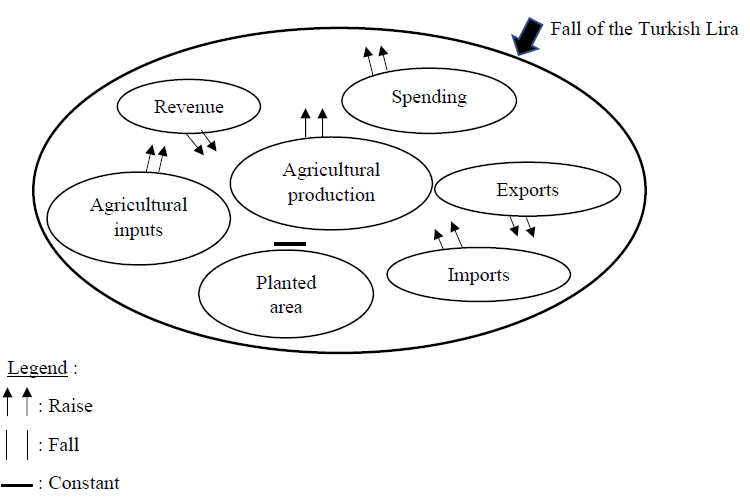
Figure: Schematic representation of the economic environment of the agricultural sector in times of monetary crisis.
The effect of the fall of the Turkish Lira is felt on a number of parameters. These are mainly: production volumes, expenses and revenue generation, quantities of inputs used, the area planted and on imports and exports. It positively influences these factors with the exception of exports fall revenues, and planted areas that remain constant. In order, to reduce the impact of this crisis on the economy of the country’s agricultural sector, it is up to the authorities to find ways to reduce imports by increasing taxes for example; to subsidize the purchase of inputs to reduce expenses and to develop strategies that will encourage people to convert their foreign currency in order to support the Turkish currency.
References
-
MAAF (2015) Politiques agricoles: Quelques exemples pp: 8.
-
De Tapia S (2007) L’agriculture turque face au défi de l’adhésion { l’Union Européenne. pp: 8.
-
Merz PF (2018) La sécurité et la stabilité en Turquie. Politique de sécurité: analyses du CSS 221: 4.
-
Çakmak EH, Kasnakoğlu H (2016) Tarim Raporu, Türkiye İhracatçilar Meclisi pp: 160.
- Enhancement of Vegetative Growth and Fruit Yield in Cucumber (Cucumis sativus L.) via Spiritual Blessing (Biofield) Energy Intervention
- Production of Açaí (Euterpe oleracea Mart.) under Different Agroforestry System Management Intensities in Amazonian Floodplain (Varzea) Forests
- Coffee and the Production Region: What is the Secret to the Expression "Quality"?
- Experiential Agripreneurship Training in Sub-Saharan Africa: Integrating a Business Incubator into Postgraduate Livestock Education at the University of Buea
- Advances in Agricultural High-Quality Development
- Linking Compost Residue to ABAGE in Plants - a Short Note