
Formal or Informal? Analysis of the Potato Seed System in Rwanda
The aim of the study was to analyze the formal and informal potato seed supply system in Rwanda and their interactions (year 2016). Three instruments were applied during this research: formal and informal interviews and expert interviews. In order to supply Rwandan farmers with high quality seed, the formal and informal systems must be complementary and mutually dependent. It is suggested that the certified seed production must be combined with the development of strong and targeted linkages along with the informal seed sector. At the same time, the strengthening of the informal seed system must be improved to increase the seed quality produced by farmers. The promotion of the integratedparticipative approaches in breeding, seed production and distribution would help improve the complementary between the two systems. By doing this, the actual quantity of certified seed could have a major impact on the overall seed supply and increase the seed quantity in the country.
Introduction
Rwanda is part of the Tropical African Highlands, together with Uganda, Burundi and Ethiopia. The largest part of the land is located over 1000 m a.s.l. [1]. It is often called the “country of thousand hills” due to the hills numbers on which many farms are scattered. At the same time, following the first half of the 1990s genocide it is also named the country of the “thousand sorrows” [2].
Despite its past, the country has reached a stable political situation and it is considered a development model for many sub-Saharan countries [3]. Despite the positive improvement, the primary sector still plays a central role in the Rwandan economy, producing approximately the 36% of the GDP and employing the 79% of the population [4]. In order to overcome this situation, the government started an ambitious project called the “Rwanda Vision 2020” with the prospective of an “African Green Revolution”. The program aims to transform Rwanda from an agricultural subsistence to a knowledge-based economy by 2020 (ibid.). To achieve the “Rwanda Vision 2020” the Crop Intensification Program (CIP) was put in place in September 2007. Its principal aim is to increase the agricultural yields, focusing on six priority crops namely: corn, wheat, rice, Irish potato, beans and cassava, and to consolidate land, which is known under the name of the Land Use Consolidation [5].
Rwandan potato production is constantly increasing, and potatoes represent one of the key staple crops being an important source of calories for the population [6]. Potatoes are principally cultivated at high altitudes, from 1800 to 2600 m a.s.l, in the Northern and Western provinces, which are the main producing potato areas of the country. Potato farming is found as well as in the South provinces but plays a minor role. The Nyabihu, Musanze, Rubavu and Burera districts, due to their favorable climatic conditions, are the 4 most productive districts counting about 60% of the national potato production [7]. However, the average potato yields in these districts remains low, corresponding to 11.6 t/ha [8].
German colonialists introduced the potato (Solanum tuberosum) in Rwanda during the period 1894-1916 [9]. Belgian missionaries grew potato, for the first time, in 1904 helping to quickly spread new European varieties and techniques through the country by establishing new missions; from that moment, the potato consumption in Rwanda has always increased [10].
To improve potato production, the Rwanda’ National Potato Program (PNAP), a section of ISAR (Rwandan Institute for Agriculture Science), was established in 1979 in co-operation with IPC (International Potato Center) and with the financial aid from Belgian Technical Co- operation [11]. The program focused four principal objectives: 1) The selection and multiplication of varieties resistant to late blight (Phytophthora infestans) and bacterial wilt (Pseudomonas solanacearum) 2) The creation of a system to produce and diffuse healthy seed of improved varieties. 3) The development of a strategy for transferring improved production techniques to potato producers. 4) The improvement of research and extension capacity through training activities [12].
Since 1979 the seed production has increased thanks to the establishment of a 40 ha seed farm which produced 300 tons of improved seed (20 ha/years); the seeds were later distributed to multipliers farms that in turn distribute their seed to potato growers [10].
By 1984, PNAP has been able to release four new local varieties resistant to late blight and the seed program could supply healthy seed to 18% of the total potato area (ibid.). Fifty percent of the seed produced by PNAP were improved varieties selected from IPC [13]. The total production of potato seeds in 1984 was 330 tons; 70 tons were replanted on the seed farms and 270 tons were given to seed organization and farmers.
Production of potato seed was expected to double in 1985 thanks to the construction of a new 100 hectares seed farm (ibid). In 1984, the expected NAPD rate of return for 1985 was 40%, more than twice the return produced by most development projects in the country [12]. The success was attributed mostly to the following program characteristics: the important support from the Ministry of Agriculture, the early incorporation of farmers’ needs and points of view into research planning, implementation and technology transfer, priority on few important lines of action (ibid.).
During the war (1994), the potato production collapsed because of the dependency on formal sector supplies such clean seed, fertilizer and fungicide; in fact, with the start of the war the latter disappeared quickly letting the farmers without inputs [9].
After the 1994 genocide, the formal activities related to potato production restarted only in 1999 [14]. Thanks to the effort of the Rwandan government, in collaboration with many farmer organizations and NGOs, the potato sector started to revive.
In 2004, the research on potato was carried out by ISAR which focused on varietal selection. The Seed National Service (SNS) was officially in charged for the management of basic potato seed and depends from MINIAGRI (Ministry of Agriculture and Animal Resources) (ibid.).
In 2010 the RAB (Rwanda Agricultural Board) was created from three agriculture agencies, namely the Rwanda Animal Resources Development Authority (RARDA), the Rwanda Agricultural Development Authority (RADA) and the Rwanda Agriculture Research Institute (ISAR) [15]. Since then the RAB, under the supervision of MINAGRI is in charge of all activities related to agriculture.
Between 2008 and 2011, thanks to the financial help of the USAID and the technical support of the IPC, a project using the “3G seed potato” strategy was put into place in Kenya, Rwanda and Uganda in order to increase the high-quality potato seed availability [16]. The result has been a strong increase in the production of mini- tubers going from 75,000 in 2008 to 715,000 mini-tubers in 2013 [17]. Seed importation from European countries is not seen as an option due to danger of introducing foreign diseases and pests that would result more virulent in tropical regions, threatening the local potato production [18].
Currently the formal seed supply system in Eastern Africa is able to supply less than 1% of the country potato seed demand with high quality seed [16]. The reaming
99% is guaranteed by the informal seed system, also known under the name of local or traditional seed system.
Although the pre-basic production has increased between 2008 and 2013 no clear data on the current Rwandan certified seed production levels are available (year 2016). Moreover, no documents describe in a detailed way the actual formal seed potato program in its multiple-aspects. In addition, a complete lack of information on the Rwandan informal potato seed system exist.
In order to full fill these gaps, the aim of the paper is that of providing a detailed description and analysis of the Rwandan formal and informal potato seed supply system. Interaction between the two systems and overall possible improvements will also be described.
Materials and Methods
Research Area
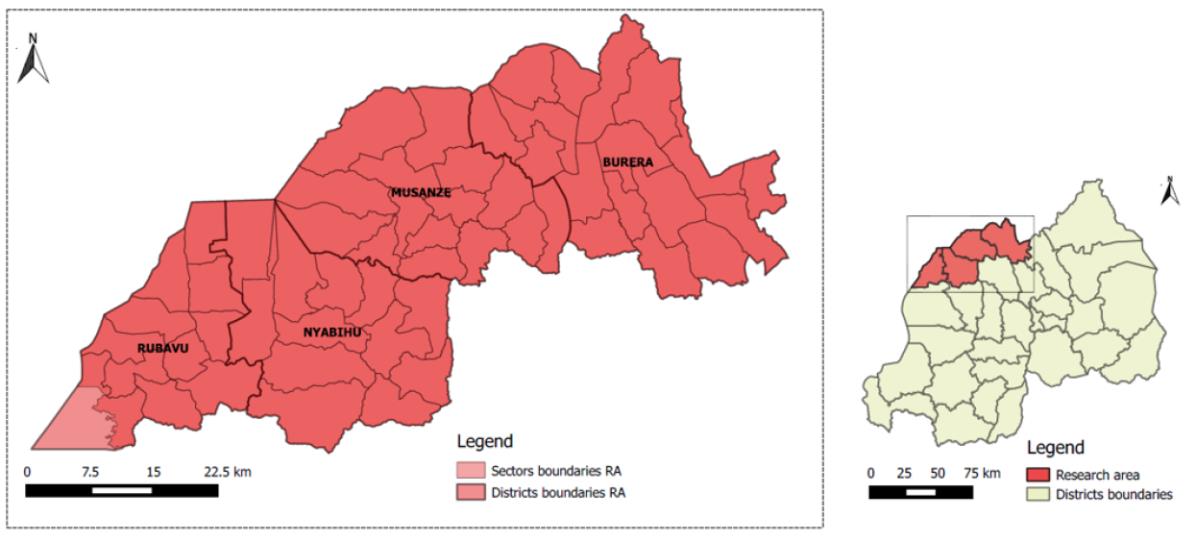
The survey has been implemented in the Rwandan districts of Muzanze, Burera, Nyabihu, Rubavu (Figure 1).
The 4 districts were selected as representative of typical potato production regions in Rwanda. All districts are connected to the Volcanoes National Park at their Northern regions, excepting Burera, which is linked only with its Northwestern regions. The villages, consisting of many scattered households, are located on the hillsides or along the main road, which connects Goma, in the Democratic Republic of Congo, with the Ugandan border. The area is characterized by a high population density of 670 inhabitants per m2 for a total population of 1,137,900 within a total area of 2090 m2. The large population majority is rural (80%). The agricultural zones are principally located in: the Buberuka highlands plateau, in the highlands Lava plateau, in the steep hills and in the valleys or flooded marsh [19]. The rainfall pattern is bimodal with the short, most reliable and important rain season from September to January (Season A); the long rain season (Season B) has high intensity rainfall and runs from mid-February to May [20]. The annual rainfall range between 1200 mm and 1600 mm. The 5 Rwandan administrative levels are: Province, District, Sector, Cell and Village.
Methodology
The survey has been implemented from the end of June to the end of September 2016. At the first time, from the end of June to beginning of August, we focused on the assessment of the formal potato seed supply system and in a second time on the informal one, from the beginning of August to the end of September. The frame time of the first evaluation corresponds to the dry season (season C 2016), the second one to the end of the dry season and the beginning of the rain one (Season A 2017). To gather the agronomic and socio-economic information on seed potato production and management, qualitative and quantitative data were collected. Three instruments, used in social science, were applied during this research: formal and informal interviews and expert interviews. To
assess the actual status of the formal potato system a total of 28 interviews were performed. To describe and evaluate the potato seed management by farmers, a total of 40 formal interviews were implemented.
Data Analysis
The answers of the formal interviews were firstly reviewed due to inconsistencies and subsequently analyzed using descriptive statistical analyses. The open questions were firstly classified into categories and afterwards analyzed. Qualitative and quantitative data were analyzed using the PSPP or R statistical package; to determine significant differences the probability level was always fixed at alpha = 0.05. To determine the specific answer importance in multiple responses with ranking, an importance score calculated in percent was created. Crosscheck among formal interviews, informal interviews and literature were performed to ensure the maximum data reliability.
Results and Discussion
Formal Seed Potato System
The RAB Northern Zone, with its headquarters in Ruhengeri, is the heart of the Rwandan formal potato seed program. Its aim is to produce certified seed in order to increase the availability of high quality potato seed for the Rwandan market. The main certified seed production is located in the 4 districts of Muzanze, Burera, Nyabihu and Rubavu, whereas only the smallest part of it is produced in the Southern Province.
In 2013, IFDC (International Fertilizer Development Center), in collaboration with RAB and the extension service (IMBARAGA and BAIR), supported the entry of private entrepreneurs in the formal seed sector providing financial help and knowledge. Nowadays, the formal seed sector is manly organized and managed by the RAB under the supervision of the MINAGRI. The RAB is in charge of the breeding program and the seed multiplication phases are shared between it and the private sector. The RAB’s long-term goal is gradually to quit the multiplication phases by increasing the share of the private sector in the formal potato seed market [21]. The seed potato multiplication is carried out by the public sector (RAB) and by the private one following a 6-generation scheme. The production of vitro plantlets is guaranteed by the tissue culture laboratories of the RAB and the Ruhengeri Institute of Higher Education (INES). Rooted cuttings are then transferred in aphid proof screen houses own by RAB or by private entrepreneurs. Two methods are used to produce mini-tubers in screen houses: the first one is the aeroponic system and the second one is the mini- tubers production on solid media with a single harvest. The RAB uses both production systems, whereas private entrepreneurs almost use exclusively the one producing mini-tubers on solid media. Two production cycles per year are produced in each screen house system. Then the multiplication is continued in the open field producing the categories“basic seed 1” and “basic seed 2”. The last production phases, “certification 1 and 2”, are produced by cooperatives and by the GroupesProducteurs de Semences (GPS). Nowadays, the category “certification 2” is only produced in few cases.
Rwanda produces annually 114,700 ha of potato [22]. In order to cover the totality of the national potato seed demand with certified seed, a total of 137,300 tons of “certification 1” should be produced (Table 1). The demand for certified seed has been estimated thanks to the actual off-farm purchases seed rate used by farmers. The latter corresponds to 0.57, meaning that a farmer buys off-farm potato seed about 1 times over 2 seasons. To give access to 50% of the potato producers with certified seed, a production of 68,600 tons is required. If the objective is to supply only 25% of the producers, 34,300 tons should be produced. A multiplication rate of 6 has been used to transform “basic seed 1” into “basic seed 2” and then into “certification 1”. It seems reasonable to use a multiplication rate of 6 for such calculation, but it may be too optimistic for the Rwandan real field condition.
Three levels coverage demand with certified
114,700 ha of potatoes are grown in Rwanda1 Assumptions Purchase of new seed (years)2 1/2 1/4 1/8 Seed rate for producing ware potato: 2.1 tons/ha Estimated seed demand (tons)3 137,296
100 50 25
68,648 34,324
| G5: Certification 1 (tons) | 137,296 | 68,648 | 34,324 | ||||||
| MR4 : 6 | |||||||||
| G4: Basic seed 2 (tons) | 22,883 | 11,441 | 5,721 | ||||||
| MR : 6 | |||||||||
| G3: Basic seed 1 (tons) | 3,814 | 1,907 | 953 | ||||||
| 5 | 0,000 mini-tubers produc | e | |||||||
| a yield of 11 tons seed | |||||||||
| G2: Pre-basic seed (mini-tubers) | 17,336,364 | 8,668,182 | 4,331,818 | ||||||
| 1Season A 2016 = 54051 ha, Season B 2016 = 52185 ha, Season C 2016 = 8483 ha; Source: NISR (National Institute | |||||||||
| Statistics of Rwanda), 2016. Seasonal Agriculture Survey 2016. NISR, Kigali, Rwanda | |||||||||
| 2Data used for the calculation: 1/2= 0.57; 1/4= 0.285; 1/8= 0.1425 | |||||||||
| 3Actual purchase: total amount required | |||||||||
| 4Multiplication rate (seed rate 2.5 tons, yield 15 tons seed) |
Table 1: Demand estimation for certified seed and multiplication schemes for 3 possible scenarios.
Almost the totality (93%) of the vitro plantlets production is guaranteed by the public sector, whereas the private ones play a smaller role (7%). The opposite situation appears when we look at the mini-tubers Laboratories maximal Shares by sector capacity per year (n° vitro plantlets) (%) production: the public sector became the principal actor having a market share of 71%, while the public has a share of 29% (Table 2).
Screen houses capacity per year (n° vitro plantlets) Mini-tubers production per year Shares by sector (%) (n° mini-tubers) Season B 2017 (2-cycle of production per year inside the screen houses) Public sector 1,600,000 93 151,200 1,649,340 29 Private sector 125,000 7 633,800 3,972,900 71 Total 1,725,000 100 785,000 5,622,240 100 * Laboratories maximum capacity per year – Screen houses capacity per year Note: This table represents situation of season B 2017. This option has been preferred to the current situation (season A 2017) due to the upcoming changes in the pre-basic seed production for the public sector: a new tissue culture laboratory and a new aeroponic screen house (capacity: 18,000 vitro plantlets per year = 481,950 mini-tubers) will be put into operation from season B 2017.
Vitro plantlets
surplus* 940,000 Table2: Estimation of the national Rwandan vitro-plantlets capacity in screenhouses and related mini-tubers production for private and public sector for season B 2017. Tissue culture laboratories capacity is also provided.
The public sector and the private one produce annually a totality of about 5,140,300 mini-tubers. Nowadays, with the actual production levels in the field, the multiplication of 5,140,300 mini-tubers could produce about 18,000 tons of certified seed. Subtracting the actual sales of the different seed categories along the multiplication process, we could reach a production potential of about 12,800 tons of certified seed. By improving the actual cultural techniques, the multiplication rates in the field could be increased achieving an annual production potential of about 40,700 tons.
However, both three theoretical production levels are not reached in reality: indeed, about 5,300 tons of certified seed (category “Certification 1”) are annually produced (Table 3). This means that the multiplication potential of 5,140,300 mini-tubers is under-exploited. Large margins of improvement, maintaining the current mini-tubers production, can be put into place improving the actual situation.
| p | Annual | Sales * | |||||||||||||||||||
|---|---|---|---|---|---|---|---|---|---|---|---|---|---|---|---|---|---|---|---|---|---|
| Annual | Annual reachabl potentia | e l | |||||||||||||||||||
| Seed generations- | otential with | ||||||||||||||||||||
| potential | Assumptions | Assumptions | |||||||||||||||||||
| Seed categories | sales | ||||||||||||||||||||
| without sales | |||||||||||||||||||||
| G2: Pre-basic seed (mini- | |||||||||||||||||||||
| 5,140,290** | 4,762,290 | 3 | 78,000 | 5,140,29 | 0 | ||||||||||||||||
| tubers) | |||||||||||||||||||||
| t | 50,000 mini- | a | |||||||||||||||||||
| 5 | 0,000 mini-tubers produce a yield of 11 tons seed | ||||||||||||||||||||
| ubers produce | |||||||||||||||||||||
| yield of 11 tons | |||||||||||||||||||||
| seed | |||||||||||||||||||||
| G3: Basic seed 1 (tons) | 1,131 | 934 | 197 | 1,131 | |||||||||||||||||
| MR: 4*** | MR: 6 | ||||||||||||||||||||
| G4: Basic seed 2 (tons) | 4,523 | 3,926 | 597 | 6,785 | |||||||||||||||||
| MR: 4 | MR: 6 | ||||||||||||||||||||
| G5: Certification 1 (tons) | 18,094 | 12,820 | 5274 | 40,711 | |||||||||||||||||
| FARMERS | |||||||||||||||||||||
| *Estimations of the actual sales per seed categories. Potato seeds are often sold outside the certification program. | |||||||||||||||||||||
| **Calculation: 5,622,240 (Table 2) – 481,950 = 5,140,290. One RAB’ aeroponic screen house is actually not in function | |||||||||||||||||||||
| (season A 2016) | |||||||||||||||||||||
| * The multiplication rate has been estimated from data of seed multipliers knowing their mini-tubers capacity and** | |||||||||||||||||||||
| their seasonal sale per seed categories |
Table 2: Annual production potentials per seed category with and without sales considering the actual mini-tubers
- Table 3: Annual production potentials per seed category with and without sales considering the actual mini-tubers production (season A 2016). A possible scenario of a reachable production potential is also provided.
- The actual mini-tubers production could cover between 13% to 30% of the actual Rwandan national demand depending on the scenario used for the calculation. However, due to a potato seed leak along the certification process and to a lack of actors who multiply lower seed categories into upper ones, the same figure is not reflected into the actual production of certified seed, which represents 5% of the national required demand
- (Table 4).
- Three levels coverage demand with certified seed (%)
- Scenario 1*
- Scenario 2**
- Annual current production
- 100
- 50
- 25
- 100
- 50
- 25
- Pre-basic seed: 5,140,290 mini-tubers (early stage)
- 30
- 59
- 119
- 13
- 26
- 53
- Certified seed : 6,400 tons*** (latest stages)
- 5
- 9
- 19
- 5
- 9
- 19
- *Scenario 1: correspond to Table 1
- ** Scenario 2 is a variant of Scenario 1: the multiplication rate (MR) to transform “basic seed 1”. Into “basic seed 2” and “basic seed 2” into “certification 1” has been changed from 6 to 4. Basis for the change: it seems a MR of 4 represents the actual field conditions better
- ***Data taken from the Table 3, calculation: 5,274 + 597 + 197 + (378,000 × 11/50,000) × 4 = 6,400 tons
Table 4: Coverage certified seed degree for 2 national seed potato demand scenarios at early and latest stages of the
| Sales * |
|---|
To increase the efficiency of the formal seed sector, the first step to be done would be to improve the management and the organization of the actors involved in the “certification 1” production such as cooperatives and the GPS. They should be specialized in seed production and should exclusively multiply certified seed. In addition, the produced “certification 1” should be sold outside of the multiplication bodies in order to maximize the certified seed diffusion. The second step should be the number increase of the multiplication bodies producing the category “certification 1” at the national level. As a rule, the certification seed production process should act as a closed cycle. Once the last multiplication phases are well organized, the production of mini-tubers could be augmented by increasing the screen houses exploitation degree (3 cycles per year instead of 2) or by building new screen houses.
Another important aspect about developing an efficient seed system is the creation of a clear seed pricing policy. The price along the year must not be fixed but adapted several times along the year. More specifically, the seed potato price should be increased by at least 50% compared to the ware potato price and follow the yearly ware potato price curve. With the application of this pricing policy, the seed potato sale as ware potato should be avoided or at least declined. A discussion with the principal credit institutions should be opened to facilitate the lending process for actors involved in the primary sector. The repayment schedule should be prolonged to allow the seed multipliers to repay their loan, made at the beginning of the season, after the storage period. The multiplication scheme must be clearly understood by the different actors involved in the process. The creation of a national potato seed association, which already existed in the past, could represent a strong signal that underlines the strengthening of the seed industry. In addition, the association can increase the bargaining power of its members with the public-private sector and international agencies or donors.
The Informal Seed Potato System
Potato represents the largest source of income for the household and is by far the most important cash crop for the sectors with the highest potato production levels in districts of Muzanze, Burera, Nyabihu and Rubavu. Farmers consider potatoes a source of money and at the same time an important source of food due to its short growing season. The average gross income per year per household is 621,750 FRw (731 USD). The sale of potatoes originates 57% of their income, 15% derives from the sale of milk or animals, 15% by off-farm activities. The remaining 13% is the result of the sale of cereals, beans and other crops. The income generated from the sale of potatoes is considered as the engine to develop the household conditions and a source of money for investments such as the purchase of livestock or land.
The average farmer size is 0.43 ha. Most households (81%) have more than one field scattered in the country side while the remaining 19% owns only one field; the average number of fields per household is equal to 4.
The large majority of farmers (76%) produces potato 2 times per year during season A and B, following the bimodal rainfall pattern; 17% produces potato 3 times per year during season A, B and C, adding a third off- season production cycle during the dry season (season C). The remaining 7% produces potato only 1 time a year (season A or B). Farmers start to plant potato for season A from July to October with a large majority (90%) planting between August and September. For season B from January to mid-March with a clear majority (95%) planting between January and March. The planting time for season C (off-season) start from April to Mai corresponding to the period between season B and A.
Potatoes are produced over large furrows along with the plains with low slope and at the valleys bottom. Farmers using the hoe and following the curves of levels prepare the furrows. The use of large furrows protects the crops from heavy rains and prevents soil erosion. Where the slope is too high the construction of large furrows is not possible anymore. Consequently, they are substituted with small furrows over the hills’ terraces and along the slopes without terraces.
Farmers generally produce potato as solo cropping of a single potato variety. In fewer cases potato is produced under a row intercropping system growing potato with corn or beans or wheat. This system seems to be applied only where large furrows are present. Potato is planted on rows along the furrow and corn or beans or wheat is planted at the two sides of the line with a low sidling density. Farmers plant a mixture of potato varieties only if no alternative were found to cover the needed potato seed quantity. The majority (77%) of the farmers produce seasonally only one potato variety and almost half of the land per household is cultivated with potatoes (47%). The rotation in the fields is often not respected and it does not follow a specific trend. Farmers adapt the rotation depending on their seasonal objectives and their personal believes. Potato is alternate with beans, peas, corn, sorghum, wheat, pyrethrum, follow and with other intercropping systems.
Most farmers (42%) use an average seed rate of 2.1 tons/ha using preferably medium size tubers. 27% use medium-big size tuber, 21% small-medium and the remaining 9% use all 3 tubers size for planting. The very big tuber, meaning tubers which size exceeding the standard big tubers size are never used as seed. The results of Nyabyeda seem to confirm the farmer preference of the use of medium size tubers: medium size tubers have an higher ratio (yield per seed rate) compared to small and big size tubers [1]. The average potato yield for season A and B is 11.7 t/ha.
Farmers mentioned a totality of 16 potato varieties used since the year 2000. The average number of potato varieties used per farmer in the past 6 years was 2.7. The variety Kuruseke, Peco and Kinigi received respectively an importance score of 23%, 17% and 15% (Figure 2). Farmers consider Kuruseke to be on average the most important potato variety in their varietal portfolio, Peco the second one and Kinigi the third one.
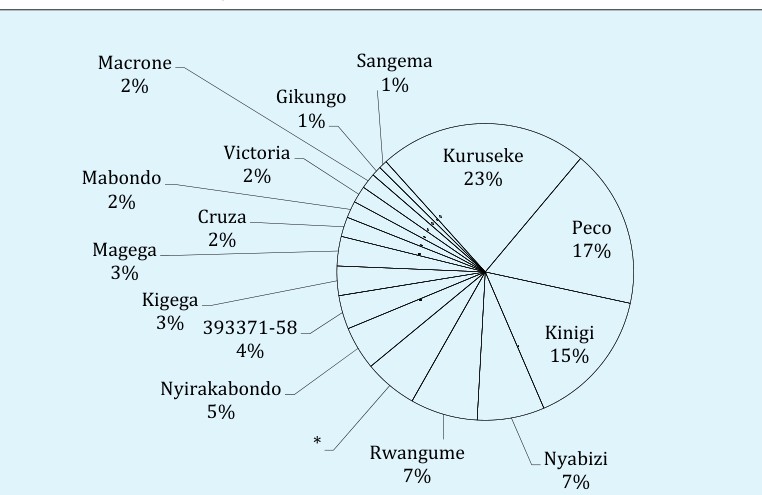
*E.g. Score Kirundo = 38 = 2 (relative frequency in the 1st. rank) * 7 (points for 1st. rank) + 4 (relative frequency in the 2nd. rank) * 6 (points for 2nd. rank); total sum of scores = 654; Kirundo = 100*38/634 = 6%. Total number of ranks = 7.
one in term of yield and quality leading to an increase of the off-farm seed purchase. The Crop Intensification Program (CIP), the need of increasing the seed stock, the high family food requirement and the need of monetary liquidity by the household represent each 8% of the reasons to buy off-farm seed. The varietal long dormancy, seed degeneration and storage capacity seem to represent minor reasons counting namely 6%, 3% and 3%.
Moreover, farmers use certified seed in few cases (3%), due to the unawareness of the certified seed presence in the market, the high price, the low seed availability along with the unwillingness to buy certified seed.
Farmers, to increase the seed potato quality, practice seed selection. Producers select their seed before storage stoking them separately from ware potato. The most diffuse storage system among farmers (58%) consists in storing the potato seed firstly over the ground, or over a remaining crop layer, in a house room, and then seeds are transferred into synthetic material bags (Figure 3). This system has the advantage of having intermediate characteristics between the storages systems “over the ground” and “direct in bags”. Indeed, good ventilation is guaranteed in the first period of storage, but not a good one during the second one in bags, decreasing its seed storability. Farmers are often happy with this last option because they prefer potato seed to germinate faster in order to be ready for the next planting. The low adoption rate of the Diffuse Light Storage (inside the category “specific storage” in Figure 3) seems to be principally related to the prolonged dormancy caused by this system. Already in the past, researchers expressed some doubts on DLS suitability for the Rwandan conditions: Monares observed that Rwandan farmers plant potato twice a year and sprouted seeds are needed as soon as possible after harvesting making diffused light technology not suitable for the region [12].
First over the ground and in a second time in bags Over the ground Direct in bags Wooden platforms or Wooden shelves Specific storage
0 10 20 30 40 50 60 70
% Figure 3: Relative frequency with respect to farmers of 5 potato storage systems (n=33).
Separate seed storage from ware potato ensures a next step in the selection level compared to fully integrated systems where seeds are selected from the stored harvest before the planting time. Nevertheless, the seed production is not generally done in separate plots indicating a not excessive degree of specialization in seed selection. High prices of non-certified seed are by far the most important problems in seed production mentioned by farmers reaching an importance score of 35%. The high prices seem to be the combination result of two elements: the low availability of non-certified seed, due to low yields, and the high seed demand. The high pests and diseases pressure (in decreasing order of problematic: Bacterial wilt, Viruses, Late blight, Leaf miner, Aphids, Cutworm) is the second most important problem (14%) followed by the low availability of non-certified seed (11%). Farmers especially complain about a lack of seed for season A due to poor weather condition along season B which lead to the high diseases pressure decreasing yields and by consequence seed availability. Other problems have been mentioned but are considered by farmers less problematic.
Interactions between Formal and Informal Potato Seed System
In order to maximize the impact of the formal seed program specific linkages have to be established with the informal system:
First, common objectives on varietal development should be defined in a clear way together with farmers using participative approaches. This will increase the new varieties adoption rates by farmers repaying the effort of the breeding program and increasing the farmers’ recognition. At the same time, important varieties widespread among farmers should be a part of the multiplication objectives of the formal seed sector. The certified seed must be “injected” into the informal seed system at right sites and points to maximize their diffusion among small farmers. To do so, we recommend the following strategies: • Multiplication bodies should sell certified seed outside the bodies’ selves.
• The quantity sold should be fixed up to a maximum of
400 kg per purchaser and no minimum quantity should be established. This measure avoids that more commercial oriented farmers, who may directly produce ware potato from purchased seed, will buy much of the certified seed.
• Thirdly, the sale priority should be given to facilitators involved in the Farmer Field Schools (FFS). Facilitators must use certified seed or new varieties for teaching purpose, for instance comparisons among seed coming from different sources and new varieties could be tested.
At the end of the evaluation process, tubers must be distributed among the FFS members. Neighbors and acquaintances, by observing their fields, may in turn adopt part of their practices generating a knock-on effect. This measure has the objective to distribute clean genetic material and new varieties widespread on the territory. At the same time, it also helps to increase the knowledge of the certified seed presence among farmers. This option, which involves local partners, well known in the farming community, would probably avoid problems that could slow down the certified seed diffusion process such as: social differences within the communities, ethnic and geographic boundaries, and diffusion of potato seed from large to small farmers [23, 24, 25]. Extension service as IMBARAGA and BAIR should introduce FFS’s facilitators to the proposed system. The TWIGIRE extension model would play a double function: the extension service and the starting “injection” point for certified seed and new varieties within the traditional seed flows.
The right price, the sale time and the physiological age of certified tubers at the moment of sale should meet the farmers’ expectations. The last two requirements should not represent a large problem due to the high time variability farmers have in planting potatoes.
Conclusion
The potato cultivation represents the largest household income source for the sectors with the highest potatoes production levels in the districts of Muzanze, Burera, Nyabihu and Rubavu and it is by far the most important cash crops in the region. The low potato varietal biodiversity at the household level, together with the low-quality rotation, the high potato presence inside the rotation could lead to a decrease in the agro- ecological system resiliency compromising the regional food security. Concrete actions must be taken to introduce more sustainable farming practices.
Since 2008, the certified seed production has strongly increased: the RAB has augmented its production of pre- basic seed thanks to the construction of a new screen houses and by increasing the production capacity of its vitro culture tissue laboratories. Furthermore, the entry of private entrepreneurs in the mini-tubers production has also strongly boosted the formal seed sector. Despite the large public-private effort, only few measures have been taken to exploit the actual pre-basic seed production potential for incrementing the certified seed production. Moreover, little attention has been given to a careful strategies planning on how to distribute and diffuse certified seed among farmers.
Farmers show a high dependency on the off-farm seed sources and certified seed are used only in few cases. To increase the self-sufficiency potato seed degree and the certified seed adoption, we recommend introducing farmers to: good sustainable agronomic practices, positive selection, plot techniques and the use of certified seed. All those practices can be discussed and evaluated at Farmer Field Schools, supported by the TWIGIRE extension model. Formal seed sector supplies 5% of the national seed demand with certified seed, whereas the informal one supplies the remaining 95%. To supply Rwandan farmers with high quality seed, the formal and informal systems must be complementary and mutually dependent. It is suggested that the certified seed production must be combined with the development of strong and targeted linkages along with the informal seed sector. The promotion of the integrated-participative approaches in breeding, seed production and distribution would help to improve the complementary between the two systems. By doing this, the actual quantity of certified seed could have a major impact on the overall seed supply and increase the seed quantity at the national level.
References
-
Nyabyeda P (2005) Les plantes cultivées en régions tropicales d’altitude d’Afrique. Les presses agronomiques de Gembloux pp: 225.
-
Braeckman C (2014) Rwanda. Nevarica pp: 93.
-
Huggins CD (2014) ‘Control grabbing’ and small-scale agricultural intensification: emerging patterns of state-facilitated ‘agricultural investment’ in Rwanda. Journal of Peasant Studies 41(3): 365-384.
-
MINAGRI (Ministry of Agriculture and Animal Resources) (2014) Decentralized extention programme in Rwanda. MINAGRI, Kigali, Rwanda, pp: 18.
-
MINAGRI (Ministry of Agriculture and Animal Resources) (2011) Strategies for Sustainable Crop Intensification in Rwanda. Shifting focus from producing enough to producing surplus pp: 1-59.
-
Tenge NG, Alphonse M, Thomas T (2012) East African agriculture and climate change: A comprehensive analysis-Rwanda. International Food Policy Research Institute 1: 127-139.
-
MINAGRI (Ministry of Agriculture and Animal Resources) (2013) Crop assessment. MINAGRI, Kigali, Rwanda.
-
NISR (National Institute Statistics of Rwanda) (2015) Seasonal Agriculture Survey 2015.
-
Sperling L (1997) The effects of the Rwandan war on crop production and varietal diversity: a comparison of two crops. Network Paper Agricultural Administration pp: 1-12.
-
Zaag PV (1982) Strategy for developing a national potato program for Rwanda. Root Crops in Easter Africa 1: 39-44.
-
FAO (1991) Potato production and consumption in developing countries. FAO, Rome, Italy.
-
Monares A (1984) Building an effective potato country programme: the case of Rwanda. International Potato Centre pp: 34.
-
IPC (International Potato Center) (1985) Annual Report 1984. IPC, Lima, Peru.
-
Fané I, Kribes R, Ndimurwango P, Nsengiyumva V, Oyono CN (2014) Les systèmes de production de la pomme de terre au Rwanda. Propositions d’actions de recherché et de développement dans les Provinces de Ruhengeri et Gisenyi. Série de Documents de Travail, pp: 122.
-
RAB (Rwanda Agriculture Board).
-
Schulte-Geldermann E, Borus D, Lemaga B, Labarta RA, Ian B (2015) The “3G seed potato revolution” a strategy to overcome the shortage of quality seed potatoes in Eastern Africa: Experience from interventions in Kenya. Transforming potato and sweet potato value chains for food and nutrition security. 9. Triennial Congress of the African Potato Association. Naivasha (Kenya).
-
Demo P, Lemaga B, Kakuhenzire R, Schulz S, Borus D, et al. (2015) Strategies to Improve Seed Potato Quality and Supply in Sub-Saharan Africa: Experience from Interventions in Five Countries. Potato and Sweetpotato in Africa: Transforming the Value Chains for Food and Nutrition Security pp: 155-167.
-
Kaguongo W, Rwomushana I, Kashaija I, Ntizo S, Kabira J (2015) Risk of Uncontrolled Importation of Seed Potato from Europe to East and Central Africa: What are the Policy Options? Transforming potato and sweetpotato value chains for food and nutrition security. 9. Triennial Congress of the African Potato Association. Naivasha (Kenya).
-
Mega cluster of potato Rwanda (2015) IFDC, Rwanda, pp: 6.
-
Nabahungu NL, Visser SM (2011) Contribution of wetland agriculture to farmers’ livelihood in Rwanda. Ecological economics 71: 4-12.
-
Ntizo S (2016) Head of potato program (RAB, Northern Zone).
-
NISR (National Institute Statistics of Rwanda) (2016) Seasonal Agriculture Survey 2016.
-
Prain G, Scheidegger U (1988) User-friendly seed programs. In: Report of the Third Social Science Planning Conference held at the IPC, Lima, Peru, pp: 182-203.
-
Almekinders CJM, Louwaars NP, Bruijn GH de (1994) Local seed systems and their importance for an improved seed supply in developing countries. Euphytica 78(3): 207-216.
-
GeoPortal (2017) Rwanda GeoPortal.
- Enhancement of Vegetative Growth and Fruit Yield in Cucumber (Cucumis sativus L.) via Spiritual Blessing (Biofield) Energy Intervention
- Production of Açaí (Euterpe oleracea Mart.) under Different Agroforestry System Management Intensities in Amazonian Floodplain (Varzea) Forests
- Coffee and the Production Region: What is the Secret to the Expression "Quality"?
- Experiential Agripreneurship Training in Sub-Saharan Africa: Integrating a Business Incubator into Postgraduate Livestock Education at the University of Buea
- Advances in Agricultural High-Quality Development
- Linking Compost Residue to ABAGE in Plants - a Short Note