
Socio-Economic and Institutional Factors Influencing Adoption of Community-Based Agriculture and Rural Development (CBARD) Crop Production Interventions Project in Kaduna and Bauchi States, Nigeria
This study was conducted to assess the socio-economic and institutional factors influencing adoption of Community- based Agriculture and Rural Development (CBARD) Crop Production Interventions Project in Kaduna and Bauchi States, Nigeria. Primary data for the study were collected using well-structured questionnaire, administered to 746 beneficiaries Descriptive statistics and Logit regression were used to analyze the data. The results of logit regression estimates indicated that age, farm size, farming experience, membership of cooperative societies, extension contact and access to input were all significant at 1% level of probability and influenced beneficiaries’ adoption of recommended crop varieties by 42% in the AfDB-CBARD Project Interventions. The rural wage earning opportunities created by the project as reported by the respondents in the study area included petty trading, crop processing and milling, commercial transportation, water vending, craftwork, bricklaying, seed multiplication, hired labour and animal traction. Constraints encountered by the beneficiaries as they participated in the project were inadequate capital, inadequate processing and storage facilities, low western literacy level and low prices for farm produce. The following recommendations were made: promotion of savings among farmers and farmer groups should be encouraged as well as encouraging the social organisation to secure loans for their members from agricultural banks. Commodity market/produce user programme and processing industries should be established to handle excess farm produce. Government should create awareness amongst the farmers conceiving the newly established agricultural cargo airports nearest to them. The cost of agrochemicals should be subsidized. Feeder roads should be constructed. Recreation facilities like viewing centers and rural telephony should be encouraged and a functional umbrella organisation for farmers is required to handle issues of capacity building for farmers.
Introduction
Community-based development is a form of development within the community through maximum participation of community members in design and implementation of the project that brings about improvement. Usually, community-based development is small-scale, low-cost, and uses simple technologies [1]. Community-based development projects help build capacity and strengthen institutions, providing services to rural poor people, assisting with necessary policy changes, developing local organizations to enhance their effective participation, and promoting initiatives to foster rapid private sector-led poverty reduction strategy and economic growth [1].
For community-based development to occur, people must adopt a new attitude, in which they become actors rather than recipients, and embrace small incremental change generated internally rather than expect large infusions of external wealth and technology [2]. Hence community-based development encompasses forms of development as well as the structures needed to achieve them. It is a participatory, community-controlled method employed by African Development Bank Community- Based Agriculture and Rural Development Project (AfDB- CBARDP).
The improved quality of life expected from participation in any community-based development project is best seen in positive change in the socio- economic status of participants [3]. Socio-economic status (SES) is an individual ranking or position in a society [4]. Socio-economic status denotes the position of an individual in a community with respect to the amount of cultural possession, effective income, material possession, prestige and social participation [5]. Socio-economic status is the position that an individual or family occupies with reference to the prevailing average standards of cultural possession, effective income, material possessions and participation in the group activities of the community [6].
Considering the pronounced poverty in the country especially in the rural areas in the northern states of Nigeria, African Development Bank (AfDB) came up with Community-Based Agriculture and Rural Development Project (CBARDP) intervention for the country. The project was approved in 2003 and started in 2005 with the Federal Ministry of Agriculture and Rural Development as the implementing agency. The project, located in northern Nigeria, covered Adamawa, Bauchi, Gombe, Kaduna and Kwara states. Major components of the project are capacity building, production development, community development as well as project management and coordination [6].
The Community Based Agricultural and Rural Programme has been designed specifically to implement the new Rural Development strategy. The programme aims at poverty reduction through improvement of the livelihood and living conditions of the rural poor. It consists of activities dealing with production development, provision of rural infrastructure facilities and capacity building. It ensures community participation from the onset in the design and implementation of the project and sustainability by providing the institutional support that will enable service providers to participate effectively. It was agreed that, as part of the programme, each financier would take on different states in the country [7].
The programme has also built on the experiences from the World Bank financed National Fadama Phase I project. This project resulted in the widespread adoption by farmer groups of simple, low-cost improved irrigation technologies, which led to a general improvement of their well-being, both socially and economically. The project will also complement the ADB/WB financed Community- Based Poverty Reduction Project by providing training for production purposes and increasing access to the credit provided by this project [7].
The proposed project focused on alleviating the major constraints such as the unreliable rainfall, a poor natural resource base and high rates of erosion. This will be done by providing the necessary know-how and introducing adaptable technologies, which have worked in the country. The project will finance simple technologies such as: high quality seeds; agro forestry and alley cropping; use of organic fertilizers and composting; integrated pest management; improved storage facilities; improved marketing facilities; improved rangelands and other income generating activities related to beekeeping and aqua-culture [7]. These technologies have been tried out in the area and have been accepted by rural poor. The project will also finance the establishment and/or rehabilitation of water points for small-scale irrigation and livestock production development. The use of fadama land for irrigated agriculture is well established and has led to improvements in the livelihood of the rural poor. Simple pumping equipment such as treadle pumps is also available in the market.
The project will also support a Community Development Fund, which is intended for social and rural infrastructure works,. Through participatory assessments, communities will prepare and implement community development plans, which will be presented to the Local Government Councils for their inclusion in the Annual Work plans and Budgets [7]. This is a major shift in approach as in practice, development works have always been determined by State and Local Government without involvement of the communities. The project will thus catalyze the participatory process of bottom-up planning and development by using the existing institutional framework at local and state government level.
Problem Statement
The African Development Fund loan was declared effective in December, 2003 and the first disbursement was done June, 2006. The ADB-CBARDP has the long held belief by development experts that the problem of Nigerian agriculture is low technical capacity or poor technical efficiency. In view of this, the ADB-CBARDP set out to address this by making technologies available to farmers in a section of Nigeria where such technical capacity was considered low. ADB-CBARDP also assumed that once technologies were adopted and agricultural inputs provided, crop production will increase and farmers will become food secure, rural income will rise, drift from rural to urban areas will reduce, wage earning activities will increase, there will be improvements in infrastructure facilities, capacity building will be enhanced and rural livelihood will improve. However, since the inception of the project in 2006 till date, independent assessment of the the socio-economic and institutional factors influencing adoption of Community- based Agriculture and Rural Development (CBARD) Crop Production Interventions Project in Kaduna and Bauchi States, Nigeria on beneficiaries has been scanty. This study therefore, is taking the challenge of filling this research gap by empirically determining its achievements vis-a-vis the goal and objectives of the Project. The study therefore intends to provide answers to the following questions: (i) What are the socio-economic and institutional factors influencing adoption of ADB-CBARD project interventions? (ii) What is the extent of rural employment opportunities benefited by farmers from the ADB-CBARD project in the study areas? (iii) What are the constraints encountered by the beneficiaries of the ADB-CBARD project in the study areas?
Objectives of the Study
The broad objective of this study was to analyze the socio-economic and institutional factors influencing adoption of Community- based Agriculture and Rural Development (CBARD) Crop Production Interventions Project in Kaduna and Bauchi States, Nigeria and other forms of rural livelihoods in the study areas. The specific objectives were to: (i) determine socio-economic and institutional factors influencing adoption of CBARD project interventions; (ii) assess the extent of rural employment opportunities benefited by the farmers from the AfDB-CBARD project in the study areas; (iii) describe the constraints being encountered in the implementation of the African Development Fund Community Based Agriculture and Rural Development Project (AfDB-CBARDP) in the study areas.
Methodology
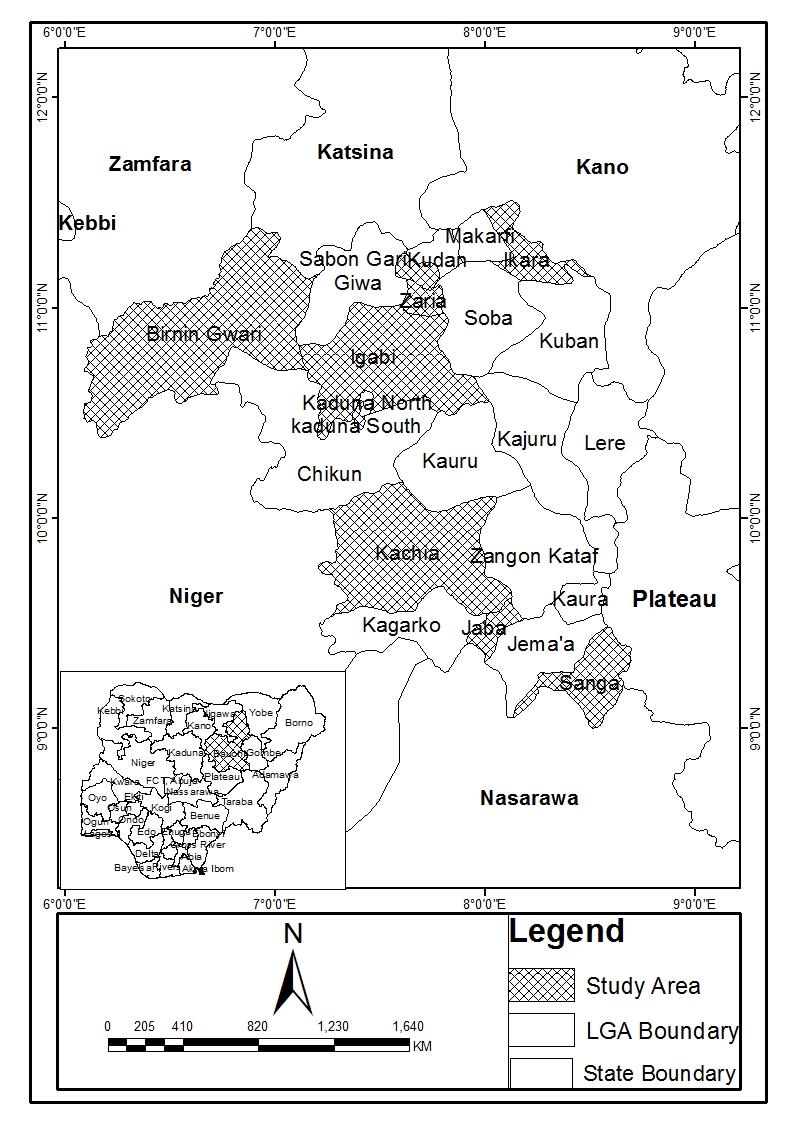
The study was conducted in two States namely Kaduna and Bauchi States. Kaduna State is located between latitude 1o and 12o N and extends from longitude 6o and 9oE and East of Greenwich Meridian. The State has a projected population of about 6,667,357 in 2017 and it is the third largest in the federation after Lagos and Kano [8]. It has an estimated cultivable land area of about 45,786km2 with only about 30,000km2 under cultivation by traditional low-income group. The mean annual rainfall shows a marked decrease from South to North (1524-633mm). The vegetation in the southern part of the State is southern guinea savannah vegetation while vegetation in the north is northern guinea savannah. Farming is the main occupation of the people of Kaduna and it is characterized predominantly by mixed cropping, of such crops as maize, sorghum, millet, cowpea, rice, cassava, sugarcane and tomatoes [9]. Rain-fed agriculture is mostly practiced in the State with little fadama farming.
The State is currently made up of twenty-three Local Government Areas (LGAs) out of which nine (9) local government areas are participating in the community based agriculture and rural development project. The participated LGAs are Zaria, Igabi, Jaba, Sabon Gari, Ikara, Birnin Gwari, Kaduna South, Kachia and Sanga.
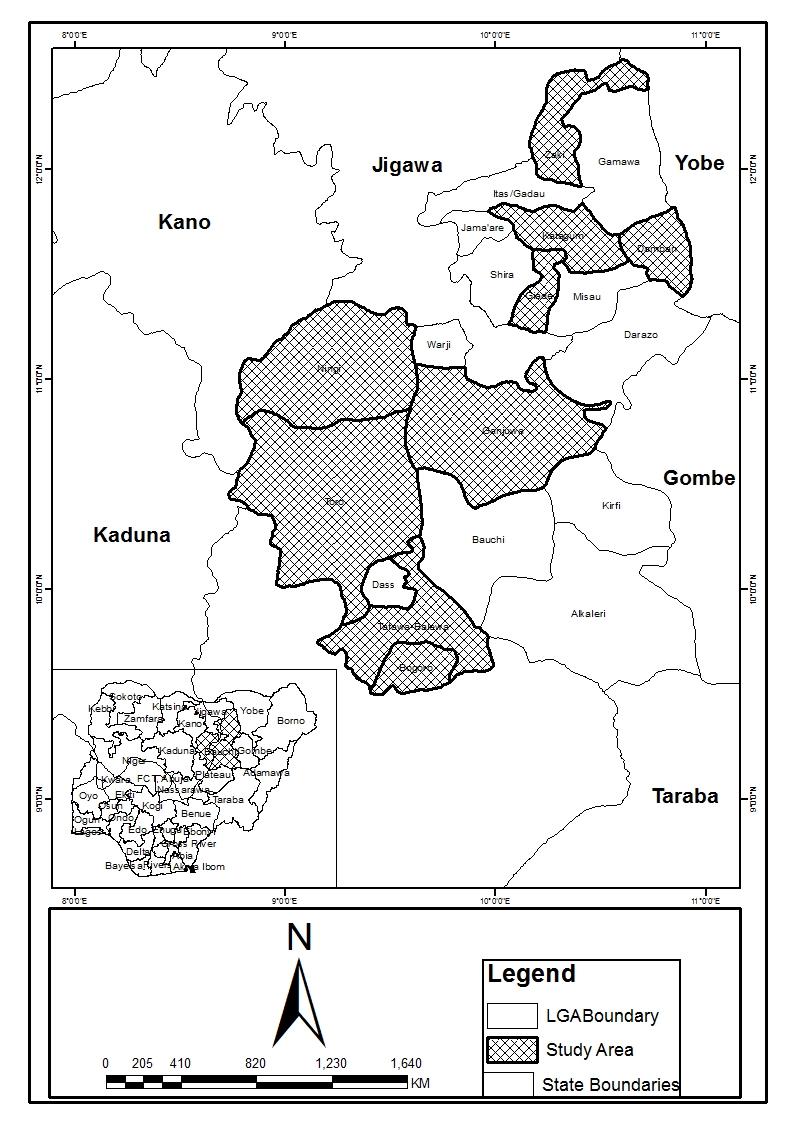
Bauchi State occupies a total land area of 49,119km² representing about 5.3% of Nigeria’s total land mass and is located between latitudes 9º3΄ and 12º3΄ north and longitudes 8º50΄ and 11º east [10]. The rainfall in Bauchi State ranges between 1300mm per annum in the south and only 700mm per annum in the extreme north. Rains start earlier in the southern part of the State, where rain is heaviest and lasts longer. Here the rains start in April, while the northern part of the State receives the late, usually around June or July. The State has a projected population of about 5,467,353 people at 2.5% growth rate in 2017. The State is currently made up of twenty local government areas out of which nine local government areas and twenty seven rural village areas are participating in the CBARD project. The participating LGAs are katagum, Bambam, T/Balewa, Bogoro, Toro, Ganjuwa, Ningi, Giade and Zaki [10].
Sampling Procedure and Sample Size
Data were collected in all the participating Local Government Areas in Kaduna and Bauchi states. The benefitting local governments in Kaduna are Birnin Gwari, Igabi, Ikara, Jabba, Kachia, Kaduna south, Sabon Gari, Sanga and Zaria while the benefitting Local Government Areas in Bauchi are Katagum, Bambam, Tafawa Balewa, Bogoro, Toro, Ganjuwa, Ningi, Giade and Zaki. The populations of beneficiaries were collected from Kaduna and Bauchi ADPs. Each benefiting Local Government Area
is made up of three Rural Village Areas (RVAs) which is headed by an Apex coordinator making a total of 27 RVAs for each state. About 5% of the beneficiaries from each Local Government Areas were selected using simple random sampling technique giving a total of 746 respondents from the two states (Table 1).
| State | LGA | Beneficiaries | |
|---|---|---|---|
| Sample frame | Sample size | ||
| Kaduna | Birnin Gwari | 450 | 23 |
| Kaduna | Igabi | 1154 | 58 |
| Kaduna | Ikara | 864 | 43 |
| Kaduna | Jaba | 1070 | 54 |
| Kaduna | Kachia | 1385 | 69 |
| Kaduna | Kaduna South | 604 | 30 |
| Kaduna | Sabon Gari | 1139 | 57 |
| Kaduna | Sanga | 644 | 32 |
| Kaduna | Zaria | 1013 | 51 |
| Bauchi | Katagum | 450 | 23 |
| Bauchi | Bambam | 600 | 30 |
| Bauchi | T/Balwa | 644 | 32 |
| Bauchi | Bogoro | 1000 | 50 |
| Bauchi | Toro | 1002 | 50 |
| Bauchi | Ganjuwa | 609 | 30 |
| Bauchi | Ningi | 804 | 40 |
| Bauchi | Giade | 705 | 35 |
| Bauchi | Zaki | 800 | 40 |
| Total | 14936 | 746 | |
Table 1: Showing sample size and sampling procedure of respondents.
Data Collection
The data collection for this study was done through the use of detailed and well-structured questionnaire and interview schedule. A set of questionnaire was utilized in the course of this study for the project (CBARDP) beneficiaries. Some of the secondary information that were collected and used for this study included reports of Kaduna ADP, Bauchi ADP, literatures on Community Based Agricultural and Rural Development Project, journals and books.
Analytical Techniques
Descriptive statistics such as percentages and ranking were used to achieve objectives 2 and 3.
Logit Regression Model
Logit regression model was used to achieve objective 1 which is factors influencing adoption of recommended crop varieties by ADB-CBARD Project. This logit regression model is one of the binary choice models in which a dichotomous regression variable is considered as the dependent variable and this dichotomous variable is related to a set of independent variables that were hypothesized to influence the outcome from set of paired variables. In this study, the outcome variable participation is binary (i.e. beneficiaries and non-beneficiaries) hence was assigned 1 for beneficiaries of the project and 0 for non-beneficiaries. The logit model of characterizing the influence of socio-economic and institutional factors is specified below:
(Y11/X_1,) = 1…. 9 = _F(Z1) = 1ez_i_ ÷ (1- e-z1 =, ez1 +Z, i = 1 – n) Where: Zi=ɑ + β_1Χi1+β2 X j2 ……………………… + β_9Χ_j9 _Y= 1 if ith is beneficiaries 0 ith is non- beneficiaries _Χ_i1= 1 – 9 are the socio-economic and institutional factors of the ith beneficiaries and Non-beneficiaries define as: X1 = Age (Years) X2 = Household size(number) X3 = Farm size (Hectare) X4 = Farming experience (Years) X5 = Years of membership in cooperative societies (Years) X6 = Education (Years of formal schooling) X7 = Extension contact (Number of contacts in a season) X8 = Access to inputs (Number of inputs) X9 = Access to credit(Naira) X1-X9 = the coefficients to be explained
Results and Discussion
Logit Regression Model Analysis for Factors Influencing Adoption of ADB-CBARD Project Interventions
From the result of logit regression in Table 2, farming experience, extension contact and access to input were significant at 1_%_level of probability. According to Amaza et al., farming experience is an important factor determining both the productivity and the production level in farming. Generally, it would appear that up to a certain number of years, farming experience has a positive effect. One researcher agrees with this when he stated that years of experience in farming has great influence on production, storage and marketing of farm output because it is an indication of the farmer’s expertise in farming [11]. With more experience in farming, farmers are less likely to oppose the adoption of new technologies. Also, a farmer’s experience can generate more confidence, thus, farming experience can have positive effects on farmers’ decision. Similarly, agricultural extension service constitutes a driving force for any agricultural development. The relationship between agricultural extension agent and the farmer is an important determinant in the adoption and sustenance of improved farm practices [11].
In addition, older workers are less likely to resign their jobs because their longer tenure tends to provide them with higher wage rates, longer paid vacations and more attractive benefits [15]. The Author concludes that older workers are stable, have fewer avoidable absences more productive and satisfied with their jobs. This will translate into higher productivity. The fact that the beneficiaries belonged to cooperative societies shows that the farmers under the project were properly organized for easy access to farm inputs, an indication that the more farmers participate in cooperative societies, the better the idea, knowledge and benefits derived from among members. The farm size was significant at 10 % level of probability. Most rural farmers owned small holdings, an indication that the farmers operate at small scale production level, [16]. Going by Olayide SO, et al., classification of farm size of 0.1 hectares to 5.9 hectares as small farms, it then implies that most of the beneficiaries are small-scale farmers [17]. This will not allow for meaningful investment and returns to scale on adoption of recommended crop varieties. These attributes of the farmers will likely reduce the adoptions of innovations. The result suggests that farm size affects adoption costs, risk perception, human capital, labour requirement, tenure arrangement and more.
A major goal of development policy in developing countries is the improvement of the income of the majority of the people. Access to farm input had substantial positive impact on levels of productive investment. Further analysis revealed that age and years of membership of co-operative societies were significant at 5 % level of probability. It is expected that the older the respondent, the greater their participation in development programmes because of the respondents experience in social dynamics and resource use. The older farmers get, the less likely they are to quit their jobs. That is the overwhelming conclusion arrived at by some Scientists, which were based on study of age-turn over relationship [12, 13, 14]. This is because as workers get older, they tend to have fewer alternatives of job opportunities.
Years of membership of Cooperative Society 0.0885658 0.0393267 2.25**
Variables Coefficients Standard Error t-value Constant 4.084127 2.221015 -1.84* Age 0.1153305 0.053493 2.16 Household size -0.0624364 0.0694345 -0.9 Farm size 0.392092 0.208107 1.88* Farming experience -0.1612436 0.0485504 -3.32* Education -0.4280819 0.2839193 -1.51 Extension contact 0.1373837 0.0431573 3.18* Access to credit -0.553938 1.392943 -0.4 Access to input 5.67 1.84 3.08* Pseudo R2 = 0.42 Log likelihood= -28.58
- * P<0.01, P<0.05 and *P<0.10.
Table 2: Logit regression model analysis of factors influencing adoption of ADB-CBARD Project Intervention.
Rural Employment Opportunities Created by the CBARD Project
The findings in Table 3 indicate that the rural populace in the study areas have now diverse pathways by which they can enhance their living conditions. However, these wage earning opportunities have great potentials to contribute in alleviating poverty and improving rural livelihood in the study areas. About 83% of the respondents indicated interest in petty trading, 26.8% in commercial transportation, 49.1% in crops processing and milling, 17.0% in water vending, 9.9% in craft work,
9.7% in bricklaying, 9.8% in seed multiplication, 7.4% in hired labour and 7.3% were engaged in animal traction. One researcher opined that for development programmes to succeed, there is a need to not only involve the community in development projects in a bottom-up manner but empowering them to initiate project based on their felt needs and priorities, planned by themselves, implemented by themselves with outsiders as facilitators, hence, user friendly approach [18]. It assumes that widespread participation will lead to more widespread distribution of benefits in the form of wage earning activities etc.
| Frequency* | Percentage | |
|---|---|---|
| Petty Trading | 619 | 83 |
| Crop Processing and Milling | 366 | 49.1 |
| Commercial Transportation | 200 | 26.8 |
| Water Vending | 127 | 17 |
| Craftwork | 74 | 9.9 |
| Bricklaying | 72 | 9.7 |
| Seed Multiplication | 73 | 9.8 |
| Hired Labour | 55 | 7.4 |
| Animal Traction | 54 | 7.3 |
Table 3: Rural Employment Opportunities Created by CBARD Project.
* Multiple responses. Table 3: Rural Employment Opportunities Created by CBARD Project.
Constraints to Effective Participation in CBARD Project
The result of the analysis of constraints faced by farmers in the project is shown on Table 4. The results show that inadequate capital had the highest rating as indicated by 87.9% of beneficiaries of CBARD Project. This was followed by inadequate processing and storage facilities which showed 83.1%. Low Western Literacy Level 72.9%, Low prices for farm produce had 71%, High cost of agrochemicals 63.4%, Poor road infrastructure 56.1%, poor recreation facilities 53.8%, delay in the distribution of subsidized farm inputs was 44.5%. These are discussed in details as follows: Inadequate Capital: The respondents (87.9%) reported inadequate capital as a major constraint in their participation in ADF CBARD Project. The importance of credit to agricultural development cannot be overemphasized. Credit enables farmers to advantageously use inputs and factors of production by granting farmers more access to resources through the removal of financial constraints. The provision of credit will reduce the costs of capital intensive technology and assets relative to family labour. Thus, instead of growing low yielding local crops, for example, access to credit may allow an increased use of improved seeds and fertilizers leading to higher crop output per unit of labour and land [19]. Looking generally at this constraint, it is assumed that shortage of capital was a major constraint. This was as a result of project implementers not given much capital to the beneficiaries directly to avoid diversion and misuse of project fund rather the inputs such as fertilizers; seeds; storage bins etc were subsidized and given to the beneficiaries. However, due to the fact that inputs were subsidized, the beneficiaries had bumper harvest. Inadequate Processing and Storage Facilities: About 83.1% of the respondents reported inadequate processing and storage facilities as the second constraint encountered in the ADF CBARD Project. However, it is an established fact that inadequate processing and storage facilities often leads to perishability of some crops, pest attack of farm products, farmers fumigating their products wasting. Similarly, processing facilities like thresher, miller and grater are very expensive to procure, highly technical for local farmers to operate and very difficult and expensive to maintain. This led to great loss in farm revenue and the risk involved in losing revenue by farmers from their investments could reduce the level of production in agriculture. Low Western Literacy Level: Result of the survey shows that 72.9% of the respondents reported low western literacy level as one of the constraints. It was asserted that formal education enhances productivity and production efficiency as well as the ability to sharpen individuals managerial skills [20]. However, the low level western education level was attributed to the fact that Islamiyya education is much more emphasized in the study areas at the expense of the Western education. This constrained the farmers understanding abilities of numerical and literacy of adopting recommended farm practices. Low Prices for Farm Produce: The farmers (71%) were constrained by low prices for farm produce. These were reportedly caused by the actions of the middlemen. The middleman is the bridge between the farmer and the market place. In the Nigerian context, it is the business man who goes to the hinterland to purchase the agricultural products from the farmer in the village market and transports same to the markets where the final consumer gets it. Other causes of low prices include glut, perishability, seasonality, weather condition, inadequate storage facilities, poor communication, lack of proper processing and packaging, over supply at season and remoteness of rural communities. All these constraints bring about low prices and the rural farmer bears the brunt. The implication is that farmers are at the expense of these middlemen who take the advantage of the situation to get higher income than the farmers. High Cost of Agrochemicals: The result shows that 63.4% of the respondents reported high cost of agrochemicals as a constraint. Agrochemicals are considered as a powerful weapon or magic bullets in the developing countries in order to enhance the agricultural productivity and considerably improve the major public health indices as well. Due to the awareness of the benefits of agrochemicals, the respondents adopted the technology. However, the subsidized input was not enough coupled with high cost of buying personal protective devices. The implication is that there was increase in cost of production and the farmers were affected economically. Poor Road Infrastructure: Similarly, about 56.1% of the respondents reported poor road infrastructure as a constraint. The existence of poor road infrastructure will inevitably impact negatively on the competitiveness of African agriculture through increasing internal transport costs. Due to poor road network in our rural communities, the farmers found it very difficult to bring their agricultural products to the market especially during rainy season. The implication is that the farmers dispose of their products at ridiculously low price and are at the mercy of middlemen. Poor Recreation Facilities: Similarly, about 53.8% of the respondents indicated poor recreation facilities as a constraint. Recreational facilities like television viewing centers, rural telephony and recreational parksare lacking in most rural areas. This often leads to rural-urban drifts, reduction in the working population in the village and low agricultural production. The implication is that as well as these amenities are in short supply, healthy youths will continue to migrate to the urban centers in search of jobs which are not there. But, the availability of these amenities will automatically reduce the rural-urban drift and more hands will be engaged in agricultural production which will translate into food security. Delay in the distribution of subsidized farm inputs: The analysis shows that about 44.5% of the respondents indicated delay in the distribution of subsidized farm inputs as a constraint. This is as a result of the chain of bureaucracy and protocols involved in a project of this nature. In order to ensure transparency and accountability in a project of this nature and magnitude, certain protocols must be observed and this brings about the delay in the distribution of subsidized farm inputs. The implication is that delay of this nature brings about interference in agricultural production in the study area.
| Constraints | Frequency* | Percentage | Ranking | ||||||||
|---|---|---|---|---|---|---|---|---|---|---|---|
| Inadequate capital | 656 | 87.9 | 1st | ||||||||
| Inadequate processing and storage facilities | 620 | 83.1 | 2nd | ||||||||
| Low western literacy level | 529 | 72.9 | 3rd | ||||||||
| Low prices for farm produce | 529 | 71 | 4th | ||||||||
| High cost of agro chemical | 438 | 63.4 | 5th | ||||||||
| Poor road infrastructure | 421 | 56.1 | 6th | ||||||||
| Poor recreation facilities | 401 | 53.8 | 7th | ||||||||
| Delay in the distribution of subsidized farm inputs | 332 | 44.5 | 8th |
Table 4: Constraints for effective participation in CBARD Project.
* Multiple responses. Table 4: Constraints for effective participation in CBARD Project.
Conclusion
The results of Logit regression estimates also indicated that age, farm size, farming experience, membership of cooperative societies, extension contact and access to input were all significant and therefore influenced beneficiaries’ adoption of recommended crop varieties in the ADB-CBARD Project Interventions. The ADB-CBARD Project being a development programme brought about some rural employment opportunities in the study areas. For example, the study reveals that petty trading, crop processing and milling, commercial transportation, water vending, craftwork, bricklaying, seed multiplication, hired labour and animal traction were additional income earning activities. These diversified opportunities have the potentials to reduce poverty, improve rural livelihoods and reduce rural- urban migration and lead to sustainable development.
However, the constraints for effective participation in ADB-CBARD Project were inadequate capital, inadequate processing and storage facilities, low western literacy level, low prices for farm produce, high cost of agro chemicals, poor road infrastructures, poor recreation facilities as well as delay in the distribution of subsidized farm inputs.
References
-
International Fund for Agricultural Development (IFAD) (2007) IFAD’s strategy in Nigeria.
-
Adegboye MA, Oyesola OB (2010) Influence of socio- economic status on participation in community-based development projects: A case study of Jos south local government area, Plateau state, Nigeria_._ Nigerian Journal of Rural Sociology 11(2): 1-10.
-
Werner S, Malaspina D, Rabinowitz J (2007) Socio- economic status at birth is associated with risk of schizophrenia: population-based multilevel study. Schizophrenia Bulletin 33(6): 1373-1378.
-
Marmot M (2004) The Status Syndrome: How Social Standing Affects Our Health and Longevity. New York: Owl Books, pp: 319.
-
Goode E (2010) For good health, it helps to be rich and important. New York Times.
-
Akinbile LA (2007) Standardization of socioeconomic status (SES) scale for farm families in south west Nigeria. Journal of Social Science 14(3): 221-227.
-
AfDB (2003) Community-based Agriculture and Rural Development, Federal Republic of Nigeria; Appraisal Report. African Development Bank.
-
FOS (2006) Federal Office of Statistics, 2006 National Census.
-
Chikwendu DO (2005) The Need for and Institutionalization of Impact assessment in the Nigerian’s Agricultural Research Institutes (NARIS). Ahmadu Bello University, Zaria, pp: 7-8.
-
Wikipedia, the Free Encyclopedias (2013) Livelihood.
-
Adebayo CO (2011) Evaluation of United Nations Development Programs (UNDP) Micro Credit Schemes on Food Security Status of Farm Households in Kaduna State. Unpublished PhD thesis, Department of Agric Economics and Rural Sociology, Ahmadu Bello University, Zaria, pp: 45.
-
Porter LW, Steers R (1972) Organization, Work and Personal Factors in Absenteeism, Turnover. Psychological Bulletin, pp: 150-176.
-
Mobely WH, Griffeth RW, Hand HH, Meglino BM (1979) Review and Conceptual Analysis of the Employee Turnover Process. Psychological Bulletin 86(3): 493-522.
-
Rhodes SR (1983) Age-Related Differences in Work Attitudes and behavior. A review and Conceptual analysis. Psychological Bulletin 93(2): 328-367.
-
Robbins SP (1989) Organizational Behavior Concepts, Controversies and Application_._ Prentice Hall International Inc.
-
Abdullahi HA (2010) Impact of Are-Irrigation Project on Agricultural Production and Livelihoods of People in Rimi Local Government Area, Katsina State. Unpublished M.Sc. Thesis submitted to the Department of Agricultural Economics and Rural Sociology, Ahmadu Bello University, Zaria, pp: 95-98.
-
Olayide SO (1980) Agricultural Policy for Nigerian Small Farmers. In: Olayide SO, Eweka JA, Bello-Osagie VE, (Eds.), Nigerian Small Farmers: Problems and Prospects in Integrated Rural Development.
-
Olukosi IE (2002) The application of Community Driven Development Approach in Nigeria, lead Paper. The Sensitization\Mobilization Workshops for Federal, State and local Government Staff on the FGN\IFAO community-Based Agricultural and Rural Development programme (CBARDP) in Nigeria.
-
Ammani AA, Alamu JF, Kudi TM (2010) Input Supply and Development of Commercial Agriculture in Nigeria. Constraints to Fertilizer use in Maize Production in Kaduna State. In: Nmadu JN, Oju MA, Mohammed US, Baba KM, Ibrahim FD, (Eds.), Commercial Agriculture, Banking Reform and Economic Downturn: Setting a New Agenda for Agricultural Economists. Held at the School of Agriculture and Agricultural Technology, Federal University of Technology, Minna, Nigeria 2: 60-65.
-
Oladipo EO (1999) Environment and Poverty. Keynote Address on Ecosystem, changes and Poverty in Nigeria, pp: 1-5.
- Enhancement of Vegetative Growth and Fruit Yield in Cucumber (Cucumis sativus L.) via Spiritual Blessing (Biofield) Energy Intervention
- Production of Açaí (Euterpe oleracea Mart.) under Different Agroforestry System Management Intensities in Amazonian Floodplain (Varzea) Forests
- Coffee and the Production Region: What is the Secret to the Expression "Quality"?
- Experiential Agripreneurship Training in Sub-Saharan Africa: Integrating a Business Incubator into Postgraduate Livestock Education at the University of Buea
- Advances in Agricultural High-Quality Development
- Linking Compost Residue to ABAGE in Plants - a Short Note