
Pharmacognosy Research of Taibai Rhubarb
Objective to make a comprehensive pharmacognostic study of Taibai rhubarb and to provide basis for the identification of Taibai rhubarb. Methods the plant was described by observing the morphological characteristics and medicinal parts of the plant, the tissue characteristics were observed by tissue section and its chemical constituents were observed by thin layer chromatography and fluorescence reaction test. Results there were significant differences in morphology and DNA between the two plants.
Introduction
Taibai Rhubarb, also known as Gloden Rhubarb is the dried roots and rhizomes of Polygonaceae Rheum Rheum palmatum Linnaeus var tanguticum Maximowicz ex Regel. It mainly grows in the region of Taibai Mountain of Shaanxi province of China, grows in the elevation of 2800m~3500m high mountain areas Taibai Rhubarb is cold in nature and bitter in taste has effect of relieving constipation by purgation removing pathogenic heat from the blood relieving stagnation and inducing or increasing men striation. Taibai Rhubarb has a long history of drug use in local mainly used in frail patients, children’s constipation, dysmenoffhea and menstrual disorder and so on. Pharmacognosy research of Taibai Rhubarb has not been reported.
Materials and Methods
Instrument: ZEISS microscope (made by Carl Zeiss company in Germany, Type: Imager A1), Nikon Imaging System (produce by company of Nikon in Japan, Type:DXM- 1200F) Materials: Experimental materials are collected from the vicinity of the Xiaowengong Temple in Taibai Mountain by author in 2008 and identified by Dr. Ligong Lei (Kunming Institute of Botany, Chinese Academy of Sciences) and Associate professor Jitao Wang (Shaanxi University of Chinese Medicine). The standards and reference rhubarbs that were used in this experiment all provided by The National Institute for the Control of Pharmaceutical and Biological Products (Batch number: Rhubarb reference drug: 12490301; Chrysophanic: 110796200716; Emodin: 110756200110) Experimental Methods: To adopt the traits observed of the plant morphology and the medical positions, method combined with photography and mapping to record the results of experiments through the tissue section observed tissue characteristic and through the TCL and the fluorescence response tested its chemical composition.
Results
Plant characteristics: Perennial herbs roots and rhizomes hypertrophy, 5-25cm in diameter, 60cm in length, tan, the transverse section is bright yellow and the golden rays is obviously, there is a lap of circular secretory cavity in the edge of the section. The stem is upright, hollow, height up to 2.5m. Basal leaves with long-handled, wide-ovated or nearly circular leaves, palmately parted, slivers are 3-5-7, each sliver further deep cleft into feathered, the edge of the feathered slivers have thick saw tooth. The stem’s leaves are smaller, petiole shorter; membranaceous of tubular sheath. Terminal or axillary panicles, flower is small, gathered into clustered, purplish red or strong red; fruit branches act of gathering together. Achene has trigon, the side arras has
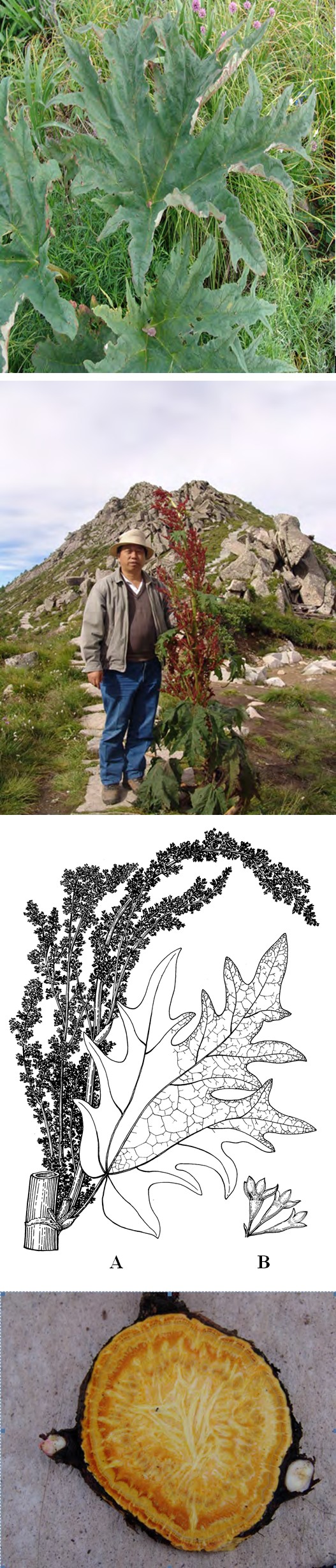
wing, brown in color. Florescence is July to September. Fruiting period is September to October. Growing in the grass or rocks Taibai Rhubarb grown in Taibai Mountain, mainly seen between Xiaowengong Temple and Dawengong Temple (Photograph 1 & 2, Figure 1).
Photograph 1: Taibai Rhubarb. Photograph 2: Basal leaves of Taibai Rhubarb.
Description
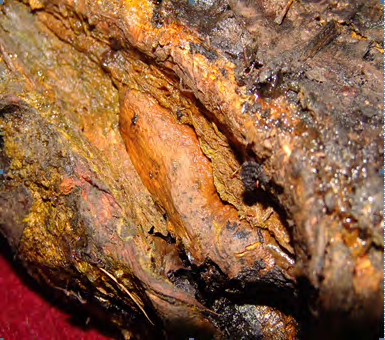
Cylindrical or conical, 10~50cm in length, 5~15cm in diameter. The outer surface is brownish-yellow to tan in color stem modes of the lower part obviously have crosswise annulation, lateral lenticel is obvious cork is loose and easily to fall off and appearance yellow-green [1, 2]. Txeture hard not easy to break the outer section of rootstock red-brown in in color, the inner section bright yellow or brownish yellow in colour often with irregularly yellowish grain, brown-red rays significantly with pith in the centre, star spots can be seen(heterotypical vascular), some can see several Rhubarb nuclear structures (more than 5years); the transverse section of root is brownish yellow to brown red in color, section is smoothly can see the structure of concentric ring. Odour slightly aroma; taste, bitter and slightly astringent (Photographs 3-5, Figure 2)
Photograph 3: Root trasversertion of Taibai Rhubarb.
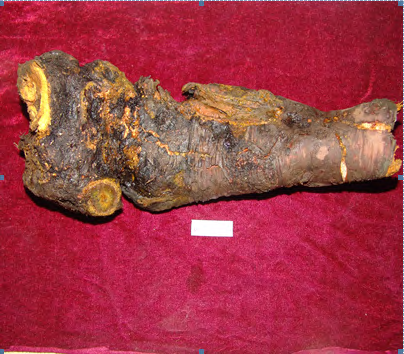
Photograph 4: Root and rhizome of Taibai Rhubarb.
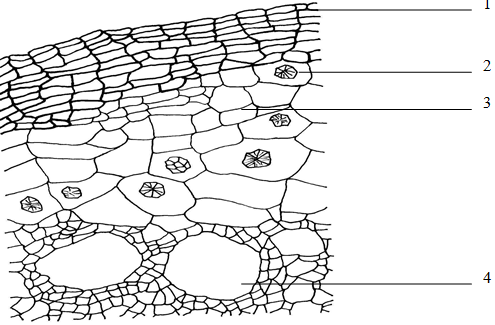
Microstructure
- Transverse section of rhizome
- Cork cells of 4~8 layers, arranged in orderly.
- Cortex broad.
- Phloem broad has lager myxocoels, phloem ray.
- Cambium appearance as wavy ring, is consisted of 1~3 layers of cells
- Xylem-ray intensity, 1~2 layers of cells in breadth.
- Marrow broad, heterotypical vascular arrange in ring. Heterotypical vascular around with wood, star-shaped rays. Parenchymatous cells containing clusters of calcium oxalate crystal (Figures 3 & 4).
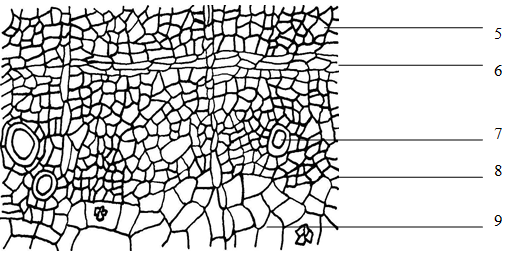
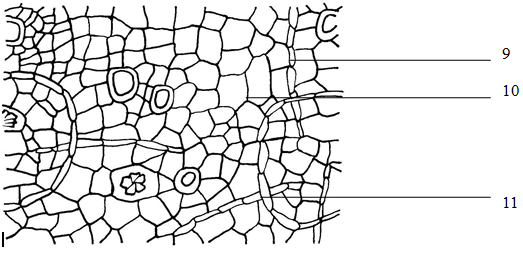
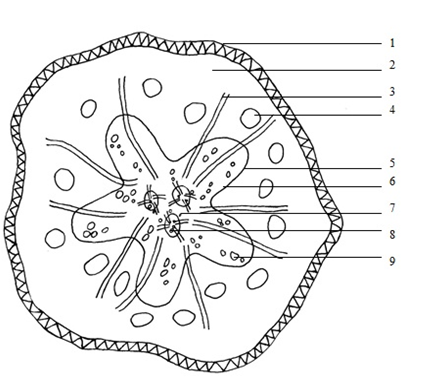
Transverse Section of Root
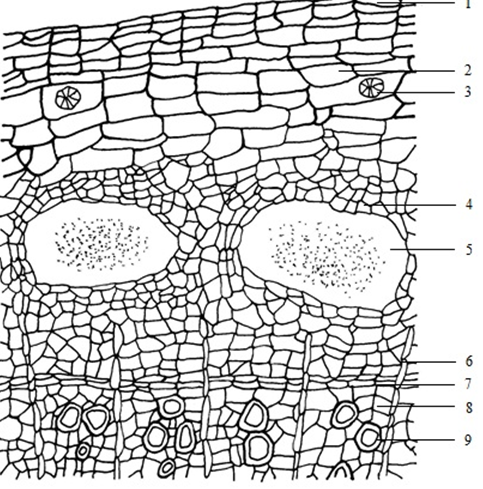
- Phellem thick, consisted by 4~10 layers of cells.
- Cortex narrow.
- Phloem broad, there are several lager myxocoels in the outer phloem, arranged in rings, phloem ray width 2 layers of cells.
- Cambium rings, generally consisting of two layers of cells.
- Xylem accounted 50percent or more of root, xylem ray consisting by 1~2 layers of cells. Parenchymatous cells containing large clusters of calcium oxalate crystal (Figures 5 & 6).
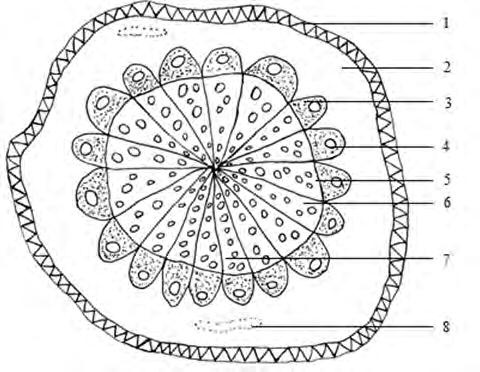
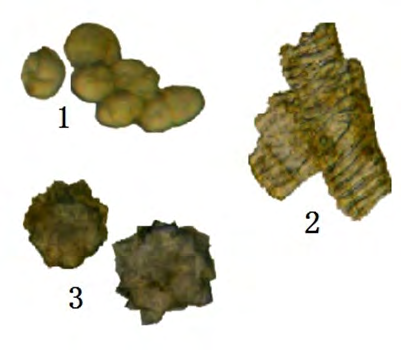
Powder: Yellowish-Brown
- Clusters of calcium oxalate crystal abundant, 25~200μm in diameter.
- Vessel mostly reticulate, bordered-pitted, spiral and annular vessels, 10~150μm in diameter [3].
- Lignification Starch granules abundant, single is spherical or polygonal, 3~50μm in diameter, compound starch granules are consisted by 2~6 branch (Figure 7).
Physical and Chemical Identification
To 0.1g of pulverized Rhubarb add 2ml of methanol, him pronated 1hour, filter, evaporate 5ml of the filtrate to dryness, dissolve the residue with 10ml of water, then add 1ml of hydrochloric acid, heat on a water bath for 30minutes, cool immediately, extracted with ether twice, 20ml at a time, combine ether solution, evaporate the filtrate to dryness and dissolve the redidue in 1ml of chloroform as the test solution. Prepare a solution with 1g of Rhubarb reference drug in the same manner as the reference drug solution. Dissolved emodin and chrysophanol and in methanol to produce a solution containing 1mg per ml as the standard solution. Carry out the method for thin layer chromatography, using silica gel G as the coating substance and the upper layer of a mixture of petroleum ether (30~60℃)-ethyl acetate-formic acid (15:5:1) as the mobile phase. Apply separately to the plate 5ul of each of the above solutions, after developing and removal of the plate, dry in air examine under ultraviolet light (main wavelength: 365nm), five of the fluorescent spots from the sample solution and the reference drug solution show the same orange yellow and RF value in the corresponding position; the orange fluorescent spots in the chromatogram obtained with the test solution correspond in position and color to the spots in the chromatogram obtained with the standard solution. The spot becomes red under sun-light on exposure to ammonia vapor (Photograph 6) Examine under ultra-violet light, Dilute alcohol filtrate of Rhubarb powder(2~3drops) drop on a piece of filter paper add dilute alcohol to spread, yellow to light brown ring, view under ultra-violet light, brown to brown-red fluorescence can be seen (Anthraquinone) [4].
Micro-sublimation: can see the yellow needles or the feather- shaped crystals.
Discussion
Taibai Rhubarb use widespread as genuine rhubarb in Taibai mountain folk in shaanxi China. According to local doctor’s introduction, it’s effect of purgation is more moderate, suitable for frail patients and children’s constipation, prorate but not making body injure Meanwhile, this variety have better effect on dysmenoffhea and menstrual disorder.
Through the observation of original plant, this variety as same as Rheum palmatum Linnaeus var tanguticum Maximowicz which was described in <<Flora of China>> (English edition). However, the literature does not set its Chinese name. Based on its growth geography and the local used customs. It’s Chinese name should be designated as “Taibai Rhubarb”. The underground rhizomes of this species (grown more than 5years) generally growth of one to multiple root-like organs, local herbalist known as the “Rhubarb Nuclear”. The organ can grow on the ground stem. “Rhubarb Nuclear” has been separated from surrounding tissue, smooth surface, and appearance conical shape. Such tissue may be caused by interxylary cork.
Through the observation of microstructure, we found that the myxocoels of this species are more than other Rheum species and it’s rays are very well-developed. Thin-layer chromatography and fluorescence response showed that the chemical composition of this spieces was not significantly different from other Rhubarb by chemical composition tests, the main chemical components of Taibai Rhubarb as same as the other Rhubarb.
References
-
Zhou ZK, Gilbert MG (2003) Flora of China. Science Press, Missouri Botanical Garden Press, St. Louis, USA, pp: 21-73.
-
(1998) Flora of China Editorial Committee of Chinese Academy of Sciences. Flora of China. Beijing: Sciences Press 25(1): 184-192.
-
(1974) Northwest Institute of Botany, Chinese Academy of Sciences. Flora of Qinling Mountains. Beijing: Sciences Press, pp: 139-144.
-
Tingguo K (2006) Chinese Herb Identification. Beijing: Chinese Traditional Medicine Press, pp: 72-76.
- Enhancement of Vegetative Growth and Fruit Yield in Cucumber (Cucumis sativus L.) via Spiritual Blessing (Biofield) Energy Intervention
- Production of Açaí (Euterpe oleracea Mart.) under Different Agroforestry System Management Intensities in Amazonian Floodplain (Varzea) Forests
- Coffee and the Production Region: What is the Secret to the Expression "Quality"?
- Experiential Agripreneurship Training in Sub-Saharan Africa: Integrating a Business Incubator into Postgraduate Livestock Education at the University of Buea
- Advances in Agricultural High-Quality Development
- Linking Compost Residue to ABAGE in Plants - a Short Note