
Climate-Smart Avocado Farming: A Community-Based Approach to Enhance Adaptation and Resilience
The purpose of the study was to promote climate-smart avocado farming among smallholder farmers using a community-based multistakeholder platform. Climate-smart avocado farming aims to increase production, and food security, and reduce risks from erratic weather patterns, aligning with sustainable development goals and enhancing agricultural adaptability. Avocado smallholder farmers and other stakeholders formed a multistakeholder platform to address climate-smart practices and adaptation requirements. Data was collected from a random sample of stakeholders using questionnaires. Descriptive statistics and binary logistic regression examined factors motivating farmers to join the platform. A logistic regression model was applied to test the relationship between farmers' expected benefits and participating in multi-stakeholder platform activities. The results indicate that avocado farming activities increased as follows: production, and marketing of improved avocado seedlings (19.2%), market information (18.26%), avocado quality and market promotion (18.92%), access to financial services (19.14%), and capacity building in avocado as a climate-smart practice (16.5%). Farmers' participation in multi-stakeholder planning is related to their anticipated social, material, and economic benefits. Higher levels of social and economic rewards resulted in more participation in the joint planning stage (OR = 1.454). Higher levels of predicted economic rewards increase participation (OR = 1.776). The study revealed that capacity building for integrating avocado as a climate-smart practice positively impacts smallholder avocado farmers' farming systems. For farmers to better adapt to climate change and build resilience, the government, investors, and practitioners are necessary. Modifying policies and programs for climate adaptation is essential. The study supports expanding the multi-stakeholder approach for smallholder farmers in promoting climate-smart agricultural innovation and contributes to enhancing Agricultural Innovation System in rural setup.
Introduction
Climate-smart avocado farming is one approach used in agriculture conservation practices to increase productivity on land facing the threats of climate change and degraded land. This is in line with climate-smart agriculture aims to increase production, ensure food security, and reduce risks from unpredictable weather patterns and climatic variability, ensuring food security and reducing risks [1]. Enhancing farm system resilience and farmers’ capacity to adapt to climatic variability are the goals of climate-smart farming). Farm resilience-building aligns with SDGs 2 and 13’s aim to improve production by adapting to climate change. Climate- smart farming focuses on boosting productivity, reducing variability, and enhancing adaptation to climate change [2].
Climate-smart farming strategies include adjustments to cropping and soil management practices, such as crop rotation, intercropping, fertilizer application, planting strips, tied ridging, contour farming, and terraces. Farmers may embrace climate-resilient technologies with the use of conventional and agroecological management techniques including biodiversification, soil management, and water harvesting [3]. These methods provide resilient soils and farming systems by boosting carbon sequestration, improving soil health, and reducing erosion. Educational interventions, focusing on local, tangible aspects, and individual behaviour, are successful in providing climate-change education for ecological development.
In the study region, the climate mitigation strategies that are used include manure, mulch farming, agroforestry, and tree integration in cropping systems. By adopting avocado climate-smart farming strategies in this region, the small- scale farming system can improve its productivity and food security while minimizing risks associated with erratic rainfall patterns and climatic variability [4]. Kenya’s climate- smart strategies among other initiatives set out to promote resilient land use planning, sustainable land management, and climate-resilient production.
The study established a community-based multi- stakeholder platform in the Upper Mara watershed, involving farmers, farmer associations, traders, community forest associations (CFAs), water resource users’ associations (WRUAs), traders, NGOs, and government ministries (SNV, 2019). Through the multi-stakeholder platform (MSP), opportunities, and strategies for integrating avocado as a climate-smart practice for watershed conservation were identified. Multi-stakeholder platforms (MSPs), also known as innovation platforms or learning alliances, are governance structures that use pooled resources to address regulatory, participation, resource, and learning gaps [5]. MSPs provide a space where complex development problems may be solved, and innovation is enhanced through the efficient use of resources.
Multi-stakeholder platforms offer inclusive discussions on agricultural practices and land use issues, fostering legitimacy and identifying shared issues for solutions. The multi-stakeholder platform strategies to enhance climate- smart practices in smallholder farming were conceptualized in this study using the institutional analysis and development (IAD) approach [6]. The IAD framework was chosen for its ease of use in identifying multi-stakeholder platform activities’ effects on issues including smallholder farmers’ initial conditions and stakeholders’ efforts to improve them, eventually encouraging more smallholder farmers to cultivate avocado as a climate-smart practice.
This study using the IAD framework identifies the concerns in agriculture need for the implementation of climate-smart practices in order to build resilience, alleviate effects, and preserve agricultural productivity. The avocado climate-smart practices include effective nutrient and water management, soil fertility conservation, and agricultural automation agrees with the earlier research by Ogundari K et al. [7]. The farmers may minimize their water usage by using novel irrigation techniques, water storage, and better water management. They can also boost soil carbon storage capacity by decreasing nitrogen fertiliser usage or using conservation tillage measures. These novel approaches seek to minimize water usage, improve soil fertility, and increase farm mechanization [8].
Regulatory, economic, and information-based policy instruments can all help to guide the development of climate- smart practices in avocado farming among smallholder farmers. Labeling and certification, for example, have proven to be successful in addressing environmental challenges by promoting ecologically friendly practices [9]. There are four types of information-based regulatory systems, each of which combines required or voluntary disclosure to external stakeholders with performance compliance with or above mandated requirements.
The study explores community-based interventions in Upper Mara Basin to promote avocado integration as a climate-smart practice, reducing land degradation and improving livelihoods. It emphasizes stakeholder access to inputs, services, financing, and markets in the avocado value chain.
Literature Review
Smallholder farmers in Africa face serious concerns about climate change, which can result in low yields, inconsistent access to food, and poverty. But adoption rates are modest. The goal of climate-smart agriculture (CSA), which calls for institutional and governmental changes, is to alter livelihoods by scaling up techniques and technology. CSA techniques and technology can raise the standard of living for African smallholder farmers. According to the FAO, climate change and variability have an influence on farmer production, income, availability, access, usage, and stability. Economic opportunity inequalities brought on by climate risk can worsen poverty and put some households in poverty traps. In order to enhance food security in the face of climate change, climate-smart strategies such as agroforestry, conservation agriculture, crop diversification, index- based insurance, and integrated soil fertility management approaches are designed to offer flexible, context-specific solutions [10]. Crop types that are stress-tolerant can be adopted, and diversifying agricultural practices can increase yields and profits. According to Makate C, et al. [11] agroforestry methods are associated with greater revenues, larger animal holdings, and improved overall household nutrition. This results in sustainable agriculture.
Building the resilience of smallholder farmers is an essential objective for policy in low-income countries like SSA [12]. However, according to Makate C, et al. [11] climate- smart activities are still rated as low or inadequate. To achieve long-term effects, community-level development, more farmer acceptance, and intensification of current adopters are required. Smallholder farmers in the Upper Mara watershed are vulnerable groups to climate change. Efforts to support farmer adaptation to climate change are hindered by the lack of information. More information is needed on how different types of smallholder farmers vary in their perceptions, responses, and experiences of climate change [13].
Low adoption rates in incorporating climate-smart approaches and technologies in agricultural systems have been reported to be primarily due to a lack of evidence or success stories and information flow among the farming community [14]. Factors affecting scaling include government dependency, weak advisory service infrastructure, and lack of financial opportunities [15]. Effective scaling requires an integrated approach that interacts with local socioeconomic conditions and cultures. The IAD framework provides an integrated approach that is therefore essential for identifying strategies to enhance the promotion of climate-smart practices through a multi-stakeholder platform.
The IAD framework, illustrated in Figure 1, was chosen because of its merit in providing a simple framework for analyzing multi-stakeholder platform actions in terms of how they can influence the initial conditions of subjects [16]. (e.g., smallholder farmers) and actions by various stakeholders interested in improving the initial conditions of subjects (e.g., avocado value chain stakeholders) and hence eventual outcomes (e.g., more smallholder farmers growing avocado as a climate-smart practice).
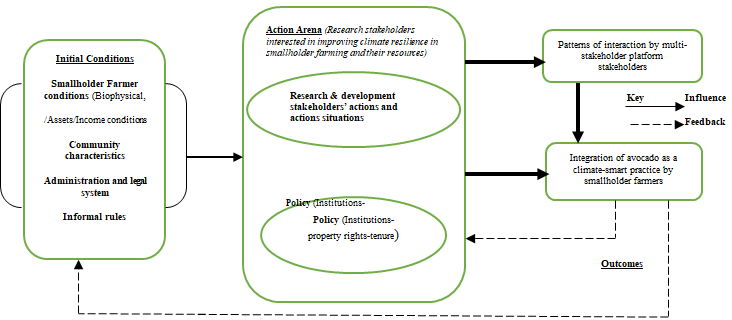
The IAD framework consists of three pillars: initial conditions, action arena, and outcomes (Figure 1). Initial conditions include biophysical conditions, farmer asset conditions, and community attributes [16]. They also include the political and legal system, as well as informal rules and norms in the smallholder farmer’s operations [17]. The effectiveness of scaling up climate-smart practices is significantly influenced by initial conditions, which include both tangible and intangible assets. In addition to information access and social capital, these assets also comprise human, financial, and capital assets. As most climate-smart activities need additional resources, these resources can have an impact on whether they are adopted [17]. Based on these initial conditions, farmers may choose which climate-smart practice to implement, thereby affecting the effectiveness of climate-smart activities.
Community characteristics play a crucial role in differentiating smallholder farmers across a wider spatial scale [18]. These attributes reveal which climate-smart practices are socially acceptable in a community and should be reflected. Legal and political systems also affect the activities of smallholder farmers. Political and institutional factors can influence climate-smart practice investments and scaling outcomes [19]. For example, property rights on land can influence climate-smart practices adoption choices at the farm level, making it essential for stakeholders to consider them for effective scaling strategies. Political will by local leaders also significantly impacts climate-smart practices adoption success [20].
Action arena is all the initial conditions highlighted earlier that will define the action environment. The initial conditions affect the action arena which is the space where all stakeholders interact (fight, negotiate, work together) to get intended adoption actions for set intended outcomes [21]. In this context, the action arena involved the avocado value chain stakeholders interested in improving climate resilience in smallholder farming and their resources. In this study, the action arena involves the capacity building of farmers on the integration of avocado as a climate-smart practice.
The outcomes were the final product (success) for the actor and or the wider society. In this study, the outcome of interest is climate-smart practices’ success (more quality benefits from climate-smart practices to the smallholder farmer and the wider society) [22]. It involves the pattern of interaction of multi-stakeholder platform stakeholders. The impacts of these interactions have either a positive or negative influence on the action arena.
The framework is iterative and includes feedback systems. Poor outcomes, for instance, would prompt the implementation of other regulations, which would modify the field of action arena. More importantly, intended results, i.e., the benefits that climate-smart activities provide to society, may also have a significant impact on initial conditions, such as strengthening present legislation and enhancing the asset base for even better outcomes [21, 23].
Therefore, climate change is a serious environmental concern that has a considerable influence on both the initial conditions of the farm and natural processes and human activities [24]. Agriculture is inextricably linked to climate conditions, and climate change affects yields and harvests. Changes in rainfall or severe occurrences, like droughts, might imperil harvests. Agriculture, on the other hand, can help to mitigate climate change by boosting soil carbon-stocking capacity via suitable management [25]. This, therefore, necessitates that smallholder farmers adopt climate-smart practices to achieve these tasks.
Methodology
Study Location
The study site was Upper Mara watershed within the Mau Forest Complex specifically East Bomet Sub-County and Narok West Sub-County region, along the Mara River agroecological zone in Kenya (Figure 2). The area is located between the coordinates of 0045’S and 10S latitude and 350 and 35015’ E longitude, at an elevation of 1900-2970M above sea level.
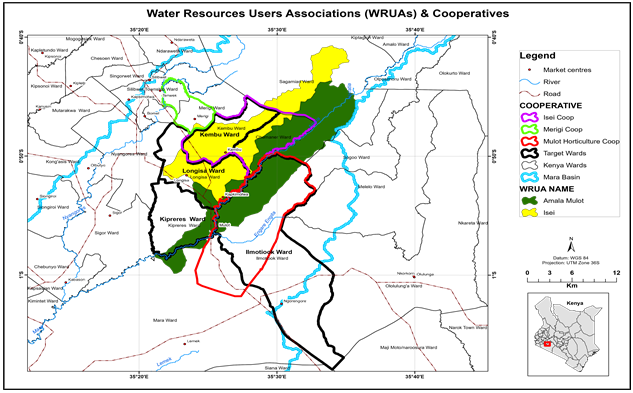
The Upper Mara watershed has bimodal rainfall patterns and moderate temperatures all year long. With a wide variety of land uses, its main land uses include forest and agricultural. Three Lower Highland agroecological zones (AEZs)—Lower
Highland Zone One, Lower Highland Zone Two, and Lower Highland Zone Three—combine to form the watershed. Valleys with natural forests are used for agriculture, while tea is grown at higher elevations. Cattle, wildlife, and lowland grasslands are essential for preserving the region’s character, boosting the local economy, and safeguarding watersheds. On the other hand, declining productivity and resource depletion have been brought on by an increase in the number of farms and people. By expressing cultural and economic values, environmental and naturalistic history, and watershed conservation, the integration of avocado cultivation has improved agricultural systems.
Study Design
The study employed a participatory action design with the use of a mixed-method approach. Training on avocado as a multipurpose fruit tree, improved avocado trees, avocado as a climate-smart practice, how to establish a tree nursery, and mapping avocado value chain actors and information flows in the platform. The training was also provided for community extension agents to not only strengthen their capacity but also to enable them to disseminate knowledge further into the communities.
The Target Population
The study targeted avocado farmers and avocado value chain stakeholders in Bomet East and Narok West Sub- Counties within 15 Kilometres of Trans Mara Block in Mau Forest Complex and using the forest directly and indirectly. The study involved multiple stakeholders in the avocado value chain.
Selection of Respondents
The purposive sampling procedure was done among the avocado value chain stakeholders. These include smallholder farmers, individuals, and organizations in research, advisory service providers, production (avocado farmers), transport and marketing, seedling suppliers (both external and local suppliers- Commercial and local nurseries respectively), and policy influencers. The selection was purposeful, based on the stakeholders’ understanding of what occurred in the avocado chain of value. Avocado producers were asked to nominate representatives to participate in the multi- stakeholder platform, whereas avocado value chain actors were purposively selected. The selection was based on the actors’ knowledge of what happened in the avocado value chain process.
Data Collection Approaches
Ten stakeholders were involved in the reliability of the instrument items testing, which was done on the questions and survey indicators. The data collection method was through the administration of a structured questionnaire to multi-stakeholder platform actors and avocado farmers. The participants that were involved in the formation of the multi-stakeholder platform were purposively selected and randomly sampled using the stratified random sampling technique to get 80 respondents for the study. The researchers conducted the in-person interviews after that, one in each cooperative and two collecting data from additional participants in the avocado value chain. The researchers met the farmers at their fields and value chain participants in their regional offices.
Data Analysis
The study analyzed data to identify stakeholder roles, networks, resources, and interactions in avocado multi- stakeholder platforms. Content analysis was used to identify patterns and themes. The study also examined the formalization of these platforms, their role in the avocado value chain scaling process, and their integration into climate- smart practices. Factors influencing their performance were also examined. Descriptive statistics were used to present data, and binary logistic regression was used to examine the association between participation in platform planning, attending training, monitoring and evaluation, and finance/ marketing stages with factors motivating farmers to join.
The logistic regression equation Y = bX₁ + bXn, was used to examine the relationship between farmers’ expected benefits for joining and participating in multi-stakeholder platform activities. The variables are defined as: 1) Y is the estimated continuous outcome; 2) bX1 + bXn is the linear regression equation for the independent variables in the model, 3) b is the intercept, or the point at which the regression line touches the vertical Y axis. This is considered a constant value (Beta coefficient). Distinct from linear regression where the value of an outcome (Y) is modeled using a linear predictor function X1 or several functions (Xn), logistic regression models, predict the probability of an outcome (Y) occurring given known values of X1 (or Xn). A p-value <0.05 was used to identify statistical significance, as well as a less conservative p-value of 0.10, for variables with data reduced into categories that decreased predicting power.
Specifically, the use of binary logistic regression to examine the association of participation in platform planning; attending trainings; monitoring and evaluation, and finance/ marketing stages of the multi-stakeholder platform activities with factors motivating farmers to join the platform because of the outcome variables– participation in multi-stakeholder platform activities multi-stakeholder platform activities – are dichotomous.
Results and Discussion
The Use of a Multi-Stakeholder Platform to Support Smallholder Farmer Activities
The study found that farmers and stakeholders engaged in various activities, including increased avocado seedling production and marketing, export market information, quality meetings, financial services access, and capacity building for climate-smart practices (Figure 3). These activities facilitated interaction and improved avocado production and marketing.
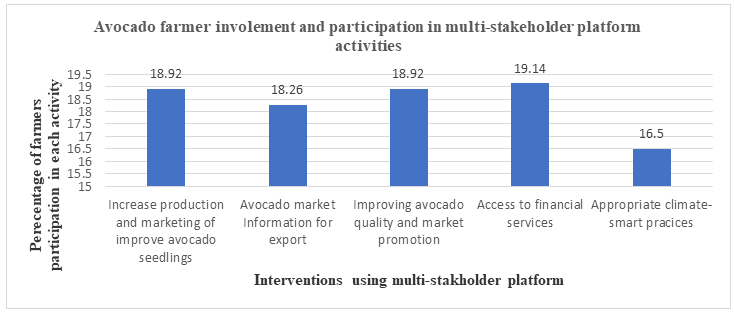
The percentage of smallholder farmers adopting avocado as a climate intervention was the lowest compared to the other interventions, indicating that most smallholder farmers were not farming using climate-smart approaches, indicating a need for greater intervention through capacity building. The most important element in farmer participation was access to payment systems. This suggests that there were no financial incentives for avocado farmers to increase their agricultural activities by providing funds to access quality avocado seedlings and farm inputs and operations, hence driving their participation.
Institutions providing policy guidelines in the avocado value chain, including land tenure, marketing, and financial activities for smallholder farmers, participated in multi- stakeholder platform activities. They provided necessary resources to support smallholder farmers’ avocado production activities, as outlined in the IAD framework action arena as described by Nigussie Z, et al. [23]. This ensures that stakeholder interactions take place in appropriate and intended contexts. The findings further suggest that stakeholder consultation discussions were the most prevalent stakeholder interaction activity adopted that brought together avocado stakeholders to address avocado production constraints.
Five intervention approaches were identified during multi-stakeholder platform interaction sessions to address avocado production challenges, including feedback-specific actions and planning workshops for resolving bottlenecks. These interventions align with the IAD action arena’s research and development stakeholders’ actions and actions situations [21]. The first suggested action was to boost avocado availability and quality; increasing avocado seedling production and marketing are essential. To increase productivity, income, and income creation, inclusive value chain research and development operators frequently focus on smallholder farmers [26]. This may be accomplished by enhancing farming practices, offerings, education, and resource availability.
The second action focused on increasing avocado production and export marketing. The stakeholders confirmed that contract farming was practiced by different export firms. The initiative aims to increase avocado availability and supply in both international and domestic markets. It aims to increase export supply, ensure market access for smallholder farmers, and improve avocado quality and yields through seedlings, farming techniques, and community outreach. This aligns with studies by van Paassen A, et al. [26] that found foreign funders are hesitant about the sustainability of informal structured multi-stakeholder platforms and favor legally formed public-private partnerships (PPPs) for private investment, technology, and know-how. Researchers are increasingly questioning the effectiveness of upper-edge scientific knowledge economy and diffusion, comparing it to farmer-based approaches for adoption and sustainability.
The third intervention involved how to improve avocado quality and market exposure, supporting buyers in becoming more competitive. Farmers’ organizations connected with avocado processors and importers from China, India, South Africa, and other regions; and learning and access to modern processing equipment [27]. This action in the study focused on partnership-embedded reasoning, highlighting the challenges of developing partnerships that prioritize smallholder inclusive value chain management in an era of ‘free market’ reasoning, promoting private capital accumulation and competition which correlate to the action area policy of institutions in the IAD framework.
The fourth intervention focused on financial services and financial links to smallholder avocado farmers. The avocado- buying companies, and farmers’ cooperative groups and societies, in partnership with Kenya’s financial institutions, created a new lending system for avocado market traders (KAM, 2018). However, the collateral management system has not been effectively implemented. Local farming systems have few formal policies and market structures, allowing low-input agriculture and informal relationships funded by informal organizations. Partnerships between local NGOs, financial institutions, and farmer groups are rare [27]. Avocado farmers must work together and take reasonable action because there is a shortage of avocado goods. Through avocado farming and structured financial markets, multi- stakeholder platform interventions attempted to promote climate-smart activities; yet, both linked development interventions with cooperation thinking.
The fifth intervention option focuses on developing, upholding, and diffusion of farming techniques and innovations among the avocado farmers in the Kenyan counties of Bomet and Narok. This approach ensures best practices and lessons are shared among avocado farmers, increasing stakeholder interest, fostering cooperation, and combining resources to address avocado farming activities [28].
The avocado growing system has been disseminated by smallholder farmers using a variety of communication channels and knowledge exchange. An inclusive and reflective process that considers multiple risk factors and how they relate to core values and norms is necessary for evaluating climate-smart actions. People’s attitudes, beliefs, and social conventions have an impact on climate-smart practice management [29].
The avocado multi-stakeholder platform aimed to increase avocado production, improve smallholder farmers’ income, and farm resilience using avocado. It applied five intervention strategies, requiring diverse skills, knowledge, and resources to overcome the limitations of smallholder farmers in the Upper Mara watershed. The platform’s stakeholders aim to overcome these limitations through activities, aligning with Bisseleua D, et al. [30] study.
The multi-stakeholder platform concept attempts to improve small and medium-sized firms’ productivity, enterprise, and innovation. The relevance of this paradigm in accomplishing economic, social, and environmental goals is highlighted by this study, which focused on avocado farming in the Upper Mara Basin (Maleko et al., 2018). Accordingly, a large number of stakeholders have a keen interest in avocado farming, which supports the multi-stakeholder strategy.
The community-based platform was a forum to improve avocado value chain governance and management, farming dialogue, and market and financial linkages. The operations of this platform concur with the work done by Buckley KJ, et al. [31] with sustainability through muti-stakeholder innovation and collaboration. To benefit stakeholders in avocado farming, governments, regulators, agribusinesses, NGOs, and county authorities form an informal platform that allowed stakeholder engagement. This informal platform, which was community-based, ensured timely implementation, resource availability, and successful outcomes by involving all stakeholders in the process.
By addressing land degradation, seedling access, and market access, the multi-stakeholder avocado platform offered solutions to the systemic challenges to avocado value chain activities. These problems were addressed among stakeholders through capacity building. To ensure collaboration with many stakeholders, it becomes imperative to address the technological and socioeconomic constraints faced by avocado producers in their specific contexts, as is examined in the IAD framework’s initial condition revealing the community attributes. The identification of strategic initiatives for boosting agricultural value chains can be aided by a multi-stakeholder platform approach [32].
The community-based approach of the multi-stakeholder platforms had a common vision to flourish. Explicit incentives for capacity building had targets important problems and ensured efficient feedback loops. Profit growth drives the adoption of climate-smart techniques; therefore, production assets as exposed in the initial conditions of the smallholder avocado farmer need to generate a unique market return [33]. The platform members worked together to develop the platform activities. Multi-stakeholder platform activities promote the setting of conducive conditions to agricultural farming innovations for a long-term adaptation. The action of bringing together the stakeholder in the multi-stakeholder platform attempt to alter the existing administration and legal system, as well as the informal rules of the smallholder farmer, that align with IAD’s initial conditions.
The interaction patterns exhibited in the multi- stakeholder platform, align with the Antille, et al. recommendations that jointly agreed guidelines and regulations should be put in place, and with feedback loops among the stakeholders that may influence their actions and subsequently the adoption of innovation. It correlated to avocado fruit production and marketing by applying good agronomic practices, improved seedling varieties and agro- inputs, and other avocado management strategies [34]. The multi-stakeholder forum emphasized the expansion of avocado farming by the smallholder farmer.
The Relationship between Expected Benefits and Participation in a Multi-Stakeholder Platform
Results indicate that farmers’ participation in the planning of the multi-stakeholder activity was associated with their expected social and material benefits, and economic benefits, respectively (Table 1). Farmers who had higher levels of expected social and material benefits were more likely to have a high level of participation in the planning actions (OR = 1.454). Similarly, farmers with higher levels of expected economic benefits were more likely to have a high level of participation in the planning activities (OR = 1.776). The results also indicate that expected social and material benefits were associated with participation in training. Farmers who had higher levels of expected social and material benefits were more likely to participate in the training in the multi-stakeholder platform (OR = 1.612). Also, avocado farmers with higher expected social and material benefits, and higher anticipated economic benefits were 2.813 and 0.873 times more likely to participate in monitoring and evaluation activities of the multi-stakeholder platform. Similarly, the results show that the avocado farmers with higher anticipated social and material benefits and higher anticipated economic benefits were 4.896 and 0.986 times more likely to participate in the finance/marketing activity of the multi-stakeholder platform compared to those low anticipated benefits, respectively.
| Independent Variables | Odds Ratio (OR) | |
|---|---|---|
| Participation in multi-stakeholder planning | Expected social and material benefits. | 1.454*** (0000) |
| Participation in multi-stakeholder planning | Expected economic benefits. | 1.776* (0.894) |
| Participation in training | Expected social and material benefits. | 1.612*** |
| Participation in training | Expected economic benefits. | 8.104(0.004) |
| Participation monitoring & evaluation | Expected social and material benefits. | 2.813*** (0.093) |
| Participation monitoring & evaluation | Expected economic benefits. | 0.873**(0.35) |
| Participation in Finance/Marketing | Expected social and material benefits. | 4.896***(0.028) |
| Participation in Finance/Marketing | Expected economic benefits. | 0.986** (0,004) |
Table 1: Logistic regression of participation in the multi-stakeholder platform with expected benefits.
Note: Dependent variable is participation in different intervention activities of a multi-stakeholder platform (0 = low participation; 1 = high participation); * p<0.01, p<0.05, * p<0.10; Standard errors in parentheses. (Source: Author, 2022). Table 1: Logistic regression of participation in the multi-stakeholder platform with expected benefits.
The study found that avocado farmers’ participation in multi-stakeholder platform activities is significantly influenced by anticipated social and economic benefits, such as avocado seedlings and farm inputs. These benefits directly impact their livelihoods, and farmers are more likely to participate in innovations affecting their livelihoods. The highest effect of social and economic benefits on participation was observed during the monitoring and evaluation activity. This supports the empirical evidence that farmers’ active and sustained participation in multi-stakeholder platforms is primarily based on material benefits, as demonstrated by Isaacs.
Avocado farmers’ interactions significantly influence expected social and material benefits and their social status. Social networks foster social inclusion, mobilization, and empowerment among farmers, requiring participation in platform action arenas. Farmers, especially women, can mobilize social capital for accessing resources like farm inputs and knowledge. This feedback loop helps change smallholder farmer perception and improve avocado climate-smart farming in the community, aligning with the IAD framework.
Economic benefits in the form of access to better input and produce markets, access to better prices for farm produce, and access to seedlings for avocado export varieties motivated farmers to participate in attending training on improved avocado production on the effects of the multi- stakeholder platforms to support interventions [35]. This finding seems to highlight the types of market-related constraints faced by farmers in this region. It may also imply that farmers in the region are market-oriented and are seeking avenues that could help link them to better market opportunities. Due to their ability to enable smallholder farmers’ interaction and cooperation with other actors along the value chain, multistakeholder platforms are becoming increasingly popular in agricultural research and development [36]. A multi-stakeholder platform is a forum where multiple interdependent actors collaborate to diagnose a problem, identify solutions and opportunities, and engage in joint action to overcome it. It is particularly important in the context of climate-smart agricultural innovations, as it provides a forum as an action arena in the stakeholder research regarding the generation, validation, dissemination, and adoption of agricultural technologies by the intended users [36].
However, the IAD framework does not ensure that smallholder farmers would actively participate in such a multi-stakeholder platform throughout the research and development in the action arena. Their willingness to participate is at least partially based on the expectation that taking part in joint decision-making and implementing avocado climate-smart practices will result in benefits that outweigh the costs associated with establishing and maintaining such relationships [37]. According to Eufemia L, et al. [17] the advantages might be financial (loan, revenue), material (improved seedlings, organic fertilizers), social, and new knowledge and skills to boost production.
According to the present findings, many farmers are fully engaged in all the multi-stakeholder platform operations. Farmers participated the most during training and monitoring and assessment events when they gained new knowledge and skills about resilience techniques and innovations and adapt to fit their farming context through on-farm experimentation to improve avocado production as envisaged in the IAD feedback loop on the outcomes that influence the smallholder farm biophysical conditions [23].
The adoption of knowledge-intensive approaches by farmers participating in multi-stakeholder platform activities, apart from financing and marketing, increases smallholder avocado building resilience against climate change shocks on their farms. Through the development of their skills, smallholder farmers can recognize production limitations and interact with other stakeholders in order to come up with practical and economically sound new solutions. This strategy aids in enhancing smallholders’ avocado biophysical initial conditions and improving their productivity [22].
The positive influence of participation in the training in avocado climate-smart practices underscores the significance of farmers’ awareness about the new practices and technologies which help to reduce their risk averseness and increase adoption. This is in line with what Nigussie Z, et al. [23] stated about the role of local communities in building resilience in their landscape conditions, similarly depicted by the IAD framework on smallholder farmers restoring their farm biophysical initial conditions. Farm demonstration, monitoring, and appraisal of climate-smart techniques and skills equip smallholder farmers with the technical “know- how” they need (Gairhe & Adhikar, 2018). These skills help them adapt to the climate-smart practices and technologies in their farming systems’ biophysical and socioeconomic conditions, all of which are prerequisites for the adoption of agricultural innovations in agricultural production [38].
The findings also showed that farmers’ interaction patterns in research demonstration trials on various agricultural technologies, which reflects on the action situations of the smallholder farmers in the IAD framework, increase the adoption of the demonstrated climate-smart practices. Participation in marketing activities was not a significant predictor of the adoption of avocado climate- smart practices and innovations [19]. This could be because a commodity crop of interest in this study, avocado, is typically grown on a small scale. Market forces that typically influence broad adoption have not yet been triggered.
Conclusion
The IAD framework identified how activities taken by multi-stakeholder platforms affect smallholder farmer conditions such as resource access, expanding knowledge, and institutional credit access. It does not directly influence the decision-making process when it comes to success and sustainability criteria for the promotion of avocado integration as a climate-smart practice. It is possible to provide climate-smart scaling techniques and strategies by recognizing initial conditions, such as community characteristics, farmer assets, and regulations at the local level.
The multi-stakeholder platform was an effective strategy for increasing stakeholder cooperation and networking. It encouraged avocado farming by facilitating interactive learning, skills enhancement, information flows, and network strengthening. The group learning process started to improve innovativeness for avocado scaling and integration as a climate-smart practice to improve output and farm resilience to land degradation.
According to the findings of this research, the multi-stakeholder platform enabled cooperation and coordination, connectivity, and interactions to develop skills for incorporating avocado as a climate-smart practice. It also enables information flow and ensures better avocado production practices and expenditures, yields, and earning levels, and improved smallholder farmers’ creative potential. The multi-stakeholder platform enabled interactive learning to integrate climate-smart practices into avocado growing, increasing the system innovations, and contributing to avocado growing adoption and expansion. Farmers on the multi-stakeholder platform had higher levels of information flow than non-platform participants, owing to their training through the platform and connections to other avocado value chain stakeholders.
Community-based multi-stakeholder platforms increase the flow and mode of information pathways to the avocado smallholder farmers that can increase the activities and performance on the integration of avocado as a climate-smart practice. Avocado stakeholders in the Upper Mara watershed set up a community-based platform as a forum to improve farmers’ farm management practices, farming dialogue, and market and financial linkages on avocado farming.
The recommendations from the findings are that the County Government and the Department of Agriculture should expand the multi-stakeholder approach to avocado farming, assisting smallholder farmers in overcoming obstacles and increasing production through partnership and networking. The policy implications show how smallholder farmers are playing a key role in the evolution of avocado as a climate- smart agricultural innovation.
Acknowledgments
This paper was developed during the Visiting Fellowship Programme in Kenya from June to September 2022. The author expresses gratitude to the AfricaLics community and mentors (www.africalics.org), for valuable comments on the article.
Authors’ Contributions
The article’s concept and main messages were developed in joint discussions. The first author (SCKR) dealt with conceptualization, project administration, data curation, formal analysis, methodology, and writing original drafts and resources. The second author (SIK) contributed to supervision, validation, and methodology, review, and editing. All authors read, revised, and approved the final manuscript.
Ethics Approval and Consent to Participate
The research was conducted in accordance with Egerton University’s research ethics committee and the National Commission for Science, Technology, and Innovation (NACOSTI) approval.
References
-
Lipper L, Zilberman D (2018) A Short History of the evolution of the climate smart agriculture approach and its links to climate change and sustainable agriculture debates. In Climate Smart Agriculture 52: 13-30.
-
Totin E, Butler JR, Sidibé A, Partey S, Thornton PK, et al. (2018) Can scenario planning catalyse transformational change? Evaluating a climate change policy case study in Mali. Futures 96: 44-56.
-
Altieri MA, Nicholls CI (2017) The adaptation and mitigation potential of traditional agriculture in a changing climate. Clim Chang 140: 33-45.
-
Kirui OK, Mirzabaev A, von Braun J (2021) Assessment of land degradation ‘on the ground’and from above. SN Applied Sciences 3: 1-13.
-
Pinkse J, Kolk A (2012) Addressing the climate change-sustainable development nexus: The role of multistakeholder partnerships. Business Society 51(1): 176-210.
-
Ostrom E, Gardner R, Walker J (1994) Rules, games, and common-pool resources. University of Michigan Press.
-
Ogundari K, Bolarinwa OD (2018) Impact of agricultural innovation adoption: a meta‐analysis. Australian Journal of Agricultural and Resource Economics 62(2): 217-236.
-
Camarotto C, Dal Ferro N, Piccoli I, Polese R, Furlan L, et al. (2018) Conservation agriculture and cover crop practices to regulate water, carbon and nitrogen cycles in the low-lying Venetian plain. Catena 167: 236-249.
-
Taylor CM, Pollard SJ, Rocks SA, Angus AJ (2015) Better by design: business preferences for environmental regulatory reform. Science of the Total Environment 512: 287-295.
-
Born L (2021) Climate Services supporting the adoption of Climate Smart Agriculture: Potential linkages between CSA adoption and climate services use.
-
Makate C, Makate M, Mango N, Siziba S (2019) Increasing resilience of smallholder farmers to climate change through multiple adoption of proven climate-smart agriculture innovations. Lessons from Southern Africa. Journal of environmental management 231: 858-868.
-
Fan S, Rue C (2020) The role of smallholder farms in a changing world. In The role of smallholder farms in food and nutrition security, pp: 13-28.
-
Onyutha C (2019) African food insecurity in a changing climate: The roles of science and policy. Food and Energy Security 8(1): e00160.
-
Aggarwal PK, Jarvis A, Campbell BM, Zougmoré RB, Khatri-Chhetri A, et al. (2018) The climate-smart village approach: framework of an integrative strategy for scaling up adaptation options in agriculture.
-
Buyinza J, Nuberg IK, Muthuri CW, Denton MD (2020) Assessing smallholder farmers motivation to adopt agroforestry using a multi-group structural equation modeling approach. Agroforestry Systems 94(6): 2199- 2211.
-
Liu H, Hou L, Kang N, Nan Z, Huang J, et al. (2022) A meta- regression analysis of the economic value of grassland ecosystem services in China. Ecolog Indicat 138: 108793.
-
Eufemia L (2020) A Framework for Community-based Governance in Grasslands and Savannahs of South America. Humboldt-Universität zu Berlin Germany.
-
Dudley N, Eufemia L, Fleckenstein M, Periago ME, Petersen I, et al. (2020) Grasslands and savannahs in the UN Decade on Ecosystem Restoration. Restor Ecol 28(6): 1313-1317.
-
Eufemia L, Pérez P, Rodriguez T, Lozano C, Bonatti M, et al. (2021) Governance in post-conflict scenarios: Assessing models of community-based governance in the departments of Caquetá and Cesar (Colombia). Territ Polit Governance, pp: 1-23.
-
Huber R, LeClech S, Buchmann N, Finger R (2022) Economic value of three grassland ecosystem services when managed at the regional and farm scale. Sci Rep 12: 4194.
-
Ostrom E (2011) Background on the institutional analysis and development framework. Policy Stud J 39(1): 7-27.
-
Green KE (2016) A political ecology of scaling: Struggles over power, land and authority. Geoforum 74: 88-97.
-
Nigussie Z, Tsunekawa A, Haregeweyn N, Adgo E, Cochrane L, et al. (2018) Applying Ostrom’s institutional analysis and development framework to soil and water conservation activities in north-western Ethiopia. Land use policy 71: 1-10.
-
Cook J, Oreskes N, Doran PT, Anderegg WR, Verheggen B, et al. (2016) Consensus on consensus: a synthesis of consensus estimates on human-caused global warming. Environmental research letters 11(4): 048002.
-
Martinsen V, Munera-Echeverri JL, Obia A, Cornelissen G, Mulder J (2019) Significant build-up of soil organic carbon under climate-smart conservation farming in Sub-Saharan Acrisols. Science of The Total Environment 660: 97-104.
-
Paassen AV, Amponsah CO, Klerkx L, Mierlo BV, Essegbey GO (2022) Partnerships blending institutional logics for inclusive global and regional food value chains in Ghana; with what smallholder effect?. The European Journal of Development Research 34(5): 2179-2203.
-
Kassem HS, Alotaibi BA, Aldosari FO, Herab A, Ghozy R (2021) Factors influencing smallholder orange farmers for compliance with GobalGAP standards. Saudi Journal of Biological Sciences 28(2): 1365-1373.
-
Gikunda R, Jepkurui M, Kiptoo S, Baker M (2022) Quality of climate-smart agricultural advice offered by private and public sectors extensionists in Mbeere North Sub- County Kenya. 3(1).
-
McDermott TKJ, Surminski S (2018) How normative interpretations of climate risk assessment affect local decision-making: an exploratory study at the city scale in Cork, Ireland. Philosophical Transactions of the Royal Society 376(2121).
-
Bisseleua DHB, Idrissou L, Olurotimi P, Ogunniyi A, Mignouna D, et al. (2018) Multi-stakeholder process strengthens agricultural innovations and sustainable livelihoods of farmers in Southern Nigeria. The Journal of Agricultural Education and Extension 24(1): 29-49.
-
Buckley KJ, Newton P, Gibbs HK, McConnel I, Ehrmann J (2019) Pursuing sustainability through multi- stakeholder collaboration: A description of the governance, actions, and perceived impacts of the roundtables for sustainable beef. World Development 121: 203-217.
-
Toillier A, Guillonnet R, Bucciarelli M, Hawkins R (2021) Developing capacities for agricultural innovation systems: lessons from implementing a common framework in eight countries. Food Agriculture Org.
-
Michler JD, Tjernström E, Verkaart S, Mausch K (2019) Money matters: The role of yields and profits in agricultural technology adoption. American Journal Agricultural Economics 101(3): 710-731.
-
Karuiru M (2018) Value chain management and the performance of avocado fruit small scale farmers in Kandara subcounty, muranga County, Kenya. International Journal of Physical and Social Sciences 8(10): 24-40.
-
Török P, Brudvig LA, Kollmann JN, Price J, Tóthmérész B (2021) The present and future of grassland restoration. Restorat Ecol 29(1): e13378.
-
Cramer L (2021) Report from Kenyas climate-smart agriculture multi-stakeholder platform (CSA MSP) livestock learning platform meeting.
-
Almeida de Souza A, Galvão LS, Korting TS, Prieto JD (2020) Dynamics of savanna clearing and land degradation in the newest agricultural frontier in Brazil. GISci Remot Sens 57(7): 965-984.
-
Kusters K, Buck L, de Graaf M, Minang P, van Oosten C, et al. (2018) Participatory planning, monitoring, and evaluation of multi-stakeholder platforms in integrated landscape initiatives. Environmental management 62(1): 170-181.
- Enhancement of Vegetative Growth and Fruit Yield in Cucumber (Cucumis sativus L.) via Spiritual Blessing (Biofield) Energy Intervention
- Production of Açaí (Euterpe oleracea Mart.) under Different Agroforestry System Management Intensities in Amazonian Floodplain (Varzea) Forests
- Coffee and the Production Region: What is the Secret to the Expression "Quality"?
- Experiential Agripreneurship Training in Sub-Saharan Africa: Integrating a Business Incubator into Postgraduate Livestock Education at the University of Buea
- Advances in Agricultural High-Quality Development
- Linking Compost Residue to ABAGE in Plants - a Short Note