
Exploring Socio-Cultural Hybridity and the Role of Indigenous Postharvest Practices in Northern Uganda: The Case of Kwania and Kole Districts
Background: There is growing recognition that addressing food and nutrition (in)security requires an acknowledgement of the plurality of knowledge systems, including indigenous management practices. This paper relies on quantitative research strategies to explore 'socio-cultural hybridity' as a bridge between low levels of 'modern' technology adoption and the loss of indigenous postharvest management practices. The results presented here partly informed a more participatory project on indigenous knowledge in Northern Uganda, and has wider implications for interventions towards postharvest food loss and waste in rural communities globally. Data was collected in Uganda’s Kwania and Kole Districts between June and July 2022 (n=213). We uniquely calculate reliance levels on post-harvest management practices using ordinal data. Results: Although sex does not significantly impact reliance on indigenous knowledge and practices (IK_Score), the coefficient of the sex variable shows that men have an IK_Score 0.87 units lower than women, explained by the skewness of access to education (p= 0.044) towards men. Secondary and tertiary educated participants had a lower IK_Score than those without formal education. Additionally, age was statistically significant on the IK_Score. Participants above 70 (p=0.01E-6) have an IK_Score 24.1 units higher than those aged between 19-35. Tertiary/university-level education has a significant impact (p=7.50E-6) reliance on modern technology (MT_Score). The importance of 'social situatedness' e.g., belonging to farmers group, is essential for 'cultural mixing' and explains the importance of social variables on adopting modern technology. Participants who belong to farmers groups (p=0.034) had a higher MT_Score. Although income was not a statistically significant variable for the IK_Score, income was statistically significant for the MT_Score (p=1.2E-4), which ultimately affects cultural mixing. Conclusion: Modernisation variables, such as education and income, significantly impact smallholder farmers' willingness to change. Finally, social situatedness, such as belonging to farmer's groups positively impacts socio-cultural hybridity. If researchers, policymakers and practitioners continuously fail to account for local and indigenous knowledge systems, the actual agents of change in rural communities may be continuously side-lined in their efforts towards reducing postharvest losses. Identifying these socioeconomic factors provides opportunities to review approaches to reducing postharvest management practices in these rural settings.
Introduction
Background
There is growing recognition among development scholars and practitioners that addressing global food and nutrition (in)security requires an acknowledgement of the plurality of knowledge systems [1, 2] and a need to understand indigenous management practices [3, 4]. For many smallholder farmers, reducing postharvest losses [3], requires wider recognition and attention to local knowledge and practices [6]. However, such knowledge is disappearing [7]. Fernández-Llamazares A, et al. [7] warn of the social and ecological consequences on our planet due to the ‘pervasive and ubiquitous erosion’ of indigenous and local knowledge systems. These scientists express the need to protect indigenous and local knowledge for biocultural conservation, including food and nutrition security [8]. In investigating the linkages between farmer’s soil knowledge with scientifically analysed soil properties in Ethiopia Laekemariam F, et al. [9] argue that although local knowledge systems are relevant for site-specific management practices, more research is needed to further investigate the how both scientific and indigenous knowledge practices can be systematically linked.
The increasing focus on modern technology and science places indigenous knowledge systems at risk, including the loss of local cultures and livelihoods [10, 11]. The disregard for local and indigenous postharvest management practices is evidenced by the support for ‘modernist’ top-down technology transfer approaches to reduce food waste in many rural and indigenous communities [12, 13]. According to Fernández-Llamazares A, et al. [7], although indigenous knowledge systems are inherently dynamic and can adapt to changing political and social-ecological dynamics, ‘a substantial body of this knowledge are being lost at an alarming rate [14]. Paradoxically, the adoption rate of ‘modern’ postharvest technology, often given priority by governments and development actors, remains low in these rural settings due to multiple socioeconomic factors [6, 15].
Some of these factors include; low levels of ‘modern’
education in rural communities, limited association of rural community members to broader networks – situatedness [16] information barriers [15], and the lack of financial capacity to afford ‘modern tools’ and technologies. This article explores the concepts of ‘socio-cultural hybridity’ [16] as the bridge between low levels of ‘modern’ technology adoption and the loss of indigenous postharvest management practices [16]. Faye [16] notion of socio-cultural hybridity resonates soundly with recent thinking around agroecology, and acknowledges local cultures whiles complementing them with ‘modern’ approaches. Such an approach has a greater likelihood for adoption and use of improved farming methods in rural communities.
Although the data for this paper paradoxically relied on quantitative strategies, which are the same knowledge capture techniques employed by the ‘western, modern’ model of agricultural development, it partly informs a more participatory action-based research project on indigenous knowledge in Northern Uganda. Additionally, we did not have adequate funding for field research at this stage. The second project, partly informed by the results presented here, includes stakeholder engagement workshops with 60 farmers in 3 districts, and more than 20 non-farming stakeholders, including district technical team members, political leaders, and representatives of community-based organisations. It also includes a radio show by the second author to spread awareness on a wider scale. Hence, for this preliminary research, we relied on electronic data collection tools and the use of enumerators for data collection [17]. As suggested by Kenny, et al. [17] this approach provides some assurance of data quality when enumerators are used to collect mainly ordinal and quantitative data. We used mainly quantitative research approaches to determine a socio- culture hybridity score (SCH_Score) and address two main objectives.
First, we explore the notion of socio-cultural hybridity in two districts in Northern Uganda [16]. Hybridity valorises cultural mixing for the creation of new transcultural forms within the ‘contact zone’ of different cultures and systems [18, 19]. This socio-cultural hybrid approach to postharvest management, we argue, involves traditional and modern practices while embracing local values, beliefs and culture [16]. The article has broader implications beyond the case- study area, by making a case for the recognition of local knowledge and practices in rural settings where post-harvest interventions are being implemented. Faye’s research shows that ‘integrating technical and cultural components’ of local agricultural systems with modern approaches ‘can generate the most productive and ecologically sound farming techniques’ [16]. Arguably, the over-reliance on so-called modern or Western-based approaches has failed to address the food security concerns in poor communities, including its impact on environmental degradation [4, 20].
Second, we highlight indigenous postharvest management practices in the case study communities and present an innovative approach for exploring socio-cultural hybridity. Like Laekemariam, et al. [9], we use ordinal data in evaluating farmers’ knowledge. We calculate a socio-culture hybridity score (SCH_Score) using ordinal data. Other researchers, including the first author, have used ordinal data to evaluate qualitative variables, such as the food insecurity experience scores (FIES) [21]. This paper uses similar approaches for analysis. We then use simple regression analysis like Faye [16] to understand the impact of socio- economic factors on socio-cultural hybridity. We examine the socioeconomic reasons for the decline in indigenous knowledge and analyse these factors to determine the degree to which they impact socio-cultural hybridity, i.e., the complementary use of indigenous and modern approaches in the case study communities [16, 19].
Although modern technology and indigenous knowledge systems cannot be wholly harmonised, we argue that the two systems might be able to constructively complement each other in achieving a more sustainable future [18, 22]. By focusing on the ‘contact zone’, i.e., where indigenous knowledge meets modern technology to co-constitute new forms of management practices, local knowledge system can contribute to the struggles for innovative postharvest management practices [23, 24]. These indigenous knowledge and management systems have a fundamental role to play in supporting local, regional and global sustainability [25]. Indeed, if researchers, policymakers and development practitioners continuously fail to account for local and indigenous knowledge systems, the actual agents of change in rural communities may be continuously side-lined in their efforts towards reducing postharvest losses [2, 7].
The paper is structured as follows. In the next section, section two, we look into the concept of ‘socio-cultural hybridity’ and examine the potential of indigenous postharvest management practices in reducing postharvest losses. Section three presents the data collection strategy and the demographic representation of research participants in the case-study communities. Section four presents the indigenous postharvest management practices in these communities. We further analyse how various socioeconomic factors contribute to the decline of indigenous knowledge and practices and the low adoption of ‘modern’ technological interventions in rural communities. Identifying these socioeconomic factors provides opportunities to review approaches to reducing postharvest management practices in these rural settings. We now turn to defining and contextualising ‘socio-cultural hybridity’ within postharvest management interventions.
Socio-Cultural Hybridity: Indigenous Postharvest Management Practices and Their Potential
This section looks into the concept of ‘socio-cultural hybridity’ Faye [16] and examines the potential of indigenous postharvest management practices in reducing postharvest losses. While precise data on measuring the amount of food loss and waste is limited Parfitt, et al. [26] it has been widely documented that much of the food grown is lost and wasted before and after it reaches the consumer [27, 28]. For example, the Food and Agricultural Organisation reports that over a third of food produced for human consumption is either lost or wasted globally [5]. Others, like Sales FCV [29] demonstrate that over 30% of all food produced in Brazil is lost at the postharvest level. In sub-Saharan Africa, 30% of staples, such as cereals, are lost at the postharvest level [30]. Certainly, there is a recurrent concern over food loss and waste and its impact on the sustainability of food production systems, including malnutrition, food insecurity and rural livelihoods [27, 28, 29]. For example, in Uganda, the Food and Agriculture Organisation (FAO) of the United Nations reports that annual postharvest losses for selected cereals such as maize, millet, and rice are estimated at 17.6%, 12.4% and 13.5%, respectively [31]. For these reasons, several strategies and policies, such as Uganda’s Food and Nutrition Policy, have been implemented to support investments in and dissemination of ‘modern’ postharvest technologies and skills [28, 32, 33].
However, authors like Chegere, et al. [34] and Ngowi, et al. [35] make the case that the cost of ‘modern’ postharvest management practices and the level of education in rural communities negatively impact the adoption of modern approaches [15]. On the other hand, the growing focus by government and development partners on technology transfer has contributed to the decline in indigenous knowledge and practices [7, 13]. Support for technology interventions in postharvest management practices in countries like Uganda has been promoted by international organisations and regional commitments aimed at reducing the scale of postharvest losses [28, 30]. For instance, in 2014, the World Food Program (WFP) introduced Uganda’s zero food loss initiative. Also, Commitment 3 of the African Union’s Malabo Declaration on Accelerated Agricultural Growth 2014 seeks to halve postharvest losses by 2025 [36].
Similarly, the African Union Commission Department for Rural Economy and Agriculture (AUCDREA) has developed the African Union Continental (AUC) Postharvest Management Strategy [36]. According to the African Union
Continental [36] the strategy ‘will support the attainment of the United Nations Sustainable Development Goal (SDG) Goal 12.3 to halve per capita global food waste by 2030, as well as to reduce food losses along production and supply chains, including postharvest losses. The African Union Continental [36] strategy highlights ‘the identification of technological advancement… through improved agribusiness and agro- processing, to support postharvest losses management’ with no mention of indigenous knowledge and practices.
The Uganda Vision 2040 aims to make Uganda’s agriculture modern and prosperous. It is conceived that deploying modern farming technologies is one of the strategies necessary for actualising this vision [37]. However, there is no mention of promoting indigenous knowledge and practices in the Uganda Vision 2040 as a strategy for agricultural transformation. Interestingly, although the African Union Continental [36] identifies that ‘the issues facing Africa in postharvest management…include the appropriateness of technology to local conditions, the cost- effectiveness of technology… cultural norms and practices which influence the adoption of technology…’, there is no clear framework for acknowledging local practices and devising strategies for integrating indigenous practices into these policy interventions. The WFP’s Taking it to Scale: Postharvest Loss Eradication in Uganda 2014–2015 [38] failed to mention local and indigenous knowledge systems. Several regional and national policy interventions continuously fail to adopt indigenous postharvest management practices – or a viable strategy for complementing local practices and ‘modern’ technology - as viable solutions to postharvest food loss reduction [6, 13].
Tefera T [28], Mastenbroek A, et al. [15] has also identified these policy gaps concerning the adoption of agricultural postharvest technology in developing countries, including Uganda. Tefera argues that ‘although many African countries are increasing investments in grain production, there is no explicit policy-based incentive to support the adoption of better postharvest technologies’. Clearly, the hegemonic discourse around the importance of ‘modern’ technology in reducing postharvest losses has largely failed to probe into the potential of alternative knowledge systems [7]. Scientists like Fernández-Llamazares, et al. [7] have argued for more research into the potential of indigenous knowledge systems as tools for sustainable development. The cultural relevance, cost-effectiveness and ecological potential of indigenous practices Yunkaporta T [24] serve as a ‘contact zone’ for co- constituting new approaches to postharvest management in rural communities [18, 19].
As a postcolonial concept [39], hybridity has received considerable attention in the social sciences for over forty years. Critical scholars like Friedman [40] have challenged the notion of hybridity for its ‘cultural interference’ and its potential to sidestep power differences [41]. For example, Araeen [42] makes the case that without negating the existence of historical inequalities, hybridity ‘cannot seek legitimation from a [neo-liberal multicultural] system which has suppressed historical inequalities—a ‘triumph of global capitalism’ [41]. However, Bhabha’s notion of hybridity does not sidestep the question of power within the contact zone, but argues that hybridity is embedded in power [18, 43]. Hence, while we agree that elements of this critique must be taken seriously and questions of power and inequality continuously interrogated within debates about cultural mixing [41, 44] we also agree with Pieterse [41] that when considered in the longue durée of history, ‘our foundations [as humans] are profoundly, structurally and inherently mixed’. Hence, as a concept, socio-cultural hybridity entails a critique of boundaries and valorisation of mixtures under certain conditions, and in particular relations to power [18, 43].
For this reason, the notion of hybridity has regained resurgence in areas like agroecology Faye [16], feminist theory and peace [45, 46]. Within agroecology, the concept of hybridity has been used to define agroecology as ‘a hybrid science’ which overcomes disciplinary isolation and stagnation through interdisciplinarity [47]. Certainly, exploring these interdisciplinarity or cultural mixing allows researchers to identify the emergence of new forms of practice that takes place in the contact zone and the hybrid process of co-production [18]. We propose that such an approach to addressing postharvest management practices challenges the dichotomy between ‘modern’ and ‘traditional’ through the valorisation of mixing [39, 24].
For example, Faye [16] research in rural Senegal shows that ‘socio-cultural hybridity’, i.e., acknowledging local cultures and complementing them with ‘modern’ approaches, have a greater likelihood for adoption and use of improved farming methods in rural communities. Of course, our aim is not to interpret and assess indigenous practices through scientific criteria [22, 48] a cultural interference challenge, but to make the case like Faye [16] that a cross- cultural study of indigenous practices and knowledge may advance interventions in postharvest management. Pieterse [41] describes this as ‘hybridity across modes of production’, which gives rise to mixed social formation and entails the combination between…agriculture and industry, craft and industry’. In the case of Faye [16], it is the space between modern techniques and traditional farming systems. This space is the ‘contact zone’ [44] i.e., where ‘modern’ meets ‘traditional’ for the emergence of new farming practices.
Hence, exploring the ‘space’ where this mixing occurs is vital for the success of agricultural practices and for addressing the changing socioeconomic and environmental context in rural communities [16, 18]. What emerges from this ‘space’ is an alternative to modern and indigenous approaches towards a multiplicity of outcomes that incorporate local communities’ ideas, norms and customs [48]. Socio-cultural hybridity becomes relevant with the recognition that the reliance on modern sciences alone can be costly, has contributed to environmental degradation, and failed to resolve the challenges of poverty and food insecurity in rural communities [7]. Additionally, there is a decline in the use of indigenous knowledge and practices [14] which have the potential to provide environmentally friendly alternatives to food production systems [11, 49]. Indigenous postharvest practices are vital in promoting culturally appropriate and environmentally sustainable approaches to reducing food loss and waste [50, 6] especially for staples such as cereals and grains, while increasing food security [51]. These indigenous based approaches can be cost-effective, contribute to food security and environmental health [7]. Contrarily, however, while indigenous knowledge ‘facilitates peoples skilful management of their resources’ [52] one also needs to guard against any romantic tendency to idealise it [2]. Breidlid [22] has argued that indigenous knowledge can also hinder sustainable practices. The localised relevance of indigenous knowledge is a significant barrier to its incorporation in broader policy debates and intervention [2, 14]. These challenges call for more research into alternative strategies that acknowledge local practices with a selective mixing of modern management systems [9, 24]. Faye [16], Altieri [53], have demonstrated the importance of cultural mixing in Senegal and Latin America, respectively. Faye [16] research with the Serer people in Senegal shows that the ‘selective mixing of modern agricultural techniques’ with indigenous agroecological practices has boosted soil fertility and agricultural production. Altieri [53] illustrates that blending modern science and indigenous techniques in agroecology enhances food security while conserving natural resources, biodiversity, soils and local cultures for several rural communities. Certainly, adapting to ecological changes, such as the impact of climate change, poverty, and socioeconomic challenges, requires adopting new ideas without necessarily abandoning pre-existing cultures [16, 24, 49]. Interventions to improve postharvest management practices within rural communities, like the case study communities presented in this research, must acknowledge the potential of indigenous knowledge systems and strategies to enhance adoption and use [7]. We now turn to the research methods used for data collection in the two case study communities.
Methodology
Collecting Data on Indigenous Postharvest Management Practices
As stated earlier, the study employed quantitative research strategies and the use of a structured questionnaire via electronic data collection tools. A free electronic data collection tool - KoboCollect v2022. 1.2, allowed for data to be collected and tracked in real-time by the authors. We, however, triangulated and validated this data through a focus group discussion and key informant interviews. The researchers could not travel to the field due to lack of funding for fieldwork. Several researchers like Kenny, et al. [17] and Dillon [54] have demonstrated the reliability and validity of electronic data collection strategies in rural settings through the use of enumerators. Data was collected using field enumerators between June and July 2022. These enumerators were purposively selected because of their experience in agriculture and data collection in the rural community. The two districts in Northern Uganda were purposively selected because it among the poorest regions in the country [55], partly attributed to vestiges of the Lord’s Resistance Army (LRA) insurgency between 1986 and 2006 [56]. The LRA insurgencies lasted for over two decades, leaving many of the affected population vulnerable to various socioeconomic and environmental challenges, including high levels of poverty [57]. This also informed our assumption that such ‘under-developed’ and poor areas would rely extensively on indigenous postharvest practices [58].
Additionally, to ensure ethical and responsible research [59] we organised virtual meetings with the field enumerators to co-develop a data collection strategy that met the ethical practices in the local communities and the RAU’s research ethics policy. For example, permission for research was sought from the sub-county leaders and lower-level authorities, particularly local council leaders, before starting field research. A copy of a participant information sheet was shown to these authorities by the field enumerators. The RAU’s research ethics committee also approved ethical clearance for the research. Approval for this research was also secured from local authorities at the district and parish levels.
Since the questionnaire was designed in English, we ensured that enumerators were familiar with the local language (Luo), the case study communities and the research topic [60]. The first point of contact was the leaders of producer groups and agricultural officers in Acungi and Abany parish (Kwania district) and Bala parish (Kole district), who introduced the field enumerators to smallholder farmers in the case study communities (Figure 1). The criteria used in sample selection was that the participant must be a smallholder farmer engaged in cereal production within the selected parishes, resulting in a sample of n= 213 (Tables 1 & 2).
The questionnaire was divided into four sections:
- Socioeconomic characteristics of the research participants include sex, age, income, educational status, family size, relationship status, access to land and other cultural characteristics such as association with a social group. Other authors like and Sales, et al. [29], Tefera T [28], Tibagonzeka [28] and Faye [16] have documented the importance of these socioeconomic factors in indigenous knowledge studies.
- Various indigenous postharvest management practices used in the communities.
- Perceptions on the effectiveness of indigenous postharvest management practices and reasons for the decline, and finally,
- The reason for the low adoption of modern postharvest management practices in rural communities.
To complement and triangulate quantitative data from the structured questionnaire, a focused group discussions (FGDs) was organised with key informants. Since the main aim of this study was to explore socio-cultural hybridity and opportunities between indigenous and modern postharvest management practices in rural settings and to determine the potential of indigenous postharvest practices and knowledge, the FGDs provided more contextual meanings to the quantitative data. This triangulation also allowed for the validation of information from the questionnaire [61]. For example, FGDs were conducted to explore different perceptions of the roles of indigenous postharvest management practices and the reasons for their decline.
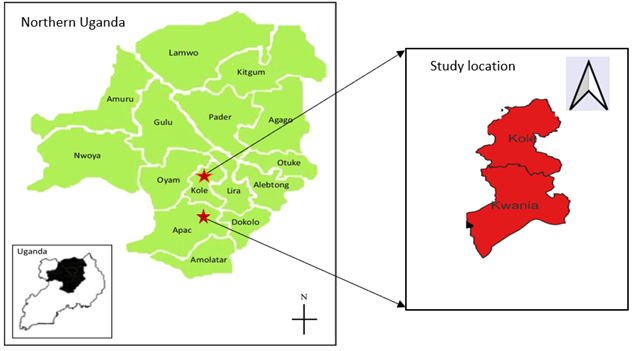
However, due to logistical and financial constraints, only one FGD was organised in the Kwania district with participants from Abany and Acungi parishes. This limitation prevented a possible comparative analysis between both districts. Nevertheless, FDG participants provided clarity and context to the various practices and perceptions of both communities. The FGDs followed a three-stage process.
- Open discussion and brainstorming on the indigenous postharvest management practices in the case study communities.
- Farmers were sub-dived into two groups, i.e., only men and only women groups, to discuss their perception of the decline in the use of these technologies. Splitting the group into male and female groups helps mitigate challenges which gendered power differences and dynamics could introduce. Single-sex groupings and inclusive and rotational selection of participants were some of the participatory techniques used by the field enumerators during FGDs. These techniques have been documented as effective in increasing participation during FDGs [62].
- Merging ideas generated from the two groups.
Finally, key informant interviews with ten community elders (five males and five females above 60) were also conducted to understand better the ideas and perspectives that emerged from the FGDs. Elders were mainly selected because they are known to have rich knowledge and experience in indigenous knowledge and practices in postharvest management.
Data Analysis
Descriptive statistics were used to summarise participants’ demographic data (Tables 1 & 2). Additionally, NVIVO, a qualitative data management software, was used for coding text data and thematic analysis [63] i.e., themes on the types of postharvest management practices used in the communities and reasons for their decline were coded for analysis. The third level of analysis involved a regression analysis. Laekemariam, et al. [9], have used ordinal data and regression analysis to understand farmers’ knowledge. Exploratory variables such as sex, age and educational level and situatedness Faye [16] were analysed against a postharvest management knowledge and socio-cultural hybridity score (dependent variable). The postharvest management knowledge score was calculated using Equation 1.
n = = ∑ ( )
1 i Postharvest manage category score x fi Equation 1: Formula for measuring postharvest management score for each category, i.e., indigenous or modern technology.
Where n is the number of specific practices for each category, i.e., indigenous (12 specific practices) or modern technology (9 specific practices), postharvest practices were recorded. x is the awareness level of each category per participant. Awareness levels were coded as follows: fully aware = 3, moderately aware = 2 and not aware =1. i is the specific postharvest practice the participant uses, and (fi) is the frequency. For example, if the specific postharvest practice used is winnowing, participants were also asked about the frequency of use. The frequency of use was coded as; often used =3, less often used = 2, Never used = 1. A similar approach to measuring ordinal data has been used in measuring Household Food Insecurity Access (HFIAS) Scales [21, 64]. These scores were then used as the dependent variables for the backward stepwise regression analysis in Tables 4 & 6. Finally, a combined score, i.e., the sum of the indigenous knowledge (IK_Score) and modern technology score (MT_Score) for each participant, was used to generate the ‘socio-cultural hybridity’ score (SCH_Score), which was then analysed against the same exploratory variables (Tables 7 & 8). This combined score represents the combined reliance on indigenous and modern postharvest practices - cultural mixing.
Demographic Characteristics of Research Participants
As mentioned, this research was conducted in Kwania and Kole districts (see Figure 1), with 60% of the 213 participants from Kwania and 40% from Kole districts. The main economic activity in the region is rain-fed agriculture which is predominantly subsistence and faces several challenges, including low agricultural production, market inaccessibility and postharvest losses [65]. Table 1 is a cross- tabulated representation of research participants by sex and age. Most of the research participants were women (60%), highlighting the predominance of women as smallholder farmers in rural communities [66]. Farming is the primary source of income for all research participants, with 33% opting for maize as the most preferred crop, followed by cassava (27%). The main crops grown in the region include maize, sorghum, finger millet, pulses, and oil crops, including roots and tubers [67].
Most research participants also practised mixed farming, with 92 % keeping livestock such as goats, cattle, pigs, ducks, chickens and sheep. From Table 1, 35% of participants were between the age of 19-35, 32% were aged 36-52, 21% were aged 53-69, and 12% were above 70 years. In all age groups, except those between 53-69, women were more represented than men. As demonstrated by our field data, smallholder farmers in these districts typically have access to less than 2ha of land and extensively rely on indigenous postharvest management practices. Hence, as part of post-conflict recovery measures and persistent levels of poverty and food insecurity [68], several government and NGO projects are increasingly introduced to transform the region through ‘modern’ agricultural interventions [69].
| Sex | |||||
|---|---|---|---|---|---|
| Column Variable | Age group | ||||
| n = | 213 | ||||
| Crosstab Table Sex * Age Group of Respondents | |||||
| Sex \ Age (% of total) | 19-35 | 36-52 | 53-69 | >70 | Row totals |
| Female | 48 (23%) | 44 (21%) | 22 (10%) | 14 (7%) | 128 (60%) |
| Male | 27 (13%) | 24 (11%) | 23 (11%) | 11 (5%) | 85 (40%) |
| Column totals | 75 (35%) | 68 (32%) | 45 (21%) | 25 (12%) | 213 (100%) |
| Row Variable | Sex | ||||
| Column Variable | Educational level | ||||
| n = | 213 | ||||
| Crosstab Table Sex of the Respondents * Educational Level | |||||
| Sex \ Educational Level (% Of Total) | No Formal Education | Primary Education | Secondary Education | Tertiary Education | Row Totals |
| Female | 41 (19%) | 72 (43%) | 8 (4%) | 7 (3%) | 128 (60%) |
| Male | 20 (9%) | 33 (15%) | 14 (7%) | 18 (8%) | 85 (40%) |
| Column totals | 61 (29%) | 105 (49%) | 22 (10%) | 25 (12%) | 213 (100%) |
Table 1: Cross-tabulation of participants by sex and age.
Table 2 shows that 81% of all female participants have some form of formal education (all educational levels combined) compared to 91% of all male participants. However, most of the participants educated at only the primary level were women (43%), and most of those with no formal education (19%) were also women. Additionally, beyond primary education, i.e., secondary and tertiary/ university education, women’s representation also declined, with women making only 4% and 3% of the sampled population at both secondary and tertiary levels of education, compared to their male counterparts accounting for 7% and 8% respectively. Again, this corresponds to findings which show that women do not have equal and adequate access to education as their male counterparts in many rural communities [70, 71]. Our field data demonstrate that these socioeconomic characteristics affect indigenous and modern postharvest management practices, including socio- cultural hybridity. Faye [16] also demonstrates that these demographic characteristics impact farmers’ ability to use mixed farming approaches.
Repositories of Indigenous Postharvest Practices and Reasons for their Decline
This section documents commonly used indigenous postharvest practices by farmers, and their associated benefits are summarised in Table 3. Farmers were asked to list and discuss the indigenous practices they were aware of and the ones they use. It was observed that indigenous postharvest practices and knowledge are applied at different stages, i.e., harvesting, storage, transportation, and marketing (Table 3). As discussed by Santeramo [27], food loss and waste occur at these stages of food production, production and distribution. The indigenous practices highlighted in Table 3 are essential for controlling various pests, including their anti-pathogenic properties against pests such as Fusarium oxysprum [23, 72], contributing to reducing food loss during identified stages of food production.
| Indigenous postharvest practices and knowledge | Associated benefits in postharvest handling | Postharvest handling stages used |
|---|---|---|
| Pounded dry blackberry leaves | Control of storage pests like Maize weevil. Antioxidant properties reduce fungal growth and mycotoxins [13,57]. | Storage |
| Local tobacco leaves | Control of storage pests of cereals and legumes. The nicotine extract from tobacco leaves (Nicotiana tabacum L.) has been used by indigenous communities as a natural insecticide against many pests [58,59]. | Storage |
| Traditional granaries | Granaries are useful for sheltering harvests against bad weather and controlling rodents, vermin, and thieves. The use of granaries is often associated with the need for more resources [60]. However, these storage methods have been improved in various local communities to enhance postharvest management practices [60,61]. | Storage, controlled drying, Threshing |
| Woven basket | Storage of legumes and cereals, transporting produce from the garden and to the market. Woven baskets are often used for tomatoes and sweet potatoes storage and transportation [62,63]. | Harvesting, Marketing, Storage |
| Plastering storage rooms with cow dung | Cow dung and urine have anti-pathogenic properties against pests such as Fusarium oxysprum and Botryodiplodia theobromae - the postharvest pathogens of yams [56,64] | Storage |
| Using cats against rodents | Control of rodents and other vermin | Storage |
| Drying and storage of harvested maize with cobs | Control of pests, clean drying, and prolonging shelf life. Maize cobs covered by husk are less susceptible to pest attacks [65]. | Drying and storage |
| Drying of cereals on papyrus-made mats | Clean drying and reducing contamination with foreign materials | Drying |
| Winnowing using locally made winnowers | Cleaning of grains from foreign materials and contaminants and sorting. Winnowing is an essential step for obtaining clean produce for storage. | Drying |
| Sawdust | saw dust is effective in cassava post-harvest management [66]. | Storage |
| Wood ash | Wood ash contains silica that disrupts fungal pathogen multiplication and insect feeding. In addition, it reduces relative humidity in storage rooms [65]. | Storage |
| Pepper | Chilli pepper has insecticidal properties, effectively managing weevils in stored rice [67]. | Storage |
Table 2: Common indigenous practices used at various stages of postharvest handling by research participants and the associated b
Awareness Level of Indigenous Postharvest Management Practices
This section presents and discusses the results of the backward stepwise regression analysis of the indigenous knowledge score (IK_Score) against various exploratory variables. Results from ‘step 1’ and the final step – ‘step 9’ of the regression analysis, are presented. Faye [16] uses a backward stepwise regression analysis ‘to correlate the degree to which farmers engage in hybrid farming’. Again, the indigenous knowledge reliance score (IK_Score) was calculated using Equation 1. A maximum IK_Score of 108 and a minimum score of 16 were recorded. From Figure 2, the majority of the participants, 47%, had a bellow median IK_Score of 39-58, and 23% had a score of 59-78. A few participants scored above 79, i.e., 13% scored 79-98, and 2% scored above 98. The skewness of the IK_Score to the left of the median score in Figure 2 is explained by the decline in reliance on indigenous knowledge and practices among research participants.
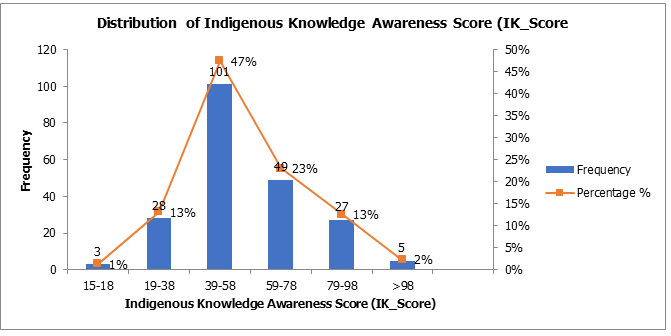
Results from the regression analysis Table 4 show that sex is not statistically significant in the reliance and use of indigenous knowledge and practices, i.e., the IK_Score. However, the coefficient of the sex variable shows that male participants have an IK_Score 0.87 lower than their female counterparts, which is explained by the impact of education, a statistically significant factor (p= 0.044). Secondary and tertiary educated participants had a lower IK_Score than those without formal education. Primary-level education is not statistically significant. As discussed earlier, in Table 2, more female participants (19%) have no formal education than males (9%).
Table 4 also shows that age has a statistically significant impacts on awareness and reliance on indigenous knowledge, i.e., the IK_Score. The higher the age group, the higher the IK_Score. For example, those above 70 (p=0.01E-6) have an IK_Score 24.1 units higher than those aged between 19- 35. Participants aged between 53-60 (p=2.4E-7) and 36-52 (p= 0.059) have a higher IK_Score of 17.33 and 5.53 than those between 19-35 years. Research participants explained that the decrease in the reliance on indigenous knowledge and practice among younger smallholder farmers is attributed to the disappearance of social gathering platforms locally known as Wigadi. Local farming practices and knowledge were often passed through gathering such as Wigadi, folk songs and folklores and everyday traditional or cultural events. Participants argued that opportunities to pass down knowledge from the older generation are declining due to increased Western communication technology and social gatherings, like in bars, trading centres, TV and cinema halls. The lack of indigenous knowledge information exchange channels hinders awareness creation, transmission and retention of indigenous knowledge in these rural communities.
Other reasons for the decline of indigenous knowledge and practices were linked to low levels of awareness, as presented in Table 5. These include the lack of dissemination and need for knowledge on indigenous practices, the influence of Western education and modernisation, including the increasing influence of government projects and programs [7]. Owach, et al. [73], Faye [16], have argued that awareness of modern postharvest technology increases with increased education/modernisation. These variables are discussed in the next section.
| Stepwise Backward Regression | |||||||
|---|---|---|---|---|---|---|---|
| Dependent variable | IK Score | ||||||
| Independent Variables | Sex (male =1),Primary education (=1), Secondary education (=1), Tertiary/University education (=1), Age group 34-52 (=1), Age group 43-56 (=1), Age group >70 (=1), Relationship status (with partner =1), Household >5 (=1), Income <499000 (=1), Association to farmers group (=1), Access and control over resources (=1), Land holding >2ha (=1) | ||||||
| N | 213 | ||||||
| Step 1 | |||||||
| R | R-Squared | Adjusted R-Squared | S | F | p-value | ||
| 0.50279 | 0.2528 | 0.20398 | 17.35177 | 5.17891 | 0.00000006 | ||
| VAR | Coefficients | Standard Error | Beta | t | p-value > t | VIF | TOL |
| Sex | -0.86879 | 2.74518 | -0.02193 | -0.31648 | 0.75197202 | 1.27851 | 0.78216 |
| Primary Education | 2.82922 | 3.09054 | 0.0729 | 0.91544 | 0.36106635 | 1.68894 | 0.59209 |
| Secondary Education | -5.97787 | 4.71218 | -0.09376 | -1.2686 | 0.20606568 | 1.4549 | 0.68733 |
| Tertiary/University Education | -5.79381 | 4.6283 | -0.09611 | -1.25182 | 0.21210408 | 1.56991 | 0.63698 |
| Age group (36-52) | 4.77004 | 3.14279 | 0.11461 | 1.51777 | 0.13065897 | 1.51859 | 0.65851 |
| Age group (53-69) | 16.82674 | 3.64648 | 0.35401 | 4.61452 | 0.00000705 | 1.56748 | 0.63797 |
| Age Group (>70) | 26.65208 | 4.51967 | 0.44212 | 5.89691 | 0.00000002 | 1.49708 | 0.66797 |
| Relationship status | 0.83306 | 3.26697 | 0.01767 | 0.25499 | 0.79899129 | 1.27849 | 0.78217 |
| Household >5 | 0.76856 | 2.62688 | 0.01962 | 0.29257 | 0.77015213 | 1.1978 | 0.83486 |
| Income <499000 | -2.84917 | 2.87567 | -0.07254 | -0.99079 | 0.32299266 | 1.42744 | 0.70056 |
| Association to farmer’s groups | -0.59605 | 2.71088 | -0.01491 | -0.21987 | 0.82619613 | 1.22521 | 0.81618 |
| Access and control over resources | 3.65082 | 9.04261 | 0.02554 | 0.40374 | 0.68684063 | 1.06593 | 0.93815 |
| Land Holding > 2ha | 1.68257 | 2.8023 | 0.0429 | 0.60043 | 0.54890567 | 1.35945 | 0.73559 |
| Intercept | 45.13732 | ||||||
| Step 9 | |||||||
| R | R-Squared | Adjusted R-Squared | S | F | p-value | ||
| 0.48719 | 0.23735 | 0.21893 | 17.18809 | 12.88449 | 0 | ||
| VAR | Coefficients | Standard Error | Beta | t | p-value > t | VIF | TOL |
| Secondary education** | -8.06233 | 3.98164 | -0.12646 | -2.02488 | 0.04416433 | 1.05863 | 0.94461 |
| Tertiary/University education* | -7.10625 | 3.73092 | -0.11788 | -1.90469 | 0.05820679 | 1.03967 | 0.96184 |
| Age group (36-52) * | 5.53082 | 2.91645 | 0.13289 | 1.89642 | 0.05929716 | 1.33276 | 0.75032 |
| Age group (53-69) *** | 17.32661 | 3.24257 | 0.36453 | 5.34347 | 0.00000024 | 1.26318 | 0.79165 |
| Age Group (>70) *** | 24.19144 | 4.04673 | 0.4013 | 5.97802 | 0.00000001 | 1.22313 | 0.81757 |
| Intercept | 50.45281 | ||||||
| *0.1 Significant level, 0.05 Significant level, *0.01 Significant level |
Table 3: Regression results for indigenous knowledge awareness score.
The Decline of Indigenous Knowledge and Awareness Level of Modern Postharvest Management Practices
Farmers were asked to rate how they agreed or disagreed with various reasons for the decline in indigenous knowledge and practice [1, 7, 52, 74]. Table 5 indicates that 65% of respondents strongly agreed that ‘modernisation’ was the reason behind the decline in indigenous postharvest practices. Modernisation involves shifting from a traditional society to a more homogenised society characterised by advanced technology and a strong complacency towards the Western world [75]. In other words, modernisation is viewed as the transition from indigenous knowledge and practices to ‘Western’/externally introduced technologies driven by factors like education [7]. Faye [16] uses education as a proxy variable to explore ‘modernisation – neoliberal theory’, highlighting that ‘educated farmers are more open to change, better understand new technologies and are more likely to integrate them with traditional ones’. The significance of secondary and tertiary education in reducing the IK_Score has been explained above.
Additionally, Table 6 shows that tertiary/university-level education has a statistically significant impact (p=7.50E-6) on modern technology awareness and use (MT_Score). Participants who are tertiary or university educated had their MT_Score increased by 2.17 units compared to those with no formal education. Furthermore, 35% (strongly agree) and 33% (agree) of respondents attributed the decline in indigenous postharvest management practices to a lack of indigenous knowledge and societal pressure, respectively. The importance of association with other community members, which Faye [16] describes as ‘social situatedness’, is essential for ‘cultural mixing’. From Table 6, participants who belong to farmers groups (p=0.034) had a higher MT_ Score. For example, participants associated with farmer’s groups, described during FDGs as mainly providing financial support and access to government projects and programmes, had their MT_Score increased by 0.7 units compared to those who did not belong to any farmer organisation/groups. From Table 5, 53% of respondents either strongly agreed or agreed that government projects and programs influenced the erosion of indigenous postharvest practices and knowledge.
Additionally, staying with a partner, i.e., married or in a relationship (p=0.02), another ‘social situatedness’ variable as defined by Faye [16], significantly impacted the MT_Score. More so, households with more than five members had a statistically significant impact (p=0.004) on participants’ MT_Score. For example, research participants in households with more than five members had an MT_Score of 0.88 units higher than those with less than five members. These social and cultural variables increase participants’ proclivity to new ideas and technology, increasing their MT_Score [16, 76].
Although income was not a statistically significant variable for the IK_Score, Table 6 shows that income is statistically significant for the MT_Score (p=1.2E-4). Participants who earn below 4,999,000 Ugandan shillings (i.e., USD 1,334.23) per annum have an MT_Score of 1.26 units less than those who earn above 4,999,000 Ugandan shillings.
The statistical significance of income is also explained by the affordability of modern technology and the ability to access education within rural households, which ultimately affects cultural mixing and hybrid approaches to postharvest management [16].
| Reasons For the Decline in the Use of Indigenous Practices | Smallholder Farmers (N=213) | ||||
|---|---|---|---|---|---|
| Strongly Agree | Agree | Neither Agree Nor Disagree | Disagree | Strongly Disagree | |
| F (%) | F (%) | F (%) | F (%) | F (%) | |
| Western education | 47 (22) | 84 (40) | 20 (9) | 39 (18) | 23 (11) |
| Lack of knowledge of IPP | 75 (35) | 70 (33) | 12 (6) | 36 (17) | 20 (9) |
| Influence of government projects and programs | 33 (15) | 80 (38) | 45 (21) | 39 (18) | 16 (8) |
| Modernisation | 138 (65) | 39 (18) | 12 (6) | 13 (6) | 11 (5) |
| Social influence | 71 (33) | 72 (34) | 32 (15) | 26 (12) | 12 (6) |
| Disappearances of vital natural resources | 54 (25) | 74 (35) | 29 (14) | 26 (12) | 30 (14) |
Table 4: Perceptions on the decline in indigenous postharvest practices and knowledge.
F-Frequency Table 5: Perceptions on the decline in indigenous postharvest practices and knowledge.
| Stepwise Backward Regression | |||||||
|---|---|---|---|---|---|---|---|
| Dependent variable | MT_Score | ||||||
| Independent Variables | Sex (male =1),Primary education (=1), Secondary education (=1), Tertiary/University education (=1), Age group 34-52 (=1), Age group 43-56 (=1), Age group >70 (=1), Relationship status (with partner =1), Household >5 (=1), Income <499000 (=1), Association to farmers group (=1), Access and control over resources (=1), Land holding >2ha (=1) | ||||||
| N | 213 | ||||||
| Step 1 | |||||||
| R | R-Squared | Adjusted R-Squared | S | F | p-value | ||
| 0.56522 | 0.31947 | 0.27501 | 2.1173 | 7.18613 | 2.00E-11 | ||
| VAR | Coefficients | Standard Error | Beta | t | p-value > t | VIF | TOL |
| Sex | 0.10066 | 0.33497 | 0.01987 | 0.30051 | 0.76411 | 1.27851 | 0.78216 |
| Primary Education | 0.49371 | 0.37712 | 0.0995 | 1.30919 | 0.19198 | 1.68894 | 0.59209 |
| Secondary Education | 0.91515 | 0.57499 | 0.11227 | 1.59159 | 0.11306 | 1.4549 | 0.68733 |
| Tertiary/University Education | 2.53202 | 0.56476 | 0.3285 | 4.48339 | 0.00001 | 1.56991 | 0.63698 |
| Age group (36-52) | -0.1525 | 0.38349 | -0.02866 | -0.39767 | 0.6913 | 1.51859 | 0.65851 |
| Age group (53-69) | 0.37416 | 0.44495 | 0.06157 | 0.84091 | 0.40141 | 1.56748 | 0.63797 |
| Age Group (>70) | -0.36424 | 0.5515 | -0.04726 | -0.66046 | 0.50972 | 1.49708 | 0.66797 |
| Relationship status | 0.8131 | 0.39864 | 0.13487 | 2.03968 | 0.0427 | 1.27849 | 0.78217 |
| Household >5 | 0.89167 | 0.32054 | 0.17804 | 2.78179 | 0.00593 | 1.1978 | 0.83486 |
| Income <499000 | -1.07893 | 0.3509 | -0.21483 | -3.0748 | 0.0024 | 1.42744 | 0.70056 |
| Association to farmer’s groups | 0.74975 | 0.33079 | 0.14671 | 2.26656 | 0.02449 | 1.22521 | 0.81618 |
| Access and control over resources | 0.29381 | 1.1034 | 0.01608 | 0.26628 | 0.7903 | 1.06593 | 0.93815 |
| Land Holding > 2ha | -0.04257 | 0.34194 | -0.00849 | -0.1245 | 0.90105 | 1.35945 | 0.73559 |
| Intercept | 15.50193 | ||||||
| Step 9 | |||||||
| R | R-Squared | Adjusted R-Squared | S | F | p-value | ||
| 0.54394 | 0.29587 | 0.27886 | 2.11168 | 17.39576 | 0 | ||
| VAR | Coefficients | Standard Error | Beta | t | p-value > t | VIF | TOL |
| Tertiary/University education*** | 2.17398 | 0.47306 | 0.28205 | 4.59553 | 7.50E-06 | 1.10739 | 0.90302 |
| Relationship status** | 0.87855 | 0.375 | 0.14572 | 2.34279 | 0.02009 | 1.13739 | 0.87921 |
| Household >5*** | 0.87959 | 0.30222 | 0.17563 | 2.91049 | 0.004 | 1.07046 | 0.93418 |
| Income <499000*** | -1.25516 | 0.32045 | -0.24992 | -3.91687 | 0.00012 | 1.19682 | 0.83555 |
| Association to farmers groups** | 0.67459 | 0.3164 | 0.13201 | 2.13208 | 0.03418 | 1.12693 | 0.88737 |
| Intercept | 16.24849 | ||||||
| *0.1 Significant level, 0.05 Significant level, *0.01 Significant level |
Table 5: Regression results for modern technology reliance score.
Socio-Cultural Hybridity: A Syncretic Approach to Postharvest Management
Participants were asked to rate the extent to which they agree or disagree with specific factors identified in previous research associated with using indigenous postharvest practices [1, 51, 52, 74]. Table 7 shows that 47% of research participants strongly agreed that using indigenous practices encourages participation in development programs. Additionally, 66% of participants strongly agreed that indigenous practices are effective in averting postharvest losses, and 39% strongly agreed that indigenous practices are cheap in averting postharvest losses, respectively. This level of recognition among research participants calls for incorporating and acknowledging the importance of indigenous knowledge in mitigating postharvest losses [7]. It includes innovative strategies that acknowledge local knowledge systems and selectively incorporate modern approaches to postharvest management. This cultural mixing was measured using a socio-cultural hybridity score (SCH_Score).
| Strength of indigenous postharvest handling practices | Small-scale farmers (N=213) | ||||
|---|---|---|---|---|---|
| Strongly agree | Agree | Neither agree nor disagree | Disagree | Strongly disagree | |
| F (%) | F (%) | F (%) | F (%) | F (%) | |
| Cheap | 84 (39) | 77 (36) | 15 (7) | 29 (14) | 8 (4) |
| Encourages participation in development programs | 99 (47) | 81 (38) | 22 (10) | 7 (3) | 4 (2) |
| Local materials are readily available | 78 (37) | 67 (31) | 19 (9) | 46 (22) | 3 (1) |
| Require less skills | 65 (31) | 60 (28) | 22 (10) | 43 (20) | 23 (11) |
| Effective | 141 (66) | 47 (22) | 11 (5) | 10 (5) | 4 (2) |
Table 6: Perception on the strength of indigenous postharvest handling practices.
F-Frequency Table 7: Perception on the strength of indigenous postharvest handling practices.
The socio-cultural hybridity score (SCH_Score) was calculated as the sum of the IK_Score and the MT_Score and served as a proxy to measure the degree of cultural mixing practised by research participants with regards to postharvest management. The resultant SCH_Score was used as a dependent variable against the same exploratory variables for the IK_Score and the MT_Score. Figure 3 represents a graphical distribution of obtained SCH_Scores. The maximum SCH_Score obtained was 120, and the minimum SCH_Score was 30. From Figure 3, over 85% of research participants were above the median SCH_Score of 60 units, showing that cultural mixing is skewed to the right of the median score. The high reliance on indigenous and modern postharvest management practices explains the high tendency for cultural mixing. Research participants explained that the complementary use of local and modern practices is beneficial in reducing postharvest losses.
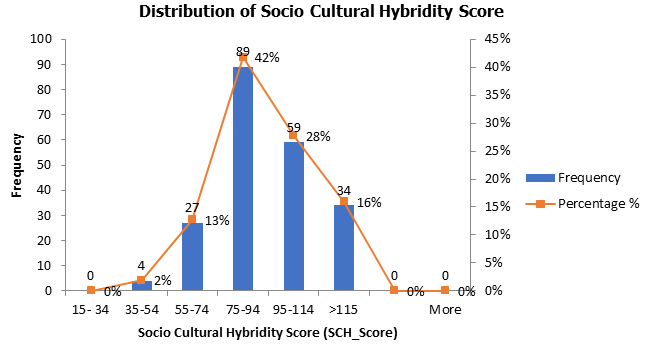
Results from the regression analysis in Table 8 further support the finding by Faye [16] and show that variables such as sex are not statistically significant for adopting hybrid farming approaches. However, modernisation theory variables such as income (p=0.085) and educational level (p=0.019) are statistically significant. Furthermore, those with at least primary level education are more open to change and accepting cultural mixing than those without education. Additionally, those earning above 4,999,000 Ugandan shillings (USD 1,334.23) per annum have a better SCH_Score than those earning below 4,999,000 Ugandan shillings (USD 1,334.23) per annum. Interestingly, older age groups are more open to cultural mixing than younger research participants, explained by the lack of indigenous knowledge among younger generations and a tendency for younger farmers to adopt solely modern approaches than their older counterparts [77, 78, 79, 80, 81, 82].
| Stepwise Backward Regression | |||||||
|---|---|---|---|---|---|---|---|
| Dependent variable | SCH_Score | ||||||
| Independent Variables | Sex (male =1),Primary education (=1), Secondary education (=1), Tertiary/University education (=1), Age group 34-52 (=1), Age group 43-56 (=1), Age group >70 (=1), Relationship status (with partner =1), Household >5 (=1), Income <499000 (=1), Association to farmers group (=1), Access and control over resources (=1), Land holding >2ha (=1) | ||||||
| N | 213 | ||||||
| Step 1 | |||||||
| R | R-Squared | Adjusted R-Squared | S | F | p-value | ||
| 0.49602 | 0.24603 | 0.19678 | 17.54763 | 4.99514 | 1.35E-07 | ||
| VAR | Coefficients | Standard Error | Beta | t | p-value > t | VIF | TOL |
| Sex | -0.76813 | 2.77617 | -0.01926 | -0.27669 | 0.78231 | 1.27851 | 0.78216 |
| Primary Education | 3.32293 | 3.12543 | 0.08505 | 1.06319 | 0.28898 | 1.68894 | 0.59209 |
| Second Education | -5.06272 | 4.76537 | -0.07888 | -1.0624 | 0.28934 | 1.4549 | 0.68733 |
| Tertiary/University Education | -3.26179 | 4.68054 | -0.05375 | -0.69688 | 0.48669 | 1.56991 | 0.63698 |
| Age group (36-52) | 4.61753 | 3.17826 | 0.1102 | 1.45285 | 0.14784 | 1.51859 | 0.65851 |
| Age group (53-69) | 17.2009 | 3.68764 | 0.35946 | 4.66448 | 5.67E-06 | 1.56748 | 0.63797 |
| Age Group (>70) | 26.28784 | 4.57069 | 0.43316 | 5.7514 | 3.30E-08 | 1.49708 | 0.66797 |
| Relationship status | 1.64616 | 3.30384 | 0.03468 | 0.49826 | 0.61885 | 1.27849 | 0.78217 |
| Household >5 | 1.66023 | 2.65653 | 0.0421 | 0.62496 | 0.53271 | 1.1978 | 0.83486 |
| Income <499000 | -3.92811 | 2.90812 | -0.09933 | -1.35073 | 0.17831 | 1.42744 | 0.70056 |
| Association to farmer’s groups | 0.1537 | 2.74148 | 0.00382 | 0.05607 | 0.95535 | 1.22521 | 0.81618 |
| Access and control over resources | 3.94463 | 9.14468 | 0.02741 | 0.43136 | 0.66667 | 1.06593 | 0.93815 |
| Land Holding > 2ha | 1.64 | 2.83393 | 0.04153 | 0.5787 | 0.56344 | 1.35945 | 0.73559 |
| Intercept | 60.63925 | ||||||
| Step 9 | |||||||
| R | R-Squared | Adjusted R-Squared | S | F | p-value | ||
| 0.48456 | 0.2348 | 0.21632 | 17.33285 | 12.70365 | 8.98E-11 | ||
| VAR | Coefficients | Standard Error | Beta | t | p-value > t | VIF | TOL |
| Primary education ** | 5.79132 | 2.4608 | 0.14823 | 2.35343 | 0.01954 | 1.07311 | 0.93187 |
| Age group (36-52) ** | 6.42688 | 2.9325 | 0.15338 | 2.19161 | 0.02952 | 1.32505 | 0.75469 |
| Age group (53-69) *** | 19.02028 | 3.36163 | 0.39748 | 5.65805 | 5.05E-08 | 1.33506 | 0.74903 |
| Age Group (>70) *** | 28.06576 | 4.15641 | 0.46245 | 6.75241 | 1.44E-10 | 1.26886 | 0.78811 |
| Income <499000 * | -4.39761 | 2.53786 | -0.11121 | -1.7328 | 0.08462 | 1.1142 | 0.8975 |
| Intercept | 64.15076 | ||||||
| *0.1 Significant level, 0.05 Significant level, *0.01 Significant level |
Table 7: Regression results for Socio-cultural hybridity score.
While social situatedness is not statistically significant on the hybridity score, the coefficient of social variables such as association to farmer’s organisations, household size, and relationship status positively correlates with the socio-cultural hybridity score. This is because participants belonging to social groups and in relationships are more likely to be open to mixed approaches than those not belonging to these social groups. Faye [16] justifies this by arguing that ‘when understood through the lens of social embeddedness, [cultural ecology] and networks of dependents’, these variables provide insight into the tendencies of smallholder farmers in rural settings to mix cultures.
Conclusion
Reducing postharvest losses requires wider recognition and attention to local knowledge and practices. However, such knowledge is disappearing, juxtaposed by a low adoption rate of ‘modern’ postharvest technology, often given priority by governments and development. This contradiction provides opportunities to review approaches to reducing postharvest management practices within rural settings. This paper explored socio-cultural hybridity as a bridge between the decline in indigenous knowledge and practices and the low adoption of modern technology. We
calculated a socio-culture hybridity score (SCH_Score) using ordinal data from field research (n=213). We argued that such an approach to mitigating postharvest losses is helpful in the valorisation of cultural mixing and involves not just traditional and modern practices but embraces local values, beliefs and culture [83, 84, 85, 86].
Using empirical data from two districts in the North of Uganda, our research shows that indigenous postharvest management practices are used in rural settings with a strong proclivity towards cultural mixing, i.e., socio-cultural hybridity. For many smallholder farmers, like those in the case, studies communities presented here, reducing postharvest losses requires wider recognition and attention to local knowledge and practices. However, several socioeconomic factors may impact cultural mixing, and an understanding of these socio-cultural dynamics is needed for policy intervention. For example, modernisation variables such as education and income are significant for adopting modern technology and positively impact smallholder farmers’ willingness to change. Additionally, age is a significant factor in disseminating and upholding local knowledge systems. However, the decline of platforms for disseminating these practices has led to a low level of indigenous knowledge awareness and use among younger farmers. This calls for better communication strategies and inventive solutions to bridge the gap across generations in rural settings.
While sex is not a statistically significant determinant of farmers’ proclivity to cultural mixing, access to resources skewed towards men impacts the adoption and awareness of modern approaches to postharvest management. Additionally, more women stick to indigenous practices because of a lack of access to alternative approaches. Finally, social situatedness is essential in determining farmers’ ability to use hybrid approaches to postharvest management. This includes access to farmer’s groups and the size of rural households. So, interventions, such as agricultural extension programs, should actively engage locals and leverage existing farmer groups in raising awareness and training farmers on indigenous postharvest practices. This will increase awareness and adoption of indigenous postharvest practices. Importantly, indigenous postharvest knowledge and practices should be incorporated in mainstream postharvest loss reduction interventions and policies across all levels in accelerating postharvest loss reduction. Future research should focus on exploring trade-offs within food system actors, power relations and processes and how local agents could influence the dissemination and adoption of indigenous postharvest knowledge and practices.
Acknowledgement
Special thanks go to Mis Conny Angwec and Mr Jannan Obabo, who administered the questionnaires for this research. Financial support from the Commonwealth Scholarship Commission is greatly acknowledged.
Declarations
Ethical Approval The RAU’s research ethics committee approved ethical clearance for this research. Approval for this research was also secured from local authorities at the district and parish levels. The ethical review reference number for this project was 20221602-Omara, obtained on 02.05.2022 Consent to Participate and Consent to Publish Informed consent was obtained from all participants involved in the study. Competing Interests The authors declare no conflict of interest. The funders had no role in the design of the study; in the collection, analyses, or interpretation of data; in the writing of the manuscript; or in the decision to publish the results. Authors’ Contributions Conceptualization, Atenchong Talleh Nkobou; methodology, Atenchong T.N, and Fredrick Omara; validation, Atenchong T.N, and Fredrick Omara.; formal analysis, Atenchong T.N, and Fredrick Omara; investigation, Fredrick Omara.; data curation, Atenchong T.N, and Fredrick Omara.; writing— original draft preparation, Atenchong T.N, and Fredrick Omara writing—review and editing, Atenchong T.N, and Fredrick Omara visualization; supervision, Atenchong T.N. All authors have read and agreed to the published version of the manuscript. Funding This research was part Mr. Frederick Omara’s M.Sc, which was funded by the Commonwealth Scholarship Commission, grant number UGSS-2021-141.
References
-
Habiyaremye A, Korina L (2021) Indigenous Knowledge Systems in Ecological Pest Control and Post-Harvest Rice Conservation Techniques: Sustainability Lessons from Baduy Communities. Sustainability 13(16): 9148.
-
Sillitoe P (1998) The Development of Indigenous Knowledge: A New Applied Anthropology. Current Anthropology 39(2): 223-252.
-
Demaria F, Kothari A (2017) The Post-Development Dictionary agenda: paths to the pluriverse. Third world quarterly 38(12): 2588-2599.
-
Escobar A (2015) Degrowth, postdevelopment, and transitions: a preliminary conversation. Sustainability Science 10(3): 451-462.
-
Ishangulyyev R, Kim S, Lee SH (2019) Understanding Food Loss and Waste-Why Are We Losing and Wasting Food?. Foods 8(8): 297.
-
Tibagonzeka JE, Akumu G, Kiyimba F, Atukwase A, Wambete J, et al. (2018) Post-harvest handling practices and losses for legumes and starchy staples in Uganda. Agricultural Sciences 9(1): 141-156.
-
Fernández Llamazares Á, Lepofsky D, Lertzman K, Armstrong CG, Brondizio ES, et al. (2021) Scientists’ Warning to Humanity on Threats to Indigenous and Local Knowledge Systems. Journal of Ethnobiology 41(2): 144-169.
-
Kuhnlein HV, Erasmus B, Spigelski D, Burlingame B (2013) Indigenous peoples food systems and well-being: interventions and policies for healthy communities. Food and agriculture Organization of the United Nations.
-
Laekemariam F, Kibret K, Mamo T (2017) Farmers’ soil knowledge, fertility management logic and its linkage with scientifically analyzed soil properties in southern Ethiopia. Agriculture & Food Security 6(1): 57.
-
Armstrong CG, Brown C (2019) Frontiers are Frontlines: Ethnobiological Science against Ongoing Colonialism. Journal of Ethnobiology 39(1): 14-31.
-
Ford JD, King N, Galappaththi EK, Pearce T, McDowell G, et al. (2020) The resilience of indigenous peoples to environmental change. One Earth 2(6): 532-543.
-
Ainembabazi JH, Mugisha J (2014) The role of farming experience on the adoption of agricultural technologies: Evidence from smallholder farmers in Uganda. Journal of Development Studies 50(5): 666-679.
-
Mandisvika G, Chirisa I, Bandauko E (2015) Post-harvest issues: Rethinking technology for value-addition in food security and food sovereignty in Zimbabwe. Advances In Food Technology and Nutrifional Sciences–Open Journal 1: 29-37.
-
Eira IMG, Oskal A, Hanssen Bauer I, Mathiesen SD (2018) Snow cover and the loss of traditional indigenous knowledge. Nature Climate Change 8(11): 928-931.
-
Mastenbroek A, Sirutyte I, Sparrow R (2021) Information Barriers to Adoption of Agricultural Technologies: Willingness to Pay for Certified Seed of an Open Pollinated Maize Variety in Northern Uganda. Journal of Agricultural Economics 72(1): 180-201.
-
Faye (2020) Indigenous farming transitions, sociocultural hybridity and sustainability in rural Senegal. NJAS Wageningen Journal of Life Sciences 92(1): 1-8.
-
Kenny A, Gordon N, Griffiths T, Kraemer JD, Siedner MJ (2017) Validation Relaxation: A Quality Assurance Strategy for Electronic Data Collection. J Med Internet Res 19(8): e297.
-
Cutcher L, Dale K (2023) Were Not a White Fella Organization: Hybridity and friction in the contact zone between local kinship relations and audit culture in an Indigenous organization. Organization Studies 44(5): 765-783.
-
Pratt ML (2007) Imperial eyes: Travel writing and transculturation. Routledge 26(3): 482-484.
-
De Sousa Santos B (2015) Epistemologies of the South: Justice against epistemicide. Routledge, USA.
-
Saint-Ville A, Po JYT, Sen A, Bui A, Melgar-Quiñonez H (2019) Food security and the Food Insecurity Experience Scale (FIES): ensuring progress by 2030. Food Security 11: 483-491.
-
Breidlid A (2009) Culture, indigenous knowledge systems and sustainable development: A critical view of education in an African context. International Journal of Educational Development 29(2): 140-148.
-
Makhuvele R, Naidu K, Gbashi S, Thipe VC, Adebo OA, et al. (2020) The use of plant extracts and their phytochemicals for control of toxigenic fungi and mycotoxins. Heliyon 6(10): e05291.
-
Yunkaporta T (2019) Sand talk: How Indigenous thinking can save the world.
-
Brondizio ES, Andersson K, de Castro F, Futemma C, Salk C, et al. (2021) Making place-based sustainability initiatives visible in the Brazilian Amazon. Current Opinion in Environmental Sustainability 49: 66-78.
-
Parfitt J, Barthel M, Macnaughton S (2010) Food waste within food supply chains: quantification and potential for change to 2050. Philosophical Transactions of the Royal Society B: Biological Sciences 365(1554): 3065- 3081.
-
Santeramo FG (2021) Exploring the link among food loss, waste and food security: what the research should focus on?. Agriculture Food Security 10(1): 26.
-
Tibagonzeka T (2012) Post-harvest losses in African maize in the face of increasing food shortage. Food Security 4(2): 267-277.
-
Sales FCV, De Souza M, Trento LR, Pereira GM, Borchardt M, et al. (2023) Food Waste in Distribution: Causes and Gaps to Be Filled. Sustainability 15(4): 3598.
-
Zorya S, Morgan N, Diaz Rios L, Hodges R, Bennett B, et al. (2011) Missing food: the case of postharvest grain losses in sub-Saharan Africa. The World Bank, USA.
-
FAO (2019) Government of Uganda, FAO, WFP, IFAD make strides in development of a comprehensive strategy plan to reduce post-harvest losses in grains.
-
Kimiywe J (2015) Food and nutrition security: challenges of post-harvest handling in Kenya. Proceedings of the Nutrition Society 74(4): 487-495.
-
Kumar D, Kalita P (2017) Reducing Postharvest Losses during Storage of Grain Crops to Strengthen Food Security in Developing Countries. Foods 6(1): 8.
-
Chegere MJ (2018) Post-harvest losses reduction by small-scale maize farmers: The role of handling practices. Food policy 77: 103-115.
-
Ngowi ER, Selejio O (2019) Post-harvest loss and adoption of improved post-harvest storage technologies by smallholder maize farmers in Tanzania. African Journal of Economic Review 7(1): 249-267.
-
AUC (2018) Post-Harvest Loss: The African Union Commission’s Post-Harvest Management Strategy. A. U. Commission.
-
GoU (2007) Uganda Vision 2024. Kampala, Uganda.
-
Costa SJ (2015) Taking it to scale: Post-Harvest Loss Eradication in Uganda 2014-2015. Food Programme, Uganda.
-
Bhabha HK (2012) The location of culture. Routledge, UK.
-
Friedman J (1997) Global crises, the struggle for cultural identity and intellectual porkbarrelling: cosmopolitans versus locals, ethnics and nationals in an era of de- hegemonisation. In: Werbner P, Modood T (Eds.), Debating Cultural Hybridity. Multi-Cultural Identities and the Politics of Anti-Racism. London.
-
Pieterse JN (2001) Hybridity, So What?. Theory Culture & Society 18(2-3): 219-245.
-
Araeen R (2000) A new beginning: Beyond postcolonial cultural theory and identity politics. Third Text 14(50): 3-20.
-
Frenkel M, Shenhav Y (2006) From Binarism Back to Hybridity: A Postcolonial Reading of Management and Organization Studies. Organization Studies 27(6): 855- 876.
-
Kuortti J, Nyman J (2007) Reconstructing Hybridity: Post-Colonial Studies in Transition. Brill Leiden 103(3): 815-816.
-
De Almagro MM (2020) Hybrid clubs: A feminist approach to peacebuilding in the Democratic Republic of Congo. In The Politics of Peacebuilding in a Diverse World 12(3): 319-334.
-
Zouggari N (2019) Hybridised materialisms: The twists and turns of materialities in feminist theory. Feminist Theory 20(3): 269-281.
-
Rivera-Núñez T, Fargher L, Nigh R (2020) Toward an Historical Agroecology: an academic approach in which time and space matter. Agroecology and Sustainable Food Systems 44(8): 975-1011.
-
Peterson JH (2012) A conceptual unpacking of hybridity: Accounting for notions of power, politics and progress in analyses of aid-driven interfaces. Journal of Peacebuilding Development 7(2): 9-22.
-
Atwoli L, Muhia J, Merali Z (2022) Mental health and climate change in Africa. B J Psych International 19(4): 86-89.
-
Prakash B, Raghavendra KV, Gowthami R, Shashank R (2016) Indigenous practices for eco-friendly storage of food grains and seeds. Adv Plants Agric Res 3(4): 101- 107.
-
Heisnam P, Moirangthem A, Pattaniaak SK, Singh YD, Hazarika BN (2019) Eco-Friendly Indigenous Storage Practices of Food Grains and Seeds. Post Harvest Technologies and Value Addition 88: 978-93.
-
Chowdhooree I (2019) Indigenous knowledge for enhancing community resilience: An experience from the south-western coastal region of Bangladesh. International Journal of Disaster Risk Reduction 40: 101259.
-
Altieri MA (2018) Agroecology: the science of sustainable agriculture. CRC Press 35: 111-115.
-
Dillon B (2012) Using mobile phones to collect panel data in developing countries. Journal of International Development 24(4): 518-527.
-
Aliro T, Chenais E, Odongo W, Okello D, Masembe C, et al. (2022) Prevention and control of African swine fever in the smallholder pig value chain in northern Uganda: Thematic analysis of stakeholders’ perceptions. Frontiers in Veterinary Science 8: 707819.
-
Branch A (2013) Gulu in War … and Peace? The Town as Camp in Northern Uganda. Urban Studies 50(15): 3152- 3167.
-
Akello G (2019) Reintegration of Amnestied LRA Ex- Combatants and Survivors Resistance Acts in Acholiland, Northern Uganda. International Journal of Transitional Justice 13(2): 249-267.
-
UBOS (2019) Poverty Maps of Uganda. Kampala, Uganda.
-
Cochrane L, Boulanger RF, Sheikheldin GH, Song G (2018) The case for local ethics oversight in international development research. Canadian Journal of Bioethics and Revue canadienne de bioéthique 1(1): 8-16.
-
Leck H (2014) Whose voice? Ethics and dynamics of working with interpreters and research assistants. In: Lunn J (Ed.), Fieldwork in the Global South: Ethical challenges and dilemmas, Routledge, USA, pp: 59-68.
-
Nassaji H (2020) Good qualitative research. Language teaching research 24(4): 427-431.
-
Queirós A, Faria D, Almeida F (2017) Strengths and limitations of qualitative and quantitative research methods. European journal of education studies 3(9): 1-19.
-
Edwards-Jones A (2014) Qualitative data analysis with NVIVO. Journal of Education for Teaching 40(2): 193- 195.
-
Wambogo EA, Ghattas H, Leonard KL, Sahyoun NR (2018) Validity of the Food Insecurity Experience Scale for Use in Sub-Saharan Africa and Characteristics of Food-Insecure Individuals. Current developments in nutrition 2(9): 1-10.
-
Adupa I (2019) On-Farm Approaches for Conservation of Indigenous Tree Species among Households in Aboko Parish, Kwania District. Makerere University.
-
Doss C, Summerfield G, Tsikata D (2014) Land Gender and Food Security. Feminist economics 20(1): 1-23.
-
Kaweesa S, Mkomwa S, Loiskandl W (2018) Adoption of Conservation Agriculture in Uganda: A Case Study of the Lango Subregion. Sustainability 10(10): 3375.
-
Malual JD, Mazur RE (2022) Social capital and food security in post-conflict rural Lira District, northern Uganda. Disasters 46(1): 80-94.
-
Dalipagic I, Elepu G (2014) Agricultural value chain analysis in northern Uganda: Maize, rice, groundnuts, sunflower and sesame. Action against Hunger (ACF) International.
-
Deere CD, Doss CR (2006) The Gender Asset Gap: What do We Know and Why Does it Matter?. Feminist economics 12(1-2): 1-50.
-
Doss CR, Deere CD, Oduro AD, Swaminathan H (2011) The gender asset and wealth gaps: evidence from Ecuador, Ghana, and Karnataka, India.
-
Ray R, Nedunzhiyan M, Balagopalan C (2000) Microorganisms associated with postharvest spoilage of yams. Annals of Tropical Research 22(1-2): 31-40.
-
Owach C, Bahiigwa G, Elepu G (2017) Factors Influencing the Use of Food Storage Structures by Agrarian Communities in Northern Uganda. Journal of Agriculture Food Systems and Community Development 7(2): 127- 144.
-
Kantiza A, Löytty T, Cherenet E, Sabimana R, Horák P, et al. (2021) Digitalization of Indigenous Knowledge in African Agriculture for Fostering Food Security. 2021 IST-Africa Conference (IST-Africa). IEEE, pp: 1-13.
-
Reyes GE (2001) Four main theories of development: modernization, dependency, word-system, and globalization. Revista Crítica de Ciencias Sociales y Jurídicas 4(2): 109-124.
-
Seeland K (1997) Nature is Culture Indigenous Knowledge and Social-Cultural Aspects of Trees and Forests in Non-European Cultures. Intermediate Technology.
-
Babarinsa O, Oluwalana I (2018) Effect of storage of fresh cassava in sawdust on Gari processing. Journal of Postharvest Technology 6(1): 57-62.
-
Bernard B, David M, Anthony E, Michael MS, James W, et al. (2019) The role of indigenous knowledge (IK) in adaptation to drought by agropastoral smallholder farmers in Uganda. Indian Journal of Traditional Knowledge 19(1): 44-52.
-
Chulze SN (2010) Strategies to reduce mycotoxin levels in maize during storage: a review. Food Addit Contam Part A Chem Anal Control Expo Risk Assess 27(5): 651- 657.
-
Khanal D, Neupane SB, Bhattarai A, Khatri-Chhetri S, Nakarmi N, et al. (2021) Evaluation of Botanical Powders for the Management of Rice Weevil in Rupandehi, Nepal. Advances in Agriculture 2021: 8878525.
-
Kigozi J, Mibulo T (2023) Post-Harvest Technology Utilization in Uganda: An Overview. Research Highlights in Agricultural Sciences 7: 83-93.
-
Shee A, Mayanja S, Simba E, Stathers T, Bechoff A, et al. (2019) Determinants of postharvest losses along smallholder producers maize and Sweetpotato value chains: an ordered Probit analysis. Food Security 11(5): 1101-1120.
-
Swain MR, Ray RC, Nautiyal CS (2008) Biocontrol Efficacy of Bacillus subtilis Strains Isolated from Cow Dung Against Postharvest Yam (Dioscorea rotundata L.) Pathogens. Current Microbiology 57(5): 407-411.
-
Tesfaye W, Tirivayi N (2018) The impacts of postharvest storage innovations on food security and welfare in Ethiopia. Food policy 75: 52-67.
-
Ujváry I (1999) Nicotine and Other Insecticidal Alkaloids. Nicotinoid Insecticides and the Nicotinic Acetylcholine Receptor. pp: 29-69.
-
Voahanginirina R (2018) Influence of the Use of Capsaicin on the Storage of Rice Grain. Open Access Library Journal 5(9): 1-13.
- Enhancement of Vegetative Growth and Fruit Yield in Cucumber (Cucumis sativus L.) via Spiritual Blessing (Biofield) Energy Intervention
- Production of Açaí (Euterpe oleracea Mart.) under Different Agroforestry System Management Intensities in Amazonian Floodplain (Varzea) Forests
- Coffee and the Production Region: What is the Secret to the Expression "Quality"?
- Experiential Agripreneurship Training in Sub-Saharan Africa: Integrating a Business Incubator into Postgraduate Livestock Education at the University of Buea
- Advances in Agricultural High-Quality Development
- Linking Compost Residue to ABAGE in Plants - a Short Note