
Agro-Forestry & Natural Farming for Bioeconomy, Speedy Net Zero Carbon and Climate Change Resilience in India
Boosting agroforestry and low emission farming on 85 million ha i.e. 25% of India’s landmass can offset about additional 750Million ton CO2 Equivalent green house gas (GHG) emissions i.e. nearly 50% % of Indian GHG emissions by 2050. This is over2 times the to the tune of 522 MtCO2E i.e. 22% of India’s total GHG emission of nearly 2,959 million ton CO2 equivalent/ yearin 2023. This can help India meet its net zero target to be carbon neutral close to 2050 as per the global target, ahead of itsdeclared plan to be next zero by 2070 at COP26 at Glasgow in 2021.
Abbreviations
CSA: Climate Smart Agriculture; NRLM: National Rural Livelihood Mission; AFOLU: Agriculture, Forestry and Other Land Use; IPCC: International Panel for Climate Change; GWP: Global Warning Potential; PMDS: Pre-Monsoon Dry Sowing; SRI: System of Rice Intensification; NDC: Nationally Determine Contribution.
Climate Change risk in Agriculture
Climate change is a global challenge and more so for the agriculture as the farmers lack the financial and technology to address its risks unlike the urban population. Agriculture is the most prevalent occupation globally and provides nearly 45% of the employment opportunities in like India, like in other developing countries [1]. However, farming sector has lowest economic productivity i.e. income per worker or per unit land area due to low price of the crop produce. Some other woes in agriculture include recurrent crop loss due to climatic extremes or market glut, rising chemical input cost and economic unviability, rising agri-debt, farmers suicides that are common today, with over 1 million in the 21st century [2]. Climate variability and extremes risked farming earlier also but its frequency and intensity is rising recently. Hence, Climate Smart Agriculture (CSA) strategies are promoted as described to reduce cost and loss, and enhance crop yield and profitability. Innovative experiments to weather-proof the small-marginal farmers especially women by training of 25 climate smart agri-technologies has been found successful over thousands of ha in India in a World bank supported project of the National Rural Livelihood Mission (NRLM), Govt. of India in 2019-20 in the states of Madhya Pradesh and Bihar that are vulnerable to climate change [3]. Over half the farmers adopted practices such as system of rice intensification, zero tillage, organic inputs, seed treatment, mobile phone based weather advisory and livestock integration. They benefitted by reduced cost or increased productivity and profitability to the tune of 25- 40%. Some technologies also led to reduced green house gas (GHG) emission i.e. climate change mitigation, so are eco- friendly due to lower or positive environmental footprint.
This brief desk review has the following objectives-
- To identify the carbon offset scope of bio-interventions- agroforestry & low carbon farming,
- To identify the relative contribution of these plant based measure vis a vis livestock.
Climate Mitigation Potential of Agroforestry
Agriculture, forestry and other land use (AFOLU) sector is responsible to offset 16 % of GHG emissions of India [4]. However, Agriculture and forestry can contribute higher to climate change mitigation by having the potential to offset about 25% of even the future GHG emissions in case of India [5]. Agriculture is also most cost effective compared to technology solutions in other sectors such as construction or energy vide International Panel for Climate Change (IPCC) [6]. Further, the IPCC underlines that the agriculture emits nearly 50% of methane (CH4) & N2O (nitrous oxide) gases that have 25 & 300 times global warning potential (GWP) than carbon di oxide (CO2), the chief GHG contributor. So it is important to contain these 2 emissions also from agriculture and forestry besides CO2. The IPCC report has further identified 4 major interventions to make AFOLU sector pro-climate with lower GHG footprint and higher mitigation to the tune of 6,000 Mt CO2E globally with their % share in GHG cut-
- Better agronomy/ farm management (25%),
- Grazing land management (24%),
- Restoration of the farm soils (carbon, microbes, 22%) and
- Restoring degraded lands (14%).
Agroforestry can help to implement the last pathway suggested while natural farming can help in 1st and 3rd option. The 2nd option requires reducing meat and animal product consumption such as milk globally [7], besides techniques such as cattlefed ingredients like seaweed to reduce methane [8].
Natural Farming Benefits
Soil restoration is vital as contributing nearly 61% of the agri-GHG (options a, c & d). Improving organic inputs through manure crops and farm bund trees to improve soil carbon and zero till (ZT) farming are 2 promising technologies in this respect [9]. Pre-monsoon dry sowing (PMDS) is an innovative traditional knowledge/ practice of summer sowing of manure crop seeds like Sesban or Drumstick and cowpea ploughing to dump into the soil. This is revived, standardised in and found to improve the soil carbon and crop productivity in the largest regenerative farming project in the world- Andhra Pradesh community natural farming (NF, www.apcnf.in) and won the 2024 Gulbenkian Prize for Humanity [10]. Studies by university of Reading, UK and ICRAF among others, indicated no significant yield reduction but much reduced chemical input & lower cost so higher profit of eco-agriculture practices [11]. Thus, it has now spread to 1 million farmers and equal land are in ha in the state. Such natural farming (NF)/ eco-agriculture makes farming climate resilient as crops sustain climate extremes such as drought, flood etc. vide Indian “natural farming mission” since 2022 [10].
NF is cost effective, it avoids chemical pesticides that are carcinogenic and destroy the farm soil biodiversity and local water sources and aquatic biota. Rainfed farming is mostly NF and can quickly adopt it as chemical inputs are less applied to dryland farms to avoid crop burning in water shortage. NF may also reduce health hazards intensity in the chemical farming to the farmers and consumers- respiratory disease and cancer etc. that haunt intensive agriculture states like Punjab. NF crops can be exported if tested and found as low or -pesticide residue free, as its in demand abroad and help to double the farmer’s income [10]. Eco- friendly Techniques such as System of Rice Intensification (SRI) also suit NF portfolio as reducing GHG emission, air and soil-water pollution [12].
Agroforestry for Net Zero NDC
AFOLU sector potential by 2030 is huge as depicted in Table 1 if agroforestry and natural farming are promoted widely. Table 1 provided current status & future potential of carbon offset of various bio-interventions to emit less carbon/ trap it. Figure 1 depicts it graphically.
| Biomass growth rate t/ha/yr | Carbon offset potential CO2 E t/ha/year# | Area status-current Million ha | Carbon offset potential CO2 E t/year-current | Addl. Area potential million ha-2030*# | Potential saving Co2 E million t/year | % Contribution to Bio-net Zero | |
|---|---|---|---|---|---|---|---|
| Forestry* (13) | 1.7 | 6.2 | 40 | 248 | 40 | 250 | 33 |
| Bamboo (14) | 7 | 26 | 8 | 208 | 5 | 128 | 17 |
| Agroforestry (15) | 2.8 | 10.3 | 5 | 51.5 | 10 | 103 | 14 |
| Natural farming (16) | 1.25 | 4.6 | 1 | 4.6 | 10 | 46 | 6 |
| SRI method** (17) | 2.5 | 9.2 | 1 | 9.2 | 10 | 92 | 12 |
| Zero tillage, mulching# (16) | 0.6 | 5 | 4 | 20 | 10 | 50 | 7 |
| Improved cattlefeed (18,19)@ | 0.625 | 0.125 | 300 | 37.5 | 100 | 12.5 | 2 |
| TOTAL | 59 | 578.8 | 85 | 750 | 100 |
Table 1: ** Indian GHG Emission Mitigation Scope from AFOLU By 2030.
*-good forest- selective felling- 40 million ha, - System of rice Intensification, #- by growing manure intercrops such as PMDS. *#- It claims 541 million ton of Carbon stock increased in Indian forests in 10 years: 2012-2021. This implies 0.85 ton/ ha/ year= 3.1 ton/ ha/ yr Co2E). Agro/ forest productivity can double if selective harvesting is restarted. @-Per cattle methane emission was considered to be 25 kg/ year/ cattle & was multiplied by 25 to get CO2E emission. About 20% of it was can be save by improved “Haritdhara” cattlefeed. Table 1:** Indian GHG Emission Mitigation Scope from AFOLU By 2030.
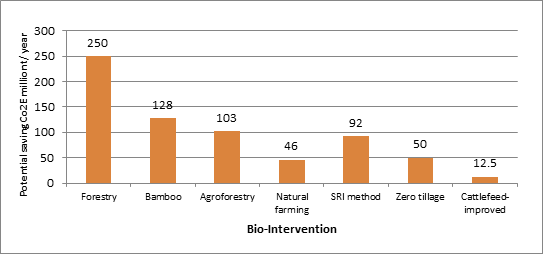
Thus, forestry has 33% carbon offset potential followed by Bamboo 16% and Agroforestry 13% while natural farming, SRI & zero tillage can together make 200 MtCO2E i.e. 30%. Livestock role is little.
Towards Evergreen Economy
Promoting certified timber and selective felling in the forest can aid its faster regrowth and carbon sequestration that is stopped for the last 3 decades after new forest policy began in 1990s to stop all forest felling operations.
Environmentalists opposed certain anti-biodiversity forestry activities such as clear-felling, conversion to monoculture of Eucalyptus, Teak, Pine etc [13, 14, 15, 16, 17, 18, 19]. However blanket ban on forest logging has caused canopy overgrowth that is unsuited for ungulates such as deer and reduced prey density and lack of fear of hunting may have pushed predators like Tiger and leopard to human habitation in search of easy prey like dogs and cattle escalating the human-wildlife conflict [20]. Restarting modest forestry operations like selective felling, nursery, replanting can generate millions of rural/ tribal livelihoods as few decades ago in tree planting, watering, aftercare- watch & ward, trimming, fire line, water holes etc [5]. Bamboo is among the fastest growing crops to generate 100 ton biomass per acre in few years and is profitable too and has huge product diversity and green livelihood potential as demonstrated by NGOs like BAIF [21]. Agroforestry and Bamboo also provides leaf manure for the soil to be fertile, carbon rich and “circular economy”. It can also provide million of jobs to the less educated rural population with low skill sets.
Such evergreen techniques make soil biota alive with microbes and rebuild the lost farm productivity due to overuse of chemicals. For, the NF inputs such as dairy products contain bacteria like Lactobacilus and akin to the marketed biofertilizers like Azotobactor/ Rhizobium/ Trichoderma. NGOs like lifeworks Global, U. K. are promoting regenerative agriculture techniques (https://lifeworks. global/). Global donor such as MacArthur, Ford, Rockefeller, Bill & Melinda gates foundations can prioritize AFLOPU activities, to speed up the net zero pathways. AFOLU today mitigates 55 Million t COE GHG emissions i.e. 22% of India’s current total, vide India’s 4th biennial report recently to UNFCCC. India has reduced its GHG emissions by 8% over 2019 vide this report and is on track to meet in nationally determine contribution (NDC) under net zero goal for 2070. It reports its basis to be enhancing renewable (non-large hydroelectric) power generation to cover nearly 45% of India’s energy production with solar (52%) and wind (42%) contributed 96% to the avoided emission. India is on track of meeting its NDC targets vide its latest report to UNFCCC [22] and can speed it up further. Thus, pursuing bio-economy by promoting rural bio-interventions can help to reduce India’s carbon footprint as suggested in UN millennium ecosystem assessment 2 decades ago [23] which may avoid the need for per capita rationing of commodities/ emissions.
Conclusions
Boosting agroforestry and low emission farming on 85 million ha i.e. 25% of India’s landmass, by doubling the the current closed forest from 40 million ha and covering 20% of Indian agriculture area of 140 million ha by natural faming techniques, system of rice intensification (SRI), zero tillage can together offset about additional 750 Million ton CO2 Equivalent of greenhouse gas (GHG) emissions i.e. nearly 50% of Indian GHG emissions by 2050. India can be net carbon sink & earn credits from 2050 if low carbon technologies are fast adopted in construction, transport & industry sectors.
Acknowledgements: We thanks our institution heads for moral support to the study and colleagues sharing views.
Conflicts: The authors declare no conflict of interest.
References
-
ILO (2024) India Employment Report 2024: Youth employment, education and skills. International Labour Organization, Geneva.
-
Ghate U, Kulkarni H (2024) Doubling Indian Agri Export through Natural Farming Management, Horticulture & African Markets. Asian J Agri Horti Research 11(4): 37- 48.
-
Gavali RS, Suresh Babu V, Reddy KK, Mukate SV, Imran Khan YD, et al. (2023) Scalable Adaptation Model for Sustainable Agriculture Livelihoods Under Changing Climate: Bihar & M P. Case. In: Nautiyal S (Ed.), Handbook of Socio-ecological Resilience & Climate Change, Springer Nature, Singapore 29: 499-526.
-
Anon (2022) Economy-wide Emissions Estimates- India-GHG trend analysis (2005-2018). GHG platform, India.
-
Ghate U, Patwardhan A, Arunachalam A (2023) Agroforestry And Organic Farming Scope In India Towards Net Zero. Indian Foreste 149(4): 418-421.
-
Smith P, Martino D, Cai Z, Gwary D, Janzen H, et al, (2007) Agriculture. In Climate Change 2007: Mitigation. Contribution of Working Group III to the Fourth Assessment Report of the Intergovernmental Panel on Climate Change (IPCC), Cambridge University Press, Cambridge.
-
WRI (2020) Course 5-Reduce Greenhouse Gas Emissions from Agricultural Production (Synthesis). World Resource Institute, Washington.
-
Wanapat M, Prachumchai R, Dagaew G, Matra M, Phupaboon S, et al. (2024) Potential use of seaweed as a dietary supplement to mitigate enteric methane emission in ruminants. Science of The Total Environment 931: 173015.
-
Singh VP, Kumar A, Banga A (2010) Current status of zero tillage in weed management. Indian Journal of Weed Science 42(1&2): 1-9.
-
Ghate U (2023) FPOs for the success of Natural faming. LEISA India 25: 19-22.
-
Galoab S, Murty CS, Rao BG (2024) Efficacy of Natural Farming over Chemical Farming: The Case of Andhra Pradesh. EPW 59(52): 1.
-
CEEW (2020) System of Rice Intensification (SRI), Centre for Energy, Environment & Water, New Delhi.
-
FSI (2021) India’s State of The Forest Report. Forest Durvey of India, Dehraudun.
-
Subbanna S, Sandhya MC, Pavithra GM, Viswanath S (2018) Influence of Agroclimatic Parameters on Growth and above Ground Biomass Production of Bambusa balcooa Roxb. And Dendrocalamus stocksii Munro. Two Commercially Important Bamboo Species in India. eJournal of Applied Forest Ecology (eJAFE) 6(2): 11-23.
-
Dhyani SK , Ram A, Dev I (2016) Potential of agroforestry systems in carbon sequestration in India Indian J Agricultural Sciences 86(9): 1103-1112.
-
Kaur R, Kaur N, Kumar S, Dass A, Singh T (2023) Carbon capture and sequestration for sustainable land use – A review. Indian Journal of Agricultural Sciences 93(1): 11-18.
-
Gathorne-Hardy A,Reddy DN, Venkatanarayana M, Harriss-White B (2013) A Life Cycle Assessment (LCA) of Greenhouse Gas Emissions from SRI and Flooded Rice Production in SE India. Taiwan Water Conservancy 61(4): 1-32.
-
Samal A, Sahu SK, Mishra A, Mangaraj P, Pani SK, et al. (2024) Assessment and Quantification of Methane Emission from Indian Livestock and Manure Management. Aerosol Air Qual Res 24: 230204.
-
ICAR (2022) ICAR-NIANP inks the third commercialization of anti-methanogenic feed supplement ‘Harit Dhara’.
-
Kulkarni H, Ghate U (2024) Cheetah Reintroduction in India: Review of Eco-Restoration Policy Gaps. Asian J Res Animal & Veterinary Sciences 7(4): 411-22.
-
Singh KK, Kolte V, Ghate U, Andhale K, Joshi R, et al. (2022) Bamboo for Community Networks. A plantation manual for green infrastructure. Community Networks, Asia Pacific Communications, U. K.
-
Anon (2025) India submits its 4th Biennial Update Report to the United Nations Framework Convention on Climate Change. Press Information Bureau, Govt. of India, New Delhi, India.
-
Ghate U, Patwardhan A, Warren A (2005) Rural bio- enterprises for food, water and climatic security. Current Science: 88(2): 213-214.
- Enhancement of Vegetative Growth and Fruit Yield in Cucumber (Cucumis sativus L.) via Spiritual Blessing (Biofield) Energy Intervention
- Production of Açaí (Euterpe oleracea Mart.) under Different Agroforestry System Management Intensities in Amazonian Floodplain (Varzea) Forests
- Coffee and the Production Region: What is the Secret to the Expression "Quality"?
- Experiential Agripreneurship Training in Sub-Saharan Africa: Integrating a Business Incubator into Postgraduate Livestock Education at the University of Buea
- Advances in Agricultural High-Quality Development
- Linking Compost Residue to ABAGE in Plants - a Short Note