
Building Living Structures – The Use of Space and Time for their Development
Solar radiation is the planet's main driving force. Its uneven and variable distribution generates the movement necessary for ecosystems to function as we know them. This energy, captured and transformed by autotrophic organisms, is then moved through the food chain. Plant canopies play an important role in this transformation, determining how the process will occur and the distribution of energy within plant communities. Many studies have been conducted on the structure of isolated plants and vegetative canopies of plantations. The vast majority of the latter studies deal with the development and formation of monospecific canopies with plants of the same age. I was unable to find anything in the literature that demonstrated the construction of a three-dimensional canopy (a group of plants forming an absorptive structure) in order to increase both the capture of radiation and its efficiency. Also, nothing was found about the temporal aspect, which is so necessary for trees and the formation of stable places suitable for the development of living beings, as well as nothing related to height and its variation as a planning factor. Thus, I propose here the use of these two additional variables in the rational construction of living absorptive structures. I thus seek to provide the initial understanding for the development of land use systems that take into account the three-dimensional structure of living beings (even more important when dealing with plants living in communities - systems). The development of an undulating system (in waves) is presented here exhibits an ordered variation of the tree canopies, also generating waves of work and harvesting and thus providing an adjustment, albeit incipient, to the ecological systems with simulations of emerging trees and forest gaps. I believe that in this way, the establishment of more resilient land use systems will simultaneously promote permanent soil cover, a better coupling to local conditions and its integration with the other components of the landscape, thus favoring the entire biotic structure and the people.
Introduction
Since the beginning of agriculture, people realize the matter of time as they save, or left behind some parts of the plants. At their return, it may be possible to found products if the plants survived the time elapsed between their migration. It is widely known the massive presence of useful trees as Commentary pequi (Caryocar brasilense Cambess., 1828) and Brazilian nuts (Bertholletia excelsa Bonpl., 1807) and many others distributed far beyond their natural range in Amazon and in many other parts of the world due to human action. In this sense, the passage of time was given between migrations due to alternating climatic conditions. In this way, land use has always been conditioned by its temporal use, which is marked by the variation in the positioning of the stars in the sky - especially the sun - during the day and throughout the year. It is no coincidence that in Greek there are two words for “time” - χρόνος (Chrónos) which refers to its linear, sequential passage and which is commonly used in our daily lives and καιρός (Kairós) which brings the notion of the opportune time, the correct or special moment in which observable events occur.
Nowadays, the perception of time and space has changed radically with the migration to large centers and with most of the population living in urban areas [1] increasing the distance from Nature and reducing its understanding. Thus, rural areas began to be considered as a factory floor aimed at meeting demands for the maintenance of people in distant places unrelated to local needs. Philosophically, rural areas have become a non-place. In this sense, the search for increased productivity as a way of maximizing financial returns on the expenses and work invested has been the main motto in the development of agriculture throughout the world. However, productivity can be deceiving, especially for small, poorer farmers who do not have access to the latest techniques – sold at high prices. It would be much better to address the issue in terms of its profitability, which, in many cases, is not directly linked to the production per area of a single crop, but to its unit value, expenses and production time (turn-over) and the overall efficiency of the system.
Solar radiation is the driving force behind almost all ecological and biological processes. This is the energy that will flow through the system once captured and transformed by vegetation. Much work has been done to maximize the efficiency of the plants of interest as well as the productivity of the crops. Despite being three-dimensional beings, nowadays agriculture and forestry deal with the fact in a two- dimensional way, establishing patterns and distances between rows and inter-rows, establishing their rectangularity by limiting itself to thinking of space in a flat way. Height (the third dimension) is very little used, with agricultural systems being larger or smaller square blocks that can be seen from a distance (Figure 1). There are practically no studies that deal with height and its variation, much less with the temporal aspect (the fourth dimension) of production systems. The growth and development of plants are largely ignored, as are their different needs throughout their life and their forms. Architecture (form) and structure play a fundamental role in productive systems (as in any other living system) by establishing capabilities and patterns of relationship with the environment. This is true both for the individual and for the group in which the living being is inserted, the system as a whole. Thus, the way in which this radiation is intercepted is of great importance, as it determines the fraction of radiation used and the quantity and quality of that radiation available and distributed within plant communities. This is why it is necessary to have a broader scope and to think about the development of production systems and their relationships with both environmental factors and their human and social dimensions. In this text, I present the initial thoughts that led me to develop living absorptive structures that respond to the environment in which they are inserted and mutually alter each other, bringing a proposal that can, and should be, widely altered, aiming at their local adjustment to their diverse needs. There are no planting schemes in the literature that take into account the height and development of plants given their temporal component. This is exactly the purpose of this work.
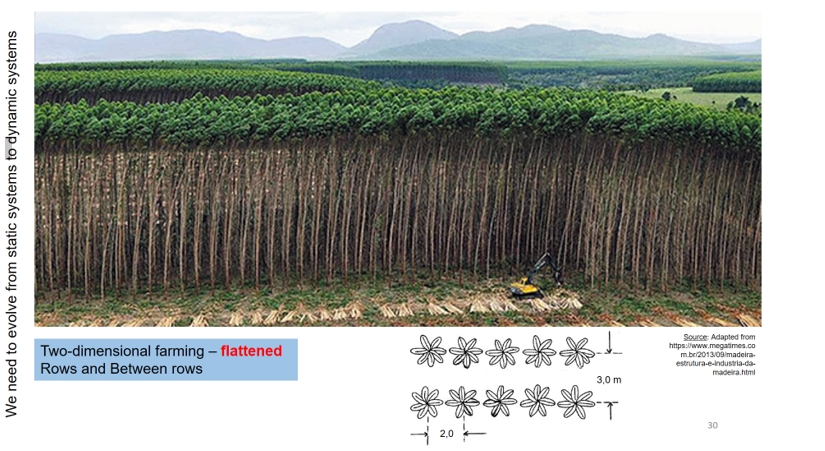
Forest Science Experimental Station - Anhembi
The Development of Systems with More Dimensions – The Use of Space and Time
The development of absorptive structures began in 2009 on two main occasions that awakened my awareness of the problem. The first was during measurements of a homogeneous eucalyptus plantation at our Forest Science Experimental Station in Anhembi – SP, Brazil. At that time, I was accompanying a group of forestry engineers who were going to evaluate the growth of trees. I pointed out that we should measure the trees on the edge, which were much bigger, but they told me no, because these would be under the effect of the edge, and we went inside the plot to measure trees with much smaller diameters. I was quite intrigued, since any producer would want to have larger and more developed trees. The second incident occurred during a trip that I was accompanying my wife on her environmental education work, and we passed by a real wall of eucalyptus trees with their much longer canopies and denser foliage (Figure 2). In addition to having a trunk diameter much larger than the others further inside the plot, the crowns of these trees occupied almost the entire length of the trunk and were very different from those I observed in the field and which are depicted in Figure 1 here. It was from these insights that I visualized the possibility of developing a system with a differentiated structure based on a temporal scale in order to promote the occurrence of edges, increasing the surface of the system and the plant-environment interface and taking advantage of their responses. The undulating agroforestry system was born.
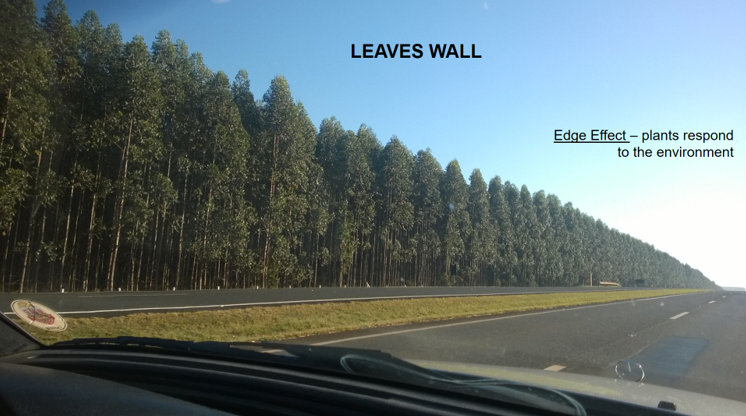
Figure 2: Partial view of a stretch of road in the municipality of Luís Antônio, Brazil, where we can see the responses of eucalyptus plants to the environment - edge effect - presenting an extensive canopy along a large part of the tree trunk with a high density of leaves forming this wall of leaves. The trees on the edge were noticeably larger than those located further inside the planting plot. Photo by the author.
This new land use system aimed to use the roughness of the tree canopies to maximize both the entry of radiation into the system and its absorption and transformation via photosynthesis. For this purpose, a temporal and spatial ordering of planting was considered, with the displacement of the crowns in height (given by the temporal component of planting) and the distance between the planting rows. This system thus encompasses not only two dimensions of space, the plane, in planning and decision-making - distance between rows and inter-rows - but incorporates height and time (third and fourth dimensions) as a way of building living absorptive structures that respond to the environment. Other ecological simulations in this anthropic system would be the presence of emergent trees and the occurrence of forest gaps due to the cutting and harvesting of older trees in addition to the modification of the light environment throughout the land use process (Figure 3). Given that, the crops between the rows of trees planted in the first year at the borders of the plot should be changed over time as the trees grow and the available radiation changes. Fast-cycle agricultural crops and/or livestock as in an agroforestry system would offset the costs of planting trees with a much longer cycle, increasing the economic viability of the system. We would also not have the area immobilized for several years without other products or income and without generating jobs.
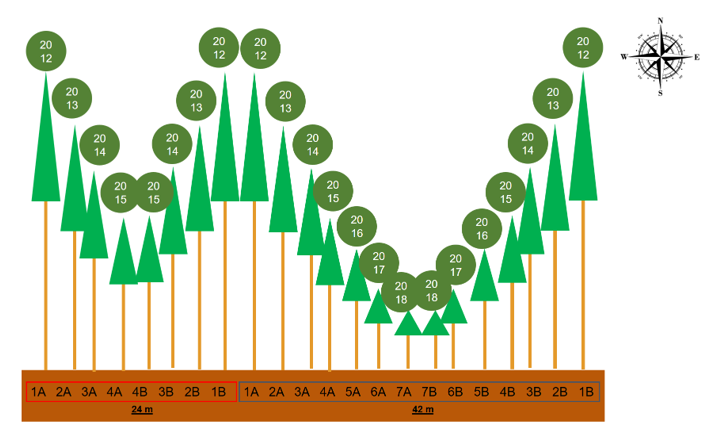
Figure 3: Cross-section of the wave planting scheme where we can observe the years of planting (balls) initiated at the ends of the plot with its closure occurring after the planting of the fourth (left - 24 m, short-wave) and seventh row (right - 42 m, long-wave) – sequential planting year numbers below the drawing of each row of trees. As in physics, the wavelength is given by the distance from the crest, in this case, the tallest and oldest trees.
Modification of canopy architecture results in changes in the plants’ interactions with the environment. Such modifications will vary according to the different structural arrangements, which are very different from homogeneous plantings, and to local conditions. Since the reflection of solar radiation depends on the zenith angle, vegetated surfaces in low latitude regions have a lower reflectivity coefficient than areas in higher latitudes. In addition, reflection depends on the geometry of the canopy, or individual crowns, as well as on the radiative properties of its components [2]. Thus, the development of living structures capable of altering the angle of solar incidence may be even more important for areas further from the equator. Such adjustments have the potential to result in increases of 10 to 20% in the radiation that is normally reflected. Diffuse radiation is less affected in its spectral composition (wavelength) than direct radiation, since a large proportion of it passes through the openings in the canopy [3] without interacting directly with the upper portion of the canopy. Thus, a system that increases solar exposure and creates breaks through which solar radiation can more easily enter the interior of the vegetation can favor the productivity of the system as a whole. Added to this are the specific abilities of the selected species, such as eucalyptus for example, in which the productivity and efficiency of photosynthesis increase directly with greater solar exposure. Understanding and respecting the architecture of the plant canopy is especially important for crops that require a lot of labor, such as rubber trees. Righi CA, et al. [4] obtained a 50% increase in latex production from rubber trees in an agroforestry system in alleys, and those that had the lowest production in monoculture showed the greatest growth in production and trunk diameter. This means a large increase in labor output, which is the largest cost in latex production.
It has long been known that solar elevation, and thus the proportion of direct/diffuse radiation reaching a surface, depends on the structure of the canopy [5] Designing and developing an absorptive structure is important because it allows planning and modification of the interactions of the system components, thus being able to shape their effects. Thus, developing structures that simulate mountain agriculture (Pereira1 – personal communication, 2018) by increasing the roughness of the terrain and forming exposure faces oriented towards specific locations could lead to a large increase in biological production.
In 2009, I presented the initial ideas for the development of a vegetative structure in an undulating format whose conformation was mediated by the differential height of its components, planting spacing (row and inter-rows) and planting times [6]. With this, it is possible to develop
1 Prof. Dr. Carlos Rodrigues Pereira, Universidade Federal Fluminense, Ni terói, RJ – Brazil - personal communication. 2018
structures in the shape of antennas - satellite dish - aiming to increase the capture of solar radiation and its distribution among the vegetation. Some initial results were presented more formally by Ribeiro GS, et al. [7, 8] who demonstrated a 150% increase in the growth of trees in the first planting in relation to those in monoculture of the same age and which were favored by this vertical displacement between neighboring trees. Tree crowns were 1.5 to 2.5 times bigger. Given the much higher growth rate of these trees, many could propose harvesting them in a shorter period of time - shortening the planting cycle - or obtaining trees with a larger trunk diameter, adding value to the wood obtained. At six years of age, trees in the wave system in the first year of planting had a mean DBH of 20.3 cm while those of the same age in monoculture only had 14.5 cm [9]. Furthermore, Ribeiro, et al. [10] found a loss of up to 66% of solar radiation in monoculture eucalyptus systems (high inefficiency), while the greater density of the eucalyptus canopy in the wave system provided greater protection for the understory plants during the hottest hours of the day and allowed greater light to enter when the sun was closer to the horizon.
The beauty of living beings lies largely in their resilience, their ability to adapt and respond to the environment by adjusting. This capacity for modification, for change, allows them to perpetuate themselves in the system while dead structures deteriorate.
In this way, maintaining the photosynthetic apparatus with permanent soil cover and thus the functioning of ecosystems is extremely important, since anthropized areas tend to occupy increasingly larger areas than natural ones. Thus, maintaining the natural processes that support life in anthropic areas through the presence of living structures capable of responding and changing over time can play a fundamental role in sustaining people interested in living and producing. The ecological impact of having production systems like this one presented here on a large scale in the landscape is something that has yet to be evaluated and understood. Aligning human activities with the functioning of ecosystems, working in their favor, is something we must pursue.
The wave system presented here can, and should be, locally adjusted to meet the most specific conditions, such as latitude, climate, interests, needs and knowledge of concerned producers. There is no need to use the same tree species throughout the system - what is presented here is just an experiment whose results should be extrapolated. Understanding natural systems and their functioning will allow the development and organization of the structure of production systems. Thus, as stated by Ribeiro, et al. [10] it is possible to increase the interception and use of solar radiation by adjusting both its components and the system as a whole. Solar radiation is an electromagnetic wave, and thus, we must evolve in the understanding of its capture and transformation into chemical compounds through the development of living structures capable of adapting and transforming. This is a humble beginning.
References
-
FAO (2024) Urban Resilience: The path to green and sustainable cities, USA.
-
Monteith JL (1973) Principles of environmental physics. In: (Edn.), New York, pp: 241.
-
Holmes MG (1981) Spectral distribution of radiation within plant canopies. In: Smith H (Edn.), Plants and the Daylight Spectrum: Proceedings of the First International Symposium of the British Photobiology Society, Leicester, Academic Press, London, UK, pp: 147-158.
-
Righi CA, Bernardes MS (2008) The potential for increasing rubber production by matching tapping intensity to leaf area index. Agroforestry Systems 72: 1-13.
-
ROSS J (1975) Vegetation and the atmosphere principles, In: Monteith JL (Edn.), Academic Press, London, UK, pp: 13-55.
-
Righi CA (2009) A utilização do eucalipto em sistemas agroflorestais: produção, ambiente e inserção social, University of São Paulo, Piracicaba, Brazil.
-
Ribeiro GS, Righi CA (2020) Canopy architecture of an agroforestry system: initial evaluation of a waveform system. Agroforestry Systems 94: 487-498.
-
Ribeiro GS (2023) A estrutura do dossel como fator determinante da produtividade florestal: o caso do sistema agroflorestal em ondas. In: (Edn.), USP / Escola Superior de Agricultura “Luiz de Queiroz”, Centro de Energia Nuclear na Agricultura, Piracicaba, Brazil, pp:149.
-
Righi CA, Ribeiro GS, Bernardes MS, Couto HTZ (2017) Canopy conformation for a greater solar radiation interception: a time-scale production system. In: (Edn.), IUFRO 125th Anniversary Congress 2017, Freiburg, Brazil.
-
Ribeiro GS, Righi CA, Couto HTZ (2025) Towards the development of living absorptive structures: light availability in a wave system, In: (Edn.), Discover Forests, Brazil.
- Enhancement of Vegetative Growth and Fruit Yield in Cucumber (Cucumis sativus L.) via Spiritual Blessing (Biofield) Energy Intervention
- Production of Açaí (Euterpe oleracea Mart.) under Different Agroforestry System Management Intensities in Amazonian Floodplain (Varzea) Forests
- Coffee and the Production Region: What is the Secret to the Expression "Quality"?
- Experiential Agripreneurship Training in Sub-Saharan Africa: Integrating a Business Incubator into Postgraduate Livestock Education at the University of Buea
- Advances in Agricultural High-Quality Development
- Linking Compost Residue to ABAGE in Plants - a Short Note