
Cardiovascular Risk Related to the Styles of Life, in Mexican Adults
Given the increase in cardiovascular diseases worldwide, risk factors are a measurable and predictive element to the increase in disease frequency within a period of time; cardiovascular pathologies are associated with unhealthy and risky, modifiable and non-modifiable lifestyles; Bibliographic references mention that it is more frequent in adults over 55 years of age, male, with: diabetes, hypertension, smoking more than ten years and more than ten cigarettes a day; in recent years the predisposition is in children under 40 and in women, related to obesity and sedentary lifestyle; Therefore, models of approximate evolution of the risk of developing cardiovascular diseases have been developed, such as the PAHO / WHO Cardio Cal application, which takes into account six variables: gender, age, diabetes, systolic blood pressure, smoking and cholesterol. It is a descriptive study, with a sample of 94 adults, with two groups: that of young adults of 20 to 35 years and mature adult of 35 to 59 years. With the objective of determining the cardiovascular risk related to lifestyles in Mexican adults, the following results were found: most women participated, with an average age of 36 years; 80% of the population studied has a low risk at an incidence of less than 10% at 10 years of presenting a cardiovascular event, less than 1% annually and 10% of those studied are at a moderate and high risk, which represents that two people will have an event annually and 20 in the coming years. With respect to cardiovascular risk factors, there is a significant difference p <0.001239 in the 35-59 age group with hypertension, diabetes mellitus, overweight, grade I obesity, increased abdominal perimeter, stress and physical inactivity. For all the above, it is relevant to implement strategies in individuals focused on lifestyle changes, due to the cardiovascular risk found.
Introduction
Risk factors are a measurable element or characteristic that has a causal relationship as an increase in the frequency of a disease and constitutes an independent and significant predictive factor of the risk of contracting a disease [1]. On the other hand, cardiovascular risk is the probability that an individual has of suffering one of these diseases within a certain period of time, directly related to the amount of risk factors that are present in the individual [2]. According to the World Health Organization (WHO), cardiovascular diseases are due to disorders of the heart and blood vessels. These include: coronary heart disease, cerebrovascular disease, arterial hypertension, peripheral vasculopathies, rheumatic heart disease, congenital heart disease and heart failure; The main causes of vascular disease are tobacco use, lack of physical activity and an unhealthy diet [3].
Cardiovascular diseases are the leading cause of death worldwide, in 2015 alone 17.7 million people were reported, representing 31%; more than three quarters of deaths occur in low and middle income countries. Behavioral risk factors can manifest in people in the form of high blood pressure, hyperglycemia, hyperlipidemia and overweight or obesity. These intermediate risk factors are indicative of an increased risk of cardiovascular disease and other complications [4]. Since cardiovascular diseases occupy one of the main causes of mortality and morbidity throughout the world, risk prediction models have been developed, either to prevent or intervene in time or, if necessary, to provide timely treatment; to mention a few is the Framingham, Mesa SCORE, Reynolds SCORE, Inter heart risk SCORE study, the ASCVD Optimal Risk of the American College of Cardiology, the 2013 ACC / AHA risk calculator and the PAHO / WHO cardiovascular risk calculator ; They take into account variables such as: gender, age, race, hypertension, diabetes mellitus, smoking, hyperlipidemia, hypercholesterolemia, treatment with aspirin or statins.
It is important to determine cardiovascular risk in adults, specifically young and mature, to implement strategies of care and self-care such as eliminating smoking, you should always try to improve your diet, following the WHO recommendations of the changes dietary, reduce alcohol, control weight, perform 30 minutes of moderate intensity exercise, at least three times a week, and the population must take into account that risk factors such as age, sex and diabetes do not change, always Look for a better lifestyle. The objective of this study is to determine the cardiovascular risk related to lifestyle in Mexican adults, through the PAHO / WHO Cardio Cal application, which takes into account variables such as: gender, age, smoking, maximum pressure (systolic) mmHg, diabetes and cholesterol; which calculates the probability of morbidity or mortality from cardiovascular disease, as follows: 10% with low risk; moderate risk of 10 to <20%; high risk of 20 to <30%; Very high risk of 30% to <40% and critical risk more than 40%. One of the advantages of this calculator is that it recalculates what would happen if the risk variables were modified by lifestyles such as: smoking, maximum pressure (systolic) mmHg and cholesterol; not so the non- modifiable risks that are: age, gender and diabetes.
Methods
It is a descriptive study, where the ability of risk factors to predict future episodes of cardiovascular and comparative diseases by age groups was determined, with a 95% confidence level, for the data analysis we used mean, variance, coefficient Pearson's correlation test t. With a sample of 94 Mexican adults with an age range between 20 and 59 years, two groups of young adults aged 20 to 35 years and mature adults aged 35 to 59 years were determined. In Mexico, heart disease accounted for almost 20% of total deaths in the country in 2015, according to information from the National Institute of Statistics and Geography (INEGI) and having cardiovascular disease or risk factors reduce the hope of life [5].
The PAHO application was used and is based on the form that the WHO proposes for the estimation of cardiovascular risk in Latin America, area called AMR-B (year 2007 - ISBN: 978 92435 4728 2). This risk score arises from an adaptation to some particularities of the region, based on the Framingham study. It takes into account six parameters of the individual: gender, age, smoking, systolic pressure, diabetes; the calculator is more accurate if the level of blood cholesterol is known, but it maintains the option of not considering it if that data is not available; Therefore, this variable was not considered. Obtaining the approximate estimate of the risk of developing relevant cardiovascular diseases such as myocardial infarction, angina pectoris, 10-year stroke.
Low risk is considered at an incidence of less than 10% at 10 years, that is, less than 1% per year. Another way to read it is to consider that of a group of 100 people in this situation, one will develop a disease every year, reaching 10 people in a decade. At the other extreme, very high risk greater than 40% at 10 years, indicates that 100
people in that condition 4 will have events annually and 40 will have them in the next 10 years; Almost one in two.
Results
Individual Parameters (Tables 1-12)
| Man | Woman | ||||||
|---|---|---|---|---|---|---|---|
| Young Adult | 20 - 35 | 14 | 28 | ||||
| Mature Adult | 35 - 59 | 24 | 28 | ||||
| Total | 38 | 56 |
Table 1: Gender.
| Adult | Rank | Average | General Average | |||||||||
|---|---|---|---|---|---|---|---|---|---|---|---|---|
| Young Adult | 20 - 35 | 42 | 25 | 36 | ||||||||
| Mature Adult | 35 - 59 | 52 | 45 |
Table 2: Age.
| Yes | No | ||||||
|---|---|---|---|---|---|---|---|
| Young Adult | 20 - 35 | 4 | 38 | ||||
| Mature Adult | 35 - 59 | 5 | 47 |
Table 3: Tobacco.
| Normal | Normal | Hipertension Arterial | |||||||||
|---|---|---|---|---|---|---|---|---|---|---|---|
| Elevado | I | Ii | Iii | ||||||||
| Young Adult | 20 - 35 | 39 | 2 | 1 | |||||||
| Mature Adult | 35 - 59 | 49 | 3 |
Table 4: Blood Pressure.
| Yes | No | |||||
|---|---|---|---|---|---|---|
| Young Adult | 20 - 35 | 6 | 36 | |||
| Mature Adult | 35 - 59 | 17 | 35 |
Table 5: Arterial Hypertension.
| Yes | No | |||||
|---|---|---|---|---|---|---|
| Young Adult | 20 - 35 | 12 | 30 | |||
| Mature Adult | 35 - 59 | 17 | 35 |
Table 6: Mellitus Diabetes.
| Overweight | Obesity | |||||||||||
|---|---|---|---|---|---|---|---|---|---|---|---|---|
| Grade I | Grade Ii | Grade Iii | ||||||||||
| Young Adult | 20 - 35 | 21 | 14 | 6 | 1 | |||||||
| Mature Adult | 35 - 59 | 16 | 19 | 12 | 3 | 2 | ||||||
| Total | 37 | 33 | 18 | 4 | 2 |
Table 7: BMI.
| Woman | Men | |||||||||||
|---|---|---|---|---|---|---|---|---|---|---|---|---|
| Normal | > 88 | Normal | > 102 | |||||||||
| Young Adult | 20 - 35 | 18 | 10 | 10 | 4 | |||||||
| Mature Adult | 35 - 59 | 14 | 13 | 18 | 7 |
Table 8: Abdominal Perimeter.
| Yes | No | ||||||
|---|---|---|---|---|---|---|---|
| Young Adult | 20 - 35 | 26 | 16 | ||||
| Mature Adult | 35 - 59 | 32 | 20 |
Table 9: Stress.
| Yes | No | ||||||
|---|---|---|---|---|---|---|---|
| Young Adult | 20 - 35 | 18 | 24 | ||||
| Mature Adult | 35 - 59 | 28 | 24 |
Table 10: Physical Inactivity.
| Yes | No | ||||||
|---|---|---|---|---|---|---|---|
| Young Adult | 20 - 35 | 4 | 38 | ||||
| Mature Adult | 35 - 59 | 6 | 46 |
Table 11: Genetic Heritage.
| Low Risk 10% | 80% |
| Moderate Risk 10% - <20% | 10% |
| High Risk 20% - <30% | 10% |
| Very high Risk 30% a <40% | |
| Critical Risk >40% |
Table 12: Riesgo Cardiovascular. Fuente: Formulario de la OMS.
Tables 1-12 shows the parameters considered to calculate cardiovascular risk, finding that 80% of the population studied has a low risk at an incidence of less than 10% at 10 years, less than 1% per year and the 10% of those studied are at moderate to high risk, which means that two people will have an event annually and 20 in the coming years.
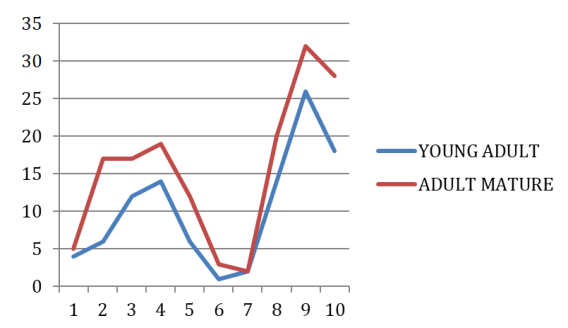
| Risk Factor's | Young Adult | Adulto Mature | ||||||
|---|---|---|---|---|---|---|---|---|
| Tobacco | 4 | 5 | ||||||
| Arterial Hypertension | 6 | 17 | ||||||
| Mellitus Diabetes | 12 | 17 | ||||||
| Overweight | 14 | 19 | ||||||
| Obesity Grade I | 6 | 12 | ||||||
| Obesity Grade Ii | 1 | 3 | ||||||
| Obesity Grade Iii | 2 | 2 | ||||||
| Abdominal Perimeter | 14 | 20 | ||||||
| Stress | 26 | 32 | ||||||
| Physical Inactivity | 18 | 28 |
Table 13: Risk Factors in the Population with Cardiovascular Risk. Source: Tables 1-12
there is a significant difference in this age group to present an episode of cardiovascular disease in one year.
Discussion
According to the WHO, cardiovascular diseases or high cardiovascular risk due to the presence of one or more risk factors such as hypertension, diabetes, obesity; they are the leading cause of death worldwide and Mexico is no exception6, as shown in this study when calculating cardiovascular risk in a population of 20 to 59 years, with a greater predisposition in the age group of 30 to 59 years and with risk factors such as hypertension, diabetes, overweight, obesity, stress and physical inactivity.
Conclusion
Cardiovascular risk factors are related to unhealthy or risky lifestyles such as: high blood pressure, diabetes mellitus, overweight, obesity, stress and physical inactivity, unhealthy diets, as well as age. There are several statistical methods to determine cardiovascular risk that take into account environmental factors, lifestyles and genetic susceptibility, the PAHO / WHO calculator offers predictive and reliability advantages. The majority of the population studied is women, with an average general age of 36 years, mostly do not smoke, have no personal history of hypertension and diabetes mellitus, but have problems with their weight and do not perform physical activity. 80% have a low risk at an incidence of less than 10% at 10 years, less than 1% per year and 10% of those studied are at a moderate to high risk, which means that two people will have an event annually and 20 in the next years. People at low, moderate and high cardiovascular risk, over 30 years of age, with cardiovascular risk factors, should follow the recommendations for the prevention of cardiovascular diseases, according to their total individual risk.
Conflicts of Interest
The authors state that there are no conflicts of interest in the preparation and execution of this work.
Funding
This project was fully funded with the researchers' own resources.
References
-
Donnell OC, Elosua R (2008) Cardiovascular risk factors, Perspectives derived from the Framingham Heart Study. Spanish Journal of Cardiology, pp: 299- 310.
-
Alvarez CJ, Alvarez MA, Carvajal GW, Gonzalez M, Duque J, et al. (2017) Determination of cardiovascular risk in a population. Colombian Journal of Cardiology 24(4): 334-341.
-
OMS (2019) Obtained from OMS: www.who.int.
-
OMS (2017) Obtained from OMS: www.who.int.
-
OMS (2008) Prevention of cardiovascular diseases. Pocket guide for the estimation and management of cardiovascular risk, Geneva.
- Anomalous Origin of the Left Coronary System from the Right Coronary Cusp: A Rare Coronary Anomaly in a Patient Undergoing Aortic Stenosis Workup
- Optimizing the Therapeutic Potential of Sacubitril/Valsartan: The Promise of Co-Crystal Engineering
- Association between Mortality and Topography of Peripheral Arterial Disease due to Atherosclerosis Obliterans
- Mitral Valve Replacement vs Mitral Valve Repair
- Characteristics and Evolution of Patients with Heart Failure Hospitalized in the Cardiology Department of Dalal Jamm Hospital
- Distribution of Association between Basic Knowledge of Chest Pain and Myocardial Infarction (Heart Attack) and Demographic Variables: A Survey-Based Study