
Analyzing Handwriting Variation in Athletes: A Comparative Study
Handwriting is a neuro-muscular phenomenon and is unique in nature. The potential of hand in designing the writing involves complex mechanism of the unite movement of finger’s, thumb and hand which is operated by the timed neural response system. It’s been said that any two objects greater than molecular size have some variation. And so it’s with the handwriting. We not at all write anything absolutely the same. The way a person moves their body determines how differently their skills can differ. Every element of writing is movement, and the more a writer moves, the more skilled they are. These subtle variations in personal traits define the boundaries of a person's handwriting.. Therefore, the purpose of this research is to study the hypothesis ‘higher the movement higher the skill’. For the analysis the handwriting sample were taken from the individual who do weightlifting or gym and half sample were taken from the normal people who don’t prefer gym. Results indicate a massive difference in variation of the handwriting of the weightlifters and non-lifters, due to stiffness of muscles there is less movement in their body while writing.
Introduction
Muscle contraction and relaxation are controlled by the motor system to maintain the posture and movement necessary for handwriting [1]. Through the nervous system, messages are sent from the brain to the muscles. During the learning process, the senses and muscles convey messages (feedback) back to the brain to let it know how the sequence, timing and force applied worked out. The brain makes the adaptation required to give a maximal outcome. A motor program eventually forms. This is a series of muscle commands that, when executed automatically and without feedback, can produce the best outcome by timing and sequencing them correctly. Since handwriting is a neuromuscular phenomenon that connects the mind and hand, it is well known that the more muscles a writer uses when writing, the more skilled the writer will be. In which there is movement of the muscles are required. And the resistance in the movement of the muscles while writing due to stiffness or hardness of the muscles. In sports person muscles become hard due to addition pressure on the muscle which makes them stiff and there is less movement of the muscles, which affect the skill of the handwriting causing variation in the handwriting of the sports person.
Handwriting
Handwriting is the result of neuro and muscular coordination where representations of alphabets are formed in the brain and our hand muscles form those alphabets on the writing surface with the help of writing instrument. Identification of handwriting is the major branch in questioned documents. Handwriting is a conscious act but rehearsal makes it a habit and the writing becomes a subconscious act. The product to begin with is the sum total of schooling, training, writing experience, environments and occupation in addition to mental, physical and emotional makeup. It is influenced by changes in life. A system of communication, handwriting is made up of small components and a set of rules that determine how these components can be combined to create meaningful messages [2]. One of the so-called evaluative features of graphism is handwriting development level. This “maturity” must be felt out with a pencil in the hand because it cannot be quantified or represented numerically. Handwriting differs from formal calligraphy or designs and encompasses both printing and cursive styles. Because handwriting varies and is distinctive to each individual, it can be used to confirm the authorship of a document [3]. Whether it’s their daily penmanship or their signature, each person has a distinct handwriting style. For example, identical twins who are genetically identical but have different handwriting do not have the same handwriting when properly evaluated Almeida PHTQD, et al. [4] handwriting is the writing done with a writing instrument such as a pen. Everybody has a different handwriting style due to a combination of factors such as their upbringing, first language learned, and the way they distribute force and shape words [5]. Study of handwriting analysis is known as Graphology. It is an effective and reliable indicator of personality and behavior [6].
Types of Handwriting
Clunky, artistic, forceful, hesitant, slow, or nervous handwriting are all possible. Clumsy handwriting is a sign of inexperienced writers. It is common with the illiterate or the semi-literate. Artistic handwriting show artistic bent of mind. People who write indiscriminately tend to write with force. Slow and hesitant writing is typically done by sick or elderly people. In free-hand or simulated forgeries, it is extremely typical. Some persons nervous and it is observed from the irregularities in their writing.
Class Characteristics
Skill Level: The best way to describe skill level is as an admiration of beauty applied to handwriting. A high skill writer creates writing that flows, has rhythm, may be artistically embellished, and is overall visually appealing. A low-skilled person produces work that is hesitant, slowly produced, occasionally contains strange letter formations, and is not visually appealing in general. Skill level, itself is one of the more important characteristics of identification or non-identification. One of the basic appearances of handwriting identification is that the individual having a low skill level cannot write above that level, while the individual with a high skill level can write to a lower level, or generally make writing of a low quality than what is his norm. This view will, at times, allow for the elimination (if not elimination) of a suspect from a questioned body of writing. A writer who is limited to writing at a much lower quality level could not have produced the questioned material if the writing demonstrates an exceptionally high level of skill. When someone with less writing ability tries to write at a higher level, they usually alter their own handwriting and try to create an artistic rendition of a handwriting style they have in mind. This is writing in a covert manner.
Slant or Inclination: Slant is the outlook of inclination of handwriting or a letter of writing from the base line of that writing. It may be leaning to the right side or forward slant, or leans to the left if it is a backward slant [7]. The angle of a writing may change from the starting of a word to the end of a word, or from the starting of a sentence, paragraph. If this find difference in slant is reproduced habitually, it may be of itself an identifying characteristic. Often a left or a right slant is thought of as characteristic of a right handed or left- handed writer. This is far from definitive. Even though many left handed people do maintain a backward slant to their writing, this is not fixed to just “lefties”. Writing angle, as an individual’s identifying characteristic, is not much important characteristics as other. However, a questioned sample of writing having a forward slant is obviously quite dissimilar from another sample of writing having a backhand slant. Many graphologists actually attempt to quantitative slant by physically measuring the angles and putting the results into report form. They may then extract out conclusions that small differences are indicative of one writer because they are, after all, only slight differences, or different writers because there are differences. This is patently absurd.
Form: This is one of the fundamental of individual characteristics. Form is the engraved representation of alphabets or writing movement. An intrinsic variation in handwriting can be seen in the form of a highly noticeable dissimilarity in the form of the same letter present in both the questioned and standard material. Form is the fundamental personal attribute that will be closely examined by the document examiner. The lamppost serves as the guide for the remaining handwriting comparison.
Movement: This is the manner in which the pen strokes to form the letters. Certain movements have historically been called “Arcade” when the pen moves underhand, or counter-clockwise, creating sawtoothed letter formations, or “Garland” when the pen moves overhand, or clockwise, producing rounded letter formations. Graphologists often use these terms in their report language and speech patterns, even though they are accurate. It is obvious how important mobility is. When it comes to the direction the pen was moving in when producing two identical letters, even though they are identical in form and appearance. Two identical lower-case “t’’ could have distinct pen crossing strokes made from left to right in one, while the other is left to right. Despite their similar appearances, these two “t”s are fundamentally different from one another. The direction of the pen’s movement during writing is frequently visible through low power microscropic observation of the pencil or ink line. Due to commonly occurring flaws in the ball housing, most ballpoint pens leave striations in the ink line. These striations will shift from the inside to the outside of the ink line as the pen direction changes. The longer section of the striation indicated the pen’s destination, while the smaller “leg” indicated the pen’s origin. The direction of the make-out pencil is considerably different, but still quite straightforward. Although writing paper’s surface seems incredibly smooth and bare to the touch eye, it is actually composed of a fibrous material with a distinct texture, albeit a tiny one. As the pencil scrapes across the surface of the paper, parts of the pencil’s “lead” are removed by these crisscrossing fibers that cross randomly. Under a microscope, the trailing edges of the fibers will show a thicker lead build- up than the leading edges. This will show direction, with the pencil moving from the sides of the fibers with heavy deposits to those with lesser deposits.
Alignment to Baseline: This is how the writing that is being questioned directly relates to a baseline of the writing. It is the writing’s adherence to an imaginary or prefabricated baseline, either printed or performed. The writing may have angle upward, downward, be concave or convex, or have a designs of changes for different letters, letters portions, or signatures. It may be on the baseline, or go above the baseline, or be irregular with regard to the baseline.
Pen Lifts: Here, we observe the point at which the writing instrument lifts off the paper-typically, inside a word or signature. It could be a coincidence that a particular writer happens to lift their pen at an odd moment in their writing, or it could be a sign of spuriousness if the writing appears to be patched together or is not present in the standard material.
Spacing: The distance between letters or words is known as letter spacing. The letters could be widely apart or closely spaced. The letters’ height, breadth, and size are all fairly self-explanatory; this only examines the handwriting’s proportions.
Speed: The writer’s speed is frequently a crucial component in the process of reviewing the document. Fast, fluid pen movement is hard for a forger to imitate, as will be covered elsewhere [8]. Many of the markers for writing quickly or slowly are represented in the comparison that follows:
Fast: Quick and fluid writing Motions Extended and erroneous “i” dots and “t” crossings Initials or words that are related a “flattened” outlook.
Slow: Trembling, hesitating, and writing “i” dots and “t” crossings in the proper places with greater angularity Crisp separation of distinct pen movements. Blunt begins and ends. Writing is composed of distinct, readable letters. There may be decorative movements.
Individual Characteristics
Individual characteristics: Characteristics which are unique to only a specific writer. This makes handwriting unique. Characters that expert looks for: Skills , Slant, Movement, Proportions Height, Dot, Crossing, Loops, Pressure, Alignment, Pen jumps , pen Speed, Entry/Exit Strokes, Retracing, Spacing, Format etc. [9].
The “i” dot: A section of writing as small and as innocuous as an “i” dot may at times become an important identifying feature. The “i” dots in handwriting come in all sizes and shapes. They may come in horseshoe shaped with the open end to the right, up, down or left, or be simply dots, circles, or dashes inclined up or down. In many teenage girls, they may be made in the shape of hearts.
The “t” crossing: A “t” crossing is having the same importance, or more, for the document examiner as the “i” dot does. A “t” crossing may go from right to left, left to right, it may incline up, incline down, or be perfectly horizontal. It may be heavily shaded on the right or heavily shaded on the left. The letter “t” can have its crossing in the middle, near the bottom, or at the top. In quick attempt to cross the “t” without taking the pen off the paper loops, it could be linked to an exit stroke from a word’s terminal letter.
Variations
Natural Variation is one’s own habit of writing and Because of the natural variation individual handwriting differs from one another, if a person write with different ink or different instruments, the Natural Variations are always same. Due to some External or surface factors handwriting and signature of person’s may be changed somehow, but its own personal habit never changes. Like health, age, influence of drugs and intake of alcohol may somehow affect the handwriting or signature of the person. In some cases individual disguised or try to change his own signature for his purpose, but Handwriting experts after examination can easily detect his or her writing. How clever is the forger but Experts after investigation detect minute details also. The execution of handwriting varies from person to person due to natural variation; no one can write exactly the same as they have written previously; there may be some variation, but it is a personal habit that is the visual impact of alphabets has not changed due to natural variation, but their distinctive habits have not changed. Put simply, it is necessary to conclude that two writings are the work of the same person when a sufficient amount of handwriting with a pattern of unique habitual movements or individual characteristics produces a totality of similarity within the parameters of individual variation with another body of writing.
Review Literature
Impact of neurological diseases on adult handwriting variation writing by hand requires precise motor control, cognitive function, and visual-perceptual processing [10]. Neurological diseases in adults can impair or even eliminate handwriting ability. For example, handwriting impairments are frequently seen in MS patients and stroke survivors. Compulsive disorders and Parkinson’s disease one of the goals of occupational therapy is handwriting restoration. Sadly, a lot of the traditional techniques for assessing handwriting movements during a clinical session lack standardization and rely heavily on the therapist’s judgment. It was discovered from two recent reviews of retraining techniques for handwriting ability that no research had evaluated the impact of the suggested treatment on the kinematics of writing movement or on the activity of the central nervous system. Consequently, it would be crucial to quantify the motor performance of handwriting and look into brain activity during handwriting. Utilizing this combined methodology may also make it possible to evaluate potential modifications to neural activations and kinematics following a rehabilitation intervention. This is among the causes for which new digital techniques that employ technology for kinematic assessment and data collection have been developed [11]. In response to this issue, recent research on handwriting motions was conducted using digital tablets, which enable a quantitative examination of the kinematic characteristics of the writing trace. In other research, handwriting was examined through the application of Mergl algorithms, which converted electromyography signal produced by hand and forearm muscles into traces of handwriting. The identification of the neural correlates of writing movements is a step toward a more thorough explanation of the laws governing handwriting, as it allows researchers to better understand the connection between behavioral data and brain activity. In this regard, functional magnetic resonance imaging, or fMRI, has developed into a potent tool for researching the way the brain is organized functionally and for detecting brain activity while performing a motor task [12].
Material and Methodology
Aim
To determine the variation in Handwriting among the sports person specially in weight Lifters.
Hypothesis
Assumption was made that the stiffness of muscle due to weight lifting can bring variation in an individual’s handwriting.
Material Used to Collect Samples
- The standard format to obtain the sample is in English.
- Writing material.
- London letter.
Sampling
Handwriting samples of the weight lifters and non-lifters were collected.
Sample Size
70 handwriting samples (40 handwriting samples from the weight lifters and 30 handwriting samples from non- lifters were collected).
Sampling Method
Convenience sampling under non- probability methods.
Inclusion Criteria
The subject must be a regular weight lifter and received their education in English medium school.
Exclusion Criteria
If the subject is incapable of understanding or writing in English language or also does not lift weights are excluded.
Procedure
Procedure for Collection of Handwriting Samples
- The subjects taken for the study were selected first according to the inclusion criteria and second on how convenient they were to reach.
- The written consent of all the subjects was obtained and the objective of the study was explained to them.
- The handwriting samples were taken in the ‘London letter”.
- The handwriting sample was collected from the
Results and Discussion
Class Characteristics of the Lifters Sample
individuals who were lifting the weight from more than 3 months. 5. The control sample were taken from the non- lifters.
| Slant | Pictorial effect | Alignment | Skill | Shading | Line quality | Spacing | Movement | Pen Lift | Style | |
|---|---|---|---|---|---|---|---|---|---|---|
| Nagesh | 2 | 1 | 1 | 1 | 1 | 1 | 3 | 2 | 2 | 2 |
| Anamitro | 2 | 2 | 1 | 1 | 1 | 1 | 3 | 2 | 1 | 1 |
| Kritika | 2 | 1 | 1 | 1 | 1 | 1 | 2 | 2 | 1 | 2 |
| Abhinendua | 2 | 1 | 1 | 1 | 1 | 1 | 2 | 2 | 1 | 2 |
| Arshad | 2 | 1 | 2 | 1 | 1 | 1 | 2 | 2 | 1 | 2 |
| Divyansh | 2 | 1 | 1 | 1 | 1 | 1 | 2 | 2 | 2 | 2 |
| Deepak | 2 | 1 | 1 | 1 | 2 | 1 | 1 | 2 | 2 | 2 |
| Arvind | 2 | 1 | 1 | 1 | 1 | 1 | 2 | 2 | 2 | 2 |
| Nikunj | 2 | 1 | 1 | 1 | 2 | 1 | 2 | 2 | 2 | 2 |
Table 1: Class characteristic of lifters having forward slant.
- From the above Table 1 we observe that the individuals having forward slant (2), majority have clumsy pictorial effect (1).
- Individuals having forward slant (2), majority of them have baseline alignment (1).
- Individual having forward slant (2), majority of them have superior skill (1).
- Individuals having forward slant (2), majority of them have uniform line-quality (1).
- Individuals having forward slant (2), majority of them have finger and forearm movement (2).
- Individuals having forward slant (2), have the inconsistence tremors (
| Sample | Slant | Pictorial Effect | Alignment | Skill | Shading | Line quality | Spacing | Movement | Pen Lift |
|---|---|---|---|---|---|---|---|---|---|
| Harsh | 3 | 1 | 1 | 1 | 1 | 1 | 2 | 2 | 2 |
| Anish | 3 | 1 | 2 | 1 | 2 | 1 | 2 | 2 | 2 |
| Anuj | 3 | 1 | 1 | 1 | 1 | 1 | 2 | 2 | 1 |
| Rmendra | 3 | 1 | 1 | 1 | 1 | 2 | 2 | 2 | 1 |
| Suraj | 3 | 1 | 2 | 1 | 1 | 1 | 2 | 2 | 2 |
| Ayush | 3 | 1 | 1 | 1 | 2 | 2 | 2 | 2 | 1 |
| Asfaque | 3 | m | 1 | 1 | 1 | 1 | 2 | 2 | 2 |
| Prashant | 3 | 1 | 1 | 1 | 1 | 1 | 2 | 2 | 2 |
| Ankit | 3 | 1 | 1 | 1 | 2 | 1 | 2 | 2 | 1 |
| Manish | 3 | 1 | 1 | 1 | 1 | 1 | 2 | 2 | 1 |
| Hamza | 3 | 1 | 1 | 1 | 2 | 2 | 2 | 2 | 1 |
| Rohit | 3 | 1 | 1 | 1 | 2 | 2 | 2 | 2 | 1 |
| Nitin | 3 | 1 | 1 | 1 | 1 | 1 | 2 | 2 | 1 |
| Atul | 3 | 1 | 1 | 1 | 2 | 1 | 2 | 2 | 1 |
| Shubham | 3 | 1 | 1 | 1 | 1 | 2 | 3 | 2 | 1 |
| Prashant | 3 | 1 | 1 | 1 | 1 | 1 | 3 | 2 | 1 |
| Mehul | 3 | 1 | 1 | 1 | 1 | 1 | 3 | 2 | 1 |
| Rishabh | 3 | 1 | 2 | 1 | 1 | 1 | 3 | 2 | 2 |
| Akash | 3 | 1 | 1 | 1 | 1 | 2 | 2 | 2 | 2 |
| Jatin | 3 | 1 | 1 | 1 | 1 | 1 | 2 | 2 | 1 |
| Manish | 3 | 1 | 2 | 1 | 1 | 1 | 3 | 2 | 2 |
| Suksham | 3 | 1 | 1 | 1 | 2 | 1 | 1 | 2 | 1 |
| Vikas | 3 | 1 | 1 | 1 | 1 | 1 | 2 | 2 | 1 |
| Gaurav | 3 | 1 | 1 | 1 | 1 | 1 | 2 | 2 | 2 |
| Rohan | 3 | 1 | 1 | 1 | 2 | 1 | 2 | 2 | 2 |
| Shijin | 3 | 1 | 2 | 1 | 2 | 1 | 2 | 2 | 1 |
| Manish | 3 | 1 | 1 | 1 | 1 | 1 | 1 | 2 | 2 |
| Karan | 3 | 1 | 2 | 1 | 1 | 1 | 2 | 2 | 2 |
| Rohit | 3 | 1 | 1 | 1 | 1 | 1 | 2 | 2 | 1 |
Table 2: Class characteristic of lifters having vertical slant.
- From the above Table 2 we observe that individual having vertical slant (3), have the clumsy pictorial effect (1).
- Individual having vertical slant (3), majority of them have baseline alignment (1).
- Individual having vertical slant (3), majority of individuals were having finger and forearm movement (2).
- Individuals having vertical slant (3), majority of individuals have the uniform medium spacing (2).
- Individuals having vertical slant (3), majority of individuals have the superior skill (1).
Individual Characteristics of the Lifter’s Sample
| Sample | m | n | g | f | i | j | b | d |
|---|---|---|---|---|---|---|---|---|
| Anish | 1 | 1 | 1 | 1 | 1 | 2 | 2 | 1 |
| Ayush | 1 | 1 | 2 | 2 | 2 | 2 | 1 | 1 |
| Rajat | 1 | 2 | 2 | 2 | 2 | 2 | 1 | 2 |
| Hamza | 1 | 1 | 2 | 2 | 1 | 1 | 2 | 2 |
| Shubham | 1 | 2 | 1 | 1 | 1 | 1 | 1 | 1 |
| Akash | 1 | 1 | 2 | 2 | 1 | 1 | 2 | 2 |
| Rohan | 1 | 2 | 2 | 2 | 2 | 2 | 2 | 2 |
| Manish | 1 | 2 | 1 | 2 | 1 | 1 | 1 | 1 |
| Karan | 1 | 1 | 2 | 1 | 2 | 2 | 1 | 1 |
| Arvind | 1 | 1 | 2 | 2 | 2 | 1 | 1 | 2 |
| Nikunj | 1 | 2 | 1 | 1 | 1 | 1 | 1 | 1 |
| Sample | m | n | g | f | i | j | b | d |
| Harsh | 3 | 2 | 1 | 1 | 2 | 2 | 1 | 1 |
| Anuj | 3 | 2 | 2 | 1 | 2 | 2 | 2 | 1 |
| Rmendra | 3 | 1 | 2 | 2 | 2 | 2 | 2 | 1 |
| Suraj | 3 | 2 | 1 | 1 | 2 | 2 | 1 | 1 |
| Asfaque | 3 | 2 | 1 | 1 | 2 | 1 | 1 | 1 |
| Nagesh | 3 | 1 | 1 | 2 | 1 | 1 | 1 | 1 |
| Ankit | 3 | 2 | 2 | 1 | 2 | 2 | 1 | 1 |
| Manish | 3 | 2 | 1 | 1 | 2 | 2 | 1 | 1 |
| Rohit | 3 | 1 | 1 | 2 | 1 | 1 | 1 | 1 |
| Anomitro | 3 | 2 | 1 | 1 | 2 | 2 | 1 | 1 |
| Nitin | 3 | 1 | 1 | 1 | 1 | 1 | 1 | 2 |
| Atul | 3 | 2 | 1 | 1 | 1 | 1 | 1 | 1 |
| Kritika | 3 | 1 | 1 | 1 | 2 | 2 | 1 | 1 |
| Prashansa | 3 | 2 | 1 | 2 | 2 | 2 | 1 | 1 |
| Mehul | 3 | 2 | 1 | 1 | 2 | 2 | 2 | 1 |
| Rishabh | 3 | 2 | 1 | 2 | 1 | 1 | 2 | 1 |
| Jatin Gupta | 3 | 2 | 1 | 1 | 1 | 1 | 2 | 1 |
| Abhinendua | 3 | 2 | 1 | 1 | 2 | 2 | 1 | 1 |
| Arshad | 3 | 2 | 1 | 2 | 2 | 2 | 1 | 1 |
| Manish | 3 | 2 | 2 | 2 | 1 | 2 | 2 | 1 |
| Suksham | 3 | 2 | 1 | 1 | 1 | 1 | 1 | 1 |
| Shijin | 3 | 1 | 2 | 1 | 2 | 1 | 1 | 1 |
| Divyansh | 3 | 1 | 1 | 2 | 2 | 2 | 1 | 1 |
| Deepak | 3 | 2 | 1 | 2 | 2 | 2 | 1 | 1 |
| Rohit | 3 | 2 | 2 | 2 | 2 | 1 | 1 | 1 |
Table 4: Individual characteristic of lifters with hook formation in ‘m’.
- From the above Table 3 we observe that, the individuals having hook formation (m) mostly having hook formation in letter (n).
- Individual having hook formation (
| SAMPLE | m | n | g | f | i | j | b | d |
|---|---|---|---|---|---|---|---|---|
| Prashant | 2 | 2 | 1 | 2 | 2 | 2 | 1 | 1 |
| Prashant | 2 | 2 | 2 | 1 | 1 | 1 | 1 | 1 |
| Vikas | 2 | 1 | 1 | 2 | 2 | 1 | 1 | 1 |
| Gaurav | 2 | 2 | 2 | 2 | 2 | 2 | 1 | 1 |
Table 3: Individual characteristic of lifters with curve in letter ‘m’.
- From the above Table 4 we observe that the individuals having curve (
- in letter (m), mostly have curve formation (
1. From the above Table 5 we observe that the Individuals having double n formation (3) in letter (m), mostly have curve (2) in letter (n). 2. Individual having double n formation (3) in letter (m), mostly have oval formation (1) in letter (g and F).
Class Characteristics of the Non-Lifter’s Sample
3. Individual having double n formation (3) in letter (m), mostly have separated dot (2) from letter (I and j). 4. Individual having double n formation (3) in letter (m), mostly have bulb (1) in letter (b and d).
| Sample | Slant | Pictorial effect | Alignment | Skill | Shading | Line quality | Spacing | Movement | Tremors | Pen lift | Style |
|---|---|---|---|---|---|---|---|---|---|---|---|
| Mahima | 2 | 1 | 1 | 1 | 2 | 2 | 1 | 2 | 1 | 1 | 2 |
| Akshita | 2 | 1 | 1 | 1 | 2 | 1 | 1 | 2 | 2 | 2 | 2 |
| Himanshu | 2 | 1 | 2 | 1 | 2 | 2 | 2 | 2 | 2 | 1 | 2 |
| Chandni | 2 | 1 | 1 | 1 | 1 | 1 | 1 | 2 | 2 | 2 | 2 |
| Puja | 2 | 1 | 1 | 1 | 1 | 1 | 2 | 2 | 2 | 2 | 2 |
| Vaishnavi | 2 | 1 | 2 | 1 | 2 | 1 | 1 | 2 | 2 | 2 | 2 |
| Prakash | 2 | 1 | 1 | 1 | 1 | 1 | 1 | 2 | 2 | 2 | 2 |
| Deepika | 2 | 1 | 2 | 1 | 1 | 1 | 2 | 2 | 2 | 1 | 2 |
| Dipankar | 2 | 1 | 2 | 1 | 1 | 1 | 2 | 2 | 2 | 1 | 2 |
| Shaily | 2 | 1 | 2 | 1 | 1 | 1 | 1 | 2 | 2 | 1 | 2 |
| Stanly | 2 | 1 | 2 | 1 | 2 | 2 | 2 | 2 | 2 | 1 | 2 |
| Kiran | 2 | 1 | 2 | 1 | 1 | 1 | 1 | 2 | 2 | 2 | 2 |
| Abhishek | 2 | 1 | 1 | 1 | 2 | 1 | 1 | 2 | 2 | 1 | 2 |
Table 5: Class characteristic of non lifters having forward slant.
1. From the above Table 6 we observe that the Individuals having forward slant (2), mostly have clumsy pictorial effect (1) in their handwriting. 2. Individuals having forward slant (2), mostly have the above baseline alignment (2) in their handwriting. 3. Individuals having forward slant (2), mostly have the uniform line-quality (2). 4. Individuals having forward slant (2), mostly have the wide range spacing (1) in their handwriting. 5. Individuals having forward slant (2), mostly have the pen-lift in words (1).
| sample | Slant | Pictorialeffect | Allignment | Skill | shading | Linequality | spacing | Movement | Penlift | Style |
|---|---|---|---|---|---|---|---|---|---|---|
| Kanika | 3 | 1 | 1 | 1 | 1 | 1 | 1 | 2 | 2 | 2 |
| Sachin | 3 | 1 | 1 | 1 | 1 | 1 | 2 | 2 | 1 | 2 |
| Aditi | 3 | 1 | 2 | 1 | 1 | 1 | 2 | 2 | 2 | 2 |
| Riya | 3 | 1 | 1 | 1 | 2 | 1 | 2 | 2 | 1 | 2 |
| Charu | 3 | 1 | 2 | 1 | 2 | 1 | 2 | 2 | 2 | 2 |
| Ekta | 3 | 1 | 1 | 1 | 1 | 1 | 2 | 2 | 1 | 2 |
| Komal | 3 | 1 | 1 | 1 | 2 | 1 | 2 | 2 | 1 | 2 |
| Prabhat | 3 | 1 | 1 | 1 | 1 | 1 | 1 | 2 | 2 | 2 |
| Mayank | 3 | 1 | 2 | 1 | 1 | 2 | 2 | 2 | 2 | 2 |
| Anmol | 3 | 1 | 1 | 1 | 2 | 2 | 2 | 2 | 2 | 2 |
| Sakshi | 3 | 1 | 1 | 1 | 1 | 1 | 1 | 2 | 2 | 2 |
| Archana | 3 | 1 | 1 | 1 | 1 | 1 | 1 | 2 | 1 | 2 |
| Jyoti | 3 | 1 | 1 | 1 | 1 | 1 | 2 | 2 | 2 | 2 |
| Rajen | 3 | 1 | 1 | 1 | 2 | 2 | 1 | 2 | 2 | 2 |
| Nikita | 3 | 1 | 2 | 1 | 2 | 1 | 1 | 2 | 2 | 2 |
Table 6: Class characteristic of non-lifters having vertical slant.
1. From the above Table 7 we observe that the Individuals having vertical slant (3), mostly have the baseline alignment (1) in their handwriting. 2. Individuals having vertical slant (3), mostly have the uniform line-quality (1). 3. Individuals having vertical slant (3), mostly have the inconsistence tremors (2) in their handwriting. 4. Individuals having vertical slant (3), mostly have the uniform medium spacing (2) in their handwriting. 5. Individuals having vertical slant (3), mostly have the superior skill (1) of writing.
Individuals Characteristics of the Non-Lifter’s Sample
| sample | m | n | g | f | i | j | b | d |
|---|---|---|---|---|---|---|---|---|
| Himanshu | 1 | 1 | 2 | 2 | 2 | 2 | 1 | 1 |
| Kanika | 1 | 1 | 1 | 1 | 2 | 2 | 2 | 1 |
| Chandni | 1 | 1 | 1 | 1 | 1 | 1 | 2 | 1 |
| Charu | 1 | 1 | 1 | 1 | 2 | 2 | 1 | 1 |
| Deepika | 1 | 1 | 1 | 1 | 1 | 2 | 1 | 1 |
| Mayank | 1 | 2 | 1 | 2 | 2 | 1 | 1 | 1 |
| Kiran | 1 | 2 | 1 | 1 | 2 | 2 | 2 | 2 |
Table 7: Individual characteristic of non-lifters having hook formation in letter ‘m’.
1. From Table 8 we can say that individuals having hook formation (1) in letter (m), mostly having the hook formation (1) in letter (n). 2. Individuals having hook formation (1) in letter (m), mostly have oval formation (1) in their letter (g). 3. Individuals having hook formation (1) in letter (m), mostly have oval formation (1) in their letter (f). 4. Individuals having hook formation (1) in letter (m), mostly have separated dots (2) in their letter (I and j). 5. Individuals having hook formation (1) in letter (m), mostly have bulb formation (1) in their letter (b and d).
| sample | m | n | g | f | i | j | b | d |
|---|---|---|---|---|---|---|---|---|
| Mahima | 2 | 2 | 2 | 2 | 1 | 1 | 2 | 1 |
| Ekta | 2 | 2 | 1 | 1 | 1 | 1 | 1 | 1 |
| Vaishnavi | 2 | 1 | 1 | 1 | 2 | 2 | 1 | 1 |
| Komal | 2 | 2 | 2 | 1 | 2 | 1 | 2 | 1 |
| Dipankar | 2 | 2 | 1 | 1 | 2 | 2 | 1 | 1 |
| Anmol | 2 | 2 | 1 | 1 | 1 | 1 | 1 | 1 |
| Shaily | 2 | 2 | 1 | 1 | 2 | 2 | 1 | 1 |
| Archana | 2 | 2 | 1 | 2 | 2 | 1 | 1 | 1 |
| Abhishek | 2 | 2 | 2 | 1 | 2 | 2 | 2 | 1 |
| Rajen | 2 | 2 | 1 | 1 | 2 | 2 | 1 | 2 |
| Nikita | 2 | 1 | 1 | 1 | 1 | 1 | 1 | 1 |
Table 9: Individual characteristic of non-lifters having curved in letter ‘m’.
- From the above Table 9 we observe that the Individuals having curved formation (
- in letter (m), mostly have the curved formation (
| sample | m | n | g | f | i | j | b | d |
|---|---|---|---|---|---|---|---|---|
| Akshita | 3 | 2 | 1 | 1 | 2 | 2 | 1 | 2 |
| Sachin | 3 | 2 | 2 | 2 | 2 | 2 | 1 | 1 |
| Aditi | 3 | 1 | 1 | 2 | 2 | 2 | 1 | 1 |
| Riya | 3 | 2 | 2 | 1 | 1 | 1 | 2 | 1 |
| Puja | 3 | 2 | 1 | 2 | 1 | 1 | 1 | 1 |
| Prakash | 3 | 2 | 2 | 2 | 1 | 1 | 1 | 1 |
| Prabhat | 3 | 2 | 1 | 2 | 1 | 2 | 1 | 1 |
| Pioosh | 3 | 2 | 1 | 2 | 1 | 2 | 1 | 2 |
| Sakshi | 3 | 2 | 1 | 2 | 1 | 1 | 1 | 1 |
| Stanly | 3 | 2 | 2 | 2 | 2 | 2 | 2 | 2 |
| Jyoti | 3 | 2 | 1 | 1 | 1 | 1 | 1 | 1 |
Table 8: Individual characteristic of non-lifters having double n formation in letter ‘m’.
- From the above Table 10 we observe that the Individuals having the double n formation in letter (m), mostly have the curved formation (
- in their letter (n).
Graph representation for the individual characteristics of lifter’s sample
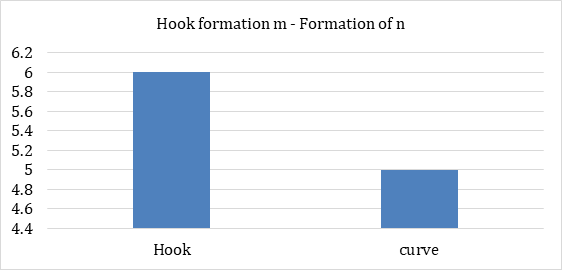
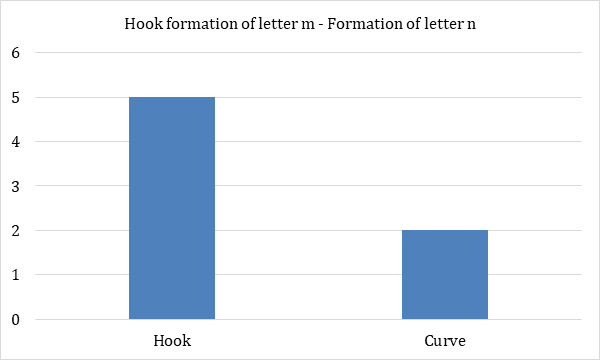
From figure 1 , it can be concluded that the subjects which were having Hook formation m, have mostly observed to have high rate of Hook formation in letter “n”, and less amount of Curve formation in letter“n” of thewriting.
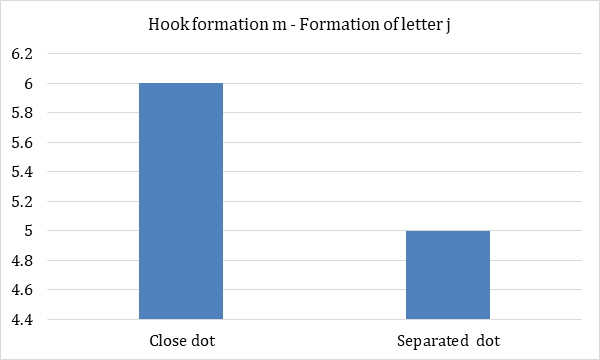
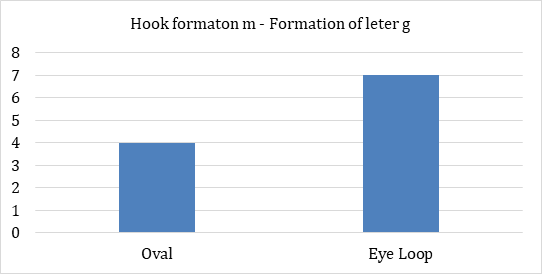
From figure 2, it can be concluded that the subjects which were having Hook formation m, have mostly observed to have high rate of Eye loop formation in the letter “g” and less amount of oval formation in letter “g”. From figure 3, it can be concluded that the subjects which were having Hook formation m, have mostly observed to have high rate of close dot in letter “j” and less amount of separated dot in the letter “j”.
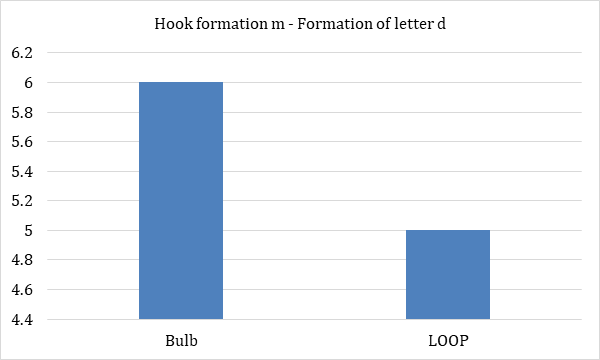
From the above figure 4, it can be concluded that the subjects which were having Hook formation m, have mostly observed to have high rate of Bulb formation in the letter “d” and less amount of loop formation in the letter “d”.
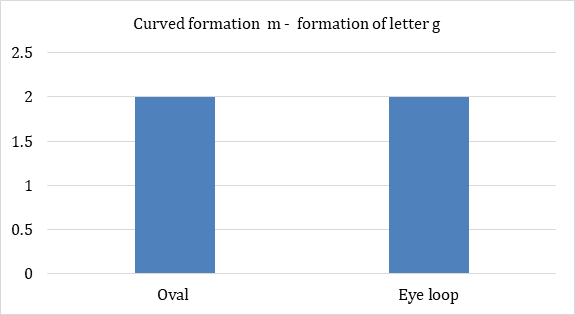
From figure 5, it can be concluded that the subjects which were having Curved formation “m”, have mostly observed to have equal rate of Oval and Eye loop formation in the letter “g”.
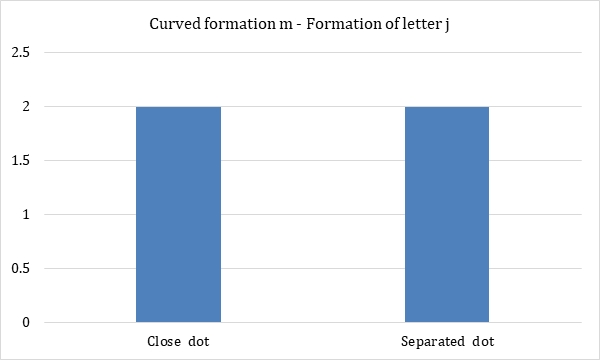
From figure 6, it can be concluded that the subjects which were having Curved formation “m”, have mostly observed to have equal rate of close dot and separated dot formation in the letter “j”.
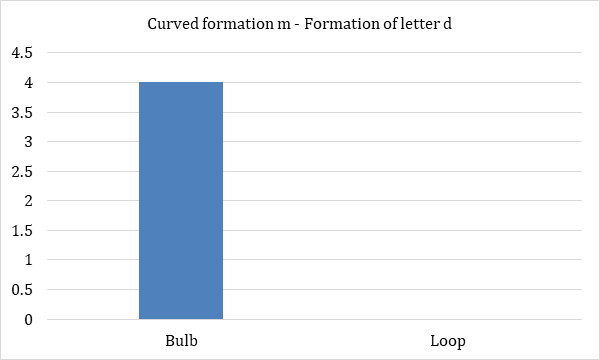
From figure 7, it can be concluded that the subjects who were having curved formation “m”, have mostly observed to have high rate of Bulb formation in the letter “d”.
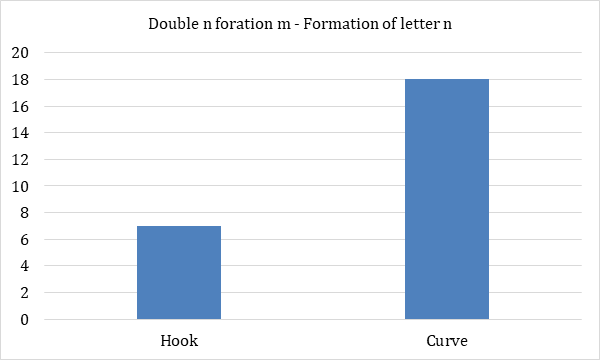
From figure 8, it can be concluded that the subjects which were having Double m formation “m”, have mostly observed to have the high rate Curve formation in letter ”n”, and less rate of Hook formation in letter “n”.
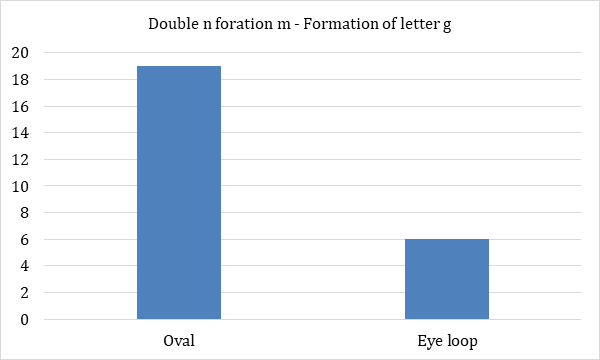
From figure 9, it can be concluded that the subjects which were having Double m formation “m”, have mostly observed to have the high rate of Oval formation in letter “g”, and less rate of eye loop in the letter “g”.
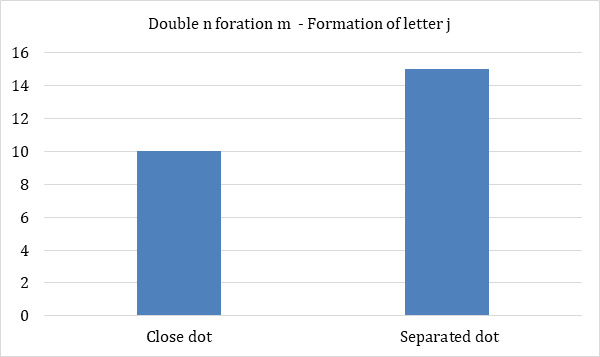
From figure 10, it can be concluded that the subjects which were having Double m formation “m”, have mostly observed to have the high rate of separated dot in the letter “j”, and moderate rate of Close dot in letter “j”.
From figure 11, it can be concluded that the subjects which were having Double m formation “m”, have mostly observed to have the high rate of Bulb formation in letter “d”, and less rate of loop formation in the letter “d”
Graph representation for the individual characteristics of non-lifter’s sample
From figure 12, it can be concluded that the subjects which were having Hook formation “m”, have mostly observed to have the high rate of Hook formation in the letter “n”, and less rate of Curve formation in letter “n”.
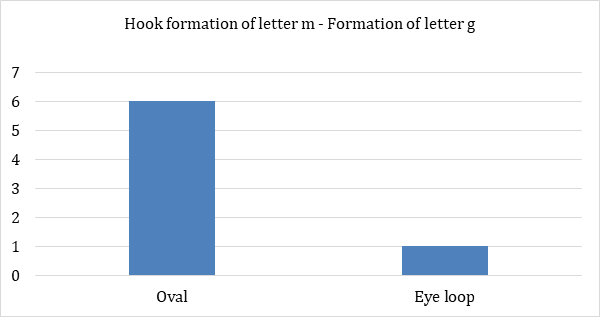
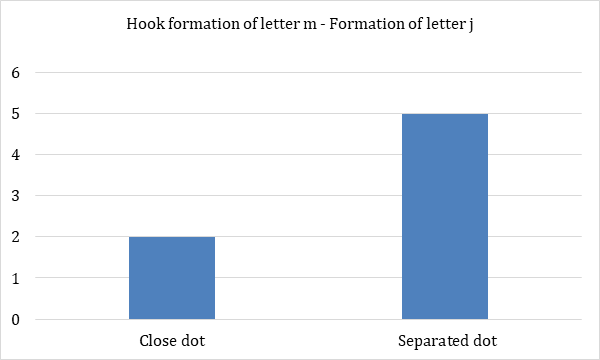
From figure 13, it can be concluded that the subjects which were having Hook formation “m”, have mostly observed to have high rate of Oval formation in letter “g”, and less rate of Eye loop formation in letter “g”. From figure 14, it can be concluded that the subjects which were having Hook formation “m”, have mostly observed to have the high rate of Separated dot formation in the letter “j”, and less rate of Close dot rate formation in the letter “j”.
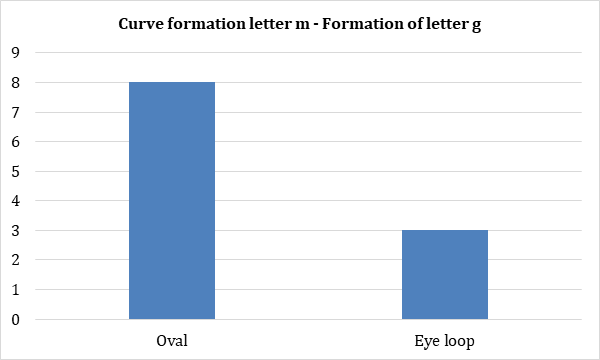
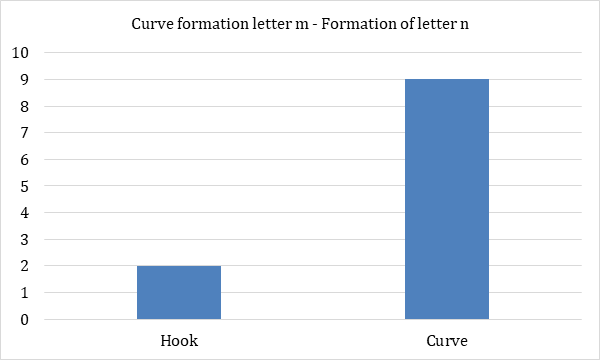
From figure 15, it can be concluded that the subjects which were having Curve formation “m”, have mostly observed to have high rate of Curve formation in the letter “n”, and less rate of Hook formation in the letter “n”. From figure 16, it can be concluded that the subjects which were having Curved formation “m”, have mostly observed to have high rate of Oval formation in the letter “g”, and less rate of Eye loop formation in the letter “g”.
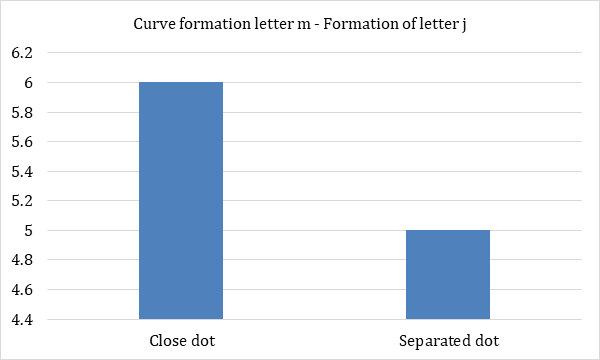
From figure 17, it can be concluded that the subjects which were having Curved formation “m”, have mostly observed to high rate of Close dot formation in the letter “j”, and less rate of Separated dot formation in letter “j” From figure 18, it can be concluded that the subjects which were having Double m formation in “m”, have mostly observed to have high rate of Curve formation in the letter “n”, and less rate of Hook Formation in the letter “n”.
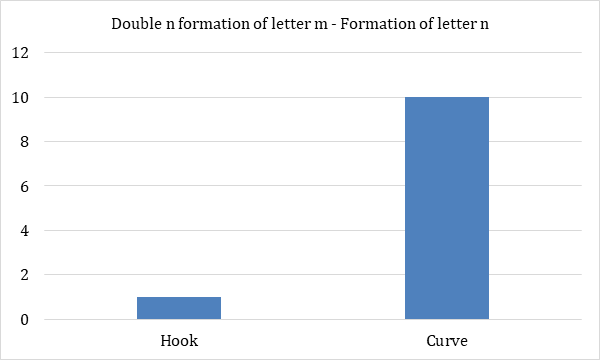
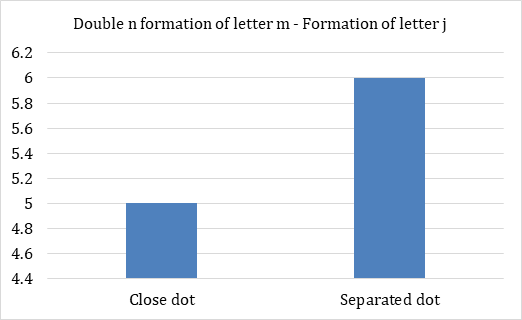
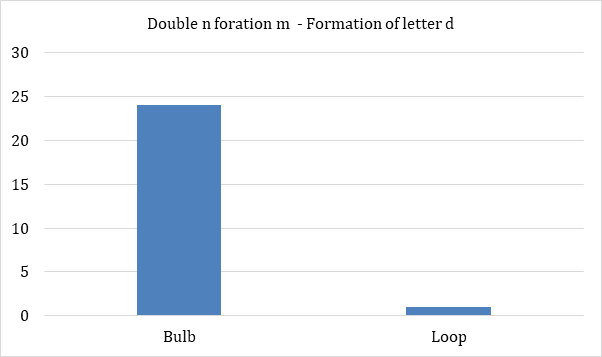
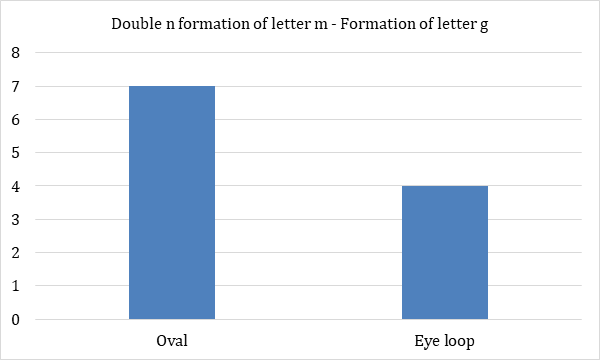
From figure 19, it can be concluded that the subjects which were having Double m formation in “m”, have mostly observed to have high rate of Oval formation in letter “g”, and less rate of Eye loop formation in the letter “g”. From figure 20, it can be concluded that the subjects which were having Double m formation in “m”, have mostly observed to have high rate of Separated dot formation in the letter “j”, and less rate of Close dot formation in the letter “j”.
Conclusion
The present study was conducted to assess variation in handwriting characteristics among the weight lifters and the non-lifters. There was a significant variation in both macro- and micro- features of handwriting with respect to muscle stiffness of the writer. Significant differences among lifter groups were observed for pen lift, alignment, spacing, slant and shading in the lifters handwriting. The study provides crucial insight on the muscle stiffness related variation (an extrinsic parameter) upon handwriting characteristics. The present study has immense significance in forensic research as it can aid to examine and assess physic of the writer from handwritten document. Further it can serve as corroborating evidence aiding in authorship determination in questioned document examination. In the research we concluded that the:- • Majority of the weight lifters were having the vertical slant in their handwriting as compared to the non- lifters.
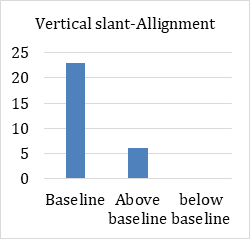
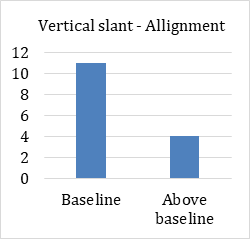
• Majority of the weight-lifters were having the baseline alignment with vertical slant, a few with having above base line alignment as compared to the non-lifters.
• From Figure 21 Majority of weight lifters were having pen lifts after every word i.e. they have cursive handwriting which in comparison to non-lifters is in high rate.
Individual characteristics
• Majority of the weight lifters were having the double n formation in their Letter “m”, as compared to the non- lifters they have curved formation in their letter “m”.
References
-
Raju P, Ramesh SV, Arvind H, George R, Baskaran M, et al. (2004) Prevalence of Refractive Errors in a Rural South Indian Population. Invest Ophthalmol Vis Sci 45(12): 4268-4272.
-
Maadeed SA, Hassaine A (2014) Automatic Prediction of Age, Gender, and Nationality in Offline Handwriting. EURASIP Journal on Image and Video Processing 1: 1-10.
-
Dandona R, Dandona L, Naduvilath TJ, Srinivas M, McCarty CA, et al. (1999) Refractive Errors in an Urban Population in Southern India: The Andhra Pradesh Eye Disease Study. Invest Ophthalmol Vis Sci 40(12): 2810- [INLINE_FIGURE:14:2] [INLINE_FIGURE:14:3] 2818.
-
Almeida PHTQD, Cruz DMCD, Magna LA, Ferrigno ISV (2013) Anelectromyography Analysis of Two Handwriting Grasp Patterns. J Electromyogr Kinesiol 23(4): 838-843.
-
Hilton O (1992) Scientific Examination of Questioned Documents. 1st (Edn.), CRC Press LLC, pp: 448.
-
Koziatek SM, Powell NJ (2003) Pencil Grips, Legibility, and Speed of Fourth-Graders’ Writing in Cursive. Am J Occup Ther 57(3): 284-288.
-
Population (2004) IOVS.
-
Schwellnus H, Carnahan H, Kushki A, Polatajko H, Missiuna C, et al. (2012) Effect of Pencil Grasp on the Speed and Legibility of Handwriting in Children. Am J Occup Ther 66(6): 718-726.
-
Singh KS (1996) People of India: Delhi. Anthropological Survey of India, pp: 746.
-
Feder, Majnemer (2007) Handwriting Development, Competency, and Intervention. Dev Med Child Neurol 49(4): 312-317.
-
Julius MS, Meir R, Shechter-Nissim Z, Adi-Japha E (2016) Children’s Ability to Learn a Motor Skill is related to Handwriting and Reading Proficiency. Learning and Individual Differences 51: 265-272.
-
Deviterne-Lapeyre M, Ibrahim S (2023) Interpol Questioned Documents Review 2019-2022. Forensic Sci Int Synerg 6: 100300.
- Reassessing Baldus Study Data
- Suicide and the Emotions of Men and Women in Uniform
- The Need to Teach Research Methods to Criminal Justice Students
- Combating Cyber VAT Fraud in the EU Member States: A Comparative Study of Criminal and Criminal Procedure Law
- Cyber VAT Fraud in the EU: A Criminological Analysis
- Advancing Compassionate Justice: Redefining Victim and Offender Rights in Victimology and Penology