
Metric Deviations between Genuine and Forged Signatures: A Mathematical Approach
Background: In the present study, a metric approach has been made to distinguish between genuine and forged signatures. Certain fixed points were selected and the range of variability between 14 different parameters was calculated. Our study provides mathematics-based corroborative evidence to support the opinion of Forensic Document Examiners. Methodology: For sample collection the samples were obtained in two different sets, in set 1 subject was guided to provide their genuine signature in a continuous running hand fashion and, in set 2, two individuals consisting of a male and a female were asked to forge the sample first by un-practiced hand and then later by the practiced hand i.e. after having practiced and then forge the sample, this exercise was also performed by 50 subjects. Therefore, 500 genuine signatures of 50 subjects were taken, each subject providing 10 samples of their original writing to understand the natural variation, master pattern and range of variability and 200 samples by forging the signature; 100 samples by male subjects and 100 samples by females; inclusive of both practiced and unpractised samples and allotted them a manually calculated mathematical value. This exercise was done for every sample. All the samples belonged to the age range of 20-25 years. Results: The study developed a scientific and reliable method to compare the practiced signature of the individual using a statistical metric deviation-based method. Conclusion: The conclusion showed that forged signatures fail to lie within the limits of the variability of the mathematical parameters taken.
Introduction
Signature identification is a process that involves comparing and analysing the unique characteristics of a person’s signature to determine its authenticity, where both class characteristics and individual characteristics are considered [1, 2]. Various characteristics of a signature, such as slant, movement, loops, alignment, t-crossing, spacing, strokes, skill, and other distinguishing features, are examined by document experts [2]. Handwritten signatures are widely used for personal verification and authentication in legal and financial transactions. However, the rise of fraud has made signature authentication more important. Confirming the authenticity of signatures is crucial in processes like account openings, property-related matters, and other transactional disputes [2, 3]. Individuals are generally more willing to have their signatures verified compared to other authentication systems. Handwritten signatures are the results of a combination of factors such as muscular control, coordination, health, age, and frequency of writing [4]. They can be classified into formal signatures (used for important documents), informal signatures (used for routine correspondence), and careless scribbles (used for credit cards, autographs, etc.) [5, 6]. An authentic signature is consistent with the natural conditions surrounding the signed document and reflects the writer’s lack of attention to the writing process [7]. It is written rapidly [8], has rhythm (when written by an experienced writer with good health), may miss certain details, and has a smooth and natural appearance [5, 8]. The handwritten signature serves as a means of identity verification in various aspects of daily life, but the visual inspection of signatures is often done casually [3, 8]. Therefore, the development of a metric system that can mathematically support the opinion of forensic document examiners is important to understand the natural variation being observed in one individual based on the variability of parameters like distances, angles between fixed points and various other meaningful mathematical parameters. Hence, in this present study, this metric approach has been made to compute the natural variation and calculate the range of variability between distance and angles between the fixed points due to natural variations, manually. Results show that forged signatures fail to lie within the limits of variability of these parameters. The present study aims to provide mathematical assistance to the opinion of Forensic Document Examiners [9, 10, 11, 12].
Materials and Methods
For the present study, a total of 700 samples was obtained in two different sets as shown in Table 1 in set 1- a subject was guided to provide their genuine signature in a continuous running hand fashion and, in set 2- two subjects consisting a male and a female individual were asked to forge the sample 1st by un-practiced hand and then later by the practiced hand i.e. after having practiced.
| Sample Type | Number of Participants | Sample given by each Participant | Total Samples |
|---|---|---|---|
| Original or Genuine | 50 | 10 by each | 500 |
| Forged by un-practiced hand (U-PH) | 50 | 2 (1 by male, 1 by female of the original signature) | 100 |
| Forged by Practiced hand (After practising 10 times) | 50 | 2 (1 by male, 1 by female of the original signature) | 100 |
| Total Samples | 700 |
Table 1: Showcasing Methodology Adopted for the Sample Collection.
In this way a total of 50 subjects, students of Jhansi city between the age group of 20-25 years were asked to provide their signature samples. The process that each student followed is to give their signature 10 times in a continuous running hand fashion. Hence, we obtained 10 such samples of signatures from each student to verify the natural variation in mathematical metric format for 14 different parameters and allotted them a calculated mathematical value for 500 such signatures. And, in the 2nd set 50 groups of each student, each having a male and a female writer to provide 1st an un-practiced sample of signature followed by practiced signature sample [13, 14].
The fourteen parameters that were studied namely:
- Length of the whole Signature,
- Width of the whole signature,
- Angle of highest point from Initial Point,
- Angle of highest point from Terminal point,
- Angle of mid-point from Initial Point,
- Angle of mid-point from Terminal Point,
- Distance between initial and terminal point,
- Distance between Highest and Lowest point,
- Distance between initial to the highest point,
- Distance between Terminal to the highest point,
- Distance between Initial to the lowest point,
- Distance between Terminal to the lowest point,
- Distance between Mid to Highest point, and
- Distance between Mid to Lowest point.
A signature sample is marked by coloured pencils by taking certain fixed points. A midpoint was taken between the initial and terminal points of stroke. All these points and their distances were then measured with the help of scale and the angles with the help of a protector [15, 16, 17, 18, 19, 20].
Step I: Sample Collection
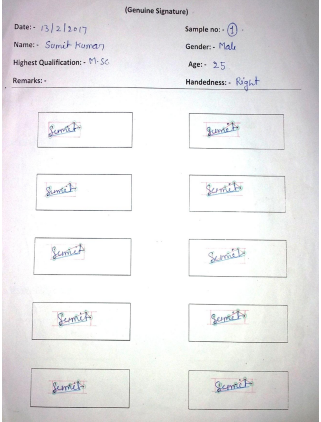
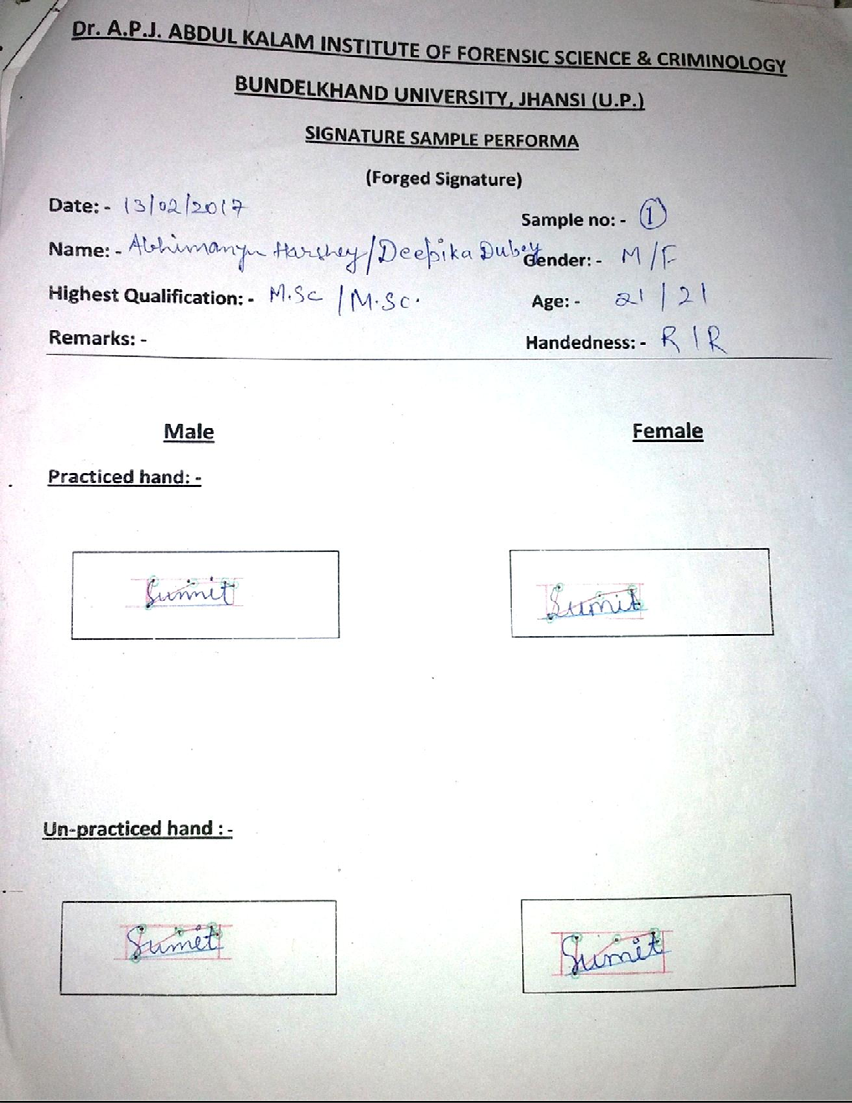
Samples were collected in the Performa shown in Figure 1 (for genuine signature samples) and Figure 2 (for forged signature samples).
Step II: Feature Extraction
Feature Extraction Performa shown in Figure 3 (Length & Width of the sample) and Figure 4 (Initial & Terminal points).
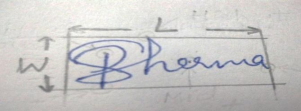
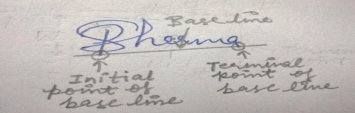
The way of marking the samples with the help of pencil colours is as follows: Step 1: Marking a fixed point in the signature with the help of a green pencil colour. Step 2: Joining of fixed points with the help of a red pencil colour using scale. Step 3: Marking a baseline for the whole signature with the help of blue pencil colour using scale. Step 4: Marking the area presenting the length and width of the whole signature using a red pencil colour by scale.
Step III: Noting Observations
The frequency distribution and percentage of each feature was calculated in the signature samples.
Step IV: Comparison
The samples of signatures were then compared based on observed differentiating features to determine the range of variability among 14 different parameters of a sample. The metric deviation of the features was then calculated manually.
Observations
The frequency distribution and percentage of each feature were observed in the practiced and un-practiced hand-forged signature samples.
Comparison
The samples of practiced hand and un-practiced hand forged signatures were compared based on observed differentiating features to determine the range of variability between the distances and angles of the practiced and un- practiced hand forged signatures. The metric deviations of the features were calculated manually [21, 22, 23, 24, 25].
Results
The results have been divided into two parts:
- Analysis of practiced hand-forged signatures
- Analysis of un-practiced hand-forged signatures.
Table 2 represents frequency and percentage of observed characteristics where forged signatures by practiced hand failed to meet the metric variability criteria of genuine signatures. The most distinguishing feature was found to be the angle of highest point from the terminal point of baseline with a frequency percentage of 68%, followed by the length of signature, width of signature, distance between initial point to the terminal point of stroke, distance between terminal point to highest point, angle of highest point from initial point of baseline, angle of midpoint from terminal point of baseline, distance between terminal to lowest point, distance between highest to lowest point, distance between midpoint to lowest point each with a percentage of 64%, 64%, 64%, 62% a 60%, 54%, 54%, 52% and 52% respectively [26, 27].
| S. No. | Features | Frequency (50 samples) | Frequency in % (50 samples) |
|---|---|---|---|
| 1 | Angle of highest point from terminal point of base line | 34 | 68% |
| 2 | Length of whole signature | 32 | 64% |
| 3 | Width of whole signature | 32 | 64% |
| 4 | Distance between initial to terminal point of stroke | 32 | 64% |
| 5 | Distance between terminal point to highest point | 31 | 62% |
| 6 | Angle of highest point from initial point of base line | 30 | 60% |
| 7 | Angle of midpoint from terminal point of base line | 27 | 54% |
| 8 | Distance between terminal to lowest point | 27 | 54% |
| 9 | Distance between highest point to lowest point | 26 | 52% |
| 10 | Distance between midpoint to lowest point | 26 | 52% |
| 11 | Angle of midpoint from initial point of base line | 23 | 46% |
| 12 | Distance between initial to lowest point | 23 | 46% |
| 13 | Distance between initial to highest point | 22 | 44% |
| 14 | Distance between midpoint to highest point | 18 | 36% |
Table 2: Frequency and Frequency Percentage of forged samples by Practiced hand (10 times).
The feature that was found to be proof of forgery was the distance between midpoint to highest point with a distinction percentage of 36%, followed by the distance between the initial to highest point, angle of midpoint from initial point of baseline and distance between initial to lowest point with a distinction percentage of 44%, 46% and 46% respectively as shown in Figure 5 (Based on the data mentioned in Table-2) [28].
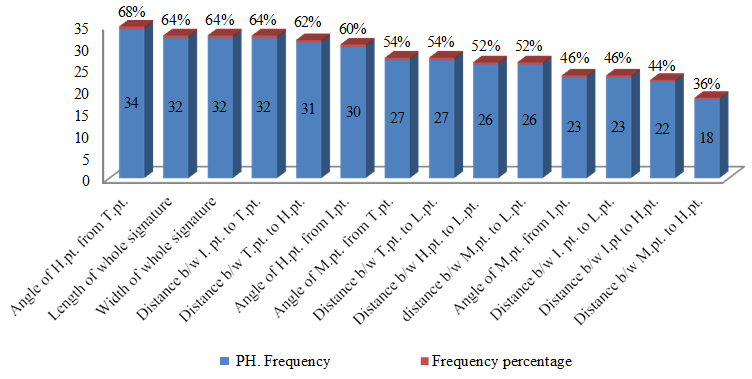
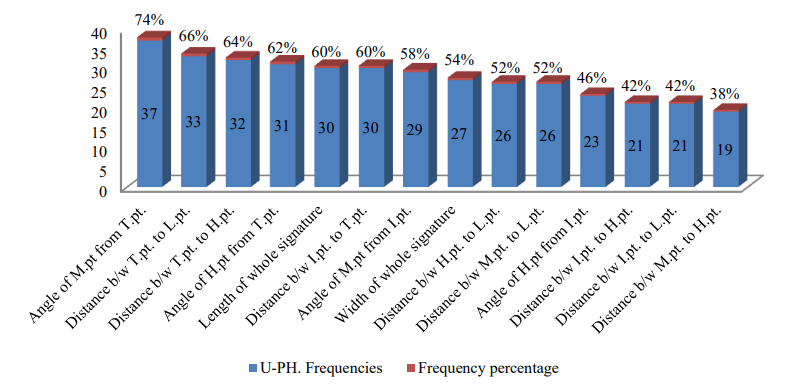
Table 3 shows the frequency and frequency percentage of those observed characteristics in which forged signatures by un-practiced hand failed to fulfil the different metric variability criteria of a genuine signature. The most distinguishing feature was found to be angle of midpoint from terminal point of baseline with a frequency percentage of 74%, followed by the distance between terminal to lowest point, distance between terminal to highest point, angle of highest point from terminal point of the base line, length of whole signature, distance between initial point to terminal point of stroke, angle of midpoint from initial point of baseline, width of whole signature, distance between highest to lowest point and distance between midpoint to lowest point each with a frequency percentage of 66%, 64%, 64%, 62%, 60%, 60%, 58%, 54%, 52% and 52% respectively [29, 30].
| S. No. | Features | Frequency (50 samples) | Frequency % (50 samples) |
|---|---|---|---|
| 1 | Angle of midpoint from terminal point of base line | 37 | 74% |
| 2 | Distance between terminal to lowest point | 33 | 66% |
| 3 | Distance between terminal to highest point | 32 | 64% |
| 4 | Angle of highest point from terminal point of base line | 31 | 62% |
| 5 | Length of whole signature | 30 | 60% |
| 6 | Distance between initial to terminal point of stroke | 30 | 60% |
| 7 | Angle of midpoint from initial point of base line | 29 | 58% |
| 8 | Width of whole signature | 27 | 54% |
| 9 | Distance between highest to lowest point | 26 | 52% |
| 10 | Distance between midpoint to lowest point | 26 | 52% |
| 11 | Angle of highest point from initial point of base line | 23 | 46% |
| 12 | Distance between initial to highest point | 21 | 42% |
| 13 | Distance between initial to lowest point | 21 | 42% |
| 14 | Distance between midpoint to highest point | 19 | 38% |
Table 3: Frequency and Frequency percentage of forged signature by un-practiced hand.
The feature that was found to be prove to forgery was distance between midpoint to highest point with a distinction percentage of 38%, followed by the distance between initial to highest point, distance between initial to lowest point and angle of highest point from initial point of base line with a distinction percentage of 42%, 42% and 46% respectively as shown in Figure 6, Based on the data mentioned in Table 3 [31].
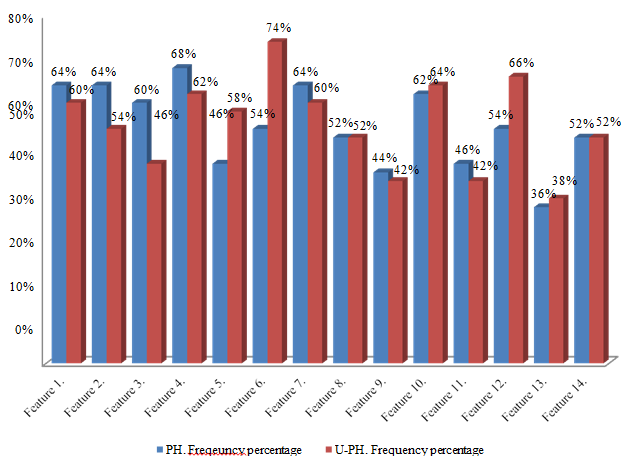
After, the individual examination of both practiced and un-practiced hand-forged offline signature samples. The practiced hand and un-practiced hand-forged samples were compared together. The comparative results of practiced and un-practiced hand-forged samples are shown in Table 4; it shows the comparison between the frequency and frequency percentage of observed distinguishing characteristics in which forged signatures by practiced and un-practiced hands failed to fulfil the different metric variability criteria of genuine signature.
| S. No. | Features | Frequency (50 samples) PH | Frequency percentage (50 samples) PH | Frequency (50 samples) U-PH | Frequency percentage (50 samples) U-PH |
|---|---|---|---|---|---|
| 1 | Length of whole signature | 32 | 64% | 30 | 60% |
| 2 | Width of whole signature | 32 | 64% | 27 | 54% |
| 3 | Angle of highest point from initial point of base line | 30 | 60% | 23 | 46% |
| 4 | Angle of highest point from terminal point of base line | 34 | 68% | 31 | 62% |
| 5 | Angle of midpoint from initial point of base line | 23 | 46% | 29 | 58% |
| 6 | Angle of midpoint from terminal point of base line | 27 | 54% | 37 | 74% |
| 7 | Distance between initial point to terminal point of stroke | 32 | 64% | 30 | 60% |
| 8 | Distance between highest point to lowest point | 26 | 52% | 26 | 52% |
| 9 | Distance between initial point to highest point | 22 | 44% | 21 | 42% |
| 10 | Distance between Terminal point to highest point | 31 | 62% | 32 | 64% |
| 11 | Distance between initial point to lowest point | 23 | 46% | 21 | 42% |
| 12 | Distance between terminal point to lowest point | 27 | 54% | 33 | 66% |
| 13 | Distance between midpoint to highest point | 18 | 36% | 19 | 38% |
| 14 | Distance between midpoint to lowest point | 26 | 52% | 26 | 52% |
Table 4: Frequency and frequency percentage of forged samples by practiced hand (PH) and un-practiced hand (U-PH).
Discussion
The present study was conducted to calculate the range of variation between distances and angles of the features of genuine and forged signatures, which was calculated manually. After evaluating the features, results showed that forged signatures fail to lie within the limits of variability of the parameter. The study emphasis was given to those features which were more differentiating in forged signatures by practiced hand and un-practiced hand forgery. Out of 14 features, the most differentiating results given by practiced hand forgery were: Angle of highest point from terminal point of base line, length of signature, width of signature, distance between initial point to terminal point of stroke, distance between terminal point to highest point and angle of highest point from initial point of base line with a relative percentage of 68%, 64%, 64%, 64% and 62% respectively as can be observed from Figure 7 [31].
Chauhan A, et al. [5] worked on the implementation of metric system in the credentials of disguised handwriting. They performed their research on the samples collected from the students of Amity University between the age group 16-20 years [5]. They used the metric system to identify the disguise writings and the original author of it, based on parameters which were fixed from line of the writing and consisted of length of the original writing as well as the disguised, breadth of the original signature as well as disguised, the angle of the signature from the line of writing that started from the below side of first letter as well as disguised and the formation of the middle letter was also measured. After taking all the measurements, the statistical analysis of both of signatures was calculated. For statistical analysis, SPSS software was used. By the statistical analysis, it was observed that the length of the original signature (µ=4.15) in comparison of disguise writing (µ=4.56) doesn’t have a significant difference. The breadth of the original signature (µ= 2.33) in comparison of the disguise signature (µ=2.33) also doesn’t differentiate them. A difference was noticed between the angle of the original signature and the disguise signatures from the starting point of line of writing as (ϴ=15.41 & 22). Although both the studies observed a different set of parameters (characteristics), the results were found to be consistent that forged signatures (both by practiced and un- practiced hand) fails to fall within the range of variability of genuine signatures [31].
Conclusion
The present study has been carried out to distinguish between genuine and forged signatures to calculate the range of variation between the features preferred for the purpose. To calculate the range of variation between the distances and angles of the features 50 genuine signature samples were randomly collected from Jhansi, Uttar Pradesh. And these genuine signatures were made to be forged by practiced hand and un-practiced hand. 14 features were studied for distances and angles for the calculation of range of variability. Then all practiced and un-practiced hand-forged signature samples are compared together and after comparison it has been concluded that:
By practiced hand angle of highest point from terminal point of baseline, length of signature, distance between initial point to terminal point of stroke, width of signature, angle of highest point from initial point of base line, distance between initial point to lowest point and distance between initial point to highest point with a percentage of 68%, 64%, 64%, 64%, 60%, 46% and 44% respectively. On the other hand, by un-practiced hand the percentage for same features are 62%, 60%, 60%, 54%, 46%, 42% and 42% respectively.
By un-practiced hand angle of midpoint from terminal point of baseline, distance between terminal point to lowest point, distance between terminal to highest point, angle of midpoint from initial point of baseline and distance between midpoint to highest point with a percentage of 74%, 66%, 64%, 58% and 38% respectively. On the other hand by practiced hand percentage for the same features are 54%, 54%, 62%, 46% and 36% respectively.
There are two features between practiced hand and un-practiced hand forged signature samples having same calculated value and percentage among 50 samples; the features are Distance between highest point to lowest point and distance between midpoint to lowest point with the same percentage of 52% and 52% respectively. Hence, the present study will provide mathematical assistance to the opinion of Forensic Document Examiners in the identification of genuine and forged signatures. The results of this study will prove to be helpful for various law enforcement agencies in distinguishing between genuine and forged signature samples.
References
-
Arora A, Choubey AS (2013) Comparative Analysis of Off-Line Signature Recognition. International Journal of Science and Research 2(7): 241-245.
-
Almehmadi A (2022) A Biometric‐Based Verification System for Handwritten Image‐based Signatures using Audio-to-Image Matching. IET Biometrics 11(2): 124- 140.
-
Desai B, Kalyan JL (2013) Signature Scrutiny System in Banking Application. International Journal of Science and Research 2(2): 114-117.
-
Bharadi VA, Kekre HB (2010) Off-Line Signature Recognition Systems. International Journal of Computer Applications 1(27): 48-56.
-
Chauhan A, Chauhan V (2016) A Study on the Implementation of the Metric System in the Credentials of Disguised Handwriting. International Journal of Research in Engineering and Applied Sciences 6(10): 115-124.
-
Garhawal S, Shukla N (2013) A Study on Handwritten Signature Verification Approaches. International Journal of Advanced Research in Computer Engineering & Technology 2(8): 2497-2503.
-
Kaur RM, Sharma AK, Sharma RK (2012) Off-line Signature Verification based on Hu’s Moment Invariants and Zone Features using Support Vector Machine. International Journal of Latest Trends in Engineering and Technology 1(3): 16-23.
-
Desai B, Kalyan JL (2013) Forensic Examination of Handwriting and Signatures. International Journal of Innovative Research & Development 2(5): 514-527.
-
Kumar P, Singh S, Garg A, Nishant Prabhat (2013) Hand Written Signature Recognition & Verification using Neural Network. International Journal of Advanced Research in Computer Science and Software Engineering Research Paper 3(3).
-
Misra VC, Agrawal N, Shukla SK (2016) A Study on the Rarest Case of Disguised Signatures in the form of Lateral Expansion. Res J Recent Sci 5(2): 51-55.
-
Ozgunduz E, Senturk T, Karsligil ME (2010) Off-line Signature Verification and Recognition by Support Vector Machine.
-
Osvaldo A, Raydonal O, Alejandro CF (2016) Classification and Verification of Handwritten Signatures with Time Causal Information Theory Quantifiers. PLoS One 11(12): e0166868.
-
Pandey V, Shantaiya S (2012) Signature Verification Using Morphological Features Based on Artificial Neural Network. International Journal of Advanced Research in Computer Science and Engineering 4(9): 1498-1504.
-
Radmehr M, Seyed MA, Nikpour M, Yaseri A (2011) Designing an Offline Method for Signature Recognition. World Applied Sciences Journal 13(3): 438-443.
-
Rantzsch H, Yang H, Christoph M (2016) Signature Embedding: Writer Independent Offline Signature Verification with Deep Metric Learning. Hasso-Plattner- Institute, University of Potsdam, Germany.
-
Sharma BR (2003) Forensic Science in Criminal Investigation and Trials. 4th (Edn.), Universal Law Publishing Co.
-
Thomas G, Gregory F, Andre H, Barton AS, Jianying Hu, et al. (2004) Retail Applications of Signature Verification. Proceedings of the SPIE 5404: 206-214.
-
Gabe A, Blue S, Morgan B (2016) Offline Signature Verification with Convolutional Neural Networks.
-
Nam S, Park H, Seo C, Choi D (2018) Forged Signature Distinction Using Convolutional Neural Network for Feature Extraction. Appl Sci 8(2): 153.
-
Bhunia AK, Alaei A, Roy PP (2019) Signature Verification Approach using the Fusion of Hybrid Texture Features. Neural Computing and Applications 31: 8737-8748.
-
Falk TH, Tam C, Schellnus H, Chau T (2011) On the Development of a Computer-based Handwriting Assessment Tool to Objectively Quantify Handwriting Proficiency in Children. Comput Methods Programs Biomed 104(3): e102-e111.
-
Padua RN, Barrera DJ, Arabis RO (2013) Fractal Similarity Index for Forensic Handwriting Analysis. PRISM 18(1): 1-10.
-
Vielhauer C, Steinmetz R (2004) Handwriting: Feature Correlation Analysis for Biometric Hashes. EURASIP Journal on Advances in Signal Processing 4: 542-558.
-
Srihari S, Huang C, Srinivasan H (2008) On the Discriminability of the Handwriting of Twins. Journal of Forensic Sciences 53(2): 430-446.
-
Thomas MW, Rajan SK (2019) Genuine Handwriting Variations in 10 years: A Pilot Study. Egyptian Journal of Forensic Sciences 9: 49.
-
Pervouchine V, Leedham G (2007) Extraction and Analysis of Forensic Document Examiner Features used for Writer Identification. Pattern Recognition 40(3): 1004-1013.
-
Wydra J, Matuszewski S (2022) Likelihood Ratio to Evaluate Handwriting Evidence Using Similarity Index. Law, Probability and Risk 21(1): 21-42.
-
Roy P, Bag S (2022) Ink Analysis based Forensic Investigation of Handwritten Legal Documents. Multimedia Tools and Applications 81(16): 23007- 23047.
-
Srihari SN, Ball GR (2008) Writer Verification of Arabic Handwriting. The Eighth IAPR International Workshop on Document Analysis Systems, IEEE, pp: 28-34.
-
Agius A, Jones K, Epple R, Morelato M, Moret S, et al. (2017) The Use of Handwriting Examinations Beyond the Traditional Court Purpose. Science & Justice 57(5): 394-400.
-
Marcinowski M (2022) Top Interpretable Neural Network for Handwriting Identification. Journal of Forensic Sciences 67(3): 1140-1148.
- Reassessing Baldus Study Data
- Suicide and the Emotions of Men and Women in Uniform
- The Need to Teach Research Methods to Criminal Justice Students
- Combating Cyber VAT Fraud in the EU Member States: A Comparative Study of Criminal and Criminal Procedure Law
- Cyber VAT Fraud in the EU: A Criminological Analysis
- Advancing Compassionate Justice: Redefining Victim and Offender Rights in Victimology and Penology