
Rationale behind Juvenile Delinquency in State of Uttar Pradesh in India: An Investigative Study
Juvenile’s rate of involving in crime has drastically increased during last few decades around the world. Inclination of children towards crime is due to many possible reasons such as family background, psychology, society, money, power and miscellaneous petty reasons. Indian criminal justice system is that which usually take action when any offence happened and will wait to happen even if they know about the post crime consequences. Today’s children are the future of tomorrow therefore efforts should be made to amend them from indulging in crime. The current study has been conducted in line to investigate the possible causes of juvenile delinquency and the most prevalent type of crimes among the juveniles of Uttar Pradesh region. Data was collected in year 2020-21 during COVID times from 61 juvenile subjects who either completed their punishments or through RTI. The study was assessed for involvement of juveniles in crime on the basis of gender ratio, age, education status, nuclear or joint family, alcoholism smoking habits, caste, religion, financial status, type of crime etc. The study outcomes reflected that large number of male is involved in crimes than females with maximum count from rural areas than urban places. Hindu’s are more in number than any other religion like Muslims, Sikhs or Christians. Teenagers from Rajput, Baniya, Jaat community juveniles are more indulged than a Scheduled Caste or other backward classes.
Introduction
Juvenile delinquency is one of the most serious problems of this age, India is the home of 1.37 billion people [1]. Children in this era love extravagance, they have awful habits, disdain for power, and show slight for seniors [2]. The act of violation done by any child under the age of 18 is called juvenile delinquency as per Juvenile Justice Act 2000. This act was amended in 2015 named as by Juvenile Justice (JJ) (Care and Protection of Children) Act, 2015. When any child under the age of 18 is involved in a crime; the procedure is different from the adult offenders. Juvenile word is first used in JJ Act 1986 and there are sections which define the different definition of juvenile. According to NCRB total cases reported in 2012 is 27,936 and it increases 31,725 in 2013 and in 2014 it were 33,526. It is increasing day by day, out of 100 only 3.5 percent children are homeless so others are from well families. It is only a myth that the entire criminals are from poor background. Talking about sexual assault cases of rape cases in 2003, the number was only 466 for registered but in a decade it increased to 1737. Numerous types of crimes are there in which the children are involved such as gambling, pick pocketing, stealing, drugs trafficking, sexual assalts etc. Juvenile delinquency and forensic science intersect in several critical ways [3, 4, 5]. Understanding the nature of juvenile delinquency, the factors contributing to it, and the application of forensic science in investigating and preventing these activities is essential. Therefore, the present research study was an attempt to investigate or evaluate the causes for juveniles those who get involved in crime in one of the largest state of India, Uttar Pradesh [6, 7].
Material and Methodology
In order to conduct the study on various different factors of Juveniles indulged in crime in U.P state; the data was collected form total 61 subjects less than the age of 18 years. Although from RTI and local information from different localities 126 juveniles were identified and contacted from different region of Uttar Pradesh but only 61 were convinced for the study as subjects (Table 1). Descriptive type of study was conducted in the form of verbal interview. A common questionnaire was prepared in advance by the interviewer for inquiring the subject. The juveniles and their parents were informed about the study in advance and mostly parents were made ready to interview their child on a condition not to disclose their child names in study publishing. UP is the largest state of India, it also present in north. It is the most populated area with 75 districts and 18 divisions. The data of juvenile delinquency were collected from Luck now, Muzzafarpur, Bulandshahar, Kanpur, Meerut, Dorala and Baghpat of U.P. state. The data collected from the delinquent juveniles was interpreted on the basis of various factors such as gender ratio, age, religion, caste, type of family, area of living, interaction with parents, financial status, education status, type of offence in which involved, parents attitude before crime, alcoholism, smoking habits and time spent with whom before crime [8].
Results and Discussion
The result of study interpreted from data collected from total sixty one juveniles. The data was collected by verbal interview from different regions of Uttar Pradesh. It has been observed that in total 61 subjects study, 57 were the males and 4 were the females that were involved in the crime. Males and females of less than 10 years of age were not reported for any crime. 15 Males were between the age of 11-15 years and 42 were in the age group of 16-18 years of age. One female in age group of 11-15 years and three females in age group of 16-18 years were involved in juvenile delinquency. So 93.4% of males where as 6.5% of females are indulged in crimes in different region of Uttar Pradesh (Table 1).
| S.No. | Age group | Gender | Total | % | |||
|---|---|---|---|---|---|---|---|
| Male % Female % | |||||||
| 1 | 6 – 10 | 0 | 0.00% | 0 | 0.00% | 0 | 0.00% |
| 2 | 11 – 15 | 15 | 93.75% | 1 | 6.25% | 16 | 26.23% |
| 3 | 16 -18 | 42 | 93.33% | 3 | 6.67% | 45 | 73.77% |
| Total | 57 | 93.44% | 4 | 6.56% | 61 | 100.00% |
Table 1: Showing the number of male and females juvenile delinquents of different age groups in U.P. State.
It is seen from the data that 90.1% juveniles came from rural background whereas 9.8% from the urban background (Table 2).
| Sr. no | Area of living | Number of respondent | Percentage |
|---|---|---|---|
| 1 | Rural | 55 | 90.16% |
| 2 | Urban | 6 | 9.83% |
| Total | 61 | 100.00% |
Table 2: showing the type of background from where the juveniles came in U.P. State.
Out of 61 subjects 53 with percentage of 86.88% were living as nuclear family and 8 with 13.1% were living as joint family (Table 3).
| Kind of family | Total | Percentage | |
|---|---|---|---|
| 1 | Nuclear | 53 | 86.88% |
| 2 | Joint family | 8 | 13.14% |
| Total | 61 | 100.00% | |
| Sr. no | Religion | No. of respondent | % |
| 1 | Hindu | 59 | 96.72% |
| 2 | Christian | 0 | 0.00% |
| 3 | Muslim | 2 | 3.27% |
| Total | 61 | 100.00% |
Table 3: showing the type of family in which juveniles were living in U.P. State.
The study further revealed that in sixty one subjects none of the female juvenile from Muslim religion was involved in any crime whereas all females were Hindu. So 96% Hindu juvenile delinquents both male and female were involved in crime whereas 3.2% Muslims were involved (Table 4).
On the basis of caste categories trend of Juvenile delinquency, the unreserved categories mostly, Jats, Rajputs and Brahmins were more in number with 73.7% followed by scheduled castes making 18.03% on the other hand backward or other backward class juvenile were least indulged in crime with 4.9% only (Table 5).
| Caste | No. of respondent | % | |
|---|---|---|---|
| 1 | Scheduled caste | 11 | 18.03% |
| 2 | Backward caste | 2 | 3.28% |
| 3 | Most backward caste | 3 | 4.91% |
| 4 | Unreserved | 45 | 73.77% |
| Total | 61 | 100.00% |
Table 4: showing the juveniles of different caste categories involved in crime in U.P. State.
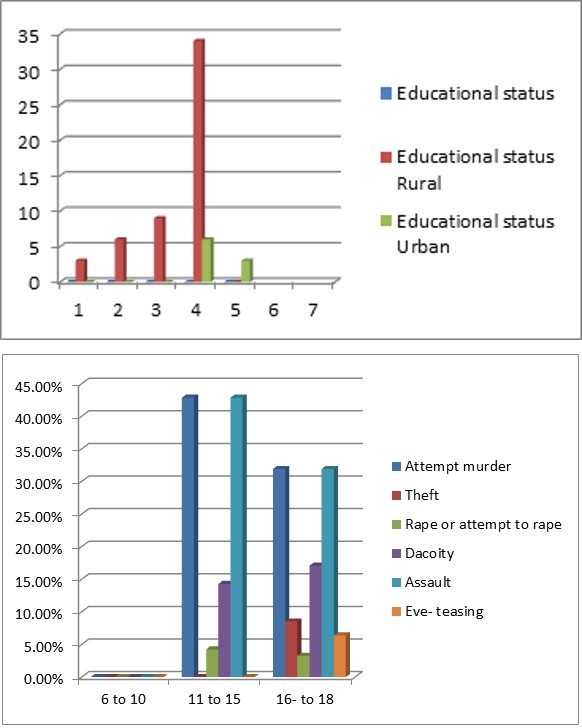
It has been observed that 40 Juveniles completed their education upto matriculation making 65.57 % followed by 14.75% and 9.83% finished secondary level and primary level education respectively. Juveniles completed matriculation and diploma holder belonged to urban regions only otherwise rest of them were from rural regions. Equal numbers of completely illiterate juveniles and diploma holder observed to be involved in crime making 4.9% (Table 6).
| Sr. No | Educational status | Place of Residence | Total | % | |||
|---|---|---|---|---|---|---|---|
| Rural Urban | |||||||
| 1 | Illiterate | 3 | 100.00% | 0 | 0.00% | 3 | 4.92% |
| 2 | Primary level | 6 | 100.00% | 0 | 0.00% | 6 | 9.83% |
| 3 | Secondary level | 9 | 100.00% | 0 | 0.00% | 9 | 14.75% |
| 4 | Matriculation level | 34 | 85% | 6 | 15% | 40 | 65.58% |
| 5 | Diploma/degree | 0 | 0 | 3 | 100 | 3 | 4.92% |
| Total | 52 | 85.25 | 9 | 14.75 | 61 | 100 |
Table 5: showing the education status of juveniles involved in crime in U.P. State.
No juvenile criminal has been reported for any crime from the age group of 6-10. Mostly, juveniles of age group 16-18 years are booked under attempt to murder charges and assault cases with 31.9% each followed by dacoity, theft and eve teasing with 17.08% , 8.51% and 6.3% respectively. Two juveniles from age group 16-18 years have been booked for rape charges with 3.2%. The subjects having age group of 11-15 years were 14 in number from total subjects and were framed in attempt to murder charges and assault cases equally making 42.85% each (Table 7).
| Sr. no | Age Group | Attempt murder | Nature of offence | Total | % | ||||||||||
|---|---|---|---|---|---|---|---|---|---|---|---|---|---|---|---|
| Theft | Rape or attempt to rape | Dacoity | Assault | Eve- teasing 0.00% | |||||||||||
| 1 | 10-Jun | 0 | 0.00% | 0 | 0.00% | 0 | 0.00% | 0 | 0.00% | 0 | 0.00% | 0 | 0.00% | 0 | 0.00% |
| 2 | 15-Nov | 6 | 42.85% | 0 | 0.00% | 0 | 4.25% | 2 | 14.28% | 6 | 42.85% | 0 | 0.00% | 14 | 22.95% |
| 3 | 16-18 | 15 | 31.91% | 4 | 8.51% | 2 | 3.27% | 8 | 17.08% | 15 | 31.91% | 3 | 6.38% | 47 | 77.04% |
| Total | 21 | 34.92% | 4 | 6.45% | 2 | 3.27% | 10 | 16.39% | 21 | 34.42% | 3 | 4.91% | 61 | 100.00% |
Table 6: showing age group of juveniles involved in different crimes in U.P. State.
On further investigation of data of juvenile delinquency in U.P. region, it has been noticed that murder or attempt to murder charges and assault cases involved higher number of subjects from considered to be higher community such as Jaat, Rajputs and Baniya’s followed by juveniles from SC/ST categories with least from BC/OBC castes (Table 8).
| Sr. no | Community | Murder/ | Theft | Rape/attempt rape | dacoity | Assault | Eve- teasing | Total & Percentage | |||||||
|---|---|---|---|---|---|---|---|---|---|---|---|---|---|---|---|
| attempt murder | |||||||||||||||
| 1 | SC/ST | 5 | 35.71% | 0 | 0.00% | 0 | 0.00% | 0 | 0.00% | 6 | 54.54% | 0 | 0.00% | 11 | 18.03% |
| 2 | BC | 1 | 50% | 0 | 0.00% | 0 | 0.00% | 1 | 50% | 0 | 0.00% | 0 | 0.00% | 2 | 3.27% |
| 3 | Other BC | 0 | 0.00% | 2 | 66.60% | 0 | 0.00% | 1 | 33.33% | 0 | 0.00% | 0 | 0.00% | 3 | 4.91% |
| 4 | Unreserved | 15 | 33.33% | 2 | 4.44% | 2 | 4.44% | 8 | 17.77% | 15 | 33.33% | 3 | 6.66% | 45 | 73.77% |
| Total | 21 | 34.42% | 4 | 6.51% | 2 | 3.27% | 10 | 16.39% | 21 | 34.42% | 3 | 4.91% | 61 | 100.00% |
Table 7: showing caste categories of juveniles involved in different types of crimes in U.P. State.
Most of the respondents (63.94%) came from the family where they were living with both parents. 29.5% and 4.92% were the juveniles that lived with single parent only either mother or father respectively. But 1.64% juveniles were having none of the parents alive (Table 9).
| Sr. no | Parents accessibility | Number of respondent | Percentage % |
|---|---|---|---|
| 1 | Single parents with mother | 18 | 29.50% |
| 2 | Single parents with father | 3 | 4.92% |
| 3 | Loss of both parents | 1 | 1.64% |
| 4 | Parents both alive | 39 | 63.94% |
| Total | 61 | 100.00% |
Table 8: showing the presence of parents in the lives of juvenile delinquents in U.P. State.
Furthermore, the study demonstrated that 8 juveniles (13.1%) belonged to rich class and 18 juveniles were from poor class (29.50%) while higher number of subjects was from middle class making total of 55.7% (Table 10).
| Sr. no | Parents monetary state | Number of respondent | % |
|---|---|---|---|
| 1 | Low class | 18 | 29.51% |
| 2 | Middle class | 34 | 55.73% |
| 3 | Rich or high class | 8 | 13.11% |
| 4 | Not applicable | 1 | 1.64% |
| Total | 61 | 100.00% |
Table 9: showing the socio economic status of juvenile delinquents family in U.P. State It has been observed from the study that
Table 10: showing the socio economic status of juvenile delinquents family in U.P. State It has been observed from the study that out of 48 subjects having alcohol drinking habit 13 were between the age group of 11-15 years and 35 were between the age group of 16-18 years. However, 13 subjects in total do not have drinking habit in both age groups from 11-15 years and 16- 18 years (Table 11).
| Sr. No | Age group | Drinking habits | Total | ||||
|---|---|---|---|---|---|---|---|
| Yes | No | ||||||
| 1 | 10-Jun | 0 | 0.00% | 0 | 0.00% | 0 | 0.00% |
| 2 | 11 – 15 | 13 | 81.25% | 3 | 18.75% | 16 | 26.22% |
| 3 | 16 -18 | 35 | 77.77% | 10 | 22.22% | 45 | 73.77% |
| Total | 48 | 78.88% | 13 | 21.31% | 61 | 100.00% | |
| Sr. no | Age | Smoking propensities | Total | ||||
| Yes | No | ||||||
| 1 | 10-Jun | 0 | 0.00% | 0 | 0.00% | 0 | 0.00% |
| 2 | 11 – 15 | 10 | 62.50% | 6 | 37.50% | 16 | 26.22% |
| 3 | 16 -18 | 32 | 71.11% | 13 | 28.88% | 45 | 73.77% |
| Total | 42 | 68.85% | 19 | 31.15% | 61 | 100.00% |
Table 10: showing the alcohol drinking habite of juvenile delinquents in U.P. State.
From the research data it has been observed that out of 42 subjects having the habit of smoking in which 32 from the age group of 16-18 years while 10 subjects were in the age group of 11-15 years. 19 subjects never smoked (Table 12).
It is seen that juveniles in age of 16-18 years were influenced or prompted by the friends more than the close family member or any relative with 53.3%, 13.3% and 6.6% relatively. On other hand, 12 subjects (26.6%) have not been influenced by anyone for indulging themselves in to the crime. Similarly, in age group of 11-15 years, friends were more responsible for persuade the subject in crime than the family member with 56.25% and 38.2% correspondingly. But no close relative or anyone urged them to jump into criminal acts (Table 13).
| Sr. no | Age | Person responsible for prompted to indulge in crime | Total | ||||||||
|---|---|---|---|---|---|---|---|---|---|---|---|
| Family members | Relative | Friends | No one | ||||||||
| 1 | 6 – 10 | 0 | 0.00% | 0 | 0.00% | 0 | 0.00% | 0 | 0.00% | 0 | 0.00% |
| 2 | 15- Nov | 5 | 38.25% | 0 | 0.00% | 9 | 56.25% | 2 | 12.50% | 16 | 26.23% |
| 3 | 16 - 18 | 6 | 13.33% | 3 | 6.66% | 24 | 53.33% | 12 | 26.66% | 45 | 73.77% |
| Total | 11 | 18.03% | 3 | 4.91% | 33 | 54.10% | 14 | 22.95% | 61 | 100.00% |
Table 11: showing the person involved in prompting juvenile delinquents to indulge in crime in U.P. State.
Data also suggested that forty nine percent of respondent complained that their parents behaved better than them with siblings, 34.42% admitted for similar attitudes of parents among the children and very less reported for worst behavior of parents with others than them with 3.2%. 13.1% subjects were not much bothered about the behavior of their parents towards them or other siblings (Table 14).
| Sr. no | Parents attitude towards sibling | Number of Respondent | Percentage |
|---|---|---|---|
| 1 | As like as same to me | 21 | 34.42% |
| 2 | Better than me | 30 | 49.18% |
| 3 | Worse than me | 2 | 3.27% |
| 4 | N/A | 8 | 13.11% |
| Total | 61 | 100.00% |
Table 12: showing behavior discrimination of parents among delinquent child and other siblings in U.P. State.
It has been interpreted from the whole study that delinquent behavior of children is more prevalent in Hindu males of higher castes such as Rajputs, Brahmins, Jaat etc. than other religions and castes (BC/OBC/SC)I in Uttar Pradesh state. Females involved in crime were very less and these too belonged to Hindu religion. Most of the respondents came from rural areas with nuclear family system. Interestingly, is has been observed that majorly the respondents finished their matriculation studies. Very few were their which had undergone senior secondary education or diplomas [9].
Maximum tendency of juveniles were seen in attempt to murder and assault cases. Less was reported in sexual assault cases that too between that age of group 16-18 years. Eve
teasing crime was also committed by them but was between the age group of 11-15 years. It is seen that though most of the juveniles had both parents alive but some juveniles lost their father. When financial status of delinquent juvenile families was evaluated most of them came from middle class families and low class families than upper or rich class. Surprisingly, a common habit of alcoholism was seen in the age group of males from 11-15 years and 16-18 years. Very less percentage was there among delinquents which not even tasted the alcohol. Smoking habits were also noted in both age group in good percentage of delinquents children. Only 31% delinquent children had not started smoking or were smoking. National Crime Records Bureau (NCRB) data indicated that there is an increase in crimes committed by juveniles, especially by those in the 16-18 years’ age group. NCRB data given below shows the trends of juvenile offences. Another, interesting information which was derived from the data was friend of similar age group prompted them to get involved into the criminal activities. But surprisingly close family member and relative were also responsible for the same. It has already been reported that juveniles develop delinquent tendencies if given opportunities or provoked to do so if they are available in their surroundings. The youth may become criminals if they have opportunities to learn illegal activities3. As per information from delinquent children, most of them thought their parents attitude towards them has propelled them to spend more time with friends or close family members where they can share their opinions, views or thoughts. In maximum cases, they thought their parents love and care more their other sibling than them. But very few noted the similar balanced behavior of parents among all the siblings. Negligible number of children think that others siblings are treated worsen than them Johnson [10].
Conclusion
It has been concluded from the whole study that there are various factors that are involved in delinquent behavior of the children in Uttar Pradesh state. Loss of father, low financial status, superiority of caste, negligence of parents towards their children leads to indulgence of children in alcohol drinking and smoking habits. Sometimes, mistreatment of parents with children does not allow them to become friendly and compels them to share their feelings and emotions with some outsider. This communication gap may lead them to criminal behavior and criminal acts. It is worth mentioning here that although Juvenile Justice Act 2016 is keeping a progressive pace with changing and challenging trends among the juvenile crime however, strong implementation of counseling of juveniles inside the rehabilitation centers and provision of educating then towards society, self- control, gender equality, their responsibilities towards state and country will help them to support their life after the punishments. At the end, whole society needs to understand the reasons of delinquent behaviors of a child and help the individual in sustaining the post punishment life.
References
-
Agarwal D (2017) Juvenile delinquency in India-Latest trends and entailing amendments in Juvenile Justice Act. People: International Journal of Social Sciences 3(3): 1365-1383.
-
Aaron L, Dallaire DH (2009) Parental incarceration and multiple risk experiences: Effects on family dynamics and children’s delinquency. Journal of youth and adolescence 39(12): 1471-1484.
-
Kaur K, Sharma T, Kaur R (2020) Development of submerged latent fingerprints on non-porous substrates with activated charcoal based small partical reagant. Indian Journal of Forensic Medicine & Toxicology 14(3): 388-394.
-
Kaur R, Sharma RK, Goswami M, Verma P (2017) Study demonstrating pattern of suicidal poisoning deaths in Shaheed Bhagat Singh Nagar (Nawanshahar) of Punjab. International Journal of Medical Toxicology & Legal Medicine 20(3): 61-67.
-
Singh GK, Kaur R (2022) Forensic examination of vermilion (Sindoor) sample using ATR-FTIR spectroscopy. Materials Today: Proceedings 68: 664- 668.
-
Cloward R, Ohlin L (1960) Delinquency and Opportunity. NY: Free Press cf Agarwal D. Juvenile delinquency in India-latest trends and entailing amendments in Juvenile Justice Act. People: International Journal of Social Sciences 3(3): 1365-1383.
-
Kumar A (1984) Causes of Juvenile Delinquency: A Study.
-
Kumar A (1983) Causes of Juvenile Delinquency: A Study.
-
Binder A, Geis G, Bruce DD (2001) Juvenile Delinquency: Historical, Cultural & Legal Perspectives. Routledge.
-
Johnson R (1989) Family structure and delinquency: general patterns and gender differences. 3 (Edn.) New Delhi: Criminology.
- Reassessing Baldus Study Data
- Suicide and the Emotions of Men and Women in Uniform
- The Need to Teach Research Methods to Criminal Justice Students
- Combating Cyber VAT Fraud in the EU Member States: A Comparative Study of Criminal and Criminal Procedure Law
- Cyber VAT Fraud in the EU: A Criminological Analysis
- Advancing Compassionate Justice: Redefining Victim and Offender Rights in Victimology and Penology