
The Relative-Age Effect in Male Japanese Football: A Cross-Sectional Analysis from Youth to Senior Competitive Level
The objective of this study was to examine the magnitude and persistence of the Relative-Age Effect (RAE) in competitive Japanese youth and senior football. A cross-sectional analysis of birthdate distributions of Japanese male youth academy football players (n= 4,488) from the U12 (n=268), U13 (n=481), U14 (n=464), U15 (n=483), U18 (n=1059) and professional players (n=1733) in the 2022 season was conducted. Chi-square goodness of fit tests and Cramer’s V tests were carried out to reveal the incidence and effect size of the RAE across the age categories. A significant RAE (P< .001) was found. It became more pronounced with age, peaking in the U18 age group (Cramer's V= 0.436; Q1/Q4 OR 6.04) before declining in senior professional players (Cramer's V= 0.204; Q1/Q4 OR=2.23). The organisation of youth competition in Japan, with a transition from annual age groups up to U15 to the U18 age group representing three years (U16, U17, and U18) appears to increase the selection bias towards early born players to the detriment of those born later in the age group. However, the transition to senior football saw, compared with the U18 proportions, a reduced proportion of Q1 players, a very similar proportion of Q2 players and increased proportions of Q3 and particularly Q4. The clear implication is that a Q3 and Q4 youth player represents a better prospect for senior professional football than Q1 or Q2 and Q2 than Q1.
Introduction
The J.LEAGUE [1], the highest level of senior professional football in Japan, introduced “Project DNA”. This developmental framework started to modernise and advance football club academies with a goal to produce more senior professional players who can compete globally [2]. In response, football club academies increased their investment in identifying and developing talented players from a young age [3]. Specifically, the approach within the J.LEAGUE academy structure increased expenditure from 2.9 billion yen (19.6 million USD) in 2012 to 8.7 billion yen (58.8 million USD) in 2022 [2].
For training and competition, youth players are typically organised into annual age groups, with the aim of reducing age-related differences and formalise a structure and platform for players to develop and compete. However, it fails to eliminate the concerns associated with age related differences, and players born early in the selection year can be up to a year older than their later born peers [4]. The upshot is that annual age groupings produce selection biases where early-born players are disproportionately selected into competitive academies and players born late in the selection year are under-represented [5]. This phenomenon is termed the Relative Age Effect (RAE) [6]. The RAE is calculated by analysing the distribution of players’ birth months in each quartile (Q) of the year with Q1 being the first three months of the year, Q2 being the second three months of the year and so on. The beginning of the annual age grouping, or first date for selection to that age group, is set arbitrarily and these vary by country. The first date of the selection year in England, for example, is September 1st, while Italy adopts January 1st. In Japan April 2nd is set as the first date of the selection year for annual age grouping. (Q1 = April – June, Q2 = July – September, Q3 = October – December, Q4 = January – March of the following year).
The skewed birth distribution in elite youth football has been observed in various countries including England [5, 7], Germany [8], Portugal [9], and Italy [10]. The origin of the RAE is unclear. One suggestion is that players born early in the selection year possess a physical advantage over their younger peers due to normative growth Lovell, et al. [11]. Coaches and scouts may then select taller and heavier players Sherar, et al. [12] who demonstrates superior physical capabilities, such as greater power and speed that may allow individuals a temporary age-related advantage over their younger peers Cobley, et al. [4]. All of this creates an uneven playing opportunity for player selection.
Selection pressure may be a driver of the magnitude of the RAE, as illustrated by a more pronounced RAE in higher ranked professional club academies in England. The Premier League Elite Player Performance Plan (EPPP) (England, United Kingdom) ranks academies from category one to category four according to factors such as coaching access and facilities, with category one the highest categorisation. Kelly, et al. [13] investigated an English category three tier four professional football club academy and found Q1 players were overrepresented with an odds ratio of 2.9 compared to Q4 players. Jackson and Comber [5] examined the U9 age group at a category one English Premier League football club academy and found the Q1:Q4 OR ratio to be nearly three times that of Kelly, et al. [13] (Q1:Q4 OR = 8.6). The results of Jackson, et al. [5] and Kelly, et al. [13] may reflect the increased selection pressures at category one academy level, compared with a category three academy. Supporting the selection pressure hypothesis, Jackson and Comber (2020) analysed birthdate data of U8 players of the local regional leagues from which the academy selected its players, which resulted in a small RAE, an odds ratio (Q1:Q4 OR = 1.4) and statistically nonsignificant differences.
In addition to explanations for the RAE, research has also found that the RAE tends to reverse with age, from which an “underdog hypothesis” has been proposed where relatively younger players, by the experience of disadvantages during their development, might develop superior technical, tactical and psychological attributes to remain competitive among relatively older pairs and survive to be retained in the academy [14]. When late-born players reach adulthood, there is the suggestion that they overcome physical and cognitive disadvantages experienced earlier, enabling them to compete equally with early born players [11]. Brustio, et al. [10] conducted research in Italy on Serie A and elite youth academy, and in support of the underdog hypothesis, a decrease in magnitude was observed with increasing age.
Specifically, the U15 league exhibited a significant odds ratio of (Q1:Q4 OR = 9.8), while the U19 league had an odds ratio of (Q1:Q4 OR = 4.3). A decrease in RAE magnitude in older age groups has been observed elsewhere [7, 15].
In Japan, the RAE was analysed by Uchiyama [16] on the J.LEAGUE, where the study revealed a biased birth distribution, with Q1 players comprising 38% and Q4 players only 16% (Q1:Q4 OR= 2.37). Kawai, et al. [17] also investigated U7-U12 grassroots football and found RAE in U9 and U12 categories. Yamamoto, et al. [18] explored the probability of becoming a professional player based on birth month and birth order in the J.LEAGUE and found a significant RAE. Further research within elite youth football by Hirose and Hirano [19] examined the relationship between birth month distribution and biological maturation in U9 - U16 players in a J.LEAGUE academy, which explored significant RAE in all age groups, but without evidence of statistically significant differences between biological maturation and birth months. Their findings suggest that only early matured players are selected from the late-born group in academies, supporting the maturation-selection hypothesis.
During adolescence, there can be considerable individual variation in height and weight, with boys experiencing peak variability between 13 and 15 years. A relative age disadvantage, combined with late maturation, may make it almost impossible for a young player to compete [6]. Malina, et al. [20] investigated the contribution of sexual maturity to speed, power, and aerobic performance in Portuguese elite youth football players aged 13–15. Their analysis revealed an advanced biological maturity status as indicated by the distribution of stages of pubic hair (PH). Notably, their findings indicated that sexual maturity status emerges as the primary contributor to variance in the intermittent shuttle run, while weight and height are the primary contributors to the explained variance in the 30-meter dash and vertical jump, respectively. This study suggests a significant influence of biological maturity status on the functional capacity of adolescent football players aged 13-15.
To the authors’ knowledge there has been only one paper Hirose and Hirano [19] published that has investigated the RAE in Japanese professional football club academies, and said that, may not fully reflect Japanese academies comprehensively. Further research is needed which can specifically examine Japanese players across different age categories over multiple academies and over a wider age range. Therefore, the objective of this study was to investigate the birth distribution in the U12, U13, U14 U15, and U18 age groups in the sixty male youth football academies. In addition, the birth dates of the senior professional players from football clubs that participate in divisions 1, 2 and 3 of the J.LEAGUE were analysed for RAE. A significant RAE is expected across all age groups, with an over-representation of players born in the first few months of the selection year and an under-representation of those born later in the year [5, 9, 13]. It was expected that the magnitude of the RAE will diminish with increasing age [7, 10, 14].
Methods and Materials
Participants
In total, the dates of birth of 4,488 male players were collected from the U12 to senior categories (senior = 58 teams and 1733 players, U18 = 29 teams and 1059 players, U15 = 26 teams and 483 players, U14 = 26 teams and 464 players, U13 = 26 teams and 481 players, U12 = 20 teams and 268 players). The experimental protocol and investigation were approved by the local Institutional Research Ethics Committee and performed according to the Helsinki Declaration’s ethical standards.
Data collection
Birthdates of U12, U13, U14, U15 and U18 players were collected from the websites of the professional academies whose first team was playing in J1, J2 or J3 of the Japanese football league in the 2022 season and whose academy was part of the Project DNA. In Japan the player’s birth dates are often published on the football club’s website, but in the case where birthdates were not published, the first researcher contacted the clubs directly to obtain birthdates. The data was collected manually and saved on an Excel database, kept securely and in full respect of confidentiality, following the Helsinki Declaration ethical guidelines. In 14 academies, U16, U17 and U18 age groups competed as a single U18 age group, whereas 10 academies have distinct listings for U16, U17 and U18. This disparity may be attributed to the absence of regulations, thus impacting the number of teams and players for those effected academies. Therefore, for consistency, the U18 age group was treated as a single age group for all participants above U15. This was justified by the competition structure in Japan, where only U18 official league competitions run after U15 category.
Procedures
Each player was assigned to the appropriate quartile based on birth month (Q1= April, May, and June, Q2= July, August, and September, Q3= October, November, and December, Q4= January, February, and March). In Japan, the last date of the selection year or “cut-off date” is the 1st April. Therefore, players born on the 1st April were assigned to Q4 of the 1-year lower age grouping. Data of national birth distribution in 1990 and 2004 - 2011 were obtained from the homepage of the Ministry of Health, Labour and Welfare (2022) and expected birth month distributions were calculated for all the categories.
Statistical analysis
The statistical analysis was completed using the Jamovi Project. Chi-square goodness of fit test was used to compare the birth distribution of academy players to the national population distribution for Japan (observed vs expected), with Cramer’s V: small (0.06 ≥), medium (0.17 ≥), and large (0.29 ≥) to analyse effect sizes [5, 21]. Correspondingly, the odd ratio test (OR) was used to compare the odds of players in Q1, Q2, and Q3 with the odds of a player in Q4 to interpret the differences across quarters [13, 22].
Results
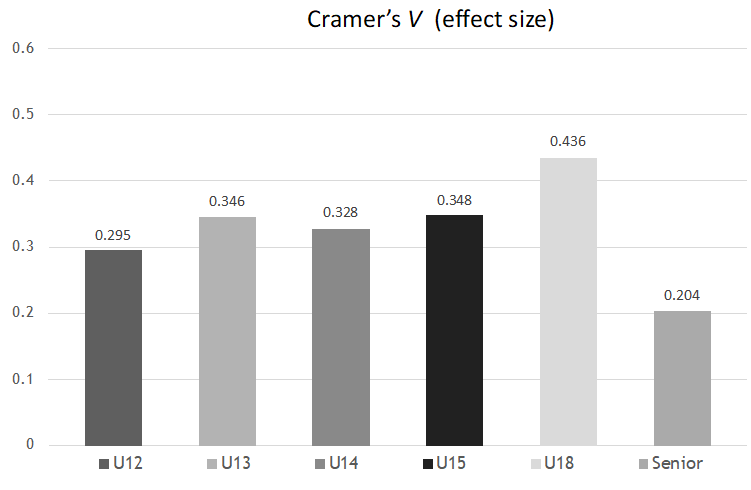
The analysis showed a significant bias in the birth distribution of players across all age categories, favouring relatively older players (P < 0.001) (Table 1). Cramer’s V showed large effect sizes in U12 (V = 0.295), U13 (V = 0.346), U14 (V = 0.328), U15 (V = 0.348) and U18 (V = 0.436) (Figure 1). A medium effect size was observed in the senior category (V = 0.204). The largest effect size was observed in the U18 category. The largest odds ratio (OR) for the first quartile (Q1) to the fourth quartile (Q4) was found in the U18 category (OR = 6.04), followed by U15 (OR = 3.93) and U13 (OR = 3.23), U12 (2.82) and U14 (OR = 2.79). The smallest OR Q1/ Q4 was observed in the senior category. In the U14 category, the OR Q3/Q4 was reversed (OR = 0.94). The small or even reversed OR between Q3 and Q4 in U12 and U14 suggests that players born in October, November and December were equally disadvantaged in these age groups. The biggest
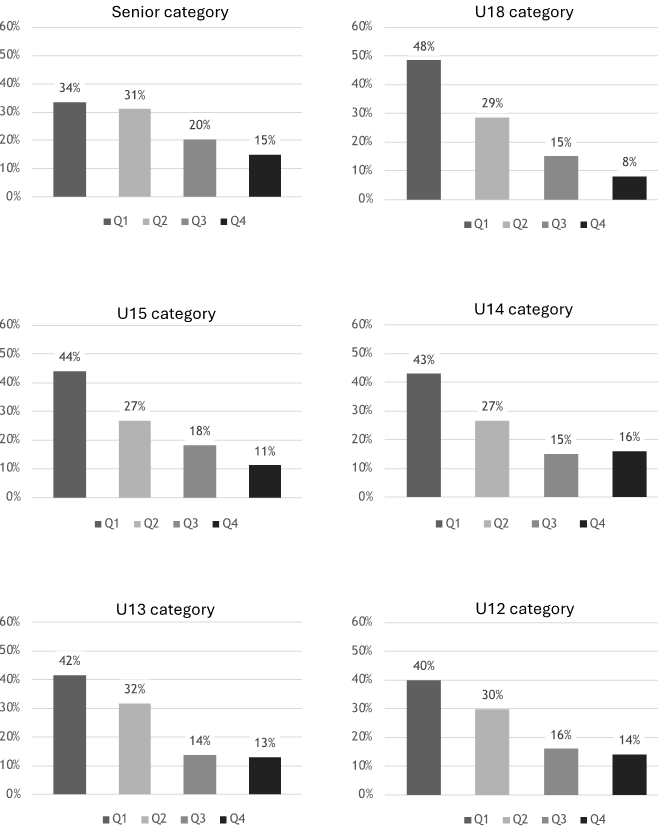
- change in ORs across categories was found between U18 and the senior team. The over-representation of Q1 players drops significantly in this transition (48% in U18 to 34% in senior) and the representation of Q4 increases by 7 points from 8% in U18 to 15% in senior level. This suggests that Q4 players are about three times more likely to become professional players than Q1 players if retained by the academy when they are 18 (Figure 2). degree of freedom p
- Cramer’s V
- Odds ratio
- Age category
- Q1
- Q2
- Q3
- Q4
- Total
- Chisquare x2
- Senior
- 582
- 538
- 352
- 261
- 1733
- 144
- 3
- <.001
- 0.204**
- 2.23
- 2.061
- 1.349
- -34%
- -31%
- -20%
- -15%
- U18
- 513
- 302
- 159
- 85
- 1059
- 403
- 3
- <.001
- 0.436***
- 6.04
- 3.55
- 1.871
- -48%
- -29%
- -15%
- -8%
- U15
- 212
- 129
- 88
- 54
- 483
- 117
- 3
- <.001
- 0.348***
- 3.93
- 2.39
- 1.63
- -44%
- -27%
- -18%
- -11%
- U14
- 201
- 123
- 68
- 72
- 464
- 100
- 3
- <.001
- 0.328***
- 2.79
- 1.71
- 0.944
- -43%
- -27%
- -15%
- -16%
- U13
- 200
- 153
- 66
- 62
- 481
- 115
- 3
- <.001
- 0.346***
- 3.23
- 2.47
- 1.065
- -42%
- -32%
- -14%
- -13%
- U12
- 107
- 80
- 43
- 38
- 268
- 46.7
- 3
- <.001
- 0.295***
- 2.82
- 2.12
- 1.132
- -40%
- -30%
- -16%
- -14%
- Cramer’s V: small*(0.06 ≥), medium (0.17 ≥), large* (0.29 ≥)
Table 1: Birth Month Distributions Per Quartile (Q) From U12 To Senior Category In 2020 Season And Results Of Chi-Square
Discussion
The aim of this study was to investigate the birth distribution and RAE in male football academies in Japan, as well as their senior teams that participate in J.LEAGUE divisions 1, 2 and 3. Consistent with the hypothesis, a strong RAE was observed in all age groups, with a large magnitude (V = 0.204 – 0.436), which is corroborated by previous studies in academy football [5, 8, 9, 10, 13, 23]. Regarding the odds ratio (OR), this study observed significant Q1/Q4 OR in all age groups with the largest OR observed in the U18 category (Q1/Q4 OR = 6.04). This data indicates that only two players in a squad of 24 are Q4 born while 12 players are Q1 born in U18 category.
Patel, et al. [7] observed large Q1/Q4 OR in U12 to U16 (OR = 7.6 for U12, OR = 10.3 for U13, OR = 8.0 for U14, OR = 7.3 for U15, OR = 8.3 for U16) in an English academy. They observed the largest OR in U9 (Q1/Q4 OR = 19) with only one player born in the last quartile within the squad of 31. They observed a decrease for U18 (OR = 4.2) U21 (OR = 3.9) and senior team (OR = 2.3). Similarly, this study observed a reduced Q1/Q4 OR in senior team. Jackson and Comber [5] also observed a large Q1/Q4 OR of 8.6 in a U9 academy, demonstrating a systematic selection bias. Figueiredo, et al. [9] observed biased birth distributions in U15-U21 academy players but with a smaller Q1/Q4 OR (1.37). Relatively older players are more likely to be selected and receive coaching at professional football club academies and have a greater probability of becoming professional players. Therefore, younger players are less likely to be recruited by academies and this decreases the talent pool capable of playing senior professional football.
Regarding the second aim of this study, to examine whether an attenuation of the RAE occurs in the oldest youth age groups, the opposite was found. Rather than a diminishing RAE with age, the magnitude increased, peaking at the highest age group before attenuating at senior level. This result contradicts previous research conducted within academies in Italy Brustio et al. [10], Spain Yagüe et al. [15] and England Patel et al. [7], where a progressive decline in the RAE in late youth age groups was found.
When later-born academy players reach adulthood, assuming they are not deselected, they will catch up physically with their older peers and find they can compete equally with early born players [11]. In fact, as relatively younger players are required to cope with disadvantages during their developmental years, they may be required to adopt coping strategies or learn superior techniques and tactical intelligence; conceivably, advanced technical and tactical skills might have been masked in the early stages of development due to inferior physicality [14]. This has been termed the “underdog hypothesis” [14]. The finding in this study of Japanese senior professional football is that actively younger players are overrepresented at the first-team level, compared with the group they were selected from, indeed be an example [24]. However, concomitantly, this study raises questions about the underdog hypothesis, at least as it has been reported in studies of youth players [5]. Rather than a reversal after adolescence as relatively young players catch up physically with their older peers, this study found a continued increase in the magnitude of the RAE into the U18 age group before reversing in adult football.
One explanation of the further increase in the RAE in the U18 age group may be the structure of Japanese youth football system. The selection process in academies for the U18 age group is made towards or at the end of the U15 age category. Previous research has highlighted that this point is the peak for RAE [4, 5]. Although there are individual differences, relatively younger players begin to catch up physically in the U17 age category and minimise anthropometric and physical differences Lovell, et al. [11] as male players reach their adult height at the age of 16 and 17 [25]. This appears to further support for selection pressure as a key driver of the magnitude of the RAE [4, 5]. There are more U15 players across academies in Japan than players per year in the U18 age group. Specifically, the current U18 age group represents three years (U16, U17 and U18) so approximately one third will leave each year to move into senior open-age football. This implies that 12 players from each academy (1059 players in 3 age categories (U16 to U18) across 29 teams) will leave the U18 group but there are 19 U15 players (483 players across 26) who will be seeking places in the U18. Assuming no change in the size of the U18 cohort, one in three U15s will be released. Furthermore, the newly promoted U16 players are forced to compete with fully matured U18 players for the same spot in the team and scouts’ emphasis on physicality may be intensified in the transition from U15 to U18. Introducing a formal U16 age group and U16 competition may mitigate the high attrition of relatively younger players by reducing the jump from U15 to U18, when those relatively young players are at greatest risk [4, 5].
Other relatively straightforward club level interventions might be considered. Research has shown that relatively younger players in one age group present with motor abilities above a normal curve while relatively older players in the same age group sit below the curve [26]. Therefore, similar to the national fitness test benchmarking and growth and maturation screening specific to each age category introduced in England by the EPPP Japanese academies might collect fitness and maturation data on each player to allow a comparison with a normal curve.
Another proposal is age-order shirt numbering [27]. Having players wear bibs displaying their birth quartile has shown some success in eliminating RAE during academy trials in the Netherlands. Players wearing bibs with age- ordered numbers made coaches and scouts aware of birth differences and perhaps allowed them to make more informed judgments. Interestingly, in the same study, when coaches and scouts were provided with a list of birthdates, a RAE was present on their selection, indicating the difference between knowledge and awareness.
Finally, Cumming, et al. [28], suggested bio-banding in training and tournaments to provide equal competition by grouping players based on biological maturity instead of chronological age. This would not only offer more equal opportunities for relatively younger players to compete with peers of similar physical maturity but also present a more optimal challenge to relatively older players who may rely on their physical characteristics at the expense of developing technical, tactical and decision-making skills. Despite this study providing important insights into competitive Japanese male football, there are some limitations to acknowledge. This study examined cross- sectional data from one year, captured through a pool of talent of senior professional players that were selected may have had a less substantial RAE than found in the current U18 age group. Therefore, the late reversal of the RAE between U18 and senior professional players found in this study should be interpreted with caution. Likewise, the more pronounced RAE in the U18 age group compared with other youth age groups may represent a large RAE inherited from previous years. Future research should collect longitudinal data to confirm the tentative findings here. This study cannot demonstrate that the football club academies are the origin of the RAE in Japan. No data was collected on local regional leagues, and it is conceivable that the RAE already exists in the talent pool from which academies recruit and therefore efforts to address the RAE at academy level will be unlikely to be successful. Further research should examine regional leagues in Japan to confirm or reject this. The focus of this study was male football, in the context of its international success, but further investigations directed by female football in Japan should be considered for future research opportunities, to increase gender player awareness and if RAE is mirrored from the male game into the female game.
Further reinforcement through the findings from this study can provide guidance towards framing talent identification, shaping the approach towards talent development and the pathway from which players can receive playing opportunities. Football club philosophy, league structure, academy infrastructure, or staff knowledge, so often detached from an appreciation towards RAE, continues to impact the player journey and those who strongly influence that process. The findings of this research reinforce the unsettling so often indicated when a coach sacrifices relatively younger players for the team’s immediate success, or the coach’s personal desire to place their achievements above individual development. Player selection, often recognised in football as scouting and recruitment, will place the staff members within the early position as a decision maker where opinions will be valued and critical for player identification, therefore, understanding judgment and how imperative decisions are to restrict the harmful consequences of RAE.
Furthermore, the player pathway needs to address all players, throughout the age groups, so although RAE has been addressed as a challenge in the academy system within this study, there is further concern associated to those early born players that may be neglected from playing up, replicating the underdog hypothesis. Continued research in this field, often with a focus on emerging playing academies as seen in the research from Japan, can only benefit all individuals that work within football and transferable towards those association, clubs and coaches that work with young children. Children that aspire to become footballers, deserve an opportunity irrespective of their birthdate, lack of identification or insufficient footballing environments, which for many has been present and has provided an uneven field from which players have been unable to enter or progress.
Conclusion
This research investigated relative age effects in male Japanese football academies (U12-U18) and senior teams playing in the J.LEAGUE in the 2022 season. Cross-sectional data showed significantly skewed birth date distributions across all age categories, favouring relatively older players. The most pronounced RAE was observed in the U18 age group indicating significant dropout of relatively younger players in the transition from the U15. However, the magnitude of the RAE declined in the transition from U18 to senior football. Q4 players who managed to be retained in academies until the U18 category are approximately three times more likely to become professional players than Q1 players. Selection pressure as players transition from U15 to U18 may be responsible for the increase in the RAE in the U18 age group. The small or reversed Q3/Q4 OR suggests that players born in October, November and December were equally disadvantaged.
There is an urgent need to establish a club philosophy that ensures long-term player development and avoids sacrificing relatively younger players for the team’s immediate success, such as winning the next game. It is imperative that the coach’s proficiency should not be solely judged on the team’s results but the ability to develop players from technical, tactical, physical, and psycho-social, on a long-term perspective. When recruiting players, scouts and coaches should be fully aware not only of the physical differences but also of the age differences and how these can influence their judgment. Education should be provided to relatively younger players and their parents about how physicality, maturation, and RAE can affect performance on the pitch, as it may help their self-regulation when they are faced with challenges. Additional training programmes should be available for players who were released from academies before fully mature, as they could potentially transform into professional players if academies provide sufficient support. Ultimately, football academies and associations should be more innovative in implementing new strategies to enhance quality for talent identification and development, such as bio-banding and Q3&Q4 only squads.
Disclosure statement
The authors report there are no competing interests to declare.
References
-
J League (2023) J League Project DNA.
-
J League (2023) Club Management Information.
-
Takahara R, Miyakawa S (2021) Selection time and differences in biological maturity of soccer players in Japan Professional Football League Academy. The Journal of Physical Fitness and Sports Medicine 10(5): 269-272.
-
Cobley S, Baker J, Wattie N, McKenna J (2009) Annual Age-Grouping and Athlete Development: A Meta- Analytical Review of Relative Age Effects in Sport. Sports Medicine (Auckland) 39(3): 235-256.
-
Jackson RC, Comber G (2020) Hill on a mountaintop: A longitudinal and cross-sectional analysis of the relative age effect in competitive youth football. Journal of Sports Sciences 38(11-12): 1352-1358.
-
Musch J, Grondin S (2001) Unequal Competition as an Impediment to Personal Development: A Review of the Relative Age Effect in Sport. Developmental Review 21(2): 147-167.
-
Patel R, Nevill A, Cloak R, Smith T, Wyon M (2019) Relative age, maturation, anthropometry and physical performance characteristics of players within an Elite Youth Football Academy. International Journal of Sports Science & Coaching, 4(6): 714-725.
-
Augste C, Lames M (2011) The relative age effect and success in German elite U-17 soccer teams. Journal of Sports Sciences 29(9): 983-987.
-
Figueiredo P, Seabra A, Brito M, Galvão M, Brito J (2021) Are Soccer and Futsal Affected by the Relative Age Effect? The Portuguese Football Association Case. Frontiers in Psychology 12: 679476.
-
Brustio PR, Lupo C, Ungureanu AN, Frati R, Rainoldi A, Boccia G (2018) The relative age effect is larger in Italian soccer top-level youth categories and smaller in Serie A. PLoS ONE 13(4): e0196253.
-
Lovell R, Towlson C, Parkin G, Portas M, Vaeyens R, Cobley S (2015) Soccer Player Characteristics in English Lower- League Development Programmes: The Relationships between Relative Age, Maturation, Anthropometry and Physical Fitness. PloS One 10(9): e0137238.
-
Sherar LB, Baxter-Jones ADG, Faulkner RA, Russell KW (2007) Do physical maturity and birth date predict talent in male youth ice hockey players?. Journal of Sports Sciences 25(8): 879-886.
-
Kelly AL, Wilson MR, Gough LA, Knapman H, Morgan P, et al. (2020) A longitudinal investigation into the relative age effect in an English professional football club: exploring the ‘underdog hypothesis’. Science and Medicine in Football 4(2): 111-118.
-
Cumming SP, Searle C, Hemsley JK, Haswell F, Edwards H, et al. (2018) Biological maturation, relative age and self- regulation in male professional academy soccer players: A test of the underdog hypothesis. Psychology of Sport and Exercise 39: 147-153.
-
Yagüe JM, Molinero O, Alba JÁ, Redondo JC (2020) Evidence for the Relative Age Effect in the Spanish Professional Soccer League. Journal of Human Kinetics 73(1): 209-218.
-
Uchiyama S (1996) Influence of Early-Born on J-league professional players. Science of Physical Education 46(1996): 67-71.
-
Kawai K, Yamamoto D, Kato T, Takafuji J (2018) A Study of Relative Age Effects in Junior Soccer Players: When does the Relative Age Effects Start in School Year?. Football Science 15(2018): 52-60.
-
Yamamoto D, Takafuji J, Kato T, Kawai K, Shimizu C (2022) The relative age and birth order effect in Japanese professional football. International Journal of Sports Science & Coaching 17(5); 1059-1070.
-
Hirose N, Hirano A (2008) The relationship between individual biological maturations and birth-month distribution in adolescent elite soccer players. Hatsuiku Hattatsu Kenkyuu 2008(37): 17-24.
-
Malina RM, Eisenmann JC, Cumming SP, Ribeiro B, Aroso J (2004) Maturity-associated variation in the growth and functional capacities of youth football (soccer) players 13–15 years. European journal of applied physiology pp: 91.
-
Simon C, Carson F, Faber IR, Hülsdünker T (2022) Low prevalence of relative age effects in Luxembourg’s male and female youth football. PloS One 17(8): e0273019.
-
Lewis J, Morgan K, Cooper S (2015) Relative Age Effects in Welsh Age Grade Rugby Union. International Journal of Sports Science & Coaching 10(5): 797-813.
-
Mujika I, Vaeyens R, Matthys SPJ, Santisteban J, Goiriena J, et al. (2009) The relative age effect in a professional football club setting. Journal of Sports Sciences 27(11): 1153-1158.
-
Gibbs BG, Jarvis JA, Dufur MJ (2012) The rise of the underdog? The relative age effect reversal among Canadian-born NHL hockey players: A reply to Nolan and Howell. International Review for the Sociology of Sport 47(5): 644-649.
-
Tsutsui T, Iizuka S, Sakamaki W, Maemichi T, Torii S (2022) Growth until Peak Height Velocity Occurs Rapidly in Early Maturing Adolescent Boys. Children (Basel) 9(10): 1570.
-
Votteler A, Höner O (2014) The relative age effect in the German Football TID Programme: Biases in motor performance diagnostics and effects on single motor abilities and skills in groups of selected players. European Journal of Sport Science 14(5): 433-442.
-
Mann DL, Van Ginneken PJMA (2017) Age-ordered shirt numbering reduces the selection bias associated with the relative age effect. Journal of Sports Sciences 35(8): 784-790.
-
Cumming SP, Lloyd RS, Oliver JL, Eisenmann JC, Malina RM (2017) Bio-banding in Sport: Applications to Competition, Talent Identification, and Strength and Conditioning of Youth Athletes. Strength and Conditioning Journal 39(2): 34-47.
- An Evaluation of Distraction Control in Experienced Cyclists During a 20 Minute Time-Trial Performance
- Do Games Missed Predict Rankings in the NBA A Machine Learning Approach
- Elite Taekwondo Athletes: The Relationship among Sport Psychology, Mental Health, and the National Sport Organization
- Immediate Effect of Continuous Running on Red Blood Cells (RBC), Packed Cell Volume (PCV) and Red Blood Cell Distribution Width (RDW) Among Physically Trained Boys
- Echocardiographic Insights into Left Ventricular Functional Adaptation in Track and Field Athletes: A Comprehensive Review
- Could there be a Relationship between early Specialization and Load Management Practices in Professional Athletes