
Study of the Presence of Microorganisms in Washroom Door Locks of UEA, Baraton as a Prime Factor to Infectious Diseases in Kenya
Door locks are frequently touched with hands and can act as vehicles of disease transmission. The aim of this study is to isolate, identify and evaluate the presence or absence of microorganisms present on door locks of washrooms or toilets in private universities in order to take the necessary remedial measures. The study will analyse swabs samples from different departments within the university campus. Sterile swabs will be firmly pressed on the various door handles up and down, left and right, and diagonally. Samples collected will be cultured and incubated at 37oc for 24 hours. Isolation and identification of bacteria will be done using a standard microbial procedure. A number of colonies will be isolated in this study based on cultural, morphological and biochemical characteristics. The levels of contamination will vary depending on the traffic exposure and the environment. The following are some of the organisms that we shall look forward to isolate: Staphylococcus species, Protease species and E.coli.
Introduction
Background of the Study
According to Alonge, et al. [1] isolation identification and characterization of microbial contaminations prevention or avoiding microbial contamination is termed as the most serious problem in toilets door locks, the contaminants replicate immediately or remain latent for long periods of time making it difficult to identify the source of contamination. The human body harbours several species of microorganisms, viruses, fungi and protozoa. These microorganisms colonize part of the body without causing infections and are called normal body flora. Faecal matter remains a major reservoir source of human pathogens which in adverse situations may bring about outbreaks of infections for example _Shigellosi_s. Occurrence of this may be attributed to the unhygienic use of toilets facilities which results to the gross contamination of the door handles in toilets which is not likely seen as contaminated by individuals.
Once the hands are contaminated, they become the vehicles for transmission of infection, such that the user may succeed in picking pathogens on the way out or even after someone washed hands. The organism picked can introduce infections either orally or tropically. Many factors have influenced bacterial transfers between surfaces, including the sources and destination surface feature, bacterial species involved, moisture levels, pressure and friction between contact surfaces and inoculum size on surfaces. Studies have also shown that household surfaces can easily be contaminated with bacteria and that viruses can easily be transferred to hands and from hands to mouth [2]. The risk of spreading of Salmonella infection to other family members via environment including contaminated hands and surfaces in the toilet areas has been highlighted as people come in contact with surfaces such as desks, keyboards, office furniture, toilet locks and handles and that there is a possibility of picking microbes deposited on them. The toilet and office lock handles are contacted more frequently by their users and visitors especially the public toilets [3]. Various bacteria have been isolated from toilet doors locks surfaces thereby providing information on the selective hygiene of commonly encountered public surface. World Health Organization (WHO) states that human carriers are the main reservoir host of infections. Both faeces and urine may find their way on the door handles via hand touch since the hand is the major public serving as the vehicle of transmission of common human disease to a susceptible host.
Significance of the Study
Door locks of toilets have the highest contamination as compared to other door locks and it displays the highest level of bacterial contamination. Door handles are always busy with high acuity clinical environments being contaminated with bacteria. To limit the pathogen transmission in toilet areas, there is a need to develop a multidisciplinary approach beyond boundaries for infection purposes and control. Some of the diseases causes by microbes of door locks include common cold, meningities, swine flu, calicivirus, etc.
Statement of the Problem
Harmful microorganisms can be transferred to hands from contaminated surfaces people come into contact with in our daily lives. Hand hygiene is one of the greatest things that should be considered since it’s from our hands that diseases are visibly transmitted. On the past studies, hands hygiene practices and toilet door locks largely contribute to bacterial loads on our hands and therefore the door locks should be disinfected more frequently to avoid disease transmission. Toilets and washrooms should also be well designed so as to eliminate the sources of contamination of hands.
General Objective
To assess Gram-negative and Gram-positive bacteria on door locks of washrooms and toilets in private universities.
Specific Objectives
To isolate Gram-negative and Gram positive bacteria on door handles of washrooms or toilets in University of Eastern Africa, Baraton. To identify the bacteria in the door handles of toilets or washrooms in University of Eastern Africa, Baraton.
Hypothesis of the Study
The prevalence of bacteria on the door locks of toilets and washrooms in the University of Eastern Africa, Baraton is high.
Justification of the Study
The study will benefit all the stakeholders in the university particularly the students, teachers, staff and faculty members of the university at large and to some extent the community as the level of contamination and type of bacteria causing the contamination will be determined. Public health officials and also the non-governmental organizations and lastly the world health organization will also benefit from the findings of the study.
Scope of the Study
This study will be conducted on the door locks or handles on the toilets or washrooms in private universities and the samples will be obtained from the University of Eastern Africa Baraton in Nandi County.
Chapter 2: Literature Review
Introduction
The most bacteria laden spots in public places are usually the ones that come in direct contact with human beings. When most of the people think of places where bacteria congregate, they normally think of money, phones, keyboards and door handles. Door handles at home and in public places are the most commonly touched surfaces, where bacteria can be transferred from one person to another.
Types of Bacteria Present on Toilet Door Handles
Staphylococcus: Most species of Staphylococcus are harmless and are usually found on the skin and mucous membrane. There are Staphylococcus types that can cause various skin infections and also cause of food poisoning. Many species of Staphylococcus can survive on dry surfaces and as a result transfer of these bacteria from a door handle is very dangerous [4].
E-Coli: Though many E.coli species are a healthy part of the human digestive system, many or majority of the species can be hazardous. E-Coli are one of the major causes for diarrhoea which is worldly distributed. This can cause also serious food poisoning in humans. Species of E.coli can also cause gastroenteritis, urinary tract infections, bacterial meningitis and pneumonia [5].
Salmonella: Salmonella is a zoonotic bacteria, this means that it can be transferred between humans and non-humans. Salmonella is a leading cause of food poisoning as well as diarrhoea. It can live for weeks outside the host and up to two years in some varieties [5].
Campylobacter: Campylobacter is one of the most common forms of bacterial infections. Campylobacter can cause severe diarrhoea and dysentery, leading to bloody bowel movements, cramps and fever [6].
Normal Microbial Flora of the Human Body
Microbial flora denotes the population of microorganisms that inhibit the skin and mucus membranes of a healthy normal person [7]. These microorganisms can be grouped into two, the Resident flora which consists of relatively fixed types of micro-organisms regularly found in a given area at a given age. The total percentage prevalence of this microorganism include: 10% candida species, 43.3% staphylococcus species, 16.7% ecoli, 6.7% proteus species, 20% salmonella, 1.7% klebsiella species. The second is the transient flora which consists of non-pathogenic or potentially pathogenic, transient flora may colonize, proliferate and produce diseases [8].
Classification of Microbial Flora of the Human Body
Since most parts of the body at a particular time are different in terms of pH, different organisms are found at sites that are favourable to them [9]. Classification of microbial flora is as follows; · Normal Flora of the Skin: This include: Staphylococcus epidermidis, Dipthemidis, Micrococcus etc.
· Normal Flora of the Nasopharynx: The examples are; haemolytic Streptococcus, anaerobic cocci.
· Normal Flora of the Gastrointestinal Tract/ Rectum: Example include; Enterococci, non-haemolytic Streptococcus, Diptheroids.
· Normal Flora of the gastrointestinal tract/rectum: Some of the examples are: enterococci, non-haemolytic streptococcus, Diptheroids.
· Normal Flora of the Genitalia: These are as illustrated: Corynebacterium, lactobacillus ssp, non-pathogenic Neisseria spp.
Kinds of Interactions between Microorganisms and Hosts
Microbial symbiosis which involves living together of two dissimilar organisms, it can mutualism, which is basically beneficial to both or on the other hand, commensalism which is beneficial to one. As compared to mutualism and commensalism, parasitism is beneficial to one and harmful to another [6].
Factors that Influence the Kind and Number of Microorganism at any Body Site
Some of the factors that influence the number and kind of microorganisms in the body are: availability and unavailability of oxygen, availability of appropriate receptor sites for attachment, pH of the host site and the influence exerted by other microorganisms at the site [6].
Beneficial Effects of Normal Flora
The indigenous bacteria of the gastrointestinal tract of an animal, perhaps, mainly as a consequence of their great number seen to have greatest overall impact of their host. Here are some of the beneficial effects of normal flora: Normal flora synthesize and secrete vitamins, they prevent colonization by pathogen. Normal flora may antagonize other bacteria. They also stimulate development of various tissues. It also stimulates the production of cross reactive antibodies [5].
Source and Mode of Transmission of Infection
Source of microorganisms is the location from which the pathogen is immediately transferred to the host, either directly from the environment or indirectly found living or from which infection of the host can occur [4]. Transmission of infection can be referred as movement of pathogens from a source of appropriate portal of entry.
Sources and Transmission are: Transient flora of the patient (indigenous infection). Bacteria present as normal flora causes infection because of transmission to the outside site of the natural habitat. Flora from other members of staff (student exogenous infection). Bacteria are transmitted between patients. Through direct contact between patients e.g. shaking of hands. Through contaminated objects by students or other environmental sources. In the air i.e. dust contaminated with patients bacteria [10].
Longevity of Bacteria on Toilet Door Knobs
On a hard, non-porous surface like a door handle, most viruses are destroyed within 24hours. The survival time for bacteria is more variable. Salmonella only lasts four hours, while others can last for even weeks e.g. MRSA has been found to survive for up to five months but on clothing or skin, the survival time is roughly halved. This may be because, these surfaces dry out more quickly. It can also be because they interfere with the bacteria’s ability to produce protective biofilms [1]. Among the bacteria contaminants isolated, Staphylococcus aureus have the highest prevalence followed by Klebsiella pneumoniae, Escherichia coli, Enterobacter species, Citrobacer species and Pseudomonas aeruginosa while Protease species had the least prevalence. This may be a big problem due to their potential to cause epidemics and to cab this, the Community Health Superintendents, Sanitary officers, Environmental Protection Board and Private Organizations need to educate people on personal and environmental hygiene [2].
A high level of bacterial contaminants on door handles contaminated with pathogenic bacteria is mostly Gram positive. Staphylococcus aureus, Bacillus spp, Micrococcus spp, Escherichia coli, Salmonella spp and Klebsiella spp are main bacterial isolates frequently associated with toilet door handles as the organisms may have their way to door handles through skin and hand to hand contacts. Frequently isolated bacterium is Staphylococcus [11]. In the International Journal of Research in Biosciences, it is noted that toilet door handles from different areas showed occurrences of bacterial and fungal contaminants and fomites serves as carriers for the transmission of infection and re-contamination of washed hands. Majority of bacteria transmitted through door handles are gram negative. The isolated gram positive were Staphylococcus spp, Micrococcus spp and Bacillus. Most frequently isolated Gram negative bacteria were E. coli, Klebsiella spp, Salmonella spp, Pseudomonas spp and Proteus spp. E.coli and Klebsiella spp were higher compared to other bacterial isolates that may be the source of UTIs, E.coli being the common cause. Toilets can serve as a serious source of infection e.g. Salmonellosis, UTI and GTI especially when hygiene is very poor due to faecal contamination. Organisms found in toilet handles include E.coli, S.aureus, Streptococcus species, Campylobacter species, Salmonella species, Klebsiella species, Proteus species, Citrobacter species [3].
Public contact surfaces e.g. door handles frequently touched with hands can act as vehicles of disease transmission. Many factors have shown to influence the bacterial transfers between surfaces, including the source and destination surface feature, bacterial species involved, moisture levels, pressure and friction between the contact surfaces and inoculum size surfaces. Studies have also shown that the risk of spreading Salmonella infection to other people via the environment, including contaminated hands and surfaces in the toilet areas had been highlighted [5]. As people come up in contact with surfaces like desks, keyboards, office furniture, toilet lock handles there’s a possibility of picking up microbes deposited on them. The toilet handles come in contact with people more frequently with their user. The hazards associated with toilet facilities office furniture and other fomites had been established but less attention has been directed to toilet and office lock handles as inanimate objects which could harbour and transmit infectious agents. Various bacteria has been isolated from public surfaces by providing information on the relative hygiene of commonly encountered public surface, hence identifying the environments with contaminants and risks of exposure [4].
Chapter 3
Methodology
Study Area
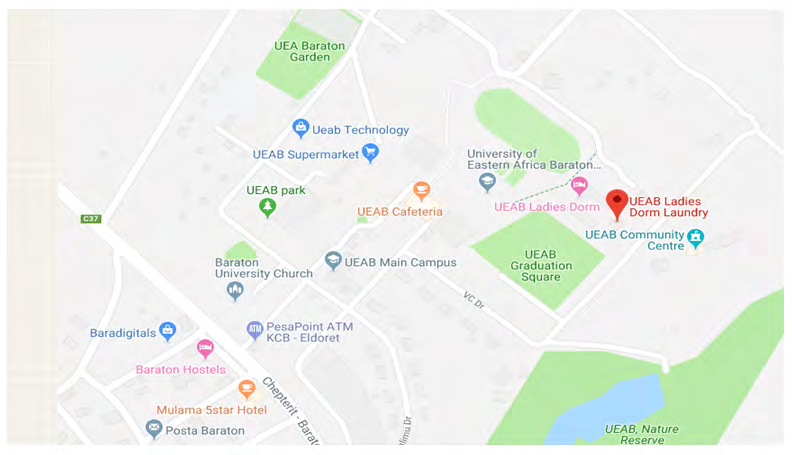
The study was conducted in the University of Eastern Africa, Baraton. The University of Eastern Africa, Baraton main campus in Kenya is located in Nandi County (Nandi district) in Kenya towards the north west of Nairobi city in Kenya and the south west part of Eldoret town in Kenya. University of Eastern Africa, Baraton main campus in Kenya is approximately 315km from Nairobi city and 49 km from Eldoret town in Kenya. The nearest town to the University of Eastern Africa, Baraton main campus is Kapsabet town in Kenya (Figure 1). Kapsabet Town in Kenya is only 15 km from the University of Eastern Africa, Baraton main campus in Kenya.
Research Design
Research design is a plan, a roadmap and blueprint strategy of investigation conceived so as to obtain answers to research questions; it is the heart of any study. Therefore, this study adopted an experimental study design. The study was aimed at collecting swabs from washrooms inoculate on various media and identifying the organisms on them.
Study Population
The study population was 200 washrooms: Administration washrooms, humanities building washrooms, church washrooms, medical laboratory science department washrooms, science building washrooms, auditorium washrooms, student centre washrooms, library washrooms, ladies dorm, men’s dorm, and annex washrooms.
Types of Media to be Used and Preparation: MacConkey agar and chocolate agar was prepared using standard media preparation methods as per manufacturer’s instruction. This was used for primary cultivation from swabs collected. Media for biochemical study, Simmons’s citrate agar, TSI agar and broth were also prepared.
• Preparation of Chocolate Agar: Heating and laying a volume of horse or sheep blood that is 5% of the total volume of media was prepared very slowly to 56°C in a water bath. The media was allowed to solidify and condensation to dry. The plate was placed in sterile plastic bags and store at 4ºC until use. Incubation and inoculated of plates was done for 48 hours at 35-37°C with ~5% CO2 (or in a candle-jar).
• Preparation of MacConkey Agar: 49.53 grams of dehydrated medium was suspended in 1000 ml purified/ distilled water. Heating to boiling to dissolve the medium completely was done. Sterilizing by autoclaving at 15 lbs.
pressure (121°C) for 15 minutes. Cool to 45-50°C was also done. Mixing was well done before pouring into sterile Petri plates.
• Gram Staining Procedure: Gram staining was done after 24 hour of incubation. A smear was made from pure colonies obtained from selective media used after which fixing was done, stained as per gram staining procedure and observed under oil immersion. Results were recorded for analysis and photos were taken for the slides.
Inclusion Criteria and Exclusion Criteria
Inclusion Criteria: Administration washrooms , humanities building washrooms, church washrooms, science building washrooms, auditorium washrooms, student centre washrooms, ladies dorm, men’s dorm (old and new), annex washrooms, Technology washrooms.
Exclusion Criteria: Faculty and staff residential washrooms.
Sample Size
Sample size was calculated using the following formula in selecting the washrooms for this study. The sample size was derived from the study population of 200 washrooms in Baraton University.
( ) 2 n = N/ 1 N e + (slovins formula) Where n= sample size, N= total population and e= margin error (0.). N=200/ (1+200(0.0995) n=120.0 the study targeted 120 washrooms.
Sampling Technique
Stratified random sampling was used to select 120 washrooms since they have been divided into groups thus we used the groups as our strata with the list of the sample frame. Random picking of washrooms from each stratum was done.
Data Collection
Samples were collected from the public toilet door handles using sterile cotton swab moistened. They were introduced into a sterile tube and transported to laboratory and incubated overnight at 37ºC in the incubator.
Data Collection Tools
The collection ran for 1 day by use of sterile cotton swabs that were moistened with sterile water. Each selected door was swabbed and the swab placed in a sterile tube for transportation to the lab for inoculation and incubation. The colonies were counted characterized and gram staining was done to evaluate whether they are gram negative or gram positive.
Data Analysis
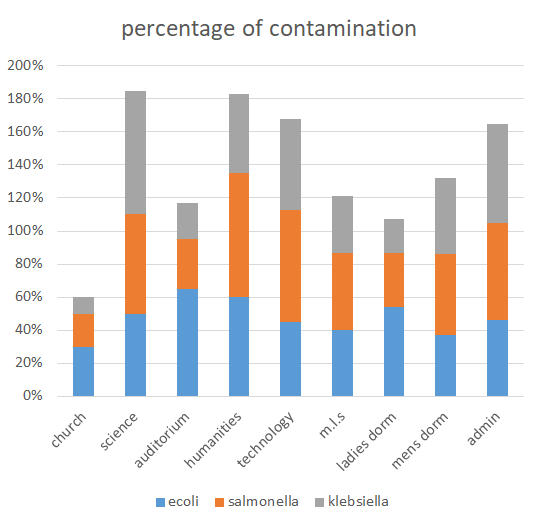
Data obtained was inserted in tables for analysis and discussion (Figure 2).
Pre- test
The experiment was pre-tested in the University Of Eastern Africa Baraton on a sample of 10% of the total population of group of 120 washrooms in this case, selected randomly using probability simple random sampling method giving a tool to 10 Washrooms. These data was used to test validity.
Data Dissemination
Findings of this study was printed in Pamphlets and be handed to the school of health sciences in the University of Eastern Africa Baraton and the heads of departments. Through the heads of departments, Baraton university community was informed of the study findings.
Chapter 4
Results
Tables of Findings from Bacterial Growth (Tables 1-5)
| Building | Growth | Color of Colonies |
|---|---|---|
| 1.MLS | Growth | Pink |
| 2.Science | Growth | Pink |
| 3.ladies dorm (box) | No growth | NONE |
| 4.Technology | Growth | Pink |
| 5.Auditorium | Growth | Pink |
| 6.Administration | No growth | NONE |
| 7.Humanities | Growth | Pink |
| 8.Baraton University Church | Growth | Pink |
| 9.Old men's dorm | No growth | NONE |
| 10.New men's dorm | No growth | NONE |
| 11.Ladies annex | No growth | NONE |
Table 1: Chocolate Agar.
Table1: MacConkey Agar.
| Building | Growth | Color of Colonies |
|---|---|---|
| 1.mls | Growth | Creamy |
| 2.ladies dorm annex | No growth | NONE |
| 3.Science | No growth | NONE |
| 4.Technology | Growth | Creamy |
| 5.Auditorium | Growth | Creamy |
| 6.Administration | No growth | NONE |
| 7.Humanities | Growth | Creamy |
| 8.Baraton University Church | No growth | NONE |
| 9.Old men's dorm | No growth | NONE |
| 10.New men's dorm | No growth | NONE |
Table 2: Chocolate Agar.
Gram Staining Results
| Building | Gram Reaction |
|---|---|
| mls | Gram positive staphylococci |
| Student C | Gram positive staphylococci |
| Technology | Gram positive staphylococci |
| Auditorium | Gram positive staphylococci |
| Humanities | Gram positive staphylococci |
| Church | Gram positive staphylococci |
| Baraton University Church | Gram negative rods |
| Mls | Gram negative rods |
| Student C | Gram negative rods |
| Technology | Gram negative rods |
| Auditorium | Gram negative rods |
| .Humanities | Gram negative rods |
Table 3: Chocolate Agar.
| Indole | Methyl Red | Voges Proskauer | Citrate | |
|---|---|---|---|---|
| BUC | Negative | Negative | Positive | Positive |
| Mls | Positive | Positive | Negative | Negative |
| Science | Positive | Positive | Negative | Negative |
| Technology | Negative | Negative | Positive | Positive |
| Auditorium | Positive | Positive | Negative | Negative |
| Humanities | Negative | Negative | Positive | Positive |
Table 4: Chocolate Agar.
Biochemical Test (IMVIC)
| Coagulase | Catalase | |
|---|---|---|
| Mls | Positive | Positive |
| Science | Negative | Positive |
| Technology | Negative | Positive |
| Auditorium | Negative | Positive |
| Humanities | Positive | Positive |
Table 5: Coagulase and Catalase.
Chapter 5
Discussion
IMVIC test showed that Klebsiella and E.coli were more prevalent Table 7:
| Indole | Methyl Red | Voges Proskaeur | Citrate | |
|---|---|---|---|---|
| E.Coli | Positive | Positive | Negative | Negative |
| Klebsiella | Negative | Negative | Positive | Positive |
Table 6: IMVIC Test.
Positive coagulase and catalase test indicated presence of Staphylococcus aureus while negative indicated presence of staph species. TSI positive indicated that more than one sugar fermented as a sign of presence of E.coli. This variation in the number of positive samples from one place to another is likely to be as a result of the differences in hygiene and sanitary conditions in the environment the results of this study showed that Staphylococcus aureus, Escherichia coli, and Klebsiella spp are the main bacterial isolates frequently associated with the toilet door handles. These organisms may probably have their way to the door handles through the skin and hand-to-hand contacts. This is because they are major components of the normal flora of the skin and nose, which probably explains its high prevalence as contaminant as it can easily be discharged by several human activities. This observation is in conformity with the finding of other researchers Rene ER, et al. [12]. Staphylococcus aureus is the most important potential pathogen that cause boils, bscesses, wound infections toxic shock syndrome and pimples. Gram- negative rods isolated in this study indicate the possibility of the presence of faecal contamination on the door handles. This might be due to the fact that most people go to toilet and end up contaminating their hands with faecal and urinal material and fail to wash their hand because they take the issue of hygiene with levity, they also lack the concept of hand washing as a simple means of stopping this spread of infectious agents, this correspond with the work of [11], who reported that the high rate of isolation of these organisms is only achieved during epidemics in which human hands serve as the vehicle of transmission.
Chapter 6
Conclusion and Recommendation
Conclusion
Staphylococcus aureus, Escherichia coli, and Klebsiella spp were the main bacteria isolated in this research. The results of the study demonstrated that public contact surfaces such as door handles are often colonized by several bacteria and serve as a potential source of infections. Contaminated and improperly washed hands contaminate door handles that means there is a high level of bacterial contamination which may lead to high level prevalence of the bacterial infectious disease due to contaminants. The isolation of pathogenic bacteria from the toilets door handles in the study indicated that they could be vehicles of disease transmission as microbial contamination of toilet door handles surfaces may be a common means of transfer of potentially pathogenic bacteria among users.
Recommendation
On the basis of the above findings, it is therefore recommended that the university management should provide hand sanitizers to the users or spray disinfectants with regular cleaning of the toilets to ensure reduction in microbial load, more cleaners should be employed especially considering the high level of bacterial contamination. Individuals both adult and young should adopt the habit of hand washing practice after using the toilets and routine surface disinfection of the toilets door handles, this can prevent cross contamination. Besides encouraging for general good hygiene practice by all (staffs, students and visitors), there is need for the university management to build more toilets so as to make it less busy, considering factors like the number of sites, the number of samples collected, conditions under which the research work was carried out, further research should be carried out particularly on the risk of fungal contamination.
References
-
Alonge OO, Auwal BM, Aboh MI (2019) Bacterial contamination of toilet door handles on Baze University campus Abuja Nigeria. African Journal of Clinical and Experimental Microbiology 20(1): 35.
-
Ashgar SS, Said HME (2012) Pathogenic bacteria associated with different public environmental sites in Mecca city. Open Journal of Medical Microbiology 2(4): 133-137.
-
Tuladhar E, Hazeleger WC, Koopmans M, Zwietering MH, Beumer RR, et al. (2012) Residual viral and bacterial contamination of surfaces after cleaning and disinfection. Appl Environ Microbiol 78(21): 7769-7775.
-
Baker FJ, Silverton RE (1976) Blood grouping technique. 5th(Edn.), Introduction to Medical Laboratory Technology, pp: 663-678.
-
Lopez GU, Gerba CP, Tamimi AH, Kitajima M, Maxwell SL. et al. (2013) Transfer efficiency of bacteria and viruses from porous and Nonporous fomites to fingers under different relative humidity conditions. Appl Environ Microbiol 79(18): 5728-5734.
-
Hassan KR, Ameen IH, Ramzi ZS (2014) Types of organisms causing urinary tract infection and their antibiotic sensitivity pattern in sulaimani teaching hospital. Journal of Sulaimani Medical College 4(1): 11- 17.
-
Kumar S (2015) Normal microbial flora of the human body. Textbook of Microbiology for BSc Nursing 252-252.
-
Dancer SJ, White LF, Lamb J, Girvan EK, Robertson C (2009) Measuring the effect of enhanced cleaning in a UK hospital: A prospective cross-over study. BMC Med 7: 28.
-
Giannini MA, Nance D, McCullers JA (2009) Are toilet seats a vector for transmission of methicillin-resistant staphylococcus aureus? Am J Infect Control 37(6): 505- 506.
-
Bright KR, Boone SA, Gerba CP (2009) Occurrence of bacteria and viruses on elementary classroom surfaces and the potential role of classroom hygiene in the spread of infectious diseases. J Sch Nurs 26(1): 33-41.
-
O’Hara AM, Shanahan F (2007) Gut microbiota: Mining for therapeutic potential. Clinical Gastroenterology and Hepatology 5(3): 274-284.
-
Rene ER, Shu L, Jegatheesan V (2018) Environmentally friendly (Bio)Technologies for the removal of emerging organic and inorganic pollutants from water. IWA Publishing 67(8): 697-702.
- Antifungal Activity of New Acetophenone Derivatives
- Interconnected Microbiomes Human Health Within an Environmental Framework
- Silkworm-Based Vaccine Production for H5N1: A One Health Approach to Pandemic Preparedness
- Microbial Diversity and Lipolytic Activity of Bacteria and Fungi from Oil-Contaminated Sites in Makurdi Metroplois
- Antibiotic Resistance Profile of Bacteria Isolated at the Central Laboratory of the National Hospital Center of Nouakchott
- Epidemiology and Sensitivity to Antibiotics of Germs Isolated from Blood Cultures in the Laboratory of the National Hospital Center of Nouakchott-Mauritania