
Association between Weight, Body Mass Index, and Breast Cancer Stage in Iranian Women
Introduction: Breast cancer is a type of cancer developed in the breast organ. Breast cancer occurs when breast tissue cells get out of the control of the cell cycle checkpoints and proliferate abnormally. Breast cancer rates are rising in developing Asian countries, especially Iran. Identifying people with early-stage breast cancer is of great importance, as it can prevent death. Materials & Methods: Data were extracted on the variables of height, weight, breast cancer stage, and body mass index (BMI) related to 109 female patients under treatment for breast cancer who had visited Namazi hospital, Shiraz, during the early stages of the symptoms between the years 2017-2019. In this study, the ANOVA test was used to compare the mean BMI scores at different breast cancer stages. Results: Our results showed a significant difference between mean BMI and breast cancer stage. As the stage of breast cancer in patients increased, the BMI increased as well. Entering advanced stages of breast cancer greatly increased the BMI. Age had no effect on the increase or decrease of BMI. Individuals with BMIs above 30 had stages 3 and 4 of breast cancer (P≤0.5). Discussion: Increased BMI and obesity are prognostic factors for advanced breast cancer stages and the mortality resulting from it. Therefore, early detection of the disease is an essential factor for prevention.
Introduction
Breast cancer occurs when some of the benign breast tissue cells continue to grow abnormally [1]. Compared with normal cells, cancer cells grow at a higher rate, and continue to grow and aggregate until they finally form a mass. If left untreated, these cells that have aggregated in the form of a mass may be transferred from the breast tissue to the lymph nodes or other parts of the body. Breast cancer usually begins benign in the milk duct cells, glandular tissue, or other parts of the breast [2, 3]. Risk factors also influence the probability of breast cancer. However, having multiple risk factors does not indicate that the individual will definitely get breast cancer. Examples of such risk factors include: increased age, family history of breast cancer, exposure to rays, occurrence of menopause at very old ages, alcohol consumption, and obesity [4, 5]. Studies show that the last factor, meaning obesity, plays a critical role in the occurrence of breast cancer [6, 7]. Moreover, overweightness in women with breast cancer can lead to recurrence following chemotherapy or radiotherapy [8]. Many women who have breast cancer may not show any symptoms. Studies that discuss the association between BMI and breast cancer stage still remain controversial [9, 10, 11]. In the current study, due to the importance of identifying prognostic factors for detecting the disease at early stages and preventing the mortality associated with it, we investigated the relationship between BMI and breast cancer stage in Iranian women.
Materials and Methods
Patient Selection
In order to assess the relationship between BMI and breast cancer stage, we used a cross-sectional study in this research. Data on the patients were obtained from the Amiralmomenin, Ali Hospital, and Gerash, Iran during the period between August 2017 to September 2019. We recorded the data related to BMI and breast cancer stage from the years 2017-2019. All participants signed informed written consent prior attending the investigation. The study approval was obtained from the Clinical Ethical Committee for Human Research at Shiraz University of Medical Sciences (IR.SUMS.MED.REC.1399.648).
Variables
Data related to height, weight, and breast cancer stage were extracted from questionnaires recorded at the hospital. BMI scores based on height and weight were first recorded for the patients at the time of breast cancer diagnosis. In this study, to compare the weight and height of the patients, we calculated their BMI by dividing their weight in kilograms by the power of two of their height in meters. BMI is a reliable indicator of body fat in most individuals. This indicator is used for weight screening. In this research, in order to determine the breast cancer stage, we used the TNM staging system.
Data Analysis
The association between BMI and breast cancer stage at the time of diagnosis was assessed using the ANOVA test. To determine the relationship between age and breast cancer stage, the chi-squared test was utilized.
Results
A total of 109 patients with breast cancer whose stages were determined by the oncologist were included in the data analysis. The BMI data for all patients were calculated using SPSS Statistics. The patients had an average BMI of 26.2. Approximately, 50% of the patients had a BMI ≤ 26, and only 6% had a BMI ≥ 29. With regard to tumor characteristics that were identified, 17.4% of the patients were in stage 1, 45% were in stage 2, 31.2% were in stage 3, and about 6% were in stage 1. More women with high BMIs were in advanced breast cancer stages compared with women with low BMIs. Table 1 listed the tumor percentages in patients with different breast cancer stages at the time of diagnosis. Using a graph, we present a box plot for the breast cancer stages grouped by BMI (Figure 1).
| Stage | N | Mean | Std. Deviation | Std. Error | 95% Confidence Interval for Mean | Minimum | Maximum | |
|---|---|---|---|---|---|---|---|---|
| Lower Bound | Upper Bound | |||||||
| 1 | 19 | 23.4359 | 3.93372 | 0.90246 | 21.5399 | 25.3319 | 18.44 | 33.22 |
| 2 | 49 | 26.1189 | 3.82871 | 0.54696 | 25.0192 | 27.2186 | 18.44 | 34.67 |
| 3 | 34 | 27.0035 | 5.16556 | 0.88589 | 25.2011 | 28.8058 | 18.44 | 36 |
| 4 | 7 | 29.8657 | 3.96124 | 1.49721 | 26.2021 | 33.5292 | 23.81 | 34.67 |
| Total | 109 | 26.1678 | 4.53203 | 0.43409 | 25.3073 | 27.0282 | 18.44 | 36 |
Table 1: Mean BMI and 95% confidence interval for breast cancer stages.
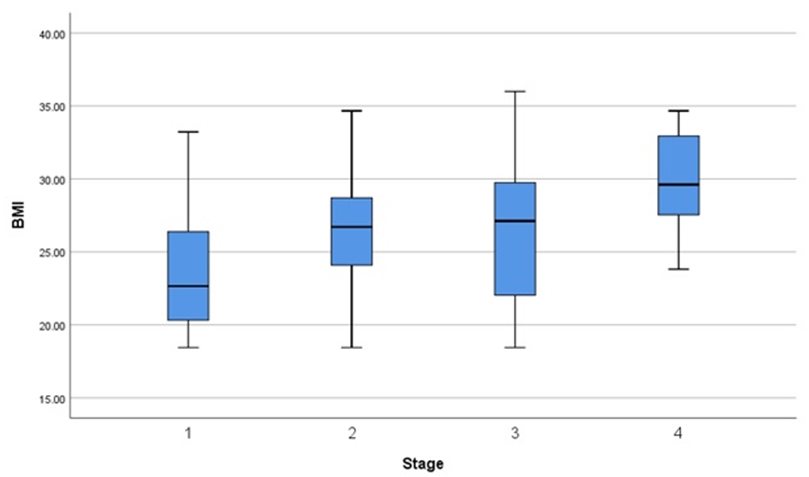
As can be observed in the table, the percentage of breast cancer stage for overweight women (BMI of 25 - 29.9) with stage 2 and higher stages and obese women (BMI≥30) is higher than women with normal BMIs. Compared with women with a BMI<25, overweight (BMI of 25 - 29.9) and obese (BMI≥30) women have higher diagnostic odds in stage 2 and higher stages. A one-way (between-groups) analysis of variance (ANOVA) was conducted to explore the impact of breast cancer stage on BMI (Table 2).
| ANOVA | |||||
|---|---|---|---|---|---|
| BMI | Sum of Squares | df | Mean Square | F | Sig. |
| Between Groups | 261.388 | 3 | 87.129 | 4.675 | 0.004 |
| Within Groups | 1956.856 | 105 | 18.637 | ||
| Total | 2218.244 | 108 |
Table 2: Impact of breast cancer stage on BMI.
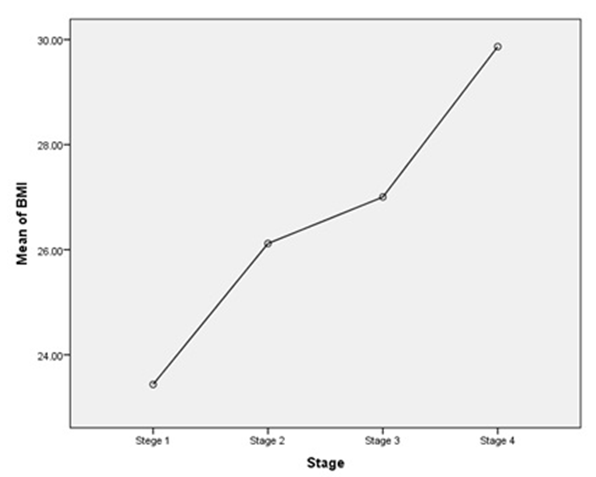
Through a plot, we demonstrate an association between breast cancer stage and body mass index (Figure 2).
Discussion
In the current study, with increased BMI, breast cancer in the women under study reached advanced stages (stages 3 and 4). Furthermore, this study showed a significant relationship between age and breast cancer stage. In other words, age does not play any role in differing stages, and breast cancer stage does not necessarily advance with increased age. In a study by Ronny Mowad, et al. on the effects of obesity on breast cancer, it was shown that patients with a normal weight had a higher overall survival rate than overweight or obese patients; however, the difference was not significant. In other words, despite an increase in the prevalence of larger tumors and higher tumor stages, obesity is not associated with an overall reduction in disease-free survival (DFS) in patients with triple-negative breast cancer (TNBC). In another study in 2018 carried out by Li Sun et al. on BMI and cancer prognosis, it was revealed that overweight and obese individuals had larger tumor sizes and older ages, and overweightness and obesity were each separately predictors of breast cancer recurrence and the mortality resulting from it. The impact of overweightness on breast cancer prognosis is associated with menstruation. In their dose-response meta-analysis in 2018 on the relationship between BMI and risk of breast cancer, Kang Liu et al. showed that with each 5 Kg/m2 increase in BMI the risk of breast cancer in women increased by 2%. Nonetheless, the body mass index can be a protective factor against the risk of breast cancer in premenopausal women.
Conclusion
Our results in the current study showed a significant relationship between increased BMI and the occurrence of breast cancer. Our findings are consistent with the findings of previous researches. However, there are certain contradictions with previous findings. As demonstrated in some previous studies, there is a significant relationship between patients’ age and having advanced breast cancer stages. Meanwhile, we could not find a significant relationship between age and breast cancer stage, and according to our study, age cannot identify the stage of breast cancer.
Conflict of Interest Statement
The authors declare that they have no conflict of interest.
References
-
Mansfield CM (1993) A review of the etiology of breast cancer. J Natl Med Assoc 85(3): 217-221.
-
Ataollahi MR, Sharifi J, Paknahad MR, Paknahad A (2015) Breast cancer and associated factors: a review. J Med Life 8(S4): 6-11.
-
Tao Z, Shi A, Lu C, Song T, Zhang Z, et al. (2015) Breast cancer: epidemiology and etiology. Cell Biochem Biophys 72(2): 333-338.
-
Key TJ, Verkasalo PK, Banks E (2001) Epidemiology of breast cancer. The lancet oncology 2(3): 133-140.
-
Stuckey A (2011) Breast cancer: epidemiology and risk factors. Clinical obstetrics and gynecology 54(1): 96- 102.
-
Vecchia CL, Giordano SH, Hortobagyi GN, Chabner B (2011) Overweight, obesity, diabetes, and risk of breast cancer: interlocking pieces of the puzzle. Oncologist 16(6): 726-729.
-
Schapira DV, Kumar NB, Lyman GH, Cox CE (1990) Abdominal obesity and breast cancer risk. Annals of internal medicine 112(3): 182-186.
-
Vance V, Mourtzakis M, McCargar L, Hanning R (2011) Weight gain in breast cancer survivors: prevalence, pattern and health consequences. Obes Rev 12(4): 282- 294.
-
Sun L, Zhu Y, Qian Q, Tang L (2018) Body mass index and prognosis of breast cancer: An analysis by menstruation status when breast cancer diagnosis. Medicine (Baltimore) 97(26): e11220.
-
Winters S, Martin C, Murphy D, Shokar NK (2017) Breast cancer epidemiology, prevention, and screening. Prog Mol Biol Transl Sci 151: 1-32.
-
Cui Y, Whiteman MK, Flaws JA, Langenberg P, Tkaczuk KH, et al. (2002) Body mass and stage of breast cancer at diagnosis. Int J Cancer 98(2): 279-283.
- Antifungal Activity of New Acetophenone Derivatives
- Interconnected Microbiomes Human Health Within an Environmental Framework
- Silkworm-Based Vaccine Production for H5N1: A One Health Approach to Pandemic Preparedness
- Microbial Diversity and Lipolytic Activity of Bacteria and Fungi from Oil-Contaminated Sites in Makurdi Metroplois
- Antibiotic Resistance Profile of Bacteria Isolated at the Central Laboratory of the National Hospital Center of Nouakchott
- Epidemiology and Sensitivity to Antibiotics of Germs Isolated from Blood Cultures in the Laboratory of the National Hospital Center of Nouakchott-Mauritania