
Targeting Quorum Sensing as a Next-Generation Approach to Bacterial Infections
The global rise of antibiotic resistance has prompted the search for innovative antimicrobial strategies that go beyond conventional bactericidal and bacteriostatic approaches. One promising avenue is anti-virulence therapy, which targets the mechanisms of bacterial pathogenesis rather than growth. Central to many bacterial infections is quorum sensing (QS), a communication system that regulates collective behaviours such as biofilm formation, toxin production, and immune evasion. By disrupting QS, known as quorum sensing inhibition (QSI), bacterial virulence can be significantly reduced without exerting selective pressure for resistance. This review aims the emerging role of quorum sensing in microbial pathogenesis and highlights the therapeutic potential of QS inhibitors (QSIs) in the context of anti-virulence therapy. We explore various types of QSIs, including natural products, and enzymatic inhibitors, and assess their efficacy in mitigating bacterial infections. Furthermore, we address the challenges in developing QS-based therapies, such as specificity, stability, and delivery, and their implications in clinical settings. As a novel, resistance-sparing approach, quorum sensing inhibition offers a new horizon in the fight against bacterial infections, paving the way for more sustainable and effective antimicrobial strategies
Abbreviations
QS: Quorum Sensing; QSI: Quorum Sensing Inhibition; QSIs: QS inhibitors; AMR: Antimicrobial Resistance; MDR: Multidrug-resistant; WHO: World Health Organization; QQ: Quorum-quenching; AIs: Autoinducers; AHLs: N-acyl Homoserine Lactones; AI-2: Autoinducer-2; PQS: Pseudomonas Quinolone Signal; DSF: Diffusible Signal Factor; AI-3: Autoinducer-3; SAM: S-adenosylmethionine; acyl-ACP: Acylated Acyl Carrier Protein; AIPs: Autoinducer Peptides; ABC: ATP-binding Cassette; SAH: S-adenosylhomocysteine; RIP: RNA III inhibiting Peptides; NPs: Nanoparticles.
Introduction
Since their discovery in the early 20th century, antibiotics have represented one of the most significant scientific breakthroughs in combating bacterial infections, leading to the development and marketing of at least 20 classes of antibiotics [1, 2]. These agents either cause microbial death or inhibit microbial growth. However, the indiscriminate and excessive use of antibiotics has accelerated the rise of antimicrobial resistance (AMR), particularly among pathogenic microorganisms [3]. This phenomenon has led to the emergence of multidrug-resistant (MDR) bacterial strains, for which treatment options are increasingly limited or non-existent. In 2019, the World Health Organization (WHO) reported that AMR is responsible for at least 700,000 deaths annually worldwide, with projections suggesting that the death toll could reach 10 million per year by 2050 if no corrective actions are implemented [4]. In high-income countries alone, AMR could result in an additional 2.4 million deaths between 2015 and 2050 recognized as one of the greatest threats to global public health, AMR poses significant challenges to modern healthcare systems. The WHO has also warned of a potential “post-antibiotic era,” where common infections and minor injuries could once again become fatal [5]. Conventional antibiotics work by interfering with essential bacterial functions such as DNA, RNA, protein and cell wall synthesis, but this mode of action exerts selection pressure on microbial populations, leading to the emergence and spread of resistant strains.
Addressing this issue requires better stewardship and regulation of antibiotic use and also the exploration of novel infection control strategies. The increasing prevalence of MDR pathogens underscores the urgent need for alternative treatment modalities that are less likely to contribute to resistance. Among these, the quorum-quenching (QQ) approach has garnered significant attention. Unlike traditional antibiotics, quorum quenching disrupts bacterial cell-to-cell communication, known as quorum sensing, which regulates virulence factors in many pathogens [6]. By targeting this communication process, quorum quenching provides a novel strategy that controls infections without imposing the selective pressures that lead to resistance. This innovative approach holds great potential as a complementary strategy to conventional antibiotics in the fight against AMR.
Quorum Sensing: Mechanisms of Bacterial Communication
Quorum sensing (QS) is a bacterial cell-to-cell communication system that regulates collective behaviours, including virulence, biofilm formation, and antibiotic resistance, by sensing population density through small signalling molecules known as autoinducers (AIs) [7]. This mechanism enables bacterial populations to coordinate gene expression and adapt to environmental changes. While Gram-negative and Gram-positive bacteria employ different QS pathways and signalling molecules, the underlying principle of communication is conserved across species. Gram-negative bacteria primarily use N-acyl homoserine lactones (AHLs), whereas Gram-positive bacteria utilize peptide signals. Interestingly, autoinducer-2 (AI-2) serves as a common signal molecule in both types of bacteria, facilitating interspecies communication. Other significant signalling molecules include Pseudomonas quinolone signal (PQS), diffusible signal factor (DSF), and autoinducer-3 (AI- 3) [8].
Quorum Sensing in Gram-Negative Bacteria
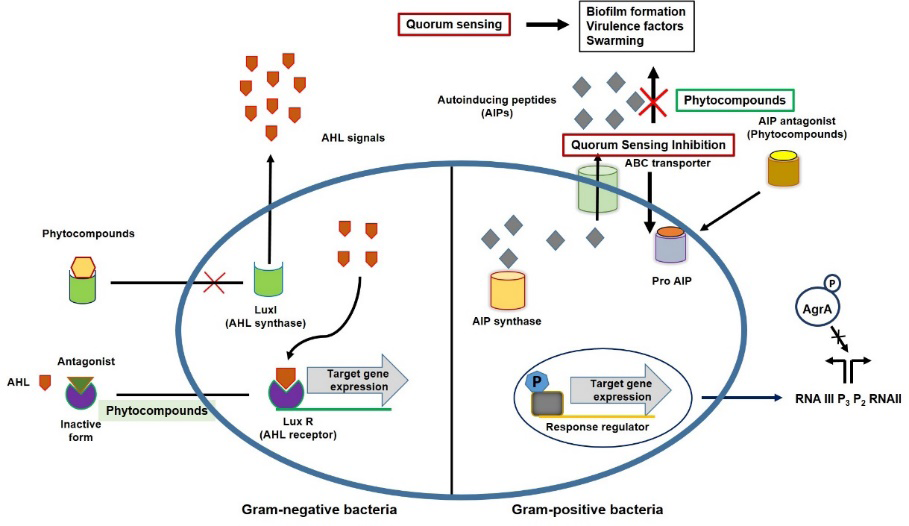
The quorum-sensing systems of Gram-negative bacteria are predominantly mediated by AHLs, which are produced by the LuxI family of synthases using substrates such as S-adenosylmethionine (SAM) and an acylated acyl carrier protein (acyl-ACP). These AHL molecules freely diffuse across the bacterial cell membrane, accumulating in the extracellular environment as the bacterial population grows [9]. When the concentration of AHLs reaches a critical threshold, they bind to their cognate LuxR-type receptors within the cell, triggering homodimerization of these receptors. This receptor-ligand complex then binds to specific promoter regions, activating the transcription of QS-regulated genes [10]. The LuxI/LuxR system is central to QS in many Gram-negative bacteria, such as Vibrio, Pseudomonas, and Escherichia coli, and plays a crucial role in regulating genes involved in virulence and biofilm formation [11].
While the LuxI/LuxR system is the best characterized, several Gram-negative bacteria also exhibit multiple or overlapping QS systems, further increasing regulatory complexity. These additional systems allow bacteria to integrate different environmental signals, thereby fine- tuning their QS responses to various stimuli.
Quorum Sensing in Gram-Positive Bacteria
In contrast, Gram-positive bacteria use a different QS system based on oligopeptides, known as autoinducer peptides (AIPs). These small peptides are secreted via ATP-binding cassette (ABC) transporters and accumulate in the environment as the bacterial population increases. The detection of AIPs is mediated by a two-component system comprising a sensor histidine kinase and a response regulator. Upon binding to AIPs, the sensor kinase undergoes autophosphorylation, initiating a phosphorylation cascade that activates the response regulator. The activated response regulator subsequently induces the transcription of QS- regulated genes by binding to target promoter regions [12, 13]. This QS system has been widely studied in bacteria such as Staphylococcus aureus, Bacillus subtilis, and Clostridium difficile. In these organisms, the AIP-mediated QS system regulates functions such as virulence factor production, sporulation, and competence development [14]. The reliance on a phosphorylation cascade in Gram-positive bacteria adds an additional layer of regulation, providing these organisms with a more dynamic response to changes in population density.
AI-2-Based Quorum Sensing
Autoinducer-2 (AI-2) is unique in its role as a “universal” QS signal used by both Gram-negative and Gram-positive
bacteria, facilitating interspecies communication. In Vibrio harveyi, a marine pathogen, AI-2 is synthesized from S-adenosylhomocysteine (SAH) through the sequential activity of the enzymes 5-methylthioadenosine/S- adenosylhomocysteine nucleosidase. The AI-2-mediated QS system in Vibrio is part of a two-component regulatory system, where AI-2 interacts with a histidine kinase sensor, activating downstream gene expression [15]. AI-2’s role as a universal signal highlights its importance in interspecies bacterial communication, contributing to the regulation of complex microbial communities.
Quorum Sensing: A Novel Target for Infection Control
The inhibition of quorum sensing (QS) presents a promising alternative strategy for the control of bacterial infections, offering an approach distinct from traditional antibiotics. QS enables bacteria to communicate via signalling molecules and collectively regulate essential pathogenic functions, including virulence factor production and biofilm formation. Targeting these communication pathways rather than killing bacteria directly can disarm pathogens, leaving them vulnerable to host defences without exerting the selective pressure typically imposed by conventional antibiotics. This reduces the likelihood of developing antibiotic resistance.
Quorum sensing inhibitors (QSIs) or anti-virulence drugs interfere with QS by targeting one of three crucial stages: (i) the biosynthesis of signalling molecules in the “sender” cell, (ii) the signalling molecules themselves, or (iii) the reception and decoding of signals by the “receiver” cell [16]. Disrupting any of these stages renders bacteria unable to perceive their population density and prevents them from executing QS-regulated functions, such as coordinating virulence. This strategy is less likely to promote the development of resistance, as it does not involve directly killing bacteria but rather neutralizes their ability to organize infection [17] (Figure 1).
Quorum Sensing Inhibitors (QSIs)
The rise of antibiotic-resistant bacteria emphasizes the urgent need for novel therapies. Quorum sensing inhibitors (QSIs) have emerged as a promising alternative to conventional antibiotics. By interfering with QS systems, QSIs can suppress the production of multiple virulence [18] factors without affecting bacterial growth, thereby exerting minimal selective pressure. Moreover, QSIs can enhance the efficacy of antibiotics when used in combination, providing a more comprehensive approach to combating resistant pathogens [19]. QSIs act rapidly and have been shown to effectively block quorum-sensing mechanisms in several bacterial species. This makes them an attractive tool for addressing the multi-drug resistance problem, where traditional antibiotics are often rendered ineffective due to bacterial adaptations.
Natural Quorum Sensing Inhibitors
Natural products have long been a rich source of bioactive compounds, including those with antimicrobial properties. Many secondary metabolites produced by plants and microorganisms possess quorum-sensing inhibitory activity, making them potential candidates for new anti- infective therapies. These natural quorum-sensing inhibitors (QSIs) offer the advantage of chemical diversity and complexity, providing mechanisms of action that differ from conventional antibiotics. Additionally, they tend to be non- toxic to humans, further supporting their use in therapeutic applications [20].
Phytocompunds
Plants have been used in traditional medicine for centuries, and their extracts contain a wide array of bioactive compounds, many of which exhibit QS inhibitory activity. Phytochemicals from medicinal plants can interfere with QS systems without affecting bacterial growth, making them ideal candidates for reducing the development of resistance [21]. Various anti-quorum molecules have been identified from plant sources, including monoterpenes, flavonoids, coumarins, and sulfur-containing compounds such as diallyl disulfide. These compounds often work by mimicking bacterial signalling molecules, binding to QS receptors and disrupting the communication necessary for coordinating infection processes. Flavonoids, tannins, and terpenoids are among the most promising plant-derived QSIs identified to date. The ability of these natural compounds to inhibit quorum sensing highlights their potential role in addressing the challenge of antimicrobial resistance [22]. The development of QSIs, particularly those derived from natural sources, provides a promising alternative to traditional antibiotics, with the potential to revolutionize the treatment of bacterial infections.
Bacterial Enzymes
Quorum quenching (QQ) enzymes offer a highly effective approach to combat bacterial infections by disrupting quorum sensing (QS) systems rather than killing or inhibiting the growth of pathogens. Unlike quorum sensing inhibitors (QSIs), QQ enzymes act directly on the QS signal molecules, interfering with bacterial communication and diminishing virulence. The unique advantage of QQ enzymes is that they pose no cytotoxic risk to the host. While the overall mechanisms of QS systems are well understood, relatively few QQ enzymes have been identified, and their potential for therapeutic use remains underexplored [23].
In QS systems, acyl-homoserine lactones (AHLs) serve as key signalling molecules. These molecules possess four potential cleavage sites where QQ enzymes can act to inactivate their function. Based on their mechanism of action, QQ enzymes can be classified into three main categories:
- Lactonases: These enzymes cleave and open the lactone ring of AHL molecules, rendering them inactive [24].
- Acylases (Amidases): These enzymes hydrolyze the amide bond of AHLs, breaking them down into fatty acids and homoserine lactone, effectively neutralizing their signalling capacity [25].
- Oxidoreductases: These enzymes either oxidize the acyl chain of AHLs or reduce 3-oxo-AHLs to their corresponding 3-hydroxy-AHLs, thus interfering with quorum sensing signals.
Microbes
Natural quorum sensing inhibitors that quench the QS signal are produced by several microbes, including bacteria, fungi, and algae. The production of QSI molecules is reported in different genera of bacteria, although only a few bacterial QSIs have been well characterized, such as phenyl ethylamides and cyclo-l-proline-l-tyrosine [26]. Generally, two types of QSIs that are mostly studied and reported in bacteria are furanones and RNA III inhibiting peptides (RIP) [27]. Furanones are known to act on both AHL and AI-2 quorum sensing systems. The RIP in its amide form (YSPWTNFNH2) is reported to reduce virulence, biofilm formation, and antibiotic resistance in Staphylococcus [28]. In a study, the presence of RIP was shown to inhibit the phosphorylation of TRAP (quorum sensing signal molecule), thus preventing the production of RNA III, which upregulates toxin production during the mid-exponential phase [29].
Nanotechnological approaches, particularly the use of nanoparticles (NPs), are becoming essential in combating bacterial infections as alternatives to traditional antibiotics. Nanoparticles, owing to their novel mechanisms of action, effectively target pathogenic bacteria [30]. Advances in microbiologically-synthesized NPs hold significant promise for healthcare, offering new possibilities for antibacterial therapies [31]. For instance, the immobilization of enzymes on nanomaterials enhances their stabilization and activity compared to conventional methods, fostering synergetic interactions [32]. Gold nanoparticles (AuNPs) coated with AHL lactonase proteins (AiiA AuNPs) from Bacillus licheniformis demonstrate potent antibiofilm activity against multi-drug-resistant Proteus species. At concentrations of 2–8 μM, these AuNPs effectively reduce exopolysaccharide production and cell surface hydrophobicity without harming macrophages, suggesting their potential to attenuate pathogens without adverse effects on host cells [33].
Silver nanoparticles (AgNPs) are widely applied in medical devices and wound dressings, exhibiting strong efficacy against both drug-susceptible and resistant bacteria. They are particularly effective against biofilms and nosocomial infections [34]. The chemical reduction method simplifies nanoparticle production, offering lower toxicity compared to other nanomaterials, and making them attractive for biomedical applications [35]. These biocomposites exhibit distinct thermal, mechanical, and biological properties, outperforming traditional free enzymes and proteins [36].
Small Molecules as Quorum Quencher
Small molecules as quorum quenchers (QQs) are emerging as effective tools to disrupt quorum sensing (QS), a communication mechanism that bacteria use to coordinate group behaviors like virulence and biofilm formation. These molecules work by inhibiting QS pathways, either by degrading signaling molecules, blocking receptor sites, or interfering with signal synthesis. Furanones, for example, structurally mimic acyl-homoserine lactones (AHLs) and prevent the activation of QS receptors [21]. Natural compounds like ajoene from garlic, and synthetic AHL analogs, also exhibit potent quorum quenching activities by binding competitively to QS receptors [37]. This inhibition of QS reduces pathogenicity without killing bacteria, thus lowering the risk of resistance development. QQs offer a promising approach to control chronic infections, particularly in biofilm-associated diseases [6]. By targeting bacterial communication, QQs provide a novel strategy against antibiotic-resistant pathogens.
Conclusion and Future Prospects
The rise of antibiotic resistance necessitates the development of alternative therapeutic strategies that target bacterial pathogenicity without exerting selective pressure for resistance. Quorum sensing inhibitors and quorum quenching enzymes represent two promising approaches that exploit bacterial communication systems to attenuate virulence. As Sun Tzu aptly noted in The Art of War, “In war, it is better to target the enemy’s strategy than to kill them.” Similarly, quorum quenching strategies aim to neutralize bacteria rather than kill them, minimizing the risk of resistance. While significant progress has been made in identifying natural and synthetic QSIs, most studies remain focused on in vitro experiments. The challenge moving forward is to translate these findings into clinically viable therapies. Additionally, further research is needed to elucidate the specific mechanisms by which natural QSIs and QQ enzymes interfere with quorum sensing.
The future of bacterial infection control lies in understanding and manipulating bacterial communication. With continued research and investment, quorum sensing inhibitors and quorum quenching enzymes could revolutionize how we treat bacterial infections, offering hope in the fight against antimicrobial resistance.
References
-
D’Costa VM, King CE, Kalan L, Morar M, Sung WWL, et al. (2011) Antibiotic resistance is ancient. Nature 477(7365): 457-461.
-
Buchy P, Ascioglu S, Buisson Y, Datta S, Nissen M, et al. (2020) Impact of vaccines on antimicrobial resistance. Int J Infect Dis 90: 188-196.
-
WHO (2019) No time to wait: securing the future from drug resistant infections. IACG Report to the Secretary General of the United Nations, April 2019. The UN Interagency Coordination Group on AMR, Geneva, Switzerland.
-
WHO (2014) Antimicrobial resistance: global report on surveillance. World Health Organization.
-
Palleja A, Mikkelsen KH, Forslund SK, Kashani A, Allin KH, et al. (2018) Recovery of gut microbiota of healthy adults following antibiotic exposure. Nat Microbiol 3(11): 1255-1265.
-
Kalia VC (2013) Quorum sensing inhibitors: an overview. Biotechnol Adv 31(2): 224-245.
-
Haque S, Yadav DK, Bisht SC, Yadav N, Singh V, et al. (2019) Quorum sensing pathways in Gram-positive and-negative bacteria: potential of their interruption in abating drug resistance. J Chemother 31(4): 161-187.
-
Brexó RP, Sant’Ana ADS (2018) Microbial interactions during sugar cane must fermentation for bioethanol production: does quorum sensing play a role?. Crit Rev Biotechnol 38(2): 231-244.
-
Galloway WRJD, Hodgkinson JT, Bowden SD, Welch M, Spring DR (2011) Quorum sensing in Gram-negative bacteria: small-molecule modulation of AHL and AI-2 quorum sensing pathways. Chem Rev 111(1): 28-67.
-
Lokender K, Patel SKS, Kharga K, Kumar R, Kumar P, et al. (2022) Molecular mechanisms and applications of N-acyl homoserine lactone-mediated quorum sensing in bacteria. Molecules 27(21): 7584.
-
Kariminik A, Baseri-Salehi M, Kheirkhah B (2017) Pseudomonas aeruginosa quorum sensing modulates immune responses: an updated review article. Immunol Lett 190: 1-6.
-
Papenfort K, Bassler BL (2016) Quorum sensing signal– response systems in Gram-negative bacteria. Nat Rev Microbiol 14(9): 576-588.
-
Koul S, Prakash J, Mishra A, Kalia VC (2016) Potential emergence of multi-quorum sensing inhibitor resistant (MQSIR) bacteria. Indian J Microbiol 56(1): 1-8.
-
Novick RP (2003) Autoinduction and signal transduction in the regulation of staphylococcal virulence. Mol Microbiol 48(6): 1429-1449.
-
Miller MB, Bassler BL (2001) Quorum sensing in bacteria. Annu Rev Microbiol 55: 165-199.
-
Rampioni G, Leoni L, Williams P (2014) The art of antibacterial warfare: deception through interference with quorum sensing–mediated communication. Bioorg Chem 55: 60-68.
-
Scutera S, Zucca M, Savoia D (2014) Novel approaches for the design and discovery of quorum-sensing inhibitors. Expert Opin Drug Discov 9(4): 353-366.
-
Defoirdt T (2018) Quorum-sensing systems as targets for antivirulence therapy. Trends Microbiol 26(4): 313- 328.
-
Martínez OF, Rigueiras PO, Pires ADS, Porto WF, Silva ON, et al. (2019) Interference with quorum-sensing signal biosynthesis as a promising therapeutic strategy against multidrug-resistant pathogens. Front Cell Infect Microbiol 8: 444.
-
Adonizio AL, Downum K, Bennett BC, Mathee K (2006) Anti-quorum sensing activity of medicinal plants in southern Florida. J Ethnopharmacol 105(3): 427-435.
-
Hentzer M, Givskov M (2003) Pharmacological inhibition of quorum sensing for the treatment of chronic bacterial infections. J Clin Invest 112(9): 1300-1307.
-
Petya DD, Damyanova T, Paunova-Krasteva T (2023) Chromobacterium violaceum: a model for evaluating the anti-quorum sensing activities of plant substances. Scientia Pharmaceutica 91(3): 33
-
Rakesh S, Elias M (2020) Quorum quenching enzymes and their effects on virulence, biofilm, and microbiomes: a review of recent advances. Expert Rev Anti Infect Ther 18(12): 1221-1233.
-
Chen F, Gao Y, Chen X, Yu Z, Li X (2013) Quorum quenching enzymes and their application in degrading signal molecules to block quorum sensing-dependent infection. Int J Mol Sci 14(9): 17477-17500.
-
Tang E, Cheng G, Ma X (2006) Preparation of nano-ZnO/ PMMA composite particles via grafting of the copolymer onto the surface of zinc oxide nanoparticles. Powder Technology 161(3): 209-214.
-
Gupta K, Daroch P, Harjai K, Chhibber S (2019) Parallels among natural and synthetically modified quorum- quenching strategies as convoy to future therapy. Microbiology 165(12): 1265-1281.
-
Pan J, Ren D (2009) Quorum sensing inhibitors: a patent overview. Expert Opin Ther Pat 19(11): 1581-1601.
-
Balaban N, Cirioni O, Giacometti A, Ghiselli R, Braunstein JB, et al. (2007) Treatment of Staphylococcus aureus biofilm infection by the quorum-sensing inhibitor RIP. Antimicrob Agents Chemother 51(6): 2226-2229.
-
Fetzner S (2015) Quorum quenching enzymes. Journal of biotechnology 201: 2-14.
-
Linlin W, Hu C, Shao L (2017) The antimicrobial activity of nanoparticles: present situation and prospects for the future. Int J Nanomedicine 12: 1227-1249.
-
Michael JC, Imrie L, Mühlbauer LF, Bihan TL, Horsfall LE (2019) Shotgun proteomic analysis of nanoparticle- synthesizing Desulfovibrio alaskensis in response to platinum and palladium. Microbiology 165(12): 1282- 1294.
-
Jairam M, Gupta A, Ahuja R, Singh M, Panda AK (2021) Recent advances in nano-engineered approaches used for enzyme immobilization with enhanced activity. Journal of Molecular Liquids 338: 116602.
-
Gopalakrishnan V, Pati R, Sonawane A, Vaseeharan B (2015) In vitro cytotoxic effects of gold nanoparticles coated with functional acyl homoserine lactone lactonase protein from Bacillus licheniformis and their antibiofilm activity against Proteus species. Antimicrobial Agents Chemother 59(2): 763-771.
-
Federica P, Pollini M (2019) Antimicrobial silver nanoparticles for wound healing application: progress and future trends. Materials 12(16): 2540.
-
Rooma D, Yadav S, Nehra R, Pundir CS (2013) An amperometric hypoxanthine biosensor based on Au@ FeNPs for determination of hypoxanthine in meat samples. Int J Biol Macromol 62: 629-635.
-
Anna CB, Emrick T, Russell TP (2006) Nanoparticle polymer composites: where two small worlds meet. Science 314(5802): 1107-1110.
-
Holm JT, Gennip MV, Phipps RK, Shanmugham MS, Christensen LD, et al. (2012) Ajoene, a sulfur-rich molecule from garlic, inhibits genes controlled by quorum sensing. Antimicrobial Agents Chemother 56(5): 2314-2325.
- Antifungal Activity of New Acetophenone Derivatives
- Interconnected Microbiomes Human Health Within an Environmental Framework
- Silkworm-Based Vaccine Production for H5N1: A One Health Approach to Pandemic Preparedness
- Microbial Diversity and Lipolytic Activity of Bacteria and Fungi from Oil-Contaminated Sites in Makurdi Metroplois
- Antibiotic Resistance Profile of Bacteria Isolated at the Central Laboratory of the National Hospital Center of Nouakchott
- Epidemiology and Sensitivity to Antibiotics of Germs Isolated from Blood Cultures in the Laboratory of the National Hospital Center of Nouakchott-Mauritania