
Comparative Antioxidative and Antidiabetic Activities of Ficus Carica Pulp, Peel and Leaf and their Correlation with Phytochemical Contents
Objective: Globally, there is a growing interest in the use of medicinal plants because of their potential therapeutic benefits as complementary and alternative therapies. The present study is focused on the In-vitro evaluation of antioxidative and antidiabetic activities of the peel, pulp, and leaves parts of of Ficus carica, commonly called fig plant. Methods: The dried parts (peel, pulp, and leaves) of the studied plant were powdered and extracted in 70% methanol for the estimation of total phenolic contents, antioxidative and α-amylase inhibitory activities. The possible antioxidant profiles of the methanolic extracts were measured by 2, 2-diphenyl-1-picrylhydrazyl (DPPH) free radical-scavenging assay while antidiabetic property of different parts of the fig plant was evaluated through inhibition of α-amylase. Results: The methanolic extract of leaves showed highest potential to inhibit DPPH free radicals compared to all other parts with resultant IC50 values of pulp = 83.918 > peel = 41.846 >leaf = 17.407 μg/mL that correlate strongly with its high phenolic contents [leaf = 353.5 ˃ peel = 187.5 ˃ pulp = 62.5 (mg gallic acid equivalents/gm of dried extract)]. Anti- α-amylase activity showed that leaf extract contained highest inhibition to inhibit this enzyme among the three parts (IC50 value of pulp = 1.237 > peel = 0.899 ˃ leaf = 0.896 μg/mL). Conclusion: Fig leaves, peel and pulp can be utilized as effective remedy to control abnormal carbohydrate metabolism associated with diabetes and hyperglycemia, however further molecular studies are needed to explore the additional mechanism(s)
Iffat Ara1^*, Syeda Hina Naqvi1^, Najeeb Ur Rehman2 and Mohammad Moiz Qureshi1
Keywords: Antidiabetic; Antioxidative; Phytochemical; Leaves; Ficus carica
Introduction
Medicinal plants have great contribution to mankind by combating multiple health related issues including oxidative stress and metabolic disorders. There is growing evidence for their application in potential health benefits and are known to reduce the risk of number of chronic diseases by effect enhancing or side-effect neutralizing components [1]. Ficus carica, commonly known as “Fig” is an Asian specie of flowering plant of the mulberry family (Moraceae) which contain about 750 species of woody plants, trees, and shrubs.
Different varieties of fig possess significant genetic
diversity [2, 3, 4] and have been reported to be useful in the treatment of improper digestion, strengthen liver functions, cure paralysis, overcome inflammation, relieve neurological, hepatic and pelvic disorders, cardiac pain, nosebleeds and provides strength to the hair [5, 6]. Reports show that F.carica is effective for the treatment of certain tumors such as bowel, prostate, colon, hepatic and testes [7, 8].
Various parts of Ficus carica have been analyzed to study phytochemicals and polyphenols responsible for their specific biological activities. Methanolic extracts from bark, fruits, and leaves of Ficus carica possess strong antioxidant activities because of high phenolic and flavonoids contents. Polyphenols contribute to positive health effects for having reported antioxidant activities [9] and also have been reported as anticarcinogenic, antimutagenic, and anti- inflammatory characteristics [10, 11]. Figure leaves decoction is utilized for the treatment of tumors, inflammation and in the prevention of nutritional anemia [12, 13]. Fruit of Ficus carica has potential antidiabetic and antiobesogenic effects as compared to the leaves and stembark. The authors reported that the fruit of Ficus carica ethanolic extract contained high quantity of polyphenols and flavonoids than all other parts of plant and potentially inhibited alpha-amylase, alpha- glucosidase (antidiabetic), and lipase (antiobesogenic) enzymatic activities [14].
Phytochemicals and phenolic compounds have been studied for their potential therapeutic role in diabetes mellitus. However, diabetes is multifactorial in its mechanism of action. It has been reported that the phenolic compounds affect the metabolic pathways and possess the capability to alter signaling mechanisms at gene expression level, involving epigenetic factors and enzyme activities [15].
The epigenetic and genetic factors involving hyperglycemic conditions demand attention of the scientists for action on diabetes to step up the prevention and treatment of the disease. Because, its complications may lead to strokes, heart attacks, blindness, chronic kidney diseases, and lower- limb amputations, therefore, there is a need to investigate alternative to modern medications for the treatment of diabetes mellitus. The present study aims to elucidate the comparative antioxidant and antidiabetic activities of pulp, peel, and leaf of F.carica in-vitro in correlation with phytochemical contents.
Material and Methods
Plant Material and Extraction
Fresh fig fruit and leaves were collected from the northern areas of Pakistan (Naran, Kaghan, and Khyber Pakhtunkhwa).The specimen was further identified and authenticated by a botanist (Dr. Javaid) of the Department of botany, Minhaj University, Lahore. Leaves from the plant specimen were removed. Both fruits and leaves parts were washed with distilled water to get rid of any foreign material that might be present. The fruit was peeled off to separate the peel and pulp. The juice of both parts was made in a grinder (80-90 mesh) by adding some water. The water content was completely removed by using a sieve (0.425mm) and residue was spread on a tray. The leaves, residue of peel and pulp were dried in an oven at 45 °C. Once samples were dried, they were milled to a fine powder with a grinder and stored in labeled bottles in a cool dark place for further use. Three grams of each ground samples were extracted by maceration with 30ml, 70% ethanol for 8 hours at room temperature with an orbital shaker. The extract was filtered and re-extracted by the same procedure until the plant material was exhausted. The collected filtrates were pooled and evaporated to dryness under reduced pressure using rotavapor to obtain the dried extracts. The final yield value for each extract was calculated and stored at 4º C till use.
Drugs and Chemicals
Methanol, ascorbic acid, monosodium phosphate, disodium phosphate and 1, 1 diphenyl 2 picrylhydrazyl (DPPH) were purchased from Sigma-Aldrich (Germany). Folin-Ciocalteu reagent, sodium carbonate anhydrous, Sodium chloride, hydrogen chloride, sodium hydroxide were obtained from Merck (Germany). Gallic acid and α-amylase were bought from Uni-chem (USA) and Avonchem (UK). Getryl was purchased from Getz Pharma Pakistan, (Pvt. Ltd.). Diclofenac sodium was obtained from Sami Pharmaceuticals (Pvt. Ltd.), Pakistan.
Determination of Total Phenolic Content
The total phenolic content of F.carica pulp, peel and leaves extracts were estimated by using Folin–Ciocalteu reagent according to the slightly modified method of Ainsworth, et al. [16]. As a standard, gallic acid was used for plotting the calibration curve. The results were expressed as microgram gallic acid equivalents (GAE) per milligram of dry plant extract. An aliquot (100ug/ml) of plant extract was mixed with 2ml of Folin-Ciocalteu’s reagent diluted (1:10) with deionized water and allowed to stand for 5 minutes at room temperature for 5 min. 4ml sodium carbonate solution (7.5%,w/v) was added to this reaction mixture and was incubated at room temperature for 1 hr with intermittent shaking for color development. The absorbance of the resulting blue color of reaction mixture was measured at 765nm using a U-V spectrophotometer (UV-752 PC). Measurement of the total phenolic contents was obtained from the linear equation of a gallic acid standard curve. The total phenolic contents expressed in terms of mg/gm gallic acid equivalent (GAE) of dry extract.
Determination of Total Antioxidant Activity by DPPH Scavenging Assay
The total antioxidant activity of phenolic contents in the extracts of pulp, peel, and leaves of F. Carica was determined according to the method of Karadag, et al. [17] using 1,1- diphenyl-2-picrylhydrazyl (DPPH) radical scavenging method [17]. Briefly, 2ml of 1mmol DPPH radical solution prepared in methanol was added in 1ml of sample extracts standard and standards of varying concentrations (10- 200ug/ml). The reaction mixture was rapidly mixed and allowed to incubate in dark at 370 for 30 minutes. Then the absorbance of the reaction mixtures was recorded at 517nm against a blank congaing DPPH with 1 ml methanol. Furthermore, ascorbic acid was used as a positive control because of having high antioxidant activity. The percentage of antioxidants or radical scavenging activity was calculated by the following formula % Free radical scavenging activity = Absorbance of control - Absorbance of sample/ control x 100
Evaluation of Anti-diabetic (In-vitro α Amylase Inhibitory Activity)
The anti-diabetic assay was performed using starch- iodine method, adapted from Hossain, et al. with slight modifications [18]. The reaction mixture in the test tube contained 1ml of standard and plant extracts of various concentrations with 20 μl of α amylase (10 mg/ml), phosphate buffer (0.02 M, pH 7.0) and 0.4 ml of NaCl (0.006 M). The reaction mixture was incubated at 37o for 10 minutes.
After incubation 200 μl of 1% starch solution was added and then re-incubated the mixture for 1h. After incubation 200 μl of 1% iodine solution was added and finally after adding 5 ml of distilled water absorbance was taken at 565nm. The α-amylase inhibitory activity was calculated to access the percentage inhibition.
% inhibition = Absorbance of control-Absorbance of sample/ control x 100
Statistical Analysis
Statistical analysis was performed using one-way analysis of variance (ANOVA) followed by LSD (Least Significant Difference) with the help of Microsoft Office Excel 2010 and IBM SPSS statistics for Windows versions 23. The results were expressed in mean ± SEM and in all cases, difference was considered significant when p<0.05.
Results
Total Phenolic Contents
Table 1 shows the total phenolic contents of (100 µg / ml) of leaf peel and pulp extracts expressed in terms of yield percentage and mg of gallic acid equivalents (GAE)/gm of dried extract. Table 1 shows the highest phenolic contents of a leaf (353± 10.77) compared to the peel (187.5±11.40) and pulp (62.5± 6.12). The total phenolic contents were calculated using the formula of linear equation using the calibrations curve of gallic acid. y=0.0002x + 0.101, R2= 0.985 Where y is absorbance at 765nm and x is the amount of gallic acid in mg.
| S.N. | Extracts | Total phenolic contents of Ficus carica (mg of GAE/gm of dried extract) |
|---|---|---|
| 1 | Leaf Extract | 353.5±10.77 |
| 2 | Peel Extract | 187.5±11.40 |
| 3 | Pulp Extract | 62.5±6.1234 |
Table 1: The Total Phenolic Contents of Leaf, Peel, and Pulp In Terms Of Yield % and Gae/Gm Of Dried Extract.
DPPH Free Radical Scavenging Activity
Figure 1 shows the antioxidant activity of different concentrations of F.carrica leaf, peel and pulp extract on DPPH free radicals in terms of inhibition (percentage, %) as compared to ascorbic acid. The present results indicate concentration dependent scavenging activity by F.carica leaf, peel, and pulp extracts. One way ANOVA shows that significant inhibition (p= 0.000) by all the extracts at various concentrations (10, 20, 50,100, 200 µg/ml) with F= 53.015, F=18.09, F= 33.30, F= 48.881, F= 50.05 respectively when compared with standard ascorbic acid. Results in Table 2 show IC50 values of F. carica leaf, peel, pulp, and the standard ascorbic acid. The IC50 value of leaf, peel and pulp extract is 17.407, 41.846 and 83.918 μg/mL respectively, whereas IC50 value of the ascorbic acid is 4.717 μg/mL (Table 2). Overall, leaf extract revealed the best antioxidant properties with lower IC50 value(17.407 µg/mL) and the F.carica pulp extract revealed a very poor antioxidant activity with higher IC50 value (83.918 µg/mL).
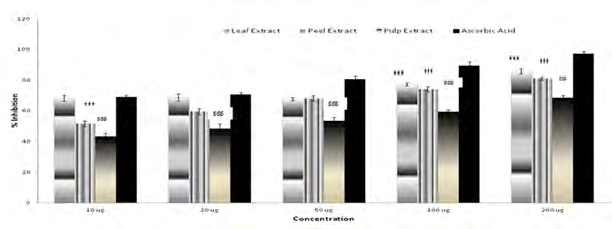
The results are expressed as the mean ± SEM. The results were analyzed by one-way ANOVA followed by LSD (least significant difference) test. The P value < 0.05 was considered to be statistically significant. The significance of difference is indicated by *P<0.05, P<0.01, *P<0.001; †P<0.05, ††P<0.01, †††P<0.001 and $ P<0.05, **$$** P<0.01, $$$ P<0.001 when control group was compared with leaf extract, peel extract and pulp extract respectively.
| S.N. | Extract/ Standard | IC value (ug/mL) 50 |
|---|---|---|
| 1 | Leaf Extract | 17.407 |
| 2 | Peel Extract | 41.846 |
| 3 | Pulp Extract | 83.918 |
| 4 | Ascorbic Acid | 4.717 |
Table 2: IC50 Values (Mg/Ml) For Methanolic Extracts/ Ascorbic Acid in DPPH Free Radical Assay.
In Vitro Antidiabetic Activity
The results of α amylase activity are presented in Figure 2. One way ANOVA shows significant inhibition (p < 0.000) by all extracts at various concentrations (0.5 mg/ ml; F= 27.05, 1 mg/ml; F= 16.20 and at 2 mg/ml; F= 11.33) compared to getryl standard. The least significant difference shows a significant reduction in inhibitory effects (p<0.000) of α amylase activity by leaf, peel and pulp extracts at concentrations (0.5 mg/ml) compared to getryl standard. However, increasing the concentration of leaf and peel extracts by 1 mg/ml shows increase in inhibition, indicating insignificant effects compared to getryl standard. However, pulp extract shows increase in enzyme inhibitory activity in concentration dependent (1 and 2 mg/ml) manner, which is less (p<0.001) compared to getryl standard. The IC50 values of the pulp, peel and leaf extracts of F. Carica were found to be 1.237, 0.899 and 0.896 respectively, whereas IC50 value of the standard getryl is 0.758 (Table 3). The anti-diabetic property of different extracts is in the following order: leaf extract > peel extract> pulp extract. Among the different extracts obtained, the IC50 value varied from 1.237 mg/mL to 0.896 mg/mL for the different parts of F. Carica. Overall, leaf extract revealed the best anti-diabetic properties (lower IC50 value= 0.896 mg/mL) and the F.Carica pulp extract revealed a very poor anti-diabetic activity (higher IC50 value=1.237 mg/mL).
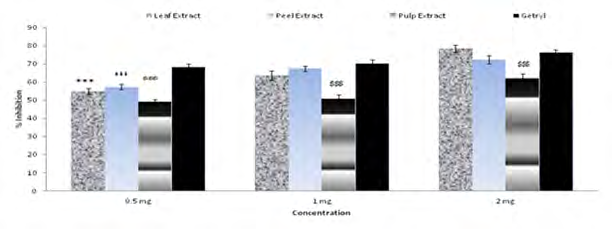
The results are expressed as mean±SEM. The results were analyzed by one-way ANOVA followed by LSD (least significant difference) test. The p-value <0.05 was considered to be statistically significant. The significance of difference is indicated by *P<0.05, P<0.01, *P<0.001; †P<0.05, ††P<0.01, †††P<0.001 and $ P<0.05, **$$** P<0.01, $$$ P<0.001 when control group was compared with leaf extract, peel extract and pulp extract respectively.
| Extract/ Standard | IC50 value (mg/mL) | |
|---|---|---|
| 1 | Leaf Extract | 0.896 |
| 2 | Peel Extract | 0.899 |
| 3 | Pulp Extract | 1.237 |
| 4 | Getryl | 0.758 |
Table 3: IC50 VALUES (mg/mL) FOR METHANOLIC EXTRACTS/ GETRYL IN α- Amylase Inhibitory Activity.
Discussion
The present results show that the methanolic extract of leaves of F. carica is the richest source of phenolic contents (353 ± 10.77) compared to the pulp and the peel. These results show a similarity with the previously reported studies showing leaves as a potent source of antioxidants and bioactive compounds [19]. Polyphenols have been a matter of attention due to their ability to stabilize the unpaired electrons and exhibit structures that prevent cellular oxidation by free radical scavengers. On the other hand, the fruit of F. Carica was found to be the richest source of phenolic contents compared to the leaves and the stem bark [14, 20]. Also, stem has been reported to be the richest part containing phenolic compounds [21]. One of the recent investigations on three figs of Tunisian varieties reported difference between polyphenolic compounds in the tested varieties. The authors further reported that the methanolic extracts of fruit, pulp, and peel of the selected varieties were rich in polyphenols, flavonoids, O - diphenols tannins and anthocyanins [22]. Likewise, methanolic extraction had higher phenolic contents, GAE/ gm of dried leaves as compared to other solvents [19, 23]. In contrast, Konyalioglu, et al. [24] reported that the water extraction had high phenolic contents in leaves compared to the other solvents [24].
It is considered that the total antioxidant potential of plants, fruits, and vegetables is linked with the proportion of phenolic and flavonoids contents in them [25, 26]. Accordingly, the present results show predominantly high antioxidant or free radical scavenging capacity in this order, leaves > peel > pulp. It can be suggested that the leaves of F.carica possess high antioxidant potential due to its high phenolic contents compared to pulp and peel. Our present results proved the correlation between phenolic contents and the antioxidant capacity of the leaves [27, 28]. Furthermore, Oliveira, et al. [23] reported that all the parts of fig were shown to possess DPPH scavenging activity but only the leaves exhibited activity to scavenge superoxides. The authors suggested that leaves be the effective part related to highest phenolic compounds [23].
Likely, infusion of leaves of F.carica is traditionally employed as folk medicine for the treatment of diabetes [29, 30] and also for the treatment of nutritional anemia, certain tumors and inflammatory diseases [12, 13]. In comparison to these investigations, present results show highest α - amylase inhibitory activity by leaves as compared to pulp and peel. Preclinical findings by Stalin, et al. [31] reported that methanolic leaf extract of Ficus carica reduced diabetes with the increase in weight in alloxan-induced diabetic rat models [31]. In another study hypoglycemic effects were seen in streptozotocin-induced diabetic rat model when treated with aqueous extract of F. carica leaves [29, 30].
According to another study, postprandial hyperglycemic effects were reduced by treating animals with a decoction of fig leaves with a reduction in hypercholesterolemia [32]. In contrast, F. carica fruit possesses anti-diabetic and antiobesity characteristics, reported by the recent investigation on Ficus carica fruit, leaves, and stem bark [14]. The anthocyanins have the capability to reduce hyperglycemic states owing to their ability to delay digestion of dietary carbohydrates [33] by reducing the activities of intestinal glucosidase and alpha- amylase. Sarraclara, et al. [34] studied the effects of fig leaves decoction on diabetic management by controlling normal hypoglycemia in short term.
It can be suggested that the dietary polyphenols contents of the Fig leaves are helpful in reducing α - amylase activity in addition to antioxidant activity. It may be due to their ability to reduce the glucose levels by increasing the serum levels of insulin, rising tissue sensitivity to insulin, stimulating the ability of glucose utilizing enzymes and lowering the activity of α – amylase [35]. Stephen, et al. evaluated the effects of F. carica ethyl acetate leaves extract on carbohydrate metabolism. F. carica leaves have a definite role in normalizing the activities of enzymes in diabetic rats [36]. Also, these glucose-lowering effects of medicinal plants containing polyphenols have been reported to be due to their binding to glucose transporters and with digestive enzymes competitively [37, 38].
Anthocyanins have a profound role to retard the activities of intestinal glucosidase and alpha-amylase activities that consequently delay the carbohydrate metabolism, inhibit postprandial hyperglycemia and suppress micro and macrovascular problems [25]. Furthermore, many phenolic compounds have been examined to target specific regulatory mechanisms of action of diabetes-related genes and proteins [39]. Some enzymes are potentially regulated by epigenetic factors that modulate diabetes-related genes. Therefore, targeting epigenetic modulation of these genes by phytochemicals can significantly reverse diabetes [40]. It can be suggested that the fig leaves can be used as potential antioxidant and the richest source of polyphenols in traditional health care system and modern medicine to control diabetes. Since type 2 diabetes mellitus is influenced by epigenetic factors, the findings may be useful for further investigation to identify the mechanism of action of the phytochemicals from leaves and peels on diabetes-related genes.
Conclusion
It is concluded that the Ficus carica leaves can be used as a useful source of antioxidants to reduce the risk of abnormal carbohydrate metabolism associated with diabetes. Further, in order to validate their use for therapeutic purposes, it is important to thoroughly investigate the mechanism by which these compounds act.
Acknowledgement
The authors acknowledge Minhaj University, Lahore for providing financial support.
References
-
Gilani AH, Rahman AU (2005) Trends in ethnopharmacology. Journal of Ethnopharmacology 100: 43-49.
-
Ahmad S, Bhatti FR, Khaliq FH, Irshad S, Madni A (2013) A review on the prosperous phytochemical and pharmacological effects of Ficus carica. Int J Bioassays 2(05): 843-8499.
-
Kislev ME, Hartmann A, Bar-Yosef O (2006) Early domesticated figure in the Jordan Valley. Science 312(5778): 1372-1374.
-
Woodland DW (1997) Contemporary Plant Systematics, 2nd (Edn), Andrews University Press, Berrien Springs, MI, pp: 610.
-
Joseph B, Raj SJ (2011) Pharmacognostic and phytochemical properties of Ficus carica Linn–An overview. International journal of pharmtech research 3(1): 8-12.
-
Patil Vikas V, Bhangale SC, Patil VR (2010) Evaluation of anti-pyretic potential of Ficus carica leaves. Evaluation 2(2): 10.
-
Bouyahya A, Bensaid M, Bakri Y, Dakka N (2016) Phytochemistry and Ethnopharmacology of Ficus carica. Int J Biochem Res Rev 14: 1-2.
-
Duke JA, Bogenschutz-Godwin MJ, du Cellier J, Duke PAK (1929) Handbook of Medicinal Herbs, 2nd (Edn.), Boca Raton, Washington DC, London, New York, pp: 870
-
Velioglu YS, Mazza G, Gao L, Oomah BD (1998) Antioxidant activity and total phenolics in selected fruits, vegetables, and grain products. J Agric Food Chem 46(10): 4113-1447.
-
Eberhardt MV, Lee CY, Liu RH (2000) Nutrition: Antioxidant activity of fresh apples. Nature 405(6789): 903.
-
Kim MY, Choi SW, Chung SK (2008) Antioxidative flavonoids from the garlic (Allium sativum L.) shoot. Food Science and Biotechnology 9(4): 199-203.
-
Lansky EP, Paavilainen HM, Pawlus AD, Newman RA (2008) Ficus spp.(fig): Ethnobotany and potential as anticancer and anti-inflammatory agents. Journal of Ethnopharmacology 119(2): 195-213.
-
Oliveira AP, Baptista P, Andrade PB, Martins F, Pereira JA, et al. (2012). Characterization of Ficus carica L. cultivars by DNA and secondary metabolite analysis: Is genetic diversity reflected in the chemical composition? Food research international 49(2): 710-719.
-
Mopuri R, Ganjayi M, Meriga B, Koorbanally NA, Islam MS (2018) The effects of Ficus carica on the activity of enzymes related to metabolic syndrome. Journal of food and drug analysis 26(1): 201-210.
-
Soobrattee MA, Neergheen VS, Luximon-Ramma A, Aruoma OI, Bahorun T (2005) Phenolics as potential antioxidant therapeutic agents: mechanism and actions. Mutation Research/Fundamental and Molecular Mechanisms of Mutagenesis 579(1-2): 200-213.
-
Ainsworth EA, Gillespie KM (2007) Estimation of total phenolic content and other oxidation substrates in plant tissues using Folin–Ciocalteu reagent. Nature protocols 2(4): 875.
-
Karadag A, Ozcelik B, Saner S (2009) Review of methods to determine antioxidant capacities. Food analytical methods 2(1): 41-60.
-
Hossain SJ, El-Sayed M, Aoshima H (2009) Antioxidative and anti-α-amylase activities of four wild plants consumed by pastoral nomads in Egypt. Orient Pharm Exp Med(3): 217-224
-
Mahmoudi S, Khali M, Benkhaled A, Benamirouche K, Baiti I (2016) Phenolic and flavonoid contents, antioxidant and antimicrobial activities of leaf extracts from ten Algerian Ficus carica L. varieties. Asian Pacific Journal of Tropical Biomedicine 6(3): 239-245.
-
Soni N, Mehta S, Satpathy G, Gupta RK (2014) Estimation of nutritional, phytochemical, antioxidant and antibacterial activity of dried fig (Ficus carica). Journal of Pharmacognosy and Phytochemistry 3(2): 158-165.
-
Saoudi M, El Feki A (2012) Protective role of Ficus carica stem extract against hepatic oxidative damage induced by methanol in male Wistar rats. Evidence-Based Complementary and Alternative Medicine, pp: 1-8.
-
Harzallah A, Bhouri AM, Amri Z, Soltana H, Hammami M (2016) Phytochemical content and antioxidant activity of different fruit parts juices of three figs (FicuscaricaL.) varieties grown in Tunisia. Industrial Crops and Products 83: 255-267.
-
Oliveira AP, Valentão P, Pereira JA, Silva BM, Tavares F, Andrade PB (2009) Ficuscarica L.: metabolic and biological screening. Food Chem Toxicol 47: 2841-2846.
-
Konyalioglu S, Saglam H and Kivcak B (2005) a-Tocopherol, Flavonoid, and Phenol Contents and Antioxidant Activity of Ficuscarica Leaves. Pharmaceutical Biology 43(8): 683-686.
-
Ajmal M, Arshad MU, Saeed F, Ahmed T, Khan AU, (2016) Exploring the Nutritional Characteristics of Different Parts of Fig in Relation to Hypoglycemic Potential. Pakistan Journal of Life and Social Sciences 14: 115-122.
-
Yang XM, Yu W, Ou ZP, Liu WM, Ji XL (2009) Antioxidant and immunity activity of water extract and crude polysaccharide from Ficus carica L. fruit. Plant Foods for Human Nutrition 64(2): 167-173.
-
Çaliskan O, Polat AA (2011) Phytochemical and antioxidant properties of selected fig (Ficuscarica L.) accessions from the eastern Mediterranean region of Turkey. Sci Hortic 128(4): 473-478.
-
Veberic R, Colaric M, Stampar F (2008) Phenolic acids and flavonoids of fig fruit (Ficuscarica L.) in the northern Mediterranean region. Food Chem 106(1): 153-157.
-
Perez C, Dominguez E, Ramiro JM, Romero A, et al (1996) A study on the glycaemic balance in streptozotocin‐ diabetic rats treated with an aqueous extract of Ficus carica (fig tree) leaves. Phytotherapy Research 10(1): 82-83.
-
Perez C, Canal JR, Torres MD (2003) Experimental diabetes treated with ficus carica extract: effect on oxidative stress parameters. Acta Diabetologica 40(1): 3-8.
-
Stalin C, Dineshkumar P, Nithiyananthan K (2012) Evaluation of antidiabeticactivity of methanolic leaf extract of Ficuscarica in alloxan induced diabeticrats. Asian J Pharm Clin Res 5: 85-87.
-
Khan KY, Khan MA, Ahmad M, Hussain I, Mazari P, et al. (2011) Hypoglycemic potential of genus Ficus L.: A review of ten years of Plant Based Medicine used to cure Diabetes (2000-2010). Journal of Applied Pharmaceutical Science 1(06): 223-227.
-
Adisakwattana S, Yibchok-Anun S, Charoenlertkul P, Wongsasiripat N (2011) Cyanidin-3-rutinoside alleviates postprandial hyperglycemia and its synergism with acarbose by inhibition of intestinal α-glucosidase. Journal of clinical biochemistry and nutrition 49(1): 36- 41.
-
Serraclara A, Hawkins F, Perez C, Domınguez E, Campillo JE, et al. (1998) Hypoglycemic action of an oral fig-leaf decoction in type-I diabetic patients. Diabetes research and clinical practice 39(1): 19-22.
-
Arif T, Sharma B, Gahlaut A, Kumar V, Dabur R. (2014) Anti-diabetic agents from medicinal plants: A review. Chem Biol Lett 1(1): 1-3.
-
Stephen Irudayaraj S, Christudas S, Antony S, Duraipandiyan V, Naif Abdullah AD, et al. (2017) Protective effects of Ficus carica leaves on glucose and lipids levels, carbohydrate metabolism enzymes and β-cells in type 2 diabetic rats. Pharmaceutical biology 55(1): 1074-1081.
-
LacroixIM, Li-Chen EC (2014) Overview of food products and dietary constituents with antidiabetic properties and their putative mechanisms of action: a natural approach to complement pharmacotherapy in the management of diabetes. Mol Nutr Food Res 58(1): 61-78.
-
NistorBaldea LA, Martineau LC, Benhaddou-Andaloussi A, Arnason JT, Levy E, et al. (132) Inhibition of intestinal glucose absorption by anti-diabetic medicinal plants derived from the James Bay Cree traditional pharmacopeia. J Ethnopharmacol 132(2): 473-482.
-
Cazarolli LH , Zanatta L , Alberton EH , Figueiredo MS , Folador P , et al. (2008) Flavonoids: Cellular and Molecular Mechanism of Action in Glucose Homeostasis. Mini-Reviews in Medicinal Chemistry 8: 1032-1038.
-
Barbagallo I, Vanella L, Distefano A, Nicolosi D, Maravigna A, et al. (2016) improves lipid metabolism during adipogenic differentiation of human stem cells. Eur Rev Med Pharmacol Sci 20(24): 5223-5232.
- Acido Labile or Gastro Irritant Apis and Enteric Release in Galenic Practice: An Overview
- A Study on Knowledge, Attitude and Practice of Hand Hygiene among Healthcare Professionals at a Tertiary Care Hospital, India
- Influence of Inoculum Concentration on In Vivo Incubation Period of Emmia lacerata, Pathogenesis and Management of Wilt in Pepper (Capsicum annuum L.)
- Vanilla’s Chemistry
- Marine Anti-Cancer Compounds and Adverse Effects of Global Warming on Oceans: An Overview
- Serological Investigation of Chikungunya Virus Antibody among Malaria-Suspected Febrile Patients in Some Healthcare Facilities in Rivers State