
Highlights on Unique Orange Pore Cap Mushroom Favolaschia Sp. and Beech Orange Mushroom Cyttaria sp. and Their Biological Activities
Fungi exist everywhere around us. However, edible Mushrooms represent promising source for novel compounds with potential uses in different biotechnological fields. Many mushrooms were sources of novel compounds showing biological actions such as antimicrobial, anticancer, antiinflammatory activities. Likewise, mushrooms are macrofungi that exist everywhere around us. They have significant roles in human life as source of nutrition and bioactive compounds. Many mushrooms have been reported as promising biotechnological tools for production of secondary metabolites of various biological activities. Favolaschia sp.; Cyttaria sp. mushrooms are especially interesting due to the rareness of Basidiomycetes. In this review, the ecology, occurrence, of unique Favolaschia sp.; Cyttaria sp. mushrooms were described, and their biological activities.
Introduction
Mushroom producing fungi belong to Basidiomycetes and Ascomycetes, including edible and non-edible species, and some mushroom fruiting body produces basidiospores at the tip of club like structures called basidia, which are arranged along the gills of the mushroom [1, 2, 3, 4, 5]. Mushrooms have been documented for centuries as use as food and medicine as they are generous sources of nutrients and biologically active compounds that have various applications in agriculture, food, pharmaceuticals, cosmetics, and food related industries, amongst others [6, 7, 8, 9, 10].
Mushroom obtain their nutrition through being saprotrophs, parasites, or symbionts such as mycorrhiza. Mushrooms are the reproductive phase (fruiting bodies) but they there is also a vegetative phase to these fungi (mycelia).
Edible mushrooms are often low in calories and can be healthy sources of proteins, flavonoids, metals, amino acids, minerals, volatile oils, carotenoids fats, phenolic compounds, and different vitamins and ergosterol that can be used as a source for vitamin D2 [3, 5, 11, 12, 13, 14, 15, 16, 17, 18] .
The diversity of compounds extracted from mushrooms has attracted attention as a mine for novel compounds. Some compounds they contain have been classified as Host Defence Potentiators (HDP) which can have immune system enhancement properties [103, 105]. Various compounds are responsible for different therapeutic activities of many mushrooms genera. Various biological activities have been reported such as anticancer, antiinflammatory, hypoglycemic, antimicrobial, antioxidant, immunomodulatory, antiviral, hepatoprotective, antineurodegenerative, antiangiogenic, and hypocholesterolemic activities [19, 20, 21, 22, 23, 24, 25, 26, 27, 28].
Favolaschia sp.
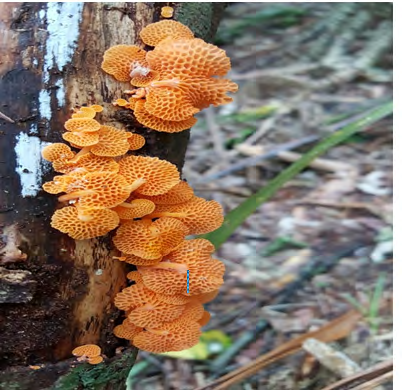
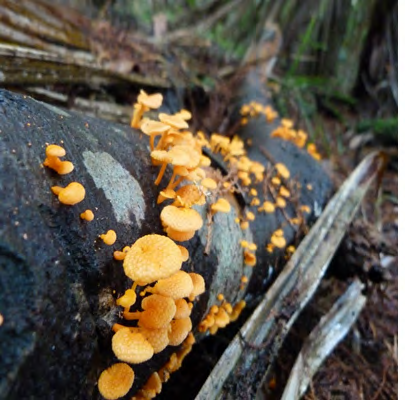
Favolaschia sp. belonging to Basidiomycota; Class: Agaricomycetes; Order: Agaricales; Family: Mycenaceae. Favolaschia sp., commonly known as the orange pore fungus, is a species of fungus in the family Mycenaceae. Due to its form it is also known as orange pore conch or orange Ping-Pong bat. Throughout much of its expanded range Favolaschia calocera is now considered an invasive species. It colonizes ruderal sites along transport routes and can become main in habitats disturbed by human activity. Favolaschia calocera is a wood-inhabiting saprotrophic fungus. It often has a bright yellow color at first, and can later appear in a brownish yellow color, though it often presents as a bright orange stalked fan, 5 mm–30 mm diameter, with prominent pores on the underside. Fruit-body: This little fungus is very bright orange in colour. It is fan shaped like a ping pong bat, with a short stem (up to 20 mm long), attached to the side of the cap and to logs or dead branches. Instead of gills it has large pores giving it a honeycombed appearance. The pore openings are polygonal to elliptical with a finely hairy inner surface. There are generally 1–2 pores per mm but they are smaller and shallower near the margin. The stem is rudimentary, about 5mm long, with sparse short white hairs and laterally attached [29, 30, 31, 32]. The pores are visible through the thin flesh. Spore print: White. Habit: Although not common in gardens. It grows in large troops on logs and is very visible in the rainforest (Figures 1 and 2).
Favolaschia Sp. Biological Activities
Kornsakulkarn, et al. reported that fourteen new compounds, oudemansins, oudemansinols, favolasins, favolasinin, polyketides, and (R,E)-2,4-dimethyl-5-phenyl- 4-pentene-2,3-diol, together with nine known compounds were isolated from the basidiomycete fungus Favolaschia sp. BCC 18686 [33]. Two new compounds, favolasin E and 9-oxostrobilurin E, were isolated from Favolaschia calocera BCC 36684 along with nine β-methoxyacrylate- type derivatives. Compounds in the class of oudemansins and strobilurins exhibited moderate to strong antimalarial activity with relatively low cytotoxicity against Vero cells. Potent antimalarial activity was demonstrated for 9-methoxystrobilurins G, K, and E. Also, several compounds showed specific cytotoxicity against NCI-187 cells (human small-cell lung cancer).
Two strobilurins, 9-methoxystrobilurin B and 9-methoxystrobilurin G, two monochlorinated 2,3-dihydro- 1-benzoxepin derivatives, and butenolide, together with four known compounds, strobilurin B, 9-methoxystrobilurin A, and oudemansins A and B, were isolated from culture BCC 18689 of the fungus Favolaschia sp. 9-Methoxystrobilurins A, B, and G and oudemansins A and B exhibited antimalarial, antifungal, and cytotoxic activities [34]. Wood, et al. Submerged liquid cultures of the basidiomycete Favolaschia pustulosa afforded the novel 9-methoxystrobilurin derivatives, 9-methoxystrobilurin L and 9-methoxystrobilurin E, and the related oudemansin derivative, oudemansin L [35]. 9-methoxystrobilurin L was cytotoxic to cells of the human B lymphoblastoid cell line (Jijoye), with an IC50 of 1.8 nM. This cytotoxicity was observed in a 5- day assay only and was not apparent after 2 days. 9-methoxystrobilurin L showed some antibacterial activity against Bacillus subtilis and antifungal activity against Candida albicans.
Favolaschia sp. 87129, Pterula sp. 82168, Collybia nivalis and Omphalotus olearius were cultivated on natural substrates. The antibiotic metabolites oudemansin A. strobilurins A, D, illudin S and pterulone were isolated and identified. A new antifungal metabolite, pterulone B, was described from cultures of Pterula sp. 82168 on wood. Collybia nivalis was found to be the first species of this genus to produce strobilurins and oudemansin A. The concentrations of the antibiotics, however, were sufficient to inhibit other saprophytic fungi [36]. Favolon triterpenoid from a Favolaschia Species exhibits potent antifungal activity but does not show cytotoxic activity on L 1210 cells [37]. Laschiatrion, a new antifungal antibiotic, was isolated from fermentations of Favolaschia sp. 87129. Laschiatrion exhibits broad in vitro activity against several human pathogens while no antibacterial and cytotoxic activities could be detected. The structure was elucidated by spectroscopic techniques [38].
Cyttaria Sp.
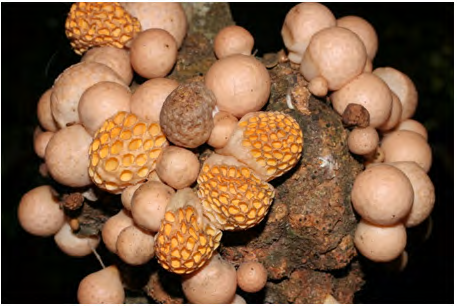
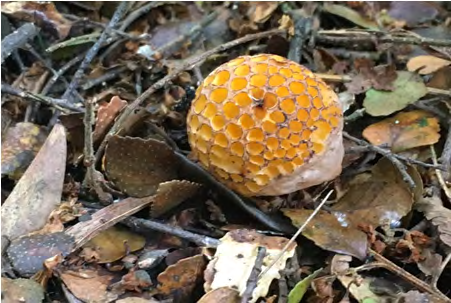
Cyttaria sp., commonly known as the myrtle orange or beech orange, is an orange-white coloured and edible ascomycete fungus native to Australia. It is a specific parasite of myrtle beech (Nothofagus cunninghamii) trees. Cyttaria gunnii is an ascomycete in Class: Leotiomycetes; Order: Cyttariales; Family Cyttariaceae. It is a caulicolous (stem parasite) fungi, restricted to species of Nothofagus, specifically Nothofagus cunninghamii, Nothofagus fusca, and Nothofagus menziesii. The species is distributed throughout Australia, New Zealand, and Tasmania wherever host trees are also found. The fruiting bodies, which grow in clusters, are usually around 2cm in diameter. The yellow/orange cup-shaped cavities form upon maturity to release wind-dispersed spores.
Stromata solitary or in dense clusters, up to 2 cm in diameter, pear-shaped, smooth and dry but becoming slimy if wetted, fawn or tan above, light coloured below, bright yellow when mature except for a sterile base which remains white. Hollow at maturity, internal fibres white. Apothecia very numerous, up to 200, bright yellow. Papillae small, scattered between apothecia, appearing as white flecks on young stroma, arising as minute elevations within shallow depressions, not raised above the surface of the stroma. Pycnidia absent. Asci 145-165 x 14 µm, ascospores sub-globose 12-12.5 x 6.5-12 µ, dark coloured, and spore print black. Paraphyses as long as asci, 2 µ wide, septate, branched, swollen at ends. Habitat: An obligate parasite forming globose galls on Nothofagus menziesii (Hook f.) Oerst, in New Zealand and Nothofagus cunninghamii (Hook. f.) Oerst, in Tasmania and Victoria. Range in New Zealand as for host (Figures 3&4) [39, 40].
Cyttaria sp. Biological Activities
The antioxidant capacities of the methanolic extracts of the dried caps of Cyttaria gunnii was determined using a number of different chemical reactions in evaluating multi- mechanistic antioxidant activities. These included the Trolox equivalent antioxidant capacity, ferric ion reducing antioxidant power, and ferrous ion chelating activity. Mineral contents of the dried caps of the mushroom was also determined by inductively coupled plasma–optical emission spectroscopy. The results indicated that Cyttaria gunnii edible wild mushrooms have a high antioxidant capacity. It can be concluded that Cyttaria gunnii edible wild mushroom are good source of nutritional antioxidants and a number of mineral elements [41].
Chemical and bioactive properties of nine wild edible mushrooms from native Nothofagus forest from Patagonia, Argentina. Macronutrients, sugars, fatty acids, tocopherols, organic acids, phenolic compounds and antioxidant properties were determined by Toledo, et al. [42]. Protein was found in high levels Cyttaria hariotii. All of them presented mannitol and trehalose as main sugars. The major fatty acid found was linoleic acid, followed by oleic acid and palmitic acid. All species presented oxalic and fumaric acids, while some also had malic, quinic and citric acids. Tocopherols composition was variable. All presented the best results in antioxidant activity assay, the highest content of phenolic compounds presenting gallic, p-hydroxybenzoic, p-coumaric and cinnamic acids.
The edible mushroom Cyttaria espinosae is a valuable food resource, not only because its pleasant taste, but also for its nutritional properties. Leiva‐Portilla, et al. studied the physicochemical characterization and antioxidant capacity determination of dehydrated Cyttaria espinosae [43]. The results show that this wild mushroom is a good source of β-carotene, proteins and nutritionally relevant minerals, especially K and Fe. Also, dehydration of Cyttaria espinosae by freeze-drying gives the possibility of adding value to this mushroom, due to the bioactive compounds are maintained, the structure were less collapsed and fewer changes occurred with respect to color and appearance when comparing with hot air-dried samples. And finally show that drying technologies will help to expand the market for this valuable resource and poses the challenge of working for a better management and conservation of related habitats [43, 44].
Conclusion
Mushrooms are generous sources of numerous secondary metabolites showing various biological activities of great importance in different field, especially in the field of pharmaceutical industries. This review represents chemical composition and nutritional value of most of Favolaschia sp. and Cyttaria sp. Furthermore, it provides important information necessary to characterize and define the use of these species as, functional foods and sources of bioactive compounds. Moreover, such rarely isolated mushrooms can represent unique sources for novel metabolites that may contribute in treatment of currently untreated diseases or have other promising applications that help in serving humanity.
References
-
Elkhateeb WA, Daba GM, Thomas PW, Wen TC (2019) Medicinal mushrooms as a new source of natural therapeutic bioactive compounds. Egypt Pharmaceu J 18(2): 88-101.
-
Elkhateeb WA, Daba GM, Elnahas M, Thomas P, Emam M (2020) Metabolic profile and skin-related bioactivities of Cerioporus squamosus hydromethanolic extract. Biodiversitas J Biological Div 21(10).
-
Elkhateeb WA, Daba G (2020) Review: The endless nutritional and pharmaceutical benefits of the Himalayan gold, Cordyceps; Current knowledge and prospective potentials. Biofarmasi Journal of Natural Product Biochemistry 18(2): 70-77.
-
Elkhateeb WA, Daba GM (2020) Termitomyces Marvel Medicinal Mushroom Having a Unique Life Cycle. Open Access Journal of Pharmaceutical Research 4(1): 1-4.
-
Daba GM, Elkhateeb W, ELDien AN, Fadl E, Elhagrasi A, et al. (2020) Therapeutic potentials of n-hexane extracts of the three medicinal mushrooms regarding their anti- colon cancer, antioxidant, and hypocholesterolemic capabilities. Biodiversitas 21(6): 2437-2445.
-
Elkhateeb WA (2020) What medicinal mushroom can do?. Chem Res J 5(1): 106-118.
-
Elkhateeb WA, Daba GM, Elmahdy EM, Thomas PW, Wen TC, et al. (2019) Antiviral potential of mushrooms in the light of their biological active compounds. ARC J Pharmac Sci 5(2): 45-49.
-
El-Hagrassi A (2020) In vitro bioactive potential and chemical analysis of the n-hexane extract of the medicinal mushroom, Cordyceps militaris. Malays J Microbiol 16(1): 40-48.
-
Elkhateeb WA, Daba GM, El-Dein AN, Sheir DH, Fayad W, et al. (2020) Insights into the in-vitro hypocholesterolemic, antioxidant, antirotavirus, and anticolon cancer activities of the methanolic extracts of a Japanese lichen, Candelariella vitellina, and a Japanese mushroom, Ganoderma applanatum. Egyptian Pharmaceutical Journal 19(1): 67-73.
-
Elkhateeb WA, Elnahas MO, Thomas PW, Daba GM (2019) To Heal or Not to Heal? Medicinal Mushrooms Wound Healing Capacities. ARC Journal of Pharmaceutical Sciences 5(4): 28-35.
-
Elkhateeb WA, Daba GM, Elnahas MO, Thomas P (2019) Anticoagulant capacities of some medicinal mushrooms. ARC J Pharma Sci 5: 12-16.
-
Elkhateeb W, Elnahas MO, Paul W, Daba GM (2020) Fomes fomentarius and Polyporus squamosus models of marvel medicinal mushrooms. Biomed Res Rev 3(1): 119.
-
Elkhateeb WA, Daba GM (2021) Mycotherapy of the good and the tasty medicinal mushrooms Lentinus, Pleurotus, and Tremella. Journal of Pharmaceutics and Pharmacology Research 4(2): 1-6.
-
Elkhateeb WA, Daba GM (2021) The Fascinating Bird’s Nest Mushroom, Secondary Metabolites and Biological Activities. International Journal of Pharma Research and Health Sciences 9 (1): 3265-3269.
-
Elkhateeb WA, Daba GM, Gaziea SM (2021) The Anti- Nemic Potential of Mushroom against Plant-Parasitic Nematodes. Open Access Journal of Microbiology & Biotechnology 6(1): 1-6.
-
Elkhateeb WA, Elnahas MO, Thomas PW, Daba GM (2020) Trametes Versicolor and Dictyophora Indusiata Champions of Medicinal Mushrooms. Open Access Journal of Pharmaceutical Research 4(1): 1-7.
-
Thomas PW, Elkhateeb WA, Daba GM (2020) Chaga (Inonotus obliquus): a medical marvel but a conservation dilemma?. Sydowia 72: 123-130.
-
Sharma SK, Gautam N (2017) Chemical and bioactive profiling, and biological activities of coral fungi from north-western Himalayas. Scientific reports 7(1): 1-13.
-
Jais HM, Tajuddin R, Iffendy KA (2014) Macrofungi of a Healty Campus (Penerbit USM). Penerbit USM.
-
Kuo M, Methven A (2010) 100 cool mushrooms. University of Michigan Press.
-
Kamalakannan A, Syamala M, Sankar P, Shreedevasena M, Ajay M (2020) Mushrooms–A Hidden Treasure. JPS Scientific, Tamil Nadu, India, pp: 1-136.
-
Cheung PCK (2010) The nutritional and health benefits of mushrooms. Nut Bull 35(4): 292-299.
-
Hobbs C (2002) Medicinal mushrooms: an exploration of tradition, healing, and culture. Book Publishing Company, pp: 1-402.
-
Rathee S, Rathee D, Rathee D, Kumar V, Rathee P (2012) Mushrooms as therapeutic agents. Braz J Pharmacog 22(2): 459-474.
-
Xu T, Beelman R (2015) The bioactive compounds in medicinal mushrooms have potential protective effects against neurodegenerative diseases. Adv Food Technol Nut Sci 1(2): 62-66.
-
Halpern G (2007) Healing mushrooms. Garden City Park, New York, USA: Square One Publishers Inc., pp: 1-194.
-
Rahi D, Malik D (2016) Diversity of mushrooms and their metabolites of nutraceutical and therapeutic significance. J Mycol pp: 1-19.
-
De Silva D, Rapior S, Sudarman E, Stadler M, Jianchu X, et al. (2013) Bioactive metabolites from macrofungi: ethnopharmacology, biological activities and chemistry. Fungal Div 62: 1-40.
-
Johnston PR, Whitton SR, Buchanan PK, Park D, Pennycook SR, et al. (2006) The basidiomycete genus Favolaschia in New Zealand. New Zealand Journal of Botany 44(1): 65-87.
-
Gillen K, Læssøe T, Kirschner R, Piepenbring M (2013) Favolaschia species Agaricales, Basidiomycota from Ecuador and Panama. Nova Hedwigia 96(1-2): 117-165.
-
Robinson R (2013) First record of Favolaschia calocera in Western Australia. Australasian Mycologist 31: 41-43.
-
Ainsworth AM, Farley D, Gainey P, Penna P, Suz LM (2015) Invasion of the orange ping-pong bats: the rapidly changing distribution of Favolaschia calocera. Field Mycology 16(4): 113-120.
-
Kornsakulkarn J, Palasarn S, Choowong W, Thongpanchang T, Boonyuen N, et al. (2020) Antimalarial 9-Methoxystrobilurins, Oudemansins, and Related Polyketides from Cultures of Basidiomycete Favolaschia Species. Journal of natural products 83(4): 905-917.
-
Kornsakulkarn J, Thongpanchang C, Chainoy R, Choowong W, Nithithanasilp S, et al. (2010) Bioactive metabolites from cultures of basidiomycete Favolaschia tonkinensis. Journal of natural products 73(4): 759-762.
-
Wood KA, Kau DA, Wrigley SK, Beneyto R, Renno DV, et al. (1996) Novel β-methoxyacrylates of the 9-methoxystrobilurin and oudemansin classes produced by the basidiomycete Favolaschia pustulosa. Journal of natural products 59(7): 646-649.
-
Engler M, Anke T, Sterner O (1998) Production of antibiotics by Collybia nivalis, Omphalotus olearius, a Favolaschia and a Pterula species on natural substrates. Z Naturforsch C J Biosci 53(5-6): 318-324.
-
Anke T, Werle A, Zapf S, Velten R, Steglich W (1995) Favolon, a new antifungal triterpenoid from a Favolaschia species. The Journal of antibiotics 48(7): 725-726.
-
Anke T, Werle A, Kappe R, Sterner O (2004) Laschiatrion, a new antifungal agent from a Favolaschia species (Basidiomycetes) active against human pathogens. The Journal of antibiotics 57(8): 496-501.
-
Minter DW, Cannon PF, Peredo HL (1987) South American species of Cyttaria: (A remarkable and beautiful group of edible ascomycetes). Mycologist 1(1): 7-11.
-
Crisci JV, Gamundi IJ, Cabello MN (1988) A cladistic analysis of the genus Cyttaria (Fungi‐Ascomycotina). Cladistics 4(3): 279-290.
-
Zeng X, Suwandi J, Fuller J, Doronila A, Ng K (2012) Antioxidant capacity and mineral contents of edible wild Australian mushrooms. Food Science and Technology International 18(4): 367-379.
-
Toledo CV, Barroetaveña C, Fernandes Â, Barros L, Ferreira IC (2016) Chemical and antioxidant properties of wild edible mushrooms from native Nothofagus spp. forest, Argentina. Molecules 21(9): 1201.
-
Leiva‐Portilla DJ, Rodríguez‐Núñez KE, Rodríguez‐ Ramos FJ, Delgadillo Acevedo Á, Uribe E (2020) Impact on Physicochemical Composition and Antioxidant Activity of the Wild Edible Mushroom Cyttaria espinosae Subjected to Drying. Chemistry & Biodiversity 17(11): e2000642.
-
Jacinto-Azevedo B, Valderrama N, Henríquez K, Aranda M, Aqueveque P (2021) Nutritional value and biological properties of Chilean wild and commercial edible mushrooms. Food Chemistry 356: 129651.
- Acido Labile or Gastro Irritant Apis and Enteric Release in Galenic Practice: An Overview
- A Study on Knowledge, Attitude and Practice of Hand Hygiene among Healthcare Professionals at a Tertiary Care Hospital, India
- Influence of Inoculum Concentration on In Vivo Incubation Period of Emmia lacerata, Pathogenesis and Management of Wilt in Pepper (Capsicum annuum L.)
- Vanilla’s Chemistry
- Marine Anti-Cancer Compounds and Adverse Effects of Global Warming on Oceans: An Overview
- Serological Investigation of Chikungunya Virus Antibody among Malaria-Suspected Febrile Patients in Some Healthcare Facilities in Rivers State