
Preparation and Characterization of Sodium Alginate- Eudragit E100 Based Systems with Prospective Pharmaceutical Delivery to Application
Regarding the preparation of a local drug delivery system, the possibility of incorporating an active substance in a matrix system was investigated to prolong the drug release. A complex between sodium alginate and a triple copolymer of dimethyl aminoethyl methacrylate was prepared in the presence of a cross-linking agent- malic acid. The formation of a polyelectrolyte complex was proven by turbidimetry, determining the specific viscosity of the diluted solutions of sodium alginate, EE 100, malic acid with IR spectroscopy.
Introduction
Sodium alginate is the sodium salt of alginic acid, which is a polysaccharide from natural origin. It is a constituent of 1,4-linked-β-D-mannuronic acid and α-L- guluronic acid monomers, and their ratio and order vary through the polymer chain. From a chemical point of view, alginates are linear unbranched polysaccharides with anionic charge, and hydroxylic and undissociated carboxylic groups can be found within their structure [1]. The excellent biocompatibility and biodegradability of alginate make it widely used for biomedical applications, especially for drug delivery systems and tissue engineering [2]. Different functions and applications of the polymer can be derived due to its possibility for easy chemical modifications [3]. These modifications lead to the obtaining of derivatives with various structures and properties. The alginate forms a gel in the presence of different polyvalent metal cations because of the polymer chains cross-linking [4]. Polyectrolyte complexes between sodium alginate and cationic polymers were investigated for drug delivery and tissue engineering [5, 6, 7]. For example, films based on sodium alginate and chitosan complexes are proposed for transdermal drug delivery. The formation of interpolyelectrolyte complexes was also characterised by Moustafine et al. [8, 9, 10]. There is a significant difference between the properties of such polymer complexes in comparison to the monomers alone [11]. This is a prerequisite for considering such polyelectrolyte complexes as a new class of polymer compounds. The chemical modification of polyelectrolytes provides a better opportunity for them to be used in the pharmaceutical practice [12, 13]. A complex formation between sodium alginate (containing carboxylic groups) and a triple copolymer of dimethyl aminoethyl methacrylate (containing tertiary amino- groups) was investigated in the present study. The polycomplex was prepared, characterised, and modified, and its potential application as a new polymer vehicle for modified drug delivery was evaluated [14].
Experimental
Materials
Sodium alginate (20- 40cps), a fine tan to brown powder, was purchased from Sigma Aldrich, Germany. Poly(butylmethacrylate-co-(2-dimethylaminoethyl) methacrylate-co-methyl methacrylate) 1:2:1 (Eudragit E 100; EE100) a cationic co- polymer based on dimethylaminoethyl methacrylate, butyl methacrylate and methylmethacrylate was purchased from Evonik Industries, Germany. Glycerol was purchased from Sigma Aldrich, Germany The citric acid and malic acid were purchased from Merck, Germany Purified water was distilled in the house.
Methods
Preparation of chemically cross-linked model systems based on sodium alginate and EE100: Sodium alginate (AL), preliminary measured, is sprinkled on top of purified water (600C) and stirred continuously with an electromagnetic stirrer until completely dissolved. The required amount of malic acid is dissolved in purified water. Eudragit E100 (EE100) is added to the acid solution as it is soluble at low pH values, and this mixture is homogenised in portions with the alginate solution. The prepared mixture is then poured into silicone moulds. The systems are subjected to slow drying at room temperature until the solvent completely evaporates. Models with suitable size and shape are prepared from the systems and then are subjected to characterisation and evaluation.
Turbidimetric Method
Solution with concentration of 0.05% EE100 in 95%
ethanol was mixed with 0.05% aqueous solution of sodium alginate at constant temperature of 250C. The following ratios between the solutions were evaluated: Z=0; 0.11; 0.22; 0.33; 0.44; 0.56; 0.67; 0.78; 0.89; 1.0; 1.11; 1.22 where Z=EE/AL (weight/weight). Spectrophotometric method was used to evaluate the turbidity of each sample at 600nm wavelength (Diode array spectrophotometer, HP8452A, USA).
Determination of the specific viscosity (ηsp) of diluted solutions containing the components of the prepared system to demonstrate complex formation: Usually, when a complex between polymers or between a polymer and low molecular weight compound is formed, a contraction of the polymer chains is observed. This contraction leads to a decrease in viscosity. Determination of the specific viscosity is carried out using the capillary viscometer of Ubbelohde at 300C±0.10C. The specific viscosity represents the relative change in the viscosity of the polymer solution compared to the viscosity of the pure solvent. It is then calculated using the following formula: ηsp=(t-t0)/t0 Where t and t0 represent when the solution and the solvent respectively need to pass through the capillary, expressed in seconds.
Evaluation of the structure of the prepared systems using Infrared spectroscopy: The IR spectres are recorded with the use of an IR spectrophotometer Nicolet IS 10 FT-IR.
Results and Discussion
The formation of interpolymer complex (IPC) between sodium alginate and EE 100 was demonstrated using the turbidimetric method. The results are presented in fig. 1a
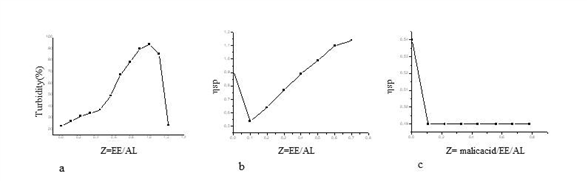
The maximal turbidity is observed at molecular weight ratio 1:1 of the polymers in media of purified water. Further addition of EE100 results in decreasing of the turbidity due to formation of stoichiometric polyelectrolyte complex with an excess of EE 100 polycation. A similar molar ratio for the IPC formation was determined between the same polymers in 0.05M acetate buffer in the pH range between 2.5- 5.5 by Moustafine et al. The prepared model systems were characterised by measuring the specific viscosity of dilute solutions of sodium alginate, EE 100, malic acid and their mixtures. The formation of a complex between sodium alginate and EE 100 was established by measuring the specific viscosity of solutions containing a constant concentration of sodium alginate to which increasing concentrations of EE 100 were added. This relation is presented in fig1b.
The decrease in the specific viscosity of the sodium alginate solution after the addition of EE 100 solution shows the formation of a complex between the two polymers. The following gradual increase in the viscosity of the system is due to the cumulation of the second polymer, EE 100. In the following experiments, increasing concentrations of malic acid were added to the formed interpolymer complex between EE 100 and sodium alginate. The results are presented in figure 1c. The addition of malic acid solution to the solution containing IPC of EE 100 and sodium alginate leads to a decrease in the specific viscosity of the system. This is due to the formation of a triple complex between the two polymers and the low molecular weight compound. The formation of IPC between EE 100 and sodium alginate is due to the interaction between the protonated tertiary amino group in the molecule of EE 100 and the carboxylate ions in sodium alginate at pH≈6. At this pH (pH≈6), the tertiary amino groups are protonated up to 99.9% (pKa of EE 100= 10). The ionisation of sodium alginate carboxylic groups (pKa=3.5) at pH≈6 is 99.7%. Thus, an ionic bond is formed between the carboxylate ion from sodium alginate and the protonated tertiary amino group of EE 100.
The addition of malic acid to the solution already containing the interpolymer complex (IPC) leads to a decrease in the pH of the media to 3.5 and further formation of hydrogen bonds between the non- ionised carboxylic groups from sodium alginate and malic acid.
The formation of an ionic bond between EE 100 and sodium alginate can also be proven by the IR spectra of the polymers alone and the spectrum of IPC. The characteristic band of the carboxylate anion in the sodium alginate spectrum can be found at 1579cm-1. Carboxylate salts have valence fluctuations in the range 1610-1550cm-1. This characteristic band can be found shifted to 1605cm-1 in the spectrum of IPC. This shift gives information for the participation of sodium alginate carboxylate ions in the formation of an ionic bond with EE100. A characteristic band of – N< can be found at 1185cm-1 in the IR spectrum of EE 100 (Meyers, 2000). These tertiary amino groups have valence fluctuations in the range 1210-1150cm-1 (C-N stretch). The characteristic band of the tertiary amino group is significantly shifted to 1235cm-
1 in the spectrum of the IPC, which shows its participation in the formation of an ionic bond between EE 100 and the carboxylic group from sodium alginate.
Conclusion
Model systems based on sodium alginate and EE 100 in the presence of a cross-linking agent- weak organic acid were prepared and characterized. The structure of the prepared systems was proven by the determination of the specific viscosity of dilute solutions of sodium alginate, EE 100, malic acid, as well as with IR spectroscopy. The formation of a polyelectrolyte complex was proven through the methods of viscometry and turbidimetry of solutions containing sodium alginate, Eudragit E 100 and malic acid alone or in different combinations. The organic acid participates in the stabilization of the polymer network. The prepared model system could have the potential for further development of a dermal drug delivery system, which can allow the release of the included active substances with a pre-determined rate and degree according to the desired therapeutic needs.
References
-
Can AS, Erdal MS, Güngör S, Özsoy Y (2013) Optimization and characterisation of chitosan films for transdermal delivery of ondansetron. Molecules 18(5): 5455-5471.
-
Elmotasem H (2008) Chitosan-alginate blends film for the transdermal delivery of meloxicam. Asian J Pharm Sci 3(1): 12-29
-
Kabanov VA, Zezin AB (1984) Soluble interpolymer complexes as a new class of synthetic polyelectrolytes. Pure and Appl Chem 56(3): 343-354.
-
Kuo CK, Ma PX (2001) Ionically cross-linked alginate hydrogels as scaffolds for tissue engineering: Part 1. Structure, gelation rate and mechanical properties. Biomaterials 22(6): 511-521.
-
Meyers RA (2000) Encyclopedia of Analytical Chemistry, Tarzana, CA, USA: John Wiley & Sons, LTD, 12.
-
Morch YA, Donati I, Strand BL, Skjak-Baek G (2006) Effect of Ca2+, Ba2+ and Sr2+ on alginate microbeads. Biomacromolecules 7(5): 1471-1480.
-
Moustafine RI, Kemenova VA, Van den Mooter G (2005) Characteristics of intrpolyelectrolyte complexes of Eudragit E 100 with sodium alginate. Int J Pharm 294(1-
-
Ouwerx C, Velings N, Mestdagh MM, Axelos MAV (1998) Physico-chemical properties and rheology of alginate gel beads formed with various divalent cations. Polymer Gels and Networks 6(5): 393-408.
-
Peppas NA, Hilt JZ, Ali K, Robert L (2006) Hydrogels in biology and medicine: From molecular principles to bionanotechnology**.** Advanced Materials 18(11): 1345- 1360.
-
Prajapati BG, Sawant KK (2009) Polyelectrolyte complex of chitosan alginate for local drug delivery. Int J Chem Tech Res 1(3): 643-648.
-
Saarai A, Kasparkova V, Sedlacek T, Saha P (2013) On the development and characterisation of cross-linked sodium alginate/gelatine hydrogels. J Mech Behavior of Biomed Mat 18: 152-166.
-
Sachan NK, Pushkar S, Jha A, Bhattcharya A (2009) Sodium alginate: the wonder polymer for controlled drug delivery. J Pharm Res 2(8): 1191-1199.
-
Stevens MM, Qanadilo HF, Langer R, Shastri VP (2004) A rapid-curing alginate gel system: Utility in periosteum- derived cartilage tissue engineering. Biomaterials 25(5): 887-894.
-
Zezin AB, Kabanov VA (1982) A new class of complex water- soluble polyelectrolytes. Russian Chem Rev 51(9): 833-855.
- Acido Labile or Gastro Irritant Apis and Enteric Release in Galenic Practice: An Overview
- A Study on Knowledge, Attitude and Practice of Hand Hygiene among Healthcare Professionals at a Tertiary Care Hospital, India
- Influence of Inoculum Concentration on In Vivo Incubation Period of Emmia lacerata, Pathogenesis and Management of Wilt in Pepper (Capsicum annuum L.)
- Vanilla’s Chemistry
- Marine Anti-Cancer Compounds and Adverse Effects of Global Warming on Oceans: An Overview
- Serological Investigation of Chikungunya Virus Antibody among Malaria-Suspected Febrile Patients in Some Healthcare Facilities in Rivers State