
Current and Future Prospects of Azetidine Derivatives an Overview
Due to the intrinsic ring strain of azetidine derivatives, there are numerous challenges involved in their synthesis. Its derivatives have several important applications, such as antibacterial, antifungal, anticancer, antitubercular, antioxidant, etc. This review provides the impact of recent advances in the synthesis of azetidines and their derivatives. It gives an overview of the different therapeutic uses of azetidines, with various structures and degrees of control. This elaborate review will furnish a basis for the progress of future azetidines to fight the various microbes which have developed their resistance against current medications.
Introduction
Significant components of heterocyclic chemistry, azetidines are four-membered saturated cyclic amines [1, 2, 3, 4]. Azetidine moieties are present in various natural (Nicotinamine, Penarisidine A and Penarisidine B) and synthetic (Penazetidine, melagatran, azetidinepaclitaxel, siponimod, cobimetinib) compounds wherein 1955, the first natural and azetidine derivative L-azetidine-2-carboxylic acid was isolated from Convallaria majalis, and is a proline receptor antagonist [5]. Using L-azetidine-2-carboxylic acid various azetidine derivatives were prepared. In 2007 one of the most complex azetidine derivatives was isolated from Daphniphyllum calycillum [6]. Due to unstable strain in the ring, the preparation of azetidines derivatives is one of the challenging steps [7]. Cycloaddition and cyclization are the two identical methods for the formation of the azetidine ring and also show unique chemical properties that may favor its lower homolog aziridine or higher homolog pyrrolidine [8]. Researchers are showing significant attention to ring infringement of azetidines to synthesize several potent heterocyclic compounds which shows various biological activities such as antibacterial, antifungal, antitubercular, anticancer, antioxidant, etc [9, 10, 11, 12, 13].
Synthetic Strategies Involved in the Formation of Azetidine
Azetidines are synthesized by cyclization, cycloaddition, and transformation of other heterocyclic reactions [14, 15].
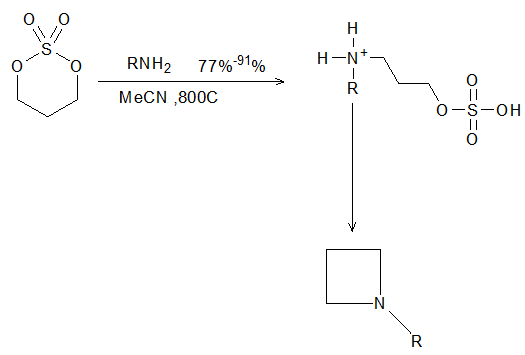
Scheme 1
Zwitterionic ammonium sulphates are obtained upon the ring-opening of cyclic sulphate of propane-1,3-diol with various alkyl, cycloalkyl, and aromatic amines. (Figure
1) Cyclization of these sulphates on microwave irradiation in aqueous potassium hydroxide leads to the formation of N-substituted azetidines in moderate to good yields [2].
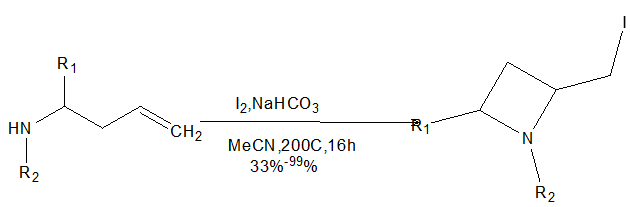
Scheme 2
In the presence of sodium hydrogen carbonate, the reaction between homoallylic amines and three equivalents of iodine in acetonitrile at room temperature results in iodocyclization forming 2-(iodomethyl) azetidine derivative with cis-diastereo selectivity [2](Figure 2).
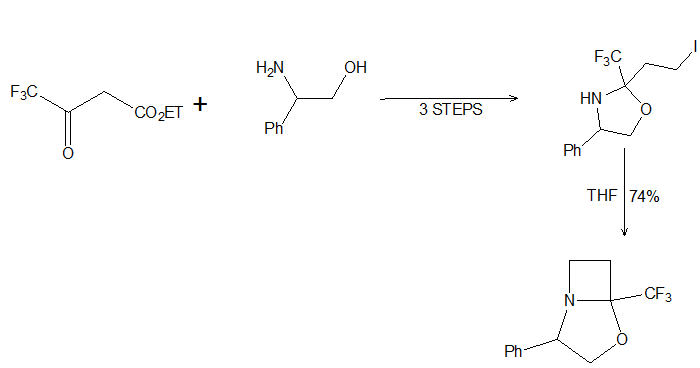
Scheme 3
A novel trifluoro methylated bicyclic azetidine (2R)- 2-phenyl-5- (trifluoromethyl)-4-oxa-1-azabicycloheptane is synthesized by sodium hydride-promoted cyclization of oxazolidine-tethered 1,3-iodoamine that is obtained by a sequence of reactions starting from the condensation of ethyl-4,4,4-trifluoroacetoacetate and (R)-phenyl glycinol 2 ( Figure 3 ).
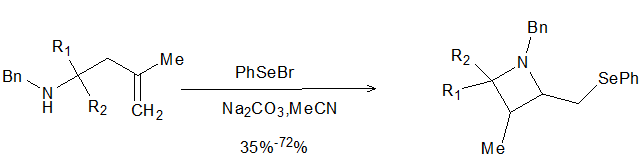
Scheme 4
The 4-exo trig cyclization of a homoallylic amine, N-benzyl-1-(1-pyridin-3-yl)but-3-ene-1-amine, in the presence of iodine at room temperature forming cis-1- benzyl-4-iodomethyl-2-(pyridine-3-yl)- azetidine. Then the functionalization was iodine was reached by nucleophilic displacement. The formation of pyrrolidines from iodomethyl azetidines was achieved by heating, with complete stereo control. A regioselective synthesis of N-benzyl-2,4- disubstituted azetidines is reported by the activation of homoallylic amines 82 with phenylselenium bromide [2] (Figure 4).
Scheme 5
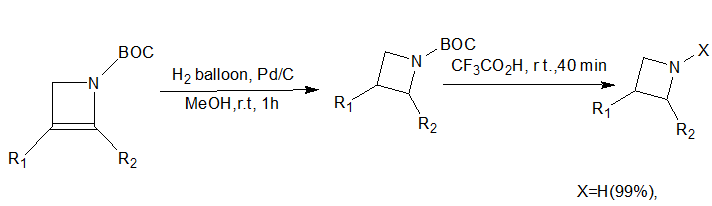
Reduction of 3,4-disubstituted N-Bocazetines in the presence of catalyst hydrogen and palladium leads to the formation of syn-2,3-disubstituted N-Boc azetidines in quantitative yields. Subsequent amine deprotection with trifluoroacetic acid leads to NH-azetidines in good yields [2] (Figure 5).
Scheme 6
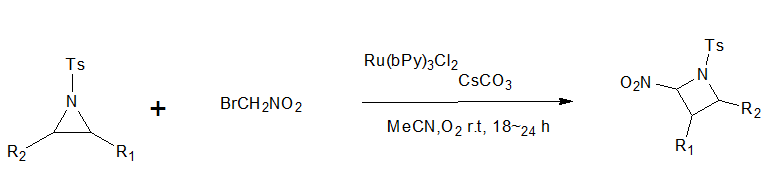
N-tosylaziridines ring expansion with bromonitromethane it forms 2-nitroazetidines with good percentage yields with high region and diastereoselectivity compounds. The reaction is of wide scope because a range of N-tosylaziridines with different aryl groups, alkyl group, fused cyclohexane, and cyclopentane ring react easily to form the corresponding nitroazetidines. 2-Nitroazetidines are a scarce class of compounds which may be very useful for further synthetic transformations [2] (Figure 6).
Scheme 7
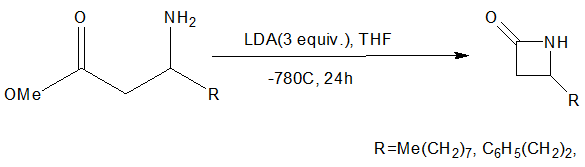
Cyclization of chiral β-amino esters in the presence of lithium di-isopropyl amide (LDA) results in the formation of 2-azetidinones in quantitative yields [2] (Figure 7).
Pharmacological Activity
Antibacterial Activity
Rani VE, et al. has Synthesized a novel Pyridine Containing Substituted Phenyl Azetidine-2-One derivatives involving condensation of nicotinaldehyde and 4-substituted anilines via Schiff base intermediates. They demonstrated antimicrobial activity of synthesized compounds, out of all the synthesized compounds of Pyridine Containing Substituted Phenyl Azetidine-2-One derivatives 3-chloro-1-(4-fluoro phenyl)-4-(pyridine-3-yl) azetidine-2-one, 3-chloro-1- (4-chloro phenyl)-4-(pyridine-3-yl) azetidine-2-one, 1-(4-bromo phenyl)-3-chloro-4-(pyridine-3-yl) azetidin- 2-one, 3-chloro-4-(pyridine-3-yl)-1-(4-(trifluoromethyl) phenyl) azetidine-2-one 3-chloro-1-(4-fluoro phenyl)- 4-(pyridine-3-yl) azetidine-2-one. 3-chloro-1-(4-chloro phenyl)-4-(pyridine-3-yl) azetidine-2-one, and 3-chloro- 1-(4-methoxy phenyl)-4-(pyridine-3-yl) azetidine-2-one showed good activity showed good antibacterial activity against Staphylococcus aureus compared to the standard drug Streptomycin [1].
Desai NC, et al. has synthesized some quinoline based dihydropyridine and 2-oxo-azetidine derivatives. The synthesized compounds were screened for their antibacterial activity and they showed good antibacterial activity [16].
Bacque E, et al. report a convenient preparation of 3-amino 3-phenyl azetidine from N-benzhydryl 3-azetidinone. Their strategy involves a modified Strecker reaction using dibenzylamine as an amino equivalent followed by the displacement of the cyano group by phenyl magnesium bromide and a final catalytic hydrogenation [17].
Ritu S, et al. had synthesized a number of N-[2 (10H-phenothiazinyl) ethyl] 4-(phenyl)-3-chloro-2-oxo-1- iminoazetidine derivatives as a compound. Compounds were prepared and screened for antibacterial activity. Among these synthesized compounds N-[2-(10H-phenothiazinyl) ethyl]-4-(phenyl)-3-chloro-2-oxo-1-iminoazetidine, N-[2- (10H-phenothiazinyl) ethyl]-4-(4-methoy phenyl) -3-chloro- 2-oxo-1-iminoazetidine, N-[2-(10H-phenothiazinyl) ethyl]- 4-(4-methylphenyl)-3-chloro-2-oxo-1-iminoazetidine against Bacillus subtilis as compared to the standard streptomycin [18].
Gupta P, et al. synthesized novel N-(3-chloro-2- oxo-4-substituted-azetidine1-yl) 2-methyl-1H-indole- 3-carboxamide derivatives. Some derivatives of these compound i.e., N-(4-phenyl- 3-chloro-2-oxoazetidine-1-yl) 2-methyl -1 H – indole - 3- carboxamide, N-(4-chlorophenyl- 3-chloro-2-oxoazetidine-1-yl) 2-methyl - 1 H - indole-3- carboxamide, N-(4-(dimethylamino) phenyl - 3- chloro-
2-oxo-azetidine-1-yl) 2-methyl-1H-indole3-carboxamide N-(4-(2, 4-dichlorophenyl) - 3- chloro-2-oxo-azetidine-1-yl) 2-methyl-1H-indole3-carboxamide against Staphylococcus aureus, Bacillus cereus and Pseudomonas aeruginosa compared to standard drug amoxicillin in in-vitro method [19].
Antifungal Activity
Rani VE, et al. has Synthesized a novel Pyridine Containing Substituted Phenyl Azetidine-2-One derivatives involving condensation of nicotinaldehyde and 4-substituted anilines via Schiff base intermediates. The heterocycles contain nitrogen such as phenyl azetidine-2-ones having somany pharmacological application such as antibacterial, antibiotics etc and these compounds shows practical importance too. The new derivatives synthesised by ether rani was confirmed by the elemental analyses and spectral data. Among five new derivatives, three were showing mild to moderate activity, when compared with Streptomycin & Fluconazole as a standard. Among this new series of 3-chloro-1(4-fluoro phenyl)/(4-chloro phenyl)-4 (pyridine- 3-yl) azetidine-2-one is having most activity [1].
Ritu S, et al. have synthesized a The antibacterial, antifungal and antitubercular activities of compounds has been assayed in vitro against selected Gram positive bacteria, Bacillus subtilis, Staphylococcus aureus and Gram negative bacteria, Escherichia coli, Klebsiella pneumoniae fungi, Aspergillus niger, Aspergillus flavus, Candida albicans Fusarium oxisporium and Mycobacterium tuberculosis H37Rv strain MIC values of compounds were determined using filter paper disc diffusion method (antibacterial and antifungal activities) and L.J. medium (Conventional) method 20 (antitubercular activity). Streptomycin and Griseofulvin used as standard for antibacterial and antifungal activity showed MIC range for all bacterial strain 1.25-6.25μg/mL and for all fungal strain 6.25-12.5μg/mL respectively and for the antitubercular activity compared with Isoniazid and Rifampicin as standards. All standards also screened under the similar condition for comparison [18].
Gupta P, et al. synthesized a New series of N-(3-chloro- 2-oxo-4-substituted-azetidine-1-yl) 2-methyl-1H-indole-3- carboxamide derivatives (VIa-d) were prepared and tested for their antibacterial and antifungal activity. The synthesis of above compound was based on the condensation of ethyl acetoacetate and phenylhydrazine in the presence of acetic acid to ethyl (2-methyl 1H- indol-3-yl)-2-oxoacetate and these on react with hydrazine hydrate gives 2-(2-methyl-1H- indol-3-yl)-2-oxoacetohydrazide. Further the condensation of oxoacetohydrazide and substituted benzaldehyde gave carbohydrazide derivatives. Finally the addition of triethylamine in 1, 4-dioxane and chloroacetyl chloride gives N-(3-chloro-2-oxo-4 substituted-azetidine-1-yl) 2-methyl- 1H-indole-3- carboxamide derivatives. The structure of newly synthesized 4-Oxoazetidin Substituted derivatives has been established by spectral (IR, 1HNMR) data. These compounds were screened for antibacterial and antifungal activity against various gram-positive and gram-negative strains. All the compounds show significant antibacterial and antifungal activity [19].
Antitubercular Activity
Yeriger MC, et al. has synthesized a series of novel Azetidin-2-One derivatives. The compounds have been synthesized and tested for structure activity relationship for Phospholipase A2 (PLA2) [E.C. 3.1.1.4] enzyme inhibition. The in vitro anti-tubercular (PLA2) enzymes inhibitory activity of azetidin-2-one derivatives and the in vivo anti-inflammatory studies was done by using mice are highlighted. The analogues of azetidin-2 one was prepared based on the initial activity against Mycobacterium tuberculosis. Certain azetidin- 2-one analogues described showed good to moderate anti- tubercular activity. In particular, two compounds exhibited MIC values of 1.56 and 0.78μg/mL respectively against the Mtb H37Rv strain. Chloro substitution on above synthesised compound was enhanced the antimyco bacterial activity and PLA2 inhibition in the azetidin-2-one derivatives. The ability of azetidin-2-one as an analogue for anti-inflammatory agents also been determined. The results show some correlation between anti-inflammatory, anti-tubercular activity and expression of PLA2 enzyme [20].
Samadhiya P, et al. has reported the synthesis of azetidinone derivatives New series of N-[3-(2-amino-5- nitrothiazolyl)-propyl]-4-(substitutedphenyl)-3-chloro- 2-oxo-1-azetidine-carboxamide, compounds have been synthesized and characterized by chemical and spectral analyses such as IR, 1H NMR, 13C NMR and FAB-Mass. All the synthesized compounds were screened for their antibacterial and antifungal activities against some selected bacteria and fungi with their MIC values and antitubercular activity screened against M. tuberculosis. In vivo Anti- inflammatory activity against albino rats was determined. Some compounds of the series showed good activities [21].
Ritu S, et al. had synthesized a number of N-[2 (10H-phenothiazinyl) ethyl]-4-(phenyl)-3-chloro-2 oxo-1-iminoazetidine derivatives. Compounds were prepared and screened for antitubercular activity. N-[2- (10H-phenothiazinyl)ethyl]-4-(phenyl)-3-chloro-2-oxo- 1-iminoazetidine, N-[2-(10H-phenothiazinyl) ethyl]- 4-(4-chlorophenyl)-3-chloro-2-oxo-1-iminoazetidine, N-[2-(10H-phenothiazinyl) ethyl]-4-(3-chlorophenyl) -3-chloro-2-oxo-1-iminoazetidine showed good anti- tubercular activity compared to standard drugs. Isoniazid and rifampicin were used as standards [18].
Anticancer Activity
Kayarmar R, et al. reported a novel series of N-substituted azetidinones. The N-substituted azetidinones was synthesized by the condensation of 4-arylidene hydrazino 1 isobutyl-1H-imidazo [4,5-c] quinolones and with chloroacetyl chloride afforded 4-arylazetidin-2-ones. The synthesized compounds were characterized by 1H NMR, 13C NMR, mass spectral and elemental analyses. All the synthesized compounds were screened for their in vitro anticancer and antimicrobial activities. The hydrazone derivatives (8a–h) showed good antibacterial activity and the compounds 9a and 9b exhibited good anticancer activity. In a molecular docking study compounds 9a and 9b showed minimum binding energy and good affinity towards the active pocket. Thus are believed to be good inhibitors of b-tubulin [22].
Rajulu GC, et al. reported A series of nine new N-(substituted azetidine-3-carbonyl)-N-methyl-hydrazino derivatives at C-7 position of fluoroquinolones were designed and synthesized through multistep synthesis. The above synthesized compounds were characterized by MS, 1H NMR, 13C NMR and IR. The synthesised compounds were tested for anti-proliferative in vitro antimicrobial. Out of the nine derivatives, some exhibited good antibacterial activity by inhibiting the growth of Methicillin-sensitive Staphylococcus aureus, Methicillin-resistant S. aureus and ATCC 35218 Escherichia coli (MIC: 0.25–16.00 μg/mL). Compounds are displayed good growth inhibition against MCF-7 Breast carcinoma, HCT-116 Colon carcinoma and A549 Lung adenocarcinoma cell lines [23].
Conclusion
The synthesis and alterations of aza-heterocycles, specifically stimulated aziridines and azetidines, their ring- elaboration offer striking paths for the building of abundant vital synthetic targets with admirable efficacy and selectivity. However there are still major challenges that have to be overcome to improve the overall synthetic effectiveness of this transformation. Therefore, we consider this review to hold great potential for the preparation of complex azetidine- containing scaffolds. In this review, well-designed synthetic routes to four to aza-heterocycles and their pharmacological activities from the literature spanning over a decade are presented.
Conflicts of Interest
No Interest
Acknowledgement
The authors thank Dr. T Y Pasha, head and professor, Department of Pharmaceutical Chemistry & Analysis and Dr. B. Ramesh Dean & Principal, Sri Adichunchanagiri College of Pharmacy, Adichunchanagiri University for guiding and providing all the necessary facilities during review.
References
-
Rani VE, Reddy PR (2018) Synthesis and Antimicrobial Activity of New Pyridine Containing Substituted Phenyl Azetidine-2-One Derivatives. Open Journal of Medicinal Chemistry 8(2): 22-29.
-
Doraswamy K, Ramana PV (2013) Synthesis and Characterization of Substituted Phenyl Azetidines as Potential Antimicrobial Agents. Chemical Science Transactions 2(2): 649-655.
-
Devi KS, Ramaiah M, Roopa DL, Vaidya VP (2010) Synthesis and Investigation of Antimicrobial and Antioxidant Activity of 3-Nitro-N-(3-chloro-2-oxo- substituted-phenyl-azetidin-1-yl) naphtho [2, 1-b] furan-2-carboxamides. Journal of Chemistry 7: 863547.
-
Mandal MK, Ghosh S, Bhat HR, Naesens L, Singh UP (2020) Synthesis and biological evaluation of substituted phenyl azetidine-2-one sulphonyl derivatives as potential antimicrobial and antiviral agents. Bioorg Chem 104: 104320.
-
Dubey A, Srivastava SK, Srivastava SD (2011) Conventional and microwave assisted synthesis of 2-oxo- 4-substituted aryl-azetidine derivatives of benzotriazole: A new class of biological compounds. Bioorg Med Chem Lett 21(1): 569-573.
-
Singh GS (2020) Advances in synthesis and chemistry of azetidines. Advances in Heterocyclic Chemistry 130: 1-74.
-
Ning S, Bednarski M, Oronsky B, Scicinski J, Saul G, et al. (2012) Dinitroazetidines are a novel class of anticancer agents and hypoxia-activated radiation sensitizers developed from highly energetic materials. Cancer Res 72(10): 2600-2608.
-
Shailesh HS, Pankaj SP (2012) Synthesis and antimicrobial activity of azetidin-2-one containing pyrazoline derivatives. Research Journal of Chemical Sciences 2(7): 62-68.
-
Bonde CG, Peepliwal A, Gaikwad NJ (2010) Synthesis and Antimycobacterial Activity of Azetidine, Quinazoline and Triazolo thiadiazole containing Pyrazines. Archiv der Pharmazie. An International Journal Pharmaceutical and Medicinal Chemistry 343(4): 228-236.
-
Kerzare DR, Menghani SS, Khedekar PB (2018) Synthesis, characterization, antidepressant activity and docking studies of some novel indole bearing azetidinone derivatives. Indian journal of pharmaceutical education and research 52(1): 110-121.
-
Jeilawi OHA (2018) Synthesis, Characterization of Organic Derivatives Containing Heterocyclic Rings and Evaluation Their Antibacterial Activity. IOSR Journal of Pharmacy and Biological Sciences 13(1): 18-22.
-
Richardson AD, Becker MR, Schindler CS (2020) Synthesis of azetidines by aza Paternò–Büchi reactions. Chem Sci 11(29): 7553-7561.
-
Dhall E, Jain S, Mishra A, Dwivedi J, Sharma S (2018) Synthesis and Evaluation of Some Phenyl Substituted Azetidine Containing 1, 2, 4‐triazole Derivatives as Antibacterial Agents. Journal of Heterocyclic Chemistry 55(12): 2859-2869.
-
Anusha K, Kumar YP, Varaprasad M, Raju VBM, Gopinath C (2015) A review on 2-azetedinones. Journal of Global Trends in Pharmaceutical Sciences 6(1): 2388-2402.
-
Swapna K, Murthy SN, Nageswar YVD (2010) Copper Iodide as a Recyclable Catalyst for Buchwald N‐Arylation. European Journal of Organic Chemistry 2010(34): 6678- 6684.
-
Desai NC, Harsora JP (2012) Synthesis, characterization and antimicrobial screening of some quinoline based dihydropyridine and 2-oxo-azetidine derivatives. Indian journal of chemistry 51: 1011-1019.
-
Bacque E, Paris JM, Bitoux SL (1995) Synthesis of 3-Amino 3-Phenyl Azetidine. Synthetic communications 25(6): 803-812.
-
Sharma R, Pushkal S, Srivastava SD, Srivastava SK (2011) Synthesis and biological activity of 2-oxo-azetidine derivatives of phenothiazine. Or Commun 4(2): 42-51.
-
Gupta P, Jain S, Kaushik A (2016) Synthesis, characterization & biological evaluation of some azetidine derivatives. International Journal of Pharmacognosy 3(1): 30-34.
-
Yerigeri MC, Murari SK, Thimmaiah KN, Math SKS, Vishwanath BS (2008) Anti-tubercular and anti- inflammatory activities of azetidin-2-one derivatives and their effects on the activity of Phospholipase A2. Med Chem 4(2): 190-193.
-
Samadhiya P, Sharma R, Srivastava SK (2013) Synthesis of azetidinone derivatives of 2-amino-5-nitrothiazole and their medicinal importance. Eur Chem Bull 2(9): 611-617.
-
Kayarmar R, Nagaraja GK, Naik P, Manjunatha H, Revanasiddappa BC, et al. (2017) Synthesis and characterization of novel imidazoquinoline based 2-azetidinones as potent antimicrobial and anticancer agents. Journal of Saudi Chemical Society 21(S1): S434-S444.
-
Rajulu GG, Naik HS, Kumar GC, Ramaraj S, Sambasivam G, et al. (2014) New azetidine-3-carbonyl-N-methyl- hydrazino derivatives of fluoroquinolones: synthesis and evaluation of antibacterial and anticancer properties. Medicinal Chemistry Research 23(6): 2856-2868.
- Acido Labile or Gastro Irritant Apis and Enteric Release in Galenic Practice: An Overview
- A Study on Knowledge, Attitude and Practice of Hand Hygiene among Healthcare Professionals at a Tertiary Care Hospital, India
- Influence of Inoculum Concentration on In Vivo Incubation Period of Emmia lacerata, Pathogenesis and Management of Wilt in Pepper (Capsicum annuum L.)
- Vanilla’s Chemistry
- Marine Anti-Cancer Compounds and Adverse Effects of Global Warming on Oceans: An Overview
- Serological Investigation of Chikungunya Virus Antibody among Malaria-Suspected Febrile Patients in Some Healthcare Facilities in Rivers State