
Effect of Egg Shell Powder (ESP) on the Strength Properties of Cement-Stabilization on Olokoro Lateritic Soil
The effect of eggshell powder or ash on the strength properties of cement-stabilization on Olokoro lateritic soil was studied. The eggshell was mixed with the cement-stabilized soil in the proportions of 3%, 6%, 9%, 12% and 15% and the geotechnical behavior of the soil was carefully observed. The results of the study showed that the strength properties of the A-6 soil, according to its AASHTO classification, improved with the addition of eggshell ash. This also indicates that further addition of eggshell ash would thus; increase the strength properties of the stabilized soil further. However, eggshell ash has been established to be a good accelerator for cement-bound materials and this would be very vital for road construction work especially during the rainy seasons for minimizing the setting time of stabilized road pavements. The study also exposes the engineering value of this agricultural material which probably causes disposal problems, leading to environmental pollution.
Introduction
In recent times, the demand for better flexible pavement materials accentuated by design guidelines that are based on the assumptions that aggregates are important ingredients of pavement structures, has increased due to increased constructional activities in the road sector and paucity of available construction materials in the developing countries [1]. Many research works have been carried out on roads to improve the strength of road bases. Such improvement is known as soil stabilization, which is concentrated on mixing two or more materials and compacting same to improve the strength of the treated soil [2]. Stabilization can increase the shear strength of soil and control the shrink-swell properties of a soil, thus improving the load bearing capacity of foundation soils [3]. Eggshell are agricultural wastes which when subjected to adequate preservation could be suitable for soil stabilization and this was confirmed by Alhassan and Mustapha [4, 5]. About 7×10⁷metric tons of eggs are produced in the world yearly, 192640 metric tons are produced in Nigeria and 12.5% of 192640 metric tons are produced by the local hens [6]. Eggshell, preferably the chicken eggshell perceived as waste material could be annexed for use as a replacement for soil stabilizer like lime since they both share the same chemical composition [7]. Egg shells in the construction industry can replace 10-30% of cement in a mix and can also improve the properties of concrete such as durability and creep [8]. So many researches were made using egg shell ash to check its effect on stabilizing agents like lime cement, common salt, bamboo leaf ash etc. and these yielded positive results [7, 9, 10]. There is an alarming rate of road pavement decay or failure in the Southeastern Nigeria and this research work aims at educating the relevant authorities and engineers at large on how to save the cost of pavement construction and other civil engineering works. This will be accomplished by ensuring that sub grade soils are improved in strength capacity by mixing a percentage of egg shell as ash with the soil or concrete.
Methodology
The soil sample used for this work was collected (using the disturbed sample technique) from a soil deposit in Olokoro, Umuahia South Local Government Area of Abia State, Nigeria. The sample was collected at a depth below 1.25m to neglect the top soil and then air- dried. UNICEM Ordinary Portland Cement was used as a binder and egg shell ash as replacement. Distilled water was used for mixing and the collected egg shells from local hens were ground, air-dried and incinerated to ash at a temperature of about 500°C and sieved through 75μm sieve in accordance with BS 12:1991 [11]. The stabilized mixtures were prepared by first of all mixing thoroughly dry Olokoro lateritic soil with cement and eggshell ash until a uniform color was attained after which water was added. Constant cement contents of 6% and 8% with variations of eggshell ash of 0%, 3%, 6%, 9%, 12% and 15%, by weight of the dry soil in all proportions of cement and eggshell ash were adopted for the mixes. The amount of water added was determined by the moisture-density relationship in which the Proctor mould was used to place the soil-cement eggshell ash mixtures in 3 layers and 25 blows were given onto each layer. The California Bearing Ratio was modified to correspond with NGS, which stipulates that specimens should be cured for 6 days and immersed in water for 24 hours before testing while the unconfined compressive strength specimens were cured for 7 days before testing [12]. The resistance to loss in strength (durability) was evaluated in accordance with BS 1924, which specifies it as a ratio of the Unconfined Compressive Strength of specimens cured for 7 days and later immersed in water for another 7 days to the unconfined compressive strength of specimens cured for 14 days [13].
Results and Discussions
The results of the Olokoro lateritic soil are given in Table 1 below.
| Properties | Results | |
|---|---|---|
| 1 | Color | Brown |
| 2 | Grain Size Distribution | |
| i | Percentage passing sieve no 200 | 45.3 |
| ii | Uniformity Coefficient, Cu}$ | $5.6 |
| iii | Coefficient of Curvature, C_{d}$ | $0.11 |
| 3 | Atterberg Limits | |
| i | Liquid Limit % | 39 |
| ii | Plastic Limit % | 26.5 |
| iii | Plasticity Index | 12.5 |
| iv | Consistency Index % | 42.4 |
| 4 | Specific Gravity | |
| i | Specific Gravity | 2.72 |
| 5 | Soil Classification | |
| i | AASHTO Classification | A-6 |
| ii | Unified Classification System | SC (Clayey Sand) |
| 6 | Major Clay Mineral Present | |
| i | Major Clay Mineral Present | Illite (Inorganic Clay of Medium Plasticity) |
| 7 | Compaction Characteristics | |
| i | Max. Dry Density (g/m^{3) | 1.72 |
| ii | Optimum Moisture Content (%) | 14.2 |
| iii | California Bearing Ratio (%) | 9 |
Table 1: Properties of Olokoro Lateritic Soil.
According to AASHTO classification, the soil was classified to be A-6 and thus, it is said to be fairly good for road construction works. This is because it has a group index of 2 and its Atterberg limits (liquid limit of 39%, plasticity index of 12.5% and plastic limit of 26.5%) makes it satisfactory. Hence, clay mineral present in the lateritic soil (illite) is inorganic clay of medium plasticity and the activity is moderately satisfactory thus the soil would be somewhat stable in volume at moisture content variations. The high cement content requirement by the soil is attributed to the high percentage of finer particles (45.3% passing Sieve No 200) in the soil. The coarse particles are almost inert in the reaction of the soil with cement; rather the finer particles play the major role as the pozzolanic component in the reaction. Therefore higher finer particles results to higher cement content requirement.
| OMC (%) | MDD (g/m³) | CBR (%) | LL (%) | PL (%) | PI (%) | |
|---|---|---|---|---|---|---|
| 0 | 16.8 | 1.87 | 26.45 | 36 | 24.7 | 11.9 |
| 3 | 16.9 | 1.85 | 27.19 | 35 | 23.7 | 11.3 |
| 6 | 17.3 | 1.75 | 29.76 | 33 | 22.8 | 10.2 |
| 9 | 17.9 | 1.72 | 53.54 | 31 | 22.6 | 8.4 |
| 12 | 17.8 | 1.69 | 56.19 | 29 | 22.5 | 6.5 |
| 15 | 17.9 | 1.67 | 58.24 | 29 | 22.5 | 6.5 |
Table 2: Effects of Egg Shell Powder (ESP) on Olokoro Lateritic Soil Stabilized with 6% Cement.
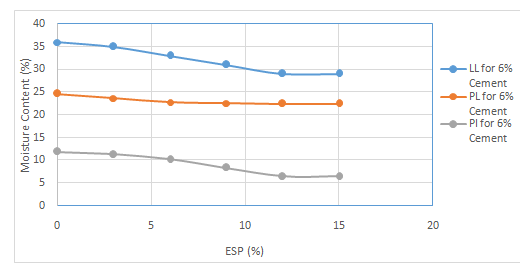
| OMC (%) | MDD (g/m³) | CBR (%) | LL (%) | PL (%) | PI (%) | |
|---|---|---|---|---|---|---|
| 0 | 15.1 | 1.81 | 82 | 34 | 23.2 | 10.9 |
| 3 | 14.7 | 1.76 | 85.4 | 32 | 22.9 | 9.1 |
| 6 | 15.7 | 1.71 | 86 | 29 | 22.6 | 8.4 |
| 9 | 16 | 1.7 | 88.5 | 29 | 20.7 | 8.3 |
| 12 | 16.2 | 1.66 | 93.3 | 27 | 19 | 8 |
| 15 | 16.6 | 1.63 | 93.4 | 26 | 18.4 | 7.6 |
Table 3: Effects of Egg Shell Powder (ESP) on Olokoro Lateritic Soil Stabilized with 8% Cement.
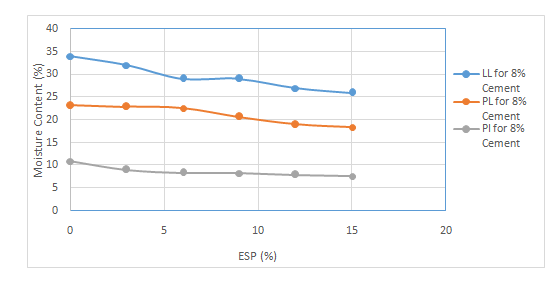
The increase of ESP brought about the reduction of the Atterberg limits of the soil, it is seen that the plastic limit, the liquid limit and plasticity index reduced gradually with increase in the percentage of ESP added. At 6% cement at varying egg shell powder percentages it is seen that the plastic limit reduced from 24.7% to 22.5%, and the liquid limit reduced from 36% to 29%. It was also observed that the plasticity index also reduced from 11.9% to 6.5%. Conversely, addition of 8% ESP reduced the liquid limit from 34% to 26%, plastic limit from 23.2% to 18.4% and its plasticity index from 10.9% to 7.6%. The subsequent decrease can be associated the agglomeration and flocculation of the clay particles as a result of ions’ exchange at the surface of the clay particles. The reduction in plasticity index with chemical treatment could be attributed to the depressed double layer thickness due to caution exchange by potassium, calcium and ferric ions.
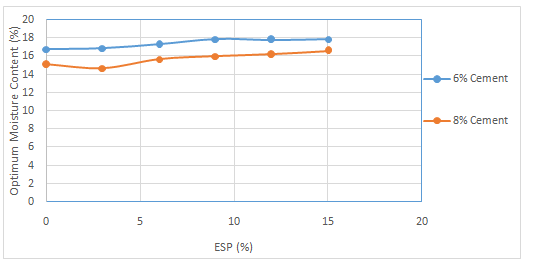
In Figure 3 above, it is observed that the Optimum Moisture Content increased with the addition of egg shell powder to the lateritic soil stabilized with cement. At 6% cement, the OMC increased from 16.8% to 17.9%, while an increase from 15.1% to 16.6% was observed at 8% cement stabilization. This increase is due to the absorption capacity of the egg shell powder as a result of its porous nature. Thus, increase in cement content step- up the hydration reaction of cement and consequently increases the demand for water in the system.
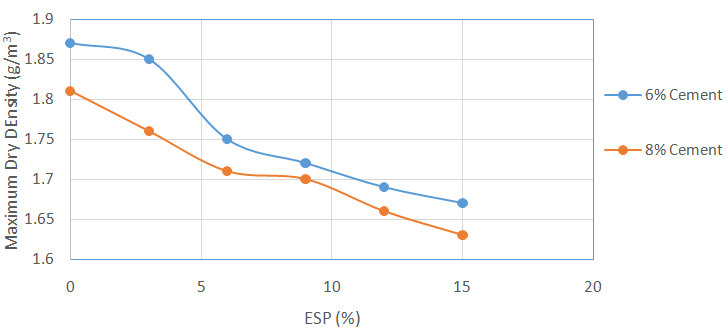
From Figure 4 above, there is continuous decrease in Maximum Dry Density from 1.87 g/m3and 1.81 g/m3to 1.67 g/m3and 1.63 g/m3 at 6% and 8% cement content respectively with the addition of eggshell ash of 0% to 15%. This is as a result of the reaction between cement, eggshell ash and fine fractions of the soil as pozzolanic component in which they form clusters like coarse aggregates. These clusters occupied larger spaces thus increasing their volume and consequently decreasing the Maximum Dry Density.
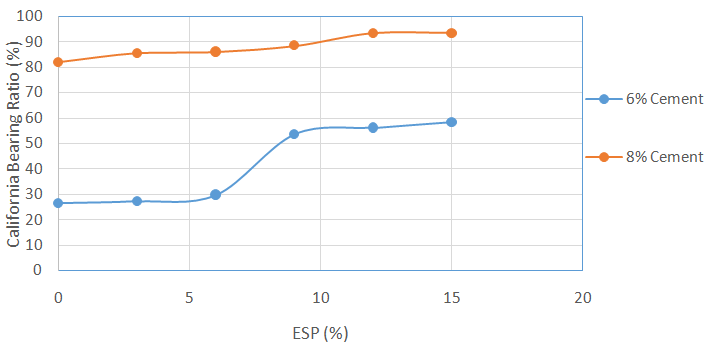
Figure 5 shows the variations in California Bearing Ratio which is the strength property, with increase in eggshell ash content. The California Bearing Ratio (CBR) increased from 26.45% to 58.24% and 82% to 93.4% at 6% and8% cement content respectively with the addition of eggshell ash from 0% to 15%. This is as a result of the progressive increase in the amount of calcium oxide as due to the gradual increase in the amount of eggshell ash added to the mixtures. The increment shows that the soil sample was effectively stabilized, which in turn improved the engineering properties of the soil by making them good non-plastic sub-base material.
Conclusion
The research work has exposed the relevance of egg shell which is disposed as waste, in engineering and for stabilization purpose. The results from various laboratory tests has shown that the utilization of egg shell ash as replacement of cement or as a soil stabilizing material will improve the soil properties, thereby making the soil suitable for construction purposes. Thus, relevant authorities should collaborate in the management and disposal of this solid waste to save the environmental from pollution and encourage more researches in the field of geotechnical engineering.
References
-
Onyelowe KC, Maduabuchi MN (2017) Waste Management and Application of Waste Micro-Sized Palm Kernel Shell Ash (MSPKSA) in the Stabilization of Engineering Soil. International Journal of Waste Resources 7(2): 1-3.
-
Onyelowe KC, Ekwe NP, Okafor FO, Onuoha IC, Maduabuchi MN, et al. (2017) Investigation of the Stabilization Potentials of Nanosized-Waste Tyre Ash (NWTA) as Admixture with Lateritic Soil in Nigeria. Umudike Journal of Engineering and Technology (Ujet) 3(1): 26-35.
-
Das BM (2000) Fundamental of Geotechnical Engineering. 4th (Edn.), Thomson Learning, USA.
-
Olarewaju AJ, Balogun MO, Akinlolu SO (2011) Suitability of Egg Shell Stabilized Lateritic Soil as Subgrade Material for Road Construction. EJGE 16: 899-908.
-
Alhassan M, Mustapha M (2007) Effect of Rice Husk Ash (RHA) on Cement Stabilized Laterite. Leonardo Electronic Journal of Practices Technologies 2: 47-58.
-
Momoh OM, Nwosu CC, Adeyinka IA (2008) Egg Production of Two Nigerian Local Chicken Ecotypes under Improved Management. Asset Series 8(2): 151- 158.
-
Fajobi AB, Amu OO, Oke BO (2005) Effect of Eggshell Powder on the Stabilizing Potential of Lime on an Expansive Clay Soil. Research Journal of Agriculture Biological Sciences 1(1): 80-84.
-
Kadyali LR (2006) Principles and Practices of Highway Engineering (Including Expressways and Airport Engineering). Khanna Publishers pp: 547.
-
Amu OO, Salami BA (2010) Effects of Common Salt on Some Engineering Properties of Egg Shell Stabilized Lateritic Soil. ARPN Journal of Engineering Applied Sciences 5(9): 1-10.
-
Amu OO, Babjide SS (2011) Effects of Bamboo Leaf Ash on Lime Stabilized Lateritic Soil for Highway Construction. Research Journal of Applied Sciences Engineering Technology 3(4): 278-283.
-
BS 12 (1991) Specifications of Portland Cement. British Standards Institute, London.
-
Nigeria General Specification (1997) General Specifications (Roads and Bridges). Vol II, Federal Ministry Works and Housing, Abuja, Nigeria.
-
BS 1924 (1990) Methods of Test for Stabilized Materials for Civil Engineering Purposes. British Standards Institute, London.
- Electronic Waste Management in the Top Ten Economies in the World: A Critical Review on Waste Generation, Regulations, Collection, Recycling and Environmental Challenges
- Some Challenging Transdisciplinary Aspects of the Sustainable Waste Management in the Permacrisis Context
- Use of Mobile Autonomous Systems for Pollution Control of Inland Water Bodies
- Environmental Impact Perspective Sustainable Online Textile Retailing: Harnessing Augmented Reality-Based Digital Twins in Bangladesh
- Composite Treatment Module for Removing Acidity and Metal (Loid)S from Acid Rock Drainage
- Household E-Waste Management Systems [E-Wms] in Malaysia