
Agricultural Waste Materials as a Potential Adsorbent for Removal of Heavy Metals in Waste Water
The world has suffered a major threat in recent years as a result of discharge of heavy metals into the environment due to industrial development and suburbanization. Adsorptions of these aforementioned metals were studied by Atomic Adsorption Spectrophotometry (AAS) and it showed that adsorption was extreme at the 100th minute. These elements pollute the water resources, contaminate of the food chain and pose a menace to the ecosystem, leading to pure water shortage. There are countless technical approaches adopted in the elimination of these metals from waste water. They include adsorption, precipitation, ion exchange, reverse osmosis, electrochemical treatments, membrane filtration, evaporation, flotation, and oxidation and bio sorption processes, but most of these techniques have detriments such as inadequate metal elimination, great reagent and energy necessities and generation of toxic sludge or other waste products. As a substitute for using commercial constituents, the research used agricultural wastes (banana peels and peanut shells) as adsorbent. The results showed that banana peels and peanut shells can be used for the removal of heavy metals with a concentration range of 10-50 mg/100cm3. Also, when the contact time was 100 minutes it showed maximum adsorption of lead and manganese for both adsorbents. It was found that the percentage removal of heavy metals was dependent on the adsorbent and adsorbent concentration.
Introduction
Pollution by heavy metal ions has become a major issue world over due to their possible toxic effects [1]. Heavy metal contamination occurs in aqueous wastes from many industries, such as metal plating, mining operations, tanneries, chloralkali, radiator manufacturing, smelting, alloy industries and storage batteries industries, they are harmful to aquatic life and water contaminated by them remains a serious public health problem to human health [2, 3, 4]. Heavy metal toxicity can result in damage or reduced mental and central nervous system, lower energy levels and damage to blood composition, lungs, kidneys, livers and other vital organs [5]. In recent years, the need for safe and economical methods for the elimination of heavy metals from waste water has necessitated research on low-cost agricultural waste by- products such as sugarcane bagasse, rice husk, sawdust, coconut husk, oil palm shell, Neem bark etc [6]. The technologies like electro floatation, electro kinetic coagulation, and coagulation combine with floatation and filtration, conventional oxidation methods by oxidizing agents, radiation and electro chemical processes etc., are the technologies which fall under chemical methods [7]. These techniques however, have disadvantages such as incomplete metal removal, high reagent and energy requirements and generation of toxic sludge or other waste products [8, 9]. Recent studies have shown that heavy metals can be removed using plant materials such as empty palm oil fruit bunch, sour sop seeds, modified cassava, cassava fibre, coconut shell and Wolffiaglobosa(duck weed) [10, 11, 12, 13, 14]. The removal of lead and copper ions from aqueous solutions by sago waste was reported by Ho, et al. [15]. Also a range of other agricultural by-products used for metal removal include banana pith, tree fern, and Humuluslumpus (hop) [16]. Adsorption is basically a mass transfer process by which a substance is transferred from the liquid phase to the surface of a solid, and becomes bound by physical and/or chemical interactions [17]. It is a partition process in which few components of the liquid phase are relocated to the surface of the solid adsorbents. The adsorption procedure can be batch, semi-batch and continuous. This study also exposes the relevance of adopting an ecological contamination free-tactics for the elimination of heavy metals from water. Dry peanut shell and banana peels were used in this research as bio-adsorbents for the removal of heavy metal ions like lead, copper, zinc and cadmium.
Materials and Methods
Materials
Peanut shells and banana peels were collected from Ubani market in Abia State, located at latitude 5°36’0” North and longitude 7°30’0” West and solution of lead (Pb) and manganese (Mn) was prepared using distilled water. The peanut shells were thoroughly washed three to four times with distilled water to remove external dust particles after which it was sun dried for 10days. The shells were ground after drying using a grinding machine. The banana peels were allowed to dry in shade for 8days and a color change from yellow to brownish black was observed. The peels were ground manually, and different fractions of peels were obtained.
Methods
Sieve Analysis, Atomic Adsorption Spectrophotometry (AAS) and Scanning Electron Microscopy (SEM) where adopted in the course of this research.
Results and Discussion
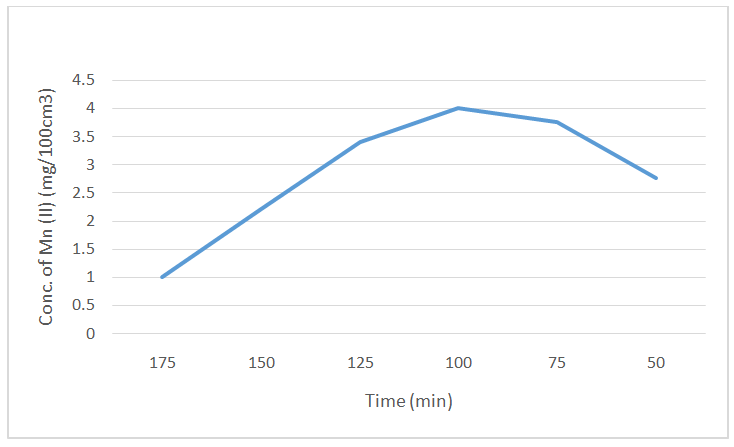
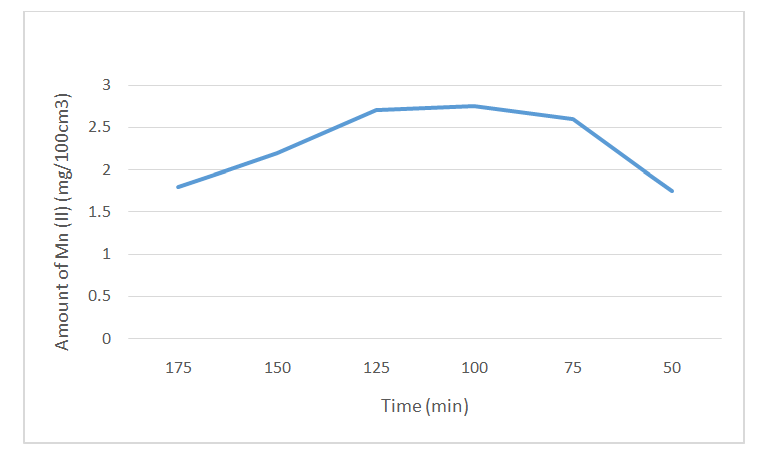
The adsorption of heavy metal ions by the banana peels and peanut shells was assessed by changes in concentration of heavy metals, effect of variation time and effect of concentration. The optimum removal condition was also identified for each metal ion. The powdered peanut shells and banana peels were subjected to sieve analysis, after which fractions of 600μm, 425μm and 300μm were used for adsorption studies. The powdered peanut shells and banana peels of maximum sizes obtained after sieve analysis were not taken up for the experiment, as they will possess much surface area for adsorption. Tables 1 & 2 show the effect of variation of contact time in the adsorption of Mn2+ and Pb2+ using peanut shell and banana peel respectively at 33°C, while Figures 1 & 2 show the graph of conc. of Mn (II) against time of banana peel and peanut shell adsorption respectively at 33°C. Tables 3 & 4 show the conc. of Mn (II) and Pb (II) bound by various concentration of peanut shells and banana peels respectively at 33°C for 90mins, while Figures 3 & 4 show the graph of Mn (II) and Pb (II) adsorption by bound against concentration of peanut shells and banana peels respectively at 33°C for 90mins.
| Concentration of Mn (II) (mg/100cm3) | 1 | 2.2 | 3.4 | 4 | 3.75 | 2.75 |
|---|---|---|---|---|---|---|
| TIME (min) | 175 | 150 | 125 | 100 | 75 | 50 |
Table 1: Effect of variation of contact time on the adsorption of Mn²+ on peanut shell starch at 33°C.
| Concentration of Mn (II) (mg/100cm3) | 1.8 | 2.2 | 2.7 | 2.75 | 2.6 | 1.75 |
|---|---|---|---|---|---|---|
| TIME (min) | 175 | 150 | 125 | 100 | 75 | 50 |
Table 2: Effect of variation of contact time in the adsorption of Mn²+ on banana peel starch at 33°C.
- Concentration of
- Concentration of
- Concentration of
- Mn (II) bound (mg/100cm3)
- Pb (II) bound (mg/100cm3) peanut shell (mg/cm3)
- 8.9
- 5
- 10
- 23
- 12.4
- 20
- 35
- 18.7
- 30
- 44.5
- 22
- 40
- 78
- 35
- 50
Table 3: Varying Mn(II) and Pb(II) ion concentration on
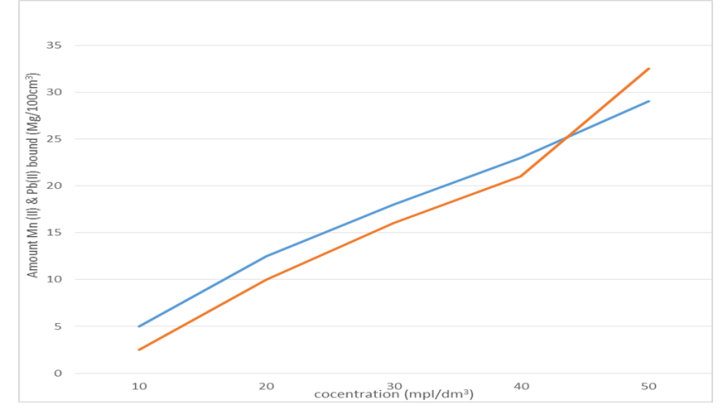
From Table 3 & Figure 3 above, it is shown that increase in adsorption of Mn(II) and Pb(II)ion concentrations are directly proportional to the increase of peanut shell concentration. At 10 mg/dm3- 50 mg/dm3addition of peanut shell, the adsorption of Mn(II) and Pb(II) ions increased from 8.9 mg/100cm3-78 mg/100cm3 and from 5 mg/100cm3-35 mg/100cm3 respectively.
- Concentration of
- Concentration of
- Concentration of
- Mn (II) bound (mg/100cm3)
- Pb (II) bound (mg/100cm3) peanut shell (mg/cm3)
- 5
- 2.5
- 10
- 12.5
- 10
- 20
- 18
- 16
- 30
- 23
- 21
- 40
- 29
- 32.5
- 50
Table 4: Varying Mn(II) and Pb(II) ion concentration on
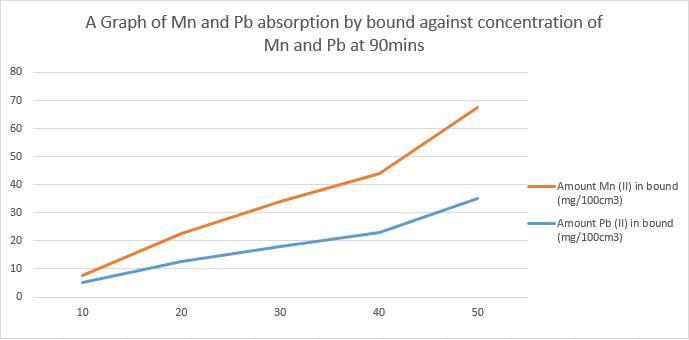
Figure 4: Graph of Mn(II) and Pb(II) adsorption by bound against concentration of banana peels respectively at 33°C for 90mins From Table 4 & Figure 4 above, it is shown that increase in adsorption of Mn(II) and Pb(II)ion concentrations are directly proportional to the increase of banana peels concentration. At 10 mg/dm3 -50 mg/dm3 addition of peanut shell, the adsorption of Mn (II) and Pb (II) ions increased from 5 mg/100cm3 -29 mg/100cm3 and from 2.5 mg/100cm3 - 32.5 mg/100cm3 respectively.
The results showed that banana peels and peanut shells can be used for the removal of heavy metals with a concentration range of 10-50 mg/100cm3. Also, when the contact time was 100 minutes it showed maximum adsorption of lead and manganese for both adsorbents. It was found that the percentage removal of heavy metals was dependent on the adsorbent and adsorbent concentration. The contact time necessary for maximum adsorption was found to be 100mins.
Conclusion
Using bio-adsorbents is an active technique to absorb toxic heavy metals from effluents and simultaneously employing the rejected open agricultural wastes in the surroundings for a beneficial purpose of waste water treatment. This technique does not only necessitate negligible energy input, less labor and low investment, but also attests to be economical, biodegradable and effective compared to man-made adsorbents and chemicals. The bio-adsorbent once used could be recycled for a definite period of time and this could be adopted commercially in prospect. In reaction to the problem of metals, whose toxic characteristics are being progressively emphasized on, health policy makers should relate the prophylactic principle at all level and inspire like researches for the profit of mankind and its environment.
References
-
Aydin H, Bulut Y, Yerlikaya C (2008) Removal of Cu (II) Ion from Aqueous Solution by Adsorption onto Low-Cost Adsorbents. J Environ Management 87(1): 37-45.
-
Dean JG, Bosqui FL, Lanouette VH (1972) Removing Metal from Waste Water. Environ Sci Tech 6: 518- 522.
-
Ko DCK, Porter JF, Mckay G (2000) Optimized Correlation for the Fixed Bed Adsorption of Metal Ions on Bone. Char J Chem Eng Sci 55: 5819-5829.
-
Koller K, Brown T, Spurgeon A, Levy L (2004) Recent Development in Low Level Exposure and Intellectual Impairment in Children. Environ Health Perspect 112(9): 987-994.
-
Goyer RA (1996) Toxic Effects of Metals. In: Klassen CD, et al. (Eds.), Casarettand Doull's Toxicology: The Basic Science of Poisons. 5th (Edn.), PP: 691-736.
-
Hala AH (2013) Removal of Heavy Metals from Wastewater Using Agricultural and Industrial Wastes as Adsorbents. HBRC Journal 9(3): 276-282.
-
Mohajerani M, Mehrvar M, Ein-Mozaffari F (2009) An Overview of the Integration of Advanced Oxidation Technologies and Other Processes for Water and Wastewater Treatment. Int J Eng (IJE) 3(2): 120-46.
-
Ahalya N, Ramachandra TV, Kanamadi RD (2003) Biosorption of Heavy Metals. Res J Chem Environ 7(4): 71-78.
-
Igwe JC, Ogunewe DN, Abia AA (2005) Competitive adsorption of Zn (II), Cd (II) and Pb (II) Ions from Aqueous and Non-aqueous Solution by Maize Cob and Husk. Afr J Biotechnol 4(10): 1113-1116.
-
Rafeah W, Ngaini Z, UsunJok V (2009) Removal of Mercury, Lead and Copper from Aqueous Solution by Activated Carbon of Palm Oil Empty Fruit Bunch. World Appl Sci J 5: 84-91.
-
Oboh OI, Aluyor EO (2008) The Removal of Heavy Metal Ions from Aqueous Solution Using Sour Sop Seeds as Biosorbent. Afr J Biotechnol 7(24): 4508- 4511.
-
Egila JN, Okorie EO (2002) Influence of Ph on the Adsorption of Trace Metals on Ecological and Agricultural Adsorbents. J Chem Soc Niger 27(2): 95- 98.
-
Gimba CE, Olayemi JY, Ifijeh DOH, Kagbu JA (2001) Adsorption of Dyes by Powdered and Granulated Activated Carbon from Coconut Shell. J Chem Soc Niger 26(1): 23-27
-
Upatham ES, Boonya B, Kriatracjie M, Pokethitiyook P, Park K (2002) Biosorptionof Cadmium and Chromium in Duck Weed WolffiaGlobosa. Int J Phytol 4(2): 73-86.
-
Ho YS, Huang CT, Huang HW, (2002) Agricultural By- Products as a Metal Sorbent: Sorption of Copper Ions from Aqueous Solution onto Tree Fern. Process Biochem 37(5): 1421-1430.
-
Gardea Torresdey J, Hejazi M, Tiemann K, Parsons JG, Duarte Gardea M, eta al. (2002) Use of Hop (HumulusLupulus) Agricultural By-Products for the Reduction of Aqueous Lead (II) Environmental Health Hazards. J Haz Mater 91(1-3): 95-112.
-
Babel S, Kurniawan T (2003) Various Treatment Technologies to Remove Arsenic and Mercury from Contaminated Groundwater: An Overview. In Proceedings of the First International Symposium on Southeast Asian Water Environment, Bangkok, Thailand, 24-25 October: 433-440.
- Electronic Waste Management in the Top Ten Economies in the World: A Critical Review on Waste Generation, Regulations, Collection, Recycling and Environmental Challenges
- Some Challenging Transdisciplinary Aspects of the Sustainable Waste Management in the Permacrisis Context
- Use of Mobile Autonomous Systems for Pollution Control of Inland Water Bodies
- Environmental Impact Perspective Sustainable Online Textile Retailing: Harnessing Augmented Reality-Based Digital Twins in Bangladesh
- Composite Treatment Module for Removing Acidity and Metal (Loid)S from Acid Rock Drainage
- Household E-Waste Management Systems [E-Wms] in Malaysia