
Pollution, Waste, and the New CE-CBE Integrative Recycling Paradigm in the Knowledge Based Society/Economy
The paper is focused on the anthropic and natural (mattergic and bioeconomic) recycling process of the pollutant products with the possibility to reintroduce in the technological flow a major quantity of the matter with a very low level of energy used with a top level of the informaction (actional information). Is introduced the contextual (2+2)Rs paradigm (reduce, recycle & reuse, recombine-recover) connected to the ENSEC, envinronmental-sociopolitic-economic paradigm of the knowledge based society/economy (KBS/E). The perspective of such a pattern is an optimistic one; so, preserving mattergic resources, even energetic, with a larger contribution of the smart components and technics of the recycling process, we could overcome the contextual thresholds of a future bioeconomy. This represents a new perspective of the recycling process and is considered an important oportunity for the global economy facing the current crisis. In order to have a comprehensive vision of the pollution and waste issue, we are puting together in this paper, in a synergistic-generative significant way (synergy 1+1>2, and significance 1-1≠0), three conceptual and analytical knowledge-spaces: transdisciplinarity as a methodology, globalization vs glocalization as a reality, and sustainable development as a necessity. The linear thermo economic recycling model is compared with the nonlinear, simply circular economic one, in the bio economic context, giving a comprehensive description of what does circular bio economic recycling pattern really means.
Introduction
Because of excessive and chaotic anthropic activities as industrialization, transportation, agriculture, household, enormous economic gaps, chaos and unequal societal phenomena are detected with uncertainity, dangerous limits, disasters, associated with large quantities of residues, waste, and ecological footprints in detriment to the natural environment and the quality of life in most places on the planet [1, 2, 3, 4], as entropic processes [5]. Most human activities generate waste; in particular, organic waste is globally generated in large quantities from various sectors, notably from agri-food and forestry activities [6]. Waste, natural and anthropic, remains a major source of concern in our developed societies since its management is becoming ever more costly and problematic [7, 8]. Also, the increase in global population and the consequently higher demand for energy and consumer products, combined with strong industrialization and improper management measures, lead to accumulation of large volumes of solid and liquid waste [9, 10, 11]. In addition, organic waste has a noticeable carbon footprint as its degradation produces greenhouse gases, as well as energetic products that have a profound impact on climate change [12, 13]. In this context, in order to diminish the entropic tendencies, we are confronted with a major dilemma: to invest in sustainable long-term projects with low economic returns, or to innovate in short-term, incremental production, and negotiate step by step the environmental harm caused by an excessive industrialization with a high consumerism level, [14, 15]. Because of these it is necessary to reverse the dangerous and perverted cycle created by globalist chemical imperialism through consumerism, and to transform the current ecological footprint into valuable assets, for all sub-systems of the biosphere, as well as change the way to approach the systemic interactions for the ENSEC components (environment, sociopolitics, and economy) from some particulars to a global one Figure 1 [8, 15]. Therefore, here are 3+1 specific integrative knowledge spaces: bearability for environmental and sociopolitics intersection, viability as environmental and energetic superposition, and finally, equitability as common aspects of the economy and sociopolitics. The united sphere represents sustainability as a transdisciplinary sphere of knowledge and a way to obtain the equilibrium through the three semiophysical sequences, space-wise, time-wise, and act-wise [16], by included middle [17]. All these knowledge spaces are responsible for the level of pollution and waste, sustainability being very important in solving the waste problem [2, 18, 19].
![Figure 1: The synergistic-generative representation of the sustainability biosphere’s triad of the ENSEC (environment, sociopolitics, economy) subsystems [15].](/fulltextimages/9130/fig_1.png)
In order to configure a new paradigm to analyze the occurrence of every kind of pollution [15] waste (in solid, liquid and gas form [20], even radioactive waste [21], and the necessary new recycling model based on circular economy (CE) [3, 22] from the perspective of bio economy [7, 23], with both entropic and negentropic aspects [5, 24]. We consider a unified perspective through a trans disciplinary methodology [25, 26], taking into account the globalization vs glocalization perspective [1, 15] with sustainability as a necessity [27, 28, 29, 15]. A complementary aspect would be the sustainable wealth, based on the modification of the conventional growth paradigm, able to regenerate regional natural resources, simultaneously being economically competitive and able to offer important social benefits to the community. SWIT (Sustainable Wealth creation based on Innovation and Technology) Scheel C [30] is such an example working on three levels: multiple businesses of zero-value residue industrial ecology processes (ZRIES), the circular value ecosystems (CVES), and sustainable sharing value systems (SVS), all these being managed and governed for benefits of the entire human community, in an all-life learning paradigm to preserve the environment with natural resources and to manage informergically entire life process [20].
In the sustainable development dynamics, some transitions are detected, such as the transition from a production inefficiency state to the state’s policies necessary to be oriented towards optimizing and improving the production process, contributing significantly to the solution of food problems in the future, socio-economic protection, two major global problems, and to ecoenergetic sollutions for the crisis as well in Scheel C [30, 31]. Various potentially successful phase transitions to sustainable development are detected, encompassing significant economic growth potential in a dynamic equilibrium regarding consumption, with contextual-driven economies [32], the protection of biodiversity [33], energy efficiency [34, 25], environmental protection [2], and investment in the quality of life at all levels [33, 35]. Only a sustainable development process [36, 37] unfolded in a transdisciplinary equillibrium expressed through the included middle [38, 39], can assure an efficient leadership of a globally and locally expansion of usable and valuable knowledge in a lot of human options, in order to meet the needs of the present and to preserve the future of the coming generations in a permanent transitional pattern [40, 41, 42]. Any development process is confronted with transitional processes, so it has to identify the appeared development crisis („glue mixed with iron” contextual incompatibilities) [1, 23], emerging directly from the interface of the social and the ecological, in the economic, specific and global context [9, 12]. The concept of sustainable development has taken root as a link between the environmental, socio-political, and economic (ENSEC) objectives of societies, in a necessary balanced way [43, 44, 45, 15].
All these natural specific knowledge spaces are interconnected and interdependent, as follows: bearability for environmental and sociopolitics intersection, viability as environmental and energetic superposition, and finally, equitability as commonly aspects of the economy and sociopolitics. The common space represents sustainability as transdisciplinary sphere of knowledge, a way to obtain the equilibrium through the three semiophysical sequences, space-wise, time-wise, and act-wise by included middle [16, 17]. The systemic synergistic-generative analysis helps people to identify major arguments related to a community problem as well as key stakeholders and their perspectives, goals, and assumptions related to the discussed problem, looking critically at the proposed solutions and the costs- financial and otherwise - and at who will bear those costs [25]. This kind of analysis can be done briefly or in depth, being a transdisciplinary approach, bridging the natural and social sciences, as well in Folke C [2]. The transgenerational term sustainability development of economic growth [46] itself depends on maintaining basic ecosystem services, a healthy environment, and cohesive societies [24, 33]. The multiple balancing of these elements will require stronger co-operation with developing and transitioning countries – which already represent over 80% of the world population, and which will account for virtually all its future increase – because risks of disintegration and exclusion affect all countries, as do opportunities to benefit from participation in a growing global economy [12, 1, 46]. “Sustainable development is development that meets the needs of the present without compromising the ability of future generations to meet their own needs”, is the most original descriptions for sustainable development, which contains within it the concept of the essential needs of the world’s poor, to which overriding priority should be given, and the idea of limitations imposed by the state to technologies and social- political organization on the environment’s ability to meet present and future needs [42, 15]. Because the sustainable development is continually evolving, being necessary to be locally relevant and culturally appropriate, it is difficult to define and to put it in an accessible pattern [47, 48].
One of the most important waste vital problems is the water pollution and treatment by extraction of the usable water from hazardous anthropic and natural wastes. The treated water is used for industrial and agricultural needs, to obtain a zero waste for water [49]. The solvents as VOC (volatile organic compounds) are of a big importance because they are polluting water, soil, and air as well. Solid waste is one of the important challenges to the environment. The inadequate waste management cause alteration the ecosystems including air, water, and soil pollution; thus, it represents a real threat to human health with a lot of potential damages. Population increase, rapid urbanization, booming economy, and the rise in the standard of living have greatly accelerated the rate, amount, and quality of the municipal solid waste generation with high costs for local and general budget [50]. Biodegradation is an important factor that governs the amount of recyclable material particularly the organic contents with a heterogeneous aspect and distribution in nature. The necessary bin collection practices, collection, transfer and/or transport systems have a great effect on the characteristics of the solid wastes, natural and anthropic as well. The plastics and metal waste disposal major global environmental problems [51, 52]. The most used and cheapest disposal of solid waste is the landfills as waste management techniques, which concerns with the process of converting waste materials into more useful products including fuels, materials, and chemicals, so the wastes from olive industry could be converted into low-cost adsorbents [53]. The anaerobic digestion of sewage sludge for biogas can be affected and limited because of the presence of heavy metals, attributed to the rapid poisoning of the several active bacteria forms in the digester. Organic solid state fermentation is a promising technology for organic waste. The household food and domestic wastes with its high dry content could produce high level of ethanol by solid state fermentation valorization [54]. Microorganisms play an important role in the degradation of organic wastes into their constituents to convert them into high value-added products. Valorization of organic matter solid waste can be accomplished via composting and anaerobic digestion, with the advantage of the technical simplicity of the composting process, valorizing and recycling activities, turning them into a valuable income. The biofuels are an alternative to the classic fuel, but it is a very big problem with technology costs an enough bio resources [55].
Pollution and Waste as Big Opportunities to Recover Resources
“Pollution is a fundamental and everywhere present concept defined as a disturbance of the equilibrium of a system, by adding or by submitting quantitative or qualitative aspects with a disaster or an und_esired damage for the system, through a reversible or nonr_eversible process” [15]. There are many aspects of the polluting process (mechanical, thermal, radioactive, chemical, electromagnetic etc) between them being even the informaction (bad action, no adequate information) aspects, not only of the mattergic (matter and embedded energy) one [16]. In this context, we start our presentation using the diagram of primary energy sources (gravitational energy, solar energy, fuels (fossils, nuclear), internal sources (geothermal, volcanoes), other kind of sources (biomass, waste, and chemical). The mattergic diagram presented in Figure 2 [5] correlates the incomes of the ENSEC (environment-sociopolitics-economics) activities [15] (Figure 1) as material and consumptable resources (mattergy-matter and energy), connected with informaction (intentional action and information) [34]. There are presented here three categories of waste, as follows: (1) garbage junk and reciclable components, rGJ, as disposable mattergy but without any specific utilization; (2) depollutant waste W and, (3) general waste mentioned through three components, as dispersed energy (Ed), dispersed matter (Md) and other kind of waste without any mattergic economical utility (w)
![Figure 2: Matergic diagram of the linear classic recycling process [5].](/fulltextimages/9130/fig_2.png)
In any economic process are identified seven fields, active and pollutant, as well, as columns of the diagram, first two, transforming the income flows of energy (Ei) and matter (Mi) from environment into controled energy (Ec) and matter (Mc) as active flows through: K, as fixed capital; C, as consumptional goods; R, as recycling, but without recyclable waste; Dp, as depoluting field; and finally Hh, as habitual consume of the population. Considering the law of entropy it is impossible to recycle all, because of unutilizing waste w, that is dispersed as energy (Ed), and matter (Md), with waste without any mattergic economic utility (w) [5]. This diagram is working as a liniar recycling process, but connected to the entropy as a measure of disorder, the main objective being to get a low speed for growth of the entropic level, alltogether with an adequate kind of approach of these aspects [15]. First of all we are focused on the waste as bad, pollutant products of all the antropic activities (food, technics, technologies, buildings, transportations, radioactive etc), and secondly we are considering the biomass as a natural source of energy, as the waste are. Here, it is very important to know that the conversion of the solar primary energy by photosynthesis process is connected to this kind of waste as so named unutilising products. To achieve the desired equilibrium of a polluted system it is necessary to generate a negentropic process, through specific ways [5]. The polluting systems are working at low efficiency in an entropic state, the aim of the new recycling paradigm being to configure the circular economic (CE)/circular bio economic (CBE) systems [56, 57, 58, 22]. The major problem of the research is how these two concepts, CE and CBE are linked one to another, and how do they work together in order to diminish the pollution effects, and recover matter by smart methods, techniques and technologies [15].
By 1970 the object of the industrial revolution was to ensure that there would be no such thing as waste, on the basis that waste is simply some substance that we do not yet have the wit to use .
It correlates the incomes of the ENSEC (environment- sociopolitics-economics) activities as material and consumptable resources (mattergy-matter and energy), connected with informaction (intentional action and information) in order to realize smart technologies with smart methods and techniques, as well in Pop IG [34].
Circular Economy (CE) Paradigm in the Bio Economic (BE) Context
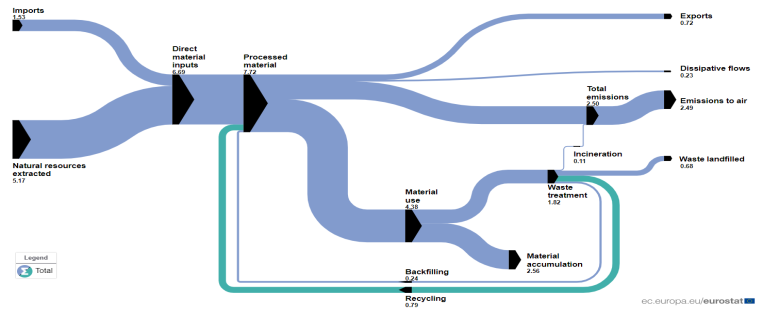
The circular economy, CE, is a model of production and consumption, which involves sharing, leasing, reusing, repairing, refurbishing and recycling existing materials and products as long as possible, in this way, the life cycle of products is extended, reducing waste to a minimum level. When a product reaches the end of its life, its materials are kept within the economy wherever possible. These can be productively used again and again, thereby creating further value. This is a departure from the traditional, linear economic model, which is based on a take-make-consume-throw away pattern. This model relies on large quantities of cheap, easily accessible materials and energy. A discusion about a recycling model is presented in the context of the sustainable systems through resilience (R), viability (V) and disaster (D) [15]. The idea of the circular economy (CE) needs to connect some aspects as entropic one, preservation of the materials, energetics, with roots in the early days of the modern environmental movement from 1960s and 1970s, puting together the concept of ‘industrial ecology’ and the term ‘industrial symbiosis’ used in economic geography in the years of 1940 to describe the determinants of the location of industries in order to make efficient utilisation of resources and avoid waste [3]. The Sankey diagram presented in Figure 3 shows the flows of materials as they pass through the EU economy and are eventually discharged back into the environment or re-fed into the economic processing. The width of every band is proportional to the flow quantity; materials are extracted from the environment to make products and assets or as a source of energy; being accumulated in societal stocks eventually discharged to the environment as residuals; imports and exports, which are flows of products with other economies, are also shown. The closed loop represents here residuals which are not discharged into the environment but reused in the economy or used to produce secondary raw materials [59], or for other purposes preventing further extraction of natural resources. In this sense see also the mattergic diagram presented in Figure 2, considered a linear pattern for recycling the waste.
In a circular economy resource use is improved by minimising the extraction of natural resources, maximising waste prevention, and optimising the environmental, social, material and economic values throughout the lifecycles of materials, components and products [60]. A very important problem is food waste, considered an environmental, economic and esspecially an ethical problem, with contributions from all players in the value chain from the producer to the consumer, in the context of the chemical imperialism of consumerism. There is no exactly definition on food waste, defined as being “composed, raw or cooked food materials, including food loss before, during or after meal preparation in the household, as well as food discarded in the manufacturing/production, distribution, wholesale/ retail and food service sectors (including restaurants, schools and hospitals)” [61, 62]. More than a big amount of food waste (4.4 gigatons) is generating equivalent of carbon dioxide (about 8% of the total anthropogenic greenhouse gas emissions-GHG), and only slightly less than that of global road transportation is detected [14]. It is necessary to avoid to thrown away the food waste (about 30% of all food in the world is thrown away and disposed of in landfills, equivalent to 1.32 billion tonnes/year of food), the hungry people being about 8.9 percent of the world population. The food waste is equivalent to a country space, as the third-largest emitter of carbon dioxide equivalent, after the United States and China [13, 63]. As a consequence of the food waste, natural resources as water, soil and energy are also being wasted. It comprises also materials such as vegetable peelings, meat trimmings, spoiled or excess ingredients from prepared food, bones, carcasses and organs, excluding those from agricultural production [61].
There are three kinds of barriers detected, barriers to the implementation of the circular economy (CE) concept, industrial-economic category, cultural barriers, and market barriers induced by a lack of synergistic governmental interventions to accelerate the transition towards a circular economy [64, 65, 59]. It is very difficult to give a coherent definition for circular economic concept, being gathered 114 circular economy definitions coded on 17 dimensions [3]. The most realistic definition can be frequently depicted as a combination of reduce, recycle, reuse, and recombine (recover) activities, as (2+2)Rs paradigm, being connected to sustainable development, in order to assure the economic prosperity, followed by environmental quality with an impact on social equity and future generations, as it is presented by ENSEC paradigm [15]. Very important to know that neither business models nor consumers are frequently outlined as enablers of the circular economy, being necessary to realize a coherence of the circular economy concept through a more significant focus on what should be configureured this concept in order to avoid a collapse of it in the context of the sustainable development in the knowledge based society/ economy [57, 8, 66, 15]. It shows the flows of materials as they pass through the EU economy eventually discharged back into the environment or re-fed into the economic processing. Materials are extracted from the environment to make products and assets or as a source of energy; being accumulated in societal stocks eventually discharged to the environment as residuals; imports and exports, which are flows of products with other economies, are also shown. The closed loop represents residuals not discharged into the environment but reused in the economy or used to produce secondary raw materials or for other purposes preventing further extraction of natural resources.
In order to implement the circular economy (CE) [67, 68, 69, 65], there are three possible setups to characterize the wellbeing level of an eco-economic system: resilience (R), viability (V), and disaster (subsistance) (D), in the context of the sustainable development, with the environment (ecology), socio-communitarian (human comunities), and economic spheres (products, market, money) [15]. The equilibrium of such a complex system, in major correllations between the three presented spheres, is determined by the way it is understood, and put to work in good practices, in a very permanent transdialog between the actors of the local, regional and global communities in diferent spatial- temporal-actional contexts [16, 31]. This negotiation between the actors involved in this process presuposes an optimum equilibrium of the authority communication spheres, leadership, education and relationship [34]. The bigger is the common space of these authority semiophysical spheres (leadership, education and relationship), the more efficient and productive will be the integrative process of the synergistic integrative knowledge process. Synergistic communication is working transdisciplinary, as a “round about table “where the involved actors should play in a common sense and rightiousness on the mattergic resources, life style, able to pay all the costs to preserve the earth heritage for the future generations [42, 70]. This approach could be named as a “communitarian ecumenism“, in a togetherness of the all aspects, economic, socio-communitarian, and ecologic, involved in the desired sustainable circular economy with its bio economic fact [42, 71] On the other side, the circular bio economic (CBE) concept is considered as a natural waste (agricultural, household, food, and other such sources) process we connect it to the biofuels as an alternative to the fossils, as biomass with a lot of aspects, even barriers, the same as we nominated above [64] Figure 4.
![Figure 4: Circular bioeconomy (CBE) [72].](/fulltextimages/9130/fig_4.png)
It exhibits an opportunity to link the circular and the bio-based economy concepts. In this diagram are identified clear intersections and advantages to be gained by aligning the two concepts. In the intersection area that defines the CBE concept, there are three complementary views as key interfaces between CBE and CE, as are: increasing resources productivity utilizing the biomass it self as a resourc: the cascading use of biomass, and to create a more sustainable and resource efficient society.
“The traditional model of industrial activity in which individual manufacturing processes take in raw materials and generate products to be sold plus waste to be disposed of should be transformed into a more integrated model: an industrial ecosystem. In such a system the consumption of energy and materials is optimized, waste generation is minimized and the effluents of one process could serve as the raw material for another processes, so the industrial ecosystem would function as an analogue of biological ecosystems” [73]. On the other hand, CBE encompasses the production of renewable biological resources and the conversion of these resources and waste streams into added-value products, such as food, feed, bio-based products and bioenergy [74]. As illustrated in Figure 3 for CBE based on land resources, biomass derived from agriculture and forestry is processed mainly into food and feed but also potentially generates bioenergy and biofuels [75], chemicals, materials, and other bio-based products. The interconnection between CE and CBE is explained as “the concepts of CE and CBE have similar targets, but none is fully part of the other nor embedded in the other” [76]. There is a distinction between exhaustible and renewable resources. Any use of the former will deplete stocks of those resources, but renewable resources have the capacity to renew themselves. Used within that capacity, renewable resources will not deplete and may increase, weakening the ‘finite resource base’ arguments for a circular economy. Biorefinery is defined as a facility that sustainably generates products of commercial interest using only biomass as substrate [77]. It is considered as the equivalent of an oil refinery where conventional fossil raw materials are replaced by biomass, an alternative feedstock derived from organic matter that includes waste from agriculture [78, 79], food industry [80], forestry activities [81] municipal organic waste [82], among others. The biorefinery concept represents a potential solution to current waste disposal problems as it facilitates the production of high value-added compounds in three major industrial domains: chemicals, materials and fuels [83]. This complementary approach to the conventional waste use practices (animal feed, composting, incineration and landfill) is identified as a second generation of organic waste valorization and re-use strategies for the production of higher-value marketable products [79], considered as one of the most promising pathways to attaining a resource- efficient circular bioeconomy (CBE), as a way of decreasing human-induced environmental impacts, generate new market opportunities and use resources more efficiently [84].
The circular economy (CE) is an increasingly topic of interest, mainly when it comes to global sustainability [119], necessary to be related to bioeconomy (BE) [85], connected to thermoeconomy, with the entropy as measure of the disorder. The circular economy proposes an approach opposite to that of the traditional linear economy presented by mattergic diagram in Figure 2 [5], where raw materials are extracted and processed into products that are thrown away after use. An illustration of flows in the CE context, adapted from a well-known diagram developed by the nova- Institute GmbH, is presented in Figure 3. Most of the bio-based products are covered by this hierarchy, showing that they are potentially part of the CE [86]. Thereby, Circular Bioeconomy (CBE) stands out as an opportunity to link the circular and the bio-based economy concepts. This is illustrated in Figure 4, where clear intersections and advantages to be gained by aligning the two concepts are identified. In the intersection area that defines the CBE concept, three complementary views can be found as key interfaces between CBE and CE. First of all is the utilization of biomass as a resource, using “by-products”, “residues”, and “waste”, increasing resources productivity. Secondly, is the cascading use of biomass, i.e. the sequential recycling of a material into another type of product after its use, the main target of both cascading use and CE being an increased resource efficiency and lower demand for raw materials, with both being frequently linked to value addition and job creation. The pulp and paper or textile industries are good examples of how cascading has been used for decades, long before the term itself became mainstream [87, 85]. Thirdly, is the strive to create a more sustainable and resource efficient society, both CE and CBE minimizing the use of fossil fuels [86].
The CE concept strengthens the resource efficiency of processes and the use of recycled materials to reduce the demand for fossil carbon, while CBE substitutes fossil carbon by renewable carbon from biomass [85]. Thus, CBE emerges as the result of the pursuit of a more sustainable and resource efficient world, providing various societal, economic and environmental benefits that are detailed in Figure 4. Recycling and other circular waste management practices are a key part of the CBE paradigm, as exemplified by the sustainable, resource-efficient valorization of biomass in integrated production chains (e.g. biorefineries) while making use of residues and wastes. For instance, the product sectors related to plastics and building materials have significant recycling and cascading potential. However, established waste management practices do not necessarily result in the most economical or environmentally friendly solution [88, 72]. In fact, key challenges for implementing circular strategies include costs (besides e.g. policies and regulations, and the current small size of bio-based markets). In this context, the optimization of the value of biomass over time is sugested as a key characteristic of the CBE [72]. The level of the recycled waste in 2021 was 3.83 million tonnes from about 6.94 million tonnes of solid waste generated. The recycled waste attributed to the non-domestic and domestic sectors increased from 2.81 million tonnes and 0.23 million tonnes respectively in 2020, to 3.58 million tonnes and 0.24 million tonnes respectively in 2021 [89]. Are presented also a lot of interesting informations about waste generation growing as economic activities with a greater urgency to shift from a linear to a circular economy, as a key part of the Zero Waste Masterplan. It appears as a great necessity to take a whole-of-nation effort to achieve the vision of a Zero Waste Nation, as more sustainable practices [89]. It is evident the necessity of a integrated concept to administrate both anthropic and natural waste as CE & CBE paradigm.
The CBE is defined as the specific application of the recycling concept, CE, to biological resources, products and materials, together with other distinct approaches, some of them considering CBE as an intersection of bioeconomy (BE) and circular economy (CE) [85], a more comprehensive vision being that CBE is “more than bioeconomy or circular economy alone” . We consider that CBE represents the CE approach projected on the bioeconomic waste, food, agriculture, biorefinery to obtain biofuels [75, 79] and other products, with specific flows to recover informactionally the mattergy through smart methods and techniques, and industrial technology, as well, under the pressure of the entropic law, with limited material and energetic resources, in an incremental tendency of the population, in a very big majority missing food [16, 15], in a specific complementarity as methodology, with technological specificities, in a sustainable equillibrium, in the resilient generative- synergistic ENSEC context [15]. The strategic goals of the European bioeconomy are to ensure food and nutrition security, manage natural resources sustainably, reduce dependence on non-renewable, unsustainable resources, limit and adapt to climate change, to assure competitiveness and create jobs, considering that the environmental impact for the economic growth is determined by multiplying population growth, affluence, and technological change in a linear form [60]. Studies on the utilization of forest and agricultural wastes are of the extreme significance in any country where there exists a gap between the availability of the requirements for livestock feeds. Forest and agriculture wastes have big potential for energetic valorization, the energetic value of these wastes in Europe being tremandous (4.5 × 10¹² MJ/year). Forest wastes are nowadays utilized as feedstock for integrated gasification processes, but there is a remarkable underutilization of agricultural wastes [87, 6, 80, 58, 49]. While waste production in the industrial sectors is usually possible to be reduced, the propensity of waste production from municipalities appears to be very dificult to manage efficiently [7, 90].
Discussions and Conclusions
People, sociopolitics and economic systems exert a tremendous pressure on the natural environment through the extraction of materials and generation of waste. In this context, circular economy (CE), with circular bioeconomy (CBE), complementarily connected, have emerged as potential solutions for the problem of resources, in the context of diminishing natural resources. Both these two concepts are positioned as technology-focused generating economic gains while alleviating pressure on the environment, CE-CBE enjoy a positive reception by organisations in public, private and civic sectors and, increasingly, academia alike. In this research we put in connection pollution as the quantitative and qualitative equilibrium disturbance in ENSEC systems, and waste, as anthropic products, which involve environment, sociopolitics and economy in the context of the knowledge based society/economy (KBS/E) considering transdisciplinarity as a methodology, globalization vs glocalization as a reality, and sustainable development as a necessity. A generative – synergistic way was implemented starting from the entropic thermoeconomic mattergic diagram, considered as a linear recycling approach for an entropic economy.
We consider that the recycling paradigm appropriate in the knowledge based society/economy, KBS/E, should be an integrative one, in order to configure a new education, methodology, and technology for the (2+2)Rs paradigm, as reduce, recycle & reuse, recombine and recover processes, applied as circular economy (CE) as anthropic with specific way to reduce the mattergical limited and consumptable resources, recycling what is possible by reusing and recovering of what it is possible by diminishing the entropic decay of a technological process. The complementarity of this concept, CE, to the CBE concept is a challenge for researchers, interested contextually in specific recycling processes, especially in biomass, in refining of industrial and agricultural waste to produce biofuels as alternative to the classical fuels, mandatory to be recovered. The answer on the correlation between the CE and CBE is a necessary complementary approach, as methodology, but with technological specificities, in a sustainable equillibrium, in a resilient ENSEC context. We consider that actual geopolitical and economic crisis context should become an opportunity to redefine the strategies to avoid the loss of the mattergy resources by using smart solutions, techniques, and technologies. Circular economy integrating circular bioeconomy can generate new business opportunities, limit material costs and price volatility, reduce dependency on imports and increase resource security, reduce global greenhouse gas emissions through the uptake of low-carbon and resource efficient strategies improving the quality of life, to create new jobs, as social benefits, reconfigureuring the approach on pollution, waste irrespective of provinience.
In this paper we consider that CBE represents the CE approach projected on the bioeconomic waste, food, agriculture, biorefinery to obtain biofuels, and other products, with specific flows to recover informactionally the mattergy through smart methods and techniques, and industrial technology, as well, under the pressure of the entropic law, with limited material and energetic resources, in an incremental tendency of the population, in the multivariable crisis with a very large majority missing food, in a specific complementarity as methodology, with technological specificities, in a sustainable equillibrium, in the resilient generative-synergistic ENSEC context.
References
-
Brown K (2014) Global environmental change: A social turn for resilience? Prog Hum Geogr 38(1): 107-117.
-
Folke C, Hahn T, Olsson P, Norberg J (2005) Adaptive governance of social-ecological systems. Annu Rev Environ Resour 30: 441-473.
-
Kirchherr, Piscicelli L, Bour R, Kostense-Smit E, Muller J, et al. (2018) Barriers to the Circular Economy: Evidence From the European Union. Ecological Economics 150: 264-272.
-
Oluleye BI, Chan DWM, Saka AB, Olawumi TO (2022) Circular economy research on building construction and demolition waste: A review of current trends and future research directions. Journal of Cleaner Production 357: 131927.
-
Georgescu Roegen N (1971) The Entropy Law and the Economic Process in Retrospect. Eastern Economic Journal 12(1): 3-25.
-
Bilgen S, Sarıkaya I (2016) Utilization of forestry and agricultural wastes. Energy Sources, Part A: Recovery, Utilization, and Environmental Effects 38(23): 3484- 3490.
-
DEFF & CSIR (2021) Food waste prevention & management: A guideline for South Africa. 1st(Edn.), Pretoria.
-
De Kemmeter M (2013) New growth in the new economy: New measuring – new cooperation Resources Systemics.
-
Goodland R, Daly H, El Serafy S (1992) Population, Technology and Lifestyle: The Transition to Sustainability. Island Press, Washington, USA, pp: 154.
-
Abdel-Shafy HI, Mansour MSM, Birkved M (2018) Solid Waste Issue: Sources, Composition, Disposal, Recycling, and Valorization. Egyptian Journal of Petroleum 27(4): 1275-1290.
-
Oluleye BI, Chan DWM, Saka AB, Olawumi TO (2022) Circular economy research on building construction and demolition waste: A review of current trends and future research directions. Journal of Cleaner Production 357: 131927.
-
Collins WD, Ramaswamy V, Schwarzkopf MD, Sun Y, Portmann RW, et al. (2006) Radiative forcing by well- mixed greenhouse gases: Estimates from climate models in the Intergovernmental Panel on Climate Change (IPCC) Fourth Assessment Report (AR4). J Geophys Res 111(D14317).
-
FAO (2015) The Global Forest Resources Assessment.
-
Nijs W, Politis S, Castello PR, Sgobbi A, Thie C, et al. (2015) Supporting the Deployment of Selected Low- Carbon Technologies in Europe. Implications of Techno- Economic Assumptions. An Energy System Perspective with the JRC-EU-TIMES Model. EUR 27608 EN, Publication Office of the European Union, Luxembourg.
-
Pop IG, Badea MC, Jaradat MH, Vaduva S, Prisac I, et al. (2021) Considerations about Sustainable Development of the ENSEC (Environmental-Social-Economic) Systems. Transdisciplinary M.E.N. (Megawatt, Ecowatt, Negawatt) Eco-Energetic Paradigm. Modern Perspectives in Economics, Business and Management 3: 26-58.
-
Pop IG, Maties V (2011) Transdisciplinary Approach of the Mechatronics in the Knowledge Based Society. Mechatronics 13: 271-300.
-
Nicolescu B (2006) Transdisciplinarity–Past Present and Future. In: Haverkort B, et al. (Eds.), Moving Worldviews. COMPAS Editions, Reshaping Sciences, Policies and Practices for Endogenous Sustainable Development, Holland, pp: 142-166.
-
Simonsen SH, Biggs RO, Schluter M, Schoon M, Bohensky E, et al. (2015) Applying Resilience Thinking: Seven Principles for Building Resilience in Social-Ecological Systems. Stockholm Resilience Centre, Sweden.
-
Brand F (2016) Ecological Resilience and Its Relevance within a Theory of Sustainable Development. UFZ Centre for Environmental Research Leipzig-Halle.
-
Scheel C, Vasquez M (2013) Regional wealth creation by leveraging residues and waste. In Life & business sciences 194: 72-92.
-
Cosma C, Cozar O, Jurcut T, Baciu C, Pop I, et al. (2005) Simultaneous Measurements of Radon and Thoron Exhalation Rate From Soil and Building Materials. Radioactivity in the Environment 7: 699-705.
-
Geisendorf S, Pietrulla F (2018) The circular economy and circular economic concepts - a literature analysis and redefinition. Thunderbird International Business Review 60(5): 771-782.
-
Friant MC, Vermeulen WJV, Salomone R (2020) A typology of circular economy discourses: Navigating the diverse visions of a contested paradigm. Resources, Conservation and Recycling 161: 104917.
-
Avery JS (2012) Entropy & Economy. Cadmus 1(4): 166- 179.
-
Prisac I (2014) Business Ethics and Leadership from an Eastern European Country: Transdisciplinary Context. The 2014 Griffiths School of Management Annual International Conference on Business: Entrepreneurship and Ethics. Oradea, Romania.
-
Pop IG, Maties V (2009) Considerations about the mechatronical transdisciplinary knowledge paradigm. The 5th IEEE International Conference on Mechatronics, pp: 14-17.
-
Hirsch Hadorn GH, Bradley D, Pohl C, Rist S, Wiesmann U, et al. (2006) Implications of transdisciplinarity for sustainability research. Ecological Economics 60(1): 119-128.
-
Andreica R, Jaradat MH (2011) Analysis of the Economic Development and Sustainable Development of ROMANIA. Metalurgia International 16(11): 9-13.
-
Gecevicius G, Markevicius A, Marciukaitis M (2015) Local Sustainable Energy Strategies as Opportunity for European Union Regional Development. Environmental Research, Engineering and Management 71(3): 49-57.
-
Scheel C (2016) Beyond sustainability. Transforming industrial zero-valued residues into an increasing economic returns. J Cle Prod 131: 376-386
-
Slaus I, Jacobs G (2011) Human Capital and Sustainability. Sustainability 3(1): 97-154.
-
Kumar Vidya SA (2003) A Critical Methodology of Globalization: Politics of the 21st Century? Indiana Journal of Global Legal Studies 10(2): 87-111.
-
Clark NE, Lovell R, Wheeler BW, Higgins SL, Depledge MH, et al. (2014) Biodiversity, cultural pathways, and human health: A framework. Trends Ecol Evol 29(4): 198-204.
-
Pop IG, Fotea I, Fotea S (2018) Innovation Networking, Knowledge Transdisciplinary Spaces. Studia Universitatis “Vasile Goldis” Arad. Economics Series 28(2): 86-106.
-
Webster K (2017) The Circular Economy a Wealth of Flows. 2nd(Edn.), Ellen McArthur Foundation Publishing, UK.
-
Borowy I (2013) Defining Sustainable Development for Our Common Future. 1st(Edn.), Routledge, London, pp: 280.
-
Folke C, Biggs RO, Schluter M, Schoon ML, Robards MD, et al. (2015) Principles for Building Resilience. Sustaining Ecosystem Services in Social-Ecological Systems, Cambridge University Press, Cambridge, UK.
-
Nicolescu B (2006) Transdisciplinarity–Past Present and Future. In: Haverkort B, et al. (Eds.), Moving Worldviews. COMPAS Editions, Reshaping Sciences, Policies and Practices for Endogenous Sustainable Development, Holland, pp: 142-166.
-
Pop IG, Talpos MF, Prisac I (2015) Transdisciplinary Approach on the Advanced on the Advanced Sustainable Knowledge Integration. Balkan Region Conference on Engineering and Business Education 1(1): 215-225.
-
Biermann F (2005) Earth system governance. The challenge for social science, IDGEC New Directions Bonn, pp: 1.
-
Fues T, Messner D, Scholz I (2005) Global environmental governance from a North-South perspective. In: Rechkemmer A, et al. (Eds.), UNEO-Towards an international environment organization: Approaches to a sustainable reform of global environmental governance, Baden-Baden. Nomos Verl Ges, pp: 242-264.
-
Brundtland G (1987) Our Common Future Brundtland Report. World Commission on Environment and Development.
-
Anderson MS (2007) An introductory note on the environmental economics of the circular economy. Sustain Sci 2: 133-140.
-
Seghezzo L (2009) The Five Dimensions of Sustainability. Environmental Politics 18(4): 539-556.
-
Senge P (2010) The Necessary Revolution: How Individuals and Organizations are Working together to Create a Sustainable, New York.
-
Stengler E (2015) Waste to Energy: A Sustainable Energy Strategy, in Circular Economy in Europe, pp: 38: 44.
-
Al-Rodhan NRF, Stoudmann G (2006) Definitions of Globalization: A Comprehensive Overview and A Proposed Definition. Geneva Centre for Security Policy.
-
Resilience Alliance (2010) Assessing Resilience in Social- Ecological Systems. Workbook for Pracitioners.
-
Burton L (2022) How To Be Zero Waste When You Generate Hazardous Materials.
-
Sheng ILS, Kok-Soo T (2010) Eco-Efficient Product Design Using Theory of Inventive Problem Solving (TRIZ) Principles. American Journal of Applied Sciences 7(6): 852-858.
-
Prabhash Kumar (2018) Impact of Plastic on the Environment. International Journal of Trend in Scientific Research and Development 2(2): 471-474.
-
Bora RR, Wang R, You F (2020) Waste Polypropylene Plastic Recycling toward Climate Change Mitigation and Circular Economy: Energy, Environmental, and Technoeconomic Perspectives. ACS Sustainable Chemistry & Engineering 8(43): 16350-16363.
-
Ali Imran, Mohd Asim, Tabrez A Khan (2012) Low cost adsorbents for the removal of organic pollutants from wastewater. Journal of Environmental Management 11: 170-183.
-
Abu Yazid N, Barrena R, Komilis D, Sanchez A (2017) Solid-State Fermentation as a Novel Paradigm for Organic Waste Valorization: A Review. Sustainability 9(2): 224.
-
Drapcho CM, Nghiem Phu Nhuan, Walker TH (2008) Biofuels Engineering Process Technology. McGraw-Hill Companies, New York.
-
Potting J, Hekkert M, Worrell E, Hanemaaijer A (2017) Circular Economy: Measuring Innovation in the Product Chain. Netherlands Environmental Assessment Agency.
-
Ekins P, Domenech T, Drummond P, Bleischwitz R, Hughes N, et al. (2019) The Circular Economy: What, Why, How and Where. Managing environmental and energy transitions for regions and cities, Paris, pp: 1-82.
-
Eberhardt Malabi LC, Birgisdottir H, Morten Birkved (2019) Comparing life cycle assessment modelling of linear vs. circular building components. IOP Conf Series Earth Environ Science 225: 012039.
-
Velis CA (2015) Circular economy and global secondary material supply chains. Waste Manag Res 33(5): 389- 391.
-
Velenturf APM, Purnell P (2021) Principles for a sustainable circular economy. Sustainable Production and Consumptio 27: 1437-1457.
-
EC (2010) European Communities (Statutory Audits) (Directive 2006/43/EC) Regulations.
-
World Bank (2015) Worldwide Governance Indicators. World Bank, Washington, DC.
-
Mardani A, Streimikiene D, Cavallaro F, Loganathan N, Khoshnoudi M (2019) Carbon dioxide (CO2) emissions and economic growth: A systematic review of two decades of research from 1995 to 2017. Science of The Total Environment 649(1): 31-49.
-
Kirschherr J, Reike D, Hekkert M (2017) Conceptualizing the circular economy. An analysis of 114 definitions, Resources. Conservation & Recycling 127: 221-232.
-
Ghisellini P, Cialani C, Ulgiati S (2016) A review on circular economy: The expected transition to a balanced interplay of environmental and economic systems. J Clean Prod 114: 11-32.
-
Mohajan H (2020) Circular Economy can Provide a Sustainable Global Society. Journal of Economic Development Environment and People 9(3): 38-62.
-
Yuan Z, Bi J, Moriguichi Y (2006) The circular economy—a new development strategy in China. Journal of Ind Ecol 10(1-2): 4-8.
-
Levy JC (2009) The circular economy: the ecological emergency. Presses of the National School of Bridges and Roads.
-
Witjes S, Lozano R (2016) Toward a more Circular Economy: Proposing a framework linking sustainable public procurement and sustainable business models. Res Conserv and Rec 112: 37-44.
-
Hughes L (2015) The effects of event occurrence and duration on resilience and adaptation in energy systems. Energy 84(1): 443-454.
-
Morgera E, Tsioumani E (2010) The evolution of benefit- sharing: linking biodiversity and community livelihoods. Reciel 19(2): 150.
-
Stegmann P, Londo M, Junginger M (2020) The circular bioeconomy: Its elements and role in European bioeconomy clusters. Resources Conservation & Recycling: X 6: 100029.
-
Frosch RA, Gallopoulos NE (1989) Strategies for Manufacturing. Scientific American 261: 144-152.
-
EPC (2014) Communication from the Commission to the European parliament, the council, the European economic and social committee and the committee of the regions. Towards a circular economy: A zero waste program for Europe.
-
Aiswarya R, Baskar G, Naveenkumar R, Varjani S, Ramanujam P (2020) Contemporary approaches towards augmentation of distinctive heterogeneous catalyst for sustainable biodiesel production. Environmental Technology & Innovation 19: 100906
-
Ronzon T, Piotrovski S, Tamusiunas S, MBareck R, Dammer L, et al. (2020) Developments of Economic Growth and Employment in Bioeconomy Sectors across the EU. Sustainability 12(11): 4507.
-
de Jong S, Barker KE, Cox D, Sveindottir Th, Van den Besselaar P (2014) Understanding societal impact through productive interactions: ICT research as a case. Research Evaluation 23(2): 89-102.
-
Fermoso FG, Serrano A, Alonso-Farinas B, Fernandez- Bolanos J, Borja R, et al. (2018) Valuable Compound Extraction, Anaerobic Digestion, and Composting: A Leading Biorefinery Approach for Agricultural Wastes. Journal of Agricultural and Food Chemistry 66(32): 8451-8468.
-
Tsioumani E, Tsioumanis A (2020) Biological Diversity: Protecting the variety of life on Earth. IISD, Earth Negotiations Bulletin.
-
Shikha D, Amradi NK, Sravan JS, Chatterjee S, Sarkar O, et al. (2017), Food Waste Biorefinery: Sustainable Strategy for Circular Bioeconomy, Bioresource Technology 248(Part A): 2-12.
-
Ozdenkci KGS (2017) The Role of Biomass Conversion Processes on Circular Economy, Utilization of Waste Biomass for Chemical and Energy Production. In: Moula M, et al. (Eds.), Constructing a green circular economy. Chapter 7, University of Helsinki, Finland.
-
Escamilla-Alvarado C, Poggi-Varaldo HM, Ponce-Noyola MT (2017) Bioenergy and bioproducts from municipal organic waste as alternative to landfilling: a comparative life cycle assessment with prospective application to Mexico. Environmental Science and Pollution Research 24(33): 25602-25617.
-
Sheldon AR (2008) Why green chemistry and sustainability of resources are essential to our future. J Environ Monit10: 406-407.
-
Nizami AS, Rehan M, Waqas M, Naqvi M, Ouda O, et al. (2017) Waste Biorefineries: Enabling Circular Economies in Developing Countries. Bioresource Technology 241: 1101-1117.
-
Carus M, Dammer L (2018) The Circular Bioeconomy- Concepts, Opportunities, and Limitations, Industrial Biotechnology 14(2): 83-91.
-
Van den Berg AE (2017) From Green Space to Green Prescriptions: Challenges and Opportunities for Research and Practice. Front Psychol.
-
Zhang W, Li H, An X (2011) Ecological Civilization Construction is the Fundamental Way to Develop Low- Carbon economy. Energy Procedia 5: 839-843.
-
Gu L, Togay O (2016) Use of Recycled Plastics in Concrete: A Critical Review. Waste Management 51: 19-42.
-
NEA (2021) Waste Statistics and Overall Recycling, Waste and Recycling Statistics, singapore.
-
Chen MF (2022) Integrating the extended theory of planned behavior model and the food-related routines to explain food waste behavior. British Food Journal.
- Electronic Waste Management in the Top Ten Economies in the World: A Critical Review on Waste Generation, Regulations, Collection, Recycling and Environmental Challenges
- Some Challenging Transdisciplinary Aspects of the Sustainable Waste Management in the Permacrisis Context
- Use of Mobile Autonomous Systems for Pollution Control of Inland Water Bodies
- Environmental Impact Perspective Sustainable Online Textile Retailing: Harnessing Augmented Reality-Based Digital Twins in Bangladesh
- Composite Treatment Module for Removing Acidity and Metal (Loid)S from Acid Rock Drainage
- Household E-Waste Management Systems [E-Wms] in Malaysia