
Land Degradation and its Management in the Highlands Ethiopia a Review
Land is important component which provides us ecosystem service. However, currently human beings are facing major problems due to natural resources degradation. It is clear that, soil erosion is a more serious problem to developing countries including Ethiopia because their economies dependence on primary economic activities specially agriculture which totally depend on soil. Ethiopian highlands land degradation occurs in the form of soil erosion, nutrient depletion and deforestation. The present review focuses on the purpose of this paper is to review the nature and severity of land degradation, causes and effects of land degradation, measures and experiences in land management as well as to identify the gaps and constraints that fostered the problem of land degradation in the highlands of Ethiopia. The review also provides some opportunities for the adoption and scale up of appropriate technologies in land management.
Introduction
The population of the world is dependent on natural resource specially on land resource for production of food and other necessities. According to More than 97% of the total food for the world’s population is derived from land, the remaining being from the aquatic systems. Agriculture is an essential component of societal well-being and it occupies 40% of the land surface, consumes 70% of global water resources and manages biodiversity at genetic, species and ecosystem levels. Currently human beings are facing major problems due to natural resources degradation. Among the problem of natural resource degradation, land degradation is the most commonly prevail in the Developing countries [1]. A survey of soil degradation by the World Resource Institute, United Nations Environment Programmed estimated that 9 million hectare of land are tremendously degraded; with their original biotic functions completely disappeared and 1.2 billion hectares, that is, 10% of the earth’s vegetative surface are moderately degraded WRI, et al. [2] of which about one fourth of these degraded land are found in Africa and Asia and the rest three fourth found in North America. certainly, the acceleration of environmental degradation in the form of soil erosion and climate change has direct effects on agricultural productivity and food security IPCC [3]. Stocking and Niamh, et al. [4] contributes additional estimate on land degradation in Africa, according to them about five to six million hectares of productive land are affected by land degradation each year. It is clear that, soil erosion is a more serious problem to developing countries including Ethiopia because their economies dependence on primary economic activities specially agriculture which totally depend on soil.
The issue of land degradation in the Ethiopian highlands (i.e. areas above 1500m.a.s.l) has been a concern for many years. The problem occurs in the form of soil erosion, nutrient depletion and deforestation. Although the extent varies from place to place, the northern and the central highlands of the country are most seriously affected [5]. Soil erosion and soil fertility deterioration resulted from human activities are mainly considered as serious problems as well as threat to agricultural productivity in the highlands. Previous studies show that one–half of the arable lands in the highlands are moderately to severely eroded [1]. According to Gete, et al. [6] the highlands of Ethiopia are the main supplier of surplus cereals to the rest of the country. However the current trends of land degradation, these highlands will no longer be able to supply surplus agricultural products to the rest of the country and will soon fail to satisfy even the food demand of their own population [6]. Therefore, sustaining these highlands in general and this potential area is a crucial step that must be undertaken in order to secure the food supply of the country.
The purpose of this paper is to review the nature and severity of land degradation, causes and effects of land degradation, measures and experiences in land management as well as to identify the gaps and constraints that fostered the problem of land degradation in the highlands of Ethiopia. The review also provides some opportunities for the adoption and scale up of appropriate technologies in land management.
Scope of the Review
This review deals with land degradation and its management in Ethiopia, particularly on soil erosion and deforestation. While the geographical scope of this review paper is delimited to highlands Ethiopian.
Land Degradation Concept and Definition
Land degradation is the major environmental problem resulting in low and in many places declining agricultural productivity and continuing food insecurity. Although land is a fundamental resource to humankind but this resource is easily overrated. from the total world’s land area only 11 percent of the presents no limitation for agricultural use; on some 28 percent the climate is too dry, and about 10 percent it is too humid; about 23 percent the soil has critical chemical imbalances, and about 22 percent it is too shallow; the remaining 6 percent is permanently frozen. In addition, natural and human-induced factors results various forms of resource degradation cited in UN [7].
There are various terms and definitions about land degradation in different literature with in different disciplinary. Some of common terms used are soil degradation, land degradation and desertification. According to land resource is comprised of the earth’s surface including all elements of the physical and biological environment that influence land use. Thus land resource refers not a only to soil but also to land forms climate , hydrology , vegetation and fauna, to gather with conservation practices such as terraces , agro- forestry and drainage works. Also define that Land is an environmental, social and economic assets and a key resource for the realization of development opportunities.
Land degradation is a complex phenomenon which is influenced by natural and socio-economic factors. It generally refers to the loss of the lands biological and / economic productivity. It is a deterioration or total loss of the productive capacity of the land for present and future uses [1]. Land degradation results from one or a combination of processes including water and wind erosion, long term reduction in the amount and /or diversity of natural vegetation, salinization or acidification. In some cases, Land degradation is taken as synonymous with soil degradation and desertification. However there is clear distinction between land degradation and soil degradation.
Soil degradation is one aspect of land degradation which refers to a process that lowers the soil’s current and potential capacity to support life and provide service. In light of this, soil degradation a term for deterioration of soil quality in terms of its physical chemical and /or biological attributes as well as its removal by erosion. The specific processes recognized as the main factors triggering soil degradation are water and wind erosion, water logging , chemical , biological and physical degradation [8, 9]. But, there is no clear distinction between land degradation and desertification Eswara, et al. [10]. However, many researchers argue that the definition of desertification is very narrow relative to land degradation because sever land degradation result from anthropoid activities can also occur in the temperate humid regions and the humid tropics Eswara, et al. [10]. Cited in Yohonnes [11] added to described land degradation as the process which result in reduction change in the entire character of land due to the loss of mineral plant food, the oxidations and disappearance of organic matter, the breakdown of soil structure, the degradation of vegetation and the setting up of the new train of land water relationship.
Land Degradation and its Severity in Ethiopian Highlands
The major environmental problem in Ethiopian highland is land degradation, which occur in the form of soil erosion, gully formation, soil fertility loss and severe soil moisture stress, which is partly the result of loss in soil depth and organic matter. In Ethiopia soil erosion affect 50 percent of the agricultural area and 88 percent of the total population of the country Sonneveld [12]. Among soil erosion processes, gullies play a very important role and the amount of soil loss due to gulling has become a very serious problem in recent decade as it was associated to remarkable depletion of cultivated land.
Currently, many studies have been conducting on land degradation in Ethiopia, specifically in the high lands. Some of these studies attempted to provide nationwide estimates of ON- site and off- site effects of land degradation. According to Mohamed, et al. [13] the Ethiopian high lands reclamation study of 1986, the soil conservation research project of 1988; the nation conservation strategy of 1993; the world bunks reassessment of 1995; estimates by Sonneveld in 2002 and the various reports of the woody biomass; Inventory and strategic planning project are the major studies carried out in relation with land degradation and land management practices on the Ethiopian highlands. Based on estimates of the severity and the extent of erosion, these studies conclude that land degradation particularly in the format soil degradation and erosion, nutrient depletion and deforestation is severe particularly in the highland. Among the different forms of land resources degradation processes soil erosion by water is the widest spread and critical problem that poses a threat to the food security of the country.
The Ethiopian high lands reclamation study, (1886) estimated that about 130 tones of soil per hectare are lost from cropland; the average for the country as a whole is about 35 tones of soil per hectare. Furthermore, the study concluded that 50 percent of the high lands were significantly eroded some 25 percent seriously eroded and 4 percent of the high land had reached a point of no return, i.e. were totally eroded. In terms of cereal production loss it was calculated that about 120.000 tons of creak output was being lost every year which was equivalent to a two percent loss from total production per annum FAO, (1986) water was estimated to erode about 30 thousand hectares were being lost annually. More recent studies after 2000 have estimated that one billion tones of top soil is lost each year training nitrogen and 15-20 kg / ha of phosphorus as cited in MOARD, et al. [8]. As a result these the country is considered as one of the most environmentally degrade countries in the world.
Causes and Effects of Land Degradation in Ethiopia
Causes of Land Degradation in Ethiopia
In Ethiopia the cause of land degradation can be categorized in to proximate and underlying causes. The proximate causes are the indicator of improper resource management practices whereas the underlying causes of land degradation include a complex of social, political, economic, technological, and cultural variables that constitute initial conditions in the human-environment interaction.
Root Causes of Land Degradation
Socio- cultural, economic, demographic, technological factors and institutional factors are underlying causes that affect land degradation through their impact on farmers decisions with respect to land use and land management practices [8]. Berry [14] explained the interacting root causes of land degradation in Ethiopia. These are: the natural condition, population growth, land ownership, institutional issue and low technological agriculture. The following paragraphs discuss these factors.
Natural Condition: In Ethiopia the basic physical conditions, which impact land degradation, include rainfall variability from year to year and place to place, particularly in the drier parts of the highlands. The sequence of drier years with reduced vegetation cover followed by wetter years with heavy rainfall is conducive to high levels of soil loss. Additionally, the physical make-up of the Ethiopian Highlands with gorges and other topographic barriers restricts the development of effective internal marketing systems in some areas [14].
Population Growth: Different scholars have different views on the relationship between population growth and environmental degradation. The study done by Muluneh [19] at Sebate Bet Guraghe highland of Ethiopia shows that a positive correlation with population growth and agricultural input in terms labour, cultivated land, manure and livestock. Population growth is determining the farming and farming technology, force farmers to adopt more intensive system of cultivation to improve their tools to employ animals and subsequently machines in order to expand the range and improve the yields of crops, animals and specialization marketing [19]. Bekele’s study, also in Limu woreda, southern Ethiopia was supported population pressure lead both to agricultural development and agricultural intensification.
On the other hand other scholars, [20, 21, 22, 23, 24] argued that, rapid population growth as the major cause for environmental degradation in Ethiopia particularly in highlands. According to them rapid population growth drive the increasing in the demand for crop and grazing land as well as for the energy consumption. Moreover expansion of agriculture is already reduced grazing land areas, pushing livestock to hillsides and forest lands. Population growth also needs more energy, So that more energy needed result in more fuel wood and dung consumption. These result lead reduction of land covers and manure input in soil to maintain soil fertility. As population growth increases the demands for arable land for crop production, grazing, forestry, for energy consumption are also increase even it become greater than the land resources available but land is still plentiful, many people may have inadequate access to land or to the benefits from its use. Therefore additional research is need in the area of effective land management practice within population growth.
Land Ownership: Land ownership arrangement influence Ethiopian farmers decision with regard to land management in general soil conservation in particular including tenure security, whether land is managed privately or communally, land holding size and fragmenting, the ability to manage land and the ability to transfer land by sale, leas or bequest [24]. Ethiopia has been a number of changed in land ownership, which continue to provide uncertainty to farmers and rural communities. The traditional feudal system was followed by a communal form of government ownership and while polices now have change there is still confusion at the regional level about security of tenure and land resources right [14].
Institutional Issues
While a number of institutions are charged with responsibility for dealing with land degradation (Ethiopian Agricultural Research Organization, Regional Agricultural Bureaus, the Environment Authority, etc.); budgets for these organizations are inadequate and with the decentralization programme to zonal and woreda levels institutional capacity has been further stressed. Institutional responsibilities are not always well defined and donor programmes are not always well integrated into national efforts [14]. As a result of the weak infrastructure and the shortage of funding, extension services are weak and serve only a small part of rural areas. Allied with this the poor historical records of local participation in finding approaches to dealing with the particular local problems of unsustainable land management aggravate the problem. The most important thing is that understanding local and regional land resource problems and the remedial action taken to reverse the problem of land resource degradation should be on basis of both local or indigenous and scientific knowledge this is a key component of successful for land resource management program.
Low Technological Agriculture
In Ethiopia Poor agricultural farming activity is one of the catastrophic results in rural land. It is one of the contributors of land degradation in the highlands of Ethiopia, which is the result in related to stagnation of agricultural technology and lack of agricultural intensification cited in. Berry [14] also added to explain the low technological agriculture as cause of land degradation in Ethiopia. Most of agriculture in Ethiopia is still low technology and is inadequately equipped to deal with drought and famine. As result of cost or availability factors fertilizers are not in general use and traditional organic fertilizer is increasingly being used as fuel. A modest transformation in technology is likely to be an important component of successful sustainable agriculture.
In addition to this there is no defined land use system of fallowing. Every farmer delicates his own ways over many years this has been lead to the overexploitation of frosts and grass lands and result in deforestation and overgrazing. Correspondingly, Yibabe [25] also explained that, the existing farming technology for crop production does not harmonize integrated to soil and water conservation with crop production. There is no slope limitation for crop production that could have save indigenous forest and fertility of soil. Hence, poor agricultural activity in Ethiopia is one of the contributors to the present land degradation. Cultures also have its own role in managing land resource. It is very fortunate that the extent and significance of the problem of environmental degradation are duly recognized both by the government and non-governmental organizations. Though there are different views as to whether the problem is well recognized by the grassroots population. Some scholar’s studies at specified areas indicate that people have good knowledge of the hazard of resource degradation. Contrary to this other studies indicate, that the problem of land degradation is either not appreciated at all by the farmers or not given priority [20].
Effects of Land Degradation in Ethiopia
The cause and effect of land resource problems are often not easily definable. Attempts have been made to quantify the extent and severity of environmental degradation and express it in terms of the amount of resources depleted and population affected or predicted to be affected [20]. According to Aggery- Menseh 1984 cited in [20] the effect of land degradation can be either economic or non-economic.
Non Economic Effect: The non-economic effect is very difficult to quantify them [20] these include.
Loss of Water Resources: Forest degradation result increase in run off the shortage of water has greatly diminished and large numbers of water point for human and animal use have dried up from the land surface.
Decline Livestock Production: Both the quality and the number of livestock affected by Land degradation; any change in livestock sector has tremendous effects on the living standards of rural people as the whole- in place where the whole has not yet penetrated, animal transport still provides a realizable and well suited mode of transport and oxen are extremely used for reactionary power.
Unemployment and Out Migration: Obviously land under land degradation, agricultural and livestock production reach very low then reduced insufficient, land leading to shrinkage farm land size which in term creates disused unemployment [20]. According to FAO [1] and Wood [26] in Ethiopia, in 1984/85 more than half of million people forced to leave their homes mainly in the highly degraded northern part of region which is highly eroded regions to the south and south western parts which are less degraded so far. Even though different views exist of to the political motives of resettlement, there is no doubt that land degradation played the major role in forcing people to leave their homes.
Long Distance Walking: Owing to the presence erosion plats have been dump and give up to grazing only. It is respected that about 20,000 to 30,000 hector of land in the highland are abounded each year because cropping cannot conger to support by the soil. This results in use of marginal lands on steep slope or to be spent for traveling [20].
Lack of Fire Wood and Burning Material: According to some studies in Ethiopia there is no forest resource at all. One cannot simply talk about the economic cost of getting fuel wood because, there is no possibility to get it even if money is available [20]. In Aklilu [20] also added to explain about lack of Fire wood and burning material; most of the northern Ethiopia high land is absolutely treeless, as a result of this so much in some rural areas manly stones are used for building houses and caw dung for fuel. Wood is scarce even to make for plough and other implementing instruments is scarce and farmers have to walk long distance in to more remote valleys to get wood.
Economic Effect
The estimated cost of loss of soil and essential nutrients due to unsustainable land management in Ethiopia is estimated to be about $139 million annually [27, 28]. Berry [28] stressed that even if this cost is about 3-4% of the agricultural GDP but where 85% of the rapidly growing population depends on agriculture; yet this small percentage is critical. Cited in Jolejole, et al. [29] also added to contribute additional estimation of range of losses through soil degradation using nutrients studies in areas of high and low nutrient loss. The total loss per hectare in areas of low soil nutrient loss is about 400 birr (46$) and 4,736 birr ($544) per hectare in areas of high soil nutrient loss or about 10-11% of the agricultural GDP. On the other hand, Sonneveld found that the loss of agricultural value due to land degradation in 2000-2010 is about $7 billion (or increased by about 12.62%).
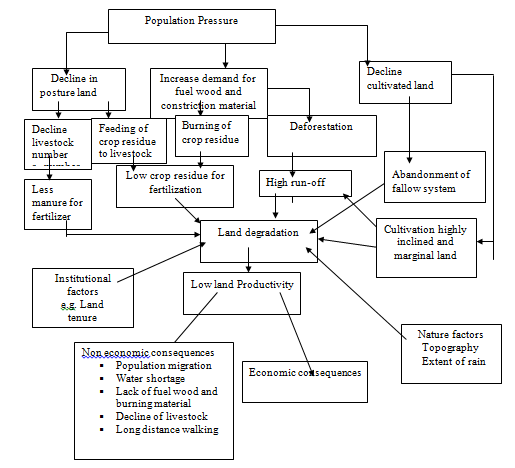
To sum up these previous studies relied on crop simulations with very limited data on farm and farming practices and only measured the direct costs of soil erosion on yield. Moreover, the wide range of estimates reflects substantial uncertainty of the impact of land degradation on agricultural production. Nevertheless, these studies illustrate the magnitude of the problem [28]. Generally, causes of land degradation and its effects in Ethiopia is complex because they are multiples and interrelated meaning one is the causes of other. The causes and effect of land degradation in Ethiopia can be generalized by the following Figure 1.
Practices Taken to Arrest Land Degradation in Ethiopian Highlands
The following paragraph discuss some of the main strategies to reverse the problem of land degradation in relevance to Ethiopian highlands states, that “The most important measure to restore the disturbed rural ecology is the implementation of afforestation and reforestation... on a scale large enough to cope with the problems of soil erosion and water wastage”. According to EPA [30] estimation 500 million tree seedlings were planted and about 80,000 hectares of hillsides closed for regeneration between 1976 and 1985. Despite these and other massive intervention and regulation, natural resource and environmental degradation continued unabated. All efforts to be made in the future in afforestation and reforestation must be viewed in conjunction with continuing deforestation.
A successful implementation of afforestation and reforestation schemes requires an ability to form pressure groups in the community or involve existing local groups. Activities like starting nurseries in villages, planting and protecting multipurpose trees along roads, on farms, and around houses, etc., for instance, call for an ability to garner the knowledge, support, and energy of rural people Postel, et al. [31]. Conservation Oriented Crop Combination Land Management: According to Belay, et al. [32]. This method appears to combine the three broad techniques of controlling soil erosion referred to by agronomic methods, which aim at controlling erosion by improving the vegetative cover; soil management techniques, which try to control erosion by improving the aggregation of the soil particles; and structural soil conservation methods, which control erosion by shortening the length and minimizing the gradient of the ground slope. Some scholar state that this technique involves construction of tied ridges, bunds, fanya juu terraces, bench terraces, hillside terraces, diversion ditches (cutoffs) waterways and special water harvesting structures [33].
Intercropping and relay or sequential cropping; crop rotation; integration of livestock farming with arable cultivation; the cut and carry method of using degraded pasture, controlled grazing and tethering; wide spread use of semi-permanent crops like enset (false banana) and cassava or self-seeding and volunteering crops, such as legumes and sweet potatoes these farming practices are believed to conserve the natural resource base and at the same time raise productivity these were distinguished by Blackwell [34]. Agro forestry and Controlling the Rate of Population Growth was also used as the main strategies to reverse the land degradation problem.
Constraints and Opportunities to Scale up and Support Land Management Practices in Ethiopia Highlands
The gaps and constraints that fostered the problem of land degradation and inhibited the implementation of success full practices for batter land resource management have been identified by Pender, et al. [35] and Mahmud, et al. [13] and Gete et al. [6] and Moard, et al. [8]. The following are the key gaps and constraints that negatively affect the quality of intervention and up-scaling of successful practices for sustainable land resource management in Ethiopia.
Low Level of Awareness: Today Ethiopia faces various environmental challenges [36]. Among these misunderstanding and lack of awareness created by different stake holder regarding the cause, extent and impact of land degradation; low awareness concerning the linkage between environment and development in general; weak participation of the people and community based organization in environmental management activities are the major once [37].
Land degradation is a long term and subtle process where its effects and expansion and hardly noticed until manifests itself through disastrous droughts and famines [38]. This is partly explained by the fact that land degradation is often only associated with the dry statistics such as ‘tonnes of soil lost per hectare per annum’ or ‘depletion of hectares of forest coverage and these do not seem to impress policy makers [8]. In addition to this the use of some improved agricultures in puts even without proper land management practices in a place, can mask the effect of land degradation especially in areas with relatively batter and depression and mare reliable rain fall [13]. Because of this many stake holder have regarded land degradation as a problem of draught prone area only [39]. Lack of Professionalism and Technical Studies: Another very important constrain not only among policy makers but also among many experts, is that construction of physical soil and water conservation measures is considered as the main solution to halt land degradation [40]. Integration among the different sustainable land management technologies to make soil and water conservation measures more effective and enhance soil productivity is seldom considered. Moreover the technical requirements for the effective maintenance and use of these measures are often forgotten [41]. Unfortunately, attention is mostly given to the number /quata of interventions but not their quality standard, sustainability and integration with other soil and land management practices [42].
For this reason, some technologies have been pushed to be used beyond their application domains; for example, the blanket recommendation for fertilizer application in areas with high moisture stress, construction of water harvesting ponds in highly permeable soils, soil bunds along the contour in high run off areas, etc [42]. These ‘Mistakes’ have sparked disillusionment among local experts and development agents as well as resentment among farmers so that both develop a tendency to disregard professional opinions Gete et al. [6].
In addition to these constraints such as top down planning approach to technical assistance weak linkages among various disciplines during sustainable land management technology generation [43], dissemination and implementation; limited capacity to plan and implement sustainable land management at all levels; limited information flow and network for sustainable land management; policy legislation and implementation constraints; socio-economic and bio-physical constraints; frequent restructuring of government institutions; Shortage of resource and incentives; incomplete technology packages these and other related issues promote the problem of land degradation and inhibit the implementation of success full practices for batter land resource management [44].
Opportunities
Attempts by the government and non-government actors in halting land degradation have shown some valuable example of successful projects and many opportunities [45]. It is believed that making good use of these examples should be the starting point to promote successful initiatives for improving land resource management in the country. The focus of many studies has so far been made on pin pointing problem or constraints rather than capitalizing on opportunities [9]. Some key opportunities to help improve the quality of intervention and upscale successful practices were identified by MoARD Sustainable Land Management Secretariat [9]. These includes; existence of environmental policies and strategies; rich experience on participatory watershed management; organizational set up of MOARD and national researcher system; availability of both indigenous knowledge and scientific technologies; existence of door support and development partners [46].
Conclusion
In this paper a review made in detailed about the nature and severity, cause and effect of land degradation and existing opportunities that could help to address land degradation and encourage for sustainable land management practice in highlands of Ethiopia [47, 48, 49, 50, 51]. Land is critical to the economic and social development of the country. Though, the country continues to face land resource degradation and needs to adopt both indigenous and modern technologies for improving land resource management in a sustainable way.
References
-
FAO (1986) Ethiopian Highlands Reclamation Study. Ethiopia Final report FAO, Rome, Italy.
-
World Resources Institute (1996) World Resources 1996-97: The Urban Environment. Energy, pp: 400.
-
IPCC (2007) State of the Science Contribution of Working Group I to the Fourth Assessment Report of the Intergovernmental Panel on Climate Change. Cambridge University Press. University, Amsterdam, UK.
-
Stocking M, Niamh M (2000) Land degradation Guidelines for Field Assessment. Overseas Development Group, University of East Anglia, Norwich, UK, pp: 121.
-
Solomon A (1994) Land use Dynamics Soil Degradation and Potential for Sustainable use in Metu Area Illubabaor Region Ethiopia. African Studies Series A 13, Berne Switzerland Geographica Bernensia.
-
Gete Z, Menale K, Pender J, Mahmud Y (2006) Stakeholder analysis for sustainable land management SLM in Ethiopia an assessment of opportunities strategic constraints information needs and knowledge gaps. Environmental Economics Policy Forum for Ethiopia.
-
UN (1995) Population and the Environment a Review of Issues and Concepts for Population Programs Staff.
-
MoARD WB (2007) Ethiopia Thematic Papers on Land degradation in Ethiopia. Ministry of Agriculture and Rural Development and World Bank, Addis Ababa, Ethiopia.
-
MoARD Sustainable Land Management Secretariat (2008) Ethiopian strategic investment framework for sustainable land management.
-
Eswaran H, Lal R, Reich PF (2001) Land degradation an overview. In: Bridges EM, et al. (Eds.), Responses to Land Degradation. CRC Press, pp: 1-16.
-
Yohonnes GM (1989) The use maintenance and development of soil and water conservation measure by small scale family households in different agro climatic zones of northern shawa and southern Wollo Ethiopia. Forum for social studies.
-
Sonneveld BGJS (2002) Land Under pressure The Impact of Water Erosion on Food Production in Ethiopia. 1st (Edn.), Shaker Publishing, Netherlands.
-
Mahmud MY, Pender J (2005) Determinants and impact of land Management technologies in the Ethiopia. Highlands a literature Review, pp: 1-96.
-
Berry L (2003) Land Degradation in Ethiopia its extent and Impact. Commissioned by the GM with WB support, pp: 1-26.
-
Hurni H (1993) Land Degradation Famine and Land Resource Scenarios in Ethiopia. In: Pimentel D (Ed.), World Soil Erosion and Conservation. Cambridge University Press, pp: 27-61.
-
Tilahun A (2003) Natural resource Degradation and Environmental Concerns in the Amhara National Regional State Impact on Food Security. Ethiopian Soils Science Society, pp: 173-183
-
FAO (2017) The future of food and agriculture Trends and challenges. Food and agriculture of the united states, pp: 1-163.
-
Alemneh D (2003) Integrated Natural Resources Management to Enhance Food Security. Environment and Natural Resource working paper 16.
-
Mulluneh W (1994) Population growth and Land use change and patterns of Agricultural production in Ezane, wllen and Cacha werdas, Sebat bet Gurague land MA thesis, Addis Ababa University, Ethiopia.
-
Aklilu D (2001) Degradation of Natural Resource in Ethiopia Assessment of student awareness and views. Regional Studies and Regional Research 11: 142.
-
Badege B (2001) Deforestation and Land Degradation in the Ethiopian Highlands A Strategy for Physical Recovery. International conference on African development archives 8(1): 1-16.
-
Demil T (2001) Deforestation wood land famine and environmental degradation in Ethiopia high land ecosystem urgent to action. Northest African studies 8(1): 53-76.
-
Girma T (2001) Land Degradation a Challenge to Ethiopia. International Environmental Management 27: 815-824.
-
Fistum H, Pendor, Nega G (2002) Land degradation and strategies for sustainable land management in Ethiopian highlands. In: Tigray R (Ed.), International Livestock Research Institute. 2nd(Edn.), Nairobi, Kenya, pp: 67-73.
-
Yibabe T, Esser KB, Haile M (2002) Soil conservation in Tigray Ethiopia. Norwegian University of Life sciences, pp: 1-21.
-
Wood AP (1990) Natural Resource Management and Rural Development in Ethiopia. In: Pausewang TK, et al. (Eds.), Ethiopia Options for Rural Development. 1st(Edn.), Zed Books, pp: 187-198.
-
Bojo J, Cassells D (1995) Land Degradation Rehabilitation in Ethiopia a Reassessment. Environmental Sustainable Development Division, pp: 1-48.
-
Berry L (2009) Land Degradation in Ethiopia Its Extent and Impact. Global Mechanism and World Bank.
-
Jolejole F, Baylis K, Leslie L, Katherine R (2012) Land Degradation’s Implications on Agricultural Value of Production in Ethiopia A look inside the bowl. International Association of Agricultural Economists.
-
EPA (1997) Environmental policy environmental protection authority in collaboration with ministry of economics and cooperation.
-
Postel S, Heise L (1988) Reforesting the Earth. World watch Paper 83, pp: 1-71.
-
Belay T (1992) Farmers Perception of Erosion Hazards and Attitudes towards Soil Conservation in Gununo Wolaita Southern Ethiopia. Ethiopian Journal of Development Research 14(2): 31-58.
-
Thomas DB (1984) Soil and Water Conservation in the Ethiopian Highlands an Assessment of Requirements and Evaluation of Activities. Addis Ababa University, Ethiopia.
-
Blackwell JM, Goodwillie RN (1991) Environment and Development in Africa Selected Case Studies. World bank group.
-
Pender J, Berhanu G, Mitiku H (2002) Livelihood strategies and land management practicesin the Highlands of Tigray.CG Space a repository of agricultural research outputs, pp: 70-73.
-
Barrow CJ (1991) Land Degradation Development and Breakdown of Terrestrial Environments. Journal of environmental quality.
-
Barrow CJ (1995) Development. University of Wales Swensea, UK.
-
Berhanu F, Melesse T (2005) Conserving soil and water. In: Ann LK, et al. (Eds.), managing land a practical guiding book for development agent in Ethiopia, pp: 282.
-
Bielli C, Gezu B, Amare I, Kriann A (2001) Population growth environment in Ethiopia. In-Depth Studies from the 1994 Population and Housing, pp: 1-69.
-
Brihanu S (1993) Farmers percepion of soil erosion and their attitude towards soil conservation in Guraghe highland of Butajria Awraga. South Shoa unpublished MA thesis Addis Ababa University, Ethiopia.
-
Fentaw Y (1996) An assessment of the status of soil degradation and consrervationin upper valley Semain mountains northern Gonder. MA these Addis Ababa Universty, Ethiopia.
-
Denboba MA (2005) Forest conservation soil degradation farmers perception Nexus implication for sustainable land use in the south west of Ethiopia. Ecology and Development series, pp: 1-9.
-
Oldeman LR, Hakkeling RTA, Sombroek WG (1990) World map of the status of human induced soil degradation. International Soil Reference and Information Centre, pp: 1-18.
-
IFPRI, ILRI (2002) Summary of Papers and Conference Proceedings. Addis Ababa, Ethiopia, pp: 24-27.
-
Pimentel D (1993) Overview in World soil erosion and conservation. In: Pimentel D (Ed.), Cambridge University Press, USA.
-
Sanders D (2004) Soil conservation in land use land cover and soil sciences. In: Verheye WH, (Ed.), This Encyclopedia of Land Use Land Cover and Soil Sciences is a component of the global. Eolss publishers, pp: 1-290.
-
Shibru TB (2010) Land degradation and farmers perception the case of Limo woreda hadya zone of snnpr Ethiopia. Addis ababa university school of graduate studies environmental science program, pp: 1-68.
-
Shiferaw B, Holden S (1999) Soil Erosion and Smallholders Conservation Decisions in the Highlands of Ethiopia. World Development 27(4): 739-752.
-
Srantantokos S (1998) Social research. 2nd(Edn.), MacMillan Education, South Melbourne, Australia.
-
UNEP (2002) Protecting the Environment from Land Degradation UNEP`s action in the Framework of the Global Environmental Facility. UN Environmental programme, pp: 1-47.
-
Bank W (2006) Sustainable land management challenges opportunities and tradeoffs. 1st(Edn.), Agriculture and rural development. World Bank Publications, pp: 1-87.
- Electronic Waste Management in the Top Ten Economies in the World: A Critical Review on Waste Generation, Regulations, Collection, Recycling and Environmental Challenges
- Some Challenging Transdisciplinary Aspects of the Sustainable Waste Management in the Permacrisis Context
- Use of Mobile Autonomous Systems for Pollution Control of Inland Water Bodies
- Environmental Impact Perspective Sustainable Online Textile Retailing: Harnessing Augmented Reality-Based Digital Twins in Bangladesh
- Composite Treatment Module for Removing Acidity and Metal (Loid)S from Acid Rock Drainage
- Household E-Waste Management Systems [E-Wms] in Malaysia