
Transdermal Drug Delivery System: An Emphasis on Transdermal Patches
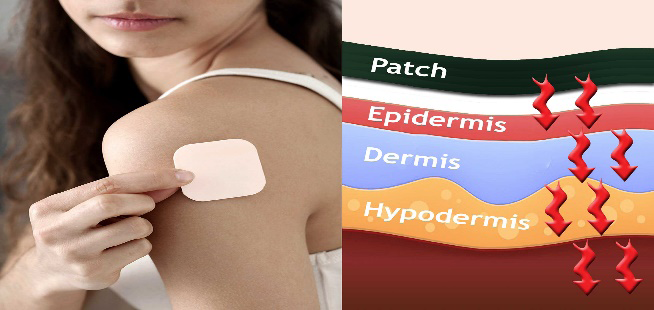
Transdermal drug delivery system was presented to overcome the difficulties of drug delivery especially oral route. A transdermal patch is a medicated adhesive patch that is placed on the skin to deliver a specific dose of medication through the skin and into the bloodstream. It promotes healing to an injured area of the body. An advantage of a transdermal drug delivery route over other types of delivery system such as oral, topical, i.v., i.m., etc. is that the patch provides a controlled release of the medication into the patient, usually through either a porous membrane covering a reservoir of medication or through body heat melting thin layers of medication embedded in the adhesive. The main disadvantage to transdermal delivery systems stems from the fact that the skin is a very effective barrier, as a result, only medications whose molecules are small can easily penetrate the skin, so it can be delivered by this method. This review article describes the overall introduction of transdermal patches including type of transdermal patches, method of preparation of transdermal patches and factor affecting etc.
Introduction
Transdermal drug delivery system is the non-invasive delivery of medications from the surface of the skin. Skin is the largest and most accessible organ of human body through its layers to the circulatory systems [1]. The transdermal drug delivery system (TDDS) is a widely accepted mode of drug delivery, and transdermal patches are devised to treat various diseases [2].
The transdermal patch is a medicated adhesive pad that is design to release the active ingredient at a constant rate over a period of several hours to days after application to the skin. It is also called skin path. A skin patch uses a special membrane to contain which the patch can pass through the skin & into the blood stream [3].
Advantages
- Avoidance of hepatic fast pass metabolism.
- Poor oral bioavailability.
- Long duration of action.
- It enhances patient compliance.
- Minimizes harmful side effects of drug caused from over dose.
- Stable & control blood level.
- Selective targeting to infections cells that compose to normal cells.
- Reduce toxicity.
Disadvantages
- Expensive.
- Difficult to maintain stability of dosage forms.
- Possibility of local irritation at the site of application.
- Technical skill required.
- Rapid clearance.
Types of Transdermal Patches
- Single layer drug in adhesive
- Multilayer drug in adhesive
- Drug reservoir in adhesive
- Drug matrix in adhesive
- Vapor patches
Single Layer Drug in Adhesive
The adhesive layer of this system also contains the drug. In this type of patch, the adhesive layer not only serves to adhere the various layers together, along with the entire system to the skin, but it also responsible for the releasing of the drug. The adhesive layer is surrounded by a temporary liner &a backing [3].
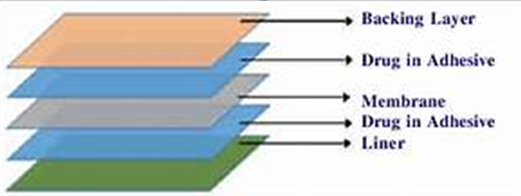
Multilayer Drug in Adhesive
The multilayer drug in adhesive patch is similar to the single layer system in that both adhesive layers are also responsible for the releasing of the drug. The multilayer system is different however that it adds another layer of drug in adhesive, usually separated by a membrane [2].
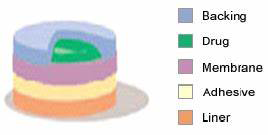
Drug Reservoir in Adhesive
The reservoir transdermal system design includes liquid compartment containing a drug solution (or) suspension. Which is separated from the release liner by a semi permeable membrane & adhesive? The adhesive component of the product can be act as a continuous layer b/w the membrane & release liner (or) as a concentric configuration around the membrane [4].
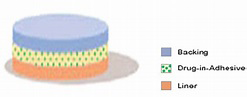
Drug Matrix in Adhesive
The matrix system design is characterized by the inclusion of a semi solid matrix containing a drug solution (or) suspension which is in direct contact with the release liner. The compartment responsible for skin adhesive is incorporated in an overlay & forms a concentric configuration around the semi-solid matrix [5].
Vapor Patches
In this type of patch, the adhesive layer not only servers to adhesive the various layers together but also to release vapor. The vapor patches are new on the market & they release essential ails for up to 6hrs. The vapor patches release essential oils & are used in case of decongestion mainly [2, 3].
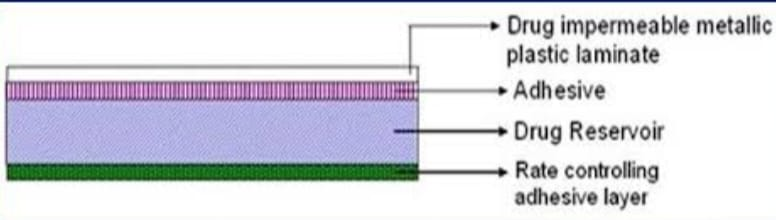
Methods of Preparation of TDDS
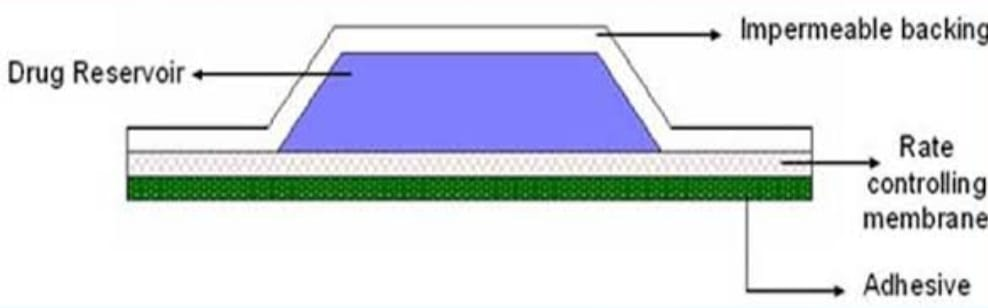
Polymer Membrane Permeation-Controlled TDDS
In this system, the drug reservoir is embedded between an impervious backing layer & a rate controlling membrane. The drug releases only through the rate controlling membrane, which can be micro porous (or) non porous. In the drug reservoir compartment, the drug can be in the form of solution, suspension, gel (or) dispersed in solid matrix. On the outer surface of the polymeric membrane a thin layer of drug compatible, hypoallergenic adhesive polymer can be applied [2, 3].
Example: Transdermscop (scopolamine) for 3 days protection of motion sickness & TransdermNitro (Nitroglycerine) for once-a-day medication of angina pectoris.
Adhesive Diffusion Controlled TDDS
The drug reservoir is formed by dispersing the drug in an adhesive polymer & then spreading the medicated polymer adhesive by solvent casting or by melting the adhesive onto an impervious backing layer. The drug reservoir layer is then covered by a non-medicated adhesive polymer of constant thickness to produce an adhesive diffusion controlling drug delivery system.
Example: Deponite (nitroglycerine) for once a day medicated of angina pectoris.
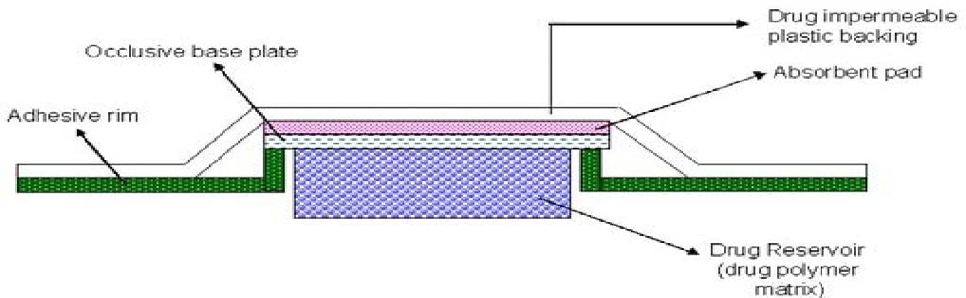
Matrix Diffusion Controlled TDDS
The drug is dispersed homogeneously in a hydrophilic [or] lipophilic matrix. The drug containing polymer disk then is fixed onto an occlusive base plate in a compartment fabricated from a drug impermeable backing layer. Instead of applying the adhesive on the face of the drug reservoir, it is spread along the circumference to form a strip of adhesive rim. Example: Nitro Dur [nitroglycerine] used for once a day medicated for angina pectoris [5].
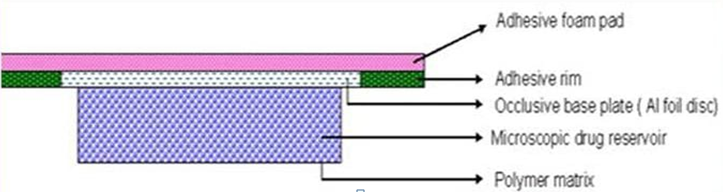
Micro Reservoir Controlled TDDS
The drug delivery system is a combination of reservoir & matrix dispersion system the drug reservoir is formed by first suspending the drug in an aqueous solution of water soluble polymer & then dispersing the solution homogenously in a lipophilic polymer to form thousands of & unreachable, microscopic spheres of the drug reservoir. A transdermal system therapeutic system thus formed as a medicated disc positioned at the center & surrounded by an adhesive rim [6]. Example: Nitro-dur system [nitroglycerine] for once a -day treatment of angina pectoris
Evaluation Methods
Evaluation methods are classified into
- Physicochemical evaluation
- In-Vitro evaluation
- In-Vivo evaluation
Physicochemical Evaluation
Interaction Studies: The drug & the excipients must be compatible with one another to produce a product that is stable. The interaction b/w drug &excipients affects the bioavailability & stability of drug. Interaction studies are taken out by thermal analysis, IR, UV & chromatographic techniques.
Thickness of The Patch: The thickness of the drug prepared patch is measured by using a digital micrometer at different point of the patch & determines the average thickness & standard deviation for the same to ensure the thickness of the prepared patch [6].
Weight Uniformity: A specific area of patch is to be cut in different parts of the patch & weigh in digital balance. The prepared patches to be dried at 800c for 4hrs before testing.
Percentage Moisture Content: The prepared patches are to be weighed individually & to be kept in a desicator containing fused CaCl2 at room temperature. %moisture content = Initial weight-final weight/final weight×100 Percentage Moisture Uptake: The prepared patches are to be weighed individually & kept in a desicator containing saturated solution of KCL in order to maintain 84% RH [8, 9]. % moisture uptake = final weight-initial weight/initial weight ×100 Content Uniformity: 10 patches are selected & content is determined for individual patches. 9 out of 10 patches have content b/w 85% to 115% of the specific value. Then transdermal patches pass the test of content uniformity.
In-Vitro evaluation
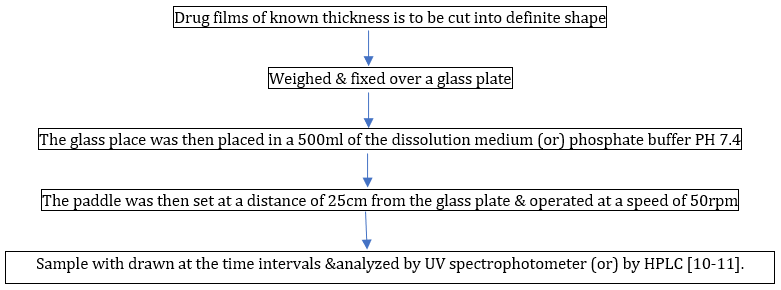
In-Vitro drug release studies: Paddle over disc method can be employed for the assignment of the release of the drug from the prepared patches.
In-Vivo Evaluation
In-Vivo evaluation of TDDS can be carried out by using animal models & human volunteers.
Animal model: Most common animal species used for evaluating TDDS are mouse, hairless rat, hairless dog, hairless rhesus monkey, rabbit & guinea pig etc.
Human volunteers: It involves collection of pharmacokinetic & pharmacodynamic data. Clinical trails have been conducted to assess the efficacy, risk, side effects etc. Phase-1: Trails for safety Phase-2: Effectiveness in patients Phase-3: Safety & effectiveness of large no. of patients Phase-4: Post marketing surveillance [10, 11].
References
-
Asbill CS, Michniak BB (2000) percutaneous penetration enhancers: local versus transdermal activity. Pharm Sci Technol Today 3(1): 36-41.
-
Barry B (2002) Transdermal drug delivery. In: Aulton EM (Ed.), Pharmaceutics: The Science of Dosage form Design. 2nd (Edn.), Harcourt Publishers, New York, pp:
-
Kumar P, Sankar C, Mishra B (2004) Delivery of macromolecules through skin. Indian Pharm 5(3): 7-17
-
Michael NP, Yogeshvar NK, Michael H, Michael SR (2015) Transdermal patches: history, development and pharmacology. Brit J Pharmac 172(9): 2179-2209.
-
Reshmi J, Jahnara H, Anupriya (2017) an Overview of Transdermal Delivery System. Asian J Pharmaceu Clin Resear 10: 36-40.
-
Eseldin K, Rakesh KS, Esmaeil B, Abd-alkadar Z (2010) Transdermal Drug Delivery System- Design and Evaluation. Inter J Advan Pharmaceutical Science pp: 201-211.
-
Keleb E, Sharma RK, Mosa EB, Aljahwi A-AZ. (2010) Transdermal drug delivery system-design and evaluation. Int J Adv Pharm Sci 1: 201-211.
-
Bangale GS, Rathinaraj BS, Rajesh KS, Shinde GV, Umalkar DG, et al. (2010) Design and evaluation of transdermal films of atenolol. J Chem Pharm Res 2: 593-604.
-
Lec ST, Yac SH, Kim SW, Berner B (1991) One way membrane for transdermal drug delivery systems/ system optimization. Int J Pharm 77(2-3): 231-237.
-
Venkateswari Y, Babu RJ, Sampathkumar D, Mittal N, Pandit JK (1995) Development of a low cost tetracycline strip for long term treatment of periodontal disease. Indian Drugs 32: 205-210.
-
Pandit V, Khanum A, Bhaskaran S, Banu V (2009) Formulation and evaluation of transdermal films for the treatment of overactive bladder. Int J Pharm Tech Res 1(3): 799-804.
- Hydrogen Peroxide Scavenging by Methanolic Extracts of Coriander: An In Vitro Antioxidant Study
- Aromatherapy in Palliative Care: A Fragrant Quest for Relief
- Empowering Women, Securing Futures: Contraception’s Role in Socioeconomic Progress in India
- Effect of Crospovidone, Croscaramellose Sodium in Combination on the Drug Release of Anti diabetic Medication in Tablet Form
- Knowledge, Attitudes, Anxiety, and Preventive Behaviors Regarding Covid-19 Affliction among Healthcare Workers in Pakistan
- “Competitive Landscape and Brand Equivalents: Implications for ANDA (Abbreviated New Drug Application) Approval”