
Autism Spectrum Disorders and Oculocutaneous Albinism - A Case Report in Indian Scenario
Oculocutaneous albinism (OCA) is a collection of autosomal recessive condition of melanin biosynthesis that rarely presents with multiple systemic exhibitions. This article accounts a case of co-morbid childhood autism and Oculocutaneous albinism in a 4 years old girl from Hubli, a city in North Karnataka region of India. The proposed case presentation is a documentation of rare condition where OCA is associated with Albinism. A Detailed Speech language profile based on systematic evaluation has been highlighted in the present study.
Introduction
Oculocutaneous albinism (OCA) is a cluster of autosomal recessive disorder of melanin biosynthesis which is known by overall decline in pigmentation of skin, hair and eyes [1]. Autistic disorder, also known as childhood autism, infantile autism, and early infantile autism is a disorder where there is noticeable and sustained impairment in aberration in communication, social interaction and limited or stereotyped patterns of behaviour and interest.
By the review of literature it is seen that connotation of OCA with albinism is seldom studied and hence reporting of such cases is very much crucial. Previous studies [2, 3, 4] do not discuss in detail the speech language and hearing characteristics of children with ASD which has been included in the present study and also there are no studies or case reports from India reporting OCA with Autism. The present study defines the speech, language, communication and hearing aspects of autism in detail which gives insight to the communication deficit associated with OCA.
The patient aged 4 years old female, a resident of Hubli, a city in North Karnataka region of India approached JSS Institute of speech and hearing, Dharwad with the complaint of limited speech output and poor social skills.
Medical History
The patient was diagnosed as having Albinism since birth and had undergone genetic testing. Geneticists suspected OCA type 1 and conducted gene analysis of OCA 1, OCA 2 and OCA 3. No mutation was noticed in the TYR
gene, TYRP 1 gene and OCA 2 gene. However, based on the review of clinical presentation observed in the patient, she was diagnosed to be having OCA type 1. Abnormal Flash VEP recordings were seen in both eyes signifying reduced visual acuity.
Physical Appearance
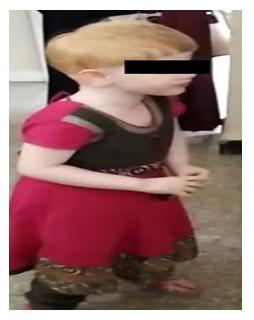
Her skin was virtually white with no seeming tanning ability and her hair was pale golden yellow. She had pale blue iris and showed trans-illumination. Visual acuity was reduced; horizontal nystagmus and strabismus were observed (Figure 1).
Speech and Language Evaluation
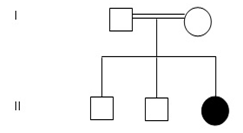
Detailed case history included a structured interview with the parents, clinical interaction with the patient and physical examination. Parents complained of reduced speech output and severe impairment in social interaction and communication. Parents were first cousins indicating second degree consanguinity. Pedigree analysis was carried out where it was found to be an autosomal recessive disorder (Figure 2).
Patient was born after full term of pregnancy and was kept in ICU for three days due to Hyperbilirubinemia. Child had undergone phototherapy for 4 hours. Developmental history revealed normal motor development [5]. Speech and language milestones were delayed with babbling attained at around 8 months and first word achieved at around two years. Poor self-help skills such as unable to put on clothes, difficulty in buckling shoes, unable to put on socks etc. were noted.
Language and Communication
Detailed Speech and Language assessment was carried out by administering several standardized tests such as REELS (Receptive Expressive Emergent Language Scale), M-CHAT –R (Modified Checklist for Autism in Toddlers- Revised) and CARS (Childhood Autism Rating Scale). Results of REELS showed Scattered Receptive Language Age from 8-9 months to 11-12 months. Whereas Expressive Language Age was found to be at 6-7 months of age, suggestive of delay in Speech and Language of around 3-3 ½ years. Results of M-CHAT –R indicated High risk of developing ASD with an overall score of 13(score of 8-20 indicates High risk. A total score 38 on CARS suggestive of moderately severe ASD. Combined results of the above tests revealed delay in speech and language along with moderately severe autism spectrum disorders.
Social and Behavioral Disruptions
Behavioral disturbances such as repetitive rocking movements, restlessness, self-injurious behaviours, fist and teeth clenching, sudden outburst of emotions through shouting, difficulty in adapting to change in routine and surroundings were observed and reported. The patient also had sensory issues corresponding to hypersensitiveness to light, touch of unfamiliar persons and certain sounds such as phone ringing and traffic noise, reduced taste and smell response.
Diagnosis and Treatment
Based on the history collected from the patient’s family, physical examination, findings of other disciplines and results of the tests administered, she was diagnosed as having Delayed Speech and Language secondary to Autism Spectrum Disorder associated with Oculocutaneous albinism [6]. Parents were counselled regarding providing her behavioural therapy, speech and language therapy on a regular basis.
Discussion
ASDs constitute a collection of severe disorders of development, disturbing communication, social relationships, play and academic skills usually leading to life-long disability [5]. Abundant inbred medical and psychological syndromes have been described in connotation with childhood autism and several of these disorders are providing treasured information on the part played by genetics in the etiology of childhood autism [7].
Association of autism and OCA is rarely described in literature; However [2] reported such an association in two boys who manifested moderate retardation and autistic behaviour along with OCA. Similar study [3] defined four families of persons with childhood autism and noted the additional feature of OCA in some families in addition to major affective or psychotic disorder and special intellectual abilities. Furthermore3 also stated two other autism cases with possible but undiagnosed OCA.
A case study of 13 year old Nigerian boy who had OCA and autism was reported [4]. A thirty months old patient was diagnosed as Oculocutaneous albinism and childhood autism based on ICD – 10 [8].
Conclusion
Going by the remark of this current case study and the reports of the other prior mention of similar conditions in literature, the question rises whether childhood autism has any genetic and clinical association along with Oculocutaneous albinism. Additional family and genetic studies into the precise association that could be present among OCA and childhood autism are necessary. These may offer useful hints into etiology, prevention and management of childhood autism and also OCA. Further studies on dysfunctional development and differentiation of ectoderm and mesoderm cell precursor through embryogenesis in inborn hypo-melanotic skin disorders that have been linked with ASDs are required.
References
-
Gronskov K, Ek J, Brondum-Nielsen K (2007) Oculocutaneous albinism. Orphanet Journal of Rare Diseases 2: 43.
-
Rogawski MA, Funderburk SJ, Cederbaum SD (1978) Oculocutaneous albinism and mental disorder. A report of two autistic boys. Hum Hered 28(2): 81-85.
-
Delong R (2007) GABA (A) receptor alpha 5 subunit as a candidate gene for autism and bipolar disorder: a proposed endophenotype with parent -of-origin and gain-of-function features, with or without oculocutaneous albinism. Autism 11(2): 135-147.
-
Bakare MO, Ikegwuonu NN (2008) Childhood autism in a 13 year old boy with oculocutaneous albinism: a case report. Journal of Medical Case Reports 2(1): 56.
-
Wijnhoven TMA, de Onis M, Onyango AW, Wang T, Bjoerneboe GEA (2004) Assessment of gross motor development in the WHO multicentre growth reference study. Food Nutr Bull 25(1): S37-S45.
-
Autism Spectrum Disorder in DSMs and ICD-10. Autism Aspergers Advocacy Australia.
-
Kielinen M, Rantala H, Timonen E, Linna SL, Moilanen I (2004) Associated medical disorders and disabilities in children with autistic disorder: a population–based study. Autism 8(1): 49-60.
-
Hesapçioğlu ST (2013) Oculocutaneous Albinism and Autism: A Case Report and Review of Literature. Dusunen Adam: The Journal of Psychiatry and Neurological Sciences 26(2): 215-218.
- Understanding Pediatric Multiple Sclerosis: Clinical Presentation, Diagnostic Criteria, Therapeutic Advances, and Supportive Care Approaches
- Hemophilia in Children
- Xia-Gibbs Syndrome- A Case Report
- A Study to Assess Effectiveness of Play Therapy in Reducing Post-Operative Pain among Children Age 2 To 5 Year who have Undergone General Surgeries in Selected Pediatric Hospitals of Vadodara
- Preterm Birth: Scope of the Problem, Cost of Care, Potential Complications and Current Guidelines for Management
- Noradrenaline: Can we Use it to Manage Hemodynamic Instability among Neonatal Septic Shock at the NICU?