
Symptomatic Syringomyelia Associated with Acute Bacterial Meningitis in a 3-Year-Old Patient
Syringomyelia is very rare in children specially in younger than 5 years. As it has slow progression therefore it takes years to become symptomatic and to be diagnosed. In most cases syringomyelia is a chronic spinal disorder which progress slowly. We report a case of symptomatic syringomyelia associated with acute bacterial meningitis in a 3 years old patient in French Medical Institute for Mothers and Children (FMIC).
Introduction
Syringomyelia is the development of a fluid-filled cavity or syrinx within the spinal cord. Hydromyelia is a dilatation of the central canal by cerebrospinal fluid (CSF) and may be included within the definition of syringomyelia [1].
If ventricular CSF does not communicate with the fluid within the spinal cord, it is called Non communicating syringomyelia. If ventricular CSF communicates with the fluid within the spinal cord, then it is called communicating syringomyelia [2].
The first time spinal cord cavitation was explained by Esteine in 1546 in a paper entitled “La Dissection Du Corps Humain” and the term syringomyelia was firstly used by d’Angers in 1827 [3].
Generally, there are two forms of syringomyelia: congenital and acquired [4]. Causes of syringomyelia are: [5]
- Congenital malformations (eg, Klippel-Feil syndrome, Arnold Chiari type I malformation, and tethered spinal cord)
- Postinfectious
- Postinflammatory (transverse myelitis and multiple sclerosis)
- Spinal neoplasms (especially ependymoma and hemangioblastoma)
- Posttraumatic [up to date]
- Disorders affecting the spinal cord Disorder affecting spinal cord If no cause found for syringomyelia then it is called idiopathic Syringomyelia [6].
Sign and symptoms of syringomyelia develop insidiously over years or decades. In general patients may develop numbness, weakness, muscle atrophy, trophic ulcerations, sphincters dysfunction, pain and spine deformity (scoliosis) [2].
Here we report a case of sympomatic syringomyelia associated with acute meningitis in a 3 years old patient in FMIC.
Case Presentation
A 3-years-old boy weighing 13kg previously healthy, presented to FMIC with 1week history of inability to move legs, inability to stand and walk associated with fever, headache, vomiting and irritability.
Problem started acutely with limping in right leg which gradually increased and in 2 days the child was not able to walk without support and then could not stand without support and finally the child became unable to move legs with sensory loss in legs and loss of sphincters control. During the illness patient was febrile, had headache, vomiting and irritable.
Patient was admitted for 3days in a local hospital, treated with high dose of ceftriaxone. Due to limited diagnostic facility just CBC and CRP was tested which were normal. After 3 days’ patient was referred to FMIC.
At arrival in physical examination the child was ill looking, conscious level was altered, GCS 12/15, had neck stiffness. Upper limbs were not affected and respiration was normal. Deep tendon reflexes were absent in lower limbs sensation was impaired from toes to the hip joints. There were no signs of cranial nerve involvement.
Past history was unremarkable there were no any specific illness and no any trauma in the past. The case reported as an acute flaccid paralysis for polio screening.
CBC, CRP, SGPT, CPK, RFT, serum electrolyte was normal. Serum glucose level was 78mg/dl. CSF analysis performed which was panic:
CSF glucose = 2mg/dl, protein > 14000/dl, Cells > 1200/ dl with lymphocyte predominant (80%). CSF culture was negative, CSF for AFB smear was also negative and CSF PCR for TB was negative too.
Chest X-ray was normal and Monteux test was negative.
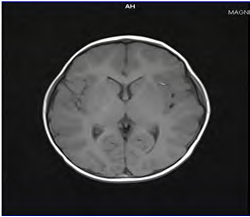
Brain MRI revealed normal brain parenchyma and ventricles (Figure 2).
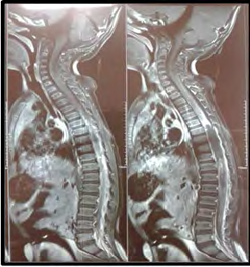
Spine MRI revealed syringomyelia in dorso-lumber spine from D8-L1 (Figure 1).
Supportive treatment and combined antibiotics (Ceftriaxone and Vancomycin) started. Patient had good clinical improvement. On 3rd day of treatment patient was afebrile, had no vomiting and irritability. He was able to set in bed and play with toes. On same day CSF analysis repeated which also showed improvement; CSF glucose 37mg/dl (serum glucose 88mg/dl), Protein 446mg/dl, cells 2900 with lymphocyte predominant (65%) On 9th day of treatment CSF analysis repeated which showed glucose 74mg/dl (serum glucose 95mg/dl), protein 75mg/dl, cells 04/dl. We continued same treatment for 14 days and referred the patient to neurosurgeon.
Unfortunately, there was no facility for treatment of such case inside the country, the patient was referred abroad by neurosurgeon and the family could not afford to take the child out of country, therefore the syringomyelia left untreated.
As tuberculous (TB) is common in our country therefore patient was closely followed in OPD base for any signs and symptoms of TB. Fortunately, patient was never febrile, he had good weight gain and always was playful but he was not able to move, paresthesia in legs with sphincters dysfunction persist.
Discussion
Symptomatic syringomyelia is rare pathology in children below 5 years old. Acute syringomyelia associated with acute bacterial meningitis was never seen in FMIC in last 10 years which suggests that this association is a very rare condition.
Conclusion
Symptomatic syringomyelia may occur even in children less than 5-year-old.
We suggest CSF analysis in selected cases of syringomyelia to rule out associated central nervous system infection.
Does bacterial meningitis precipitate signs and symptoms of syringomyelia?
Are patients with syringomyelia more prone to the central nerve system infections? Further studies are needed to answer these questions.
References
-
Al-Shatoury HAH, Benbadis SR, Galhom AA (2017) Syringomyelia. Medscape.
-
Rekate H, Stanton B, St. Geme J, Schor NF (2015) Syringomyelia. Nelson textbook of pediatrics. 20th (Edn.).
-
International society for pediatric neurourgery (ISPN).
-
Wikipedia (Syringomyelia).
-
Eisen A, Aminoff MJ, Wilterdink JL(2018) Disorders affecting the spinal cord.
-
Chen JK, Chen CH, Lee CL, Chen TW, Weng et al. (2004) Acute Idiopathic Syringomyelia: A Case Report. Kaohsiung J Med Sci 20(8): 1-6.
- Understanding Pediatric Multiple Sclerosis: Clinical Presentation, Diagnostic Criteria, Therapeutic Advances, and Supportive Care Approaches
- Hemophilia in Children
- Xia-Gibbs Syndrome- A Case Report
- A Study to Assess Effectiveness of Play Therapy in Reducing Post-Operative Pain among Children Age 2 To 5 Year who have Undergone General Surgeries in Selected Pediatric Hospitals of Vadodara
- Preterm Birth: Scope of the Problem, Cost of Care, Potential Complications and Current Guidelines for Management
- Noradrenaline: Can we Use it to Manage Hemodynamic Instability among Neonatal Septic Shock at the NICU?