
Fungal Balls: The Importance of Diagnosis and Treatment in Pediatric Patients. Report of 3 Cases
A bladder fungoma is a mobile, oval, echogenic mass in the bladder resulting from the accumulation of long and broad hyphae. The incidence of urinary tract infection of fungal etiology has increased notably. Yeasts are isolated in 7 to 8% of urine cultures. Different species of Candida cause urinary infection, with Candida albicans being the most frequent, followed by Candida tropical. The majority favoured by invasive devices, many of them requiring intensive care, as well as the use of broad spectrum antibiotics for prolonged periods, within these devices are by far the permanent urinary tract catheter. Next we present 3 cases diagnosed in the Hospital Civil de Guadalajara Fray Antonio Alcalde in pediatric patients in the pediatric infectious disease service. They are not quite frequent lesions, but due to all of the above and having better imaging techniques, they have been diagnosed more frequently. All three received treatment once the lesion was detected in imaging studies, they were treated with antifungals, all survived and are in follow-up.
Introduction
Fungal UTI has become an increasingly prevalent healthcare associated infection. This increases in patients who were catheterized or received antimicrobial agents. Candida albicans is the most commonly isolated species, but not the only one, Candida glabrata is the next most common.
Girls are hospitalized 2.5 times more often than boys. Kidneys are the second major target organ for antegrade invasion by Candida. The persistence of fungi in the urinary collecting system leads to fungal balls. Perform ultrasonography with selective voiding cystourethrography.
Following an extensive review of the cases of urinary tract infections caused by candida albicans. Fisher and associates demonstrated the following as the predisposing factors: diabetes mellitus, antibiotic administration, steroid therapy, urine flow turbulence, congenital anomalies, neurogenic bladder, indwelling catheter and ileal conduits [1, 2].
The fungoma is a mobile and oval mass resulting from the accumulation of numerous long and broad hyphae. The main location is intrarenal; however, pediatric cases reported in the literature of Vesico-renal Fungomas (RVF) are anecdotal. They are observed by ultrasound (USG) as hyperechoic avascular foci without sonic shadow. We present 3 cases of patients treated in the Antiguo Hospital Civil of Guadalajara, “Fray Antonio Alcalde” Concentration hospital for tertiary care for patients who lack social security and who on many occasions have received multiple treatments.
Cases Report
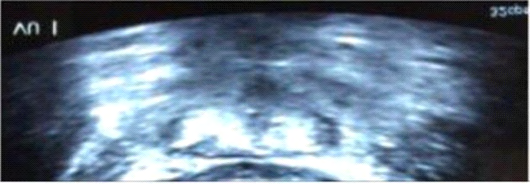
Case 1: 4-year-old male with a history of Guillain Barre, endotracheal intubation, urinary catheter for 1 month, Bacteremia and Uroculture: C. tropicalis 30,000 CFU with MIC < 0.25 sensitive to Amphotericin B, on the 7th day of treatment resistance was shown and USG was performed that bladder fungoma, underwent surgical resection by cystoscopy on day 14; negative control urine culture. Complete Amphotericin B 44 days. USG control day 40 without fungus. He graduated with favourable evolution, follow-up by consultation (Figure 1).
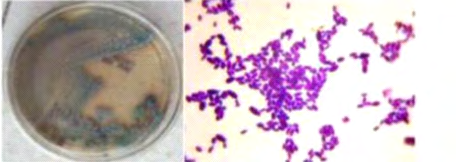
Case 2: 13 month-old female, a history of myelomeningocele and secondary hydrocephalus for which a valve (PVD) and multiple indwelling catheters were placed, bacteremia and UTI due to E.coli ESBL+, presented with persistent fever, USG reported right renal dilatation grade V, EGO with yeasts, fluconazole was started for 10days, a needle biopsy directed by USG was performed, registering multiple bacteria without fungi, C. albicans were reported in blood culture and Candida sp in URO 40,000 CFU, MIC & lt; 0.25 sensitive to Amphotericin B so it was changed to it on 6th day, completed 60days, conservative treatment due to surgical risk due to underlying pathologies. With adequate evolution, he was discharged with follow-up by urology and infectology consultation (Figure 2).
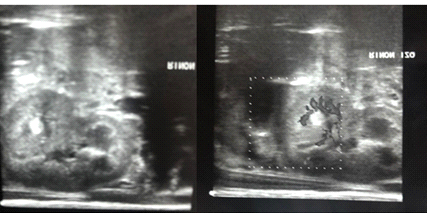
Case 3: 50-day-old female, history of preterm product and study heart disease, endotracheal intubation and bronchodysplasia, urinary catheter and CVC, C. parapsilosis was isolated in blood culture sensitive to Amphotericin (MIC & lt;0.25) and Caspofungin (MIC 1.0), negative urine cultures Amphotericin B was started, persisting positive blood cultures, Caspofungin was indicated on day 15, endocarditis was ruled out, and renal USG was performed with an upper pole imagine of the left Kidney of 4 mm diameter highly suggestive of fungus. Currently serious, he is still in treatment (Figure 3).
Conclusion
Fungomas are usually a rare complication in immunocompetent pediatric patients. Common predisposing factors of fungal infections in the urinary tract are diabetes mellitus, prolonged Foley catheter, urinary tract abnormalities, prolonged antibiotic therapy, steroids, immunosuppressive therapy, malnutrition and malignance. In our patients there was a history of having received long- term broad-spectrum antibiotics therapy and having urinary catheters for long periods of time favours their development, thus forcing antifungal treatments to be given for long periods until they are eradicated and sometimes surgical treatment is necessary. Most frequent pathogens seen to cause such complications are C. albicans and C. tropicalis [3, 4].
Urinary catheter replacement every 72 hours is recommended to reduce the risk of urinary infections and complications such as RVF. Timely pharmacological and surgical treatment provides clinical improvement and a shorter hospital stay with an excellent prognosis.
References
-
Fisher JF, Sobel JD, Kauffman CA, Newman CA (2011) Candida urinary tract infections treatment. Clin Infect Dis 52(6): 457-466.
-
Monaco LS, Bosio O, Brava AJ (2010) Nosocomial candiduria: Etiology and prevalence of its causative agents at the Paroissien Hospital. Acta Bioquim Clin Latinoam 44(4): 705-709.
-
Vazquez OT, Campos RT, Jimenez DR, Ahumada MH, Martinez BI, et al. (2001) Renal candidiasis in pediatric patients. A two case report. Rev Mex Patol Clin Med Lab 48(1): 17-22.
-
Abuelnaga M, Khoshzaban S, Badr MR, Chaudry A (2019) Successful Endoscopic Management of a Renal Fungal Ball using Flexible Ureterorenoscopy. Case Reports in Urology.
- Understanding Pediatric Multiple Sclerosis: Clinical Presentation, Diagnostic Criteria, Therapeutic Advances, and Supportive Care Approaches
- Hemophilia in Children
- Xia-Gibbs Syndrome- A Case Report
- A Study to Assess Effectiveness of Play Therapy in Reducing Post-Operative Pain among Children Age 2 To 5 Year who have Undergone General Surgeries in Selected Pediatric Hospitals of Vadodara
- Preterm Birth: Scope of the Problem, Cost of Care, Potential Complications and Current Guidelines for Management
- Noradrenaline: Can we Use it to Manage Hemodynamic Instability among Neonatal Septic Shock at the NICU?