
Umbrella Reviews in Pediatric Dentistry - A pinnacle in Hierarchy of Evidence Based Literature
Background: Systematic reviews and meta-analyses represent high rank in the evidence hierarchy pertaining to health science including pediatric dental health. However, this research methodology is associated with its own drawbacks and disadvantages. As a result, with the invention of flawless methodology, an Umbrella Review as a new tertiary research tool has taken its birth in the scientific research literature. Aim: To overview in detail pertaining to Umbrella reviews and to alarm all pediatric dental researchers for conducting future such reviews on all oral health related conditions occurring in children. Design: The detailed literature search was performed for published articles of individual Umbrella reviews carried out exclusively in the arena of paediatric dentistry encompassing all topics (domains) related to children from inception till 30 June 2023. Results: Following search for the umbrella reviews revealed limited evidence on this research methodology encompassing few domains. Conclusion: There is insufficient evidence on the literature pertaining to different oral health related factors in children including the methodological quality related studies like systematic reviews or meta-analyses. Therefore, it is highly essential for future studies to be undertaken to best provide standard protocols and recommendations to pediatric dentistry specialty regarding all oral health aspects encountered in children.
Introduction
Paediatric Dentistry (formerly referred as Pedodontics in American English or Pedodontics in Commonwealth English) is the branch of dentistry dealing with children from birth through adolescence. The specialty of Pediatric dentistry is recognized by the American Dental Association, Royal College of Dentists of Canada and Royal Australasian College of Dental Surgeons. And according to American Academy of Pediatric Dentistry (AAPD), “Pediatric Dentistry is an age-defined specialty that provides both primary and comprehensive preventive and therapeutic oral health care for infancy and children through adolescence, including those with special health care needs [1].
Across the globe, currently oral health related problems significantly impact a vast population of children. The fundamental scope of Pediatric dentistry, and the key to a child’s optimal oral health, encompasses early diagnosis, prevention and treatment of this disease [2]. As a result, there is a tremendous research work happened and happening in the arena of pediatric dentistry consisting of various health topics pertaining to children [3]. The overwhelming quantity of research evidence, decision-making on specific pediatric topics and the application of specific methodologies have shown robust challenging surge and are rapidly expanding even in the specialty of pediatric dentistry. This has led to the birth of Systematic Reviews (SRs) and Meta-Analysis (MA) which address clinical and epidemiological questions of interest and finally provide an evidence-based result [4]. As a result, numerous SR focusing various topics in the field of Pediatric Dentistry have been published. However, recently the problem has raised, as everyday more than ten SR or MA are being published on the same topic in the same year which cause inconclusive results about the topic of interest leaving decision-makers not sure about how to draw final conclusions. Moreover, recently, the Database of Uncertainties about the Effects of Treatments (DUETs) and the Swedish Council on Health Technology Assessment (SRU), has identified a knowledge gap in SRs, as most of SRs reveal uncertainty about a health technology’s medical effects [5, 6]. Therefore, there is a paradigm shift in the methodology which logically and appropriately deal with the overwhelming evidence of SR/MR. The quest for a ‘new methodology’ which objectively collect and summarize the previously published SR on given topics as well as to compare and evaluate them has led to the evolution of a novel concept which has been termed as “Umbrella Reviews” [7, 8]. Various synonyms have been used for this methodology, such as reviews of reviews, syntheses of reviews, summaries of systematic reviews and overviews of reviews [7, 8].
Pediatric Dentistry is such a holistic specialty dealing with infants and adolescents and integrated with multiple other specialties of dentistry and broadly covering numerous essential fields of oral health care in children and adolescents [1, 2]. They are: early diagnosis and treatment of oral diseases like dental caries and periodontal diseases, disturbances in tooth development and tooth eruption, dental anxiety/ behaviour management problems, oral surgical procedures, orthodontic problems, traumatic injuries in primary and young permanent teeth, mineralization disturbances, oral mucous lesions and oral manifestations of malignant diseases. Although vast number of SRs have been published addressing above topics in the field of pediatric dentistry [9, 10, 11, 12, 13, 14, 15, 16, 17, 18, 19] their methodological quality has not been systematically assessed and the state of research knowledge of common interventions in pediatric dentistry has not been compiled properly.16 Therefore, the purpose of this research was to explore the evidence-based result by overviewing in order to identify, appraise and summarize current knowledge and to identify the knowledge gaps of all umbrella reviews performed in the field of Pediatric Dentistry pertaining to essential domains of oral health care in children and adolescents.
Materials and Methods
Various research papers constituting sufficient data pertaining to the articles on umbrella reviews which were carried out in the field of pediatric dentistry were browsed and selected using the most recognized four electronic databases/platforms including PUBMED, Web of science, Scopus and Google Scholar. Using the above electronic databases, a thorough search of the articles using various medical subheadings (MeSH keywords) such as umbrella review, pediatric dentistry, early childhood caries (ECC), bruxism, pulp therapy including vital and non-vital pulp therapy, pulp revascularization, regenerative endodontic procedures in children, behavioural modification, behavioural science, intracanal medicaments, obturation techniques/ materials in primary teeth, caries risk assessment, clinical diagnosis, cleft lip and palate and dental anomalies in children. The articles published from inception until 30 June 2023 in peer-reviewed journals were selected. The search of articles included all peer-reviewed journals and was not restricted to pediatric dentistry specialty journals.
Results
Descriptive Analysis of Umbrella Reviews
Total number of URs published in each respective year from inception to 2023 was analysed as shown in Table 1, Figure 1.
| Year of Publication | Total Number of Umbrella Reviews Published | |
|---|---|---|
| 2020 | 1 | |
| 2021 | 6 | |
| 2022 | 7 | |
| 2023 | 3 |
Table 1: Number of Umbrella Reviews published pertaining to Pediatric Dentistry from inception till 30 June 2023.
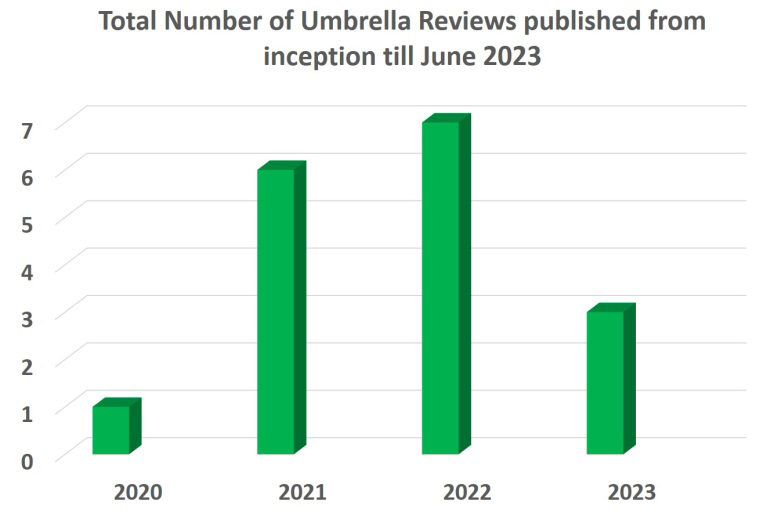
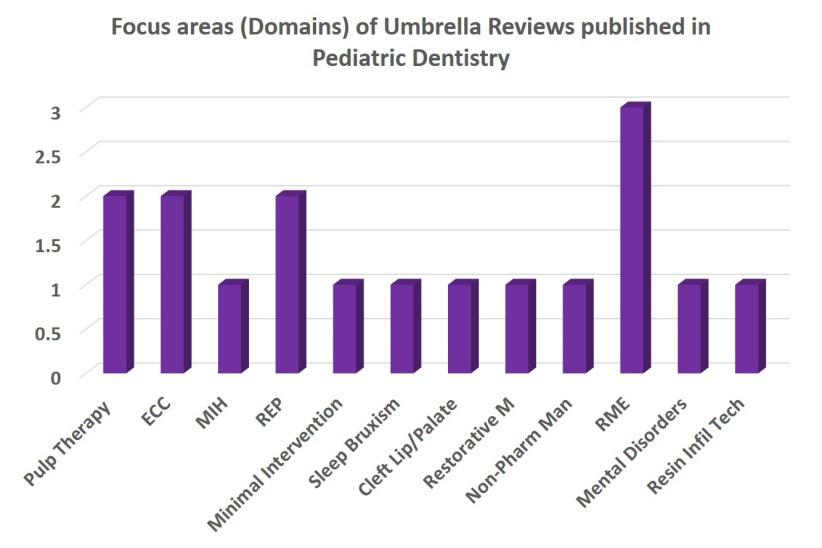
Maximum URs were published in 2022 (N=7) with least in 2020. Final analysis of each UR consisting of researcher details, year of publication, topic or domain on which UR is done and the journals in which UR is published were recorded as shown in (Tables 2 & 3) and (Figure 2).
| Year of Publication | Number of Umbrella Reviews published | |
|---|---|---|
| Pulp therapy in primary teeth (Vital and non-vital pulp therapy) | 2021 | 2 |
| Pulp therapy in primary teeth (Vital and non-vital pulp therapy) | 2021 | 2 |
| Early Childhood Caries | 2021 | 2 |
| Early Childhood Caries | 2022 | 2 |
| Molar-Incisor Hypo-mineralization | 2021 | 1 |
| Regenerative Endodontic Procedures | 2021 | 2 |
| Regenerative Endodontic Procedures | 2022 | 2 |
| Minimal Intervention for Carious Primary Teeth | 2022 | 1 |
| Sleep Bruxism | 2023 | 1 |
| Cleft lip/palate children (Dental Caries experience) | 2022 | 1 |
| Restorative Materials for Primary teeth | 2022 | 1 |
| Non-pharmacological management of Children Behaviour | 2022 | 1 |
| Rapid Maxillary Expansion in children | 2020 | 3 |
| Rapid Maxillary Expansion in children | 2023 | 3 |
| Rapid Maxillary Expansion in children | 2023 | 3 |
| Mental Disorders in children | 2021 | 1 |
| Resin Infiltration Technique for White Spot Lesions in Primary Teeth | 2022 | 1 |
Table 2: Focus areas (Domains) of Umbrella Reviews published in the literature about Pediatric Dentistry.
| Sl. No. | Journal Name | Number of Umbrella Reviews published |
|---|---|---|
| 1 | Pediatric Dentistry (AAPD) | 2 |
| 2 | European Archives of Pediatric Dentistry | 1 |
| 3 | Journal of Clinical Pediatric Dentistry | 1 |
| 4 | International Journal of Clinical Pediatric Dentistry | 1 |
| 5 | European Journal of Pediatric Dentistry | 1 |
| 6 | Acta Odontology Scandinavica | 1 |
| 7 | Journal of Clinical Medicine | 2 |
| 8 | Iranian Endodontic Journal | 1 |
| 9 | International Journal of Environment Research Public Health | 1 |
| 10 | Journal of Evidence-Based Dental Practice | 1 |
| 11 | Neuroscience Biobehavioural Revolution | 1 |
| 12 | Brazilian Oral Research | 1 |
| 13 | International Journal of Pediatric Otorhinolaryngology | 1 |
| 14 | Brazilian Journal of Otorhinolaryngology | 1 |
| 15 | Journal of Dental Sleep Medicine | 1 |
Table 3: List of Journals with published Umbrella Reviews.
More number of publications were found in the domains like early childhood caries, regenerative endodontic procedures and pulp therapy (N=2). The credit of Maximum contribution towards URs was shared by the journals like Pediatric Dentistry and Journal of Clinical Medicine (N=2).
In addition to this, detailed information of each umbrella reviews published in the field of pediatric dentistry including objectives of the study, results and conclusions were also recorded (Table 4 and 5).
| Sl. No. | Authors | Topic/Domain | Journal name | Year of publication |
|---|---|---|---|---|
| (Article title) | ||||
| 1. | Gianono-Capenakas S, Horta C, Flores-Mir C, Lagravere MO, Pacheco- Pereira C. [20] | Rapid maxillary expansion effects on the upper airway dimensions and function in growing patients: An Umbrella Review. | Journal of Dental Sleep Medicine | 2020 |
| 2. | Bandeira Lopes, Machado V, Botelho J, Haubek D. [21] | Molar-incisor hypo-mineralization: an Umbrella Review. | Acta Odontology Scandinavica | 2021 |
| 3 | Lopes LB, Neves JA, Botelho J, Machado V, Mendes JJ. [22] | Regenerative endodontic procedures: An Umbrella Review. | International Journal of Environment Research Public Health | 2021 |
| 4 | Gizani S, Seremidi K, Stratigaki E, Tong HJ, Duggal M, Kloukos D. [23] | Vital pulp therapy in primary teeth with deep caries: An Umbrella Review. | Pediatric Dentistry | 2021 |
| 5 | Thang Le VN, Kim JG, Yang YM, Lee DW. [24] | Risk factors for Early childhood caries: An Umbrella Review. | Pediatric Dentistry | 2021 |
| 6 | Lopes LB, Calvao C, Vieira FS, Neves JA, Mendes JJ, Machado V, et al. [25] | Vital and non-vital pulp therapy in primary dentition: An Umbrella Review | Journal of Clinical Medicine | 2021 |
| 7 | Solmi M, Dragioti E, Arango C, Radua J, Ostinelli E, Kilic O, et al [26] | Risk and protective factors for mental disorders with onset in childhood/ adolescence: An umbrella review of published meta-analyses of observational longitudinal studies. | Neuroscience Biobehavior Revolution | 2021 |
| 8 | BaniHani A, Santamaria RM, Hu S, Maden M, Albadri S. [27] | Minimal intervention dentistry for managing carious lesions into dentine in primary teeth: An Umbrella Review | European Archives of Pediatric Dentistry | 2022 |
| 9 | Abirami S, Panchanadikar NT, Muthu MS, Swaminathan K, Vignesh KC, Agarwal A, et al [28] | Dental caries experience among children and adolescents with cleft lip and or palate: An Umbrella Review: | International Journal of Clinical Pediatric Dentistry | 2022 |
| 10 | Amend S, Seremidi K, Kloukos D, Bekes K, Frankenberger R, Gizani S, et al [29] | Clinical effectiveness of restorative materials for the restoration of carious primary teeth: An Umbrella Review. | Journal of Clinical Medicine | 2022 |
| 11 | Rojas-Gutierrez WJ, Pineda-Velez E, Agudelo- Suarez AA.[30] | Regenerative Endodontics Success Factors and their overall effectiveness: An Umbrella Review | Iranian Endodontic Journal | 2022 |
| 12 | Quek JS, Lai B, Yap U, Hu S. [18] | Non-pharmacological management of dental fear and anxiety in children and adolescents: An Umbrella Review. | European Journal of Pediatric Dentistry | 2022 |
| 13 | Lin GSS, Chan DZK, Lee HY, Low TT, Laer TS, Pillai MPM, et al [31] | Effectiveness of resin infiltration in caries inhibition and aesthetic appearance improvement of white spot lesions: An Umbrella Review. | Journal of Evidence-Based Dental Practice | 2022 |
| 14 | Panchanadikar NT, Muthu MS, Jayakumar P, Agarwal A. [32] | Breastfeeding and its association with early childhood caries – An Umbrella Review. | Journal of Clinical Pediatric Dentistry | 2022 |
| 15 | Garrocho-Rangel A, Rosales-Berber MA, Ballesteros-Torres A, Hernandez-Rubio Z, Flores-Velazquez J, Yanez- Gonzalez E, et al [33] | Rapid maxillary expansion and its consequences on the nasal and oropharyngeal anatomy and breathing function of children and adolescents: An Umbrella Review. | International Journal of Pediatric Otorhinolaryngology | 2023 |
| 16 | Barbosa DF, Bana LF, Buta- Michel MC, e-Cruz MM, Zancanella E, Machado- Junior AJ. [19] | Rapid maxillary expansion in pediatric patients with obstructive sleep apnea: An Umbrella Review. | Brazilian Journal of Otorhinolaryngology | 2023 |
| 17 | Scarpini S, Lira AO, Gimenez T, Raggio DP, Chambrone L, Souza RC, et al [34] | Associated factors and treatment options for sleep bruxism in children: An Umbrella Review. | Brazilian Oral Research | 2023 |
Table 4: Details of the Umbrella Reviews published about Pediatric Dentistry.
| Sl. No. | Author/Year | Aims/Objectives | Results | Conclusions |
|---|---|---|---|---|
| 1 | Bandeira Lopes, Machado V, Botelho J, Haubek D. 2021 [22] | To analyse previously published systematic reviews on Molar-incisor hypo-mineralization in children and adolescents. | 18 SRs were included for data extraction Two on prevalence, five addressed etiology, one SRs highlighted the mechanical and chemical characteristics of enamel in MIH and one article underlined the association between MIH and dental caries. | The quality of evidence produced by the available SRs was not favourable. |
| 2 | BaniHani A, Santamaria RM, Hu S, Maden M, Albadri S. 2022 [27] | To systematically appraise published SRs on minimal intervention dentistry interventions carried out to manage dentine carious primary teeth to determine how best to translate the available evidence into practice and to provide recommendations for what requires further research | 18 SRs were included. Among these eight evaluated the caries arresting effects of 38% Silver Demine Fluoride (SDF), one on Hall Technique (HT), one on selective removal of carious tissue and eight assessed interventions using atraumatic restorative treatment (ART). Topical application of 38% SDF showed significant caries arrest effect in primary teeth. Data on HT were less and selective removal of carious tissue in deep carious lesions significantly reduced the risk of pulp exposure. | Selective removal of carious tissue, 38% SDF, HT, ART for single surface cavity appeared to be effective in arresting the progression of dentinal caries in primary teeth when compared to conventional restorations. |
| 3 | Lopes LB, Neves JA, Botelho J, Machado V, Mendes JJ. 2021 [22] | To critically assess the available SRs on Regenerative endodontic procedures. | Methodological quality of SRs revealed ten of critically low, three low, 14 of moderate and two were with high quality. | The quality of evidence produced by the available SRs was not favourable. |
| 4 | Gizani S, Seremidi K, Stratigaki E, Tong HJ, Duggal M, Kloukos D. 2021 [23] | To retrieve and assess the available systematic review reporting on pulp treatment of vital primary teeth with deep carious lesion. | Nine SRs with a high degree of overlap [14% Corrected Covered Area (CCA)] were included. Indirect pulp capping showed the highest success rate of 94% at 24 months, followed by direct pulp capping of 88.8% with different medicaments and not significantly affecting the final outcome. Whereas pulpotomy exhibited the lowest success rate (82.6%), and mineral trioxide aggregate and formocresol showed highest quality of evidence following effective application. | The high success rate of pulp therapy procedures for the treatment of deep caries in vital primary teeth is evident. However, there is insufficient evidence to draw scientifically strong conclusions about which technique and material are superior. |
| 5 | Thang Le VN, Kim JG, Yang YM, Lee DW. 2021 [24] | To summarize and evaluate the available evidence concerning risk factors for Early Childhood Caries. | Among 15 studies selected, the risk of bias varied from critically low to high. The included studies reported risk factors for Early childhood caries like dietary factors, mutans streptococci, maternal age, prenatal maternal cigarette smoking, moderate to late preterm birth, presence of Candida albicans, the presence of dentinal caries, obesity, enamel defects, low social class, parental education level, low family income and low maternal education. | The potential risk factors for ECC are enamel defects, high levels of mutans streptococci, increased consumption of soda, obesity, daily intake of sugary snacks, and the presence of dentinal caries. Longitudinal studies are highly essential in the future to explore the potential relationship between these risk factors and ECC. |
| 6 | Panchanadikar NT, Muthu MS, Jayakumar P, Agarwal A. 2022 [32] | To systematically assess SRs and MA investigating the association of breastfeeding with ECC. | Four SRs were included. Out of four, three had low risk of bias and one had unclear risk of bias. Two SRs evaluated duration of breast feeding above the age of 12 months had odds ratios of 1.86 and 1.99. Nocturnal breastfeeding showed highest odds ratio of 7.14. | Breastfeeding beyond the age of 12 months, in association with nocturnal feeding showed a positive correlation with ECC. Further research is essential for evaluation of diurnal and nocturnal sleep-time breastfeeding habits, together with the role of enamel defects or hypoplasia and the risk of ECC. |
| 7 | Lopes LB, Calvao C, Vieira FS, Neves JA, Mendes JJ, Machado V, et al. 2021 [25] | To critically evaluate the available SRs on vital and non-vital pulp therapy in primary teeth. | 33 SRs were considered out of which three were critically low, nine low, 17 moderate, and six were rated as high quality. | The quality of evidence produced by the available SRs was moderate. High standard SRs and well- designed clinical trials are essential to better conclude the clinical protocols and outcomes of Vital and non-vital pulp therapy. |
| 8 | Lin GSS, Chan DZK, Lee HY, Low TT, Laer TS, Pillai MPM, et al 2022 [31] | To comprehensively appraise the previously published SRs on the effectiveness of resin infiltration in arresting caries progression and improving the aesthetic appearance of white-spot lesions. | Out of 13 SRs only eight were chosen. The overall corrected covered areas value was very high (19.8%). Only three studies were classified as ‘high quality’ and it is evident that resin infiltration demonstrated acceptable aesthetic results. It also reduced risk of caries progression in white-spot lesions. | Resin infiltration was considered as an effective treatment option in reducing the risk of caries progression and improving the aesthetic appearance of white-spot lesions. |
| 9 | Solmi M, Dragioti E, Arango C, Radua J, Ostinelli E, Kilic O, et al 2021 [26] | To conduct an Umbrella review of meta-analyses on environmental factors (risk and protective factors) for mental disorders associated with onset in childhood/ adolescence. | Ten articles met inclusion criteria. Almost half of the associations were nominally significant; none of them met criteria from either convincing or highly suggestive evidence (maternal exposure to lithium or antipsychotics with neuromotor deficits), but it was affected by confounding by indication. Ten more associations were not statistically significant. | Methodologically-sound research is needed in this field. |
| 10 | Scarpini S, Lira AO, Gimenez T, Raggio DP, Chambrone L, Souza RC, et al 2023 [34] | To synthesize the available evidence from SRs on the associated factors and treatment approaches for clinical management of sleep bruxism in children. | Six SRs were found. Sleep conditions, respiratory changes, personality traits, and psychosocial factors were the associated factors commonly identified. Different treatment modalities evaluated were psychological and pharmacological therapies, occlusal devices, physical therapy, and surgical therapy. All these SRs showed a high risk of bias. Overlapping of the included studies was very high. | The best evidence available for the management of sleep bruxism in children is based on associated factors, with sleep duration and conditions, respiratory changes and personality traits and psychosocial factors being the most important factors commonly reported by studies. However, Insufficient evidence to make recommendations for specific treatment options. |
| 11 | Abirami S, Panchanadikar NT, Muthu MS, Swaminathan K, Vignesh KC, Agarwal A, et al 2022 [28] | To evaluate SRs and MA investigating the dental caries experience in children with cleft lip and palate. | Only three relevant SRs out of 25 SRs were considered for qualitative synthesis. The CCA was estimated to be 0.26. Based on the ROBIS tool, only one SR reported with low risk of bias. | Patients with cleft lip/ palate had more decayed, filled or missing teeth or surfaces compared to patients without Cleft lip/ palate in primary, mixed and permanent dentition. |
| 12 | Amend S, Seremidi K, Kloukos D, Bekes K, Frankenberger R, Gizani S, et al 2022 [29] | To assess the quality of evidence on the clinical effectiveness of different restorative materials for the treatment of carious primary teeth. | 14 SRs with a moderate overlap (6% CCA) were included. All materials studied performed similarly and were equally efficient for the restoration of carious primary teeth. Amalgam and resin composite showed the lowest mean failure rate at 24 months, whereas, high-viscosity glass ionomer cements showed the highest failure rate with compomer showing the lowest. Most reviews had an unclear risk of bias. | All restorative materials showed acceptable mean failure rates and could be recommended for the restoration of carious primary teeth. |
| 13 | Garrocho-Rangel A, Rosales-Berber MA, Ballesteros- Torres A, Hernandez-Rubio Z, Flores-Velazquez J, Yanez-Gonzalez E, et al 2023 [33] | To identify, qualify and summarize the evidence from different SRs about the outcomes of Rapid Maxillary Expansion (RME) on upper airway dimensions and breathing function in young patients. | 11 SRs along with five combined with meta-analysis were selected. Risk of bias assessment showed an average global moderate/ high quality among the included studies. High heterogeneity between the SRs and MA methodologies was observed. | Significant and stable increase in the nasal and oropharyngeal space volumes and a decrease in airway resistance of growing children and adolescents, occur immediately after RME and at 3-, 6- and 12-months follow-up. |
| 14 | Rojas-Gutierrez WJ, Pineda-Velez E, Agudelo-Suarez AA. 2022 [30] | To discover the scientific evidence on the effectiveness and the factors result in successful regenerative endodontic therapies in teeth with necrotic pulps and with incomplete root development. | 13 SRs and seven MA were included. Three articles showed low methodological quality based on AMSTAR-2 tool assessment. Overall success rates for the endodontic regeneration therapy ranged from 50% to 98% and the survival rates ranged between 94% and 100%. | No valid conclusion drawn. |
| 15 | Quek JS, Lai A, Yap U, Hu S. 2022 [18] | To synthesise knowledge on the relative efficacies of non- pharmacological strategies for managing dental fear and anxiety (DFA) in children and adolescents, specifically their effects on behaviour, anxiety levels and pain perception. | 13 SRs were considered. Majority were of low or critically low quality. Audio-visual distraction was the most effective strategy for reducing anxiety, but effects on pain perception and behaviour were inconclusive. Traditional behaviour management techniques and audio distraction had mixed outcomes. Other strategies like aromatherapy and cognitive behaviour therapy were found to be effective for reducing anxiety but evidence was weak. | Audio-visual distraction was effective in reducing anxiety during a variety of dental procedures including those requiring local anesthesia. A combination of techniques may be more effective in managing DFA in children and adolescents, possibly improving pain perception and co-operative behaviour. |
| 16 | Barbosa DF, Bana LF, Buta-Michel MC, e-Cruz MM, Zancanella E, Machado-Junior AJ. 2023 [19] | To compare polysomnographic parameters with others from the literature in order to provide more accurate information about rapid maxillary expansion for treating obstructive sleep apnea (OSA) in children, through raising the question: Is RME a good option for treating OSA in children. | No consistent evidence favouring RME for long-term treatment of OSA in children. All the studies presented considerable heterogeneity due to variability of age and length of follow-up. | RME is not recommended for treating OSA in children and further studies and more evidence identifying early signs of OSA are necessary in order to achieve consistent healthcare practice. |
Table 5: Descriptive Analyses of Umbrella Reviews performed in Pediatric Dentistry.
| 17 | Gianono- Capenakas S, Horta C, Flores-Mir C, Lagravere MO, Pacheco-Pereira C. 2020 [20] | As numerous published SRs have assessed the effect of RME over upper airway dimensional changes it is important to map and summarize their conclusions. | Only tens SR were included out of 66 SRs searched. | Methodologic inconsistencies and disagreements between the studies showed significant uncertainties about the consistency in the effect of RME changes, on the oropharynx region dimensions. |
|---|
Table 6: Descriptive Analyses of Umbrella Reviews performed in Pediatric Dentistry.
Following detailed search of articles on URs based on their titles and abstracts, only 17 relevant articles with the heading umbrella review along with the study topic were collected from PUBMED, Scopus and Google Scholar search. Only 17 articles which fulfilled the qualifying requirements for inclusion of articles needed for this manuscript were finalized and remaining non-relevant, duplicate articles were excluded. Among 17 UR articles, only one article was published in the year 2020, six in 2021, seven in 2022 and three in 2023 (Table 1). The umbrella reviews pointed out through this detailed literature search, identified and investigated a wide portion of pediatric dentistry field but not covering all aspects/topics of pediatric dentistry and is elaborated in (Table 2). When focus area or domain in which UR is carried out was analysed, two articles on pulp therapy, two on early childhood caries, one on molar- incisor hypomineralization, two on regenerative endodontic procedures, one on minimal intervention dentistry, one on sleep bruxism, one on cleft lip and palate in children, one on non-pharmacological management of children, one on restorative materials for primary teeth, three on rapid maxillary expansion in children, one on mental disorders in children and one on resin infiltration technique for white spot lesions in primary teeth were found (Table 2). Evaluation of journals in which URs are published revealed publication of UR only in five pediatric dentistry journals such as Pediatric Dentistry from AAPD, European Archives of Pediatric Dentistry, Journal of Clinical Pediatric Dentistry, European Journal of Pediatric Dentistry and International Journal of Clinical Pediatric Dentistry. Remaining URs were found in other journals namely Acta odontology scandinavica, Journal of Clinical Medicine, International Journal of Environment Research Public Health, Journal of Evidence-based Dental Practice, Neuroscience Biobehavior Revolution, Brazilian Oral Research, Brazilian Journal of Otorhinolaryngology, Iranian Endodontic Journal and Journal of Dental Sleep Medicine. Among five pediatric dentistry journals, more than one URs was found in pediatric dentistry published from AAPD. In other category journals, journal of clinical medicine published two URs and remaining journals published a single URs (Table 3).
Discussion
By performing an overview on Umbrella reviews carried out in pediatric dentistry, it is highly feasible to showcase the top-most evidence found in different areas of pediatric dentistry. It was observed that the systematic reviews carried out were associated with insufficient data, bias, and errors so that it was difficult for Ur to conclude the final evidence [16, 17]. Although UR was found in every aspects of pediatric dentistry, but they were limited to those areas of pediatric dentistry including pulp therapy, sleep bruxism, cleft lip and palate, regenerative endodontic procedures, minimal intervention procedures for deep carious lesion, risk factors for early childhood caries, rapid maxillary expansion in children, risk factors for mental disorders in children, non- pharmacological behaviour management in children, resin infiltration technique for white spot lesions in primary teeth and efficacy of various restorative materials in primary teeth [18, 19, 20, 21, 22, 23, 24, 25, 26, 27, 28, 29, 30, 31, 32, 33, 34]. Moreover, the final conclusive statement pertaining to any treatment procedure or risk factor for a disease aspect was not pleasing. This shows the quality SRs are lacking and more SR should be undertaken. In addition to this, other areas of pediatric dentistry like oral habits, caries risk assessment, diagnosis and dental anomalies, stainless steel crowns, psychology and many other domains still need to be explored.
The emergence of UR in the arena of pediatric dentistry can be observed just recently from the year 2020. Prior to this, literature evidence on UR is lacking and it can be speculated that even the sufficient number of SR or MA has not fulfilled the objectivity of performing UR [35]. For a researcher, it is not possible to perform UR unless they found huge, sufficient SRs/MAs to elucidate with final evidence. This strongly emphasizes the need for further quality investigations in the field of pediatric dentistry.
When the pediatric journal in which UR is published was evaluated, it was found that only five UR among total 17 UR were published in five pediatric dentistry specialty journals. Among five, two UR were from Pediatric dentistry (AAPD), one from European Archives of Pediatric dentistry, one from Journal of Clinical Pediatric Dentistry and one from International Journal of Clinical Pediatric Dentistry journals. The remaining UR were found from other general topic related journals such as Acta odontology Scandinavica, Brazilian Oral Research, Journal of Clinical Medicine, Iranian Endodontic Journal. This scenario too strongly recommends for a greater number of SRs/MA to be conducted on the existing literature in children.
The focus area of UR carried out shows that two UR evaluated the systematic reviews on the pulp therapy procedures including both vital and non-vital pulp therapy in primary teeth. One UR can be found on dental caries experience in children with cleft lip/palate, one on minimal intervention procedure, one on restorative materials in primary teeth, one on sleep bruxism, two URs on early childhood caries, three on rapid maxillary expansion in children, one on mental disorders in children and one on resin infiltration procedure in primary teeth for white spot lesions. Each domain is discussed in detail as shown below.
Pulp therapy in Primary Teeth
With regard to the above topic, two umbrella reviews were identified. One is published in Pediatric Dentistry in 2021 and the other in Journal of Clinical Medicine in the same year.
Pulp therapy in primary teeth (direct and indirect pulp therapy) Two types of pulp therapy procedure are mentioned in the literature for the management of deep dental caries occurring in primary teeth of children. These pulpal procedures are indicated based on the depth of carious lesion and those are vital pulp therapy and non-vital pulp therapy [1, 2]. Only one recent Portugal study 28 performed an UR in order to critically evaluate the available SRs on vital and non-vital pulp therapy. Following detailed search using AMSTAR-2 only 33 SRs were extracted among these, three SRs were critically low, nine showed low and seventeen moderate and six were rated as high quality. The results of these techniques should be concluded with caution, as the quality of evidence obtained by the existing SRs was associated with moderate evidence. In the future, well- designed clinical trials and high standard SRs are necessary to critically evaluate the efficacy of treatment options, clinical outcome results and suitability of the material used. Although authors have carried out comprehensive review of the available SRs using a transparent methodology, in this UR, authors have shown one limitation that is they have not included the individual studies found in each SR evaluated for the assessment. Therefore, the conclusions of this UR are based on the assumptions of authors. Vital pulp therapy in primary teeth with deep caries Pulp treatment with deep caries in primary teeth is a challenging task in children. Various treatment modalities have been established to perform successful procedure and invention in different materials has been undertaken. In 2021, Sotiria Gizani, et al [24] carried out an UR to evaluate and retrieve the available SRs reporting on vital pulp therapy techniques or medicaments with two-arm comparisons and a follow-up period of at least 24 months. Authors extracted and included only nine SRs that cited 96 primary studies, with a high degree of overlap having CCA of 14%. This UR showed that indirect pulp capping is performed more frequently with high success rate of 94 % at 24 months, followed by direct pulp capping (88.8%) with different medicaments which did not affect the outcome significantly. Pulpotomy procedure exhibited the lowest success rate (82.6%), with the highest quality of evidence supporting the effective application of mineral trioxide aggregate (MTA) and formocresol (FC). However, authors finally drew a conclusion for this UR stating that, although high success rate of pulp therapy procedures for the management of deep caries in vital primary teeth is present, still one can see insufficient evidence to frame scientifically proven strong recommendations regarding which technique and materials are superior in primary teeth.
Molar-Incisor Hypo-mineralization (MIH)
Only one Umbrella review done by Lopes et al in 202122 can be found in PUBMED search regarding the domain molar- incisor hypo-mineralization. In this review, authors have studied the MIH focusing on its diagnosis, prevention, clinical management and quality of evidence. The methodological qualities of SRs which authors studied ranged from moderate to critically low, and therefore current evidence is far from being of high confidence. The main conclusions drawn mainly signify on the importance of its prevention, since the available evidence on prevalence, aetiology, and clinical management is still very heterogeneous. The present UR is highly relevant given the relatively high number of SRs published in the last few years, indicating the importance and relevance of this topic. Also, this is the first UR on MIH compiling evidence from multiple reviews about MIH, a recent clinical entity, as the term ‘Molar Incisor Hypo- mineralization’ was defined in 2000 established to the European Academy Paediatric Dentistry (EAPD) definition [36]. The major strength of this UR is that authors have used novel two ongoing PROSPERO registers which are still not published. Authors have stated that in the meeting held in Athens, Greece in 2003, eight years of age was declared as the best age for the examination of MIH. Therefore, based on this assumption not all studies selected for this UR were based on the same clinical parameters and criteria using the terminology of MIH defined by EAPD [37].
Early Childhood Caries (ECC)
With respect to the above-mentioned domain two studies [25, 26] can be found in the literature in that, one UR evaluated the effect of breast feeding with ECC and another UR assessed the risk factors for occurrence of ECC. Breast feeding and its association with ECC A single UR has been undertaken by panchanadikar et al from India in 2022 [22] in order to evaluate breast feeding and its association with ECC. Authors included four eligible SRs after following thorough protocol. For the evaluation, findings were categorized based on four important factors like duration, frequency, pattern and comparison of feeding habits. Among four, two SRs which assessed the duration of breastfeeding in children with age above 12 months showed odds ratios of 1.86 and 1.99, thereby showing positive correlation with ECC. Nocturnal breastfeeding showed highest odds ratio of 7.14. Out of four SR, three SR were associated with low risk of bias and one had unclear risk of bias. This UR concluded that breastfeeding beyond the age of 12 months, accompanied by nocturnal feeding had a positive association with ECC. However, future research is recommended for assessment of diurnal and nocturnal sleep-time breastfeeding habits, along with the role of enamel defects like hypoplasia and risk of ECC. Risk Factors for Early Childhood Caries. In 2021, Thang et al [25] performed an extensive work on ECC and came up with an UR which is the only one UR conducted so far on this domain. Among total of 977 articles on ECC, only 15 studies were selected for qualitative analysis. Among 15 studies, the risk of bias varied from critically low to high and risk factors for ECC which were identified were dietary factors, mutans streptococci, obesity, enamel defects, low social class, low family income, parental education level, maternal age, low maternal education, prenatal maternal cigarette smoking, moderate to late preterm birth, presence of candida albicans and presence dentinal caries. This UR finally drawn conclusions based on the significant impact of the surveyed risk factors, low heterogeneity and quality of included systematic reviews. Among the numerous surveyed risk factors, high levels of mutans streptococci, enamel defects, obesity, increased consumption of soda, daily intake of sugary snacks were considered as potential risk factors for ECC. However, in the future, well-structured longitudinal research studies are warranted to correlate the potential relationship between the risk factors and ECC.
Clinical effectiveness of restorative materials for the restoration of carious primary teeth
Although there is a remarkable decrease in caries over recent years, one can see millions of untreated carious primary teeth which constitutes a global burden and major health care challenge. Various treatment options ranging from minimum intervention dentistry to restorative modalities exists among several treatment options for carious primary teeth with increasing invasiveness [38]. Therefore, it is time for evaluation of quality of evidence on the clinical effectiveness of different restorative materials including new biomaterials for the management of carious primary teeth. Amend et al [32] in their UR included fourteen SRs among a total of 101 initial studies, majority of which were RCTs, with a moderate overlap of 6% CCA showing moderate risk of bias. Different restorative materials like Glass-Ionomer cement, compomer, amalgam, resin composite and stainless- steel crowns were used to restore single or multi-surface carious lesions of affected primary teeth. In addition to these restorative materials, two different restorative techniques such as conventional restorative treatment and the atraumatic restorative treatment were investigated. The above studied materials performed similarly and were equally efficient for the restoration of carious primary teeth. Resin composite and amalgam showed the lowest mean failure rate at 24 months whereas, metal-reinforced glass ionomer cements and high-viscosity cements showed the highest failure rate. At 36 months, high-viscosity glass ionomer cement showed highest failure rate with compomer showing the lowest. Therefore, authors concluded that all materials have acceptable mean failure rates and can be recommended for the restoration of carious primary teeth.
Non-pharmacological management of dental fear and anxiety in children and adolescents
When literature search was performed regarding UR carried out on dental fear and anxiety in children, a single UR [18] was found about the domain consisting of non- pharmacological management of dental fear and anxiety in children and adolescents. This UR was carried out by authors Quek, Lai, Yap and Hu working in National University of Singapore [18]. While performing an UR, authors found 191 studies, among these only 13 SRs were included and majority studies were of low or critically low quality. Results of SRs indicated that audio-visual distraction was the most effective strategy for reducing anxiety in children, but its effect on pain perception and behavior were not conclusive. Traditional behavior management techniques and audio-distraction exhibited mixed outcomes. Other behavior techniques like aromatherapy and cognitive behavior therapy were proved to be effective for reducing anxiety but the evidence obtained was weak. Therefore, audio-visual distraction procedure can be applied during a variety of dental procedures including those requiring local anesthesia. In addition to this, a combination of techniques may be more effective in managing dental fear and anxiety in children and adolescents, thereby improving pain perception and co-operative behavior. The
limitation observed in this UR is that, use of different scales made authors to difficult in merging the extracted data. And the studies included patients of a wide age group, with different levels of cognitive abilities and behavior, leading to difficult in evaluating the efficacy in specific age groups. Most of the evidence evaluated were of low quality thereby limiting generalizability of the results.
Minimal intervention dentistry for managing carious lesions into dentine in primary teeth
It is of great essential to determine how best to reform the available evidence into practice and to provide recommendations in the management of dentinal caries in primary teeth. BaniHani et al [21] aimed to analyse this and included eighteen SR to perform UR. These SR were published between 2006 and 2020 covering a defined time frame of included randomised controlled trials ranging from 1969 to 2018. Among these 18 SRs, 8 SRs investigated the caries arresting effects of 38% silver demine fluoride, another 8 evaluated interventions using atraumatic restorative treatment (ART), one SR assessed the Hall technique (HT) and one on selective removal of carious tissue. Results revealed that topical application of 38% SDF showed a significant caries arrest effect in primary teeth and its success rate in arresting dental caries increased when it was applied twice ranging between 53 and 91% as compared to once-a-year application which ranged between 31 and 79%. Pertaining to Hall technique there was insufficient data and showed that preformed metal crowns placed using the Hall technique were likely to reduce the discomfort at time of treatment, risk of major failure like pulp therapy or extractions if needed. Atraumatic restorative treatment resulted higher success rate of 86% when placed in single surface compared to multi-surface cavities (48%) following for 3 years recall check-up. Therefore, the findings drawn from this UR is that minimal intervention dentistry techniques like Hall technique, 38% SDF, selective removal of carious tissue, and art for single surface lesions appeared to be effective in arresting the progress of dentinal caries in primary teeth when compared to no treatment or conventional restorations. These techniques can be strongly recommended for managing carious primary teeth as a mainstream option rather than a compromise option in those circumstances where the conventional methods are not possible due to co-operation or cost.
Dental caries experience in cleft lip/palate children
One umbrella review done by Abirami, et al in 2022 [27] evaluated the validity of SRs and MA in estimating dental caries experience in children and adolescents with cleft lip and palate. Although search result yielded a total of 25 relevant SR, only three SR were taken into consideration for qualitative synthesis. These three SRs showed substantial heterogeneity in terms of cleft type, age range, and geographical area. Based on the review results, two reviews reported unclear risk of bias with their findings and recommendations need to be carefully studied, and one review reported with low risk of bias. It is evident from this review is that due to strict inclusion criteria regarding age and gender matched control groups and restriction of language to English and also considering the PUBMED as only database, very few number of SR studies were found in the literature.
None of the SRs showed clear methodology regarding data collection and scoring criteria by Swedish council on technology assessment in health care for methodological quality assessment. The final conclusions were drawn from this UR shows that in primary, mixed and permanent dentition the dental caries experience of patients with Cleft lip/palate was comparatively higher as compared to patients without cleft lip/palate. Among three SR which were considered for UR analysis only two SR showed unclear risk of bias and the findings and recommendations given by those two SR needs to be carefully examined further. Therefore, future studies should be undertaken focusing on those factors which could modify the caries risk of an individual with Cleft lip/ palate. Finally, this UR offers a more reliable and balanced opinion regarding the dental caries experience in individuals with cleft lip/palate and also highlights the important role of pediatric dentist in multidisciplinary health care team in implementing first dental visit and anticipatory guidance to implement early diagnosis and specific preventive interventions for early childhood caries in patients with Cleft lip/palate.
Effectiveness of resin infiltration in caries inhibition and aesthetic appearance improvement of white spot lesions
In management of white spot lesions, a novel minimal invasive technique like resin infiltration technique has been introduced. it is essential to know in detail whether resin infiltration is really effective in arresting caries progression and improving the aesthetic appearance of white-spot lesions in primary and permanent teeth [39]. A recent Malaysian study [29] performed an UR on this domain, by including eight SRs which are eligible for the study. Among these eight SRs only three studies were considered as high quality and qualitative synthesis stated that resin infiltration demonstrated acceptable aesthetic results, whereas quantitative analysis demonstrated favourable outcomes in minimizing the risk of caries progression. White spot lesions treated with resin infiltrate in permanent teeth exhibited a lower risk of caries progression compared to primary teeth.
Therefore, low data heterogeneity was found in this UR. Because of limited data, quantitative umbrella analysis on the aesthetic outcome was not sufficient.
Rapid maxillary expansion in Pediatric patients
Rapid Maxillary Expansion in Pediatric Patients with Obstructive Sleep Apnea Pertaining to rapid maxillary expansion in pediatric patients only one UR can be retrieved from the literature [19]. Among 40 studies on rapid maxillary expansion for treatment of obstructive sleep apnea in children only seven were selected in which polysomnographic measurements of the Apnea-Hypopnea Index (AHI) was carried out. Using this, author analyzed whether any consistent evidence exists for advising RME as a treatment protocol in the management of obstructive sleep apnea in children. In their analyses author found no consistent favouring RME for long-term treatment of obstructive sleep apnea in children. Most of all the studies exhibited considerable heterogeneity due to variability of age and length of follow-up. Therefore, through this UR author recommended for methodologically better studies on RME. However, authors also suggested that RME is not recommended for treating obstructive sleep apnea in children. In addition to this, future long-term studies on more evidence on identifying early signs of obstructive sleep apnea is mandatory to achieve consistent health care practice. The preventive action to re-establish nasal breathing in the pediatric patients is needed in order to avoid deviation from normal growth and development. In addition to this other risk factors like mouth breathing and nasal obstruction, anatomical and functional changes, craniofacial abnormalities, quality of life and cognitive and behavioural factors needs to be studied in detail.
Rapid Maxillary Expansion Effects on The Upper Airway Dimensions and Function in Growing Patients It is highly important to map and summarize the final conclusions about rapid maxillary expansion over upper airway dimensional changes, as there were numerous published SRs have been carried out to elucidate the effects of RME. In this UR, [20] included those studies which investigated upper airway changes using three-dimensional imaging (cone beam computed tomography, computed tomography, magnetic resonance imaging), acoustic rhinometry, rhinomanometry and polysomnography correlated with RME effects. After thorough search, only ten SRs were included for this UR. The results of this UR revealed that, although a significant amount of evidence has been published showing RME changes to increase the nasal respiratory capability, nasal volume, and linear transverse enlargement, still methodologic inconsistencies and disagreements between the studies exist. This can be seen especially on the oropharyngeal dimensional changes. This was led to significant uncertainties about the consistency of the effect of RME changes. It was also not clearly studied that upper airway dimensional changes necessarily help an improvement in actual breathing function. Therefore, RME could be considered a positive adjunctive sleep breathing management appliance for a specific group of children with maxillary constriction. But unfortunately, such group has not been identified and studied.
Rapid Maxillary Expansion and Its Consequences on the Nasal and Oropharyngeal Anatomy And Breathing Function of Children and Adolescents RME is a technique that provides considerable transverse skeletal effects and this approach has been considered as an early orthopaedic therapy for children and adolescents suffering from obstructive sleep apnea [40]. With the intention of providing low-biased evidence regarding therapeutic efficacy and dimensional changes of RME on the nasal and oro-pharyngeal structures in young children, in terms of airflow permeability, and immediate and long- lasting effects of RME, Garrocho-Rangel et al [34] recently carried out this UR. They considered 11 SRs in that five were combined with meta-analysis which showed average global moderate/high quality risk of bias. Authors also found high heterogeneity between the SRs methodologies used in those articles. At the end of this UR, they concluded that significant and stable increase in the nasal and oropharyngeal space volumes and a decrease in airway resistance of growing children and adolescents, occur immediately after RME and at 3, 6 and 12 months of follow-up. Regenerative endodontic procedures Regenerative endodontic treatment is the novel approach in the management of immature necrotic young permanent teeth seen in children. Although various research based clinical as well as in-vitro studies have been undertaken including systematic reviews and meta-analysis [41, 42, 43, 44] the final evidence about this treatment modality is not clinically understood as this treatment approach is highly challenging. Pertaining to this approach, only one UR has been undertaken as evident from the literature search. In this UR, authors [23] evaluated 403 SRs, out of which only 29 SRs were selected. When methodological quality was assessed, ten studies exhibited critically low, three of low, fourteen of moderate, and two were rated as high quality. The quality of evidence obtained from the available SRs was not favorable. Authors finally concluded this UR by stating future high standard SRs and well-designed clinical trials are essential to better standardize the clinical protocols and final outcomes of regenerative endodontic procedures.
Regenerative Endodontic Success Factors and Their Overall Effectiveness In 2022, Rojas-Gutierrez from Columbia [33] made an effort to discover the scientific evidence on the effectiveness and the factors necessary for the success of the regenerative endodontic procedures in teeth with necrotic pulps in immature teeth. Following AMSTAR-2 evaluation for quality assessment, three articles evidenced low methodological quality out of 13 SRs and seven MA articles. Overall success rates for the endodontic regeneration procedures ranged from 50% to 98% and the survival rates were ranged from 94% and 100%. Pulp regeneration showed a high success rate, witnessed by several factors like the resolution of symptoms, healing, recovery of sensitivity, dentin thickening and increased root length. The original studies taken for SRs and MA showed a follow-up period ranging from 1 to 48 months. Authors showed few limitations of their UR stating that, the SRs included were performed from only few countries such as North America, Europe, Latin America, Brazil, and Asia. This will lead to an iceberg effect because the results of the original studies carried out are based on the populations studied, but regenerative endodontic procedures are applied globally. Another limitation is the omission of major literature as majority of studies were published in languages other than English and not published in a recognized journal.
Associated factors and treatment options for sleep bruxism in children
Literature shows inconclusive data on clinical management modalities for management of sleep bruxism in the primary dentition [45, 46]. Authors [31] extracted only six articles including various factors such as sleep conditions, respiratory changes, psycho-social factors and personality traits. Different treatment therapies which were evaluated were psychological and pharmacological therapies, occlusal devices, physical therapy, and surgical therapy. The six SRs which selected showed high risk of bias with overlapping of included studies was also found high. From this UR, authors suggested conclusive statements stating that the best evidence available to date for the management of sleep bruxism in children is based on associated factors, with sleep duration and conditions, respiratory changes as well as personality traits and psychosocial factors being the most important factors. The recommendations suggested by this UR are that there is currently insufficient data to make guidelines for specific treatment options.
Risk and protective factors for mental disorders with onset in childhood/adolescence
There is no well-established evidence regarding pathoetiology of mental disorders with onset in childhood or adolescence. Therefore, Solmi M, et al [30] performed an UR on environmental factors (risk and protective factors) associated with mental disorders with onset in childhood/ adolescence. Following thorough search, ten articles which met inclusion criteria providing 23 associations between 12 potential environmental factors and nine disorders were taken for the evaluation. From this UR, authors found that half of the associations were nominally significant; one of them met criteria from either convincing or highly suggestive evidence. A single association was supported by suggestive evidence which includes maternal exposure to lithium or antipsychotics with neuro-motor deficits, but this was affected by confounding by indication. Other ten associations were associated with weak evidence, and 12 associations were not statistically significant. Authors rated the quality of meta-analyses as high in two, moderates in one, low in four, critically low in two and not permanent in one which is the individual participant data. Therefore, authors finally concluded suggesting for methodologically sound research is needed in this area.
Conclusion
Umbrella Reviews provide valuable information about available research evidence pertaining to different oral health related domains occurring in children. Although Umbrella reviews stand top rank in the arena of contemporary research methodology pertaining to health science, there are scanty research available in this field. Therefore, knowledge about conducting umbrella reviews is highly warranted among all academicians and clinicians in the arena of pediatric dentistry to enrich the existing pediatric dentistry literature.
References
-
American Academy of Pediatric Dentistry Overview The reference manual of pediatric dentistry. Chicago III American Academy of Pediatric Dentistry 2023: 7-9.
-
Koch G, Poulsen S (2009) Pediatric Dentistry A clinical approach Chichester. Willey Blackwell.
-
Guyatt GH, Oxman AD, Vist GE, Kunz R, Falck-Ytter Y, et al. (2008) GRADE an emerging consensus on rating quality of evidence and strength of recommendations. BMJ 336: 924-926.
-
Mejare IA, Klingberg G, Mowafi FK, Stecksen-Blicks C, Svante HA, Et al (2015) A systematic map of systematic reviews in pediatric dentistry what do we really know PLoS One 10(2): 1-21.
-
Chalmers SI (2010) Systematic reviews and uncertainties about the effects of treatments. Cochrane Database Syst Rev.
-
Clapton J, Rutter D, Sharif N. Social care institute for excellence (SCIE) Systematic mapping guidance.
-
Bonczar M, Ostrowski P, D’Antoni AV, Tubbs RS, Iwanaga J, et al. (2023) How to write an umbrella review A step- by-step tutorial with tips and tricks. Folia Morphol (Warsz) 82(1): 1-6.
-
Belbasis L, Bellou V, Ioannidis JPA (2022) Conducting umbrella reviews. BMJ Med 1(1): e000071.
-
Ladewig NM, Tedesco TK, Gimenez T, Braga MM, Raggio DP (2018) Patient reported outcomes associated with different restorative techniques in pediatric dentistry A systematic review and MTC meta-analysis. PLoS One 13(12): e0208437.
-
Cianetti S, Paglia L, Gatto R, Montedori A, Lupatelli E (2017) Evidence of pharmacological and non- pharmacological interventions for the management of dental fear in paediatric dentistry a systematic review protocol. BMJ Open 7(8): e016043.
-
Tedesco TK, Gimenez T, Floriano I, Montagner AF, Camargo LB, et al. (2018) Scientific evidence for the management of dentin caries lesions in pediatric dentistry A systematic review and network meta- analysis. PLoS One 13(11): e0206296.
-
Oliveira LB, Massignan C, De Carvalho RM, Savi MG, Bolan M, et al. (2020) Children’s perceptions of dentist’s attire and environment A systematic review and meta- analysis. Int J Clin Pediatr Dent 13(6): 700-716.
-
Kohli N, Hugar SM, Soneta SP, Saxena N, Kadam KS, et al. (2022) Psychological behaviour management techniques to alleviate dental fear and anxiety in 4-14-year-old children in pediatric dentistry: A systematic review and meta-analysis. Dent Res J (Isfahan) 19: 47.
-
Amend S, Boutsiouki C, Bekes K, Kloukos D, Lygidakis NN, et al. (2022) Clinical effectiveness of restorative materials for the restoration of carious primary teeth without pulp therapy: a systematic review. Eur Arch Paediatr Dent 23(5): 761-776.
-
Elagami RA, Tedesco TK, Pannuti CM, da Silva GS, Braga MM, et al. (2023) Selective outcome reporting in paediatric dentistry restorative treatment randomized clinical trials A meta-research. Int J Paediatr Dent 33(1): 89-98.
-
Jayaraman J, Dhar V, Donly KJ, Priya E, Raggio DP, et al. (2021) Reporting standards for research in pediatric dentistry (RAPID) an expert consensus-based statement. BMC Oral Health 21(1): 369.
-
Jayaraman J, Mallineni SK (2022) Editorial Integration of evidence-based research and practice in preventive and pediatric dentistry. Front Oral Health 3: 1017226.
-
Quek JS, Lai B, Yap U, Hu S (2022) Non-pharmacological management of dental fear and anxiety in children and adolescents An umbrella review. Eur J Paediatr Dent 23(3): 230-242.
-
Barbosa DF, Bana LF, Buta-Michel MC, Meira e Cruz M, Zancanella E, et al. (2023) Rapid maxillary expansion in pediatric patients with obstructive sleep apnea an umbrella review. Braz J Otorhinolaryngol 89(3): 494- 502.
-
Gianono-Capenakas S, Horta KC, Flores-Mir C, Lagravere MO, Pacheco-Pereira C (2020) Rapid maxillary expansion effects on the upper airway dimensions and function in growing patients An umbrella review. J Dent Sleep Med 7(4).
-
Bandeira Lopes, Machado V, Botelho J, Haubek D (2021) Molar incisor hypo mineralization an umbrella review. Acta Odontol Scand 79(5): 359-369.
-
Lopes LB, Neves JA, Botelho J, Machado V, Mendes JJ (2021) Regenerative endodontic procedures An umbrella review. Int J Environ Res Public Health 18(2): 754.
-
Gizani S, Seremidi K, Stratigaki E, Tong HJ, Duggal M, et al. (2021) Vital pulp therapy in primary teeth with deep caries An umbrella review. Pediatr Dent 43(6): 426-437.
-
Thang Le VN, Kim JG, Yang YM, Lee DW (2021) Risk Factors for Early Childhood Caries an Umbrella Review. Pediatr Dent 43(3): 176-194.
-
Lopes LB, Calvao C, Vieira FS, Neves JA, Mendes JJ, et al. (2021) Vital and Nonvital Pulp Therapy in Primary Dentition an Umbrella Review. J Clin Med 11(1): 85.
-
Solmi M, Dragioti E, Arango C, Radua J, Ostinelli E, et al. (2021) Risk and protective factors for mental disorders with onset in childhood/adolescence An umbrella review of published meta analyses of observational longitudinal studies. Neurosci Biobehav Rev 120: 565-573.
-
BaniHani A, Santamaria RM, Hu S, Maden M, Albadri S (2022) Minimal intervention dentistry for managing carious lesions into dentine in primary teeth an umbrella review. Eur Arch Paediatr Dent 23(5): 667-693.
-
Abirami S, Panchanadikar NT, Muthu MS, Swaminathan K, Vignesh KC, et al. (2022) Dental Caries Experience among Children and Adolescents with Cleft Lip and/or Palate an Umbrella Review. Int J Clin Pediatr Dent 15(2): S261-S268.
-
Amend S, Seremidi K, Kloukos D, Bekes K, Frankenberger R, et al. (2022) Clinical Effectiveness of Restorative Materials for the Restoration of Carious Primary Teeth An Umbrella Review. J Clin Med 11(12): 3490.
-
Rojas-Gutierrez WJ, Pineda-velez E, Agudelo-Suarez AA (2022) Regenerative endodontics success factors and their overall effectiveness An umbrella review. Iran Endod J 17(3): 90-105.
-
Lin GSS, Chan DZK, Lee HY, Low TT, Laer TS, et al. (2022) Effectiveness of Resin Infiltration in Caries Inhibition and Aesthetic Appearance Improvement of White Spot Lesions An Umbrella Review. J Evid Based Dent Pract 22(3): 101723.
-
Panchanadikar NT, Muthu MS, Jayakumar P, Agarwal A (2022) Breastfeeding and its association with early childhood caries An umbrella Review. J Clin Pediatr Dent 46(2): 75-85.
-
Garrocho RA, Rosales Berber MA, Ballesteros Torres A, Hernandez Rubio Z, Flores VJ, et al. (2023) Rapid maxillary expansion and its consequences on the nasal and oropharyngeal anatomy and breathing function of children and adolescents: An umbrella review. Int J Pediatr Otorhinolaryngol 171: 111633.
-
Scarpini S, Lira AO, Gimenez T, Raggio DP, Chambrone L, et al. (2023) Associated factors and treatment options for sleep bruxism in children an umbrella review. Braz Oral Res 37: e006.
-
(2023) Scientific abstracts of the 16th Congress of the European Academy of Paediatric Dentistry (EAPD) Lisbon Portugal June 2022 15-18. Eur Arch Paediatr Dent 24(Suppl): 1-96.
-
Bekes K, Steffen R, Kramer N (2023) Update of the molar incisor hypo mineralization Wurzburg concept. Eur Arch Paediatr Dent 24(6): 807-813.
-
Lygidakis NA, Garot E, Somani C, Taylor GD, Rouas P, et al. (2022) Best Clinical Practice Guidance for Clinicians Dealing with Children Presenting with Molar Incisor Hypo Mineralization (MIH) an Update European Academy of Paediatric Dentistry Policy Document. Eur Arch Paediatr Dent 23(1): 3-21.
-
Urquhart O, Tampi MP, Pilcher L, Slayton RL, Araujo MWB, et al. (2019) Nonrestorative Treatments for Caries Systematic Review and Network Meta-Analysis. J Dent Res 98(1): 14-26.
-
Dziaruddin N, Zakaria ASI (2022) Resin Infiltration of Non-Cavitated Enamel Lesions in Paediatric Dentistry a Narrative Review. Children (Basel) 9(12): 1893.
-
Balasubramanian S, Kalaskar R, Kalaskar A (2022) Rapid Maxillary Expansion and Upper Airway Volume Systematic Review and Meta-Analysis on the Role of Rapid Maxillary Expansion in Mouth Breathing. Int J Clin Pediatr Dent 15(5): 617-630.
-
Saxena N, Hugar SM, Soneta SP, Joshi RS, Dialani PK, et al. (2022) Evaluation of the Treatment Protocols in the Management of Pulpally Involved Young Permanent Teeth in Children A Systematic Review and Meta- Analysis. Int J Clin Pediatr Dent 15(Suppl 1): S103-S113.
-
Panda P, Mishra L, Goind S, Panda S, Lapinska B (2022) Clinical Outcome and Comparison of Regenerative and Apexification Intervention in Young Immature Necrotic Teeth A Systematic Review And Meta-Analysis. J Clin Med 11(13): 3909.
-
Swaikat M, Faus-Matoses I, Zubizarreta-Macho A, Ashkar I, Faus-Matoses V, et al. (2023) Is Revascularization the Treatment of Choice for Traumatized Necrotic Immature Teeth? A Systematic Review and Meta-Analysis. J Clin Med 12(7): 2656.
-
Cushley S, McLister C, Lappin MJ, Harrington M, Nagendrababu V, et al. (2022) Outcomes Reporting In Systematic Reviews on Revitalization a Scoping Review for the Development of A Core Outcome Set. Int Endod J 55(12): 1317-1334.
-
Emodi PA, Shreiber FY, Kaminsky KS, Eli I, Blumer S (2023) Sleep bruxism in children what can be learned from anamnestic information. J Clin Med 12(7): 2564.
-
Restrepo SC, Winocur E (2023) Sleep bruxism in children from evidence to the clinic A systematic review. Front Oral Health 4: 1166091.
- Understanding Pediatric Multiple Sclerosis: Clinical Presentation, Diagnostic Criteria, Therapeutic Advances, and Supportive Care Approaches
- Hemophilia in Children
- Xia-Gibbs Syndrome- A Case Report
- A Study to Assess Effectiveness of Play Therapy in Reducing Post-Operative Pain among Children Age 2 To 5 Year who have Undergone General Surgeries in Selected Pediatric Hospitals of Vadodara
- Preterm Birth: Scope of the Problem, Cost of Care, Potential Complications and Current Guidelines for Management
- Noradrenaline: Can we Use it to Manage Hemodynamic Instability among Neonatal Septic Shock at the NICU?