
A Simple System Demonstrating the Mpemba Effect in Classical Mechanics
The name "Mpemba effect" was given to the unexpected finding that "If two systems are cooled, the water that starts hotter may freeze first". This counterintuitive finding has been later confirmed by numerous of observations. Nowadays this paradoxical statement obtained a more general form "the state that is initially more distant from its equilibrium state comes to this state earlier". Though seemingly violating the fundamental laws of physics, this effect has been experimentally demonstrated for aqueous and various other syThe name "Mpemba effect" was given to the unexpected finding that "If two systems are cooled, the water that starts hotter may freeze first". This counterintuitive finding has been later confirmed by numerous of observations. Nowadays this paradoxical statement obtained a more general form "the state that is initially more distant from its equilibrium state comes to this state earlier". Though seemingly violating the fundamental laws of physics, this effect has been experimentally demonstrated for aqueous and various other systems, up to quantum dots. It was widely discussed in the highly reputable journals, but the fundamental physical mechanism(s) underlying this effect remained elusive. Here I describe a simple mechanical system demonstrating the Mpemba effect ("the state that is initially more distant from its equilibrium state comes to this state earlier"), and show what physical mechanism causes this effect in this system.stems, up to quantum dots. It was widely discussed in the highly reputable journals, but the fundamental physical mechanism(s) underlying this effect remained elusive. Here I describe a simple mechanical system demonstrating the Mpemba effect ("the state that is initially more distant from its equilibrium state comes to this state earlier"), and show what physical mechanism causes this effect in this system.
Introduction
The Mpemba & Osborne’s statement that “If two systems are cooled, the water that starts hotter may freeze first” became known as the “Mpemba effect” [1] almost 60 years ago. Since then, this counterintuitive effect that seems to violate fundamental laws of physics has been observed in many systems: not only in freezing liquids like sweet milk, where this effect was – quite accidentally – observed for the first time [1], and water [1, 2], but also in polymer crystallysation [3], clathrate hydrates [4], and quantum ferrimagnet systems [5], while numerical simulations have predicted a Mpemba- like behavior in spin glasses [6], granular fluids [7], and even quantum Ising models [8] and quantum dots [9].
The Mpemba effect has been reported in many experimental and even more numerous theoretical works published, among others, in the American Journal of Physics, Proceedings of the National Academy of Sciences of the USA, Physical Review, Physical Review Letters, Nature, and Nature Portfolio journals.
Despite the skepticism of some authors (Elton DC, Spencer PD [10], Bier M [11]) regarding the reproducibility of the Mpemba effect and the lack of its generally accepted physical explanation, this experimentally confirmed effect became famous because it was truly surprising that even such an important and widespread phenomenon as water freezing had not yet been fully solved and understood.
The phenomenon now called the “Mpemba effect” (or “Mpemba paradox”) was first mentioned almost 2,400 years ago by Aristotle, and much later, but still a very long time ago, by many famous natural philosophers, including Francis Bacon, René Descartes, Joseph Black, and others [12, 13].
Since then, various explanations have been proposed for the Mpemba and Mpemba-like effects. Most of them concern the faster cooling and freezing of the hotter liquid. Briefly:
- A “special construction” of hydrogen bond networks that appears to exist [14, 15] in the “initially hot” water – rather than in the “initially cold” one – may decrease the cooling time and raise the freezing temperature of the “initially hot” liquid.
- Evaporation and convection [16, 17] can be stronger in hot than in cold liquid, and this may also decrease the cooling time and raise the freezing temperature of the “initially hot” liquid. Besides –although this does not apply to pure liquid itself, but rather the quality of its purification from contaminants and the quality of the vessel walls –
- Some mineral salts dissolved in water may precipitate or leave the vessel walls during heating, and this may change the freezing temperature of the liquid [15];
- Some dissolved gases may be released from the liquid when it is heated [16, 18], also changing the freezing temperature.
But here the following questions arise:
- What is the difference between the states of unexcited, “initially cold” and excited, “initially hot” (but then cooled) pure liquids when both have a temperature of about +20 °C (+20 °C is usually taken as the initial temperature of the “initially cold” liquid)?
- Why are the factors like evaporation, convection and a special hydrogen bonding persist acting in the “formerly hot” liquid (but not in the “initially cold” one) when both liquids are cooled from the same +20 °C to 0 °C and further to the freezing point – which takes many minutes? In summary, despite extensive research, the fundamental physical mechanism(s) underlying the Mpemba and Mpemba-like effects remained elusive [19].
With the discovery of numerous Mpemba-like effects in various systems boosting the interest in such phenomena, the original Mpemba’s statement “hot water freezes faster than cold water” has acquired the more general form of “the state that is initially farthest from its equilibrium state attains the latter at the earliest time” [5]. However, the above questions remain unanswered, although the fields of physics, biophysics, quantum computing, etc. could benefit from an explanation of this effect.
Simple Mechanistic Model that Demonstrates the Mpemba-Like Effect
To clarify the widely discussed Mpemba paradox, we will consider a simple mechanistic model [20] that demonstrates the “counterintuitive” Mpemba effect, which is that “the state initially farthest from its equilibrium attaining the latter at the earliest time.” The privilege of this mechanistic model is that it is completely described by the elementary equations of motion. The picture sketched below is simplified in that it neglects the dissipative processes caused by friction. But it is obvious that low friction will not change the overall process (and will only complicate the equations), and very high friction will stop all motion in the system being described.
Consider a point particle (red in Figure 1A) that begins to fall, under the action of gravity, along a slope of the potential well that is quite steep in its upper part and quite gentle at the foot, below the level H. The initial height of the particle’s position is h, and its initial speed vh=0.
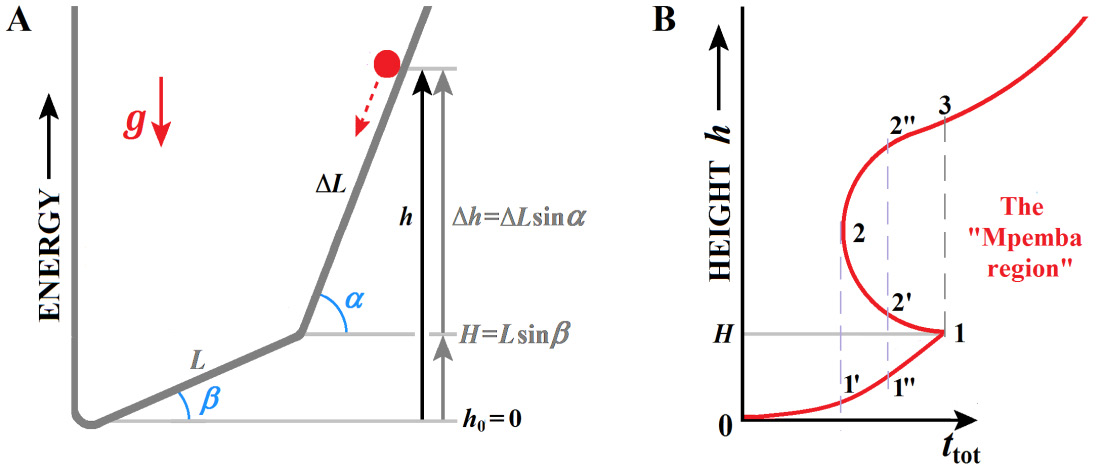
Figure 1: (A) A point particle (red) falls from the hill under the action of gravity (the acceleration of gravity is g). The slope of the hill is quite steep in its upper part and gentle at the foot (the angle α is much larger than β). The particle begins to move at an initial height of h with an initial speed vh=0. Simple question: How does the time ttot required for this particle to reach its most stable state (i.e. height h0 = 0) depend on its initial height h? (B) Schematic representation of the dependence of the time ttot required for the point particle to reach its equilibrium position (final height h0 = 0) on the initial height h of the position of this particle on the hill shown in Panel (A).
The introduced model is described by elementary Newtonian mechanics.
When the initial height $h$ of the position of the point particle is below $H$ (Fig. 1A), the particle reaches the level $h_0 = 0$ in time $t_{tot} = \frac{\sqrt{2h}}{\sqrt{g \cdot \sin \beta}}$, which only increases with its initial height $h \left( \frac{\partial}{\partial h} t_{tot} > 0 \right)$, see Fig. 1B, curve 0-1’-1’-1’; this is “normal”, and no “Mpemba effect” occurs in this situation.
However, the situation is quite different when the initial height $h$ of the particle’s position is above $H$.
Now the particle reaches the level $H$ in time $\frac{\sqrt{2\Delta h}}{\sqrt{g \cdot \sin \alpha}}$ (where $\Delta h = h - H$) with the speed $\sqrt{2g \Delta h}$, and then spends extra time $\frac{\sqrt{2L}}{\sqrt{g(h - H)} + \sqrt{gh}}$ to descend to level $h_0 = 0$ (where it arrives with the speed $\sqrt{2gh}$). So, the total time of the descent from $h > H$ to $h = 0$ is $t_{tot} = \sqrt{\frac{2}{g}} \left( \frac{\sqrt{h - H}}{\sin \alpha} + \frac{L}{\sqrt{h - H} + \sqrt{h}} \right)$.
When $h$ grows $\frac{\partial}{\partial h} t_{tot} = \frac{1}{\sin \alpha \sqrt{2g(h - H)}} \left( 1 - \frac{L \sin \alpha}{\sqrt{h - H} + h} \right)$ at $h > H$, and $\frac{\partial}{\partial h} t_{tot}$ is negative when $h$ is only slightly larger than $H$, since then $\sqrt{h(h - H)} + h \approx h$ and $L \sin \alpha = H \frac{\sin \alpha}{\sin \beta} >> H \approx h$ (Fig. 1A).
Thus, $\frac{\partial}{\partial h} t_{tot}$ changes its sign at the level of $H$: below $H$ it was positive, and just above $H$ it becomes negative (see the vicinity of point 1 in Figure 1B).
The “strange” Mpemba effect is produced by this non-monotonic behavior of the $t_{tot}$ as a function of $h$.
The value of $\frac{\partial}{\partial h} t_{tot}$ remains negative from the level $h = H$ to the level where $\frac{L \sin \alpha}{\sqrt{h(h - H)} + h} = 1$, that is, where $h = H + L \frac{\left( \sin \alpha - \sin \beta \right)^2}{2 \sin \alpha - \sin \beta}$ (see the line 1-2’-2 in Fig. 1B).
Thus, the total descent time $t_{tot}$ decreases here. From this level of $h$, the total descent time $t_{tot}$ grows (see the line 2-2’-3 in Figure 1B), and, when $h >> H$, that is, when $h$ becomes big enough (after the point 3 in Figure 1B), this total time can be approximated by a “normally looking”, that is growing with $h$ dependence $t_{tot} \approx \frac{\sqrt{2h}}{\sqrt{g \cdot \sin \alpha}} \left[ 1 + \frac{H}{2h} \left( \frac{\sin \alpha}{\sin \beta} - 1 \right) \right]$.
Thus, the described system demonstrates a "Mpemba-like" behaviour when:
• the initial height $h_{hot}$ of the “hotter” (excited) point particle is between points 1 and 3 in Figure 1B: above point 1, the force pulling the particle to its equilibrium state is greater than below this point, and at point 3, the value of $t_{tot}$ is the same as in point 1;
• the initial height $h_{cold}$ of the “colder” point particle is below $h_{hot}$ and this height $h_{cold}$ is such that $t_{tot} \left( h_{cold} \right) > t_{tot} \left( h_{hot} \right)$.
If these three conditions are satisfied by the initial states of the “initially hot” and “initially cold” particles, then this pair of particles demonstrates the Mpemba effect: “the state that is initially farthest from its equilibrium state attains the latter at the earliest time”.
Thus, the Mpemba effect may be “counterintuitive”, but, being described by elementary equations of motion, it is by no means “strange”.
Now we can answer both questions concerning the behaviour of our "Mpemba-like" system:
• The state of a particle is determined not only by its position (height), but also by its speed. The difference between the states of unexcited (“initially cold”) and excited (“initially hot”) particles, when both are at the same height, is the greater speed of the latter.
• The gravity factor persists all the time: it has the same accelerating effect on the particle independently of its current speed.
• The inertia saves the kinetic energy obtained by the excited (“initially hot”) particle while its descending to the initial level of the “initially cold” one, and the latter does not possess the kinetic energy at all at this level.
Above, I deliberately avoided talking about the freezing of hot and cold water, since in this case all the explanations I found in the literature are unsatisfactory, which makes many physicists doubt the existence of the Mpemba effect as such. Establishing a reliable long-lived difference between “initially cold (+20 °C)” and “initially hot but already cooled (to +20 °C)” water is an experimental task. Our recent experimental and theoretical work [21] has shown that the "Mpemba effect" in pure water has not a deterministic but only a stochastic origin (due to the stochastic uncertainty of the moment of the onset of the first-order phase transition).
Therefore, here I have presented a simple case in which the intelligible "Mpemba effect" is deterministic (in the sense that “the state that is initially farthest from its equilibrium state always attains the latter at the earliest time”) and exists unambiguously.
I have deliberately avoided speaking above about “hot” and “cold” particles, but one can see at once that given the particle potential $U(l) = mgl.\sin \beta$ at $l \leq L$ and $U(l) = mgl.\sin \alpha - mgL.(\sin \alpha - \sin \beta)$ at $l \geq L$ defined by Figure 1), one can determine the average position of the particle $\langle h \rangle_T$ and its corresponding height $\langle h \rangle_T$ for any temperature $T$, and arrive at the strict Mpemba effect with “hot” and “cold” particles when they are cooled down to very low temperature.
Acknowledgment
I am grateful to Bogdan S. Melnik, Andrei A. Klimov and Vladimir V. Filimonov for discussions and to Eugenia V. Serebova for editing the manuscript. This work has been supported by the Russian Science Foundation grants 21-14-00268, 25-14-00260.
References
-
Mpemba EB, Osborne DG (1969) “Cool?”. Phys Educ 4: 172-175.
-
Freeman M (1979) Cooler still—an answer? Phys Educ 14(7): 417-421.
-
Hu C, Li J, Huang S, Li H, Luo C, et al. (2018) Conformation directed Mpemba effect on polylactide crystallization. Cryst Growth Des 18: 5757-5762.
-
Ahn YH, Kang H, Koh DY, Lee H (2016) Experimental verifications of Mpemba-like behaviors of clathrate hydrates. Korean J Chem Eng 33: 1903.
-
Joshi LK, Franke J, Rath A, Ares F, Murciano S, et al. (2024) Observing the quantum Mpemba effect in quantum simulations. Phys Rev Lett 133: 010402.
-
Baity-Jesi M, Calore E, Cruz A, Fernandez LA, Gil-Narvión JM, et al. (2019) The Mpemba effect in spin glasses is a persistent memory effect. Proc Natl Acad Sci, USA
-
Lasanta F, Reyes V, Prados A, Santos A (2017) When the hotter cools more quickly: Mpemba effect in granular fluids. Phys Rev Lett 119(14): 148001.
-
Nava, Fabrizio M (2019) Lindblad dissipative dynamics in the presence of phase coexistence. Phys Rev B 100: 125102.
-
Chatterjee K, Takada S, Hayakawa H (2023) Quantum Mpemba effect in a quantum dot with reservoirs. Phys Rev Lett 131(8): 080402.
-
Elton DC, Spencer PD (2021) Pathological Water Science – Four Examples and What They Have in Common. In book: Water in Biomechanical and Related Systems. In book series: Biologically-Inspired Systems Book 17th, Gadomski A (Ed.), Hamburg, Springer Verlag GmbH pp: 155-169.
-
Bier M (2023) The rise and fall of the Mpemba effect. Skeptical Inquirer 47(4).
-
Auerbach D (1995) Supercooling and the Mpemba effect: when hot water freezes quicker than cold. Am J Phys 63: 882-885.
-
(2025) Mpemba effect. Wikipedia.
-
Jeng M (2006) The Mpemba effect: When can hot water freeze faster than cold. Am J Phys 74(6): 514-522.
-
Katz J (2009) When hot water freezes before cold. Am J Phys 77(27): 27-29.
-
Kell GS (1969) The freezing of hot and cold water. Am J Phys 37(5): 564-565.
-
Jin J, Goddard III WA (2015) Mechanisms underlying the Mpemba effect in water from molecular dynamics simulations. J Phys l Chem C 119(5): 2622-2629.
-
Tao Y, Zou W, Jia J, Li W Cremer D (2017) Different ways of hydrogen bonding in water - Why does warm water freeze faster than cold water? J Chem Theory Comput. 13(1): 55-76.
-
Santos A (2024) Mpemba meets Newton: Exploring the Mpemba and Kovacs effects in the time-delayed cooling law. Phys Rev E 109: 044149.
-
Finkelstein AV (2025) Analogue of the Mpemba effect in classical mechanics. arXiv preprint arXiv: 2503.22387.
-
Klimov AA, Finkelstein AV (2025) The Mpemba effect in pure water has a stochastic origin. Experimental and theoretical resolution of the paradox. Preprint arXiv: 2508.05607v1.
- Sense, Gravity, Parity & Chirality in Mathematical Physics
- Quantum Lattice Simulations PHYSICS: Microcircuit Particle Formation and Observable Macroscopic Irreversible Time - A Discrete Lagrangian with Cellular Automata Framework
- Quantum Biology from Biomacromolecule to Cell, and Central Dogma Described by Quantum Theory
- Focus, Agility, Speed and Technology (FAST) for Sustainability and Growth
- Square Root Metric Geometry and Pati-Salam Model in Curved Space-Time
- The Mental Feeling Effect and the Triad Related to the Human