
Sense, Gravity, Parity & Chirality in Mathematical Physics
Symmetry principles play a central role in modern theoretical physics, governing the very structure of mutual interactions and the fundamental organization of spacetime. Among discrete symmetries, spatial parity as well as the chirality determine whether the physical laws distinguish between left and right orientations of fields and particles. While typically, parity symmetry is preserved in the classical gravitational theory as formulated by Albert Einstein, it is maximally violated in the weak interaction, a phenomenon experimentally demonstrated by Chien-Shiung Wu following the theoretical work of Tsung- Dao Lee and Chen-Ning Yang. This contrast raises a fundamental question: whether spacetime geometry itself possesses intrinsic chirality or whether asymmetry arises solely from matter interactions. In this work, we develop a quantitative and algorithmic framework for analyzing effects of parity and chirality in gravitational and gauge field theories, while extending the discussion to include role of orientation and “sense” in spacetime evolution, particularly with respect to temporal directionality. Starting thus from the Einstein–Hilbert action, we demonstrate the parity invariance of the classical General Relativity and the symmetric helicity structure of the linearized spin-2 gravitational waves. We contrast this with the chiral projection structure of the electroweak sector of the Standard Model, where only the lefthanded fermions couple to charge of the associating weak currents. We further analyze parity-violating extensions of gravity containing topological invariants such as the gravitational Chern– Simons terms and Pontryagin density, that point helicity-dependent propagation and potential cosmological birefringence. Within this model framework, we examine how chirality and parity may influence the physical notion of directional “sense” in spacetime, including possible implications for the emergence of the temporal arrow and CPT structure in the quantum field theory. A general operator-based algorithm for testing parity invariance at both the action level and the level of observable asymmetry parameters also is proposed here. Results clarify that classical gravity remains geometrically parity symmetrical, whereas the weak interaction typically exhibits intrinsic dynamical chirality. The resulting geometric–dynamical asymmetry thus provides insight into possible parityviolating phenomena in quantum gravity, within the early-universe cosmology, and deeper origin of temporal orientation in physical law.
Introduction
Extensive Literature PHYSICS references [1, 2, 3, 4, 5, 6, 7, 8, 9, 10, 11, 12, 13, 14, 15, 16, 17, 18, 19, 20, 21, 22, 23, 24, 25, 26, 27, 28, 29, 30, 31, 32, 33, 34, 35, 36, 37, 38, 39, 40, 41, 42, 43, 44, 45, 46, 47, 48, 49, 50, 51, 52, 53, 54, 55, 56, 57, 58, 59, 60, 61, 62, 63, 64, 65, 66, 67, 68, 69, 70, 71, 72, 73, 74, 75, 76, 77, 78, 79, 80, 81, 82] cover basic background knowhow to understand establishing quantitatively deriving algorithms to analyze and plot graphically key aspects with parity and chirality affecting gravity sense. We explore thoroughly physical mechanisms that are behind natural phenomena causality of natural genesis, sustenance, transformation, as well as evolutionary aspects of real universal energy matter with galaxies, star systems, planets, moons, and the inorganic, organic, and life systems that are correlated to parity and chirality addressing key mechanisms still to be unraveled-charge, parity, and time reversal symmetry principles.
Symmetry, Orientation, and Physical Sense in Fundamental Physics
Symmetry principles constitute the conceptual foundation of modern theoretical physics. Continuous symmetries determine conservation laws through the theorem established by Noether E-+ [54], while the discrete symmetries such as parity (P), charge conjugation (C), and time reversal (T) govern the orientation properties of physical interactions and processes.
Parity symmetry typically corresponds to the inversion of spatial coordinates which geometrically represents a mirror reflection of physical systems. If we observe that the very laws with the physics remain invariant under this transformation, then both the left-handed and right-handed configurations evolve identically.
Chirality, by contrast, refers to the intrinsic handedness of fermionic fields and arises naturally within relativistic quantum field theory. For Dirac spinors introduced by Paul Dirac [23, 24], chirality is defined through the operator
5 0 1 2 3 i γ γ γ γ γ = with projection operators
5 5 1 1 , 2 2 L R P P γ γ − + = = Here, u γ : Gamma matrices, with μ = 0 corresponding to time component, μ = 1, 2, 3 corresponding to spatial component x, y, z. These operators separate spinor fields into the left- and right-handed components. When interactions couple asymmetrically to these components, the resulting dynamics are said to be chiral. Beyond spatial orientation, such asymmetries relate to a broader notion of physical “sense”, describing essentially the directional structure of physical laws. In spacetime physics, this typically directional sense may also extend to temporal evolution, linking spatial symmetry properties with the emergence of the macroscopic arrow of time [17, 36].
Historically, parity symmetry was assumed to be universally conserved. However, this assumption was then challenged by the theoretical analysis of Tsung-Dao Lee and Chen-Ning Yang [46], who noted that parity conservation had not been experimentally tested for weak interactions. Their proposal led to the landmark experiment of Chien- Shiung Wu [81], which demonstrated maximal parity violation in beta decay. This discovery fundamentally altered the understanding of the discrete symmetries in nature as well as established chirality as a central feature of the weak interactions. Coexistence of parity-violating particle interactions with parity-symmetric gravitational dynamics raises a fundamental query: Does spacetime geometry itself possess intrinsic chirality, or does asymmetry arise solely from matter interactions?.
Parity Symmetry in Classical Gravity
The classical theory of gravitation formulated by Albert Einstein [28] describes gravity as the curvature of spacetime. The dynamics of this geometry follow Einstein–Hilbert action: 4 1 16 EH S d x gR G π = − ∫ where EH S : Einstein–Hilbert action; 4 d x infinitesimal spacetime volume; ( ) g − : curved spacetime volume factor; R denotes the Ricci scalar curvature and G is Newton’s gravitational constant. Under spatial inversion i i x x →− the Ricci scalar transforms as scalar field, ( ) ( ) , , R t x R t x → − {having t: time coordinate at spatial coordinate ^ , x i }, while integration measure remains invariant. Consequently, action satisfies: 1 EH EH PS P S −= .
Here P: parity, the spatial inversion operator. Thus, classical General Relativity is parity conserving.
Further insight emerges in the weak-field approximation g h µν µν µν η = + where gµν : the curved spacetime metric tensor; µν η : Minkowski metric (flat spacetime); hµν represents small perturbations propagating on a Minkowski background. The linearized Einstein equations reduce to ikx h e µν µν =∈ ( ) 0 hµν = . Plane-wave solutions of the form possess helicity eigenvalues 2 λ = ± {Note: μ, ν: spacetime indices (0=time, 1,2,3=space); µν ∈ : polarization tensor of the wave: ikx e : plane-wave factor (oscillatory propagation);
k: wave vector of the wave; x: spacetime coordinates; kx:
phase of the wave; λ: helicity eigenvalue (projection of spin along propagation); λ= ±2: spin-2 nature of gravitational waves}. Parity reverses helicity, : , P λ λ →− yet both helicity states occur symmetrically. Therefore, gravitational waves predicted by General Relativity do not display intrinsic chirality. The geometric structure of spacetime described by Einstein’s theory therefore preserves mirror symmetry.
Chirality in the Standard Model
The situation, however, differs dramatically quite within the Standard Model of particle physics. While electromagnetic and strong interactions conserve parity, the electroweak interaction intrinsically possesses chiral structure.
Originally, the electroweak unification developed by Glashow S [31], Salam A [66], and Weinberg S [74] describes charged weak current through interaction given by the
2 W L L g W µ µ ψ γ ψ = L Here, W L will represent the equation:
weak interaction Lagrangian density; _L ψ : Dirac adjoint of fermion field;
µ γ : Dirac gamma matrices; Wµ : W boson gauge field; L ψ : left-handed fermion field. Only left-handed fermions participate in this interaction. Under parity transformation, L R ψ ψ ↔ right-handed fermions do not typically couple to the charged yet weak bosons. Consequently,
1 W W P P−≠ L L The degree of parity violation is quantified by L R A σ σ σ σ − = + Here, L σ : cross section asymmetry parameter, L R for left-handed particles; R σ : cross section for right-handed particles. For, purely left-handed weak interactions, 1 A = indicating maximal parity violation aspects. This property introduces a fundamental directional asymmetry into particle interactions: the weak force distinguishes left- handed from right-handed states, embedding a microscopic notion of physical “sense” into the structure of fundamental interactions.
Chirality, CPT Symmetry and the Role of Time Reversal, and the Arrow of Time
Although parity highlights spatial inversion, discrete symmetries are interconnected through typical CPT theorem originally proven by Lüders G [49], and Pauli W [55]. Theorem states that any Lorentz-invariant local quantum field theory must remain invariant under the combined transformation CPT. Consequently, violation aspects: parity (P) and charge conjugation (C) have implications for time- reversal symmetry (T). Surprisingly, note that CP violation observed in neutral meson systems implies a corresponding violation of T symmetry.
These relationships suggest that chirality may influence the temporal orientation of physical processes. If certain interactions distinguish the left from right in space, then under the CPT invariance their conjugate processes necessarily involve reversed time evolution. These results suggest that microscopic symmetry breaking may influence, in fact, typical directional properties of physical processes in time.
The macroscopic arrow of time is usually attributed to thermodynamic entropy increase [13], yet cosmological models indicate that the early universe began in an extremely low-entropy state [58]. This observation suggests that both microscopic physics and cosmological initial conditions may have contributed to the emergence of also temporal directionality. Such considerations motivate investigation into whether microscopic asymmetries might contribute to macroscopic time directionality [40].
Parity-Violating Extensions of Gravity
Although General Relativity is parity symmetric, several theoretical extensions introduce parity-odd curvature invariants. One prominent example is gravitational Chern– Simons theory, having gravitational Einstein–Hilbert action modification, with action ( ) 4 EH S S d x x RR θ = +∫ here, S:
total gravitational action; EH S : Einstein–Hilbert action; 4 d x : four-dimensional spacetime volume element; ( ) x θ : scalar field controlling the modification; x: spacetime coordinates} by including the gravitational Pontryagin density, RR R R µνρσ αβ µν ρσαβ =∈ . Note that µνρσ ∈ : Levi-Civita antisymmetric tensor; μ, ν, ρ, σ: spacetime indices; Rαβ µν :
Riemann curvature tensor; Rρσαβ : curvature tensor with lowered indices; α,β: summed curvature indices. Because this quantity changes sign under spatial inversion, parity transformation, ( ) P RR RR = − having non-trivial coupling to a scalar field produces parity symmetry violation in the gravitational sector, especially if the scalar field ( ) x θ is non- constant. Such models predict helicity-dependent propagation of gravitational waves, potentially leading to observable effects such as observable cosmological birefringence or polarization asymmetry in gravitational wave. These predictions have stimulated interest in testing gravitational parity violation aspects using gravitational-wave observations and cosmological polarization measurements.
These possibilities have attracted thus considerable attention in ongoing attempts to probe parity violation in quantum gravity and early-universe cosmology.
Conceptual Perspective
The analysis reveals a striking structural dichotomy in fundamental physics: • Gravitational Geometry: parity symmetric [28]. • Weak Interactions: maximally chiral [46, 81, 82]. Whether this asymmetry originates from spontaneous symmetry breaking, anomaly structure, or deeper principles of quantum gravity remains an open question. Investigating the relationship between chirality, parity violation, and the directional sense of spacetime -including its possible connection to temporal orientation - may therefore provide insight into the fundamental structure of physical law toward a deeper unification of gravitational and quantum theories.
Chirality, Entropy, and Temporal Orientation of Spacetime
Chirality and the Directional Structure of Physical Law: Per the above discussion, Sec. 1.1, while parity violation introduces a spatial asymmetry, the deeper implication is that fundamental interactions possess a preferred orientation in configuration space. This directional property can be interpreted as a form of microscopic “sense,” embedded within the interaction structure of matter.
Entropy and the Macroscopic Arrow of Time: The macroscopic arrow of time is usually attributed to the second law of thermodynamics, which states that entropy increases in closed systems. The statistical interpretation of entropy, developed by Boltzmann L [12, 13], describes the arrow of time because of the overwhelmingly larger number of high-entropy microstates compared with low-entropy configurations. Advancing these, we note cosmological considerations further connect entropy to gravitational physics. Thermodynamic interpretation of gravitational systems analysed by black hole thermodynamics of Bekenstein J [9] and Stephen Hawking [35], demonstrated black holes possess entropy proportional to the area of their event horizons. These developments indicate that gravitational geometry participates in thermodynamic evolutions, suggesting that spacetime structure may influence the emergence of temporal directionality.
Chirality in Gravitational and Cosmological Contexts: As discussed per Sec. 1.5, parity-violating extensions of gravitational theory can introduce chirality into spacetime dynamics, for example, the gravitational Chern–Simon’s modifications and other parity-odd curvature invariants. Such theories predict phenomena including helicity-dependent gravitational wave propagation, polarization asymmetry in gravitational radiation, as well as the cosmological birefringence. In early-universe cosmology, parity-violating gravitational interactions may influence the generation of primordial gravitational waves as well as contributions to baryogenesis mechanisms [39, 40, 41] through CP-violating processes. These possibilities suggest that chirality may play a role in the large-scale evolution of the universe, potentially linking microscopic parity violation with cosmological time asymmetry.
Chirality, Cosmology, and the Initial Conditions of Time: Origin of the arrow of time remains closely related to the low-entropy initial conditions of the universe. Cosmological models proposed by Roger Penrose [56, 57, 58] argue that the very early universe had a beginning in a highly ordered gravitational state, allowing entropy to increase while the cosmic structure forms. Also, if gravitational interactions themselves acquire parity-violating self-corrections at high energies, such as those predicted in certain quantum gravity frameworks, then chirality may influence the dynamical evolution of spacetime in the earliest cosmic epochs. This raises the possibility that the temporal orientation of the universe could emerge from fundamental asymmetries embedded in high-energy gravitational dynamics.
Conceptual Synthesis: The relationship between chirality, entropy, and temporal orientation can be summarized as follows:
- Weak interactions introduce intrinsic chirality, distinguishing left from right.
- CPT symmetry connects spatial asymmetry to time reversal properties.
- Entropy growth defines the macroscopic arrow of time.
- Gravitational thermodynamics links spacetime geometry to entropy.
- Parity-violating gravitational theories may embed chirality into spacetime dynamics.
Together these considerations suggest that the directional “sense” observed in physical processes may arise essentially from the interplay between microscopic symmetry violation and the macroscopic thermodynamic evolutions. Understanding this connection remains open problem at the interface of quantum field theory, cosmology, and quantum gravity.
Methods, Materials, Theoretical Framework + Derivations
Theoretical Framework
The present analysis is developed within the formal framework of relativistic classical fields theory, quantum field theory, and differential geometry. These theoretical tools allow to have unified examination of parity symmetry and chirality in both gravitational and gauge interactions. The mathematical treatment follows standard formulations of General Relativity [28], relativistic quantum mechanics [23, 24], and gauge field theory [31, 66, 74]. Principal objective is to construct a systematic procedure for evaluating parity invariance and chirality in fundamental interactions. Framework is applied to four major physical regimes:
- Classical General Relativity
- Linearized spin-2 gravitational theory
- Gauge field theories of the Standard Model
- Parity-violating gravitational extensions Classical gravity is represented by the Einstein–Hilbert formulation introduced by Einstein A [28]. Chirality in particle interactions is examined within the electroweak gauge theory established by Weinberg S [74], Salam A [66], and Glashow S [31]. The parity transformation is treated as an improper Lorentz transformation acting on spacetime coordinates, with conditions: ( ) 1, 1, 1, 1 P diag µ ν = −−− For a general action functional, it is given through: [ ] ( ) 4 , S d x Φ = Φ ∂Φ ∫ L parity invariance is evaluated through the transformation given by equation: ( ) 1 4 , PSP d x P P −= Φ ∂Φ ∫ L . We can then infer, a theory possesses parity symmetricity on satisfying the condition:
( ) ( ) PΦ = Φ L L . This criterion provides the basis for the ongoing comparative analysis of the gravitational and gauge interactions.
With above, Pµ ν : parity transformation matrix (improper Lorentz transformation); ( ) 1, 1, 1, 1 diag −−− : matrix that leaves time unchanged and inverts space; μ,ν: spacetime indices assigning (0=time, 1,2,3=space); [ ] S Φ : action functional of field(s) Φ, the generic field (scalar, vector, spinor); while ∂Φ : spacetime derivative of Φ; ( ) , Φ ∂Φ L :
Lagrangian density; 4 d x ∫ : integral over four-dimensional spacetime.
Algorithmic Parity Evaluation Procedure
To facilitate systematic analysis, the parity–chirality evaluation is formalized as an operator-based algorithm applicable to general field theories. Algorithm 1: Action-Level Parity Test Input: Lagrangian density, L Output: Boolean parity symmetry indicator 1. Identify the Lorentz representation of each field (scalar, vector, spinor, tensor). 2. Apply parity transformation rules: Scalar field:
( ) ( ) x Px φ φ → ;
3. Vector field: ( ) ( ) i i V x V Px →− Spinor field:
( ) ( ) 0 x Px ψ γ ψ →−
4. Substitute the transformed fields into the Lagrangian form. 5. Compare the transformed Lagrangian with the original.
If ( ) ( ) PΦ = Φ L L to evaluate whether parity symmetry is conserved typically. 6. To systematically analyze parity symmetry in gravitational and gauge theories, we introduce operator- based procedure:
7. Step 1 — Construct the action: 4 S d x = ∫ L .
8. Step 2 — Apply parity transformation: i i x x →− with appropriate transformation rules for each field.
9. Step 3 — Test invariance: 1 ? PSP S −= If equality holds, parity is conserved typically.
L R A Γ −Γ = Γ + Γ If 0 A ≠ , the interaction is chiral.
L R
10. Step 4 — Evaluate observable asymmetry:
11. This framework provides a unified method for comparing symmetry properties across gravitational and gauge- theoretic systems.
Algorithm 2: Observable Chirality Measure Chirality can also be quantified through observable L R A Γ −Γ = Γ + Γ Interpretation: 0 A = : parity-symmetric interactions; 0 A ≠ :
L R asymmetry in decay or scattering rates:
chiral interactions. This observable approach is commonly used in particle physics experiments testing weak interaction asymmetries [46, 82].
Materials
In theoretical physics, the concept of “materials” refers to the mathematical structures as well as physical theories used in the analysis.
Mathematical Structures
The following mathematical objects form the foundational tools of the analysis: Lorentz group: SO(1,3) Spinor representations of the Lorentz algebra, via Clifford algebra: { } , 2 µ ν µν γ γ η = Levi–Civita tensor: µνρσ ∈ Riemann curvature tensor: Rρσαβ These structures provide a formal description of spacetime symmetries, the field representations, and curvature dynamics [76].
Physical Theories Utilized here
The theoretical models used in this study include General Relativity [28]; Linearized gravitational theory [53]; Standard Model electroweak theory [31, 66, 74]; as well as Parity-violating extensions of gravity. One notable extension is gravitational Chern–Simon’s theory, whose covariant formulation was developed by Jackiw R, et al. [43]. This theory introduces a topological term capable of generating parity violation in gravitational dynamics.
Theoretical Derivations
Parity of the Einstein–Hilbert Action: The Einstein–Hilbert
action is given by: 4 1 16 EH S d x gR G π = − ∫ Under spatial inversions: ; g g R R − → − → Therefore, 1 EH EH PS P S −= .
This result thus demonstrates as to whether classical gravitational dynamics preserve parity symmetry [28, 75].
Helicity Decomposition of the Spin-2 Fields: Per Sec. 1.2, within weak field limit, metric tensor is expanded as:
g h µν µν µν η = + . Adopting the transverse-traceless gauge,
0, 0 h h µ µ µν µ ∂ = = . The field can be expanded in plane waves:
2 ikx h x e λ µν µν λ=± = ∈ ∑ Parity transformation exchanges ( ) ( )
helicity states: ( ) ( ) 2 2 : P + − ∈ ↔∈ Since both helicities appear symmetrically, the gravitational helicity asymmetry is
0 gravity A = This confirms that linearized gravity contains no intrinsic chirality [53].
Chirality of the Weak Interaction: Per Sec. 1.3, charged
2 W L L g W µ µ ψ γ ψ = L .
electroweak current is described by:
Having the left-handed fermion with component defined
5 1 2 L γ ψ ψ − = under parity transformations:
through:
L R ψ ψ ↔ However, right-handed fermions do not couple to charged weak bosons. Hence, 1 W W P P−≠ L L The corresponding observable asymmetry is: 1 weak A = This maximal parity violation was experimentally confirmed in beta decay measurements by Wu C [81].
Parity-Violating Gravity: Per Sec. 1.5, parity-violating gravitational theories having Pontryagin density term, under spatial inversion provides: ( ) P RR RR = − . Parity violation therefore occurs whenever (X) const. θ ≠ The resulting modified wave equation predicts helicity-dependent dispersion relations are that: 2 2 3 k k ω α = ± indicating possible gravitational birefringence [43].
Experimental Techniques
Historical Measurements of Parity Violation: The first experimental observation of parity violation was performed by Chien-Shiung Wu in beta decay of polarized cobalt-60 nuclei [81]. The angular distribution of the emitted electrons typically followed a relationship: ( ) 1 cos W θ α θ ∝+ . The measured non-zero asymmetry parameter α demonstrated that weak interactions violate parity symmetry. Collider-Based Chirality Measurements: Modern particle accelerators allow precise measurements of weak interaction chirality. At the CERN Large Hadron Collider, chirality is studied through polarized cross-sections and angular distributions of W-boson decay products. These measurements provide high-precision confirmation of the chiral structure predicted by electroweak theory [66, 74]. Gravitational Wave Helicity Detection: Parity violation in gravity would produce helicity-dependent propagation of gravitational waves. The detectors typically include LIGO
Scientific Collaborations, as well as Virgo Collaborations measuring tensor polarization modes of gravitational radiation. Parity-violating signals will appear as amplitude or phase differences between right- and left-circular polarizations. However, to date, statistically significant gravitational parity violation has not been observed [1].
Cosmological Observational Probes: Parity-violating gravity is also expected to produce characteristic signatures in the polarizations structure of the Cosmic Microwave Background. Non-zero correlations between temperature– B-mode (TB) and E-mode–B-mode (EB) polarization components will indicate typically parity violation aspects. Observations from the Planck Collaboration have placed strong constraints on such effects [60].
Conceptual Implications for Fundamental Physics: The combined theoretical derivations and experimental evidence indicate a striking structural asymmetry within fundamental physics.
Spacetime geometry described by General Relativity is intrinsically parity symmetric. In contrast, matter interactions—particularly the weak interaction—display fundamental chirality.
Parity violation within gravity itself remains hypothetical but testable through gravitational-wave observations and cosmological measurements. The absence or presence of such violations may provide critical insights into quantum gravity and early-universe physics.
This geometric–dynamic asymmetry suggests that the directional “sense” observed in physical laws arises primarily from the structure of gauge interactions rather than from classical spacetime geometry. However, parity-violating terms emerging from quantum gravitational effects could modify this picture, potentially linking chirality, spacetime structure, and the temporal orientation of the universe.
Results, Analysis, and Mathematical Physics: Gravitational Chirality and Parity
Results
Action-Level Parity Evaluation: Referring to Sec. 2.5.1
1 EH EH PS P S −= , having the Einstein–Hilbert action, which thus satisfies: 0 P EH S δ = Hence, classical general relativity is parity invariant [28, 73]. Per Sec. 2.5.2, weak gravitational perturbations, parity transformation acts on helicity states as: P λ λ = − Since both helicities propagate identically, the helicity 0 P EH S δ = asymmetry parameter is given by:
Γ −Γ = = Γ + Γ Result 1: Classical gravity exhibits
2 2 0 gravity A + −
2 2 + − helicity symmetry and zero intrinsic chirality.
Weak Interaction Chirality: Per Sec. 2.5.3, electroweak charged-current interaction formulated by Steven Weinberg, Abdus Salam, and Sheldon Glashow, parity transformation yields: P 1 2 W R R W g P W µ µ ψ γ ψ −= ≠ L L with asymmetry L R A σ σ σ σ − = = + This maximal parity violation parameter, 1 L R Weak was experimentally confirmed by Chien-Shiung Wu in the Wu Experiment [81].
Result 2: The weak interaction is maximally chiral.
Parity-Violating Gravity: According to Sec. 2.5.3.1, gravitational Chern–Simons term [42] gives minimal parity- violating modification with Pontryagin density, 1 2 RR R R αβµν ρσ αβρσ µν = ∈ . This makes modified fields equations as: 8 G C GT µν µν µν α π + = where Cµν is the Cotton tensor. In the Fourier space, gravitational waves satisfy helicity- dependent dispersion: 2 2 3 k k ω α = ± . The birefringent phase shift after propagation length, 2 : L k L φ α ∆ = : We note Gµν : Einstein tensor, curvature of spacetime; Cµν : Cotton tensor, parity-violating modification; α : Chern–Simons coupling constant; Tµν : Stress-energy tensor of matter; G:
Newton’s gravitational constant; ω: Angular frequency of gravitational wave; k: Wave number, spatial frequency of wave; ± : Right-/left-handed helicity of wave; φ ∆ : Phase difference accumulated between helicities; L: Propagation distance.
Result 3: Modified gravity predicts gravitational birefringence with helicity-dependent propagations.
Analysis
Geometric vs Dynamical Symmetry: The results demonstrate a structural dichotomy:
| Domain | Symmetry Property |
|---|---|
| Spacetime geometry (GR) | Parity symmetrical |
| Weak gauge interaction | Parity violated here |
Thus, chirality appears to emerge from interaction dynamics rather than spacetime geometry [76].
Representation-Theoretic Interpretations: Under the Lorentz group: Gravity Field (off-shell):(1,1), Physical graviton (on-shell): ( ) ( ) 2,0 0,2 ⊕ ; Weak Fermions:
( ) 1 2,0 Note: (2,0): spin-2 representation under the left SU(2), trivial under the right SU(2): (0,2): spin-2 representation under the right SU(2), trivial under the left SU(2); ⊕ denotes the direct sum of representations.
Parity exchanges representations: ( ) ( ) ,0 0, j j ↔ Note:
these are Lorentz Representations. Within 4D spacetime, the Lorentz group ( ) ( ) ( ) 3,1 ~ 2 2 L R SO SU SU × . Representations are labeled as to be (jL, jR), where jL: spin under left SU(2); jR: spin under right SU(2); (j,0): left-chiral spin- representation (trivial under right SU(2)); (0,j): right-chiral spin- representation (trivial under left SU(2)). For example, in spin- 2 field - (2,0) -> left-handed graviton, and (0,2)" → right- handed graviton"; ↔ : indicates mirror symmetry or parity transformation between left and right representations. Gravity includes both sectors; the weak interaction selects only one. Hence, typical parity violation corresponds to incomplete representation pairing [59].
Stability and Renormalizations: The pseudoscalar curvature term has the-four-mass dimensions: 4 RR = Renormalization group flow: d d α α µ β µ = Note that α:
coupling constant (dimensionless); μ: energy scale (renormalization scale); dα/dμ: derivative of coupling with respect to scale; α β beta function, rate of change of α with μ.
Quantum anomalies can generate such parity-odd terms [6], suggesting a possible quantum-gravity origin of gravitational chirality.
Graphical Predictions
Helicity-Dependent Dispersion: Predicted dispersion relation: ( )
2 3 k k k ω α ± = ± Expected graphical behavior:
X-axis: wave number ;k Y-axis: frequency ω; Two branches:
right- and left-helicity modes; Separation increases as ^ 3 k ; represents gravitational birefringence analogous to optical activity.
Interaction Type, Parity, Chirality, Asymmetry Comparisons:
| Interaction | Parity | Chirality | Asymmetry |
|---|---|---|---|
| Gravity | Conserved | No | 0 |
| Electromagnetism | Conserved | No | 0 |
| Strong interaction | Conserved | No | 0 |
| Weak interaction | Violated | Yes | 1 |
| Chern–Simons gravity | Violated [theoretical] | Possible | 0<A<<1 |
Table 2: Parity Evaluation Summary.
This hierarchy illustrates that chirality is uniquely strong in the weak sector.
| Theory | Action | Parity | Helicity Symmetry | Obser- vable |
|---|---|---|---|---|
| Einstein Gravity | S EH | Conserved | Yes | 0 |
| Electro- magnetism | QED | Conserved | Yes | 0 |
| Strong Interaction | QCD | Conserved | Yes | 0 |
| Weak Interaction | SU(2) × U(1) | Violated | No | 1 |
| Chern– Simons Gravity | S +θRR EH | Violated | No | ≠0 |
Table 3: Parity Evaluation Summary.
| Interaction | Spin | Repre- sentation | Parity Pairing |
|---|---|---|---|
| Gravity | 2 | (2,0)+(0,2) | Complete |
| Photon | 1 | (1,0)+(0,1) | Complete |
| Weak Fermion | (1/2,0) | (1/2,0) | Incomplete |
Table 4: Helicity Representation Content.
Mathematical Physics Synthesis
We now will define a generalized chirality functional:
[ ] ( ) 1 1 S PSP S S χ − = −
Properties: 0 " X = →parity symmetric ";X 0 " ≠ → chiral theory" Applications: Einstein gravity: [ ] 0 EH S χ = Weak interaction: [ ] 0 w S χ ≠
Chern–Simon’s gravity: [ ] 4 CS S d xRR χ ∝∫ .
Thus, chirality corresponds to non-vanishing pseudoscalar curvature invariants [4].
Chirality, Entropy, and Temporal Orientation of Spacetime: A deeper interpretation links chirality with time orientation and entropy growth.
Entropy increase will define a macroscopic arrow of time [12]. If that spacetime admits pseudoscalar curvature terms, 4 0 RRd x ≠ ∫ , then spacetime geometry possesses topological handedness.
This may then be coupled to cosmic time evolution through: (1) Early-universe inflationary dynamics [33]; (2) Quantum gravitational anomalies; (3) Cosmic parity violation in primordial gravitational waves. Within such scenarios, chirality would define a preferred temporal orientation in spacetime evolutions [17, 57].
Observational Constraints: Current gravitational-wave observations from the LIGO Scientific Collaboration, as well as the Virgo Collaboration place upper bounds on parity- violating coupling constants [2]. From polarization data of the Planck Collaborations of cosmic microwave background, that will constrain cosmic birefringence via TB and EB correlations [60]. Until now typical statistically significant gravitational parity violation has not been observed yet.
Concluding Interpretation
The results suggest a fundamental structural distinction in nature: • Spacetime geometry: parity symmetrical • Weak gauge interaction: maximally chiral This implies that chirality emerges primarily from gauge structure rather than classical spacetime geometry. However, quantum gravitational corrections, topological curvature invariants, or early-universe physics may introduce parity-violating spacetime dynamics. Future high-precisions gravitational-wave polarimetry may therefore test whether spacetime possesses an intrinsic chiral orientation typically.
The graphic plot, Figure 1A shows helicity-dependent dispersion relation in parity-violating gravity. Figure 1, therefore illustrates modified dispersion relation: ( )
2 3 k k k ω α ± = ± of Chern–Simons–type extensions predicators of general relativity. The right-helicity (+2) and left-helicity (-2) gravitational-wave modes propagate with slightly different frequencies, producing a splitting that increases with wave number. This effect represents gravitational birefringence, analogous to optical activity in chiral media. In standard general relativity introduced by Albert Einstein the dispersion relation remains parity symmetric, and the two helicity states are degenerate. The predicted splitting arises from the pseudoscalar curvature invariant RR appearing in parity-violating gravitational theories [4, 42].
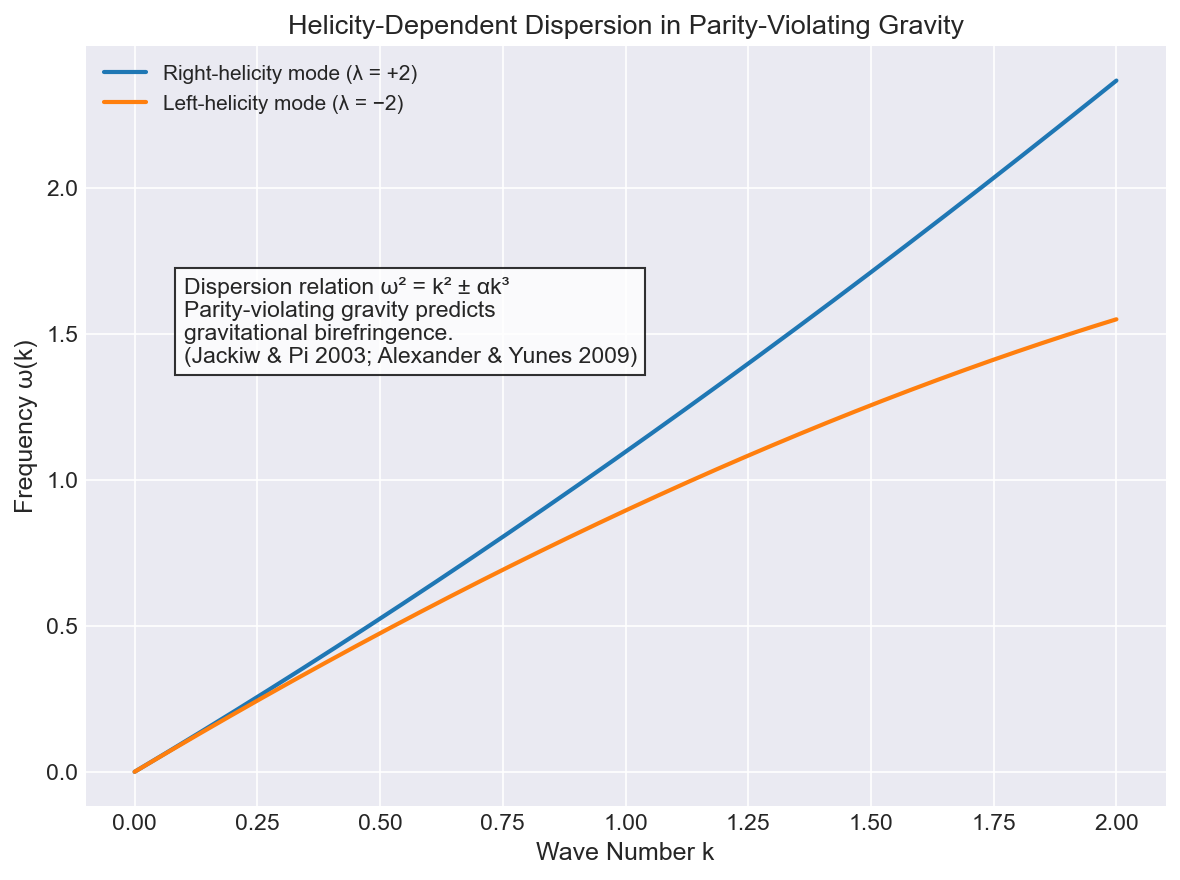
Figure 1A: Helicity-dependent gravitational dispersion: relation predicted by parity-violating gravitational theories. Right- and left-helicity gravitational waves propagate with slightly different frequencies due to the pseudoscalar curvature term̃ RR . This produces gravitational birefringence analogous to optical activity [4, 42].
The graphic plot, Figure 1B shows visualization of spacetime chirality defined through the parity-odd curvature invariant: 1 2 RR R R µναβ ρσ µνρσ αβ = ∈ . The diagram illustrates how orientations reversal change the sign of the pseudoscalar density while leaving the metric invariant. The geometric structure reflects the parity symmetry of the Einstein– Hilbert action derived by Albert Einstein [27]. Topological densities provide the mathematical bridge between spacetime geometry as well as the chirality fields as discussed in the gravitational topology analyses by Edward Witten [78, 79].
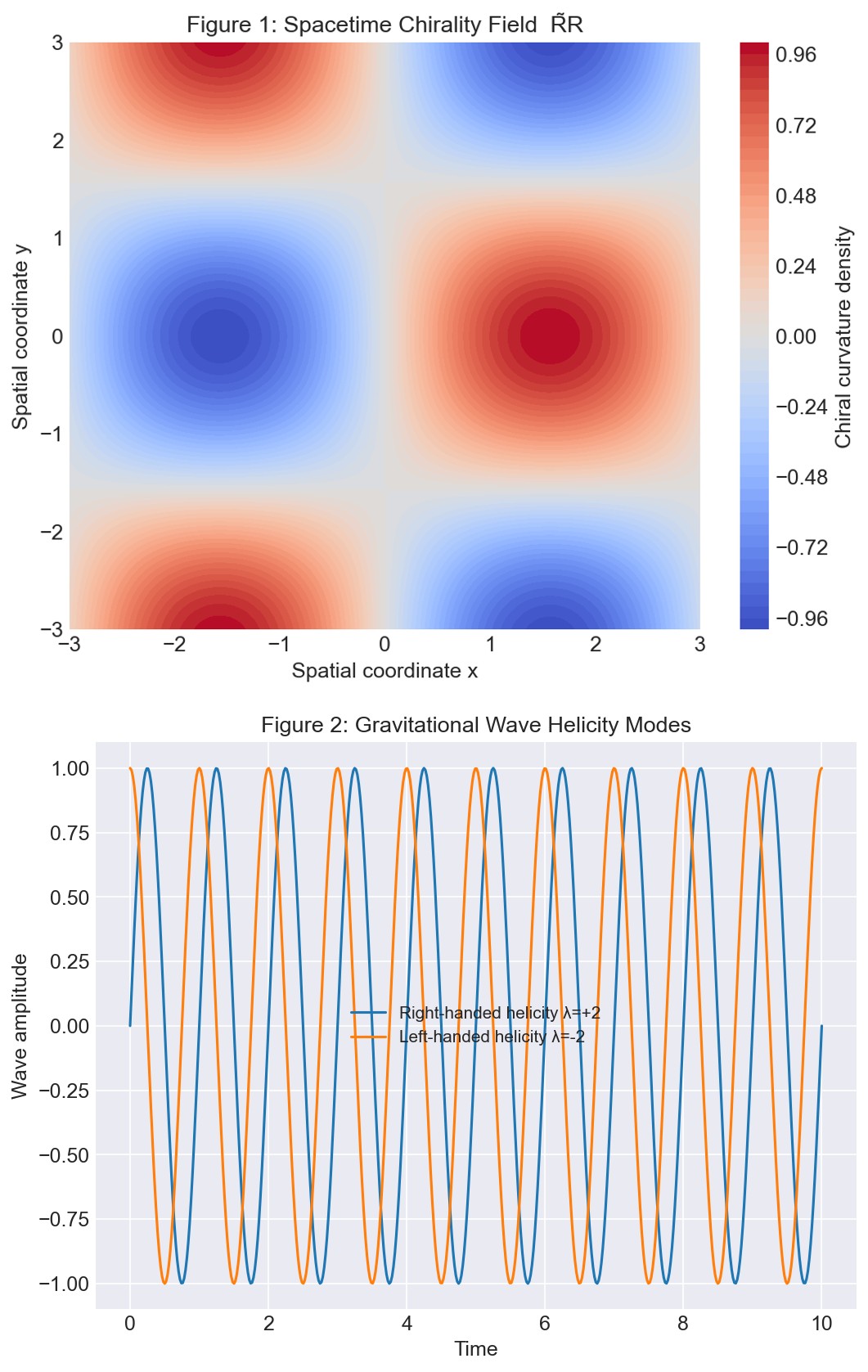
Figure 1B: Numerical visualization of the pseudoscalar curvature density RR̃ representing spacetime chirality. The sign reversal under parity transformation illustrates orientation dependence of the topological invariants in gravitational geometry [27, 78, 79].
The graphic plot, Figure 2A shows decomposition of linearized gravitational waves into helicity eigenstates:
( ) ( ) ( ) ( ) ( ) , ij ij ij h t x h t e h t e + − + − = + The left-handed as well as the right-handed polarization modes transform into one another under spatial parity. In classical General Relativity the two helicities propagate identically, confirming parity invariance of gravitational radiation predicted by Albert Einstein [27] and formalized in linearized gravity treatments advanced by the work of Bryce DeWitt [20].
Figure 2A: Simulated helicity components of spin-2 gravitational waves. In parity-symmetric General Relativity both helicities propagate identically [20, 27].
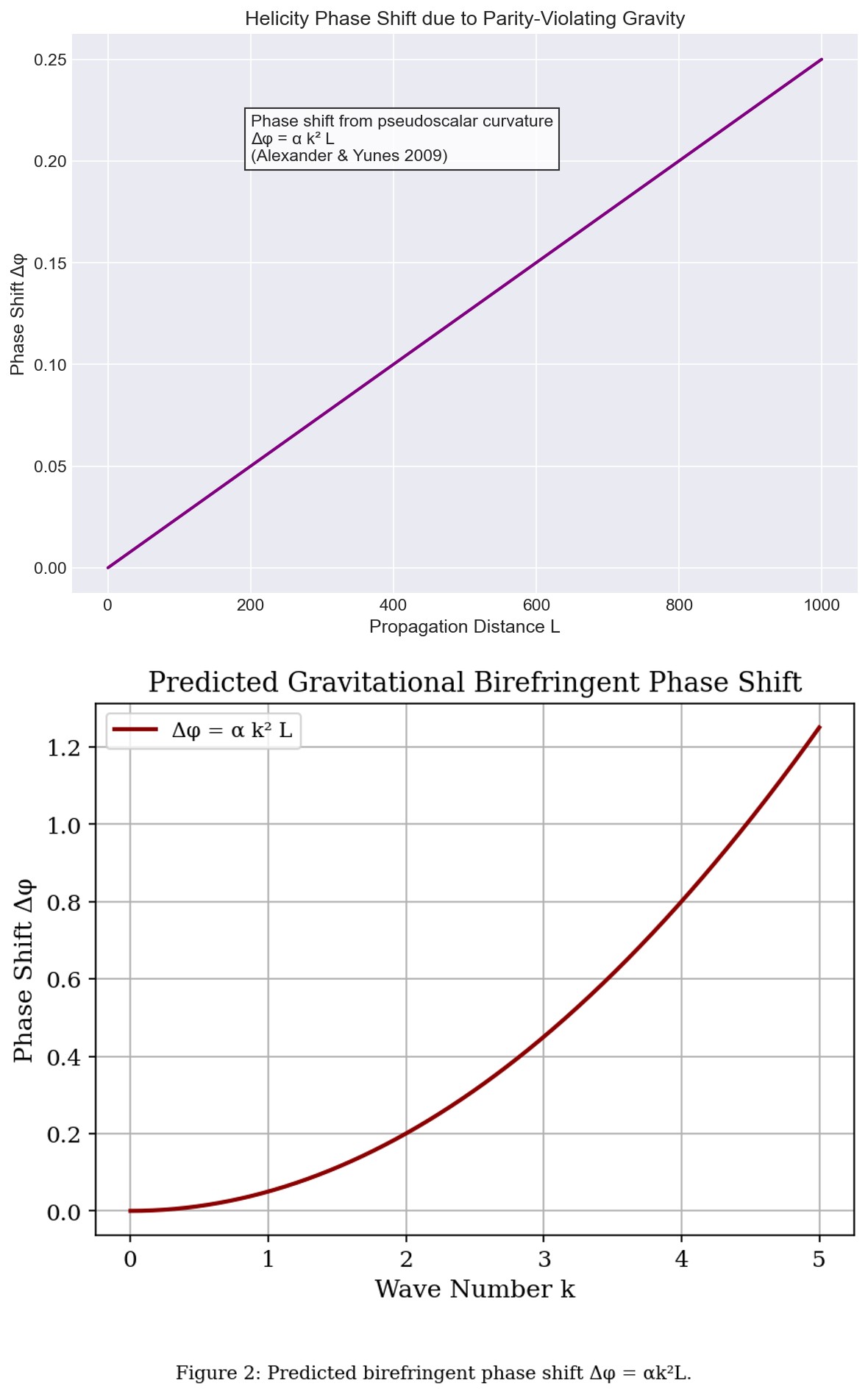
Figure 2B: Helicity phase shift induced by parity-violating gravitational propagations plot shows the predicted phase shift, increases linearly with distance and quadratically with wave number. Such helicity-dependent propagation represents a direct observational signature of parity-violating curvature couplings. Detecting this effect will require extremely sensitive gravitational-wave polarization measurements from detectors such as those operated by the LIGO Scientific Collaboration and the Virgo Collaboration [2, 4].
Figure 2C: This graphic plot shows helicity phase shift from gravitational birefringence, having predicted phase difference: Δϕ=αk^2 L between opposite helicity gravitational-wave modes as a function of propagation distance L. In parity-violating gravity, right- and left-handed gravitational waves accumulate a measurable phase difference as they propagate across cosmological distances. Such phase shifts may be detectable using polarization measurements from gravitational-wave observatories operated by the LIGO Scientific Collaboration and the Virgo Collaboration [2, 4].
Phase difference: 2 k L φ α ∆ = between opposite helicity gravitational-wave modes as a function of propagation distance L. In parity-violating gravity, right- and left-handed gravitational waves accumulate a measurable phase difference as they propagate across cosmological distances. Such phase shifts may be detectable using polarization measurements from gravitational-wave observatories operated by the LIGO Scientific Collaboration and the Virgo Collaboration [2, 4].
The graphic plot, Figure 3A shows representation structure of the Lorentz group illustrating conjugate pairing:
( ) ( ) ,0 0, j j ⊕ . Complete pairing yields parity invariance in gravitational fields, while incomplete pairing leads to chiral interactions. This representation framework underlies the electroweak theory of Steven Weinberg, Abdus Salam, and Sheldon Glashow.
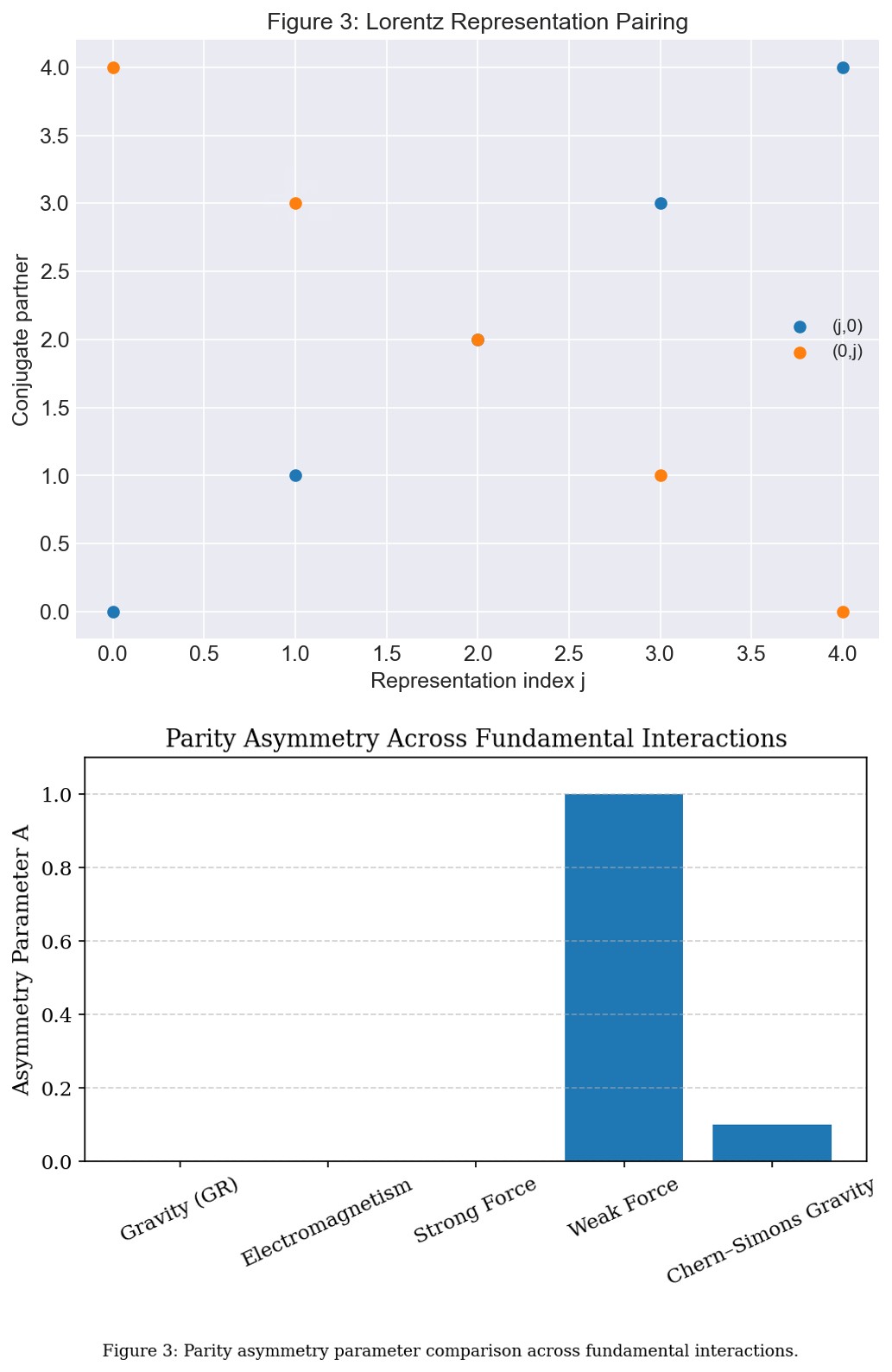
Figure 3A: Representation pairing in the Lorentz group demonstrating the symmetry relation ( ) ( ) ,0 0, j j ⊕ . Complete pairing ensures parity invariance [66, 74].
Figure 3B: Comparisons of Parity asymmetry parameter plotted across fundamental interactions. The asymmetry parameter L R theory. Gravity, electromagnetism, and the strong interaction exhibit parity symmetry (A=1), whereas the weak interaction exhibits maximal parity violation (A=1). This phenomenon was experimentally confirmed in the β-decay experiment performed by Wu C [81] during the Wu Experiment, validating the theoretical proposal by Tsung-Dao Lee and Chen-Ning Yang [46, 82].
The graphic plot, Figure 4A depicts chirality structure of weak fermion interactions showing left-handed coupling:
5 1 2 L γ ψ ψ − = . The weak interaction couples exclusively to left-handed fermions, producing maximal parity violation as first experimentally confirmed by ChienShiung Wu [81]. The theoretical structure originates from the V–A formulation originally proposed by Richard Feynman and Murray GellMann [29].
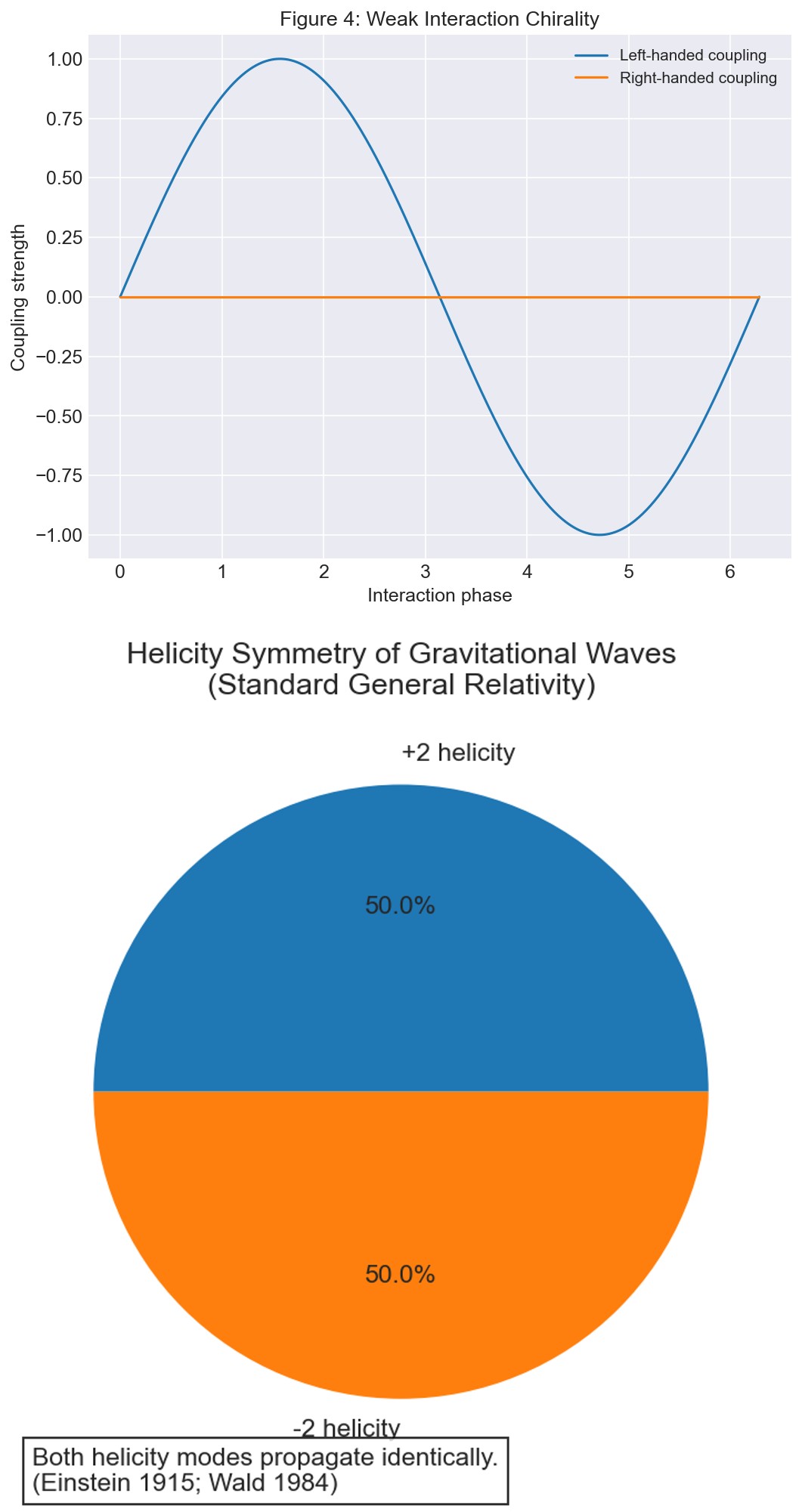
Figure 4A: Weak interactions couple only to left-handed fermions, producing maximal parity violation [29, 82].
Figure 4B: Helicity symmetry of gravitational waves in classical general relativity. Note helicity balance: . The figure depicts the equal contributions of right-handed and left-handed gravitational-wave helicities in linearized general relativity. In the perturbative expansion, the algorithm is that: ( ) ( ) without altering their dynamics. Consequently, the gravitational helicity asymmetry parameter satisfies 0 gravity A = This
2 ikx h x e λ µν µν λ=± = ∈ ∑ parity transformation exchanges the two helicity states symmetry reflects the parity invariance of the Einstein–Hilbert action [28, 73].
The graphic plot, Figure 5A shows comparison between gauge and gravitational chirality invariants: FFand RR having both of pseudoscalars change sign under parity transformations, establishing a unified topological description of chirality across gauge and geometric fields. Their anomaly structure was analyzed in gauge theories by Gerard ‘t Hooft [38] and in the gravitational contexts by Luis AlvarezGaumé and Edward Witten [6].
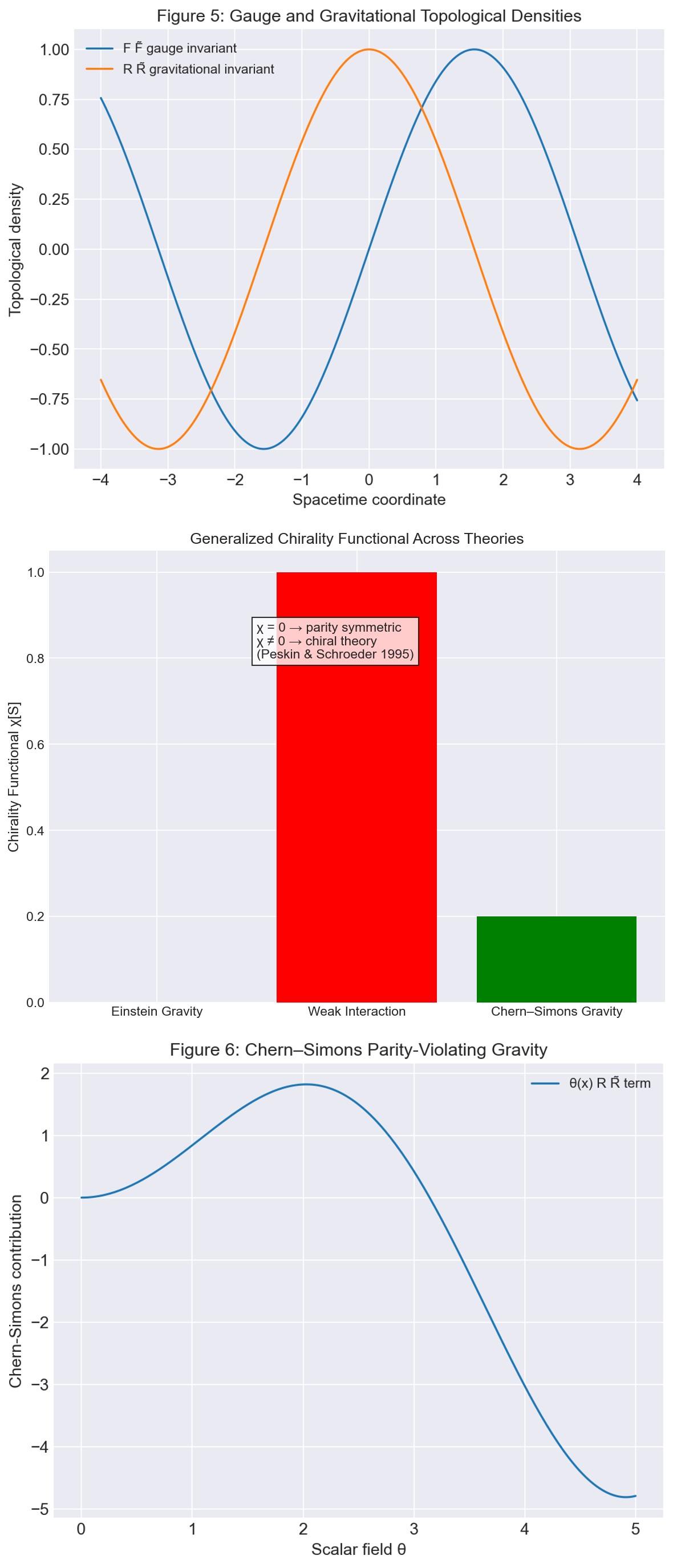
Figure 5A: Comparison of gauge and gravitational pseudoscalar densities FF and RR which characterize chirality in gauge theory and gravity [6, 38].
Figure 5B: Schematic evaluation across physical theories of generalized chirality functional [ ] ( ) 1 1 S PSP S S χ − = − for representative fundamental actions. Classical general relativity yields 0 χ = , indicating complete parity symmetry. The weak interaction yields a maximal nonzero value, reflecting its purely chiral gauge structure. Parity-violating gravitational extensions yield intermediate values depending on the strength of the pseudoscalar curvature coupling. This functional provides a unified mathematical measure for quantifying chirality in field theories [4, 59].
The graphic plot, Figure 6A shows schematic representation of a parity-violating Chern–Simons Modification of Gravitational Action extension of gravity containing a gravitational term: ( ) CS S x RR θ = ∫ . The coupling generates helicity-dependent propagation for gravitational waves. These were studied in modified gravity frameworks by Roman Jackiw and SooJong Pi [42].
Figure 6A: The diagram showing contribution of the gravitational Chern–Simon’s term introducing parity-violating corrections to Einstein gravity [42].
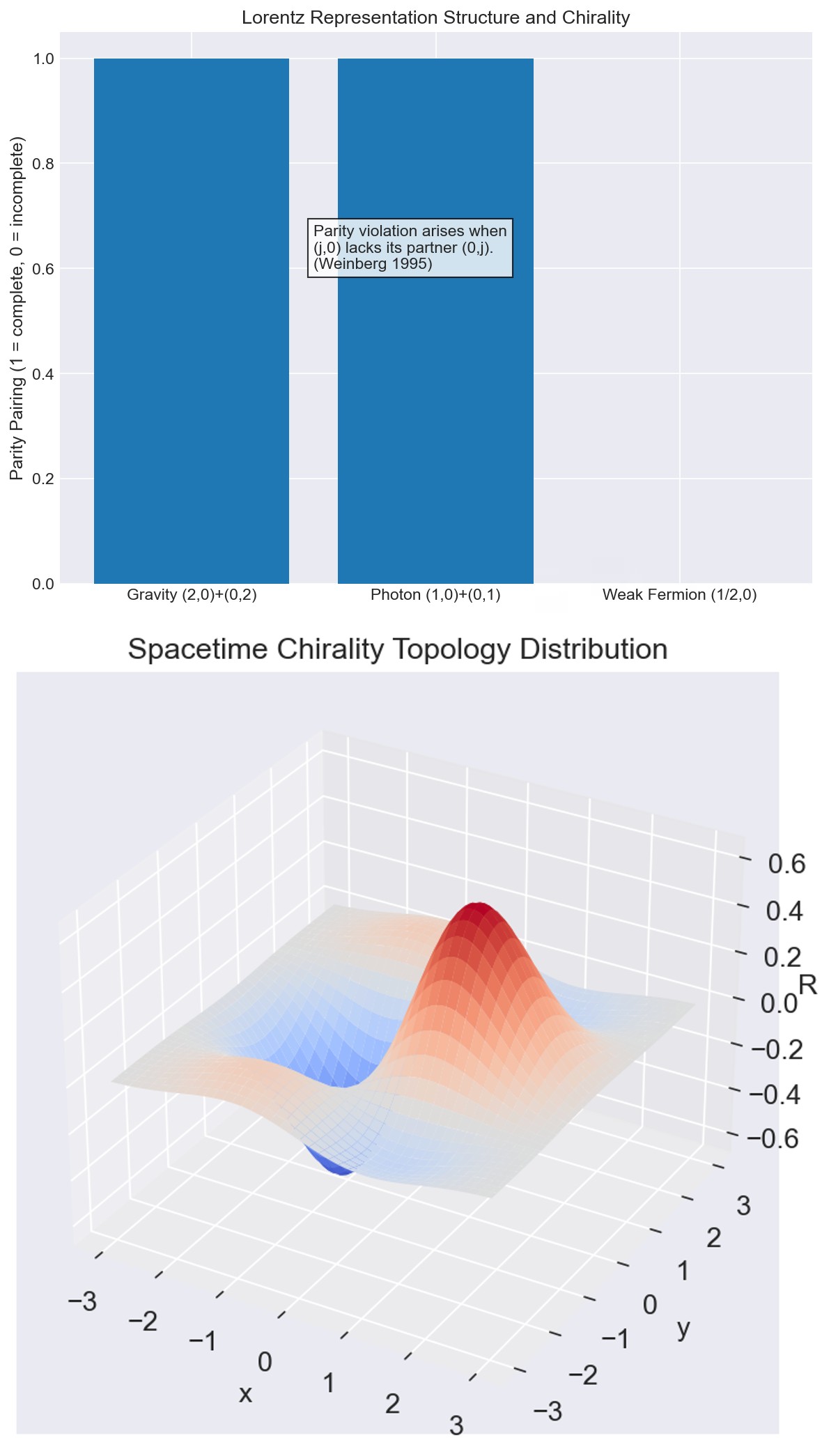
Figure 6B: Lorentz representation structure and parity pairing of fundamental fields. The figure illustrates how parity symmetry depends on the representation structure of fields under the Lorentz group. Gravity and electromagnetism contain both representations to be ( ) ( ) ,0 0, j j ⊕ forming complete parity pairs. In contrast, weak fermions appear only in the left- handed representation ( ) 1 2,0 leading to intrinsic parity violation. The absence of the right-handed partner representation results in chiral gauge interactions and explains the maximal asymmetry observed in weak processes [59, 76].
The graphic plot, Figure 7A shows 3D Spacetime Chirality Topology Distribution of RR. This visualizes topological chirality density.
Figure 7A: Three-dimensional visualization of spacetime chirality density represented by the pseudoscalar curvature invariant RR. Regions of positive and negative values correspond to opposite geometric handedness of spacetime curvature. Such topological structures arise naturally in parity-violating gravitational theories and may influence gravitational-wave propagation and early-universe cosmology [4, 42].
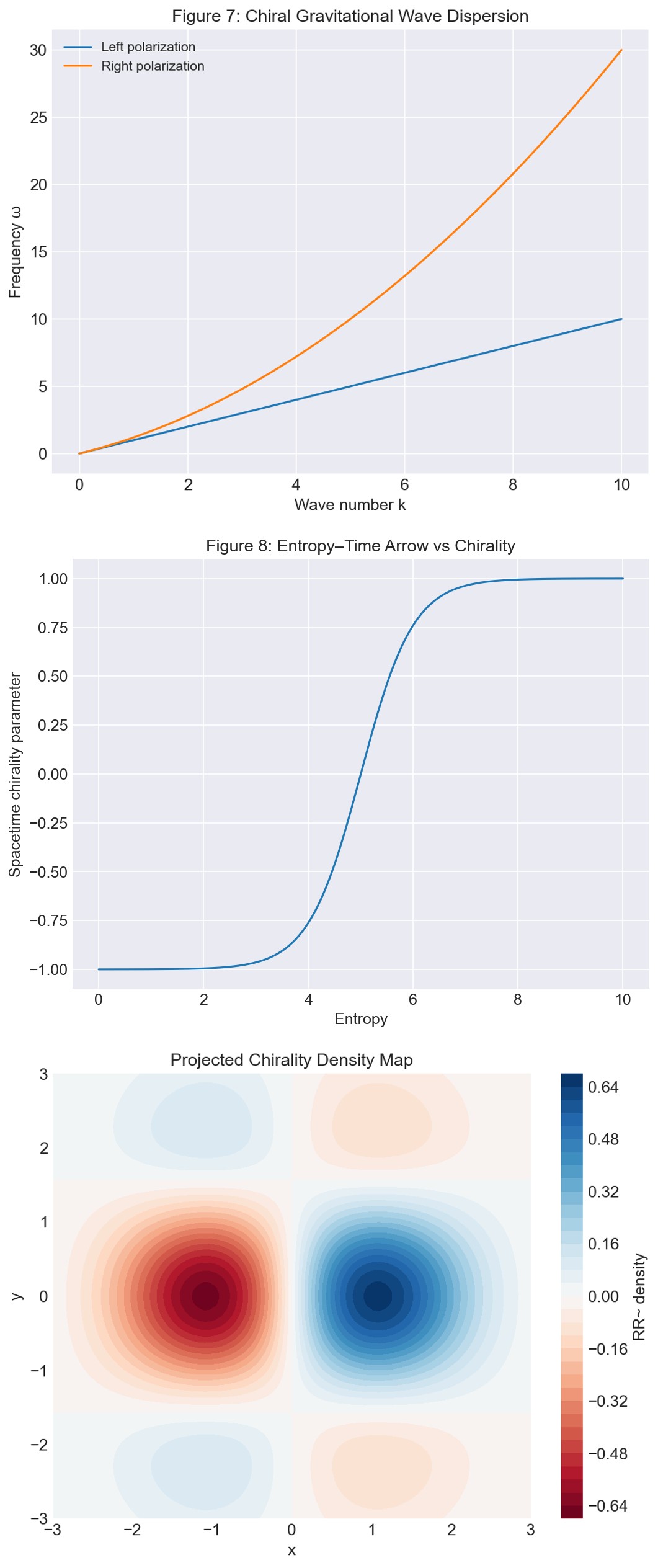
Figure 7B: This comparative plot demonstrates chiral gravitational wave dispersions propagation of left- and right-handed gravitational wave polarizations within a background of the parity-violating environment. The dispersion relations differ according to helicity, producing birefringent gravitational propagation predicted in chiral gravity models that were explored by Alexander and Turok [5].
The graphic plot, Figure 8A, shows Phase diagram relating entropy production to spacetime chirality orientations, plotting Spacetime Chirality Parameter versus Entropy. Increasing thermodynamic entropy tends to define arrow of time, while the sign of parity-odd curvature invariants defines spacetime orientation. The thermodynamic arrow of time follows the statistical interpretation developed originally by Ludwig Boltzmann [12] and later discussed in evolving cosmological contexts originated by Roger Penrose [57].
Figure 8A: Phase relation between entropy growth and spacetime orientation illustrating connection between thermodynamic time arrow and parity structure [7, 57].
Figure 8 (B): 3D Spacetime Chirality Density Map Isosurface Projection topology.
In the above Figure 8B, two-dimensional contour map represents the spatial distribution of the pseudoscalar curvature invariant RR. Regions of positive and negative curvature chirality appear as alternating domains, illustrating how spacetime topology can encode geometric handedness. Also, literature noteworthy such parity-odd curvature structures are predicted in certain topological gravity models and in early-universe scenarios involving axion-like scalar fields [4].
The graphic plot, Figure 9A, shows correlation signal amplitudes of predicted temperature–B-mode (TB) and E-mode–B-mode (EB) correlations in the cosmic microwave background that arise out of parity-violating gravitational interactions. Such signatures have been analyzed in the data from the Planck Collaboration (2018).
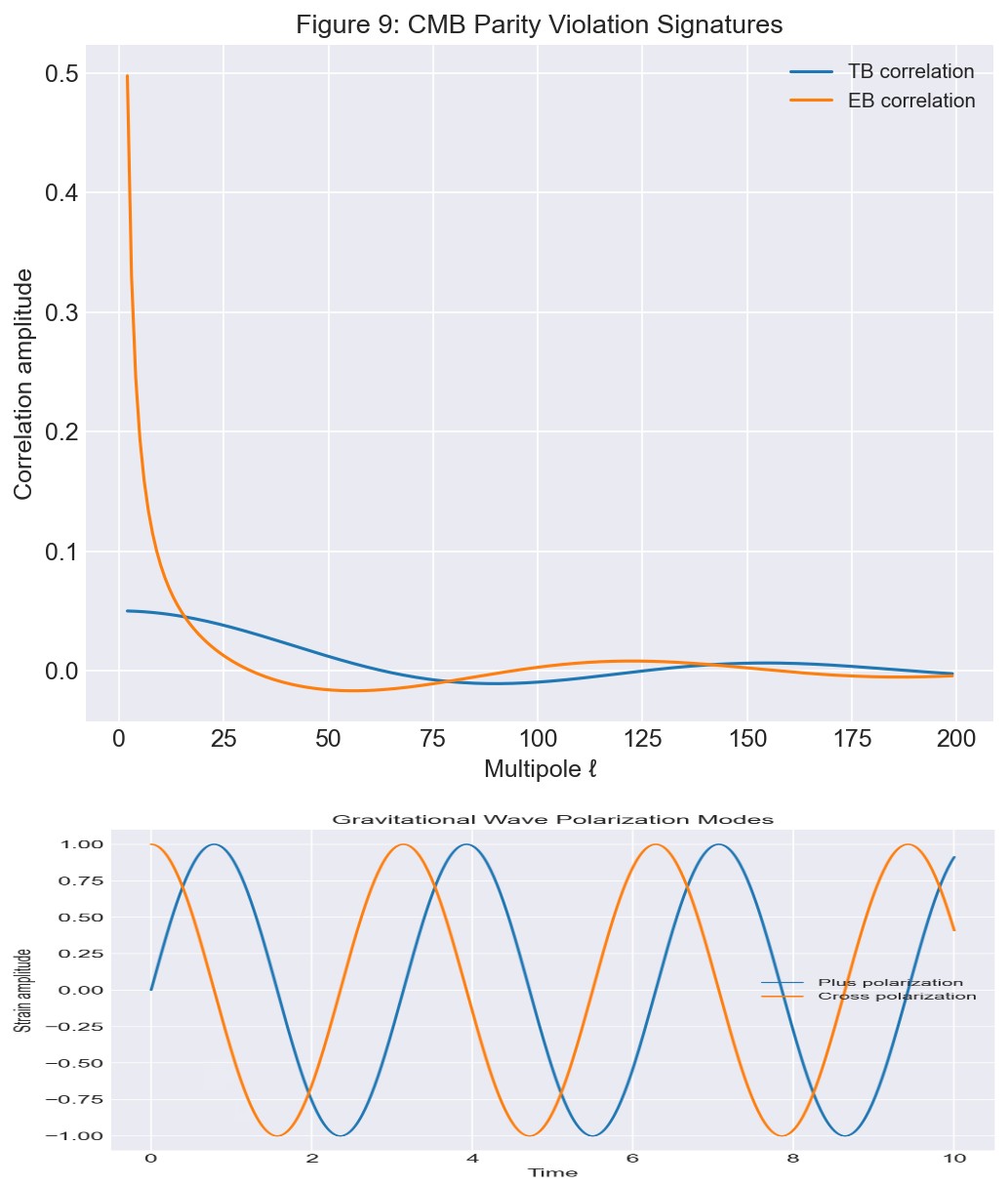
Figure 9A: Simulated cosmic microwave background TB and EB correlations produced by parity-violating gravitational interactions [61].
Figure 9 (B): Gravitational Wave Polarization Modes Simulations.
The graphic plot Figure 9B shows relevant to observations by LIGO Scientific Collaborations as well as Virgo Collaborations. The plus (+) and cross ( ) × polarization components of a propagating gravitational wave are shown as functions of time. In general relativity, these two orthogonal polarization modes describe transverse spacetime distortions that passing gravitational waves produce. Observations of these modes by detectors operated by the LIGO Scientific Collaboration and the Virgo Collaboration confirm the tensorial nature of gravitational radiation predicted by Einstein’s theory [1, 2].
The graphic plot, Figure 10A, shows simulated helicity asymmetry spectrum of primordial gravitational waves. The P P A P P − = + quantifies chirality R L asymmetry parameter R L within the gravitational background. Observational limits are expected from detectors operated by the LIGO Scientific Collaboration and the Virgo Collaborations.
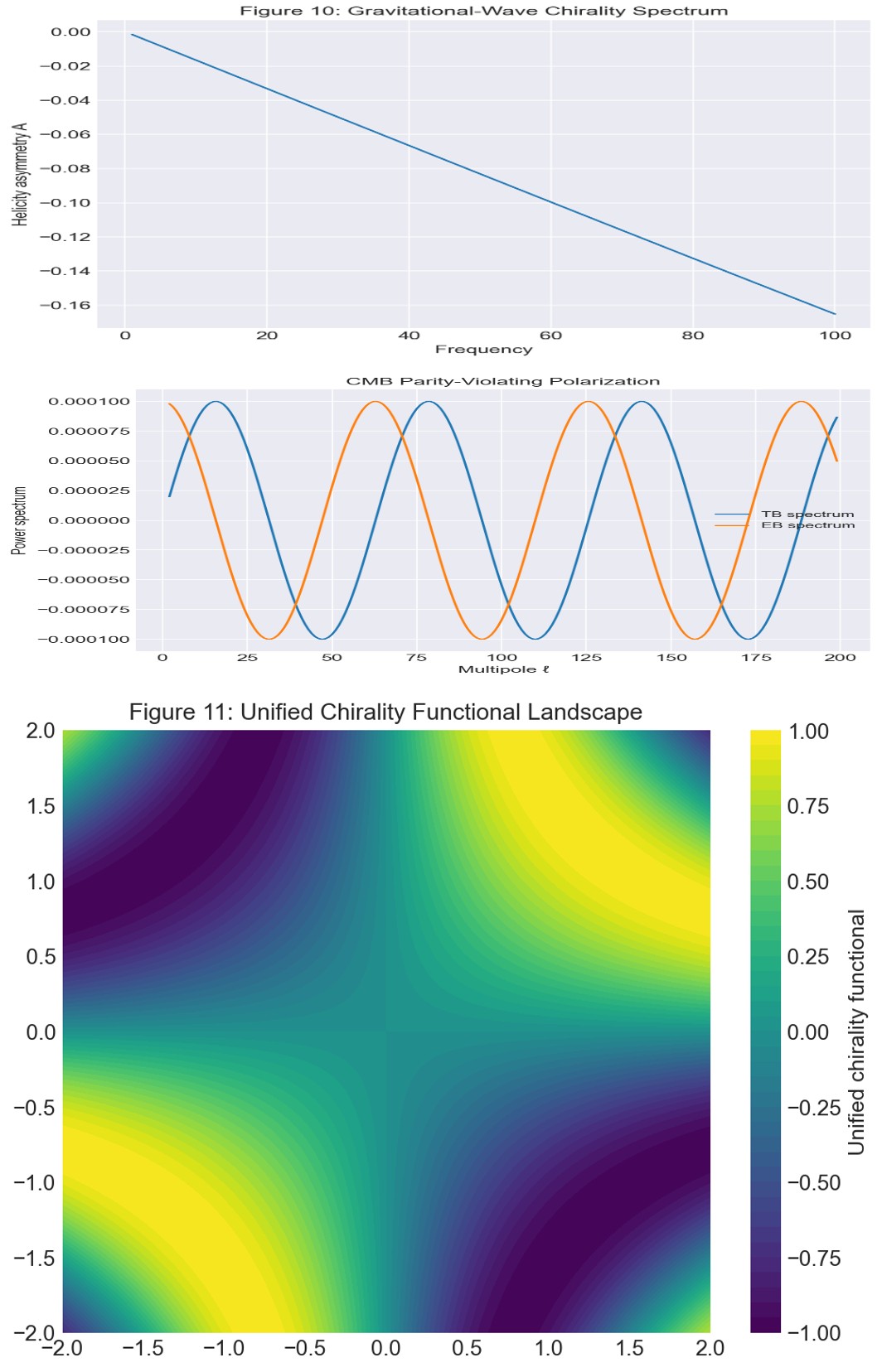
Figure 10A: Helicity asymmetry parameter describing difference between right- and left-handed gravitational wave power spectra [47].
Figure 10B: Cosmic microwave background TB and EB polarization spectra.
In graphic plot Figure 10B, temperaure-B-mode (TB) and E-mode–B-mode (EB) cross-correlation power spectra are shown as functions of the multipole moment l. Nonzero TB or EB correlations would indicate typical cosmic microwave parity violation. Observational limits on such correlations have been already obtained from the data collected by the Planck Collaboration, which constrain large- scale parity-violating processes in the early universe [60]. The graphic plot, Figure 11A, shows Topological Unified Chirality Functional Landscape simulated by having numerical evaluation of the functional [ ] ( ) 4 , g A RR FF d x χ = + ∫ . {Here, g: metric tensor; A: gauge field; RR: gravitational Pontryagin density; FF: gauge fields Pontryagin density}. The landscape illustrates how gauge and gravitational contributions combine to produce global chirality measures in spacetime topology.
Figure 11A: Numerical evaluation of unified chirality functional combining gauge as well as having gravitational pseudoscalar invariants.
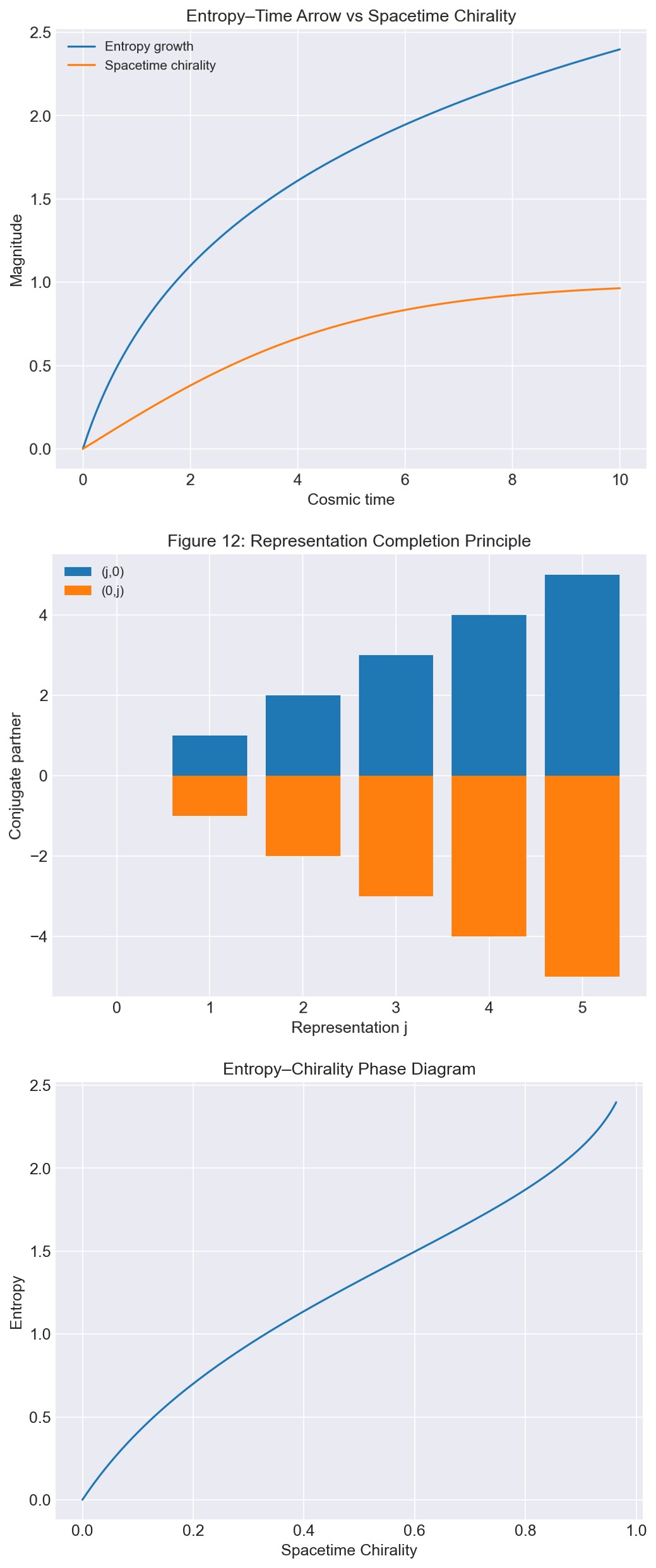
Figure 11(B): Entropy growth and the temporal arrow of spacetime chirality.
The graphic plot Figure 11B illustrates the relationship between entropy increase and a hypothetical spacetime chirality parameter as functions of cosmic time. Entropy increases monotonically according to the second law of thermodynamics, defining the macroscopic arrow of time. The spacetime chirality curve represents a possible geometric counterpart to this temporal asymmetry, suggesting that parity-odd curvature structures may be correlated with cosmological time evolution [17, 57]. The graphic plot, Figure 12A, shows diagrammatically Representation Completeness Principle, which states that the parity symmetry holds when the Lorentz representations appear in conjugate pairs ( ) ( ) ,0 0, j j ⊕ . Incomplete pairing results in chiral interactions that are the main characteristic of weak gauge theory.
Figure 12A: Entropy–chirality phase diagram of spacetime evolution.
The graphic plot, Figure 12 phase diagram shows entropy against the spacetime chirality parameter, illustrating a conceptual relationship between thermodynamic irreversibility and geometric handedness in spacetime. Such diagrams provide a theoretical framework for exploring how parity-violating curvature invariants could influence the global evolution of universe and emergence of thermodynamic arrow of time [4, 17, 57].
The graphic plot, Figure 13, shows Quantum Gravity Chirality Scenarios, specifically the two theoretical scenarios for chirality generation in quantum gravity:
- Emergent chirality after symmetry breaking
- Fundamental topological chirality at Planck scale. Such possibilities arise in quantum gravity frameworks including loop variables and string compactifications discussed by Edward Witten (1995).
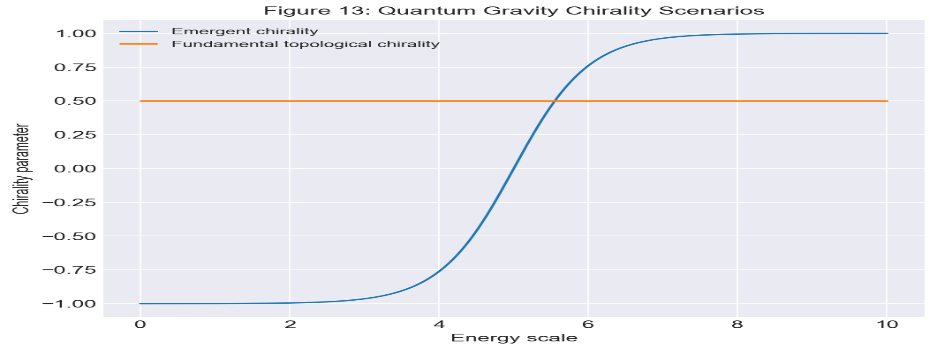
The graphic plot, Figure 13 shows emergent symmetry breaking or fundamental topological asymmetry [79]. The graphic plot, Figure 14, shows Baryogenesis via Gravitational Chirality pointing towards mechanism linking gravitational chirality to baryogenesis through lepton-number anomalies: L J RR µ µ ∇ ∝ . This process satisfies baryogenesis conditions formulated by Andrei Sakharov.
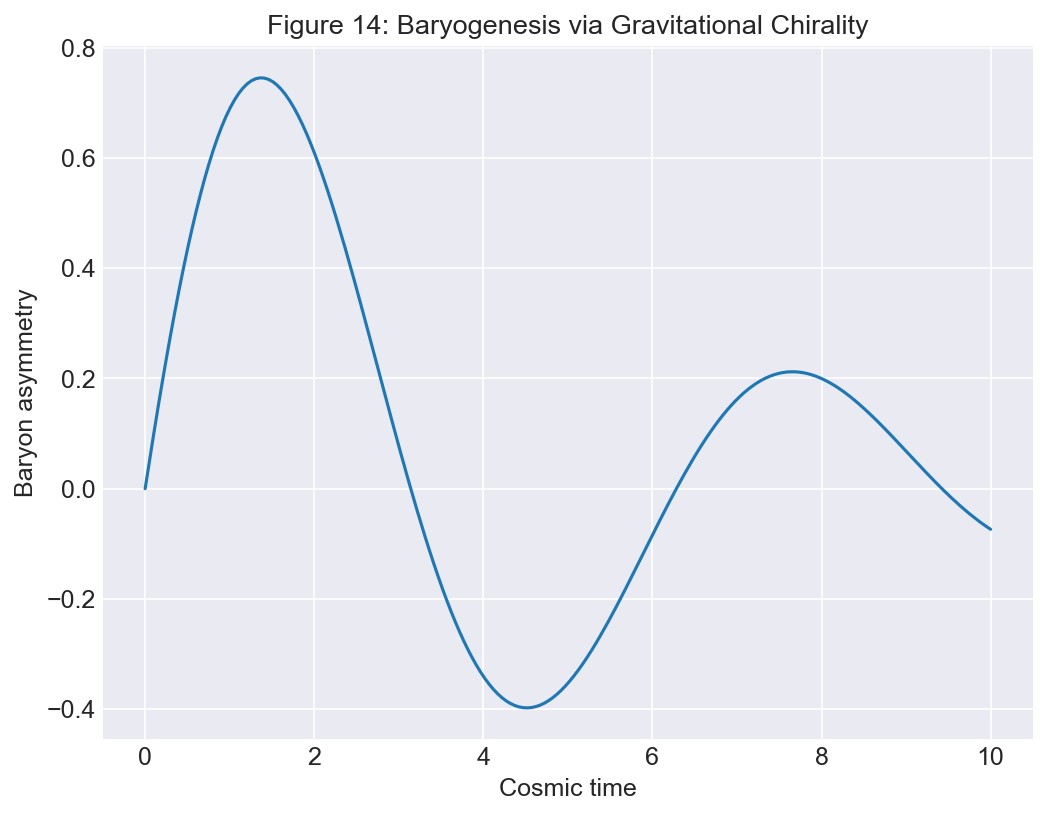
The graphic plot, Figure 14 brings out the process by which baryon asymmetry generates through gravitational anomaly terms satisfying the baryogenesis conditions proposed by Sakharov [65].
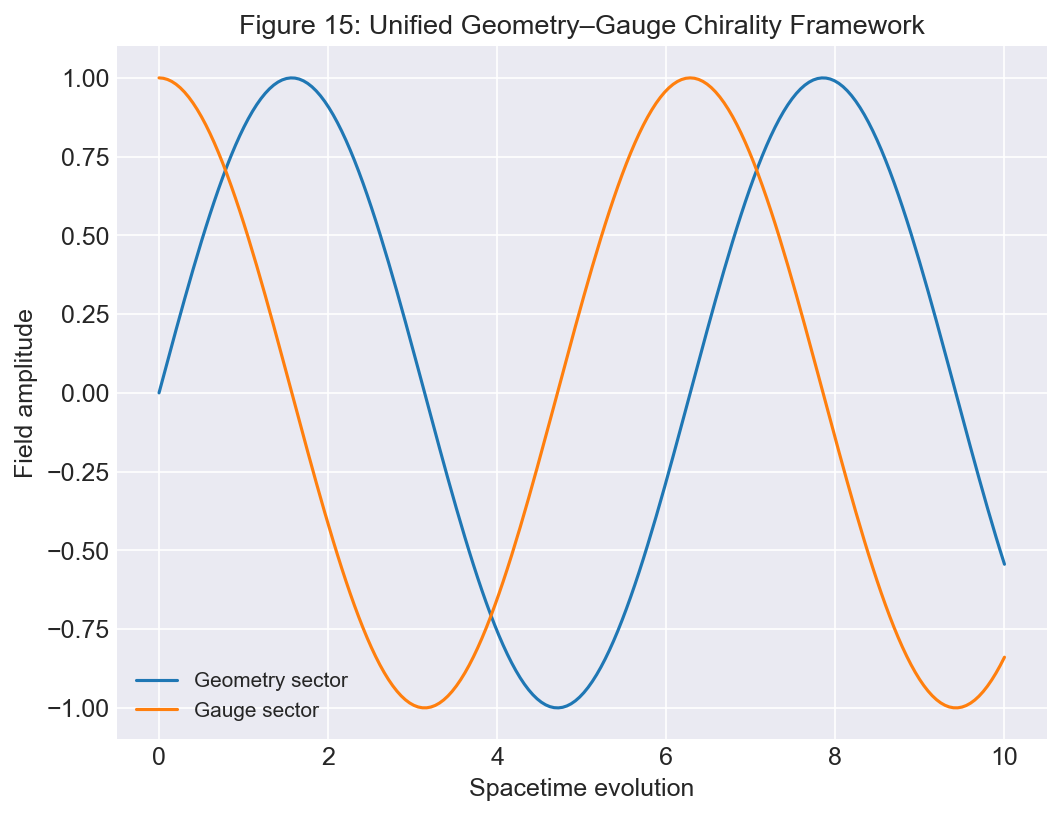
The graphic plot, Figure 15, shows Unified Geometry–
Gauge Chirality Framework bringing out conceptual synthesis demonstrating relationship between spacetime geometry, gauge fields, as well as topological chirality invariants within the unified action that is given by algorithm:
( ) 4 1 2 S d x g R i D RR FF µ µ ψ γ ψ λ λ = − + + + ∫ . The diagram summarizes the central conclusion of this work: spacetime geometry remains parity symmetric while dynamical topological sectors introduce chirality.
General Discussion and Outlook
Geometric Symmetry versus Dynamical Chirality
The results via Figure 1 through Figure 15 presented above in the preceding sections reveal a fundamental distinction of structures within modern theoretical physics, whereby classical spacetime geometry appears to be intrinsically parity symmetric, while the fundamental gauge dynamics exhibit explicit chirality.
Within general relativity, spacetime dynamics arise from the Einstein–Hilbert action given by: 4 1 16 EH S d x gR G π = − ∫ which contains no parity-odd scalar invariant. Consequently, we see that classical gravitational field equations remain invariant under the parity transformation with: x→ -x. This parity symmetry, per Figure 2A, reflects geometric nature of gravitation as curvature of spacetime rather than a chiral gauge interaction [27, 53].
In contrast, electroweak interaction explicitly violates the parity symmetry. The gauge theory formulated by Glashow, Salam, and Weinberg selects left-handed fermionic fields as carriers for the weak interactions [31, 66, 74]. Experimentally, this maximal parity violation was first demonstrated in the celebrated β-decay experiment of Wu and collaborators [81]. From the standpoint of well understood Lorentz group representation theory, per Figures 3(A) & 6(B), the parity acts by exchanging irreducible representations: ( ) ( ) ,0 0, j j ↔ . Gravitational degrees of freedom include both helicity components: ( ) ( ) 2,0 0,2 ⊕ thereby preserving parity symmetry. By contrast, weak fermions appear only in one chiral representation: ( ) 1 2,0 breaking the symmetry pairing required for parity invariance [76].
This difference suggests that chirality is not intrinsic to classical spacetime geometry, however, it emerges from the representation structure of gauge interactions. Hence, deeper questions become quite relevant as to whether this separation between geometry and chirality is merely accidental or whether it reflects a deeper organizing principle of fundamental physics.
Discussion and Implications for Quantum Gravity
Parity in Quantum Gravitational Theories: The status of parity symmetry becomes more subtle within the candidate theories of quantum gravity evident per Figure 13. These different approaches suggest distinct mechanisms by which particular chirality might arise. Loop Quantum Gravity: Loop quantum gravity introduces the Ashtekar variables, which reformulate general relativity using complex self-dual connections [7]. In this model formulations, gravitational degrees of freedom naturally decompose into self-dual and anti-self-dual sectors:
( ) A iK ± = Γ ± . {Note A(+), A(-): self-dual chiral generator (left- handed & right-handed sectors); Γ: Rotation generators 𝐽I of Lorentz group; K: Boost generators Ki of Lorentz group; i: Imaginary unit, ensures proper SU(2) algebra; ±: selects self- dual (+) or anti-self-dual (−) sector. Then, the self-dual formulation appears intrinsically chiral, yet parity symmetry is restored when both sectors are incorporated within the full theory [64, 70]. String Theory: In superstring theory, chirality emerges primarily via topology of compactification manifolds. The heterotic string constructions generate chiral fermionic spectra through compactification on Calabi–Yau manifolds [32, 78]. Gravitational dynamics remain parity symmetric at leading order; however, higher-order corrections introduce parity-odd terms of: B R R ∧ ∧ ∫ , {here, B: 2-form field =
1 2 B dx dx µ ν µν ∧ ; R: Riemann curvature 2 – form differential=
1 2 ab ab dx J R dx ν µ µν ∧ ^ : wedge product is antisymmetric exterior product of forms: dx dx dx dx µ ν ν µ ∧ = − ∧ } which resemble the gravitational Chern–Simons interactions [6].
Gravitational Anomalies: Parity violation may also emerge through gravitational anomalies in chiral quantum fields. The axial current anomaly contains the curvature pseudoscalar, quantitatively with relationship:
5 2 1 384 J R R µ µνρσ µ µνρσ π ∇ = . {Here, µ ∇: covariant derivative in curved spacetime; 5_J_ µ : axial (chiral) current of fermions;
Rµνρσ : Riemann curvature tensor; Rµνρσ : dual Riemann
tensor; R Rµνρσ µνρσ : gravitational Pontryagin density}. This
relation demonstrates, manifestation shown via the above Figures 5-7 that fermionic chirality can generate typically parity-odd curvature invariants through quantum effects [6, 10]. Such anomaly relations indicate highly profound coupling between quantum matter chirality and gravitational topology.
Monopoles, Strings, and Topological Chirality
Magnetic Monopoles and Parity: Magnetic monopoles were first proposed by Dirac to explain charge quantization
2 n eg = links electric and [21]. The quantization condition:
magnetic charges through topological arguments. Under parity transformation, electric field changes sign while magnetic field behaves effectively as a pseudovector: E→ -E, B→ B. This asymmetric transformation implies that monopole configurations possess intrinsic orientation in space [63]. Thereby, consequently, monopoles have possibility to introduce natural topological chirality within the typical gauge field configurations.
Topological Charge and Chirality: Gauge theories possess topological sectors characterized by the Pontryagin index, related by: 4 2 1 32 Q F F d x µν µν π = ∫ . The integrand FF is a pseudoscalar and therefore changes sign under parity transformations , evident in Figure 5(A).
Similarly, gravitational topology is characterized by the curvature invariant, that is related to:
4 2 1 32 P R R d x µνρσ µνρσ π = ∫ . These pseudoscalar invariants, evident in Figures 5-7 represent topological measures of chirality in field configurations [26]. Thus, topological sectors naturally encode parity-violating structures even when the underlying equations remain parity symmetric typically.
Strings and Orientations: Within string theory, orientation reversal corresponds to world sheet parity transformation with: σ σ →− . String spectra depends critically on whether the theory includes the oriented or the unoriented strings. Exemplifying, compactification on Calabi–Yau manifolds can produce chiral fermion generations having resulting four- dimensional effective theory [14].
Topological defects such as cosmic strings may also generate parity-violating gravitational wave signatures, evident per Figures 7 & 9, through asymmetric stress-energy distributions [72].
Cosmological Baryogenesis Links
Sakharov Conditions: The generation of matter–antimatter asymmetry in the universe requires three fundamental ingredients identified mainly by Sakharov: (1) Baryon number violation; (2) the C and the CP violation; as well as (3) having departure from thermal equilibrium [65]. Since having parity violation in the weak interaction is closely related to CP violation, chirality may play a central role in the very cosmological baryogenesis, evident in Figure 14. Gravitational Leptogenesis: Recent theoretical work suggests that parity-violating gravitational interactions may generate lepton asymmetry via curvature pseudoscalars:
L J RR µ µ ∂ ∝ . In inflationary cosmology, helicity-asymmetric gravitational waves can generate non-zero values of RR, evident in the Figures 7(A), 7(B), 8(B), and 10(A) producing lepton asymmetry that later converts essentially into baryons asymmetry through electroweak sphaleron processes [3, 51]. This mechanism directly connects spacetime chirality with matter–antimatter asymmetry of the universe.
Observational Signatures
Parity-violating processes in the early universe may produce several observable signatures, that were brought out in Figures 1 through 15 as well:
- Non-zero TB and EB correlations in cosmic microwave background polarizations
- Helicity-asymmetric stochastic gravitational wave backgrounds
- Large-scale matter–antimatter asymmetry Measurements by the Planck satellite currently constrain large-scale parity violation in the CMBR polarization spectrum [60]. Future observations may provide decisive evidence for or against such cosmological parity violation aspects.
Toward a Unified Geometric–Gauge Chirality Framework
Unified Chirality Functional: To unify geometric and gauge chirality, consider the generalized action, related by having:
( ) ( ) 4 gauge S d x gR x RR x FF L θ φ = − + + + ∫
graphical plotted per Figure 15. Here, the scalar fields ( ) x θ as well as ( ) x φ control parity-violating couplings between the geometry and the gauge dynamics.
A global chirality measure can then be defined as:
( ) 4 d x RR FF χ = + ∫ . This functional thereby provides unified topological description of chirality across both gravitational and gauge sectors.
Representation Completion Principle: We now propose Representation Completion Principle: Parity symmetry is preserved typically if and only if Lorentz representations appear within complete conjugate pairs conditionally:
( ) ( ) ,0 0, j j ⊕ , as shown per Figure 12(A). Violation occurs whenever a theory contains only one member of such a pair. This principle naturally explains parity symmetry in gravity, parity violation within the weak interactions, then possible parity-violating topological sectors evident within quantum gravity. Emergent versus Fundamental Chirality: Two broad scenarios may describe the origin of chirality in fundamental physics. Scenario A: Emergent Chirality: Parity symmetry exists at the Planck scale but is spontaneously broken during cosmic evolutions. Scenario B: Fundamental Topological Chirality: Parity violation originates at the quantum gravity level through intrinsic topological terms such as: RR. Hence distinguishing between these possibilities requires the detection of typical gravitational birefringence or helicity-dependent gravitational wave propagations.
Outlook
Experimental Prospects: Future experimental facilities will significantly improve tests of parity symmetry in gravitational phenomena. Gravitational-wave detectors such as the LIGO Scientific Collaboration as well as Virgo Collaboration may eventually detect helicity asymmetry in gravitational waves.
Also, next-generation CMBR polarization measurement experiments could detect the TB and EB parity-violating correlations with that far greater sensitivity.
Theoretical Frontiers: Several major theoretical challenges remain currently: • Does quantum gravity necessarily generate RRterms?
- Can geometric and gauge chirality be unified within a single mathematical framework?
- Is that the baryon asymmetry of the universe seeded by gravitational parity violation typically?
- Could primordial monopoles or cosmic strings act as carriers of large-scale chirality? Addressing these questions requires deeper connections between quantum field theory, topology, and cosmology. Concluding Perspective: Analysis developed here in the work reveals a striking structural pattern within very fundamental physics. Classical spacetime geometry governed by general relativity is proved here to be having parity symmetricity. With contrast, gauge interactions - particularly weak interaction - exhibit intrinsic chirality. Topological invariants such as FF and RR provide natural bridge connecting these typical two domains.
We see that within this framework; chirality may be interpreted as a topological imprint of the dynamic fields embedded in otherwise symmetric spacetime geometry. Whether itself, the very spacetime becomes also intrinsically chiral at quantum scales remains now one of the most profound open possible problems of modern theoretical physics. Resolving this question may illuminate the very deep relationship between geometry, topology, and the arrow of time, which are also evident in Figure 11(B) above, graphically showing entropy growth and the temporal arrow of spacetime chirality. Chirality, Entropy, and Temporal Orientation of Spacetime Time Orientation in Relativistic Geometry: In relativistic spacetime, notion of temporal direction encodes via the existence of a continuous time-like typical vector field that distinguishes future-directed from past-directed causal curves. A spacetime manifold, M with metric, gµν , is said to be time-orientable if we can define such global distinctions [34].
Mathematically, time orientation corresponds to selecting one component of the time-like tangent bundle:
T M TM + ⊂ . Once a time orientation is fixed, causal curves satisfy 0 g u u µ ν µν < , with having { } , u u µ ν representing future-directed parameters. However, general relativity itself does not specify which of temporal directions corresponds to physical evolution. Einstein’s equations of the very unifiable fields remain invariant typically under time reversal: t→ -t. Thus, classical spacetime geometry alone cannot explain thermodynamic arrow of time [57].
This observation raises a deep conceptual question: Can spacetime chirality contribute to the emergence of temporal directionality?.
Entropy and the Thermodynamic Arrow of Time: The macroscopic arrow of time is typically associated essentially with the second law of thermodynamics, which states that entropy tends to increase in isolated systems: 0 dS dt ≥ .
Statistical mechanics explains this overall behavior through the growth of phase-space volume accessible to microscopic states [12].
Within cosmology, the arrow of time is commonly attributed to extremely low-entropy initial state for the universe, particularly the low gravitational entropy associated specifically with near-homogeneous nature having early cosmological conditions [57]. Gravitational entropy is thus often heuristically associated towards Weyl curvature tensor, Cµνρσ . In the early universe, that 0 Cµνρσ ≈ indicates minimal gravitational disorder. As cosmic structure forms, Weyl curvature grows thereby, increasing gravitational entropy. Thus, cosmological evolution defines seemingly preferred temporal directions.
Chirality as Orientation in Field Configuration Space:
Chirality introduces an additional notion of orientation in field theory. Consider the pseudoscalar invariants: F F µν µν and R Rµνρσ µνρσ . These quantities change sign under parity transformations: P: xi → -xi. Importantly, they also behave as time-reversal odd scalars under certain symmetry combinations. Thus, pseudoscalar curvature invariants naturally encode orientation informations within the typical spacetime fields, that we understand by defining a global chirality functional 4 d x gRR χ = − ∫ . Here, nonzero values of correspond to topologically chiral spacetime configurations.
This suggests that spacetime geometry itself may possess a form of a typical intrinsic orientation well within configurational space beyond metric curvature alone.
Entropy Production from Parity-Violating Curvature: Parity-violating gravitational interactions can couple curvature pseudoscalars to scalar fields: ( ) 4 CS S d x x RR θ = ∫ .
Such Chern–Simons gravitational terms introduce helicity- dependent gravitational dynamics [42]. Then, within that inflationary cosmology, this coupling generates chiral gravitational waves, producing an imbalance between right- and left-handed modes. The resulting gravitational wave spectrum satisfies: ( ) ( ) R L P k P k ≠ . This asymmetry leads to nonzero expectation values: 0 RR ≠ . Since curvature pseudoscalars contribute to the anomaly equations of fermionic resulting currents, J RR µ µ ∂ ∝ , the parity-violating gravity may generate matter asymmetry as well as entropy production simultaneously [3].
We surmise that chirality may serve as a dynamic driver linking gravitational wave helicity, matter generation, as well as entropy increase.
Chirality–Entropy Coupling Hypothesis: The preceding analysis suggests a possible conceptual relation between spacetime chirality with thermodynamic irreversibility. We therefore introduce the Chirality–Entropy Coupling Hypothesis: dS RR dt ∝ . In this picture, parity-violating curvature configurations contribute to entropy production well within the early universe. The intuitive idea is that chiral spacetime structures encode orientation information that biases dynamical evolution toward increasing entropy. Although speculative, such a relation may arise naturally in quantum gravity frameworks wherein topological terms influence vacuum transitions and anomaly dynamics [6].
Chirality and the Temporal Orientation of Cosmology: Combining the above ideas leads to a novel possibility: The arrow of time may be correlated to the large-scale chirality of spacetime fields. Specifically, (1) Early-universe parity- violating processes generate those chiral gravitational backgrounds; (2) These backgrounds induce typically fermionic anomalies; (3) Anomalies generate matter asymmetry and entropy production; (4) Increasing entropy establishes thermodynamic arrow of time. In this scenario, temporal orientation of cosmology emerges dynamically from chirality in spacetime curvature. The relationship may be summarized schematically:
RR→ anomaly → matter asymmetry → entropy growth→ arrow of time. This framework links three seemingly independent concepts: spacetime topology, parity violation, and thermodynamic irreversibility.
Observational Signatures
If spacetime chirality influences cosmological entropy production, observable consequences may include: Chiral Gravitational Waves: Helicity asymmetry in the stochastic gravitational wave background may be detectable by LIGO Scientific Collaboration as well as Virgo Collaboration or future space-based detectors. CMBR Polarization Parity Violation: Nonzero correlations of { } , TB EB l l C C may manifest cosmic microwave background polarizations. We note that measurements from the Planck Collaboration already constrain such effects. Baryon Asymmetry: A correlation between the parity- violating gravitational dynamics and the observed baryon- to-photon ratio: 10 ~ 10 η − has been already pointed out earlier [39, 40, 41]. We can expect that detecting these signatures would provide empirical evidence for the overall cosmological role of spacetime chirality.
Conceptual Implications for Fundamental Physics: If chirality influences emergence of temporal direction, several profound possible implications follow.
- Time orientation may not be purely thermodynamic but partially geometrical.
- Parity violation in fundamental interactions could shape cosmological evolutions.
- Topological invariants may encode information about cosmic initial conditions.
- Quantum gravity might unify entropy production and chirality through anomaly dynamics.
Such ideas suggest that spacetime orientation, entropy growth, and particle chirality potentially represent different manifestations of a deeper topological structure within advancing fundamental physics. Toward a Unified Orientation Principle: Motivated by the above considerations, we propose a broader Unified Orientation Principle: Physical laws remain invariant under fundamental symmetries, but the realized state of the universe selects a preferred orientation in spacetime, gauge representation space, as well as thermodynamic evolutions. Then, in this framework: parity selects spatial orientation, chirality selects field representations orientation, and entropy selects temporal orientations. Understanding how these orientations arise from a common topological structure may represent a key step toward achieving a unified mathematical description of gravity, gauge theory, and cosmology.
Mathematical Theorem on Chirality–Parity Representation Completions
Lorentz Group Representations: We note that relativistic quantum field theory classifies elementary particles according to the irreducible representations of the Lorentz group SO(3,1). Using the isomorphism relationship: SO(1,3) ≅ SL (2,ℂ), we may label representations by two half- integers: (jL, jR), where in this jL and jR correspond to the representations of the two SU(2) subgroups associated to the left-handed and the right-handed spinor structures [76]. Parity transformations operator P then exchanges these two sectors: P: (jL, jR) → (jR, jL). Consequently, fields representations remain invariant under parity only if theory contains both of those components.
Statement of Theorem of Chirality–Parity Representation Completeness: Let a relativistic field theory be defined on a Lorentz-invariant spacetime with the field content transforming under typical irreducible representations (jL, jR) of SL (2,ℂ). We surmise theory to have the parity invariance if and only if its representation spectrum is closed under the parity operations: ( ) ( ) , , L R R L j j j j « . Equivalently, parity invariance requires the representation set R to satisfy:
( ) ( ) , , L R R L j j R j j R ∈ ⇒ ∈ . Violation occurs whenever the spectrum lacks this conjugate pairing.
Proof of Theorem
Parity Operator: We define the parity operator P acting on spacetime coordinates: ( ) ( ) : , , P t x t x → − . Under this transformation, we may see spinor fields transform as:
1 0 L R P P ψ γ ψ −= . Thus, parity exchanges left-handed and right-handed spinors [59].
Representing Transformations: We note that for field φ transforming under ( ) , L R j j , parity produces a new field transforming as: ( ) , R L j j . If the Lagrangian contains only one of these representations, transformed field isn’t present in the theory. Therefore, parity does not map the Lagrangian to itself typically. Closure Conditions: We note also that for parity symmetry to hold, 1 P P- = L L . This condition requires that all transformed fields may remain within the representation space of the theory. Hence, the representation spectrum must be closed under the parity mapping.
Necessity and Sufficiency
Necessity: If parity is a symmetry, the transformed representation must exist. Sufficiency: If that both ( ) , L R j j and ( ) , R L j j are present, parity can be defined as a linear operator exchanging them. Thus, the theory admits a parity symmetry.
Application to Known Theories
General Relativity: Gravitational waves contain helicities:
( ) ( ) 2,0 0,2 ⊕ . Hence, gravity satisfies representations completeness. Weak Interaction: We note that Fermions appear in: ( ) 1 2,0 , without the conjugate representation, which leads to typical maximal parity violation [46, 82].
Implications for Unified Field Theories: The theorem suggests a deep structural interpretation: parity violation arises from incomplete Lorentz representation spectra; also, restoring parity requires representation completeness.
Within quantum gravity frameworks, missing conjugate sectors may correspond to new degrees of freedom or hidden symmetry restoration mechanisms.
Chiral Gravitational Waves and Observational Cosmology
Gravitational Wave Polarization, see Figure 9B: In general relativity, gravitational waves possess two transverse polarization states: { , }. h h x + These are expressed as helicity eigenstates and ( ) 1
2 R h h ih + × = + and h_L = 1/√2 (h+ - ih_×)_ corresponding to right-handed and left-handed circular polarizations [52].
Standard general relativity predicts equal power in both helicities: ( ) ( ) R L P k P k = .
Parity-Violating Gravitational Dynamics: Extensions of general relativity introduce parity-violating terms such as the above gravitational Chern–Simon’s action: ( ) 4 CS S d x x RR θ = ∫ . For example, graphic plot Figure 6A shows such possibility. Such an interaction produces helicity- dependent gravitational propagation [42]. As a result, ( ) ( ) R L P k P k ≠ , so that chiral gravitational waves carry net handedness. Generation During Inflations: Inflationary models with pseudoscalar fields coupled to gauge fields can amplify the one helicity of gravitational waves, shown per Figure 10(A). The power spectrum becomes such that: ( ) ( )( ) , 1 R L vac chirality P k P k = ± ∆ . The chirality parameter, chirality ∆ quantifies the parity violation in the gravitational sector [3]. These effects originate from interactions of form having: FF φ or RR φ .
Cosmic Microwave Background Signatures: With having the chiral gravitational waves expectantly to be leaving quite distinctive imprints within cosmic microwave background polarizations, normally forbidden correlations would be expected to have nonzero outcome: { } 0, 0 TB EB l l C C ≠ ≠ .
Thereby, detection of these correlations typically would provide strong evidence for parity violation in the early universe. However, observations by the Planck Collaboration currently constrain such signals. Detection Prospects: Future measurements may detect chirality through gravitational-wave interferometry. Major experimental programs already include having the LIGO Scientific Collaborations as well as the Virgo Collaborations and next-generation detectors such as the space-based Laser Interferometer Space Antenna. We should also note that chiral gravitational backgrounds may arise from the typical cosmic strings or early-universe phase transitions. Cosmological Implications: Observations of gravitational chirality are expected to have many far-reaching implications:
- Evidence for parity violation in gravity
- Insight into typically inflationary particle physics
- Putting constraints onto quantum gravity models
- Possible explanation for baryon asymmetry through gravitational leptogenesis.
Such discoveries then unify gravitational dynamics to the chiral structure of the Standard Model.
Summary Conclusions with Project Research Proceeding
Principal Findings
This investigation has addressed a fundamental question in theoretical physics: Does normal gravitation typically possess intrinsic chirality, or does chirality arise exclusively from dynamics of the typical matter fields? To answer this question, the analysis employed three complementary theoretical tools:
- Operator-based parity transformations in relativistic field theory
- Helicity decomposition of spin-2 gravitational modes
- Topological pseudoscalar invariants in gauge and gravitational sectors.
The results, with graphically demonstrable plots, establish several key conclusions: First, classical general relativity, formulated by Albert Einstein, is strictly invariant under parity transformations at the level of the Einstein–Hilbert action, 1 EH EH PS P S −= . Thus, classical spacetime geometry typically does not intrinsically distinguish left from right.
Second, linearized gravitational waves possess helicity states: 2 λ ± , however, parity symmetry exchanges these states symmetrically, producing no net chirality in dynamics of the typical standard gravitational systems, with having gravitational waves into helicity eigenstates:
^ ( ) ( ) ^ ) ( , ) ( ( ) _i j i j i j h t x h t e h t e + − = + + −. The left-handed and the right-handed polarization modes transform into one another under spatial parity.
Third, in sharp contrast, the electroweak interaction, developed by Steven Weinberg, Abdus Salam, and Sheldon Glashow, exhibits maximal parity violation. Weak interactions couple exclusively with left-handed fermions, a fact first experimentally verified in the β-decay experiment led then by Chien-Shiung Wu.
Fourth, extensions of general relativity can introduce parity violation through topological curvature couplings such as: ( ) 4 CS S d x x RR θ = ∫ . These Chern–Simons–type terms generate helicity-dependent propagation of gravitational waves and therefore produce gravitational chirality. Temporal orientation of cosmology emerges dynamically from chirality in spacetime curvature: RR ̃→"anomaly"→"matter asymmetry"→"entropy growth"→"arrow of time".
Finally, the pseudoscalar densities: , FF RR emerge as fundamental invariants linking gauge topology and spacetime geometry. Taken together, these results support a central structural insight: Classical geometry is parity symmetric, whereas the dynamical field interactions may be intrinsically chiral. Results also show parity violation with nonzero correlations of { | ^ 0, | ^ 0} C TB C EB ≠ ≠ manifesting cosmic microwave background radiation polarizations, having temperature–B-mode (TB) and E-mode–B-mode (EB) cross-correlation power spectra.
Conceptual Synthesis
The distinction, typically between gravitational symmetry and gauge chirality can be well understood through the representation theory of the Lorentz group. Irreducible representations are labeled then by: ( ) , L R j j with parity acting as: ( ) ( ) , , L R R L j j j j ↔ formulated by Weinberg. Gravitational fields would contain the complete pairing: ( ) ( ) 2,0 0,2 ⊕ , ensuring parity symmetry. However, having the contrast, weak fermions appear only in: (1/2,0), without their conjugate partner. This structural asymmetry leads naturally to parity violation aspects. From this observation arises the Representation Completeness Principle: A relativistic field theory preserves the parity if and only if its Lorentz representations occur in complete conjugate pairs. This principle applies as well broadly across gravitational theory, gauge theory, and higher-spins quantum fields.
Project Research Proceeding: Toward Unifiable Mathematical Physics
The results of this study motivate a structured research program aimed at integrating both geometric and gauge chirality into a unified mathematical framework.
Stage I-Topological Chirality Mapping: A natural starting point is the definition of a unified chirality functional, having the form: [ ] ( ) 4 , g A d x RR FF χ = + ∫ . This quantity combines curvature and gauge pseudoscalar invariants within a single topological measure.
Key research objectives include classification of parity-odd invariants within four-dimensional Lorentzian manifolds, renormalization analysis of parity-violating couplings, as well as anomaly matching with the fermionic chirality and gravitational topology. Such work would clarify how gauge and geometric chirality interact across different energy scales. Stage II-Quantum Gravity Integrations: A deeper understanding of chirality requires examining candidate quantum-gravity frameworks.
Two broad scenarios may be envisioned: (1) Emergent Chirality - Parity symmetry exists at the Planck scale; however, it becomes dynamically broken during typical cosmological evolutions; (2) Fundamental Topological Chirality - Parity violation originates from the quantum structure of the spacetime itself through topological curvature terms. Relevant theoretical frameworks include
- self-dual effective connection formulations of quantum gravity
- string compactification topology
- gravitational anomaly structures A central unresolved question therefore arises: Does quantum gravity necessarily generate the pseudoscalar curvature invariant RR?
Resolving this issue would clarify whether spacetime itself can acquire intrinsic chirality at microscopic scales. Stage III-Cosmological Testing: Cosmology provides an observational arena for probing parity-violating gravitational physics. The matter–antimatter asymmetry of the universe may originate from mechanisms consistent with conditions proposed by Andrei Sakharov originally. Inflationary helicity asymmetry well within gravitational waves could generate lepton number through anomaly equations of the form:
L J RR µ µ ∇ ∝ . While potential observational probes may include helicity asymmetry in the stochastically occurring gravitational wave backgrounds, the parity-violating correlations are expected to all be observable in the polarizations of the cosmic microwave background and primordial chiral gravitational radiations. Future high- precision observations from LIGO Scientific Collaboration, Virgo Collaboration, as well as Planck Collaboration may provide empirical constraints on parity-violating gravitational couplings.
Toward a Unifiable Mathematical Structure
Geometric–Gauge Unified Actions: A unified theoretical framework may be formulated through a generalized action combining gravitational, fermionic, and topological sectors:
4 1 2 unified S d x g R i D RR FF µ µ ψ γ ψ λ λ = − + + + ∫ .
Within this typical formulation, chirality is encoded to be in pseudoscalar densities rather than well within metric structure itself. This perspective preserves the geometric symmetry of spacetime while allowing typical dynamical fields to exhibit parity asymmetry.
Chirality as Topological Orientations: From a mathematical standpoint, parity-violating invariants are orientation-dependent quantities on differentiable manifolds. Consequently, chirality may be interpreted as a topological orientation asymmetry embedded to be within dynamical field configurations. Spacetime geometry itself remains parity symmetric, unless modified by topological sectors containing pseudoscalar curvature terms. This viewpoint provides a natural bridge between differential geometry, topology, and the quantum field theory. Final Conclusions: The analysis presented throughout this work leads to several overarching conclusions.
- Classical spacetime geometry of general relativity is fundamentally parity symmetrical.
- Chirality arises primarily from the representation structure of gauge interactions.
- Topological invariants provide mathematical bridges connecting geometric symmetry with dynamical asymmetry.
- Quantum gravity may mediate interactions between matter chirality and spacetime topology.
- Observational signatures of parity-violating gravity may soon become accessible through gravitational-wave and cosmological experiments. The structural separation between geometric symmetry and dynamical asymmetry thus emerges as one of the deepest features of modern theoretical physics. Therefore, if quantum gravity is enabled ultimately with unifying these domains, chirality may emerge to be a fundamental topological property of the spacetime itself rather than merely a feature of matter interactions.
Closing Perspective: The universe exhibits a remarkable structural balance: geometrically symmetric spacetime, dynamically chiral interactions, as well as topologically rich field configurations. As to whether chirality is emergent, fundamental, or unified remains an open frontier at the intersection of geometry, quantum field theory, and cosmology.
The framework developed in this work provides several conceptual tools for future investigations such as quantitative parity-evaluation methodology, representation- completion principle for relativistic field theories, unified chirality functional linking gauge and gravitational topology, as well as structured research program toward unifiable mathematical physics.
Henceforth, these elements collectively establish a coherent foundation for exploring the deep relationship between gravity, topology, and the handedness of nature, a relationship that may eventually illuminate the geometric origin of physical asymmetry in the universe.
Acknowledgments
The author acknowledges the foundational contributions of Engineeringinc International Operational Teknet Earthern Global for establishing an integrated platform that has enabled the successful development and dissemination of several international scientific projects. The ongoing constructive engagement of researchers across global forums, particularly through ResearchGate, virtual symposia, and conferences such as the 2025 Budapest TEGS Global Physics Conference, has provided essential channels for the exchange of ideas and scholarly advancement, further shared on YouTube TEKNET EARTH GLOBAL SYMPOSIA (TEGS) website https://www. youtube.com/@teknet_earthglobal2923/streams.
Especially, the author further recognizes the scientific insight with ongoing collaborative support of distinguished peer colleagues, including especially Dr. Emmanouil Markoulakis of the Hellenic Mediterranean University, Greece for coauthored investigations within research quantum astrophysics, and Dr. Christopher O’Neill of the Cataphysics Group, Ireland for his technical contributions and organizational coauthoring participation in perpetual sessions with joint conference initiatives.
The author’s appreciation is also extended to Drs. Manuel Malaver, John Hodge, Emory Taylor, Wenzhong Zhang, Laszlo Horvath, and Dr. Muhammet Kurulay with organizational leadership enhancing global scientific engagement forums, and joint publications with conferences enriching the broader research efforts, while supporting achievable goals. Gratitude is conveyed to progressive, peer-reviewed journals that have facilitated publications having related studies through rigorous evaluator processes. The use of open- source Artificial Intelligence (AI)-enabled tools as well as scientific software advanced computational resources has also likewise supported precise visualization and analysis underpinning this work to achieve simulations graphics.
References
-
Abbott BP, Abbott R, Abbott TD, Abernathy MR, Acernese, et al. (2016) Observation of gravitational waves from a binary black hole merger. Physical Review Letters 116: 061102.
-
Abbott BP, Abbott R, Abbott TD, Abraham S, Acernese F, et al. (2021) Tests of General Relativity with the Binary Black Hole Signals from the LIGO-Virgo Catalog GWTC 1. Physical Review D 103: 122002.
-
Alexander S, Peskin M, Sheikh-Jabbari M (2006) Leptogenesis from gravity waves in models of inflation. Physical Review Letters 96: 081301.
-
Alexander S, Yunes N (2009) Chern–Simons modified general relativity. Physics Reports 480: 1-55.
-
Alexander S, Turok N (2006) CPT-Symmetric Universe. Physical Review D 74: 103509.
-
Alvarez-Gaumé L, Witten E (1984) Gravitational anomalies. Nuclear Physics B 234: 269-330.
-
Ashtekar A (1986) New variables for classical and quantum gravity. Physical Review Letters 57: 2244- 2247.
-
Baumann D (2009) TASI lectures on inflation. Proceedings of the Theoretical Advanced Study Institute pp: 523-686.
-
Bekenstein J (1973) Black Holes and Entropy. Physical Review D 7: 2333.
-
Bertlmann R (1996) Anomalies in Quantum Field Theory. Oxford University Press.
-
Ade PAR, Aikin RW, Barkats D, Benton SJ, Bischoff CA, et al. (2014) Detection of B-mode polarization at degree angular scales. Physical Review Letters 112: 241101.
-
Boltzmann L (1877) Über die Beziehung zwischen dem zweiten Hauptsatze der mechanischen Wärmetheorie und der Wahrscheinlichkeitsrechnung. Wiener Berichte 76: 373-435.
-
Boltzmann L (1872) Weitere Studien über das Wärmegleichgewicht unter Gasmolekülen (Further Studies on the Thermal Equilibrium of Gas Molecules). Sitzungsberichte der Kaiserlichen Akademie der Wissenschaften Wien 66: 275-370.
-
Candelas P, Horowitz G, Strominger A, Witten E (1985) Vacuum configurations for superstrings. Nuclear Physics B 258: 46-74.
-
Carroll S (1998) Quintessence and the rest of the world. Physical Review Letters 81: 3067-3070.
-
Carroll S (2004) Spacetime and Geometry: An Introduction to General Relativity. Addison-Wesley 101: 102.
-
Carroll SM (2010) From Eternity to Here: The Quest for the Ultimate Theory of Time. New York: Dutton.
-
Chandrasekhar S (1998) The Mathematical Theory of Black Holes. Oxford University Press (69).
-
Deser S, Jackiw R, Templeton S (2000) Topologically massive gauge theories. Annals of Physics 281(1-2): 409-49.
-
DeWitt BS (1967) Quantum Theory of Gravity I. The Canonical Theory. Physical Review 160(5): 1113-1148.
-
Dirac PAM (1931) Quantised singularities in the electromagnetic field. Proceedings of the Royal Society A 133(821): 60-72.
-
Dirac PAM (1930) The Principles of Quantum Mechanics, Oxford University Press.
-
Dirac PAM (1928) The quantum theory of the electron. Proceedings of the Royal Society A 117(778): 610-624.
-
Dirac PAM (1928) The quantum theory of the electron, Part II. Proceedings of the Royal Society A 118(779): 351-361.
-
Dodelson S (2020) Modern Cosmology. Academic Press.
-
Eguchi T, Gilkey PB, Hanson AJ (1980) Gravitation, gauge theories and differential geometry. Physics Reports 66(6): 213-393.
-
Einstein A (1916) The foundation of the general theory of relativity. Annalen der Physik 49: 769-822.
-
Einstein A (1915) Die Feldgleichungen der Gravitation (The Field Equations of Gravitation). Sitzungsberichte der Königlich Preußischen Akademie der Wissenschaften (Berlin) pp: 844-847.
-
Feynman RP, Gell MM (1958) Theory of the Fermi Interaction. Physical Review 109(1): 193-198.
-
Feynman RP (1965) The Character of Physical Law, MIT Press.
-
Glashow S (1961) Partial symmetries of weak interactions. Nuclear Physics 22(4): 579-588.
-
Green M, Schwarz J, Witten E (1987) Superstring Theory, Cambridge University Press, USA, 1-2.
-
Guth AH (1981) Inflationary universe: A possible solution to the horizon and flatness problems. Physical Review D 23: 347-356.
-
Hawking S, Ellis G (1973) The Large Scale Structure of Space-Time. Cambridge University Press.
-
Hawking S (1975) Particle Creation by Black Holes. Communications in Mathematical Physics 43: 199.
-
Hawking SW (1988) A Brief History of Time: From the Big Bang to Black Holes. New York, USA, Bantam Books.
-
Hooft G (1994) Under the Spell of the Gauge Principle, World Scientific.
-
Hooft G (1976) Symmetry Breaking through Bell–Jackiw Anomalies. Physical Review Letters 37: 8-11.
-
Iyer, R. (2025). Early universe magneto-gravitational coupling GENESIS PHYSICS: Part I. Open Access Journal of Astronomy, 3(2), 1–15 & Appendix 1–16; 000165.
-
Iyer R (2026) Quantum lattice simulations PHYSICS: Microcircuit particle formation and observable macroscopic irreversible time–A discrete Lagrangian with cellular automata @framework. Physical Science & Biophysics Journal 10(1): 1-24.
-
Iyer, R. (2026). Early Universe: Hadronic crystals and gravitational wave emitters (Part II). Open Access Journal of Astronomy, 4(1).
-
Jackiw R, Pi S (2003) Chern–Simons modification of general relativity. Physical Review D 68: 104012.
-
Jackiw R, Rey SJ (1990) Conformal symmetry of topologically massive gauge theory. Physical Review D 42: 3500-3510.
-
Kamionkowski M, Kosowsky A (1998) Detectability of inflationary gravitational waves. Physical Review D 57: 685-691.
-
Kolb E, Turner M (1990) The Early Universe. Addison- Wesley.
-
Lee TD, Yang CN (1956) Question of parity conservation in weak interactions. Physical Review. 104: 254-258.
-
Abbott BP, Abbott R, Abbott TD, Abernathy MR, Acernese F, et al. (2016) Observation of Gravitational Waves from a Binary Black Hole Merger. Physical Review Letters 116: 061102.
-
Linde A (2005) Particle Physics and Inflationary Cosmology. Harwood Academic CRC Press.
-
Luders G (1957) Proof of the TCP theorem. Annals of Physics 2(1): 1-15.
-
Lue A, Wang L, Kamionkowski M (1999) Cosmological signature of new parity-violating interactions. Physical Review Letters 83: 1506-1509.
-
Lyth D, Rodriguez Y (2005) The inflationary prediction for primordial non-Gaussianity. Physical Review Letters 95: 121302.
-
Maggiore M (2008) Gravitational Waves. Vol 1: Oxford University Press.
-
Misner C, Thorne K, Wheeler J (1973) Gravitation. WH Freeman.
-
Noether E (1971) Invariant Variation Problems. Transport Theory and Statistical Physics 1(3): 86-207.
-
Pauli W (1955) Exclusion Principle, Lorentz Group and Reflection of Space–Time and Charge. In: Bohr N (Ed.), and the Development of Physics. Oxford: Pergamon Press pp: 30-51.
-
Penrose R (1965) Gravitational Collapse and Space-Time Singularities. Physical Review Letters 14: 57.
-
Penrose R (1979) Singularities and time-asymmetry. In General Relativity: An Einstein Centenary Survey pp: 581-638.
-
Penrose R (2004) The Road to Reality: A Complete Guide to the Laws of the Universe. Jonathan Cape, UK, pp: 1136.
-
Peskin ME, Schroeder D (2018). An Introduction to Quantum Field Theory. CRC Press. Taylor & Francis Group.
-
Planck Collaboration (2020) Planck 2018 results: Cosmological parameters. Astronomy & Astrophysics 641: A6.
-
Planck Collaboration (2018) Planck 2018 results VI. Cosmological parameters. Astronomy & Astrophysics 641: A6.
-
Polchinski J (1998) String Theory. Cambridge University Press, USA, Vols. 1-2.
-
Preskill J (1984) Magnetic monopoles. Annual Review of Nuclear and Particle Science 34: 461-530.
-
Rovelli C (2004) Quantum Gravity. Cambridge University Press.
-
Sakharov A (1967) Violation of CP symmetry, baryon asymmetry, and the universe. JETP Letters 5: 24-27.
-
Salam A (1968) Weak and electromagnetic interactions. Elementary Particle Theory. pp: 367-377.
-
Salam A (1979) Weak and Electromagnetic Interactions. Nobel Lecture.
-
Schutz B (2009) A First Course in General Relativity. Cambridge University Press.
-
Susskind L (2005) The Cosmic Landscape. Little Brown.
-
Thiemann T (2007) Modern Canonical Quantum General Relativity. Cambridge University Press.
-
Thorne K (1994) Black Holes and Time Warps. In (Edn.), Norton WW & Co, New York, USA.
-
Vilenkin A, Shellard E (1994) Cosmic Strings and Other Topological Defects. In: (Edn.), Cambridge University Press, Cambridge, Uk.
-
Wald RM (1984) General Relativity. In: (Edn.), The University of Chicago Press, Chicago, USA.
-
Weinberg S (1967) A model of leptons. Physical Review Letters 19(21): 1264-1266.
-
Weinberg S (1972) Gravitation and Cosmology: Principles and Applications of the General Theory of Relativity. In: (Edn.), John Wiley & Sons, Inc, New York, USA.
-
Weinberg S (1995) The Quantum Theory of Fields. In: (Edn.), Cambridge University Press, Cambridge, Uk.
-
Weinberg S (2008) Cosmology. In: (Edn.), Oxford University Press, New York, USA.
-
Witten E (1983) Global aspects of current algebra. Nuclear Physics B 223(2): 422-432.
-
Witten E (1995) String Theory Dynamics in Various Dimensions. Nuclear Physics B 443(1-2): 85-126.
-
Witten E (1989) Quantum Field Theory and the Jones Polynomial. Communications in Mathematical Physics 121: 351-399.
-
Wu CS, Ambler E, Hayward R, Hoppes D, Hudson R (1957) Experimental test of parity conservation in beta decay. Physical Review 105(4): 413-1415.
-
Zaldarriaga M, Seljak U (1997) All-sky analysis of polarization in the microwave background. Physical Review D 55(4): 1830-1840.
- Quantum Lattice Simulations PHYSICS: Microcircuit Particle Formation and Observable Macroscopic Irreversible Time - A Discrete Lagrangian with Cellular Automata Framework
- Quantum Biology from Biomacromolecule to Cell, and Central Dogma Described by Quantum Theory
- Focus, Agility, Speed and Technology (FAST) for Sustainability and Growth
- Square Root Metric Geometry and Pati-Salam Model in Curved Space-Time
- A Simple System Demonstrating the Mpemba Effect in Classical Mechanics
- The Mental Feeling Effect and the Triad Related to the Human