
Production of Porcine Circovirus Type 2 Virus-Like Particles by an Attenuated Recombinant Pseudorabies Virus
Pseudorabies virus (PRV) and porcine circovirus type 2 (PCV2) are economically important swine viruses that causepseudorabies (PR) and porcine circovirus-associated disease (PCVAD), respectively. Vaccination appears to be efficaciousfor PR eradication and control of PCVAD. Combining the PRV marker vaccine and the PCV2 immunogen in a single vaccinewould reduce cost and stress on vaccination strategies. We constructed a glycoprotein E (gE)/thymidine kinase (tk)double-deletion pseudorabies virus (gE-tk-/PCV2cap+ PRV) containing PCV2 cap encoding the major capsid protein (Cap).The recombinant virus gE-tk-/PCV2cap+ PRV expressed PCV2 Cap proteins that self-assembled to form virus-likeparticles. Virulence of gE-tk-/PCV2cap+ PRV was completely attenuated in mice. Guinea pigs immunized with gE-tk-/PCV2cap+ PRV mounted significant antibody responses against PRV and PCV2. The recombinant virus has the potentialto be developed into a candidate live, attenuated bivalent vaccine to simplify vaccination strategies.
Introduction
Porcine circovirus type 2 (PCV2), a small, non- enveloped virus with a circular single-stranded DNA genome, is the causative agent of porcine circovirus- associated disease (PCVAD) [1]. PCV2 is an economically important disease agent in major pig-producing countries; it mainly affects nursery and fattening pigs [2, 3, 4]. Hepatic disease is a classical clinical sign of PCVAD- affected pigs, and severe hepatic lesions are reported to be associated in case of pseudorabies virus (PRV) and PCV2 co-infection [5]. The PCV2 genome is organized into two major ambisense open reading frames (ORFs). ORF1 encodes the viral replication associated protein, Rep. ORF2 encodes the capsid (Cap) protein, the only structural protein of PCV2 [6, 7]. The Cap protein is the primary immunogenic protein of PCV2 and the main target of vaccines and serological diagnostic reagents [8, 9]. Self-assembling recombinant Cap proteins that form virus-like particles (VLPs) have been generated using baculovirus or Escherichia coli expression systems, suggesting that Cap is sufficient to constitute VLPs
Virology & Immunology Journal
[10, 11]. All commercialized PCV2 subunit vaccines are based on Cap protein and induce a protective immune response against PCV2 infection in immunized hosts. PCV2 vaccines are highly efficacious in reducing PCVAD in pigs, decreasing the severity of lesions and preventing viral shedding and transmission in pig farms [12, 13, 14]. Pseudorabies virus (PRV) is an alphaherpes virus that causes pseudorabies (PR), an economically important viral disease among pigs [6]. The genome of PRV is a linear, double-stranded DNA of about 150 kb [15]. The disease causes high mortality in infected newborns and results in stillborn fetuses in pregnant sows. The most common strategies against PRV infection are vaccination with marker vaccines and monitoring serum antibody using companion serological diagnostics reagents [16, 17]. PRV strains that are genetically engineered to have double deletions of glycoprotein E (gE) and thymidine kinase (tk) have highly reduced virulence and are widely used as maker vaccines [18]. These vaccines are used as viral vectors against multiple pathogens due to their genomic accommodation properties [19]. Since both PCVAD and PR are threatening and economically important swine diseases, development of a bivalent vaccine for the two diseases could benefit farmers of breeding pigs and simplify vaccination programs. In our previous study, a recombinant gE-/PCV2cap+ PRV that contains the PCV2 cap gene replacing the gE gene showed potential as a vaccine candidate for developing a PCV2 subunit vaccine [20]. The purpose of this study was to construct a PRV recombinant virus with a double deletion of the gE and tk genes (gE-tk-) that expressed PCV2 Cap proteins. We tested the immunogenicity of VLPs for further development as a bivalent vaccine against PRV and PCV2.
Materials and Methods
Cells and viruses
Porcine kidney cells (PK-15; ATCC CCL33) and wild- type PRV TNL were cultured as described previously [20]. The parent virus gE-tk-GFP+PRV was a derivative of gE- PRV [20], constructed by introducing a green fluorescent protein (GFP) gene driven by a CMV promoter into the tk gene to obtain the parent virus (Figure 1). Genomic material for PCV2 was extracted from 20 mg frozen lymph nodes that was collected from a piglet severely affected with PCVAD, as described previously [9].
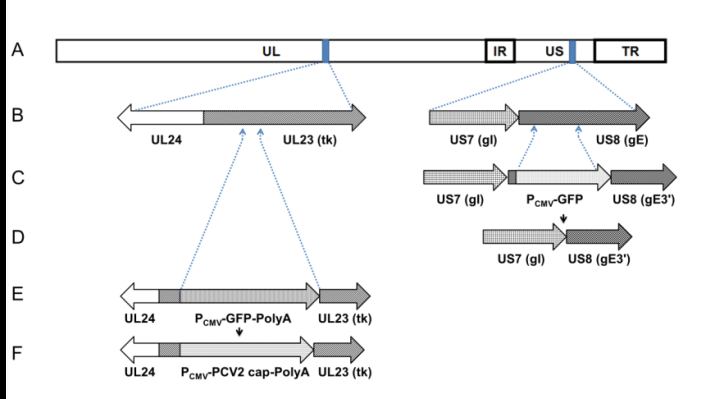
Figure 1: Construction of recombinant gE-tk- /PCV2cap+ PRV. A. The 150 kb genomic DNA of PRV was divided into unique long (UL), internal inverted repeat (IR), unique short (US), and terminal inverted repeat (TR) regions. B. Genes for gE and tk are at US8 and UL23 regions, respectively. C. Recombinant gE- /GFP+ PRV was constructed previously by replacing a defined 5'-region of the gE gene with the GFP gene driven by promoter Pcmv. D. GFP was deleted by recombination with the transfer plasmid pUC/gIgE3' to generate recombinant virus gE- PRV. E. UL24 and UL23 (tk) genes were cloned into pUC19 (pUC19/UL2423) and the tk gene was truncated with the GFP gene to generate transfer plasmid pUC19/UL24/GFP/ΔUL23. Recombinant gE-tk-/GFP+ PRV was constructed by recombination of gE- PRV with transfer plasmid pUC19/UL24/GFP/ΔUL23. F. GFP gene was replaced with PCV2 Cap gene by recombination with transfer plasmid pUC19/UL24/PCV2cap/ΔUL23 to generate recombinant gE-tk-/PCV2cap+ PRV.
Plasmid construction
Coding sequences for the PRV UL24, UL23 (tk) gene and PCV2 cap gene were amplified by polymerase chain reaction (PCR) using primer pairs designed according to the PRV Ka strain (GenBank accession no. AY368490) and the PCV2 YL strain (GenBank accession no. AY885225). Primers contained restriction enzyme recognition sequences (Table 1). PCR reactions were as described previously [21]. UL24-UL23 gene fragments were gel- purified and cloned into pUC19 to generate the recombinant plasmid pUC19/UL2423. The UL23 gene was partially deleted by insertion of PCMV-GFP derived from pEGFP-N3 (BD Biosciences) via _Nru_I and _Dra_III digestion. The GFP gene coding region was replaced with the PCV2 cap gene to generate the transfer plasmid pUC19/UL24/PCV2cap/ΔUL23 (Figure 1). All
Virology & Immunology Journal
recombinant plasmids were confirmed by DNA sequencing.
| Sequence in 5’-3’ | |||||||||||
|---|---|---|---|---|---|---|---|---|---|---|---|
| Oligonucleotides | Restriction site | Target region | |||||||||
| Directiona | |||||||||||
| UL24f | ggcgacgtactcggcgg | / | UL24-23 | ||||||||
| UL23r | atctccgacatgaaggcgca | / | |||||||||
| capf | gctagcatgacgtatccaagg | NheI | PCV2 cap | ||||||||
| capr | gctgagcttagggtttaagtgg | BlpI | |||||||||
| CMVPpf | tcgcgaattagttcatagcccat | NruI | Pcmv-GFP of pEGFP- N3 | ||||||||
| GFPr2 | gtcgacctccacctcaatcgat | SalI |
Table 1: The sequence of oligonucleotides used for amplifying and cloning the defined target regions.
Construction of recombinant PRV
PK-15 cells at 60% confluence were co-transfected with transfer plasmid pUC19/UL24/PCV2cap/ΔUL23 DNA and parent virus gE-tk-/GFP+ PRV DNA using Lipofectamine™ 2000 (Invitrogen) in accordance with the manufacturer's instructions. Recovery of recombinant PRV was by visualizing non-green fluorescent plaques using an Olympus IX 70 phase-contrast fluorescence microscope at 72 h post transfection. Individual plaques were isolated and amplified in PK-15 cells at least three times for plaque purification. Gene recombination was confirmed by PCR and DNA sequencing.
Indirect immunofluorescence
Confluent PK-15 cells were infected with gE-tk- /PCV2cap+ PRV at multiplicity of infection (MOI) 0.01. Infected cells were washed three times with phosphate buffered saline (PBS), and fixed with 10% formalin solution (Fisher) for 10 min at 18 h post infection. After washing with PBS, cells were treated with PBS with 1% bovine serum albumin (PBS/1% BSA), with an appropriate dilution of monoclonal antibody (MAb) specific to PCV2 Cap or swine immuneserum to PRV, then with 1000-fold diluted FITC-conjugated rabbit anti-pig IgG antibody (Abcam) or Alexa 488-conjugated goat anti- mouse IgG (Invitrogen). Cells were visualized using an Olympus IX 70 phase-contrast fluorescence microscope.
Western blotting analysis
Confluent PK-15 cells were infected with wild-type PRV TNL or gE-tk-/PCV2cap+ PRV at MOI 1 and harvested at 18 h post infection. Time-course expression of gE-tk- /PCV2cap+ PRV-expressed PCV2 Cap was determined at indicated intervals over 72 h. Pellets of gE-tk-/PCV2cap+ PRV-infected cells were resuspended in 100 μl lysis buffer (M-PER Mammalian Protein Extraction Reagent; Thermo Scientific) and clarified by centrifugation. Protein samples were subjected to 12% sodium dodecyl sulfate polyacrylamide gel electrophoresis (SDS-PAGE) followed by Western blotting analysis as described previously [20].
Growth curves
Confluent PK-15 cells were infected with gE-tk- /PCV2cap+ PRV or wild-type PRV (TNL) at MOI 1. Supernatant samples were collected at indicated intervals over 48 h and viral titers determined by plaque assay. PRV titers were expressed as plaque forming units per ml (pfu/ml).
Production and purification of VLPs
Confluent PK-15 cells were infected with gE-tk- /PCV2cap+ PRV at MOI 0.1 and incubated at 37°C for 36 h. After three cycles of freezing and thawing, cell lysates were divided into supernatants and pellets by centrifugation at 3000 rpm for 15 min. Pellets containing mostly Cap VLPs were disrupted in lysis buffer and clarified by centrifugation at 8000 rpm for 30 min.
Virology & Immunology Journal
Supernatants were layered in centrifuge tubes containing an equal volume of 40% sucrose and centrifuged at 270,000 ×g for 6 h at 4°C in a SW55 rotor (Beckman). Pellets were resuspended in 0.5 ml Tris buffer (50 mM Tris, 150 mM NaCl, pH 7.2) and examined by transmission electron microscopy (TEM).
Transmission electron microscopy and immunogold staining
Purified VLPs were adsorbed onto carbon-coated copper grids for 3 min at room temperature. Grids were dried using filter papers, negatively stained with 6% uranyl acetate (UA) for 40 s and examined by TEM (JEOL JEM1400). For immunogold staining, purified VLPs were adsorbed onto formvar/carbon-coated nickel grids. After 2 min blocking with PBS/0.1% BSA, grids were incubated with 1:100 diluted MAb specific to PCV2 Cap (Ingenasa) in incubation buffer (1% BSA in PBS) at 4°C for 18 h. Grids were gently washed with incubation buffer four times, followed by incubation with 1:20 diluted anti-mouse IgG goat antibody conjugated to 15 nm gold (Aurion), at room temperature for 1 h. Grids were washed twice with PBS/0.1% BSA, fixed with 1% glutaraldehyde, washed with distilled water and negatively stained with 6% UA for 40 s. Results were examined by TEM.
Inoculation of Mice with gE-tk-/PCV2cap+ PRV
Thirteen 6-week-old specific-pathogen-free female BALB/c mice were randomly divided into three groups. Two inoculation groups (n = 5) were intraperitoneally inoculated with gE-tk-/PCV2cap+ PRV at 7 × 10⁶ or 7 × 10⁵ pfu. The control group (n = 3) received PBS. Clinical signs and skin lesions were monitored and documented daily.
Immunization of guinea pigs
Five Hartley guinea pigs around 350-400 g each were randomly divided into an immunized group (n = 3) immunized intramuscularly once with 1.4 × 10⁷ pfu gE-tk- /PCV2cap+ PRV or a control group (n = 2) that received PBS. Blood samples were collected by cardiac puncture under anesthesia for serological examination.
Enzyme-Linked Immunosorbent Assay
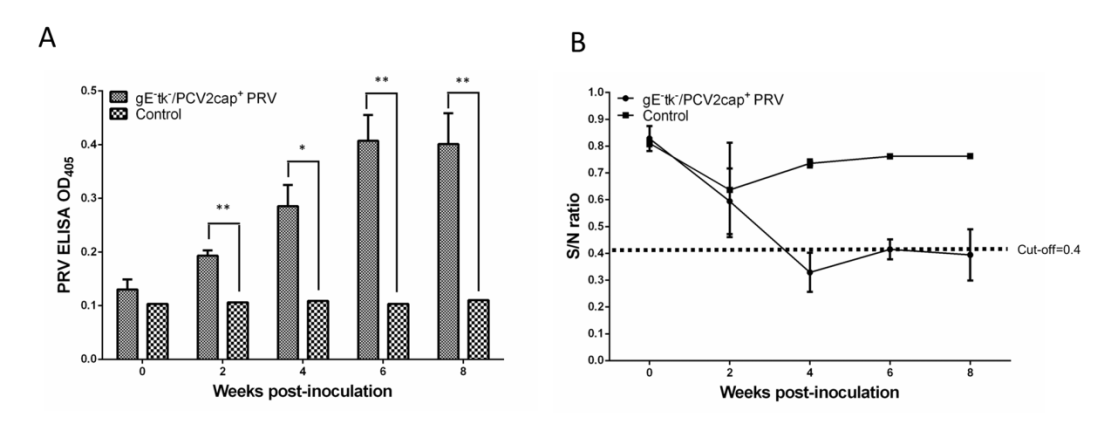
Enzyme-linked immunosorbent assay (ELISA) plates (Corning) were coated at 4°C overnight with 50 μl purified 20 μg/ml PRV soluble antigen in coating buffer (15 mM Na2CO3, 35 mM NaHCO3, pH 9.6) and indirect ELISA performed as described previously [20]. To examine specific PCV2 serum antibody from immunized guinea pigs, blocking ELISA kits (SERELISA® PCV2 Ab Mono Blocking; Synbiotics) were used. In accordance with the manufacturer's instructions, 10 μl immuneserum was diluted with 90 μl sample dilution buffer. Diluted serum sample were added to ELISA plates and incubated for 1 h at 37°C. After washing, horseradish peroxidase (HRP)- conjugated MAb was added and detected by peroxidase substrate. Optical densities (OD) were calculated as: OD sample ratio (S/N) = mean OD sample (S)/ mean OD negative control (N). S/N ratio <0.4 was considered positive.
Statistical analysis
ELISA OD values were expressed mean ± 1 standard deviation. Student's t-test was used to analyze numeric parameters (GraphPad Prism, Version 5.0) and for P values calculations. Statistical differences among groups were assessed by ANOVA using Tukey's test. All differences were considered significant at P <0.05 (*), and <0.01 (**).
Results
Characterization of recombinant gE-tk- /PCV2cap+ PRV
Recombinant gE-tk-/PCV2cap+ PRV was constructed by sequential homologous recombination to delete defined regions of the gE and tk genes to obtain the PCV2 cap gene (Figure 1). The virus was subjected to five cycles of plaque purification. Gene recombination was confirmed by PCR and DNA sequencing (data not shown). Expression of PCV2 Cap proteins was examined by indirect immunofluorescence (IIF) (Figure 2A) and Western blotting analysis (Figure 2B) to ensure that that gE-tk- /PCV2cap+ PRV-infected PK-15 cells and lysates were recognized by specific antibody to Cap. Expressed recombinant Cap protein was 28 kDa and continuously produced to72 h post infection (Figure 2C). Virus growth properties were analyzed using growth curves. No significant differences in viral replication were observed between the recombinant virus and wild-type PRV at 12 h post infection but gE-tk-/PCV2cap+ PRV had slightly decreased replication at 48 h post infection (Figure 2D).
Virology & Immunology Journal
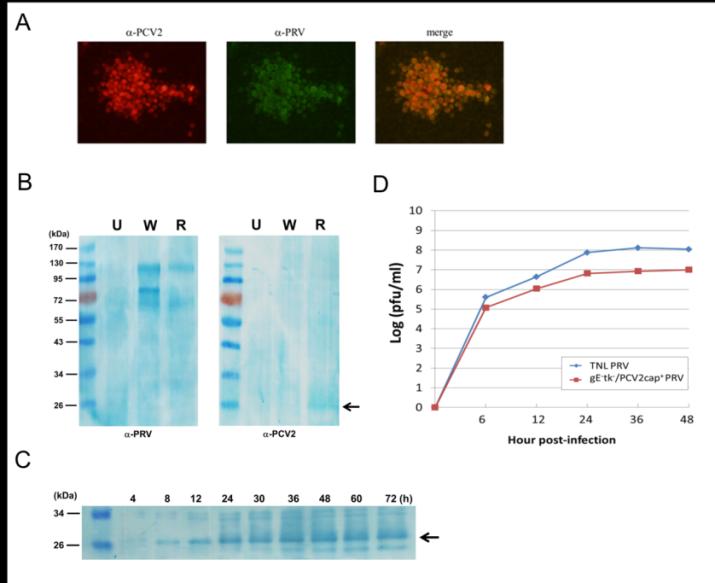
Figure 2: Characterization of recombinant gE-tk- /PCV2cap+ PRV. A. Recombinant gE-tk-/PCV2cap+ PRV-infected PK-15 cell was incubated with MAb against PCV2 (α-PCV2) and swine immuneserum to PRV (α-PRV) at 18 h post infection followed by IIF and examined using a fluorescent microscope at 100× magnification. B. Supernatants of lysates of PK-15 cells that were uninfected (U) or infected with wild-type TNL (W) or recombinant gE-tk-/PCV2cap+ PRV (R) at 18 h post infection were separated by 12% SDS-PAGE, followed by Western blotting analysis with MAb against PRV gC (α-PRV) or swine immune serum against PCV2 Cap (α- PCV2). The expected Cap protein is indicated by an arrow. C. Lysates from gE-tk-/PCV2cap+ PRV-infected PK-15 cells at indicated times were analyzed by Western blotting analysis with swine immune serum against PCV2 Cap. D. Growth curve of gE-tk-/PCV2cap+ PRV. Recombinant gE-tk-/PCV2cap+ PRV (■) or wild-type (TNL) PRV (◆) were used to infect PK-15 cells at 0.1 MOI. Virus titers were determined at 6, 12, 24, 36 and 48 h post infection by plaque forming assays.
VLPs formed by gE-tk-/PCV2cap+ PRV
-expressed Cap
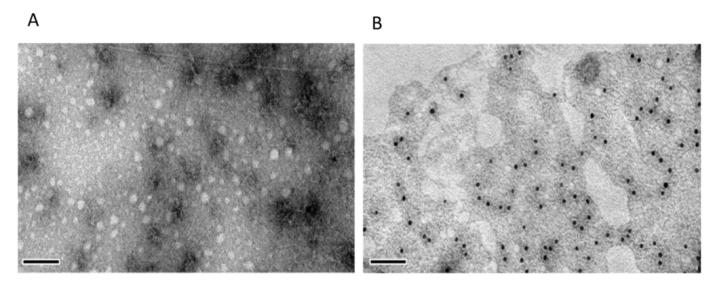
VLPs harvested from gE-tk-/PCV2cap+ PRV-infected cell lysates were subjected to TEM and immunogold staining. Expressed Cap self-assembled to form VLPs with diameters of 17 nm to 25 nm (Figure 3A). Specificity of VLPs was confirmed by immunogold staining (Figure 3B).
Determination of virulence of gE-tk-/PCV2cap+ PRV in mice
Virulence of recombinant gE-tk-/PCV2cap+ PRV was examined by inoculation of mice with high virus titers of 7 × 10⁵ and 7 × 10⁶ pfu. Clinical signs and skin lesions were monitored daily and percent surviving mice was determined for 2 weeks post inoculation. All gE-tk- /PCV2cap+ PRV-infected mice were alive and healthy, even at the highest dose of 7 × 10⁶ pfu.
Immunogenicity of gE-tk-/PCV2cap+ PRV in guinea pigs
To evaluate the immunogenicity of gE-tk-/PCV2cap+ PRV, three guinea pigs were immunized intramuscularly with 1.4 × 10⁷ pfu recombinant virus; two control guinea pigs received PBS. The immunized group seroconverted to PRV-specific antibody as determined by indirect ELISA at 2 weeks post immunization and antibody titers increased significantly afterward (Figure 4A). Specific antibody against PCV2 Cap was detected in the immunized group since 4 weeks post immunization using a commercialized blocking kit (Figure 4B). Control guinea pigs remained antibody negative to PRV and PCV2 during the experimental period.
Virology & Immunology Journal
Discussion
PCVAD is recognized one of the most economically important diseases worldwide [22]. Strategies for controlling PCVAD are eliminating virus co-infection, managing sanitary conditions, and implementing vaccination programs [12]. Three highly efficacious, commercialized subunit based-PCV2 vaccines and one chimeric PCV1-2 vaccine are major tools for controlling PCV2 infection and PCVAD prevalence. The high cost of mass vaccination strategies remains a great concern for pig farmers [23]. Sows and young piglets are suggested as the two main vaccination targets. In barren sows, vaccination could provide offspring with maternal antibody transfer or decrease the possibility of horizontal transmission [24]. Vaccination of young piglets could induce active immune responses against decayed maternal antibody [13]. Use of marker vaccines and tests of antibodies with companion tests assist pseudorabies eradication strategies [17]. PRV vaccines with gE deletion have been examined for residual virulence and the latency reactivation [25, 26]. The gE-deleted vaccines decrease virus excretion and transmission among pigs, but neuronal latency is not affected [27]. Although viral replication in resting non-dividing cells relies on thymidine kinase function, deletion of the tk gene from PRV vaccines could reduce viral virulence and invasion of neurons [18]. Based on our previous study, recombinant gE-/PCV2cap+ PRV retains vaccine efficiency and induces a significant antibody response to PRV and PCV2 [20]. In this study, recombinant gE-/PCV2cap+ PRV was further attenuated by deletion of the tk gene. All gE-tk-/PCV2cap+ PRV-infected mice were alive and healthy even with the highest titer of 7 × 10⁶ pfu, suggesting complete attenuation in mice and potential as a live attenuated vaccine candidate. Deletion of the gE and tk genes did not interfere with the propagation characteristics of the recombinant viruses (Figure 2D), which is a prerequisite for a practical vaccine. Demonstration of the ability of expressed Cap to form virion morphologically and antigenically similar to native PCV2 was determined by TEM and immunogold staining (Figure 3). A further advantage of viral vector vaccines is that vectors carrying protein are processed in infected cells and presented to antigen-presenting cells for more efficient protection of immunized host, which is different from traditional inactivated vaccines [28]. Guinea pigs immunized with recombinant gE-tk-/PCV2cap+ PRV seroconverted to PRV-
Virology & Immunology Journal
and PCV2-specific antibody and retained vaccine efficacy. Combining PRV and PCV2 in a single inoculation could reduce the cost and labor of massive vaccinations and help farmers with profits from breeding pigs [23]. VLPs-based vaccines are subunit vaccines that have been shown to be able to imitate the original structure of virions without carrying their genomic contents [29]. Direction of immune responses is influenced by antigen arrangements on VLP vaccines and enhanced by epitope densities on VLPs [30]. Trible et al. [31] found a decoy epitope at amino acid residues 169-180 of Cap that could drive different immune response outcomes. Complete assembly of PCV2 VLPs might bury the decoy epitope and direct the immunized host to produce neutralizing antibodies. In contrast, the decoy epitope exposed on an incorrect folding protein could result in an immunized host with a seroconversion state without neutralizing antibodies [31, 32]. Therefore, a PCV2 VLP-based vaccine could be important for achieving vaccine efficacy. Recombinant Cap proteins expressed by gE-tk-/PCV2cap+ PRV-infected cells could self-assemble to form VLPs that block the decoy epitope. Furthermore, insertion of a proper antigen or epitope into VLP has been tested with PCV2 VLPs [33, 34]. Further studies may take advantage of VLPs integrating immunomodulating agents against infections.
Conclusion
In conclusion, a recombinant PRV double-deleted for gE/tk and containing the PCV2 cap gene (gE-tk-/PCV2cap+ PRV) was constructed. Expressed Cap proteins self- assembled into VLPs during virus replication. Deletion of the gE and tk genes did not interfere with the propagation or immunogenicity of the recombinant virus. Virulence of gE-tk-/PCV2cap+ PRV was completely attenuated in mice. Guinea pigs immunized with gE-tk-/PCV2cap+ PRV mounted a significant antibody response against PRV and PCV2. The recombinant virus demonstrated the potential to develop into a candidate live attenuated bivalent vaccine to simplify vaccination strategies.
Acknowledgment
This work was supported in part by a grant NSC99- 2324-B-005-013-MY2 from the Ministry of Science and Technology, Taiwan, Republic of China.
References
-
Allan GM, Ellis JA(2000) porcine circoviruses: a review. J Vet Diagn Invest 12(1): 3-14.
-
Allan GM, McNeilly F, Kennedy S, Meehan B, Ellis J, et al (2000) Immunostimulation, PCV-2and PMWS. Vet Rec 147(6): 170-171.
-
Opriessnig T, Meng XJ, Halbur PG (2007) porcine circovirus type 2 associated disease: update on current terminology, clinical manifestations, pathogenesis, diagnosis, and intervention strategies. J Vet Diagn Invest 19(6): 591-615.
-
Segales GM, Allan M, Domingo (2005) porcine circovirus diseases Anim Health. Res Rev 6(2): 119- 142.
-
Ellis J, Clark E, Haines D, West K, KrakowkaS, et al. (2004) Porcine circovirus-2 and concurrent infections in the field. VetMicrobiol 98(2): 159-163.
-
Mankertz J, Mankertz K, Wolf HJ, Buhk (1998) Identification of a protein essential for replication of porcine circovirus. J Gen Virol 79(2): 381-384.
-
Truong C, Mahe D, Blanchard P, Le Dimna M, Madec F (2001) Identification of an immunorelevant ORF2 epitope from porcine circovirus type 2 as a serological marker for experimental and natural infection. Arch Virol 146(6): 1197-1211.
-
Nawagitgul P, Harms PA, Morozov I, Thacker BJ, Sorden SD (2002) Modified indirect porcine circovirus (PCV) type 2-based and recombinant capsid protein (ORF2)-based enzyme-linked immunosorbent assays for detection of antibodies to PCV. ClinDiagn Lab Immunol 9 (1): 33-40.
-
PC Wu, Chien MS, Tseng YY, Lin J, Lin WL, et al (2008) Expression of the porcine circovirus type 2 capsid protein subunits and application to an indirect ELISA. J Biotechnol 133(1): 58-64.
-
Nawagitgul P, Morozov I, Bolin SR, Harms PA, Sorde SD, et al. (2000) Open reading frame 2 of porcine circovirus type 2 encodes a major capsid protein. J Gen Virol 81(1): 2281-2287.
-
PC Wu, Lin WL, Wu CM, Chi JN, Chien MS, et al. (2012) Characterization of porcine circovirus type 2 (PCV2) capsid particle assembly and its application to virus- Virology & Immunology Journal like particle vaccine development, Appl. Microbiol Biotechnol 95(6): 1501-1507.
-
Chae C (2012) Porcine circovirus type 2 and its associated diseases in Korea. Virus Res 164(1-2): 107-113.
-
Fachinger V, Bischoff R, Jedidia SB, Saalmuller A, Elbersn K (2008) the effect of vaccination against porcine circovirus type 2 in pigs suffering from porcine respiratory disease complex. Vaccine 26(11): 1488-1499.
-
Martelli P, Ferrari L, Morganti M, De Angelis E, Bonilauri P (2011) one dose of a porcine circovirus 2 subunit vaccine induces humoral and cell-mediated immunity and protects against porcine circovirus- associated disease under field conditions. Vet Microbiol 149(3-4): 339-351.
-
Pomeranz LE, Reynolds AE, Hengartner CJ (2005) Molecular biology of pseudorabies virus: impact on neurovirology and veterinary medicine Microbiol Mol Biol Rev 69(3): 462-500.
-
Mengeling WL, Brockmeier SL, Lager KM, Vorwald AC (1997) the role of biotechnologically engineered vaccines and diagnostics in pseudorabies (Aujeszky'sdisease) eradication strategies. Vet Microbiol 55(1-4): 49-60.
-
vanOirschot JT, Kaashoek MJ, FAMRijsewijk, Stegeman JA (1996) The use of marker vaccines in eradication of herpesviruses. J Biotechnol 44(1-3): 75-81.
-
Moormann RJ, de Rover T, Briaire J, Peeters BP, Gielkens AL (1990) Inactivation of the thymidine kinase gene of a gI deletion mutant of pseudorabies virus generates a safe but still highly immunogenic vaccine strain. J GenVirol 71(7): 1591-1595.
-
McGregor S, Easterday BC, Kaplan AS, Ben-Porat T (1985) Vaccination of swine with thymidine kinase- deficient mutants of pseudorabies virus. Am J Vet Res 46 (7): 1494-1497.
-
Chi JN, Wu CY, Chien MS, Wu PC, Wu CM, et al. (2014) The preparation of porcine circovirus type 2 (PCV2) virus-like particles using a recombinant pseudorabies virus and its application to vaccine development. J Biotechnol 181: 12-19.
-
Huang C, Hung JJ, Wu CY, Chien MS (2004) Multiplex PCR for rapid detection of pseudorabies virus, porcine parvovirus and porcine circoviruses. Vet Microbiol 101(3): 209-214.
-
Opriessnig T, Prickett JR, Madson DM, Shen HG, Juhan NM, et al. (2010) Porcine circovirus type 2 (PCV2)- infection and re-inoculation with homologous or heterologous strains: virological, serological, pathological and clinical effects in growing pigs. Vet Res 41(3): 31-44.
-
Alarcon P, Wieland B, Mateus AL, Dewberry C (2014) Pig farmers' perceptions, attitudes, influences and management of information in the decision-making process for disease control. Prev Vet Med 116(3): 223-242.
-
Kurmann J, Sydler T, Brugnera E, Buergi E, Haessig M, et al. (2011) Vaccination of dams increases antibody titer and improves growth parameters in finisher pigs subclinically infected with porcine circovirus type 2 Clin. Vaccine Immunol 18(10): 1644-1649.
-
Jacobs L, Mulder WA, Priem J, Pol JM, Kimman TG (1994) Glycoprotein I of pseudorabies virus (Aujeszky's disease virus) determines virulence and facilitates penetration of the virus into the central nervous system of pigs. Acta Vet Hung 42(2-3): 289- 300.
-
Jacobs L, Mulder WA, Van Oirschot JT, Gielkens AL, Kimman TG (1993) Deleting two amino acids in glycoprotein gI of pseudorabies virus decreases virulence and neurotropism for pigs, but does not affect immunogenicity. J Gen Virol 74(10): 2201- 2206.
-
Kritas SK, Nauwynck HJ, Pensaert MB (1995) Dissemination of wild-type and gC-, gE- and gI- deleted mutants of Aujeszky's disease virus in the maxillary nerve and trigeminal ganglion of pigs after intranasal inoculation. J Gen Virol 76(8): 2063-2066.
-
Collins MK, Cerundolo V (2004) Gene therapy meets vaccine development. Trends Biotechnol 22(12): 623- 626.
-
Noad R, Roy P (2003) Virus-like particles as immunogens. Trends Microbiol 11(9): 438-444.
-
Bachmann MF, Rohrer UH, Kundig TM, Burki K, Hengartner H, et al (1993) the influence of antigen Virology & Immunology Journal organization on B cell responsiveness. Science 262(5138): 1448-1451.
-
Trible BR, Ramirez A, Suddith A, Fuller A, Kerrigan M, et al. (2012) Antibody responses following vaccination versus infection in a porcine circovirus- type 2 (PCV2) disease model show distinct differences in virus neutralization and epitope recognition. Vaccine 30(27): 4079-4085.
-
Trible BR, Kerrigan M, Crossland N, Potter M, Faaberg K, et al. (2011) Antibody recognition of porcine circovirus type 2 capsid protein epitopes after vaccination, infection, and disease. Clin Vaccine Immunol. 18(5): 749-757.
-
Bucarey SA, Pujol M, Poblete J, Nunez I, apia CVT, et al. (2014) Chitosan microparticles loaded with yeast- derived PCV2 virus-like particles elicit antigen- specific cellular immune response in mice after oral administration. Virol J 11:149.
-
Zhang H, Qian P, Liu L, Qian S, Chen H, et al. (2014) Virus-like particles of chimeric recombinant porcine circovirus type 2 as antigen vehicle carrying foreign epitopes. Viruses 6(12): 4839-4855.
- hMPV: Is It Another Covid-19 Like Situation?
- Streptomyces: Sources of Novel Discoveries in Antibiotic Research to Combat Antimicrobial Resistance
- A Review of Mosquitoes (Diptera: Culicidae) and Their Biodiversity, Medical and Veterinary Importance
- Past and Current Immunotherapy in Cancer
- Hematological Cancer and Viral Infection
- The Growing Threat of Antimicrobial Resistance in India: Challenges and Solutions