
Association of Cytomegalo Virus and Epstein-Barr Virus with Systemic Lupus Erythematosus
Background and Objectives: In recent decades, many research groups have focused on the role of viral infection in the etiopathogenesis of Systemic lupus erythematosus (SLE). The main candidates are Herpes virus such as Cytomegalovirus (CMV) and Epstein Barr virus (EBV). In India on this aspect is limited. Therefore it is aimed to study the involvement of Cytomegalovirus and Epstein Barr virus among the SLE patients from this part of country. Methods: Serum samples were collected from the SLE patients and subjected to Enzyme linked Immunosorbent Assay (ELISA) for the detection of CMV IgM antibody. The samples were also tested for the presence of EBV IgM antibody. Result and Conclusion: Out of 92 SLE cases tested by CMV IgM assay, 27 (29.3%) samples were found to be positive. The remaining 65 (70.56%) samples were found to be Negative for CMV IgM assay. 15 (16.3%) samples were found to be positive and 77 (83.6%) samples were negative for EBV IgM assay.
Introduction
Systemic lupus erythematosus (SLE) is an autoimmune multi-organ disease characterized by the production of autoantibodies in serum directed against a wide spectrum of nuclear, cytoplasmic, and cell membrane autoantigens, such as Sm/RNP, Ro/SS-A or La/SS-B [1].
Viruses have long been considered to be primarily responsible for causing SLE. In recent decades, many research groups have focused on the role of viral infection in the etiopathogenesis of Systemic lupus erythematosus. The main candidates are herpes viruses such as Cytomegalovirus (CMV) and Epstein-Barr virus (EBV) was noted to be risk factor for developing SLE [2].
The etiopathogenesis of SLE remains unclear, although Epstein-Barr virus (EBV) has also been implicated in the pathogenesis of SLE. EBV is a ubiquitous human gamma- herpesvirus with cell growth transforming ability that predominantly infects B-lymphocytes and elicits strong immune responses in the infected host [3].
Cytomegalovirus is a ubiquitous virus and primary exposure usually occurs at an any age. However, clinical signs of infection usually do not manifest in immunocompetent individuals. Adult CMV disease may occur as result of primary infection, reinfection or activation of latent infection.
The present study aimed to study the involvement of Cytomegalovirus and Epstein Barr virus among the Systemic lupus erythematosus patients from this part of the country.
Materials and Methods
Ninety-two patients fulfilling the 1997 revised criteria of the American college of Rheumatology (ACR) for SLE were enrolled from July 2008 to July 2009 in Government General Hospital and Sri Ramachandra Medical college and Research, Chennai. Cytomegalovirus IgM antibody and Epstein Barr virus IgM antibody were detected by using ELISA (Calbiotech, USA).
Results
| S.No | Gender | Positive | Negative | Total |
|---|---|---|---|---|
| 1 | Male | 1 | 3 | 4 |
| 2 | Female | 26 | 62 | 88 |
| Total | 27 | 65 | 92 | |
| Total | -29.34% | -70.65% | 92 |
Table 2: Showing distribution of Positive and Negative pattern for Cytomegalovirus IgM antibody among Systemic lupus erythematosu
29.34% 70.65% CMV IgM Positive (%)
CMV IgM Negative (%)
$$ = \frac {1}{2} $$ Figure 1: “Pie” diagram showing distribution Positive and Negative pattern for Cytomegalovirus IgM antibody among Systemic lupus erythematosus.
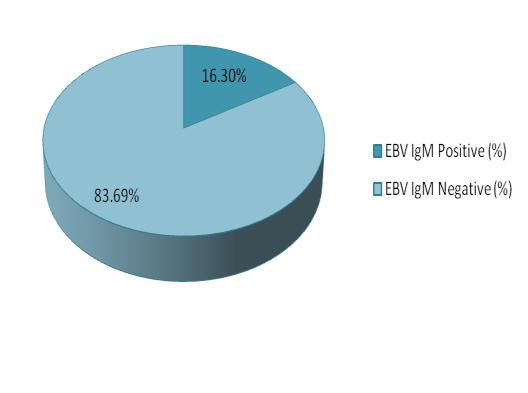
Out of 92 Systemic lupus erythematosus cases tested by Epstein Barr virus IgM antibody, 15 (16.3%) samples were found to be Positive. The remaining 77 samples were found to be Negative for Epstein Barr virus IgM antibody (Table 2; Figure 2).
| S.No | Gender | Positive | Negative | Total |
|---|---|---|---|---|
| 1 | Male | 0 | 4 | 4 |
| 2 | Female | 15 | 73 | 88 |
| Total | 15 | 77 | 92 | |
| Total | -16.30% | -83.69% | 92 |
Table 1: Showing distribution of Positive and Negative pattern for _Epstein Barr virus_ IgM antibody among Systemic lupus erythem
Discussion
Viruses have long been postulated to play a role in autoimmune disease. One of the viruses most frequently suspected of acting as a trigger for autoimmunity is Cytomegalovirus and Epstein Barr virus.
The present study Cytomegalovirus IgM antibody positive (29.34%) was seen in our SLE patients. This findings is an agreement with several earlier studies in a study included 199 patients with SLE in Saudi Arabia, found that 3.5% patients had positive for Cytomegalovirus infection [4, 5, 6, 7, 8].
Epstein Barr virus (EBV) is a Herpes virus that initially infects epithelial and B cells, which is followed by lifelong latent infection of B cells with occasional reactivation and productive cycles of viral replication [4]. James et al supported the association of Epstein Barr virus infection and Systemic lupus erythematosus by showing that IgG anti-EBV viral capsid antigen (VCA) in serum and EBV DNA in peripheral blood mononuclear cells (PBMC) were detectable 99% of young systemic lupus erythematosus patients [9]. Epstein Barr virus (EBV) has long been hypothesized to play a role in the etiology of Systemic lupus erythematosus [10]. In the present Epstein Barr virus (EBV) IgM antibody positive 16.30% was seen in our SLE patients. Al-rayes, et al. in a study included 199 patients with SLE in Saudi Arabia, found that 6% patients had positive for Epstein Barr virus infection [8].
References
-
Von Muhlen C, Tan EM (1995) Autoantibodies in the diagnosis of Systemic rheumatic diseases. Seminar arthritis & Rheum 24(5): 323-358.
-
James JA, Neas BR, Moser KL, Hall T, Bruner GR, et al. (2001) Systemic lupus erythematosus in adults is associated with previous Epstein Barr virus exposure. Arthritis Rheum 44(5): 1122-1126.
-
Rickinson AB, Kieff E (2001) Epstein Barr virus. _In_: Kinpes DM, Howley PM (Eds.), Fields Virology. Lippincott Williams and wikins, pp: 2575-2627.
-
Tokunaga Y, Takenaka K, Asayama R, Shibuya T (1996) Cytomegalovirus-induced interstitial pneumonitis in a patient with systemic lupus. Inter Med 35(6): 517-520.
-
Ikura Y, Matsuo T, Ogami M, Yamazaki S, Okamura M, et al. (2000) Cytomegalovirus associated pancreatitis in a patient with systemic lupus erythematosus. J Rheumatol 27(11): 2175-2717.
-
Gladman DD, Hussain F, Ibañez D, Urowitz MB (2002) The nature and outcome of infection in systemic lupus erythematosus. Lupus 11(4): 234-239.
-
Sakamoto O, Ando M, Yoshimatsu S, Kohrogi H, Suga M, et al. (2002) Systemic lupus erythematosus complicated by CMV-induced hemophagocytic syndrome and colitis. Intern med 41(2): 151-155.
-
Al-Rayes H, Al-Swailem R, Arfin M, Sobki S, Ruzvi S, et al. (2007) Systemic lupus erythematosus and infections: a retrospective study in Saudis. Lupus 16(9): 755-763.
-
James JA, Scofield RH, Harley JB (1997) Lupus humoral autoimmunity after short peptide immunization. Ann N Y Acad Scie 815: 124-127.
-
Mclain MT, Harley JB, James JA (2001) The role of Epstein Barr virus in Systemic lupus erythematosus. Bio Sci 6: 137-147.
- hMPV: Is It Another Covid-19 Like Situation?
- Streptomyces: Sources of Novel Discoveries in Antibiotic Research to Combat Antimicrobial Resistance
- A Review of Mosquitoes (Diptera: Culicidae) and Their Biodiversity, Medical and Veterinary Importance
- Past and Current Immunotherapy in Cancer
- Hematological Cancer and Viral Infection
- The Growing Threat of Antimicrobial Resistance in India: Challenges and Solutions