
Certain Inflammatory Changes in Scabies Stressed Patients Treated with Permethrin 5%
The main manifestations of scabies disease are mediated through inflammatory and hypersensitivity like-reactions to mite products that lead to itching with different lesions. The initial inflammatory response is towards the mite and its products.The aim of this study is to Determinate certain inflammatory elements including eosinophil, CRP and ESR in Scabies patients (ordinary and Prisoners) treated with Permethrin 5%. The study included (28) Ordinary, (32) prisoners scabies patients as well as (30) healthy person as a control group. Determination of CRP was done by Ichroma, ESR by using (Mix RAT 20, VITAL) and Eosinophil count determined from complete blood count (CBC). The results showed that the level of CRP in sera of ordinary scabies patients was somewhat higher (non- significantly) as compared to prisoners (3.60±0.44 vs.2.75±0.35 mg/L), in pre-treatment stage, while in post-treatment, the levels were elevated in prisoners (non- significantly) as compared to ordinary scabies patients (3.57± 0.59 vs. 3.29±0.31mg/L) respectively. ESR levels were significantly increased in both patient groups (ordinary 25.68±2.97 and prisoners 25.34±0.77 mm/hr ) in comparison to control (8.0±1.06 mm/hr), but significantly decreased values (9.46±0.17 mm/hr) were recorded post-treatment in ordinary patients compared to that (19.78±0.17 mm/ hr) in prisoners. Eosinophil count in (ordinary and prisoners) groups of patients pre-treatment was significantly higher compared to control group (5.9±0.77, 5.2±0.5 and 2.2±0.17 cell/ μl ) respectively., while a decreased mean values of ( 2.4 ±0.17 cell/ μl, 1.7 ±0.17cell/ μl ) were recorded in ordinary and prisoners patients post-treatment.
Introduction
Scabies is a parasitic infestation of the skin caused by the mite Sarcoptes scabiei, in developed countries .Its outbreaks are common in residential and nursing care homes where they cause significant morbidity and distress [1]. According to the review of scabies study show that, globally, more than 200 million people are affected, with a mainly high prevalence in low income tropical regions [2]. Scabies is a condition of the skin caused by human itch mites, the mite usually is spread by direct, prolonged, skin-to-skin contact with a person who has scabies, Scabies occurs worldwide and affects people of all races and social classes, so all travelers are at risk. It can spread rapidly in crowded conditions, Travelers going to nursing homes, extended care facilities, schools, and prisons are at higher risk, and among socially disadvantaged populations and immunocompromised hosts, the most common symptoms of scabies are intense itching (especially at night).The time required to induce immunity in primary infestations probably accounts for the latent period of 4-8 weeks of asymptomatic infestation, In re- infestation, the sensitized individual may develop a rapid reaction (within hours). Inflammation can cause abnormal proteins to appear in the blood. These proteins cause the RBCs to clump together, making them fall more quickly, the CRP test at the same time tested the ESR, and other factors such as smoking, stress and antidepressants are effects on immunocompromised individuals in prisoners. Reasons for high CRP levels may indicate higher levels of some cytokines that can increase the feeling of stress; Post-treatment itch may persist for up to 2-4 weeks. Have been shown to promote eosinophilia as well as their anti-inflammatory effects. Large numbers of eosinophils are produced in cases of allergies and worms, Eosinophil, which are found at the sites of infection when infected with these diseases [3]. Topical treatments are effective, but the most effective, permethrin 5%, alternative treatments may be less effective, poorly tolerated, or have more significant adverse effects such as sulfur, benzyl and benzoate, Reduced compliance between home contacts may reduce the effectiveness of contact therapy, leading to re-infestation, the aim of this study is to Determination of inflammatory factors eosinophil, CRP and ESR in Scabies patients (ordinary and Prisoners) treated with Permethrin 5%.
C- Reactive Protein (CRP)
It is synthesized in the liver, its physiologic role is to bind to phosphocholine expressed on the surface of dead or dying (apoptosis) cells in order to activate the complement/ immune system, which enhances phagocytosis by macrophages. Levels of CRP begin to rise within 2 hours of an insult, and have a half-life of about 18 hours. Rapid, marked increases in CRP occur with a wide variety of disorders including infection, trauma, tissue necrosis, malignancies, and autoimmune disorders, Since a large number of disparate conditions can increase CRP production, it cannot be used to diagnose a specific disease such as rheumatoid arthritis, CRP is merely an indicator or biomarker of a disease process that is causing cell death due to inflammation [4]. increasing CRP levels were associated with increasing risk for psychological distress and depression, High levels of CRP caused by inflammation in the body are believed to be associated with an increased risk of heart attack and cardiovascular disease, but the authors suggest that high levels of CRP may indicate elevated levels of certain cytokines that can increase feelings of stress, Depression itself can also lead to increased inflammation but conflicting results [5, 6]. CRP levels may decrease after anti scabietic therapy that inhibits the activity and production of T cells, which are predominant cells in the inflammatory [7].
Erythrocyte Sedimentation Rate (ESR)
Influenced by several factors such as the plasma concentration of fibrinogen and other acute phase proteins, the immunoglobulin concentration, number, size and shape of the erythrocytes and the patients’ age and sex. In an inflammatory reaction the ESR is mainly influenced by the P-fibrinogen concentration, ESR requires a test time of at least 60 min which sometimes makes it less suited for diagnosis of inflammatory and infectious diseases. The erythrocyte sedimentation rate (ESR or sed rate) and C-reactive protein (CRP) are among the oldest laboratory tests still in use, Multiple cells are involved in the release of inflammatory mediators, which combine to generate pain and inflammation are present, as well as be markers of treatment [8].
Eosinophils
Multifunctional leukocytes Involved in both allergic and parasitic infections [9, 10]. Their function in inflammatory scabies remains an indeterminate response, but they are known. Large numbers of eosinophils are produced in cases of allergies and worms, Eosinophil, which are found at the sites of infection when infected with these diseases [3]. These eosinophils are controlled by immune infiltration, and the detection corresponds to the high expression of Th 2 representative for IL- 4, IL-5 and IL-13 in CS [11]. Eosinophils may also regulate the inflammatory response to Th1. and production of IL-12 and gamma antiviral (IFN-γ) [12]. Eosinophils have an important role in non-specific (innate) immunity. Its elevation means that this kind of immunity is effective.
Material and Methods
Blood Sample Collection
Samples were collected from (28) ordinary and (32) prisoners scabies patients as well as (30) healthy individuals as a control group (15 to 63 years old). Samples were collected at the period from May to August 2019. The clinical examination had been done by the dermatologists in hospital and the patients were diagnosed according to clinical features beside laboratory findings.
Under sterile conditions, 4 ml of peripheral blood was withdrawn from each participant. whole blood was collected in sterile EDTA tubes for Eosinophil count was determined from complete blood count (CBC) by using (Ad via 120 diagnostic, Siemens) and sera were used for ESR estimation by using (Mix RAT 20, VITAL) the hematologist automatically, and for determination of C-reactive protein levels by Ichroma.
Statistical Analysis
Results are expressed as mean ± standard errors (M±SE) which were analyzed by one-way analysis of variance (ANOVA) followed by Fisher’s test for multiple comparisons, using Stat view version 5.0. Differences were considered significant when p<0.05. The other data expressed as percentage (%) which were analyzed by chi square test using excel program version 2010. Regression analysis was performed by analysis of covariance (ANCOVA) also using Stat view version 5.0.
Results
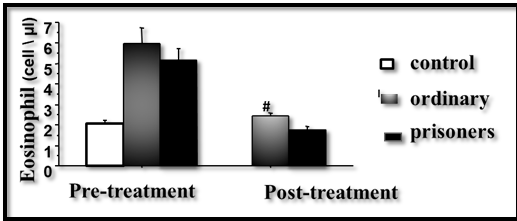
Differential white blood cells count revealed elevated eosinophilic count in both patient groups (ordinary and prisoners) during pre-treatment period, which was significantly highly compared to control group (P= ˂0.0001). While they showed the mean values of ( 2.4 ±0.17 cell/ µl, 1.7 ±0.17cell/ µl ) in post-treatment phase, which were significantly decreased in comparison to pre-treatment phase (P= ˂0.0001) .
| Eosinophil (cell/μl) pre-treatment | Eosinophil (cell/μl) post-treatment | P. Value | |
|---|---|---|---|
| Mean±S.E. | Mean±S.E. | ||
| Control | 2.2±0.17 | ||
| Ordinary | 5.9±0.77 | 2.4±0.17* | <0.0001 |
| Prisoners | 5.2±0.5 | 1.7±0.17* | <0.0001 |
| P. value | C. vs O. <0.0001 | ||
| C. vs P. <0.0001 | P. vs O.=0.009 | ||
| P. vs O. =0.32 |
Table 1: Comparison of Eosinophil count in ordinary and prisoners scabies patient groups as well as healthy control in pre-and po
*Different letters= Significant difference (P≤0.05) between mean. Table 1: Comparison of Eosinophil count in ordinary and prisoners scabies patient groups as well as healthy control in pre-and post- treatment stages.
| Groups | CRP(mg/L) pre-treatment | CRP(mg/L) post-treatment | P.value |
|---|---|---|---|
| Mean±S.E. 3.60±0.44 | Mean±S.E. 3.29±0.31 | 0.79 | |
| Ordinary | |||
| Prisoners | 2.75±0.35 | 3.57±0.59 | 0.27 |
| P. value | 0.93 | 0.88 |
Table 2: Comparison of ESR in Ordinary and prisoners scabies patients as well as in controls in pre and post- treatment stages.
As it is illustrated in Table 2, in pre-treatment phase, the level of CRP was a little bit higher in ordinary scabies patients compared to prisoners patients (3.60±0.44 vs.2.75±0.35 mg/L, while in post-treatment stage, the situation was (non- significantly) inverted toward cuff of prisoners as compared with ordinary scabies patients (3.57± 0.59 vs. 3.29±0.31mg/L) respectively.
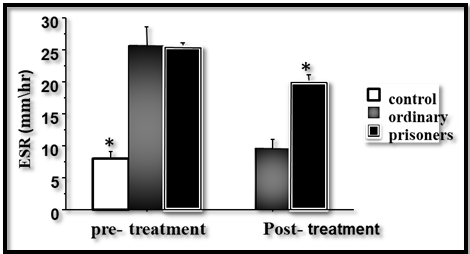
As shown in Table 3 ESR in pre- treatment phase was significantly (P=˂0.05) increased in both scabies patients groups (ordinary 25.68±2.97and prisoners 25.34±0.77mm/ hr), compared to control group (8.0±1.06 mm/hr), whereas in post- treatment its levels were significantly (P=˂0.05) decreased in ordinary patients group (9.46±0.17 mm/hr) and to less extent in prisoners patients (19.78±0.17 mm/hr).
| ESR (Mm/Hr) Pre-Treatment | ESR (Mm/Hr) Post-Treatment | P.Value | |
|---|---|---|---|
| Mean±S.E. | Mean±S.E. | ||
| Control | 8.0±1.06 | ||
| Ordinary | 25.68±2.97 | 9.46±0.17 | <0.0001 |
| Prisoners | 25.34±0.77 | 19.78±0.17* | <0.0005 |
| P.value | C. vs O. <0.0001 | ||
| C. vs P. <0.0001 | P. vs O.=0.0001 | ||
| P. vs O.=0.89 |
Table 3: Comparison of ESR in Ordinary and prisoners scabies patients as well as in controls in pre and post- treatment stages.
*Different letters= Significant difference (P > 0.05) between mean. Table 3: Comparison of ESR in Ordinary and prisoners scabies patients as well as in controls in pre and post- treatment stages.
Discussion
Increased eosinophils in scabietic patients could be attributed to allergic response against the mites and their products. Eosinophils have an important role in non-specific (innate) immunity. Its elevation means that this kind of immunity plays certain role in the pathogenic events of this disease. In this study it was noticed that the early scabietic patients (acute stage) were with higher eosinophils count than in late stages, which still higher in comparison with controls. In the early stages of scabies or when increased levels of adrenal glucocorticoids and epinephrine, as in prisoners, concurrent psychiatric disorders develop due to eosinophilia in acute infection. The theoretical interpretation for the dramatic decline in post- treatment phase in prisoners may reflect immune suppressive milieu related to stressful conditions, nature of nutrition and types of treatment. Patients may need excessive and repeated scabies treatment including appropriate anti-inflammatory therapy, and even may require corticosteroid injections [13]. In ordinary patients we observe somewhat high level of CRP compared to prisoners, in pre-treatment, post- treatment stage. The stress response is an adaptive and complex mechanism that promotes immediate survival by mobilizing energy stores resulting from the release of glucocorticoids (GCs) by activating the hypothalamus-pituitary-adrenal axis (HPA) [14, 15]. GCs work on almost all organs and tissues and effectively regulate every component of the immune and inflammatory responses. One of the most potent anti- inflammatory effects of Glucocorticoids is the suppression of the mediators of the immune response. Psychological stress beside the impact of devastating irritation accompanying scabies may be a powerful inflammatory catalyst Cytokine IL- 10 and homolog IL-19 by activation Adrenal receptors, and may be key mediators to induce stressed Immunity. The most common anti-scabies treatment (permethrin 5%) inhibits activity and production of T cells, which are predominant cells in the inflammatory process by blocking the signal pathway, preventing the release of histamine from mast cells and basal cells [7]. Antihistamines block histamine signaling pathways and thus will prevent cell migration to inflamed tissues and thus reduce the production of inflammatory mediators. Research results indicate that stress enhances the production of immunosuppressive milieu, that it may have an impact on stress-related disease processes [5]. Controversially it has been observed that increased CRP levels have to do with an increased risk of psychological distress and depression [16, 17]. Numerous studies have shown that high levels of CRP may indicate elevated levels of certain cytokines that can increase feelings of stress [16, 17]. Depression itself can also lead to increased inflammation but conflicting results [18].
The closed and densely populated environment and contact with other prisoners who may carry the infestation, perhaps lead to the development of continuous provocation, some prisoners with permanent symptoms with re- infestation due to failure to take appropriate administration to prevent the disease and use the treatment incorrectly, while others suffer from simultaneous conditions with scabies, such as chronic or acute infections could interpret the insufficiently decreased ESR levels. Most male prisoners specifically have a nodular scabies type, and this type may take another route in terms of treatment and persistent symptoms after treatment nodules can last for several weeks or even months after treatment course.
Conclusion
Psychological Stress is an inflammatory catalyst which promotes the production of immune mediators that may have an impact on inflammatory and stress-related pathological processes Delaying the healing process or persistent symptoms.
References
-
Karimkhani C, Colombara DV, Drucker AM, Norton SA, Hay R, et al. (2017) The global burden of scabies: a cross- sectional analysis from the Global Burden of Disease Study. Lancet Infect Dis 17(12): 1247-1254.
-
Chandler JD, Fuller C (2018) A Review of Scabies : An Infestation More than Skin Deep. Dermatology 235(2): 79-90.
-
Prussin C, Metcalfe DD (2006) IgE, mast cells, basophils and eosinophils. J Allergy Clin Immun 117(S2): S450- 456.
-
Clyne B, Olshaker JS (1999) The C-reactive protein. J Emerg Med 7(6): 1019-1025.
-
Almeida OP, Norman P, Hankey GJ, Jamrozik K, Flicker L (2007) The association between C-reactive protein concentration and depression in later life is due to poor physical health: results from the Health in Men Study (HIMS). Psychol Med 37(12): 1775-17861.
-
Tiemeier H, Hofman A, van Tuijl HR, Kiliaan AJ, Meijer J, et al. (2003) Inflammatory proteins and depression in the elderly. Epidemiology 14(1): 103-107.
-
Lin AN (2007) Topical calcineurin inhibitors. In: Wolverton SE, et al. (Eds.), Comprehensive dermatologic drug therapy. 2nd (Edn.), Saunders Elsevier, China, pp: 671-689.
-
Du Clos TW, Mold C (2004) C-reactive protein: an activator of innate immunity and a modulator of adaptive immunity. Immunol Res 30(3): 261-277.
-
Rothenberg ME, Hogan S (2006) The Eosinophil. Annu Rev Immunol 24: 147-174.
-
Khalifa KE (2000) Role of eosinophils in parasitic infections. Faculty of Medicine, Ain Shams University, Cairo, pp: 77.
-
Walton SF, Pizzutto S, Slender A, Viberg L, Holt D, et al. (2010) Increased immune response to allergic reactions to sarcoptes antigens in scabies versus normal scabies. Clen Immune Vaccine 17(9): 1428-1438.
-
Sunderkotter C, Becker K, Kutzner H (2018) Molecular diagnosis of skin infections using paraffin-embedded tissue - review and interdisciplinary consensus. J Dtsch Dermatol Ges 16(2): 139-147.
-
Hashimoto K, Fujiwara K, Punwaney J, DiGregorio F, Bostrom P, et al. (2000) Post-scabietic nodules: a lymphohistiocytic reaction rich in indeterminate cells. J Dermatol 27(3): 181-94.
-
Reeder DM, Kramer KM (2005) Stress in free-ranging mammals: integrating physiology, ecology, and natural history. J Mammal 86(2): 225-235.
-
Kim DS, Chavera C, Gabor CR, Earley RL (2018) Individual variation in ACT Hinduced cortisol levels in females of a live bearing fish at different gestational stages. Gen Comp Endocrinol 261: 51-58.
-
Gimeno D, Kivimaki M, Brunner EJ, Elovainio M, De Vogli R, et al. (2009) Associations of C-reactive protein and interleukin-6 with cognitive symptoms of depression: 12-year follow-up of the Whitehall II Study. Psychol Med 39(3): 413-423.
-
Puustinen PJ, Koponen H, Kautiainen H, Mantyselka P, Vanhala M (2011) Psychological distress and C-reactive protein: do health behaviours and pathophysiological factors modify the association?. Eur Arch Psychiatry Clin Neurosci 261(4): 277-284.
-
Matthews KA, Schott LL, Bromberger J, Cyranowski J, Everson Rose SA, et al. (2007) Associations between depressive symptoms and inflammatory/hemostatic markers in women during the menopausal transition. Psychosom Med 69(2): 124-301.
- hMPV: Is It Another Covid-19 Like Situation?
- Streptomyces: Sources of Novel Discoveries in Antibiotic Research to Combat Antimicrobial Resistance
- A Review of Mosquitoes (Diptera: Culicidae) and Their Biodiversity, Medical and Veterinary Importance
- Past and Current Immunotherapy in Cancer
- Hematological Cancer and Viral Infection
- The Growing Threat of Antimicrobial Resistance in India: Challenges and Solutions