
The Study for Usefulness of Mandala Art Therapy in Primary Dysmenorrhea
Primary dysmenorrhea is painful menstruation due to uterine functional origin without any other gynecologic diseases such as endometriosis or adenomyosis. The pain of primary dysmenorrhea is from hyper contraction or high sensitivity to pain. The primary dysmenorrhea has been treated by NSAIDs (nonsteroidal anti-inflammatory drugs) or oral contraceptives from the past. However, primary dysmenorrhea is not controlled in all patients by these treatments. Some patients need more supportive treatment. The many supportive treatment have tried to this condition. The art therapy can also tried for this supportive treatment, so we studied mandala art therapy for primary dysmenorrhea. The purpose of this study is observing the usefulness of art therapy for supportive therapy of primary dysmenorrhea.We estimate the degree of pain by VAS (Visual Analog Scale), and statistically compares the change of pain before and after mandala therapy by χ-square with Fisher’s exact test. We did mandala therapy 2 times/week from menstruation to next menstruation, and we compare the change of pain before and after mandala therapy by VAS score. The result of this study is as follows. We observed the pain change in 10 patients. The four of 10 patients felt no change in pain after therapy, but the 2 of 10 patients felt no pain after therapy. The four of 10 patients felt decreased pain after therapy although not disappear completely. Therefore, the six of 10 patients can be felt decreased pain after mandala therapy (P
Introduction
Background of Research
The dysmenorrhea can be divided to the secondary dysmenorrhea that caused by other diseases and the primary dysmenorrhea that caused by own uterine origin. The usual causative diseases of secondary dysmenorrhea are endometriosis, adenomyosis and intrauterine device. This secondary dysmenorrhea can be controlled by treatment of original diseases. The primary dysmenorrhea caused by stronger contraction than other person or more sensitive to pain than other person. The hormone that contracts the uterus has been known as prostaglandin which is known to be very much produced during menstruation in the endometrium. In primary dysmenorrhea, this prostaglandin is excessively secreted or more sensitive to pain than other person.
The primary dysmenorrhea is usually treated by next three methods. 1) Because the production of the prostaglandin is generated by the foods containing omega-6, an omega-3 rich food is recommended. It has been known that the omega-3 is rich in fish and omega-6 is rich in meat. 2) The NSAIDs (nonsteroidal anti-inflammatory drugs) inhibit the prostaglandin production from the endometrium during menstruation, and this drug should be taken before the hormone is production during menstruation. 3) Third method is the reducing the production of prostaglandin from endometrium by taking oral contraceptives. The decrease of pain in 70-80% of menstrual cramps using NSAIDs has been reported [1, 2, 3, 4, 5, 6, 7, 8]. Using oral contraceptives to inhibit the growth of endometrium reduces the production of prostaglandin, and the pain can be reduced in 90% [9]. However, despite these treatments, many cases are not well treated or reduce pain completely.
If you do not treat menstrual cramps completely by these treatments medications, the other supportive treatment is needed. There have been many reports of treatments by various complementary alternative therapies. The mandala art therapy is also one of these complementary alternative therapies. The improving of menstrual cramps can be expected by promoting psychological stability through mandala art therapy.
Mandala therapy was introduced in the 1960s by Swiss psychiatrist Gustav Jung to psychotherapy, and it has recently been used as an art therapy for psychotherapy. Mandala art therapy is that paints the color in various forms of patterns or circle. It is known that mandala psychotherapy is effective in promoting the patient’s sense of self-esteem and stability. The identifying the psychological state can be done observing by what colors and tools is used and where the color is filled by patients in the circle. However, there are few papers that have studied art therapy for primary dysmenorrhea, and there are quite a few attempts the art therapy for primary dysmenorrhea using mandala.
Purpose of Research
The several reports have been published that mental instability caused by stress is related to primary dysmenorrhea [10, 11, 12, 13]. Among the art treatments, we were to use art therapy with mandala. If the primary dysmenorrhea is not controlled by other treatments completely, the possibilities of the art therapy with mandala are supposed to pain therapy of primary dysmenorrhea. Because some mental state is related to a part of primary dysmenorrhea, it is expected that the suppressed the pain of mental part will help to induce a sense of psychological stability by releasing them while drawing which will have a significant effect on the weakening. If the art therapy using mandala is effective in reducing pain in primary menstrual cramps, the mandala art therapy will be useful therapy as the secondary treatment for primary dysmenorrhea.
Materials and Methods
Materials
In patients identified as primary dysmenorrhea after exclusion of other original diseases through ultrasound or many clinical diagnoses are studied. The study was performed in 10 patents whose pain of primary dysmenorrhea is not completely controlled by conventional treatments of nonsteroidal anti-inflammatory drugs or diet control and who agreed to this study. The average age of the patients participating in the study was 31 ± 4 year-old.
Methods of Art Therapy
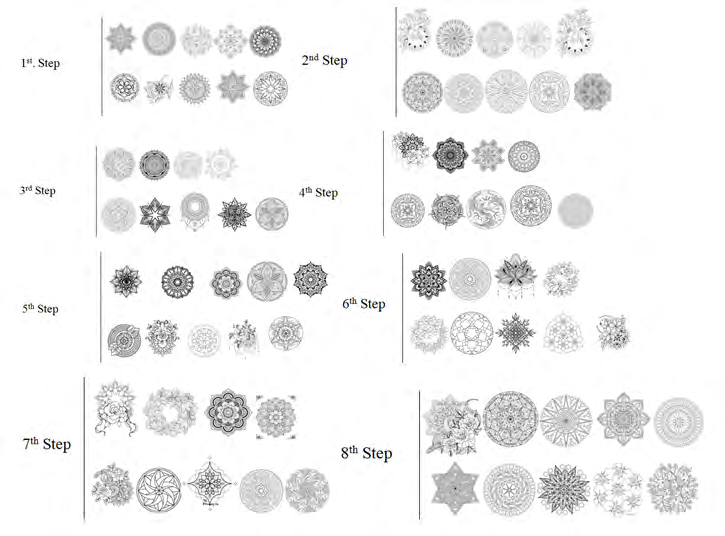
Using the technique of mandala that starting 2-3 days before menstruation and then carried out 2 times a week until the end of menstruation, the art therapy using mandala is performed for 7-8 times. The degree of menstrual pain before and after art therapy by VAS (Visual Analog Scale) was analyzed compared to each other. The mandala illustrations used in the treatment of primary dysmenorrhea in this study are shown in Figure 1 as bellows.
Mmeasurement of Pain Score
The Visual analog scale (VAS) was used to measure the degree of pain. The score was recorded before and after mandala art therapy, and the difference in score was analyzed.
The VAS system is a method of dividing the step into 10 steps with a point of 0 score without pain and unbearable pain to 10 score. It is usually represented with no pain to score 0, a slightly painful point 2, the significant pain point 4, the more significant pain score 6, very severe pain score 8 and unbearable very painful pain score 10. The 1, 3, 5, 7, 9 scores are in the every middle of those.
In four of 10 patients in the study, we cannot observe change in VAS after mandala art therapy. In two of 10 patients, no pain after mandala therapy was observed. In the remaining four patients, the pain is remained after mandala therapy, but pain is markedly reduced of change of VAS that changed more than 2 scores. Therefore after mandala treatment in 10 hit 6 people who participated in this study, it was able to find a statistically significant difference by decreasing the original menstrual pain (p < 0.05). Therefore, mandala art therapy has been suggested that it can be used as a useful secondary treatment for the treatment of primary (-01).
Statistical Analysis
Statistical analysis was done by using the 2x2 table of χ -square with Fisher›sexact test.
Results
| Number of patients | p value | |
|---|---|---|
| Vas score reduction | Pain loss : 2 of 10 patients | p<0.05 |
| Vas score reduction | Pain is reduced ( VAS with more than 2 score : 4 of 10 patients) | p<0.05 |
| No VAS score changes | 4 of 10 patients | p<0.05 |
Table 1: Number of patients who changes in VAS score in before and after mandala art therapy.
Comments
Menstrual cramps can be divided into two types of dysmenorrhea. The secondary dysmenorrhea is menstrual pain caused by other diseases, and the primary dysmenorrhea is menstrual pain caused by uterine itself. The primary dysmenorrhea occurs mainly in 1-2 years after menstruation and it is usually often in young women, but sometimes it goes into their 40 years-old. The secondary dysmenorrhea has typical causal diseases like as endometriosis, adenomyosis and intrauterine devices. The menstrual pain of secondary dysmenorrhea occurs after several years from the menarche, and the severity of pain is gradually increased year by year. The cause of the primary dysmenorrhea is not yet fully known, but is due to the increase in prostaglandin production of the endometrium. The prostaglandin is increased in the secretion at menstrual period after luteal phase when the blood levels of progesterone hormone drop. In patients of primary dysmenorrhea, the prostaglandin secreted more than normal women. Excessive secreted prostaglandin cause strong contractions of the uterine muscle more than normal women. Sometimes in primary dysmenorrhea, the menstrual pain is explained by increase the susceptibility to pain in the nerve end. Diagnosis of the primary dysmenorrhea can be done by direct estimation of the strength of uterine muscle contraction, but it is clinically difficult to use. Therefore, it is diagnosed mainly after excluding clinically causative diseases of the secondary dysmenorrhea.
Medication for primary dysmenorrhea first has a way of using non-steroidal anti-inflammatory drugs (NSAIDs). NSAIDs inhibit prostaglandin-producing enzymes to inhibit prostaglandin production, making uterine contractions weaker and decreasing pain. Second, it is also treated by administering oralcontraceptive pills. Oral contraceptives inhibit the proliferation of endometrium, and it decreases the prostaglandin production from endometrium. It can be also decreased the production of leukotriene, that is made from endometrium and that is another causative hormone of menstrual contraction. However, all of these treatments cannot control the menstrual cramps completely. In this case, the concepts of complementary alternative therapies are needed. The using of complementary alternative therapy is recently increased, and especially the complementary alternative therapies is tried to treat primary dysmenorrhea. There are currently several types of complementary replacement therapy; 1) therapy using medicines and vitamins, 2) massage therapy, 3) psychotherapy using relaxation, 4) energy therapy using a magnetic field 4) therapy using acupuncture. Art therapy is also tried by a method of psychotherapy among these alternative therapies.
With the rise of psychoanalysis in the 20thcentury, the symbolic content of unconscious images began to study for psychoanalysis. Art therapy was first introduced by Naumburg in the 1940s, and it is said that art psychotherapy can be tried for psychological healing through observing the symbolic image [14]. Art is able to relieve stress in life by expressing thoughts and emotions that are not expressed by language, which can bring a sense of psychological stability [15, 16]. Camic, et al. [17, 18] said that art therapy is a therapeutic tool for medical interventions , and many other studies have been reported that art therapy improves the quality of life of patients suffering from pain. Many studies have reported that medical art therapy can improve physical health and allowing them to heal anxiety and pain [19, 20, 21, 22, 23].
Mandala art therapy is to paint various patterns and paint in a circle in a relaxed state. Mandala Art Therapy is to identify the psychological state by observing colors and tools that the patient uses in the circle to fill. Thus we can create a treatment and promote the patient to self-esteem and stability by mandala art therapy. Mandala has been used steadily in many places for the treatment. The Navaho Indians healed wounds and diseases through sand mandala. They used colored sand to draw a mandala on the patient’s body. The German Jung, who first referred to Mandala in psychology, understood it as a process of individualization and tried to psychologically heal the confusion caused by the process of human self-achievement using mandala. It elevates the contents of the subconscious to consciousness and heals psychologically by drawing a mandala. Patients can be concentrating on the circle drawing by mandala, and thus patients have the opportunity to relieve the mind and the body is physiologically stable [24, 25, 26]. The circles are important visual representations in humans and are understood as cosmic origins like orbits around the sun, and the circles in art therapy are easy to use as a treatment because they are very easy to work. While drawing a mandala, the conflict in our inner world is symbolically expressed through mandala and projected into the outside world.
Therefore, we studied the effect for reducing the residual pain that was not healed by the conventional therapy by mandala art therapy through mental concentration and psychological relaxation.
Conclusion
In patients of primary dysmenorrhea whose symptoms were improved completely by conventional treatments such as nonsteroidal anti-inflammatory drugs or oral contraceptives, art therapy can be studied by using the technique of mandala for patients for decreasing symptoms. The study was performed by comparing the degree of menstrual pain before and after art therapy. Four of 10 patients were not able to observe significant changes in VAS after mandala art therapy. However in two of 10 patients, primary dysmenorrhea was almost improved after mandala therapy. In four of 10 patients, two or more VAS pain scores were reduced after therapy although pains were persisted. The mandala therapy reduced the pain in six of the 10 patients and these changes were statistically significant (p < 0.05). Therefore, the mandala art therapy seems to be useful alternative therapy in primary dysmenorrhea whose symptoms were not improved completely by conventional treatments. However, this study has somewhat short study period and small experimental group. Therefore, the long- term and mass research analysis should be added for confirm of effectiveness.
References
-
Ozgoli G, Goli M, Moattar F (2009) Comparison of effects of ginger, mefenamic acid, and ibuprofen on pain in women with primary dysmenorrhea. Journal of Alternative Complemental Medicine 15(2): 129-132.
-
Sanctis V, Soliman A, Bernasconi S, Bianchin L, Bona G, et al. (2015) Primary Dysmenorrhea in Adolescents: Prevalence, Impact and Recent Knowledge. Pediatric Endocrinology 13(2): 512-520.
-
Shirvani M, Motahari Tabari N, Alipour A (2015) The effect of mefenamic acid and ginger on pain relief in primary dysmenorrhea: a randomized clinical trial. Archeive Gynecology and Obstetrics 291(6): 1277- 1281.
-
Marjoribanks JA, Reuben O, Farquhar C, Proctor M (2015) Nonsteroidal anti-inflammatory drugs for dysmenorrhea. Cochrane Database Syst 2015(7): CD001751.
-
Ortiz M, Murguía-Cánovas G, Vargas-López L, Silva R, Parra MG (2016) Naproxen, paracetamol and pamabrom versus paracetamol, pyrilamine and pamabrom in primary dysmenorrhea: a randomized, double-blind clinical trial. Medwave 24(9): e6587.
-
Feng X, Wang X (2018) Comparison of the efficacy and safety of non-steroidal anti-inflammatory drugs for patients with primary dysmenorrhea: A network meta- analysis. Morphology of Pain 14: 1744806918770320.
-
Gomathy N, Dhanasekar K, Trayambak D, Amirtha R (2019) Supportive therapy for dysmenorrhea: Time to look beyond mefenamic acid in primary care. Journal of Family Medicine Prim Care 8(11): 3487-3491.
-
Camlibel M, Erdur B, Yilmaz A, Ozen M, Uyanik A (2019) Comparison of the Effects of Piroxicam and Diclofenac Sodium as Treatments for Primary Dysmenorrhea. Medical Science Monitoring 6(25): 157- 164.
-
Dawood Y (2006) Primary dysmenorrhea: advances in pathogenesis and management. Obstet Gynecol 108(2): 428-441.
-
Faramarzi M, Salmalian H (2014) Association of psychologic and nonpsychologic factors with primary dysmenorrhea. Iran Red Crescent Medical Journal 16(8): e16307.
-
Xu K, Chen L, Fu L, Xu S, Fan H, et al. (2016) Stressful Parental-Bonding Exaggerates the Functional and Emotional Disturbances of Primary Dysmenorrhea. International Journal of Behavioral Medicine 23(4): 458- 463.
-
Katwal PC, Karki NR, Sharma P, Tamrakar SR (2016) Dysmenorrhea and Stress among the Nepalese Medical Students. Kathmandu Univ Med J (KUMJ) 14(56): 318- 321.
-
Bajalan Z, Moafi F, MoradiBaglooei M, Alimoradi Z (2019) Mental health and primary dysmenorrhea: a systematic review. Psychosomatic Obstetet Gynaecol 40(3): 185- 194.
-
Malchiodi CA (1987) Strategies for obtaining art therapy funding from arts-related sources. American Journal of Art Therapy 25(3): 91-94.
-
Rubin JA (1982) Art therapy: what it is and what it is not. American Journal of Art Therapy 21(2).
-
Detre K, Frank T, Kniazzeh C, Robinson M, Rubin J, et al. (1983) Roots of art therapy. Margaret Naumburg (1890-1983) and Florence Cane (1882-1952). A family portrait. American Journal of Art Therapy 22(4): 111- 123.
-
Camic P, Tischler V, Pearman C (2014) Viewing and making art together: a multi-session art-gallery-based intervention for people with dementia and their careers. Aging Mental Health 18(2): 161-168.
-
Camic P, Zeilig H, Crutch S (2018) The arts and dementia: Emerging directions for theory, research and practice. Dementia (London) 17(6): 641-644.
-
Abbing A, Ponstein A, Hooren van S, Sonneville de L, Swaab H, et al. (2018) The effectiveness of art therapy for anxiety in adults: A systematic review of randomized and non-randomized controlled trials. PLoS One 13(12): e0208716.
-
Abbing A, Sonneville L, Baars E, Bourne D, Swaab H (2019) Anxiety reduction through art therapy in women. Exploring stress regulation and executive functioning as underlying neurocognitive mechanisms. PLoS One 14(12): e0225200.
-
Czamanski Cohen J, Wiley J, Sela N, Caspi O, Weihs K (2019) The role of emotional processing in art therapy (REPAT) for breast cancer patients. Journal of Psychosocial Oncology 37(5): 586-598.
-
Kline J, Van Ryzin K, Davis J, Parra J, Todd M, et al. (2020) Randomized Trial of Therapy Dogs Versus Deliberative Coloring (Art Therapy) to Reduce Stress in Emergency Medicine Providers. Academic Emergency Medicine 27(4): 266-275.
-
Gebhart V, Buchberger W, Klotz I, Neururer S, Rungg C, et al. (2020) Distraction-focused interventions on examination stress in nursing students: Effects on psychological stress and biomarker levels. A randomized controlled trial. International Journal of Nursing Practice 26(1): e12788.
-
Marshall M (2003) Creative learning: the mandala as teaching exercise. Journal of Nurse Education 42(11): 517-519.
-
Potash J, Chen J, Tsang J (2016) Medical student mandala making for holistic well-being. Medical Humanity 42(1): 17-25.
-
Quinn K (2019) Something Is Going to Happen Here: The Use of Mandala Art in Enhancing Reflective Practice. Advanced Nursing Science 42(3): 1-19.
- hMPV: Is It Another Covid-19 Like Situation?
- Streptomyces: Sources of Novel Discoveries in Antibiotic Research to Combat Antimicrobial Resistance
- A Review of Mosquitoes (Diptera: Culicidae) and Their Biodiversity, Medical and Veterinary Importance
- Past and Current Immunotherapy in Cancer
- Hematological Cancer and Viral Infection
- The Growing Threat of Antimicrobial Resistance in India: Challenges and Solutions