
Cuban Approaches to Climate and Health Studies in Tropics Early Warning System and Learned Lessons
Infectious diseases are sensitive to variations and climate change, causing impacts on health systems in the countries. Current climatic conditions favor the appearance of outbreaks and the circulation of new viruses such as SARS COV2. To alert such dangers, the creation of specialized warning systems for the health sector from climatic conditions is currently a global priority. This requires intense collaboration between medical and environmental communication, with new work approaches and methods for forecasting, using integrated climatic and epidemiological information. The objective of this publication is to show the advances and experience of Cuban research and projections, in terms of approaches and methodological procedures for the studies of the relationships between climate and health for forecasting purposes. An Early Warning System for infectious diseases and their causative agents was created. This warning system strengthens the health sector surveillance system for decision-making.
Short Communication
Today no one can be indifferent to the cost generated by the burden of infectious diseases in human populations. Anomalies in climate variability associated with climate change are increasingly frequent, the damages generated by these changes constitute the most significant environmental problem that humanity could face in the coming years [1].
Efforts to reduce the magnitude of the impacts attributable to climate variability and change are currently one of the greatest challenges for the international scientific community. Environmental alterations, whether local, regional or global, natural or of anthropogenic origin affect the functioning of host-environment-pathogen systems that can have repercussions on the emergence and re-emergence diseases, as well as their extinction or survival and spread.
Faced with this situation, it is important that the control and control programs rely on solid knowledge about the biology, ecology and evolution of the host-environment-pathogen systems. Therefore, epidemiology cannot be studied independently of host-pathogen-environment relationships. Humans and other organisms, as well as biological processes react to the configuration of coexisting climatic variables and interacting with each other in their immediate environment. An alteration in one of the elements of the climate leads to a variation in the ecosystem. Climate as element of environment is one of the factors that modifies different ecosystems, if the ecosystem becomes ill we can also expect man to become ill as element of it. Any variation that it experiences will influence the other components, which include microorganisms (viruses, bacteria, vectors, susceptible animal and human reservoirs), generating a change in the incidence, distribution and burden of numerous diseases, mostly infectious such as acute respiratory infections. (ARF), the leading cause of morbidity and mortality worldwide, particularly in tropical areas and developing countries [2].
Human beings are exposed to natural reservoirs of viruses and bacteria when they come into contact with the animal and plant fauna that live there, which then colonize man. This leads to the emergence of infectious diseases as a result of ecosystems becoming diseased and not providing service, increasing the risk of human colonization by new pathogens [3, 4]. Viruses are natural components of the ecosystem and live in constant competition with the immune defenses of humans and animals. But when the ecosystem is altered by climatic or anthropic causes, or a combination of both, humans come into contact with animals and plants. In this way, humans interact with viruses, generating new diseases, because the immune system is not prepared. The growing expansion of microorganisms such as viruses is not only due to anthropic pressures, due to human movements towards virgin natural spaces, for the purpose of urbanization and obtaining food or natural resources, which cause deforestation, it is also produced by pressure that climatic variations and changes provoke on ecosystems, which modify natural habitats.
Then, if we want to foresee future epidemics, and effects on human beings by new viruses and bacteria, human beings have to understand these interactions between man and the ecosystems of which they are part, as well as abandon simplifying approaches, otherwise New diseases will continue to surprise us, associated with viruses that live in their ecological niches and that colonize man. What it requires for its understanding of a change of thought towards a complex approach to interactions, because with the advances of the 21st century, greater connectivity and interaction between man, animals and different ecosystems is evidenced.
Work Approach for Climate and Health Studies
Studies mentioned above leads to a one health approach, allows to establish the links between humans, animals and the environment, allowing a complex approach and therefore guarantees us better results for human health.
For this reason, when approaching, to understand the interactions, the selection of the work approach is required, which can be in two ways [5].
- Independent variables
- Compound variables (those that give rise to the formulation of indexes).
Approach 1: example: temperature or humidity (only explains a partial part of climate and its impact on organisms and biological systems).
Approach 2: permits to explain more consistently the effects of climate variability, allowing to maximize its relevance to human health. Since humans and other organisms react to the configuration of coexisting climate variables and interact with each other from their immediate environment, researchers are encouraged to use climate index that combine individual climate variables.
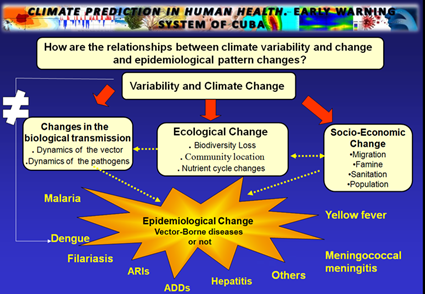
Cuba has its own methodology to deal with the effects of weather and climate on the virus, which does not exclude the use of the method of separate variables indistinctly. However, to approach the studies of relationships and change in the patterns of infectious diseases from an approach that considers biology, ecology and the pressures on the human ecosystem and social vulnerabilities, Cuba has focused on the following model of work for the development of his investigations that allow him to understand the complex interactions and pressures on the niches, which then lead to epidemiological changes and the appearance of diseases transmitted by vectors or not. Avoiding establishing merely statistical relationships between the elements of variability and climate change directly with the reports of disease cases (Figure 1).
Research and Studies in Cuba
The research developed in Cuba on climate variability and change and its impact on health during the last 30 years has been continuous and systematic. During the first two decades, it was aimed at assessing the burden of diseases attributable to climate variability and change on infectious diseases and agents’ projections are taken into account for future years [6].
In the past decade, efforts have been addressed at understanding and attributing the effects of climate on changing patterns of viral and bacterial agents that cause infectious diseases. This aspect provides a greater understanding and clarification of the influences of climate as a determinant of health, allowing a better understanding of the effects of changing climate on infectious diseases and changes in their morbidity.
Different approaches have been used to review and establish methodologies on how to evaluate at local and national levels the impact of climate variability and change on the spatial and temporal behavior of viruses and bacteria that cause infectious diseases. Therefore, climate indicators have been formulated and developed for these studies, as well as models for predicting the behavior of agents according to climate variations and studies of vulnerability to climate change [1, 6, 7]. This model was developed in order to identify vulnerabilities in the area of viruses and bacteria and to lay the foundations for the preparation and presentation of prediction models for infectious diseases that are vulnerable to climate anomalies, under the framework of the surveillance systems already established in the country.
As a result of the research and studies carried out in Cuba, the main (tracers) infectious diseases produced by virus and bacteria sensitive to climate were identified, which show a high vulnerability to climate variations and changes. They include the bacterial diarrheic diseases (produced by Salmonella and E. coli), acute respiratory infections (ARI) (produced by Influenza and Respiratory Syncytial Virus) and dengue (analyzed, from the confirmed cases to dengue according to circulating viruses, the indicator number of monthly outbreaks of Aedes aegypti (Ae), the Breteau Index and the house index) [8, 9, 10].
Priorities for Climate and Health Research
According to the populations and priority areas, the following research needs are recognized:
Evaluation of the effect of climate change on health, considering the projections of the country’s demographic structure and the influence of other sectors, under the different climate change scenarios: Mapping of the most vulnerable areas for human health under socioeconomic and climate change scenarios.
Integrated vulnerability and adaptation studies, identifying and prioritizing vulnerable areas and/or sectors in the country, coordinating economic, agricultural, natural resource management, health and government policy projects, seeking synergy among them.
Calculations on adaptation costs of the health sector to climate change. Relate environmental data with the population’s conditions.
Forecasts and Early Warnings
The forecasts and early warnings, issued as a product of the analysis and modeling of the climate and epidemiological variables, have implied an immediate challenge. They must be carried out and sent to the MINSAP with enough time to allow decision-makers in health to incorporate it in the management of epidemic outbreaks.
Early Warning Systems (EWS) In Cuba
Early warning systems are designed to alert the population and relevant authorities in advance about possible adverse conditions that could lead to a disease outbreak and to implement effective measures to reduce adverse health out. For the development of an early warning system, they are necessary three steps the first, is identification and forecasting of the environmental variables that are associated with a disease outbreak. This step requires collaboration with, at least, meteorologist to develop exposure-response relationships between the environmental factor and the health outcome, in order to identify the threshold/trigger/ or other factor that can be used to forecast an impending epidemic [11].
The second step in developing an early warning system predicting possible disease outbreaks. The factors that need to be considered are listed. Again, the goal of an early warning system is to develop effective and timey interventions, taking into consideration all factors that can affect the occurrence of an outbreak. The third step in developing an early warning system is to develop a response plan, including explicit identification of where and when the plan will be implemented (including thresholds for action), what and how specific interventions will be implemented, and to whom the interventions will be communicated [12].
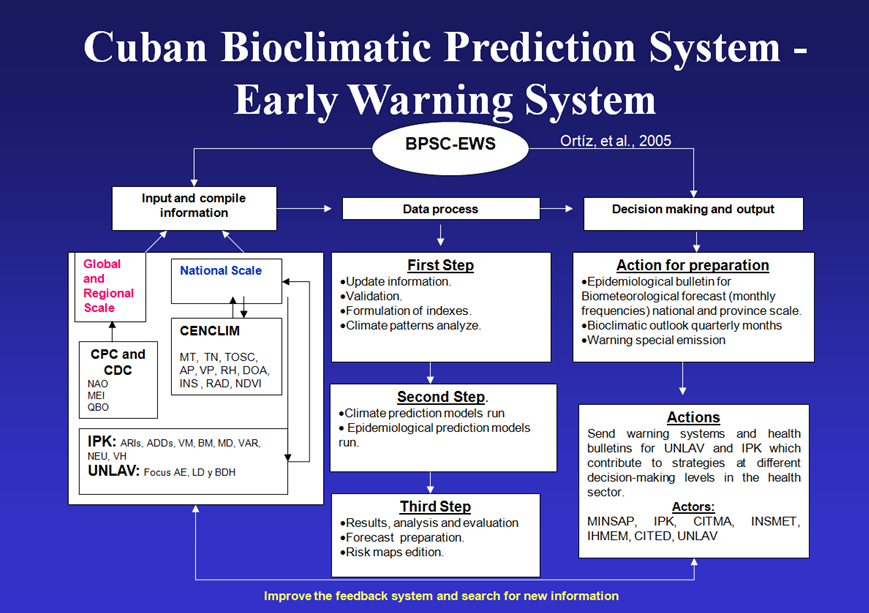
Early Warning System based combination of climate, epidedemiologic, ecologic, socioeconomic data and forecasts in different scale (Figure 2), Illustrate the degree of certainty associated with data from prediction and surveillance activities. It shows how we incorporate data collection needs into current surveillance frameworks and systems, making use of all sectors and actors.
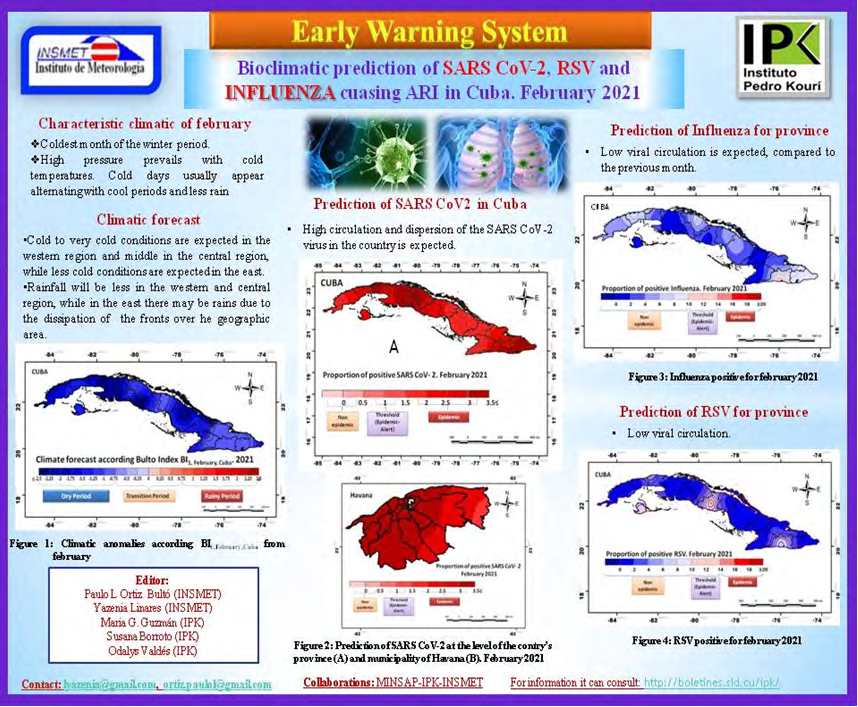
The raw modeling system is already operating in Cuba, it is shown with an example of the exit of the system through the bulletin (Figure 3).
The EWS has served as an input for the health authorities in the treatment of outbreaks, epidemics and endemic diseases. This Climate Health Early Warning System has the goodness that it is applicable to other regions of the world with different climates, as well as can be used for the prediction of other infectious diseases such as: Acute Diarrhoeal Diseases (ADD), Viral Hepatitis (VH), Acute Respiratory Infections (ARI), Influenza Circulation (INF), Respiratory Syncytial Virus (RSV), SARS-CoV 2, Aedes Aegypti Vector, Dengue Fever, Viral Meningitis (VM), Meningococcal Disease (MS), Chicken Pox (V), Leishmaniasis (L), Plasmodium vivax Malaria (PV), Plasmodium falciparum Malaria (FP) (Scheme 1). Cuban Network The Ministry of Public Health (MINSAP) has prioritized research into climate change and health and provided the political will and guidance to take an intersectoral, interministerial approach to the problem. Centers collaborating on current studies include the Pedro Kourí Tropical Medicine Institute, CLAMED (its work now merged into the National School of Public Health), the Cuban Red Cross, MINSAP itself, and the Ministry of Science, Technology and Environment (CITMA), through Climate Center and Provincial Meteorological Center.
Organizing our work through this consortium of interdisciplinary research centers gives us new tools and approaches for how to mitigate and adapt to climate change. For instance, CITMA is responsible for setting priorities and designing policies for environmental protection. Concurrently, MINSAP sets priorities and designs policies for protecting and improving health the intersection of climate change and health means these ministries must work together.
This national climate-health group aims to follow the guidance and best practices of the WMO guidelines on forecasting and warning services based on multi-hazard impacts. In addition, it has developed vulnerability and adaptation studies in the health sector that have been taxed on the 3 national communications of Cuba and has collaborated with some countries in the region, for these fines [13].
Sustainability of Information Systems on Climate and Health
Guaranteeing the measurement, collection, storage, validation and report of the fundamental statistics associated to the topic in Cuba this process is enabled, but in other countries it could be a problem, when there are different information sources, both public and private. In that case, it is required to look for an impartial entity designated to compile the data and to establish the necessary networks for their integrated (climate-health) management. To achieve it, Cuba works in the Create the observatory of Climate Variability and Change-Health
Main Challenges
• Access from health sector to resources that finance climate change adaptability programs.
• Create a specific coordination framework for climate change among public administrations and sectors involved together with the climatology center.
• Rigorously estimate climate change mitigation and adaptation expenses for health sector.
• Develop models and estimate the impacts of non- communicable diseases associated with climate variability and change from CPR scenarios.
• Design and plan citizen habitats with territorial planning criteria that include the variable of climate change, or only in the areas identified by the Task Life.
• Continue working with populations settled in highly vulnerable areas (flood zones) and plan their evacuation.
• Strengthen the health sector at the structural level (green and resilient hospitals prepared for climate- related disasters).
• Continue building capacity for risk management associated with climate-related hazards on a territorial basis - “prevent the event”.
• Include climate variability and change in the curriculum of medical science professional training.
• Mobilize funding to create the observatory of Climate Variability and Change-Health in Cuba, as a tool for analysis, diagnosis, assessment and continuous research on the effects of climate variability and change on health facing a changing climate.
Learned Lessons of EWS
• A key issue has been the sustainability and systematization for more than 30 years of early warning for health in association with climate conditions.
• The forecasts and early warnings, issued as a product of the analysis and modeling of the climate and epidemiological variables, have implied an immediate challenge. They must be carried out and sent to the MINSAP with enough time to allow decision-makers in health to incorporate it in the management of epidemic outbreaks.
• The EWS has served as an input for the health authorities in the treatment of outbreaks, epidemics and endemic diseases.
• The monthly prediction and the quarterly outlook have been achieved for various infectious diseases such as Acute Respiratory Infections (ARIs), specifically on the circulation of influenza (FLU), respiratory syncytial virus (RSV) and SARS-CoV2, acute diarrheal iseases (ADDs) of origin bacterial, dengue and infestation from Aedes aegypti mosquito.
• A key issue has been the sustainability and systematization for more than 30 years of early warning for health in association with climate conditions.
• An important lesson learned is the joint work between health professionals and climatologists involved in surveillance, who have had to learn using and interpreting the EWS outputs, as well as the concepts and modeling of both sciences, to incorporate them into the epidemiological control programs in the country.
Future Actions
• Continue training decision-makers.
• Refine the EWS tailored to the user, which allows strengthening the national epidemiological surveillance network of MINSAP.
• Continue improving the input information to the models, both climatic, epidemiological and virological data.
• Strengthen INSMET capacity and cloud platform capacity to integrate the Early Warning System and all required data.
• To continue a multisectoral working group to finalize the research agenda, and work towards obtaining funding for and coordinating and tracking progress in implementation of the research agenda in the tropical regional.
Conclusions
• In order to understand the future behavior of viruses, their dispersion and the appearance of new pathogenic viruses in humans, it must first identify the pressures that natural ecosystem and the species that inhabit it are receiving. Only in this way we can anticipate new viruses, with potential risks for human beings. To avoid situations like the world is facing today with the pandemic generated by SARS-CoV2, a virus that jumped to humans due to its contact with virgin ecosystems where the coronavirus family has lived for hundreds of years.
• It is evident the usefulness of a group of adaptation measures, where proactive adaptation is valued as very positive, through the implementation of early warning systems in the country.
• The communication shows how much Cuba has advanced in the research and approaches studies relationship climate variability and infectious diseases under changing climate.
References
-
Vega YL, Ortiz PLB, Acosta BH, Valdés OR, Borroto SG, et al. (2018) Influenza’s Response to Climatic Variability in the Tropical Climate: Case Study Cuba. Virol & Mycol 7: 1000179.
-
Greer A, Ng V, Fisman D (2008) Climate change and infectious diseases in North America the road ahead. Can Med Assoc J 178(6): 715-722.
-
WHO (2003) Climate change and human health-risks and responses.
-
Millennium Ecosystem Assessment (2005) Ecosystems and Human Well-being: Synthesis. Island Press, Washington.
-
Lowry WP (1988) Atmospheric ecology for designers and planners. McMinnville, A Peavine Publication.
-
Ortiz Bulto PL, Vega YL, Ramirez OV, Herrera BA, Gutierrez SB (2017) Temporal-Spatial Model to Predict the Activity of Respiratory Syncytial Virus in Children Under 5 Years Old from Climatic Variability in Cuba. Int J Virol Infect Dis 2(1): 030-024.
-
Vega YL, Ramirez OV, Herrera BA, Ortiz Bulto PL (2017) Impact of Climatic Variability in the Respiratory Syncytial Virus Pattern in Children Under 5 Years-Old Using the Bulto Climatic Index in Cuba. Int J Virol Infect Dis 2(1): 014-013.
-
Ortiz BPL, Pérez A, Rivero A, Linares YV, Perez AY (2015) Spatial models for forecasting and early warning behavior Aesdes Aeypti from climate variability and change in Cuba. MEDICC Review 17(2): 20-28.
-
Linares Vega Y (2020) Modeling and Predicting the Impact of Climate Variability on Influenza Virus Spread in Cuba. J Mycol Mycological Sci 3(3): 000130.
-
Borroto S, Linares Y, Ortiz P, Valdés O, Acosta B (2020) Influence of climatic variability and respiratory viruses on the burden of medically attended acute respiratory infections in Cuba. J Respir Dis Med 2: 1-7.
-
WHO (2004) Using climate to predict infectious diseases outbreaks: A review. Geneva.
-
Ortiz PL (2008) Assessment of Human Health Vulnerability in Cuba due to Climate or Weather Variability and Change. In book “Global Warming and Climate Change: Kyoto - Ten Years and Still Counting.
-
UNFCCC-National communication of Cuba.
- hMPV: Is It Another Covid-19 Like Situation?
- Streptomyces: Sources of Novel Discoveries in Antibiotic Research to Combat Antimicrobial Resistance
- A Review of Mosquitoes (Diptera: Culicidae) and Their Biodiversity, Medical and Veterinary Importance
- Past and Current Immunotherapy in Cancer
- Hematological Cancer and Viral Infection
- The Growing Threat of Antimicrobial Resistance in India: Challenges and Solutions